All posts by Nivedita Menon

Race too, after all, along with Gender: Arvind Elangovan

A few facts and some thoughts on the reception of Michaela Cross’s experience of India – Guest Post by ARVIND ELANGOVAN

Since Michaela Cross’s experience was part of a study abroad program conducted annually by the University of Chicago, and I was part of the program – for three years as a graduate student assistant (for the Fall quarters of 2007-2009), and one year as faculty in the program (Fall of 2010) – I think I could most usefully contribute by highlighting a few facts about the program itself. In the process I would think aloud about some of the issues that have come up in the reception of Cross’s experience in India, especially in the responses of Rajyashree Sen and Ameya Naik. I choose Sen’s and Naik’s responses partly because they have been the most recent, but also because between them they represent the spectrum of possible positions that one could usefully take about this issue. Needless to add, there have been other responses, such as the one posted by another fellow University of Chicago student on the trip, an article titled ‘In Defence of Rose Chasm (Michaela Cross) and countless other comments, criticisms, and responses that have flooded the Internet world.

However, between Sen and Naik, the basic ends of the spectrum are quite clear. Sen contends that it is not only a white woman’s problem but an issue for all women and that some self-regulation and discipline would have gone a long way to avert the unsavory experiences if not completely eliminate their possibility. Naik, at the other end of the spectrum, points out that the expectation of preparedness or caution urged by Sen belies the possibility of questioning the pervasive culture of sexual violence, in which any cautionary attempt to be safe, is to pay merely lip service to acknowledging the crime of sexual violence, instead of combating more difficult questions about such a culture. Continue reading Race too, after all, along with Gender: Arvind Elangovan

How to dress for your body shape

How to dress for your body

Courtesy Pramada Menon’s Facebook Page

Indians of Another Colour, Or why Goans are More than Just Portuguese: Hartman de Souza

This guest post by HARTMAN DE SOUZA is in response to Europeans of An Other Colour – Why the Goans are Portuguese

The news that Goa’s Catholics obtain Portuguese citizenship and flee wherever they can with their families, availing in fact of whatever loopholes are available, is not that new a phenomenon to Goans following matters on the ground – even though it may now serve to open out a new thread in the discussion of postcolonial societies, and in particular, the travails of immigrant communities in what is supposedly a ‘globalized’ world.

It helps to keep in mind that it is Goa that is the classic case of a ‘failed state’, and not Pakistan, as Indians like to believe. Goa was once a beautiful territory protected by Ghats on three sides, rich with an abundance of water, blessed with fertile land, and made up of villages each of which had control of their commons through a sophisticated system of village governance that far predated the Portuguese Colonialists. Today however it is a state governed by politicians who work hand-in-glove with their crony partners whether in mining, real estate or industry,  a state in a freefall towards entropy. Continue reading Indians of Another Colour, Or why Goans are More than Just Portuguese: Hartman de Souza

Exemplary guidelines for the Police regarding sexual assault

RAHAT is a collaboration between Women and Child Development and Majlis Legal Centre, Mumbai, to provide Socio-Legal Support to Victims of Sexual Assault. One of the initiatives taken by RAHAT was the drafting of  guidelines for Police while recording and investigating cases of Sexual Assault. A circular with these guidelines has been issued by the Police Commissioner of Mumbai to all police stations in Mumbai. 

This is the English translation of the circular.

Special Police Circular No. 27/2013, Dated 12.8.2013

Sexual offences against:

• a person (boy or girl) under 18 years of age shall be registered under POCSO ( Protection of Children from Sexual Offences)Act,  2012

• a woman above 18 years of age shall be registered under IPC ( Under Ss. 354, 354A, 354B, 354C, 354D, 376, 376A, 376B, 376C, 376D, 376E and 509 IPC) Continue reading Exemplary guidelines for the Police regarding sexual assault

Europeans of An Other Colour – Why the Goans are Portuguese: R. Benedito Ferrão & Jason Keith Fernandes

Guest post by R. BENEDITO FERRÃO & JASON KEITH FERNANDES 

This article serves as a response to Sir Andrew Green’s comment on the alleged misuse of Portuguese citizenship by Indian nationals of Goan origin whom the Daily Star and the Daily Mail have characterized as immigrants who travel to Great Britain to take advantage of it. Green’s perspective from a few months ago mirrors prevalent xenophobic views on the rights of immigrants to Europe; hence, the counterpoint offered here hopes to challenge such bias as it will surely continue to be expressed.

On 13 May, 2013, the Goan Ethernet was aflame with outrage at statements made by Sir Andrew Green, chairperson of Migration Watch, carried in the Daily Star and the Daily Mail. The Daily Star reported, “An Indian national from Goa can obtain Portuguese citizenship if their parents were Portuguese citizens prior to 1961,” and quoted Green as saying, “They can then move straight to the UK with their family. On arrival they can avail themselves, immediately, of all the benefits available to UK citizens.” The Daily Mail seems to have been spurred on by Green’s statement, going on to claim that “[a] number of Indian nationals from the former Portuguese territory of Goa are thought to have taken advantage of the loophole. Indians living in Goa can claim they have Portuguese heritage and so claim Portuguese citizenship. They can then move directly to Britain – without ever having to visit Portugal – and bring a family without meeting any qualification test.”

Given the manner in which the matter regarding Goan access to Portuguese citizenship has been reported in the British press, as academics studying Goa and the Goan community, we believe that there is a need to redress such misrepresentations and firmly call out, not only the wilful amnesia about Britain’s imperial past, but also the Anglo-centric interpretation of colonialism, the post-colonial, and de-colonised world order that motivates such representations. In so doing, our aim is to address not merely a need for Goans and others of former Portuguese India to assert the legitimacy of their actions, but to also enable a view of the global order from a position that is more respectful of the formerly colonised. Continue reading Europeans of An Other Colour – Why the Goans are Portuguese: R. Benedito Ferrão & Jason Keith Fernandes

Mathura too did not scream: Forum Against Oppression of Women

Guest Post by FORUM AGAINST OPPRESSION OF WOMEN

As a feminist collective that was formed in the aftermath of the historic Mathura rape case in 1980, in which two police men had sexually assaulted a tribal girl within the police station, two recent cases of sexual assault (in Mumbai) have become matters of grave concern for us. These were filed by women against medical professionals who had committed the crime within their clinic or hospital,

On May 17th 2013, a 26 year old woman had gone, accompanied by her husband, to meet Dr. Rustom Soonawala who had been treating her for TB and later infertility since August 2012. This was at around 6 pm as per appointment. Upon examination, the doctor told them that the TB was almost cured and then asked the husband to go out of the examination room, locked the room, and raped her while covering her mouth with his hand. Continue reading Mathura too did not scream: Forum Against Oppression of Women

To travel or not to travel to India: Karen Dias

This is a Guest Post by KAREN DIAS

The most recent ‘Incredible India’ video ad campaign shows a young woman of seemingly European descent traveling alone through India. She is seen drinking coconut water and being friendly with a man, playing chess with holy men, being helped after a fall by two men, cheering at a snake boat race on a boat filled with men, playing Holi surrounded by more men and strolling on what looks like a deserted beach with a male mahout and his elephant. Sadly, the truth is far from what the video depicts for foreign women traveling in India, and most of them will try their best to not find themselves alone in situations like the ones shown in the video.  Stories of foreign women being verbally and sexually harassed are not new in this country and being accompanied by male friends or relatives is almost never a deterrent. Continue reading To travel or not to travel to India: Karen Dias

Joint statement on atrocities on cultural activists and Dalits

Please send endorsements to  asit1917@gmail.com

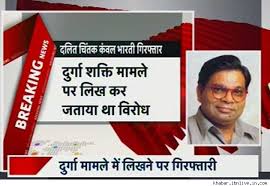
download (1)We, the undersigned, are appalled and outraged by the arrest of Kanwal Bharti eminent Dalit writer for his comments on Face book. If one looks seriously at the banner headlines in the corporate media, the Indian ruling classes are  the new economic power house of the world and India, the world’s largest democracy. Various clauses of the Indian constitution guarantee the fundamental rights of its citizens to to freedom of expression and to choose ones cultural and political views. The pretensions of the Indian state about it being a liberal democracy have proved to be a total mockery of the very meaning of the words like liberalism, democracy and rule of law. Since the past six decades, under draconian laws like AFPSA, UAPA, National Security Act, tens of thousands of people have died in ‘encounters’, thousands of youth have vanished from Kashmir and Punjab. There are genocides happening on the struggling people of oppressed Nationalities, thousands are tortured, there are thousand of unknown mass graves in Kashmir. Thousands of woman are raped, tortured and killed in police custody. Continue reading Joint statement on atrocities on cultural activists and Dalits

Network of Women in Media demands safety for women media professionals

The Network of Women in Media, India, (NWMI) is shocked and angry at the alleged gangrape of a woman journalist and the assault on her male colleague in the evening of August 22 while they were on assignment for a print publication near the Shakti Mills compound at Mahalaxmi in Central Mumbai.

The two journalists were accosted and intimidated by a few people who demanded to see their authorisation for shooting in the area. They took the woman journalist aside on the pretext of securing the authorisation for her, tied up her colleague and allegedly gangraped her. In all, five persons perpetrated the attack, according to preliminary reports. The woman journalist showed great presence of mind in freeing herself and also managed to free her colleague and the two then sought to file a complaint with the N M Joshi Marg police station. They are being treated at Jaslok Hospital now for multiple injuries.

The incident is a grim reminder of the deteriorating state of safety for women in Mumbai as well as the lack of security for media professionals, especially women media professionals. The harassment of women professionals in the media is on the rise and, along with work-place related harassment, journalists also have had to contend with anti-women prejudices and biased reactions from employers as well as law enforcement officers.

The Network of Women in Media, India extends all support and solidarity to the journalists who were assaulted. The NWMI also cautions its colleagues in the media to report on the incident responsibly and sensitively, without providing unnecessary details that provide markers to the identity of the journalists involved.

NWMI also demands that the police conduct a speedy investigation into the assault and ensure that justice is delivered without delay. It also urges media employers to ensure the safety and security of their staff.

Yours sincerely,

Geeta Seshu, Kalpana Sharma, Meena Menon, Sameera Khan, Sandhya Srinivasan, Laxmi Murthy, Sharmila Joshi, Ammu Joseph, Rajashri Dasgupta, Jyoti Punwani and others

on behalf of

Network of Women in Media, India

Salaam, Sharmila Rege!

2006112210820401

Sharmila (right) receiving the Malcolm Adiseshiah Award (2006) from Padmini Swaminathan, Director of Madras Institute of Development Studies (Source: The Hindu)

Sharmila Rege passed away yesterday, aged 48, a month after she was diagnosed with cancer. Sharmila described herself as a Phule-Ambedkarite feminist, and was a dear friend to many of us, a political activist of enormous integrity and the moving spirit behind Krantijyoti Savitribai Phule Women’s Studies Centre at Pune University. Her scholarship was immense and inspiring, consistently traversing the minefields of caste and gender, constantly complicating one with the other. Writing Caste, Writing Gender: Reading Dalit Women’s Testimonios brought together first-person accounts of eight Dalit women from the 1920’s to the present – the voices of Babytai Kamble, Shantabai Kamble, Muktabai Sarvagod, Shantabai Dani, Kumudtai Pawde, Urmila Pawar, Janabai Girhe and Vimaltai More, emerge powerfully and relentlessly in their matter-of-fact assault on caste society’s smugness and violence. Sharmila worked with these ‘testimonios’ (a term she drew from Latina feminism) in a series of’ ‘translations’ – translating from Marathi, translating time and place, translating herself, and encouraging  readers to translate themselves too, in terms of Phule and Ambedkar’s scholarship and politics, to read themselves through the lens of the non-Brahmin and Dalit movements in Maharashtra. Continue reading Salaam, Sharmila Rege!

We’re singing Holi songs: Inayat Anaita Sabhikhi

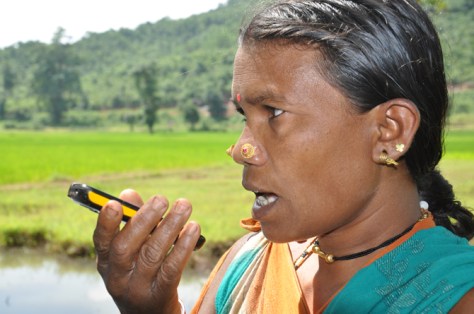
Guest post by INAYAT ANAITA SABHIKHI: CGNet Swara is a voice based portal, where stories reported by citizen journalists are available for playback online on their website or through a regular mobile phone. By dialing the CGNet number, you can either record a message or listen to the previous four messages recorded on the server. This is primarily operating in the Central Gondwana region, a tribal belt in central India known to be economically and socially disadvantaged.

woman-reporting

A reporter for CGNet Swara

The idea behind this, as explained by its founder, Shubhranshu Choudhury in this TEDx talk is to democratise the use of media. It is an attempt to combat the neglect and skewed approach of mainstream media towards this entire region and its people. Continue reading We’re singing Holi songs: Inayat Anaita Sabhikhi

IB’s desperate and dirty tricks to scuttle the Ishrat Jahan investigation

This is a press statement put out on 14 June 2013 by a group of individuals whose names are given at the end.

It is a clear indication of the desperation being felt by the IB establishment as the heat turns on its senior officers in the Ishrat Jahan probe, that they are down to doing what they do best: use pliant sections of the media to plant stories to deflect scrutiny and create a favourable public mood.  Following the summons issued to IB Special Director Rajender Kumar by the CBI (which is probing the case on the direction of the Gujarat High Court), the IB Director first sought to sell the familiar old story of ‘investigation will hit the morale of the IB’ – it seems as though a blanket immunity from any scrutiny and accountability is the only guarantee of IB morale.  The IB then ran complaining to the Prime Minister; and when nothing worked, it used the agency’s tried and tested trick of enlisting the support of discredited ‘journalists’.  Continue reading IB’s desperate and dirty tricks to scuttle the Ishrat Jahan investigation

Interview with Amalia Ziv – queer, feminist and anti-occupation in Israel

KveesaShchora020403CWPsm

On April 3rd, 2002, Israeli peace organizations led by women activists tried to enter Palestine, but were violently rebuffed by Israeli soldiers – 21 required hospitalization when it was all over. The picture shows seven members (six women and one man) of the organization Kveesa Shchora – Lesbians and Gay Men Against the Occupation – as they set out that morning.

It was through Amalia Ziv ‘s work that I came to know about ‘Kvisa Shchora’ (Black Laundry), an Israeli anti-Occupation queer group, which positions itself against both Israeli Zionist queer politics and the Israeli Left, against whose universalist understanding Black Laundry poses its queer identity as a platform for critique. Ziv suggests that Black Laundry tied together ‘sexual deviance’ and ‘national deviance’ with slogans like ‘Free Condoms, Free Palestine’, ‘Bull Dykes, Not Missile Strikes’, ‘Transgender not Transfer’ (that is, forced deportation of Palestinians)  – which break down the hierarchies of Nation and Sex, challenging queer politics in Israel with anti-occupation politics and Left anti-occupation politics with the queer gaze. Ziv argues that through the ‘twin strategies of national betrayal and sexual depravity’, Black Laundry deliberately situated itself outside both  discursive communities – that of Israel/Palestine as well as of hetero/homosexual.

Read this wonderful interview by  TSAFI SAAR with Amalia Ziv in which she talks about queer parenting, pornography, masochistic fantasies, her envy of people who have the capacity to be polyamorous, how tolerance in Israel for queer politics  ‘runs out when queer politics melds with politics against the occupation,’ and about her crush as an adolescent for Woody Allen. ‘Eros is blind’, she says unrepentantly. Continue reading Interview with Amalia Ziv – queer, feminist and anti-occupation in Israel

Theme Park Mumbai: Hussain Indorewala

This is a guest post by HUSSAIN INDOREWALA: The draft of Mumbai’s twenty year Development Plan is scheduled for release soon. There is another plan that is worth looking at, if only to get a sense of what the city’s power elite have in mind for its future. This plan may be found on the website of the Mumbai Transformation Support Unit (MTSU) by the name Concept Plan for MMR. Though not a statutory document, it claims to become the “guiding framework” for all the subsequent Development Plans in the MMR region, and also the basis for local sectoral schemes on transportation, infrastructure, housing, industrial development, and others.

Mumbai’s Concept Plan

In May 2011, a Singapore based planning firm, Surbana Corporation, with experience in planning for cities in Africa, Asia and the Middle East, submitted a “Concept Plan” for the Mumbai Metropolitan Region (MMR) to the MTSU. The object of the plan is to provide a “long-term development framework which directs future investments and urban growth in the region.”[1] With a population of 37 million, by 2032 the MMR will become a “world class metropolis,” with a “vibrant economy” and “globally competitive quality of life.” By 2052, with a population of 44 million, the Region will be “elevated” to become a “Global City,” recognised around the world as an “international business hub, a leading technological innovator, a melting pot of local and cosmopolitan cultures, and a centre of excellence for urban environmental management.”

Continue reading Theme Park Mumbai: Hussain Indorewala

Mourning Reingamphi Awungshi: Pratiksha Baxi

This is a guest post by PRATIKSHA BAXI:  

imagesWhen the police found Reingamphi Awungshi, a twenty-one year woman from Ukhrul district in Manipur brutalised, assaulted and dead in her rented apartment in Chirag Delhi on 29 May 2013, they did not file an FIR. Rather, the Malaviya Nagar police station, a site of anguished protests, began by designating her death as suicide, even as they waited for a post mortem report! Although the family argued that the state of her bloodied and injured body clearly indicated sexual assault and murder, the police ended up filing an FIR, after three days, as a case of abetment to suicide. 
It seems very clear that the aftermath of the Delhi gangrape protests have not made a dent in practices of policing—it should not take hundreds of protestors to ensure the registration of a police complaint. Nor is it reasonable for the police without thorough investigation and competent medical examination of the body to conclude that the death was a suicide rather than murder; and that the injuries on the body, the outcome of substance abuse rather than assault. This is evidence of bias, rather than an impartial investigation.  Continue reading Mourning Reingamphi Awungshi: Pratiksha Baxi

White Women in the Indian Imagination: Alexandra Delaney

This is a guest post by ALEXANDRA DELANEY: 

“Yeah, Indian guys think white girls are easy”, a British-born Indian remarked nonchalantly to me this week. Normally I’d be shocked by such gross racial stereotyping (of Indians) but in this case I’m inclined to agree. Not because Caucasian women by their very skin colour or cultural preferences are any more promiscuous than their South Asian sisters, but because of their sustained portrayal as loose and morally deficient. The image of the sexually liberated and ‘easy’ white woman runs deep in the Indian imagination, a perception which is drip-fed by the country’s all-pervading mainstream media.

The brutal rape and murder of an Indian student in New Delhi last December followed by numerous sexual attacks on foreign women has sparked international outrage. This year alone, a Chinese woman was date-raped in New Delhi, a Korean woman was raped after being drugged in Bhopal, a Swiss tourist was gang-raped by five men in Madhya Pradesh while holidaying with her husband, and a British woman broke both her legs after jumping off a hotel balcony to avoid an alleged sexual attack by the hotel’s manager. These incidents have led to a shift in how tourists perceive India, resulting in a 25% fall in foreigners travelling to the country and a 35% reduction in women travellers, reports New Delhi-based Associated Chambers of Commerce and Industry. Continue reading White Women in the Indian Imagination: Alexandra Delaney

Gujarat and the Illusion of Development: Shipra Nigam

This Guest post by SHIPRA NIGAM is a review of a volume of essays edited by Atul Sood Poverty Amidst Prosperity: Essays on the Trajectory of Development in Gujarat (Aakar Books 2013).

gujarat-farmers_507544e

Thousands of farmers protested in March this year in Ahmedabad against the state’s industrialization policies

This volume of essays is the outcome of a detailed study by a team of contributing research scholars led by Atul Sood. This timely evaluation provides an insight into many crucial questions: What are the constituent elements of Gujarat’s growth story? To what extent can the successful features of Gujarat’s growth story be attributed to the political regime fashioned by Narendra Modi? Is it possible to replicate even this limited success story at the national level – as Modi’s starry eyed upper and middle class following would like to believe? More significantly: what are the implications of Gujarat’s Development Model in terms of its sustainability and its desirability? What happens when we assess this development through a set of comprehensive   measures, judge its implication for the average citizen’s material wellbeing, and see what it means for the political and economic rights of citizens?  Continue reading Gujarat and the Illusion of Development: Shipra Nigam

Capitalism, Sexual Violence, and Sexism: Kavita Krishnan

Sexual violence cannot be attributed simply to some men behaving in ‘anti-social’ or ‘inhuman’ ways: it has everything to do with the way society is structured: i.e., the way in which our society organizes production and accordingly structures social relationships. Once we understand this, we can also recognize that society can be structured differently, in ways that do not require – or benefit from – the subordination of women or of any section of society. 

What are the material structures that underpin sexual violence? As I address this question I will also engage with some of the arguments made in two recent articles which offer a professedly Marxist analysis of sexual violence and women’s subordination in India; one is ‘On the Empowerment of Women’ by Prabhat Patnaik, People’s Democracy, January 27, 2013, and the other is ‘Class Societies and Sexual Violence: Towards a Marxist Understanding of Rape’, by Maya John, Radical Notes, May 8, 2013.    Continue reading Capitalism, Sexual Violence, and Sexism: Kavita Krishnan

Letter from Shahbagh: Kalyani Menon-Sen

POWER_OF_LIGHT_orgGuest post by KALYANI MENON-SEN: Ever since I came back from Dhaka on 12th April this year, I have been opening my mailbox every morning with a feeling of excitement and anticipation, confident that there will be a mail from  Bangladesh with the latest news from Shahbagh. Just brief snippets – a slogan, a comment, a moment captured in a cellphone photo – but they are enough to bring back the   feeling of being there, feeling the excitement and the energy, sensing the emergence of a new kind of political space – chaotic and confused, yet alive with radical possibilities.

But last Sunday, 12th May, came a brief one-liner from Habib: “The police have dismantled Projonmo Chottor. Will keep you informed of further developments.”  Continue reading Letter from Shahbagh: Kalyani Menon-Sen

Kerala apologizes for Sreesanth: Sajan Venniyoor

This is a Guest post by our sports correspondent, SAJAN VENNIYOOR:  In an unprecedented gesture, the state of Kerala has apologized for what it calls “the darkest chapter in our history”, Shanthakumaran Sreesanth.

downloadIn the face of overwhelming criticism that it did nothing to prevent Sreesanth, the state’s Chief Minister and Governor, in a joint statement, apologized formally for the crime against those bits of humanity that watch cricket, and admitted collective responsibility for Sreesanth. “It is time for us to acknowledge that Kerala civil servants, sports administrators and other Malayalis took part in Sreesanth.” Continue reading Kerala apologizes for Sreesanth: Sajan Venniyoor

Two days in the Srinagar High Court: Shrimoyee Nandini Ghosh

This is a guest post by SHRIMOYEE NANDINI GHOSH

Impressions of the Hearing of the Public Interest Petition on the Mass Rapes at  Kunan Poshpora

Day 1: 7th May 2013: I happen to be in Srinagar. I hear through a friend that a Public Interest Petition has been filed by a group of fifty odd Kashmiri women, before the Srinagar Bench of the High Court, asking that the Kunan Poshpora mass rape case be reopened, and re-investigated. It would take a group of very odd women indeed, to ask for something so far fetched. They are students, housewives, teachers, doctors, some of whom were not even born in 1991, when the rape took place on the ‘intervening night’ (as such records always read) of the 23rd and 24th of February during a ‘search and cordon’ operation by personnel of the Indian army.

Continue reading Two days in the Srinagar High Court: Shrimoyee Nandini Ghosh