All posts by Shivam Vij

Shivam Vij is a writer and journalist based in New Delhi.

Thinking through UP election results with numbers: Rahul Verma

Guest post by RAHUL VERMA

Here’s a closer analysis of Uttar Pradesh 2012 election results

In an article the Times of India says the Samajwadi Party’s victory in Uttar Pradesh seems to be an even more impressive sweep than the BSP’s 2007 showing, but it’s actually a less comprehensive domination. According to the same article, the SP did not do well in western UP and Bundelkhand. They do not provide any reason for this.

My analysis of the election results data shows that average number of candidates per assembly constituency and average number of candidates per one lakh electorate in west UP and Bundelkhand, was slightly lower than other regions of the state. In west UP and Bundelkhand, the average number of candidates per one lakh electorate was approximately 8.5 and average number of candidates per assembly constituency was approximately 16. Whereas in other parts of the state average number of candidates per one lakh electors was approximately 9.5 and average number of candidates per assembly constituency was 17. This means that in other regions of the state votes were more divided and thus the SP got an edge in terms of winning seats. In the first-past-the-post (FPTP) system with multi-cornered contests, even such small gaps lead to big swings in terms of seats a party can win. Continue reading Thinking through UP election results with numbers: Rahul Verma
Free Waqar Ahmad

The text below comes from the FREE WAQAR CAMPAIGNfreewaqar.org

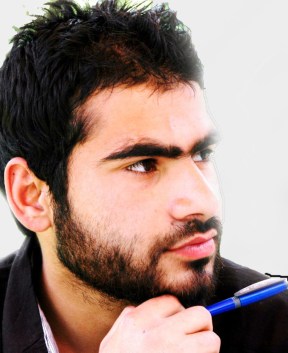
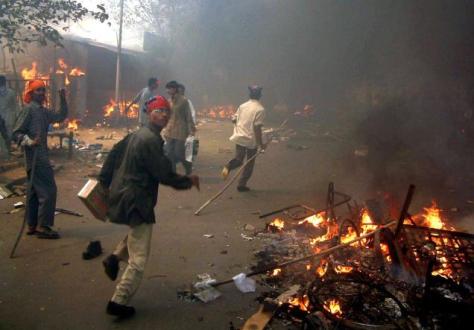
Waqar Ahmad Moharkan was born in Indian-held Kashmir in 1990. Currently, he is a final year student of Bachelor’s in Commerce at Srinagar’s Islamia College of Science and Commerce. Waqar was arrested on 4 October, 2011, during a raid on his house in Lal Bazaar on charges of participating in protests in the Downtown area of Srinagar. Waqar was arrested by police personnel from MR Gunj station. The court allowed his bail application on 23 October, 2011. Instead of being released, he was rebooked by same police station and shifted to Central Jail under judicial remand on 15 December, 2011 and suddenly slapped with the draconian Public Safety Act (PSA). Continue reading Free Waqar Ahmad

We, the People of Gujarat: Urvish Kothari

This guest post by URVISH KOTHARI was originally written in Gujarati and has been translated by VISTASP HODIWALA

Associated Press

Some facts are so simple and self-evident that they elude you completely at the time they happen. Digesting them takes time – 2, 3,7, maybe even 10 years. By that time, the passion and the anger has abated a bit and there is a sense of composure that pervades our beings.

Like the fact about the communal violence that gripped the State of Gujarat in 2002.

Of course, a mere mention of this is enough to get the chief minister’s fanboys roll up their sleeves, even as their opponents ready themselves to launch a counter onslaught. But with the passage of ten long years, the first question should not be about whether the Chief Minister was complicit in the crime or not. No, it cannot be.

Continue reading We, the People of Gujarat: Urvish Kothari

A Flawed Democracy – The Case for Proportional Representation in India: Srinivasan Ramani

Guest post by SRINIVASAN RAMANI

Times of India graphic

For all the chest thumping and tomtoming about the Samajwadi Party’s emphatic victory – winning 224 seats out of 403 in the UP Assembly elections – a true reflection of the mandate is to be seen in the individual vote shares of the four main (“effective”) parties in the elections (the Bahujan Samaj Party – Bhartiya Janata Party, the Samajwadi Party, and the Congress – in alliance with the Rashtriya Lok Dal). Data from the Election Commission of India website shows the following in terms of vote shares:

Continue reading A Flawed Democracy – The Case for Proportional Representation in India: Srinivasan Ramani

Why Geneva and not Matara, Jaffna or Batti?: Kusal Perera

Guest post by KUSAL PERERA

English: Photo of Mahinda Rajapaksa, president...
Mahinda Rajapaksa, President of Sri Lanka

Thousands of Tamils from across Europe protested in front of UN headquarters in Geneva Monday demanding the creation of an international tribunal to try “war crimes” committed in Sri Lanka…. [AFP report, 6 March 2012]

The battle is raging. It will go on till about the 23rd of March, 2012. In Geneva. The battle is against the Rajapaksa regime in Sri Lanka and not against Sri Lanka itself. It’s a battle over “war crimes and accountability” during the Sri Lankan war, in particular its final stages. Delhi’s vacillating position of “not right to interfere on a country basis” as regards the US Resolution to the United Nations Human Rights Council’s Session 19, is being challenged firmly in Chennai by the two major political parties in Tamil Nadu, the DMK and the AIDMK firm. Beijing and Moscow are clear about the issue. They will vote against the US Resolution, and also muster up support amongst other countries to vote with them. If they could collect 24 votes in total, they will have had their say and the Sri Lankan regime will not have to worry about Geneva anymore. Continue reading Why Geneva and not Matara, Jaffna or Batti?: Kusal Perera

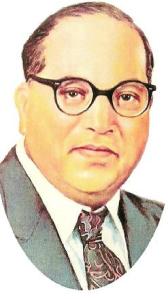
Ambedkar – A poem by Ravikumar

Guest post by RAVIKUMAR

Under the scorching Sun
in the shadow of a tamarind tree
there assembled a small crowd
children, women and men
words about Ambedkar,
Dalit rights and Women’s rights
breezed over
sweating faces

When we sow
Some seeds fall in bushes
Some on rocks
Some on dry land
Some in ponds
Some on wet land
Who knows–
who is the wet land

(Ravikumar is a well-known activist and theoretician of the Dalit movement in Tamil Nadu. A former legislator in the Tamil Nadu legislature, he is general secretary of Viduthalai Ciruthaikal Katchi.)

Previously by Ravikumar in Kafila:

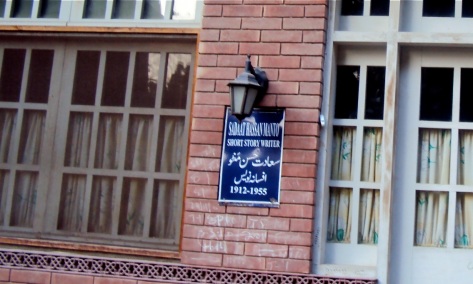
A Hundred Years of Manto

31, Laxmi Mansions, Hall Road, Lahore

“Here lies buried Saadat Hasan Manto in whose bosom are enshrined all the secrets and art of short story writing. Buried under mounds of earth, even now he is contemplating whether he is a greater short story writer or God.”

May 2012 will mark the hundredth birth anniversary of the man who wrote that epitaph for himself, Saadat Hasan Manto (1912-1955). One cannot help but compare Manto’s centennial to Faiz Ahmed Faiz’s last year, preparations for which had begun much in advance. There seems to be an odd silence about Manto. Continue reading A Hundred Years of Manto

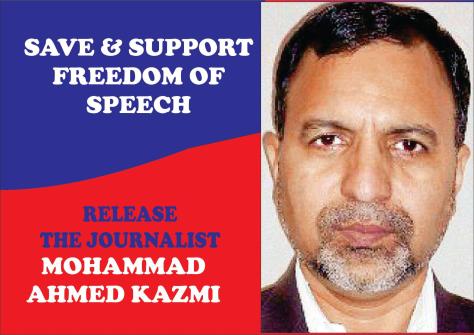
On the arrest of Mohammad Ahmad Kazmi

On 7 March, Delhi Police arrested Delhi-based journalist Mohammad Ahmad Kazmi on charges of being part of the plot to kill an Israeli diplomat’s wife in Delhi on 13 February. Many have expressed concern that Kazmi is being falsely implicated. Give below is the text of a letter to the Delhi Police Commissioner by the DELHI UNION OF JOURNALISTS, followed by a statement from the INTERNATIONAL FEDERATION OF JOURNALISTS, and thereafter by a statement issued by a group of citizens.

    9 March 2012 

The Commissioner of Police,
Delhi Police,
New Delhi

Sir: Continue reading On the arrest of Mohammad Ahmad Kazmi

Why Mayawati’s defeat is the BSP’s victory

Satish Chandra Mishra with Mayawati at a rally near Delhi during the Lok Sabha elections in 2009, amongst the last such appearances together

Even before the results came out, the Mayawati cabinet passed a resolution to dissolve the assembly. Never before has an incumbent shown such confidence about losing. Mayawati’s body language during the campaign was proof of the same lack of confidence. Mayawati was going to lose, the Samajwadi Party was in the air. And yet, Mayawati must be relieved right now. She knows that this defeat of hers is, ironically, a victory of the Bahujan Samaj Party and what it stands for. Here’s how.

Continue reading Why Mayawati’s defeat is the BSP’s victory

Some thoughts on the “hawa” in Indian elections

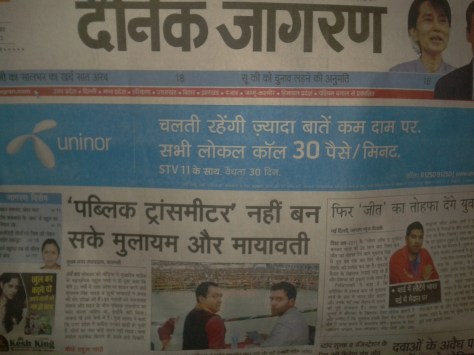
‘Public transmitter’ nahi ban sakey Mulayam aur Mayawati. (Mulayam and Mayawati could not become public transmitters.)

In the Hindi original of that line, the phrase public transmitter is in single quotes only because they are English words in a Hindi paper. The entire sentence is not in quotes. A sentence like this, if it were the title of a text, would count as an expression of opinion. And yet, it was a news headline in the Varanasi edition of UP’s largest selling daily, Dainik Jagran. In case you could not guess who it was trying to help, there was the photo of Rahul Gandhi below the headline. This was the lead story. Continue reading Some thoughts on the “hawa” in Indian elections

Why Rahul Gandhi’s Congress flopped in Uttar Pradesh

In 2008 if you had said the Congress could revive in Uttar Pradesh you would have been laughed at. No party structure or caste base, you would have been told. In 2009, Rahul Gandhi earned perhaps the first laurel of his political career by proving critics wrong. He beat conventional wisdom by saying no to allying with the Samajwadi Party and the Congress won just 22 of 406 seats. Since then, Congress revival in UP has been taken for granted in many corners. Some pundits were predicting as many as 100 seats for the Congress this election. This speculation had a good basis: Rahul Gandhi always left crowds happy. And he flew on a helicopter addressing as many as 4 rallies a day. If you spoke to the people who attended his rallies, you’d be surprised by the amount of goodwill he created for himself. The rise in vote share despite the poor seat performance is proof for the rising appreciation of the Congress’ efforts to regain relevance in state politics. But then, what went wrong? Continue reading Why Rahul Gandhi’s Congress flopped in Uttar Pradesh

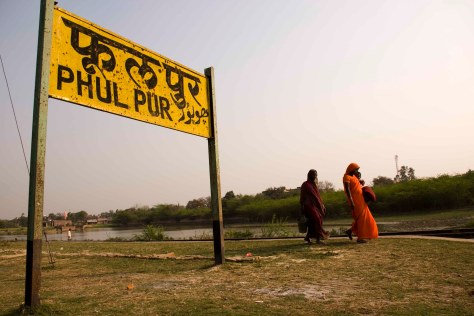
Seeing UP from Phulpur

Photograph by Akif Ahmad for Fountain Ink magazine

In which I go to Phulpur, once famous as Nehru’s seat, and do walk-the-talk with village-level workers of the four main political parties in Uttar Pradesh. Here. Continue reading Seeing UP from Phulpur

Three Stories of Resilience from Gujarat: Ayesha Khan

Guest post by AYESHA KHAN, Baroda-based journalist

Bilkis Bano. Photo via a grab from a recent NDTV report

To mine the detritus of the Gujarat pogrom for positive stories may seem like sacrilege. But when memories are dredged up to mark a decade of the horrors of 2002, a little blasphemy could help balance the account books.

Mostly what we recount of Gujarat 2002 is deaths. Yet, more than the murder and mayhem, the pogrom stood out for an unprecedented scale of sexual violence that Muslim women were subjected to. George Fernandese in his capacity as the Union defence minister had explained to the Parliament after a quick tour of Gujarat that women raped or molested during riots was not surprising or exceptional. I will not go here into the polemics of why violating women’s sexuality is considered a means of dishonouring a community,

There’s an untold story about how the community handled sexual violence. If the dominant community legitimised rape driven by its insecurities and politics that stemmed from history and identity issues, it was perhaps for the first time that the persecuted community reacted to rape in a progressive way.

Rape is double-edged sword, first leading to physical violation and second to social ostracisation in most societies. Which is common to mask the identity of rape victims for fear of social stigma. Strangely, during the 2002 riots, Muslim women, some of them burqa clad and most of them from tightly-knit rural communities never betrayed the kind of shame or guilt that rape victims are expected to show. What was their fault? Why should the victim feel shame and guilt? And so it was that many of them did not cloak their identities, and instead chose to come out publicly to demand justice. Continue reading Three Stories of Resilience from Gujarat: Ayesha Khan

Defending Narendra Modi: An Exercise in Obfuscation

In Outlook magazine last week, its web editor Sundeep Dougal asked 25 questions of Narendra Modi about the 2002 Gujarat pogrom and the subversion of justice since then. Predictably, the army of Narendra Modi Defenders began to spill outrage at such blatant compilation of true charges against Mr Modi. Doing the rounds of the internet is a point by point rebuttal to Dougal’s questions by a blogger, Shashi Shekhar, who goes by the name Offstumped, and is a known online Modi defender. Offstumped’s answers have been responded to by Dougal, and yet Offstumped’s rejoinder is being circulated all over the internet by Modi defenders in the hope of persuading public opinion that Mr Modi is a spotlessly clean man whose actions and inactions did not result in any loss of life, property or dignity of anyone in 2002 and later. The rather large army of Narendra Modi Fans on the internet hopes that by repeating their standard lies again and again, they will one day become accepted truth. Continue reading Defending Narendra Modi: An Exercise in Obfuscation

Batla House and the problem with the deluded journalist: Manisha Sethi

This guest post by MANISHA SETHI is a response to “Congress and the Problem with the Deluded Liberals” by Mihir Srivastava in Open magazine

Mihir Srivastava is very upset that the debate on Batla House refuses to die down. In his view, his piece in India Today – “Inside the Mind of the Bombers – appearing soon after the ‘encounter’ should have settled the debate once and for all. But he was surprised that it wasn’t received as a resolution. He is even more upset that deluded liberals (read Arundhati Roy) are no longer on talking terms with him.

“In the Batla House case, which I reported much the same way I had reported so many of the cases they were happy with, it is just that the facts I saw and reported did not mesh with what they wanted to believe.”

This is simply not true. The many stories that deluded liberals approved of, according to, Mr. Srivastava, and which he cites to bolster his own reputation, are in fact very different from his India Today’s ‘story’. His expose on the Red Fort terror attack in Tehelka, for example, critically examined the evidence produced by the police, verified and cross checked the statements made by the accused in court and even brought out the discrepancies in the observations made by the court and its eventual judgement which upheld the death sentence of Md. Arif alias Ashfaq alias Abu Hamad. ‘Wrong Man to the Gallows’ is an example of good investigative journalism, not because it confirms our worst suspicions about the ways in which investigative agencies frame innocents, but because it painstakingly pieces together evidence and doesn’t get swamped under nationalist hyperbole spun by the mainstream media to take a cold, hard look at the evidence. Continue reading Batla House and the problem with the deluded journalist: Manisha Sethi

The Gulberg Memorial

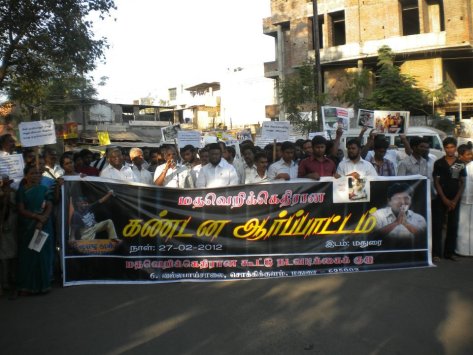
The photograph above is that of a small protest by People’s Watch yesterday, in Madurai, for justice and reparations in Gujarat. Such demonstrations were held across India. Nothing irks the Narendra Modi Fan Brigade than remembering. Move on, they say, move on, forget it. It happened. The struggle of man against power, said Milan Kundera, is the struggle of memory against forgetting.

The short film below, about making a memorial at Gulberg Society in Ahemdabad, was put out by the Teesta Setalvad-led Sabrang Trust in 2008. Yesterday, tenth anniversary of the day Gujarat began to burn for a few weeks in 2002, Sabrang Trust held a meeting at what is now the Gulberge Memorial. Given below the film is the text read out by Justice Hosbet Suresh read out at the Memorial meeting, which was webcast live by Sabrang Trust.

Continue reading The Gulberg Memorial

A decade on, Gujarat justice incomplete: Human Rights Watch

This release was put out on 24 February 2012 by HUMAN RIGHTS WATCH

(New York) – Authorities in India’s Gujarat state are subverting justice, protecting perpetrators, and intimidating those promoting accountability 10 years after the anti-Muslim riots that killed nearly 2,000 people, Human Rights Watch said today. The state government has resisted Supreme Court orders to prosecute those responsible for the carnage and has failed to provide most survivors with compensation.

The violence in Gujarat started on February 27, 2002, when a train carrying Hindu pilgrims was attacked by a Muslim mob and caught fire, killing 59 people. In a retaliatory spree by Hindu mobs, hundreds of Muslims were slaughtered, tens of thousands were displaced, and countless Muslim homes were destroyed. Continue reading A decade on, Gujarat justice incomplete: Human Rights Watch

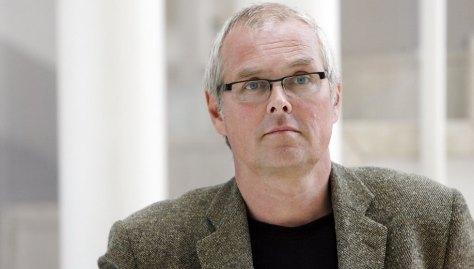
What does Gunnar Toresen know about children?: Suranya Aiyar

Gunnar Toresen (Photo credit: Marie von Krogh / http://www.rogalandsavis.no/)

Guest post by SURANYA AIYAR

Much has been made of the differences between Indian and western parenting in the wake of the removal of two small children from their Indian family in Norway by the Norwegian Child Welfare Service. But there is something more invidious than racism at work here?

The children were two and a half and four months old at the time of their removal to foster care. Observe any mother with children, babies rather, of this age, and you will see that the mother is the centre of a small child’s world. For a young breast-fed infant of the age of four months, as was Aishwarya, the mother is almost her entire world. That is how infants and toddlers experience the world. So let us, first and foremost bring to centre stage this very un-adult, unscientific, but immutable truth of a baby’s reality before we start to speak of its rights.

Let us also make a distinction between adults and babies. Babyhood has its own unique set of needs – physical and emotional; its own personality, quite separate from adult needs and perceptions. You cannot apply adult co-ordinates of well-being to an infant or young child. Continue reading What does Gunnar Toresen know about children?: Suranya Aiyar

Everything you wanted to know about the great Kingfisher Airlines scam but didn’t know who to ask

This slideshow requires JavaScript.

All your queries will be answered here.

On Josh Malihabadi’s death anniversary

On Josh Malihabadi’s 30th death anniversary, doing the rounds is this recently uploaded interview of the Urdu poet, amongst a rich archive uploaded on YouTube by Radio Pakistan.

Josh migrated to Pakistan only in 1958. About the loss of Lucknow, he says it was like losing the world. He says in this interview about a visit to Lucknow, where he asked a taxi driver, how is it going with all these Sikhs and Punjabis who have come to Lucknow. The taxi driver replies, we have taught them (Lakhnavi) etiquette!