All posts by Shivam Vij

Shivam Vij is a writer and journalist based in New Delhi.

Partition Revisited: 2 October 2011, Rudrapur

This is a film by RAJEEV YADAV and SHAHNAWAZ ALAM of the Uttar Pradesh unit of the PEOPLE’S UNION FOR CIVIL LIBERTIES

This is to introduce our documentary film ‘PARTITION REVISITED’ on the Rudrapur riot of 2nd October 2011, where four persons were killed. Policemen and mobs led by leaders of the Bhartiya Janta Party, the Congress and the Bahujan Samaj Party had ransacked shops and settlements of Muslims in their third successful attempt within two years to stoke communal violence. The riot, which took place on Gandhi Jayanti, led to a massive outmigration of the victimised community, reminding one of the days of the 1947 Partition. This film focuses on precisely this yet unnoticed phenomenon that we could trace out in this first-ever state-sponsored communal riot since the formation of the hill state of Uttarakhand, engineered by the Rashtriya Swayamsewak Sangh, which has been working for a long time in this area to arouse anti-Muslim sentiments in the Bengalis, Sikhs & Panjabi Hindus who settled in Rudrapur after the Partition to India. At a time when the state is going to polls this riot assumes an electoral importance.

On the Srinagar Sharia court’s statement against Christian pastors: AICC

This release comes from ALL INDIA CHRISTIAN COUNCIL comes to us via John Dayal

All India Christian Council concern at Srinagar Sharia court statement against Christian pastors

New Delhi, 13 January 2012

The All India Christian Council is deeply disturbed at the Srinagar based Sharia Court issuing a statement against Christian pastors Jim Borst and C M Khanna Srinagar, Jan 11: Supreme Court of Islamic Sharia Wednesday indicted Christian Pastor C M Khanna and Dutch national, Jim Borst for their involvement in luring people to convert their religion. The Sharia court has threatened it will issue a sentence shortly. Such statements can encourage extremist elements to indulge in violence, the Council fears. Continue reading On the Srinagar Sharia court’s statement against Christian pastors: AICC

Demanding a ban on visit of Salman Rushdie to India is outrageous: PUCL

This release comes from the PEOPLE”S UNION FOR CIVIL LIBERTIES

The People’s Union for Civil Liberties (PUCL) views it with deep concern that some organizations have demanded ban on entry of Salman Rushdie in the country. The present call is illogical, preposterous and untenable as the writer has visited the country for several times after the Satanic Verses book controversy. Continue reading Demanding a ban on visit of Salman Rushdie to India is outrageous: PUCL

Invisible Censorship – How India Censors Without Being Seen: Pranesh Prakash

Guest post by PRANESH PRAKASH

The Indian government wants to censor the Internet without being seen to be censoring the Internet. This article by Pranesh Prakash shows how the government has been able to achieve this through the Information Technology Act and the Intermediary Guidelines Rules it passed in April 2011. It now wants methods of censorship that leave even fewer traces, which is why Mr. Kapil Sibal, Union Minister for Communications and Information Technology talks of Internet ‘self-regulation’, and has brought about an amendment of the Copyright Act that requires instant removal of content.

Power of the Internet and Freedom of Expression
The Internet, as anyone who has ever experienced the wonder of going online would know, is a very different communications platform from any that has existed before. It is the one medium where anybody can directly share their thoughts with billions of other people in an instant. People who would never have any chance of being published in a newspaper now have the opportunity to have a blog and provide their thoughts to the world. This also means that thoughts that many newspapers would decide not to publish can be published online since the Web does not, and more importantly cannot, have any editors to filter content. For many dictatorships, the right of people to freely express their thoughts is something that must be heavily regulated. Unfortunately, we are now faced with the situation where some democratic countries are also trying to do so by censoring the Internet. Continue reading Invisible Censorship – How India Censors Without Being Seen: Pranesh Prakash

Bhopal, Media and a “Training Manual”: Shalini Sharma

Guest post by SHALINI SHARMA

It hardly needs any corroboration that the Bhopal Movement led by survivors of the world’s worst industrial disaster adheres to the principles of non- violence as dearly as they adhere to their demands of justice and accountability. However, on the 3rd of  December 2011, as thousands of Bhopal gas victims walked towards the city’s railway lines they had little idea that their act of civil disobedience, marking the 27th Anniversary of the disaster, would be sabotaged by the government and that they would be treated like a violent mob.

Anniversary actions are usually treated as rituals by the media. This occasion was different because even though chakka jaam (block the road) has been organised on several previous occasions, the call for blocking the trains or rail roko was an unusual decision. These survivor-led groups were asking the State government to provide the Supreme Court with the right data related to the number of deaths and actual extent of injuries due to the gas exposure.

Continue reading Bhopal, Media and a “Training Manual”: Shalini Sharma

This is the story of the monkeys of Delhi

From 2009 to early 2011, I lived in a south Delhi barsati which had an enormous terrace area. When I moved in, this open space looked sad and empty, so I spent many thousands of rupees doing it up with all kinds of plants. Then came the monkeys. A team of five to ten. On finding the kitchen locked, they would break the pots, and sometimes eat the plants. No flower was allowed to bloom.

I replaced the mud pots with heavy cement ones. The monkeys broke fewer of them but ate more shoots and leaves. They would come at night. Soon they’d come at dawn, and make such a commotion I’d wake up terrified. Mild banging on the door wouldn’t ward them off, nor would the other tactics I tried. I was afraid of them. They could be aggressive and strong and these traits were multiplied because they operated in gangs. I felt caged in the small room of my large barsati. All I could do was share my misery on Facebook. “Be careful,” a friend warned in a comment, “they once killed the deputy mayor of Delhi.” Read more…

Waiting for Guddo: Farid Alvie

Guest post by FARID ALVIE

Three miles west of nowhere, I wait atop a grassy knoll landscaped with deliberate carelessness by the authorities of this semi-dilapidated amusement park. She said she will meet me here at the appointed time but as luck would have it, neither one of us owns a watch. Ravenous crows with their wings a-stretched and eyes a-bulged circle overhead: a dark, black ring set against a grey sky. I scan my surroundings and find myself alone… as alone as the day I was born. As I shoo my mother, the doctor and his two nurses away, I wonder where she might be at this very moment: caught in a jam full of traffic or confined to her room by the elders of her household, barred from meeting the man she loves and his lustrous, well-coiffed do.

Creepily crawling ants dodge my sneakered soles as they make their way home for the day. Leaves rustle and droop as they emit whiffs of carbondioxide that make my blood pressure plunge. City lights flicker in the distance as a rickshaw throttles by on the road below, polluting my environs and coating the withering leftovers of a despondent spring with soot and non-biodegradable petrol fumes. Continue reading Waiting for Guddo: Farid Alvie

The inter-connected destinies of strangers across an international border

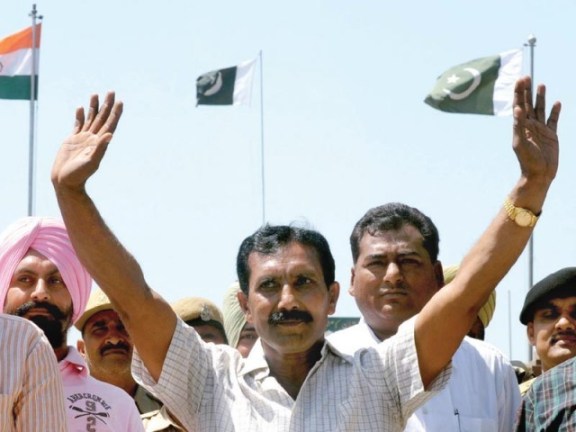
Gopal Das at Wagah border. AFP photo

The central government wants him to do it, the Rajasthan government wants him to do it, but Rajasthan’s acting Governor Shivraj Patil wouldn’t sign on a file for several months now. His obstinacy could become a major hurdle for many Indians and Pakistanis lodged in each others’ prisons.

In an unusual order, the Supreme Court of India quoted William Shakespeare and Faiz Ahmed ‘Faiz’ to directly appeal to the government of Pakistan to pardon and release Indian prisoner Gopal Das. Pakistan President Asif Ali Zardari signed the papers within 16 days, ahead of Prime Minister Yusuf Raza Gilani’s visit to Mohali to witness the cricket world cup semi-final with his Indian counterpart. On 7 April, Gopal Das crossed into India. There were those in Pakistan who had opposed his release, arguing he had a few months left to complete his sentence, and that he should not be shown mercy because he had been found guilty in 1984 by a Pakistani military court on charges of being a an Indian spy. He and his family claimed this was not true, and wanted him pardoned because now 52, he had spent the last 27 years in several Pakistani prisons. Continue reading The inter-connected destinies of strangers across an international border

Amitav Ghosh on Goa

Some musings here about the liberation of Goa from Portugese rule by India:

But the interaction between Portugal and India also produced vibrant cultural hybrids in architecture, music and food. Among the state’s most famous dishes is the spicy vindaloo, a curry whose name is thought to be a contraction of the Portuguese phrase “vinho de alho,” or garlic wine. Besides, as Mr. deSouza pointed out, Goa was where the influence of the Enlightenment and the Renaissance in Europe was felt much before it reached other parts of India. As a result, the practice of sati – or widows immolating themselves on their husbands’ funeral pyres – was abolished in Goa 200 years before the British banned it in the rest of India. [Naresh Fernandes]

And on Portugese language, 50 years after the Portugese were sent back to Portugal:

The popular history of the Portuguese period in Goa has largely been restricted to the gory tales of the initial conquest of the island of Goa, of the Inquisition, and the dramatization of the anti-colonial episodes in the territory’s history. To a large extent, this nationalist history dissuades Hindus from subaltern castes from studying the language. This has ensured that it is solely dominant-caste narratives that are incorporated into the histories of the territory, preventing alternative and liberatory narratives to emerge from a re-reading of the texts and narratives of the period of Portuguese sovereignty over the territory.  It is little known for example, that the knowledge of Portuguese is critical to the bahujan challenge to Hindu upper-caste groups’ monopolistic control of the Goan temples. This monopolistic control of the temples was forged in particular through these latter groups’ knowledge of Portuguese. [Jason Keith Fernandes]

Let’s march faster towards the metric system: Subhash Chandra Agrawal

Guest post by SUBHASH CHANDRA AGRAWAL

Even after half-a-century of introduction of metric measure in India, certain commodities like cloth, paper, furniture, land, time etc are being traditionally manufactured/measures in old units or their metric-converts. For example, cloth is usually manufactured in widths like 36” (91 cms), 48” (122 cms), 50” (127 cms), 54” (137 cms), 120” (305 cms) etc which should now be woven in metric-measures in multiples of 10 cms. It is time that measuring tapes may be available only in metric units after some specified date.

Continue reading Let’s march faster towards the metric system: Subhash Chandra Agrawal

Human Rights Review – Jammu and Kashmir in 2011: JKCCS

This release comes from the JAMMU AND KASHMIR COALITION OF CIVIL SOCIETY, the Bund, Amira Kadal, Srinagar 190001, (www.jkccs.net)

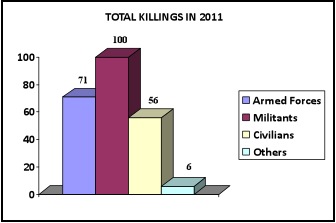
TOTAL KILLINGS

Year 2011 has just passed, and many have declared this year, a peaceful year in Jammu and Kashmir. Of course assertions of peace by various quarters are relative. Enforced silence cannot be construed as peace. Despite the hype of peace, people of Jammu and Kashmir have witnessed unabated violence, human rights abuses, denial of civil and political rights, absence of mechanisms of justice, heightened militarization and surveillance. The figures of violent incidents suggest that 2011 as usual has been the year of loss, victimization, mourning and pain for the people. Continue reading Human Rights Review – Jammu and Kashmir in 2011: JKCCS

When the Wandering Falcon came to Delhi: Pragya Tiwari

Guest post by PRAGYA TIWARI

Nilanjana Roy moderating the prize ceremony; Jamil Ahmad in the background via Skype. Photo courtesy: The Shakti Bhatt Foundation

There is this world among the many worlds of Delhi, the world of book events. You show up for a reading followed by a conversation between the author and some other prominent member of the fraternity. Afterwards you drink wine and exchange news with everyone you know there. And you know everyone there. The scale of some of these events would make you think books actually sell. But the greater riddle for those of us who show up is this: Why do we show up? To see friends, to socialise and occasionally to celebrate books, or perhaps the very existence of books irrespective of quality; to register our support for words and stories bound by charming jackets; to toast these objects of desire in a simulated bubble where they shine on undeterred. Debatable as their meaning might be, for most part these events are mere rituals. On the 21st of December, however, for a brief moment I was made to see that they could be more than that. The man who made that apparent was not even physically present in the room. Continue reading When the Wandering Falcon came to Delhi: Pragya Tiwari

J&K government has buried the SHRC report on unmarked graves in Kashmir: APDP

This release comes from the ASSOCIATION OF PARENTS OF DISAPPEARED PERSONS,  the Bund Amira Kadal, Srinagar, Jammu and Kashmir

28 December 2011: Callousness of the government continues vis-à-vis victims of human rights abuses and in particular against the family members of those who have disappeared in the last two decades in Jammu and Kashmir. The relatives of more than 8000 persons continue to wait for the government to probe all the cases of disappearances, deliver justice to the families of the disappeared and punish the perpetrators. Continue reading J&K government has buried the SHRC report on unmarked graves in Kashmir: APDP

‘Protests and Repression: Struggles in the Forests of India’

This note comes from the CAMPAIGN FOR SURVIVAL AND DIGNITY

The last few weeks have seen struggles over forest rights and forest control intensifying across the country. On the one hand there are larger and larger protests taking place, and on the other, the continued use of force by Central and State governments is combined with total silence and apathy on protecting people’s rights.  Continue reading ‘Protests and Repression: Struggles in the Forests of India’

Suggestions for India Post: Subhash Chandra Agrawal

Guest post by SUBHASH CHANDRA AGARWAL

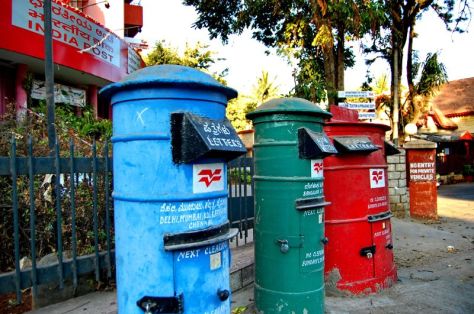
Photo credit: Aditya Bhelke

1.      All postal-tariffs should be generally in multiples of rupees five with Speed Post tariff being universal at rupees fifteen or twenty for every 50-gms rise in weight abolishing differential tariff of rupees 12 for local and rupees 25 for non-local mail-articles. Considering sharp decline in use of inland-letter-cards and post-cards, sponsored Meghdoot post-card should be priced at rupee one abolishing loss-giving Inland-Letter card and ordinary post-cards altogether. Continue reading Suggestions for India Post: Subhash Chandra Agrawal

The Year of the Coup D’état: Fawzia Naqvi

Guest post by FAWZIA NAQVI

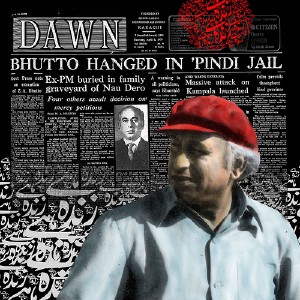
Imran Khan was not the first one to be obsessed with both cricket and politics. Saira and I beat him to it 20 years ago. We spent 50% of our time swooning over him and the other 50% worshipping Mr. Bhutto. 20 years later I believe it was I who got over Imran Khan and Saira who got over Mr. Bhutto. Although I must confess, it was Imran who adorned every inch of wall and closet space in my dressing room, the “shrine” as my brother labelled it. And it was Imran’s picture which popped out of the inside cover of my high school notebook. During moments of boredom and droning lectures I would stare at his picture for an hour straight and muse and sigh over the fact that one could see his house from the balcony of our school and perhaps today might be the day when he would come to pick up his sister from our school. The God, the Adonis, Imran was it for both of us.

I don’t know how Saira became an Imran groupie. I do recall well how I did. I was taken to my first ever live cricket match in 1976. My brother’s best friend pointed toward the field from high up in the spectator stands to what looked to me like white dots, and told me with much seriousness in his voice, “there over there is the most handsome man you’ll ever see…” and then he made his most remarkable claim, “he’s so handsome you’ll forget about Izzy!” Continue reading The Year of the Coup D’état: Fawzia Naqvi

‘NAPM condemns arrest and harassment of anti-dam protesters in Assam’

This press release was issued on 26 December by the NATIONAL ALLIANCE FOR PEOPLE’S MOVEMENTS

New Delhi, December 26 : Tonight at 2:15 am Assam Police in collusion with other security forces swooped down on the protesters at Ranganadi who have been blockading the Highway since December 16 and thwarting state’s attempt to carry turbines and dam materials to project site of Lower Subansiri Dam. Nearly 200 people have been arrested and earlier also security forces have been harassing the ptotestors. In past too, Krishak Mukti Sangram Samiti fighting against the big dams on Brhamaputra have faced government’s ire and often been attacked and jailed. NAPM stands in solidarity with KMSS and other students groups of the region who have been consistently opposed to the Big dams in highly sensitive seismic zone. We condemn the sustained action and harassment of KMSS and their activists and targeting of Akhil Gogoi for constantly opposing the destructive development policies and corruption of the government machinery. Continue reading ‘NAPM condemns arrest and harassment of anti-dam protesters in Assam’

Z for Zalim: Semiotics and the Occupation of Kashmir

Ours was the marsh country, down by the river, within, as the river wound, twenty miles of the sea. My first most vivid and broad impression of the identity of things, seems to me to have been gained on a memorable raw afternoon towards evening. At such a time I found out for certain, that this bleak place overgrown with nettles was the churchyard; and that Philip Pirrip, late of this parish, and also Georgiana wife of the above, were dead and buried; and that Alexander, Bartholomew, Abraham, Tobias, and Roger, infant children of the aforesaid, were also dead and buried; and that the dark flat wilderness beyond the churchyard, intersected with dykes and mounds and gates, with scattered cattle feeding on it, was the marshes; and that the low leaden line beyond, was the river; and that the distant savage lair from which the wind was rushing, was the sea; and that the small bundle of shivers growing afraid of it all and beginning to cry, was Pip. – Charles Dickens, Great Expectations

A for Apple and Z for Zebra. Children are taught the alphabet with the help of images. And the association of images with sound. It helps them associate the sound of A with the sound of Apple, and associate that in turn with the image of an apple. The alphabet book depends on images that may be familiar to children. The word Apple is a signifier, and the apple itself is the signified. This is, most simply, what semiotics or the study of signs and sign processes.

In a future world, if there are no zebras, alphabet books may have to replace the last entry with something else. What could it be? Zebra crossing? Zimbabwe?

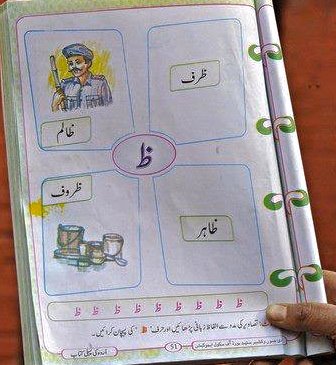
Last week, the Jammu and Kashmir Police registered a case of sedition, defamation and criminal conspiracy against six officials of BoSE, the government’s very own Board of School Education, for this:

This is a page from a book called Baharistaan-e-Urdu. This attempt to teach Kashmiri children the Urdu alphabet (note to self: this is what I need to learn Nastaliq!) makes them say, “Zoi se Zalim,” Z for Zalim, meaning cruel. That is only one of four examples. The other two are: zaroof (utensils), zahir (visible) and zarf (ornamental cup holder).

Continue reading Z for Zalim: Semiotics and the Occupation of Kashmir

Pakistan ki Tareef: Haseeb Asif

This guest post by HASEEB ASIF is in Urdu, in Roman script

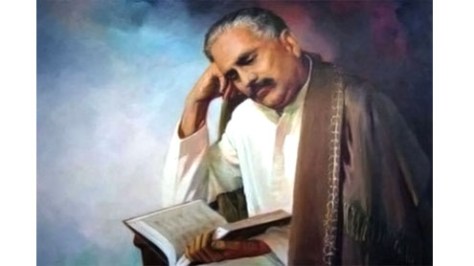
Allama Iqbal (1877-1938)

Islami Jamhooriya Pakistan ki tareekh Hindustan se bohut purani hai. Balkay Islam se bhi purani hai. Jab aathveen sadi mein Muhammad Bin Qasim Islam phelane bar-e-sagheer tashreef laye tau ye jaan ker sharminda huwe ke yahan tau pehle hi Islami riyasat maujood hai.

Yahan kufr ka janam tau huwa Jalaaludin Akbar ke daur mein, jo Islam ku jhutla ker apna mazhab banane ko chal diya; shayid Allah-ho-Akbar ke lughwi maani le gya tha.

Baharhal, in kafiron ne butparasti aur mehkashi jaisay gheir munaasib kaam shuro kerdiye aur apne aap ko Hindu bulaane lage. Sharaab ki aamad se Pakistan ke Musalmanon ki woh taaqat na rahi jo tareekh ke tasalsul se honi chahiye thi. Iski vaja ye nahin thi ke Muslaman sharaab peene lag paray the, balkay ye kay unki saari quwat-e-nafs sharab ko naa peene mein waqf hojati thi, hukmarani ke liye bachta hi kya tha.

Is ke bawajood Musalmanon ne mazeed do sau saal Pakistan per raaj kiya, phir kuch dinon ke liye angrezon ki hakoomat agayi (hamari tafteesh ke mutabiq yehi koi chalees hazaar din honge).

San 1900 tak Pakistan ke Musalmanon ki haalat nasaaz hochuki thi. Is dauran aik ahem shakhsiat hamari khidmat mein hazir huwi, jis ka naam Allama Iqbal tha. Continue reading Pakistan ki Tareef: Haseeb Asif

Who’s afraid of Veena Malik?

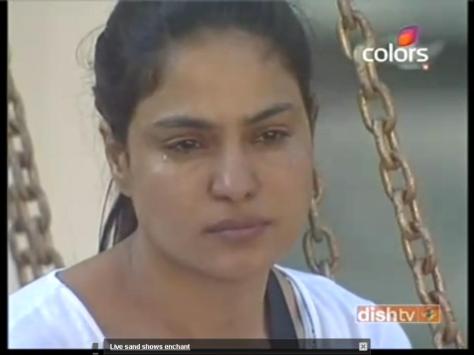
News broke of Veena Malik’s “nude” – more accurately, implied nude – photographs in FHM India magazine when the image of the magazine’s cover went viral on Twitter, even before the magazine was on newsstands. The media in India and all over the world reported “outrage” in Pakistan, in keeping with the international image of Pakistan as a country taken over by Islamists who would wreak havoc over a Pakistani woman posing without clothes for an Indian magazine with ISI tattooed on her arm.

FHM India itself magazine emphasised Malik’s nationality, calling her a “Pakistani WMD” and discussing burqas with her, even mentionining the word burqa on the cover, to reinforce the stereotype of a hot Pakistani model defying a country riven with Islamic extremism.

But in reality, there hasn’t been as much backlash in Pakistan as the world outside would expect or believe. Says Islamabad-based journalist Shiraz Hassan, “I am surprised that except a few news channels and papers nobody has been bothering about Veena Malik, as though they don’t care what she did. Haven’t seen anything from hardliners also.” Continue reading Who’s afraid of Veena Malik?

Does the Universal Declaration of Human Rights impose Western values?: Gita Sehgal

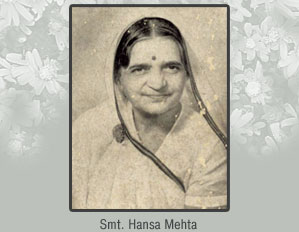
The Indian freedom fighter was a key drafter

Guest post by GITA SEHGAL

10 December was Human Rights Day, anniversary of the Universal Declaration of Human Rights. Does the idea of human rights with their firm assertions, their belief in the ‘rule of law’ and their globalised vision, remain relevant in the world? The idea that there are absolute standards has come under attack from both the left and the right. The philosopher Alasdair MacIntyre , author of ‘After Virtue’, said, Natural rights and self evident truths proclaimed in the American declaration of independence are tantamount to belief in witches and unicorns. While from the left,  in ‘Human Rights and Empire’, Costas Douzinas has called human rights the political philosophy of cosmopolitanism and argued that human rights now codify and ‘constitutionalise ‘ the normative sources of Empire. Continue reading Does the Universal Declaration of Human Rights impose Western values?: Gita Sehgal