
All posts by Shivam Vij

Shivam Vij is a writer and journalist based in New Delhi.

‘Non-violent terrorism’ and India’s dirty war in Kashmir

Guest post by MOHAMAD JUNAID
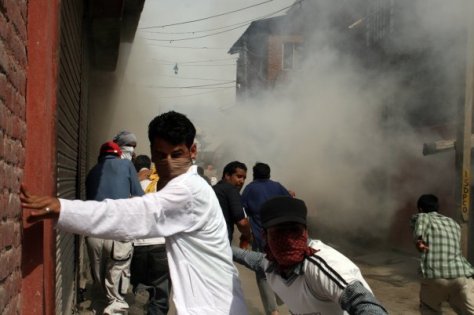
Dozens of young boys have been arrested across Kashmir under draconian laws over the last few weeks. The charges that have been filed against them range from “waging war against the state” to defiling “state honor”. In recent months Indian military and police commanders have described protests in Kashmir as “agitational terrorism” and “non-violent terrorism” in order to justify violent clampdown on protests by Kashmiris.

As the headlines go, Stone-pelting an act of war: J-K gov.

In the same period around 8 people, mostly teenagers, have been either shot to death or fatally injured by indiscriminate use of tear-gas shells. Over the last two years the number of dead in shootings is more than a hundred. Meanwhile thousands of people have been injured. Many of them will be left with permanent physical disabilities. The police authorities have banned any peaceful assembly of people. Many places in downtown Srinagar and other towns have reported police brutalities. Even the villages are not being spared. Only yesterday, mourning villagers were attacked by CRPF troopers in Redwani in South Kashmir. Dozens of them were injured by CRPF’s indiscriminate firing. Most of the injuries were inflicted above the waist showing an intention to kill Continue reading ‘Non-violent terrorism’ and India’s dirty war in Kashmir
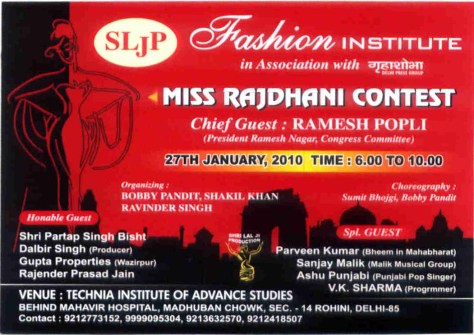
Miss Rajdhani Contest

You are cordially invited

Of SubTerrains and Seismology: Notes on the Contemporaneous in India

Guest post by MOHD. SABIH AHMED

Of SubTerrains and Seismology: Notes on the Contemporaneous in India [1]

If the starting point of an enquiry is to investigate into the larger ambit of cultural production in which a notional unity of ‘contemporary art’ is one formation, the study of alternative systems/networks/formations would not suffice merely as mapping them as ‘alternative art’ in the same field. Instead, the demand would be to trace the contexts that give rise to a necessity for peculiar and disparate kinds of alternatives, and how certain cases instigate the field, maybe even risk rearranging the very conceptual and pragmatic constituents of that field.

This paper is a series of ponderings, questions, and a hesitant proposition regarding the above-mentioned, as much as it is an exposition on the state of affairs of that notional unity that is ‘Contemporary Art in India’. Continue reading Of SubTerrains and Seismology: Notes on the Contemporaneous in India

Asim Butt (1978-2010)

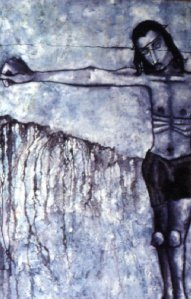
Self-portrait as Christ. 1998. Oil on board, paper, and wax palimpsest.

Karachi-basd artist Asim Butt committed suicide yesterday by hanging himself to death. He was only 31, and his work made waves. Part of the Stuckist art movement, he made figurative paintings, most notably a series of seven portraying a dog’s carcass. He was also a graffiti artist, painting red the walls of Karachi. His best known graffiti work was the eject symbol painted all over towards the end of General Musharraf’s rule.

Read this moving tribute by a journalist friend and this one with a lot of links at Stuckism.com. You can pay homage here, but most of all, see his pictures and paintings on his own Facebook profile.

As one of the tributes on Facebook reads, good people die early.

‘Major Embarassment for Ibobi government’: press release from the Delhi Solidarity Group

MEDIA RELEASE
24 November 2009
New Delhi

MANIPUR:
UNION HOME MINISTRY REVOKES DETENTION ORDERS ON TEN PEOPLE

MAJOR EMBARASSMENT FOR IBOBI GOVERNMENT

New Delhi: Less than a day after the release of a citizen’s report in the city on the civil unrest in Manipur, Union Home Secretary G K Pillai stated that his ministry had revoked the detention orders of ten people, including Jiten Yumnam, a well-known environmental activist. Pillai informed his ministry’s decision to Dr. K.S Subramanian, a member of the Independent Citizens’ Fact Finding Team that released the report ‘Democracy ‘Encountered’: Rights’ Violations in Manipur’ on the 23rd November at the India International Centre. The report was released by Randhir Singh, former Professor of Political Theory at Delhi University. Continue reading ‘Major Embarassment for Ibobi government’: press release from the Delhi Solidarity Group

Caste and Modernity

A friend remarked the other day that this is an “unendingly interesting” country. The phrase is stuck in my head, and it recurs when I come across stuff like this:

There were no Hindu untouchables in the West Punjab, and such work as that of sweepers, skin-flayers and leather workers was done by Muslims. They were presumably untouchable Hindus who had at one time become Muslims to escape their lot, which they apparently did not manage to do…

As I boy I would feel quite ashamed when my mother, asking for a glass of water at some Muslim house, would be told with ingratiating courtesy that both the glass and the water had come from a neighbouring Hindu family. But slowly I saw the change come in. Our father made no bones about eating with Muslims and bringing them home. Interestingly, this problem was solved in our home, as in many other homes where a similar change was at work, by the introduction of chinaware. Continue reading Caste and Modernity

Narendra Modi – Murdabad! Murdabad, murdabad!

Can you even imagine Indian politics, or even India, without Murdabad? Who in this country has not seen a protest with people shouting “murdabad” after the name of a politician? Murdabad literally means death be upon you. In Gujarat, though, wishing death upon Narendra Modi can land you in jail. After the chief minister contracted swine flu, one Umesh Anupchandra Jain in Surat sent his friend Nirav Jagdishchandra Rana an SMS that read: “Jay Shree Ram. Narendra Modi ne swine flu positive. Bhagwan ene jaldi uthavi le aevi prarthna. Jaisi karni vaisi bharni.” That translates as: ‘Jai Shri Ram. Narendra Modi is swine flu positive. Let’s pray that god takes him away soon. As you sow, so you reap.’

So what if the recipient, Nirav, further circulated this to another 500 people? And so what if some of those were Modi fans, who were infuriated enough to go to the police station with it? What in those words gives the police the right to arrest Umesh and Nirav under charges of promoting enmity between groups, criminal conspiracy and abetting a crime, besides the IT Act. The irony of the Narendra Modi government accusing somebody of promoting enmity amongst groups. You may say it’s in bad taste, you may invoke Gandhi and say and eye for an eye makes the whole world blind. But jail for an innocuous SMS makes Gujarat a police state. Continue reading Narendra Modi – Murdabad! Murdabad, murdabad!

Five Days with VS Naipaul


By
NASIR ABID

(An edited, shorter version of this essay had
appeared some years ago in
Man’s World magazine.)

*

Call me the man who met V.S. Naipaul.

It all started innocently enough. A journalist telegraphed from Bombay that he was reaching Lucknow on such and such a date with V.S. Naipaul.

My excitement knew no bounds and I fixed it with a mutual friend, Azad, to go to the airport to pick them up. As luck would have it we got stuck in the traffic jam and reached the airport late. With hindsight I shudder to think what a close shave I had, what with Naipaul’s antipathy to people being late for an appointment.

We shook hands and since there was hardly any luggage we got into the car and headed back to the city. In spite of the intense summer heat Naipaul was wearing a summer suit and a felt hat. He was wearing a checked shirt with the collar buttoned but without a tie, white socks and loafer shoes, the kind in which the socks show.

His skin was dark like walnut, and because the felt hat hid his thick head of hair the initial impression which had become familiar to us from Hollywood gangster movies. The expression was fixed in a perpetual grimace with the lips pursed as if he was just enduring being stuck in a place like this. There was not a hint of a smile.

I told Naipaul that A House for Mr Biswas was one of my favourite books and I am sure that he must be pleased with it too. He modestly said, “It just got written and yes I am very fond of Biswas too.” Modestly because in one of his interviews Naipaul said that he knew that it was going to be a big one. I referred to the ‘skin tights’ episode and Naipaul gave an amused chuckle. In my younger days, when I had read the novel, I had felt that it was very cruel to write this episode however amusing it might have been. But I did not say so to him. Continue reading Five Days with VS Naipaul

A postcard from Bombay for Raj

Don’t think it’s a good idea and you’ll do it one of these days. Do it today! Go to your nearest post office, buy a postcard and address it to Raj Thackeray. Don’t be abusive, write a peace message, and when you write the MNS office address, write BOMBAY instead of Mumbai. And shoot it off today! If you like the idea, buy more than a few postcards and give them to friends.

Details here.

Some stories are never told

So what is Maywati in news for? For statues and concrete parks, for being reprimanded by the Supreme Court and for being insecure about Rahul Gandhi trying to woo Dalit voters away from her. And for not garlanding Gandhi.

Did anyone tell you the story of a scheme she came up with, a simple one, nothing as complicated as Mahatma Gandhi National Rural Corruption Guarantee Act. A scheme that simply hires sweepers for the village, from the village.

Well, someone just did, and I can’t thank him enough. Here it is.

There are many such stories, but we don’t want to hear them. Let’s just gaze at the Mayawati statue and wonder when it’s coming down.

And this song is dedicated to Buddhababu

CM Buddhadeb back, denies quit rumours

sar par paaon rakh kar bhaago
katne waala patta hai
suno ji ye kalkatta hai
hurr..

Beaten, tortured, forced to do drugs, wrists slashed with razors

There have been so many ragging incidents coming out in the news, but the media is done with ragging and there’s no hype beyond the singular news report. It would be a mistake to presume that there’s been a spurt in ragging incidents; the spurt has instead been in the reporting of incidents, in punishment and implementation of the law.

A student in Howrah was subjected to the things mentioned in the headline of this post, but it became a news story when the fresher tried to commit sucide by consuming poison. So the headline in the Times of India goes, “Howrah student attempts suicide after ragging“. A reader flipping through news reports could well think, another loser, another victim, another case. The attention is not on the victimiser, the perpetrator.

On Friday, Nayan was waiting at Uluberia station to catch a train home when four seniors grabbed him and took him to a house in the locality, says his uncle. Once inside, the door was barred and the torture began. Nayan was beaten and forced to smoke a cigarette. Then an unknown drug was forced down his throat. When he lay delirious, his wrists were slashed with a razor. Then, one of the seniors asked another to fetch an empty syringe, the FIR says. As Nayan desperately struggled, he was held down and air injected into his left hand.

Surely, the FIR named the four seniors? Why could they not be named in this news report?

The Times report also misses the point, mentioned in the Telegraph report, that the wrist slashing happened because Nayan Adak refused to obey orders to undress and dance. Ragging always does boil down to the fresher’s body, doesn’t it? The Telegraph and Express reports don’t mention names of the four accused either.

Balmiki, Bawaria, Garg, Chauhan: Proclaimed offenders all

haryanapolice1
The Haryana Police website has a list of proclaimed offenders. Great. E-governance and all. But how does it help them to record the caste of every ‘proclaimed offender’? Perhaps because caste is such a valuable marker of identity that it helps nabbing them – after all, where would a Chauhan hide if not in the house?

Or perhaps there is more to it.Is it merely incidental that most proclaimed offenders seem to be Balmiki Dalits in a state known for atrocities against Dalits, in which the upper castes act with impunity in collusion with the Haryana police?

Browse through and you will see, fortunately or unfortunately, that they haven’t been able to find the caste of many, and for very few Muslims have they any caste detail.

“China should break up India”

That’s the view of a Chinese strategic expert. The funniest part is:

China can give political support to Bangladesh enabling the latter to encourage ethnic Bengalis in India to get rid of Indian control and unite with Bangladesh as one Bengali nation; if the same is not possible, creation of at least another free Bengali nation state as a friendly neighbour of Bangladesh, would be desirable, for the purpose of weakening India’s expansion and threat aimed at forming a ‘unified South Asia’. [DS Rajan]

‘It will lead to the commodification of homosexuals’

(I had conducted this interview while working on a story on the Delhi High Court judgement on the 377 case. While that story didn’t materialise, I thought I should post this interview now.)

PURUSHOTHAMAN MULLOLI is general secretary of the Joint Action Council, Kannur-India (JACKINDIA) which intervened in the Section 377 case in the Delhi High Court. In an interview he explains his opposition to the case.

What is JACKINDIA? Continue reading ‘It will lead to the commodification of homosexuals’

Deora Uncle, this ain’t fair

Read this post by Girish Shahane before it’s removed under the threat of a legal notice:

At the start, I reported to a gentleman on deputation from Intel, but he was soon replaced by a gang of four youngsters whose designations were never made clear. Three of them had a parent on the board of Reliance Industries, while the fourth, Milind Deora, was the son of the politician Murli Deora. Continue reading Deora Uncle, this ain’t fair

MILITARIZATION WITH IMPUNITY: A Brief on Rape and Murder in Shopian, Kashmir

This release dated 19 July comes from the International People’s Tribunal on Human Rights and Justice in Indian-administered Kashmir (IPTK)

Enclosed, please find our brief on the events and investigative process in Shopian, Kashmir, connected to the brutalization and death of Asiya Jan and Neelofar Jan in end May 2009, in which the state security forces have been implicated.

While investigations have emphasized the procedural conduct of the police in their handling of the investigation, they failed to focus on the actual crimes that were committed, or the conduct of state institutions. The investigations in Shopian have not focused on the identification and prosecution of perpetrators or on addressing structural realities of militarization in Kashmir that foster and perpetuate gendered and sexualized violences, and undermine rule of law and justice. The investigations have instead concentrated on locating ‘collaborators’ and manufacturing scapegoats to subdue public outcry. ‘Control’ rather than ‘justice’ has organized the focus of the state apparatus, including all processes related to civic, criminal, and judicial matters.

What is the ‘truth’ of the matter, who are in the know, and what is being shielded?

We were compelled to write this brief to mark the inability of the state apparatus to deliver justice. We urge civil society institutions and international human rights groups and those working with issues of social justice to seek accountability.

In writing this, we have visited, and been in contact with, the family of Asiya Jan and Neelofar Jan, and civil society leaders and organizations in Shopian, and in Srinagar. We are grateful for the collegiality extended us, and especially to those that placed themselves at risk to offer us insight.

You can read here the full report.

‘My friends have always urged me to come out’

These situations haven’t changed much. My identity is still a threat to me. It may effect my promotions, appraisals, friendships and relationships. I live every moment of my life in this fear. I feel that there will be many like me who will be leading such dual lives… we deceive ourselves, trying to hide our identities.

No, that’s not another post about 377 on Kafila. It’s about something else, on a fantastic new blog that you should immediately add to your feedreader.

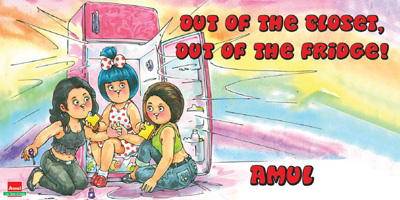
The Amul girl comes out of the closet

Via amul.com
Via amul.com

BP Singhal: “I don’t have any problem with homosexuals. Do you?”

Photo credit: Salman Usmani

Bharatendu Prakash Singhal, 78, is a Hindutva ideologue, a retired IPS officer and a former BJP Rajya Sabha MP. On a Sunday afternoon I visited him to discuss his opposition to the decriminalization of gay sex by the Delhi High Court. He is preparing to appeal against it in the Supreme Court. Singhal explained that he wasn’t opposed to private consensual sex between same-sex adults, he didn’t want such adults prosecuted or persecuted, but he merely wanted the law to remain on paper as a deterrent. This is the transcript of a recorded interview; a much shorter, edited version has appeared in Open. Continue reading BP Singhal: “I don’t have any problem with homosexuals. Do you?”

Speaking of litigation: Anant Maringanti

Guest post by ANANT MARINGANTI

Speaking of successful litigation, one day after what some may call the makings of India’s rainbow coalition celebrated the Delhi High Court’s final verdict in the Naz Foundation case, agricultural workers in Andhra Pradesh celebrated a favorable interim order in the APVVU (AP Agricultural Workers Union) case. Judge N.Ramamohana Rao of AP High Court ignored the Additional Solicitor General’s objections and ordered that the National Rural Employment Guarantee Scheme wage rates be revised up from Rs 80 per day to the prevailing minimum wage of Rs 119 (111 and 112 in some areas) per day set by the Government of Andhra Pradesh. This will remain in force for 8 weeks. Of course, a favorable interim order does not imply that the final verdict will be favorable. But it bolsters the confidence of the contestants. It is a precious gift of time for solidarity building. And in this particular case, it will put an additional amount of a whopping Rs 31-40 per each of the 100 work days in a year in the hands of those availing work under the NREGA. It did not bring tears to the eyes, but in a general clime of judicial unresponsiveness to the claims of the poor it made many heave a sigh of relief. Continue reading Speaking of litigation: Anant Maringanti