Category Archives: Capitalism

Trampling on Workers’ Rights in Sriperumbudur: Ramapriya Gopalakrishnan and Bobby Kunhu

Guest post by RAMAPRIYA GOPALAKRISHNAN and BOBBY KUNHU

On January 2nd this year, management officials at the Sriperumbudur factory of NVH India Auto Parts Ltd, the Indian subsidiary of a Korean auto parts manufacturing company manhandled the company’s striking workers. The shocking visuals of the Korean managers of the company dragging workers on the floor and a manager standing over a worker holding him between his feet sparked outrage amongst civil society groups and caught the attention of the mainstream media.

Literally trampling workers!

The trigger for the strike was the suspension of 15 workers which their union alleges was without any reason. Several other issues festering for a long time also gave an impetus to the workers to go on strike. These include the lack of adequate toilet facilities. Apparently, there are only 6 toilets in a factory where more than 700 workers are employed of which only 4 are in usable condition. In a juvenile twist, the workers have to seek and secure the permission of the management officials each time they need to use the toilet. If this rule is violated in cases of emergency, warning letters are issued to workers alleging that they were found missing from their work spot. Another issue is the lack of a regular and sufficient supply of drinking water in the factory. The workers were also miffed at being under the glare of surveillance cameras all the time during their work hours. A very important issue that was a sore point was the management’s use of trainees and contract labour to perform production work of a regular nature. The workers were also upset at the attitude of the Korean management and the way they treat them.  They allege that there are instances of physical abuse where the management officials hit and slap workers and spit on their faces. Over and above all this, the permanent workers in the factory were peeved at the failure of the management to grant recognition to the union they had joined in 2013 and negotiate with the union.
Continue reading Trampling on Workers’ Rights in Sriperumbudur: Ramapriya Gopalakrishnan and Bobby Kunhu

Make in India – A critical examination of an economic strategy: Leila Gautham

This is a guest post by LEILA GAUTHAM

‘Make in India’ is now an all-pervasive catchphrase – every newspaper and television channel trumpeting the Modi’s ‘clarion call’ to investors – but surprisingly empty in terms of substance. The website is flashy and vastly different from the run-of-the-mill government-of-India websites one is used to – but one has a hard time imagining the ‘captains of industry’ who attended the Make in India launch on September 25th finding any use for it. One begins to wonder, who exactly is the campaign aimed at? Is it the Indian public? An impressive farce, an ad campaign, the neoliberal dream of the efficient state come true – Make in India is not some brilliant brainwave of Modi’s: it is the culmination of very intensive campaign of worldwide propaganda that has been launched by global corporate capital.

I tried to probe deeper, to tease out concrete details if any – and the following article reflects my understanding, incomplete though it may be.

Continue reading Make in India – A critical examination of an economic strategy: Leila Gautham

Why Should Adivasis Bear the Burden of ‘National Development’? Deba Ranjan

Guest post by DEBA RANJAN

On 25th August 2014 large number of armed police including CRPF with magisterial power reached at the top of the Baphlihill, where Utkal Alumina of Aditya Birla – Hindalco is continuously transporting bauxite through trucks to its Doraguda Alumina Plant. They started beating the villagers of Paikakupakhal. “They were in 25 four wheelers and one bus” Padman Nayak of the same village said. Many got the injured and three dalit villagers namely Mangaldan Nayak (30 years), Kalendra Nayak (30) and Ms Kiyabati Nayak got seriously injured. Kalendra got treatment outside but again was lifted from the Medical by the police so that he may not speak about such action of police to the outside world. Both print media and TV channels (except one newspaper) did not cover the incident. The local journalist of that newspaper later on was harassed by the goons not to write more on it.

I had been to Siju Mali few days before and went to the top of the Hill. It falls in Kashipur area of Odisha just behind the Niyamgiri hill. For last few months this Siju Mali and its adjacent Kutru Mali, two bauxite hill ranges, have been in news because the Vedanta International Limited (VIL) has kept its eyes on it.

After the Lok Sabha election, between April and November 2014, Anil Agrawal, director of VIL has met Odisha Chief Minister Naveen Patnaik thrice and every time he comes out with fully glowing remarks that the latter assured him of transferring the bauxite hills to the Company. It is quite possible too. Election experts have highlighted corporate funding behind Biju Janata Dal’s election campaign and the State Election Commission is unmoved on such complaints. Continue reading Why Should Adivasis Bear the Burden of ‘National Development’? Deba Ranjan

Demolition Drive in Vadodara, 2014: Kathyayini Dash, Rushabh Vishawakarma, Hussain Sabu, Bhagwati Prasad Suryavanshi

Guest post by KATHYAYINI DASH, RUSHABH VISHAWAKARMA, HUSSAIN SABU & BHAGWATI PRASAD SURYAVANSHI

Untitled

In Tarsali, 10 kilometers from Vadodara

Note from authors:

We are a group of friends and students from MS University, Baroda. One of us, Rushabh, lives in Kalyannagar which has partly been demolished and this house too is slated for demolition. We have written this to bring to the surface what demolition and displacement means, from the perspective of those who live in places like Kalyannagar, which cannot even be called a ‘slum’. We could see first hand what happened during the demolition because our friend lived there.  We all have spent happy times at Kalyannagar, Rushabh’s home. We felt we owe it to these memories to at least record these events. You can visit us at BarodaBeat.

Development they say…

They say by 2015, not one jhopdi will be seen…Vadodara’s landscape would be studded with flyovers, high rise buildings, malls, clean pothole-free roads. There will be no stench of garbage, leave alone the sight of it.

The recent floods in Vadodara set off an alarm, urging the quick setting up of “river-front projects” which included the demolition and re-location of slum dwellings near the river which were so awfully affected during the floods.

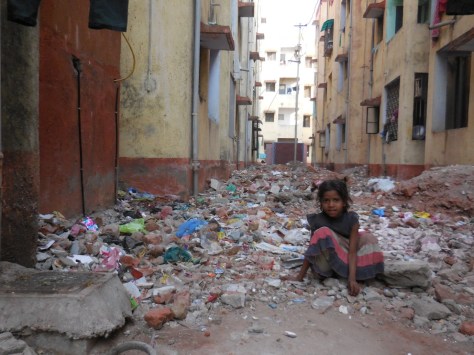
They say, “this is not fair. They sure need help; first priority in fact. They have to be the first to be taken into consideration before going on to people who have it all: a raised plinth level, a well cemented house, resources to recover the losses incurred in the floods. The jhopdiwaale, well, they have nothing at all, don’t they? Already low on the economic scale, they have no resources to recover the losses incurred during the floods, they don’t even have pakka houses to resist the floods. And on top of it all, they have houses built along the river itself. Poor things, where else would they build their houses. But then, these houses shouldn’t be there in the first place isn’t it? Because this is government land, and they don’t have the right to live there. What good is it anyway?” they say. “It is near the river, there is always a dangerous risk of the river flooding and them and their houses drowning,” they say. Continue reading Demolition Drive in Vadodara, 2014: Kathyayini Dash, Rushabh Vishawakarma, Hussain Sabu, Bhagwati Prasad Suryavanshi

From Ferguson to Pune—The Minority Report: Archit Guha

This is a guest post by ARCHIT GUHA

Prima facie, the grand jury decision in the United States to not indict a white police officer, Darren Wilson, in the murder of a black teenager, Michael Brown, and the flurry of protests that have occurred since the incident in August are distinctly symptomatic of the structural racism that continues to plague the settler colonial nation that institutionalized slavery nearly 500 years ago, but claims to be post-racial today. Continue reading From Ferguson to Pune—The Minority Report: Archit Guha

Days and Nights in Manesar – Reflecting on the ASTI Workers’ Struggle: Anshita & Arya

Guest Post by Anshita & Arya (Krantikari Naujawan Sabha)

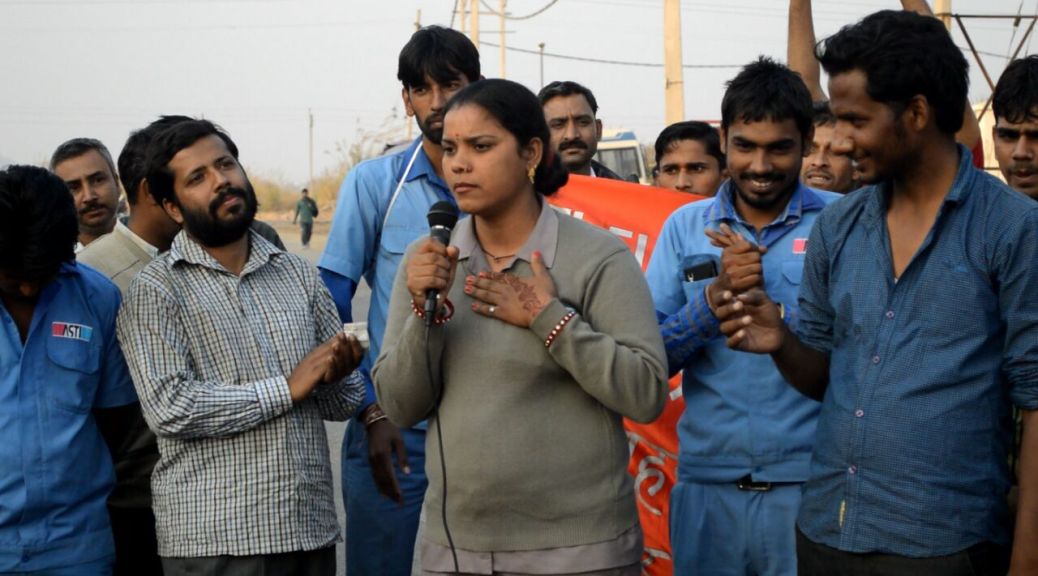
All 310 contract workers in ASTI Electronics factory in IMT Manesar in Gurgaon, Haryana have been on dharna since 3rd November 2014 after they were laid-off on 1st November 2014 citing low work demand. Seven of them are on fast-unto-death from 24th November, while ten workers and pro-worker activists each everyday sit on relay hunger strike.

 In a context where contract workers, increasing exponentially as a demand of the capitalists gleefully forced down by the government through labour law reforms, are finding it ever harder to organize/unite and sustain spontaneous outburts of discontent, due to the precarious nature of their life and work conditions, workers at ASTI Electronics (as a continuation of the 60-70 strikes in various factories in the industrial belt of Gurgaon-Manesar-Dharuhera-Bawal in the last few months) are fighting back and keeping the flame of new emergent struggles alive.

These workers are raising important questions on contractualisation and informalisation within the organized sector which even Central Trade Unions have constantly avoided. Over 250 of these 310 workers are women whose militancy in struggle and leadership is redefining the overall struggle and changing the gender relations within the workers movement.

This struggle for work-livelihood-life is unmasking the heart of the developmental model on DMIC (see current projects in makeinindia.com) which Mr Modi under the supervision of the capitalist class is proposing as the solution to all ills before so-called ‘progress of the country.What follows is a short reflection from the factory gate on the ongoing struggle. Continue reading Days and Nights in Manesar – Reflecting on the ASTI Workers’ Struggle: Anshita & Arya

The deadly land policies planned by Modi’s advisers and the links to Ukraine and Honduras: Aditya Velivelli

This is a guest post by ADITYA VELIVELLI

One year after the Land Acquisition Act was passed in Parliament with bipartisan support, commerce minister Nirmala Sitharaman stated that changes will be made to the Act during the upcoming Winter Session of Parliament.

The earliest indication that this would happen, came from of all people, a first-time MP and microfinance lobbyist Jayant Sinha. Sinha had mentioned in a CNBC interview right after BJP’s win that land acquisition policy was the first priority. For those wondering why CNBC interviewed Sinha and allowed Sinha to lay out the new Government’s priorities, and why Sinha has been appointed junior finance minister, they should refer – Who is guiding Modi’s economic thinking and what is their background? Continue reading The deadly land policies planned by Modi’s advisers and the links to Ukraine and Honduras: Aditya Velivelli

The voices we didn’t hear: K.S. Narendran

Guest Post by K.S. NARENDRAN

As I write this, we are entering the ninth month after the disappearance of Malaysia Airlines flight MH370. I would not want it to be forgotten soon. My wife Chandrika Sharma was on that flight.

Over the past few months, as public attention has shifted to other issues, the long-drawn search for MH370 has seen many developments, ranging from the disturbing to the outrageous. The ineptitude of the Malaysian authorities was on public display, particularly in the early weeks of March 2014, and so merits no further comment. What is intriguing, even worrisome, though is that relevant institutions have been inaccessible or indifferent, be it in terms of pushing for the truth and seeking accountability, or in responding to the affected families’ needs. What follows is my own experience, my take.

The Indian Government: Mute and invisible

In the first week following the disappearance of Malaysia Airlines’ Flight 370, I had asked whether our government had any view on the incident, and any role in responding to it. After all, Indian citizens were involved. This evoked an interesting, if not distressing, set of responses. Indian Minister of State for External Affairs, E Ahmed, deemed the election campaign a higher priority, and opined that the Indian Embassy (at Kuala Lumpur) ought to have stepped in. In informal conversation, many were sympathetic with this view. The Ministry of Civil Aviation and the DGCA seemed similarly indifferent, or saw no role for themselves in responding to the incident or in assisting the affected families. Even the state governments, otherwise quick to take offence at any perceived slight or injury to sons and daughters of their ‘soil’, remained untouched, conspicuous by their silence. The only face of the government that I saw were the CB-CID Special Branch of the Police, the Indian arm of the Interpol and the Intelligence Bureau.  Each asked the same set of questions, suggesting that they work in silos,  that they don’t trust each other. Continue reading The voices we didn’t hear: K.S. Narendran

Concerns on proposed meetings of Intellectual Property Owners Association with IPAB and the Delhi High Court: Campaign for Affordable Trastuzumab

The Campaign for Affordable Trastuzumab was launched in November 2012 and has been endorsed by over 200 Indian and global patient associations, cancer survivors, health movements, women’s rights activists and eminent jurists.

Kalyani Menon-Sen, Leena Menghaney and KM Gopakumar from this campaign express serious concerns about  the intent and purpose of the “Innovation Dialog” being organised in India from November 16-22, 2014 by the Intellectual Property Owners Association (IPOA).

To: Hon’ble Justice Mr. H.L. Dattu (Hon’ble Chief Justice of India); Hon’ble Justice Smt. G. Rohini, (Chief Justice, Delhi High Court); Hon’ble Justice K.N. Basha (Chair, Intellectual Property Appellate Board)

Dear Hon’ble Justice Dattu, Hon’ble Justice Rohini and Hon’ble Justice K.N. Basha,

We write to you on behalf of the Campaign for Affordable Trastuzumab, a network of treatment activists, patients and public interest lawyers committed to making the breast cancer drug – trastuzumab – affordable in India. We have closely followed the misuse of patent rights and more recently the vexatious litigation of the Swiss pharmaceutical company Hoffmann-La Roche Ltd in India to maintain control over the market for the lifesaving drug (trastuzumab), thus blocking access to treatment for thousands of women with HER2+ breast cancer.

This letter is to express our grave concern about the intent and purpose of the “Innovation Dialog” being organised in India from November 16-22, 2014 by the Intellectual Property Owners Association (IPOA).

The IPOA is a US-based group consisting of large corporations and law firms which has been aggressively lobbying on issues of intellectual property standards and enforcement in India and pushing a pro-corporate agenda. The biased and unbalanced position taken by the IPOA is especially troubling when it concerns medicines, where the use of intellectual property protections have restricted access to affordable treatment and blocked competition.
Continue reading Concerns on proposed meetings of Intellectual Property Owners Association with IPAB and the Delhi High Court: Campaign for Affordable Trastuzumab

Whatever happened to the great debate? Ankita Anand

Guest Post by ANKITA ANAND

On 6 November 2014 BBC World invited three panellists from different sectors to debate on ‘A New India: Free, Fair and Prosperous’ as part of the World Economic Forum. Issues of content and objectivity apart, one still has high expectations of a group like BBC when it comes to setting high standards of form. But this ‘debate’ fell flat on its face on all counts.

No rules of the game

One would think that in a discussion like this all three panellists would bring in varied viewpoints due to their specialization in their individual sectors. However, if one wants to quote either the minister or the corporate voice in the debate, it would require constant rechecking to distinguish who said what. Of course businnesses and governments need not always be in conflict with each other. But this smooth overlapping can be dangerous if those who are to be at the receiving end of this coalition between corporate bodies and governing bodies get completely left out. So for all practical purposes, instead of having three distinct voices, the format of the session (to keep calling it a debate would be to perpetuate technical erroneousness) was two against one. The yesmanship resulting out of this format naturally dulled the sparkling energy any debate worth its salt should have. Continue reading Whatever happened to the great debate? Ankita Anand

From a Professor to a Showman: Kishen Pattnayak on Prannoy Roy

Translated from the original Hindi by Akhil Katyal

Kishen Pattnayak (1930-2004) was a socialist thinker and writer. He had been a member of the Indian parliament from Orissa. Pattanayak was the founding editor of a Hindi monthly periodical called ‘Samayik Varta’. In this Hindi essay ‘Professor Se Tamashgeer’ published in March, 1994, he understands Prannoy Roy as representative of a new class of intellectuals which came into being precisely with the changing economic policies of the Indian government in the early ’90s.

Those who do not know English in this country might not know Prannoy Roy. But knowing him is important because Prannoy Roy represents a new social phenomenon. Prannoy Roy’s fame has been sealed by the program “The World This Week” running every Friday on Doordarshan. Not unlike a magician putting on a show, it has lately become quite an art for Doordarshan to concentrate the attentions of the TV viewers and keep them spellbound with only select news and statements on the channel. Pritish Nandy’s show and Prannoy Roy’s weekly program etc. are prime examples of this art.

Among the country’s intellectuals, such folks must surely be rare, who apart from being immensely intelligent, can also put on a circus-show in the middle of a street. Television professionals are always on a hunt for such gifted intellectuals. Through them, the TV business gets some intellectual prestige, making it reputable to carry on showing several dreadful and obscene things. Continue reading From a Professor to a Showman: Kishen Pattnayak on Prannoy Roy

Whither Social Movements? Exploring the Problematic and Action Strategy: Soumitra Ghosh

Guest post by SOUMITRA GHOSH

The context

One of the biggest and most visible problems plaguing the anti-capitalist social movements of today is the statist framework which conditions, shapes and governs their thoughts and actions. Thus the political praxis which should ideally be moored in a post-capitalist (hence post-state) vision of society, is seldom reached, and the movements are stuck in the morass of extremely limited actions informed by their purely normative and emotive thoughts about how the present society should function. The war-cry of justice is aired, millions take to the street demanding it, yet this ‘justice’ is rarely explained in terms of the real and the grounded. It is taken for granted that the state will be transformed from its overtly pro-capital avatar to a more radical one by this means or another because the movements want it to change: what is forgotten is that history has seen hundreds of experiments with such ‘changed’ states—each one of which failed in the long run, and led to a more coercive rule of capital.

Also, today’s social movements are non-violent and democratic, which in reality means that they prefer working within the framework of parliamentary democracy, and where that is absent, fight for it. Once again, the history of the institution of parliamentary democracy is forgotten: willy-nilly, it’s ignored that historically—more so going by today’s neo-liberal situation—such democracy is intrinsically linked with capitalist production systems and the hegemony of capital in both our societies and polities. Continue reading Whither Social Movements? Exploring the Problematic and Action Strategy: Soumitra Ghosh

Feed The Poor, Go To Jail

image : Courtesy eideard.com

Whether serving food to the homeless is a crime?

Ask Arnold Arbott, known as Chef Arbott, a 90 year old man from Fort Lauderdale, Florida, who along-with two other members of a Church charity faces potential jail term for at least six months for the same ‘offence’. In fact his name finds prominent mention in the police records in the past week for breaking the new city ordinance which has come into effect recently which characterises his act as breach of law, according to reports.

Talking to a newsperson he said:

“These are the poorest of the poor. They have nothing. They don’t have a roof over their head. And who could turn them away?”

Continue reading Feed The Poor, Go To Jail

धर्मनिरपेक्ष दक्षिणपंथ – एक कल्पना का सच: सुशील चन्द्र

Guest post by SUSHIL CHANDRA

पिछले जयपुर साहित्योत्सव (हालांकि मैं उसे ‌‌‌तमाशा-ए-अदब कहना अधिक पसंद करूंगा) के दौरान अमर्त्य सेन ने अपनी सात अभिलाषाएं व्यक्त कीं। दिलचस्प यह है कि उनमें से एक अभिलाषा उलटबांसी अधिक नजर आती है – कि वह देश में एक धर्मनिरपेक्ष दक्षिणपंथ चाहते हैं । यह मासूम सी सदिच्छा न सिर्फ कई प्रश्न उठाती है बल्कि एक साथ कई सारी विवेचनाओं की मांग भी करती है। सच तो यह है कि यह कामना कोई नई बात नही है और पश्चिम की अधिकांश दक्षिणपंथी पार्टियां जैसे रिपब्लिकन पार्टी़, कंजरवेटिव पार्टी़, क्रिश्चियन डेमोक्रेटिक पार्टी इत्यादि इसी संकल्पना की उपज हैं। वस्तुत: यह संकल्पना इस अवधारणा से निकली है कि दक्षिणपंथ के धार्मिक-सामाजिक पक्ष (जिसकी परिणति कठमुल्लावादी रूढि़वाद में होती है) और आर्थिक पक्ष (जो अंतत: नव रूढि़वाद में प्रतिफलित होता है) बिल्कुल अलग अलग हैं और उनके बीच कोई पारस्परिक निर्भरता नहीं है।

पहली नजर में यह सही भी लगता है जहां फ्रांस में लंबे समय तक दक्षिणपंथी शासन के बावजूद प्रशासन राज्य और धर्म के बीच संपूर्ण अलगाव के प्रति समर्पित नजर आता है। यहां तक कि भारत में भी न सिर्फ स्वतंत्र पार्टी बल्कि मनमोहन सिंह सरकार भी अपने सारे नवउदारवादी आग्रहों के बावजूद धार्मिक रूढि़यों से मुक्त नजर आती थी। मैंने जानबूझ कर नजर आती शब्दों का इस्तेमाल किया है क्योंकि सचमुच ऐसा है या नहीं इसकी जांच अभी बाकी है। लेकिन इसके पहले कि हम इस बिंदु की पड़ताल करें, इन दो बहुचर्चित शब्दों ‍- वामपंथ और दक्षिणपंथ को समझना जरूरी है । जरूरी इसलिए है कि इन दो शब्दों का अर्थ संदर्भ के साथ बदलता जाता है । Continue reading धर्मनिरपेक्ष दक्षिणपंथ – एक कल्पना का सच: सुशील चन्द्र

MNREGA’s Swan Song – Not everyone’s idea of ‘achche din’: Amitava Gupta

Guest Post by AMITAVA GUPTA

Concerned about the approach of the central government toward the Mahatma Gandhi National Rural Employment Guarantee Act (MNREGA), 28  development economists wrote a letter to the PM, urging him to stop tampering with the scheme. The letter, as one might have suspected, did not go down well with Jagdish Bhagwati. He, along with his Man Friday Arvind Panagariya, was quick to put forward a rebuttal. Though Bhagwati’s credentials as a trade theorist cannot but be acknowledged even by his bitterest critics, he is hitherto not known for his contribution toward development economics. Panagariya would merit even lesser mention. But, that should not ideally deny their argument a fair scrutiny.

The central government announced a set of measures over the last couple of months or so. Those include restricting the scheme to the poorest 200 districts; reducing the labour to material ratio from 60:40 to 51:49; freezing the real wage rate; imposing cap to state expenditure on the scheme.  Put together, those measures deliver a lethal blow to MNREGA. Bhagwati and Panagariya extend unconditional support to this rather brutal amputation. What they essentially do is to summarize the standard arguments against the scheme. The arguments can be clubbed under two heads— i) the scheme is marred in corruption; ii) it does not generate revenue to justify the spending from the exchequer and hence, it should be done away with. It is worthwhile to check whether any of these arguments has some merit or these are just political salvos packaged as economic wisdom.

Continue reading MNREGA’s Swan Song – Not everyone’s idea of ‘achche din’: Amitava Gupta

The Majestic Parvati Valley – Paradise Lost: Ujithra Ponniah

Guest Post by UJITHRA PONNIAH  

In what is known as the heart of Shiva, the majestic Parvati Valley in Himachal Pradesh, a trekker writes about a chance encounter with a Russian man and the impending destruction of the valley. 

My growing alienation with Delhi and city life in general has been buttressed by my frequent, life breathing trips to the mountains. One such getaway took me on a week long trek to the beautiful Parvati valley in the Kullu district of Himachal Pradesh along with a friend. The valley is home to majestic waterfalls tucked away at every turn, lush green forests with the promise of thriving wildlife, unique flowers and a well marked trekking trail. The waterfalls are generous and since we went in the rainy season every shade of green was visible in the forest. The forests are generously sprinkled with their share of marijuana plants that provides a living to many locals and keeps the travellers, especially a large number of Israelis in states of bliss.

Untitled

Russian Baba with Prem

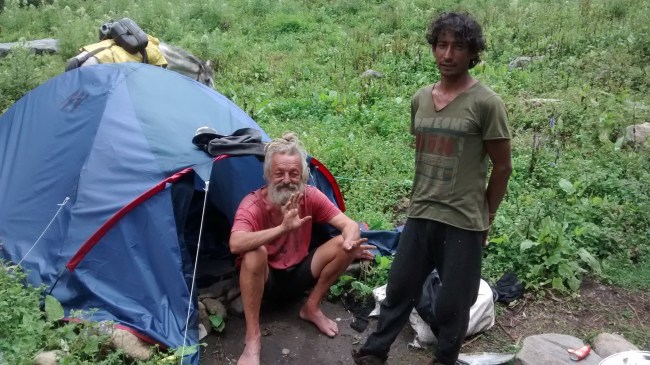
The trek to Kheerganga begins from Barshani village, which is the last motorable point. It is a 14km uphill trek through the forest.  The forest is alive and buzzing with life and the Parvati River accompanies you through your walk. Having recuperated from our long trek to Kheerganga and enjoyed the dip in the hot spring and rejuvenating sight of the first layer of snow on the surrounding mountains, we trekked further with the hope of reaching Tunda Bhuj, a place adorned with a wide variety of sub-alpine forests. About half way into our journey it began to get dark and started pouring. The mist was setting in impeding our vision and we were happy to see a couple of tents in the middle of the forest, next to a small brook. When we stopped by we were warmly greeted to join in for a cup of hot tea. This is where we met a foreigner, in his late 60s and his two companions – Prem and Mansingh (both from Nepal). The initial round of niceties revealed that the foreigner was from Russia and I realised this is the ‘Russian baba’, we had heard about in Kheerganga. He had dreadlocks in his hair, a pair of torn shoes, a torn t-shirt and a bundle of beedi that he constantly drew on. He could not hear too well and retained a thick Russian accent. Continue reading The Majestic Parvati Valley – Paradise Lost: Ujithra Ponniah

Letter to PM about US-India Bilateral Relations on Intellectual Property

Dear Prime Minister Modi ji,

We, the undersigned, wish to share with you some of our concerns on India’s position on intellectual property (IP), particularly in the context of bilateral relations between the United States of America and India. We gather from the US-India Joint Statement dated 30 September 2014 that the Indian Government

(a)greeing on the need to foster innovation in a manner that promotes economic growth and job creation…committed to establish an annual high-level Intellectual Property (IP) Working Group with appropriate decision-making and technical-level meetings as part of the Trade Policy Forum. 

The necessity for setting up the joint Indo-US IP Working Group is not entirely clear. As the Department of Industrial Policy & Promotion (DIPP)‘s press release of 3 October 2014 mentions, there is already in operation an Indo-US Trade Policy Forum since 2010. Therefore, we request your Government to kindly make the specific purpose of this joint Working Group publicly known. Continue reading Letter to PM about US-India Bilateral Relations on Intellectual Property

‘Make in India’ – Modi’s War on the Poor

For some months now, I have been thinking of someone whom I saw on television during the parliamentary election campaign. The place was Benaras and Modi’s candidature from the seat had just been declared. The television journalist was interviewing a group of clearly poor people, taking their reactions on this new, though expected development. This person, fairly drunk in his Modi-elixir – and perhaps also a bit literally drunk – swaggered as he answered, affirming his support for Modi: Modi bhi chaiwala hai, hum bhi chaiwala hain (Modi is also a tea-seller and I am also a tea-seller). His words reflected the success of the remarkable gamble – that of projecting the new poster boy of corporate capital as a humble tea-seller. It was clear how so many of the poor had bought into this campaign.

What reminded me of this person initially, was that very soon after the election results were out, even before the government was formed, ‘team Modi’ announced a series of measures for the development of Benaras, which included the building of 60 flyovers – ‘to ease traffic congestion’. Mainly meant for the benefit of smooth flow of motorized traffic (rikshas, cycles and pedestrians, after all, have little place in the economy of the flyover), this was the beginning of a plan that would transform this holy city. If the experience of building flyovers anywhere in India is any experience, this would additionally mean mass demolition of settlements of the poor, shops and even entire informal markets – including tea shops that have long been part of life of local communities.

Then the government took office. Within a couple of months, the plan for Varanasi’s upgradation started being drawn up more concretely. Not everything in the proposed subsequent plan (end July 2014) seemed objectionable -not the least the idea to work on a possible mono rail, improvement of the bus network, and a Bus Rapid Transit System (BRTS) like the one in Ahmedabad. Except that this would mean more and more dislocation of the poor and destruction of their livelihoods. We have seen this happen in city after city in India, including in Delhi. Continue reading ‘Make in India’ – Modi’s War on the Poor

Letter to PM on NREGA from Development Economists

Dear Prime Minister,

We are writing to express our deep concern about the future of India’s National Rural Employment Guarantee Act (NREGA).

The NREGA was enacted in 2005 with unanimous support from all political parties. It is a far-reaching attempt to bring some much-needed economic security to the lives of millions of people who are on the margin of subsistence.

Despite numerous hurdles, the NREGA has achieved significant results. At a relatively small cost (currently 0.3% of India’s GDP), about 50 million households are getting some employment at NREGA worksites every year. A majority of NREGA workers are women, and close to half are Dalits or Adivasis. A large body of research shows that the NREGA has wide-ranging social benefits, including the creation of productive assets. Continue reading Letter to PM on NREGA from Development Economists

‘Nirmal Gujarat’ – Chronicle of ‘Swachh Bharat’ foretold? Rohit Prajapati

ROHIT PRAJAPATI, indomitable Vadodara-based activist, invites Narendra Modi to read 2 reports:

Report of the Task Force on Waste to Energy (In the context of Integrated MSW Management)’ and

Comprehensive Environmental Pollution Index (CEPI) Report of 2009, 2011 & 2013 of CPCB’.

These reports reveal the hollowness of Modi’s political sloganeering.

Mr. Modi launched the “Swachh Bharat Mission” on 2 October 2014 and in his message on his website, he says, “A clean India is the best tribute we can pay to Bapu when we celebrate his 150th birth anniversary in 2019. […] Today, I appeal to everyone, particularly political and religious leadership, mayors, sarpanchs and captains of industry to plan and wholeheartedly engage in the task of cleaning your homes, work places, villages, cities and surroundings.”[1]

I want to remind Mr. Modi that earlier as the  Chief Minister of Gujarat,  Mr. Narendra Modi had also launched a similar campaign ‘Nirmal Gujarat – 2007’[2] and made tall claims during that campaign. But reality is best seen in Ahmedabad at illegal solid waste dumping site, the ‘Gyaspur-Pirana Dumping Site’ – a Waste Mountain near Sabarmati River adjacent to the main road.

Mr. Modi should know the basic facts as revealed in the ‘Report of the Task Force on Waste to Energy’ dated 12 May 2014 by the Planning Commission of India. This report states “As per CPCB report 2012 – 13 municipal areas in the country generate 1,33,760 metric tonnes per day of MSW, of which only 91,152 TPD waste is collected and 25,884 TPD treated.”[3]

Continue reading ‘Nirmal Gujarat’ – Chronicle of ‘Swachh Bharat’ foretold? Rohit Prajapati

Vicious cycle of ‘Development’, Displacement and Death

Gujarat Oustees jump into Narmada Canal 

Kashinathbhau Mohite, Wang Marathwadi dam affected activist, commits suicide 

7th October, Narmada Dist/ Satara /New Delhi: False promises; snatching away of  rights  and even hope; continued mistreatment and harassment at the hands of police and administration; physical, psychological and emotional exploitation- these are not just sporadic instances but a common pattern of grave injustices seen where people have been displaced in the name of ‘development’.

On 6th October, 12 oustees of Sardar Sarovar Dam from Gadher village in Narmada district of Gujarat, jumped into Narmada canal to awaken the administration to their plight of 22 years. The official claim is that they were ‘rehabilitated’ in 1992, however in reality, they still have not been given alternate land and government job to one family member at the time of acquiring their land, which is clear and outright non-compliance of Narmada Water Dispute Tribunal Award 1979, Rehabilitation policy of Government of Gujarat and orders Hon’ble Supreme Court.  After 22 long years, they still await justice and were left with no other option but to resort to this form of protest. On one hand, the Government of Gujarat has always justified Sardar Sarovar Project and glorified the Narmada Canal as the ‘lifeline of Gujarat’, but  on the other, it turns a complete blind eye to its own people of Gujarat who have been so severely affected by  the displacement caused by this very project. Why this apathy? Whose interests are being served? Continue reading Vicious cycle of ‘Development’, Displacement and Death