संसदीय कैबिनेट ने १३ मई को बाल श्रम प्रतिबंधन एवं नियमन कानून (CLPRA act) में संशोधन को मंजूरी दे दी. मुख्य सकारात्मक बदलावों में १४ वर्ष की आयु तक किसी भी व्यवसाय अथवा प्रक्रिया में बाल श्रम पर पूर्ण प्रतिबन्ध का प्रावधान किया गया है जो स्वागत योग्य है. साथ ही ज्यादा कठोर सजा एवं जुर्माने का प्रावधान भी किया गया है जो कि सकारात्मक है. हालाँकि अभी भी यह बाल अधिकार समझौते की कसौटी पर खरा नहीं उतरता क्योंकि इसमें १४ से १८ साल के बच्चों को गैर खतरनाक उद्योगों में काम करने की अनुमति दी है पर फिर भी चौदह वर्ष तक पूर्ण प्रतिबन्ध एक प्रगतिशील कदम है.
चौदह वर्ष तक पूर्ण प्रतिबन्ध के बावजूद पारिवारिक व्यवसायों में बच्चों के काम करने को छूट दी गयी है .बच्चे पारिवारिक व्यवसायों में काम कर सकते हैं बशर्ते यह काम बच्चे स्कूल जाने के बाद करते हों. सरकार इस छूट का मुख्य कारण यह बता रही है कि इससे बच्चों को अपने पारंपरिक काम सीखने का मौके मिलेगा.
आइये इस बात की समीक्षा की जाये कि यह कारण कहाँ तक तार्किक है. सरकार पारंपरिक कौशल को लेकर कितनी चिंतित है यह तो पिछले बीस साल में हथकरघा और अन्य पारम्परिक पेशों के लिए बनाई गई नीतियों से स्पष्ट है. कोई उनसे पूछे की पिछले बीस सालो में घरेलू उत्पाद में पारंपरिक व्यवसायों का योगदान किस दर से बड़ा है? अगर सरकार को पारंपरिक कौशल के लुप्त होने का इतना ही डर है तो क्यों नहीं इसे स्कूली पाठ्यक्रम में शामिल करती ? अगर इसे पाठ्यक्रम में शामिल किया जाये तो बच्चे पढाई के साथ साथ व्यावसायिक कौशल भी सीखेंगे जो उनके जीवन में काम आयेगा. साथ ही पढाई के साथ काम सीखने से पढ़े लिखे लोगों में श्रम को नीची नज़र से देखने के नज़रिए पर भी लगाम लगेगी और शिक्षा और शारीरिक श्रम के बीच का फासला घटेगा. Continue reading बाल श्रम कानून में बदलाव का औचित्य :किशोर→
This week, Mumbai-based artist Ashok Sukumaran was denied a UAE visa to travel as an invited speaker and moderator at the March Meeting, an annual gathering of artists in Sharjah. Sukumaran has a long history of artistic work and commitments in the region including at the Sharjah Biennials (2009, 2011, 2013) and at events including Art Dubai and several prior editions of the March Meetings. His visa application by the hosts of this year’s March Meeting, to be held mid-May, was denied three times.While the official reason was given only as “security”, we believe this denial of entry is due to his association with Gulf Labor, a group of artists who have been boycotting the Guggenheim Abu Dhabi and asking for better conditions for the workers building museums on Saaidyat Island. Last month, another Gulf Labor associate NYU professor Andrew Ross was denied entry to the UAE for “security” reasons. We believe this is a negative and cynical trajectory in which artists and academics who have a stake in and long-standing concerns for the region, are being excluded from it.
Despite the almost daily dose of information on some aspect of cancer or the other in the national and international media these days, the confusion around cancer persists. The reports and their headers are calculated to catch the public eye rather than inform: “tetanus shot may boost brain cancer survival”; “extra oxygen could help you fight cancer”, etc. The reality on the ground is far removed and infinitely more complex.
To begin with, cancer is one word used to describe a number of different diseases. Furthermore, despite the progress made, we are still far from curing a majority of cancers, from preventing them or finding them early enough to ensure long term survival. The progress that has been made is largely in the West and can be attributed to screening techniques which are able to detect cancers earlier than they did before. In fact, some would argue, too early.
The question being asked is: should we be meddling with pre- cancerous or early stage tumours that are unlikely to ever become life threatening? Studies show that in some people, for no clear reason, these tumours do not progress. Once again, the baffling question is: Are these tumours best left alone? And if so, at what stage should we begin to engage with them? Only now are we learning that the mammogram touted as the gold standard for detecting breast cancer works best for women over 50 years of age. Before that age there are too may false positives with their attendant consequences to ethically warrant its regular use as a diagnostic tool. Shame that it took medical science so long to work this out. In the meantime, thousands of women have had surgeries and gone through emotional trauma they could have avoided.
After the order in the case of film star Salman Khan over a 2002 hit-and-run case was delivered by Sessions Court Judge D.W. Deshpande on Wednesday, 6 May 2015, there understandably were divided opinions on whether he deserved to be handed five years in jail.
But the rather more shockingly breath-taking comments from some of his friends in the industry and his fans were to do with pavement dwellers, such as the victim Nurullah Mahboob Sharif.
“Kutta rd pe soyega kutte ki maut marega, roads garib ke baap ki nahi hai (If a dog sleeps on the road, he’ll die a dog’s death. Roads are not poor people’s property)…,” singer Abhijeet Bhattacharya tweeted. “Roads are meant for cars and dogs not for people sleeping on them…,” he said, appealing to the film industry to back the star, whose sentence has now been suspended by the High Court.
Designer Farah Khan Ali chipped in with this: “No one should be sleeping on the road or footpath. It is dangerous to do that just like it is dangerous to cross tracks.” She quite rightly laid the blame on the state: “The govt should be responsible for housing ppl. If no1 was sleeping on d road in any other country Salman wuld not have driven over anybody.”
The labelling of the Seshachalam incident as a ‘law and order’ problem by State actors obfuscates the larger underlying problem deriving from lopsided notions of the human-environment relationship, and flies in the face of ecological concerns and social justice
The massacre of twenty people in the Seshachalam forests in a joint operation by the Red-Sanders Anti-Smuggling Task Force (RSASTF) of the Andhra Pradesh Police and the Andhra Pradesh Forest Department is reflective of the hegemonic control of natural resources by an increasingly militarised state. It is particularly shocking that such a massacre occurred just as calls are being made nationally for a democratic forest management approach that gives local people more rights and powers to manage forests.
Encounter killings in Seshachalam forests, courtesy Hindustan Times
While the state has chosen to depict the killing of 20 people in the Seshachalam forests as a response to a law and order issue, such a draconian response to the cutting of trees by peasants is indicative of a much deeper malaise in the governance of natural resources in India. On the evening or night of 6th of April, 2015, twenty people, purportedly smugglers of red sanders, were shot to death by ten officials of the RSASTF and one official from the Andhra Pradesh Forest Department. The shooting and killing (using automatic weapons) was supposedly an act of ‘self-defence’ precipitated by an attack on the officials by more than 100 people who ‘rained stones and hurled sickles’ during the raid. Three days after the incident, ‘country weapons’ and ‘firearms’ were added to the list of weapons used by the smugglers. That would work in their favor, because who better than the smugglers to know where to buy AK 47 Rifles and assault weapons.
Observer accounts mention that several of those killed were shot in the face, chest, or back. Nobody was apprehended in an injured state. Official post-mortem reports of those killed remain unavailable. No government officials were reported injured immediately after the operation, although mysteriously, all eleven officials involved were placed in isolation in the A-Class ward of a government hospital four days after the incident occurred. Human rights activists, led by the Coordination of Democratic Rights Organization have labelled the incident as a staged encounter, questioned the use of brute force, and have pointed out several inconsistencies in the official version of events. Continue reading An Encounter in the Forest: Bharath Sundaram and Nitin Rai→
The jalsatyagrah at Omkareshwar M.P. going on to its 26th day now, with around 24 people in water for 24 hours, under deteriorating health conditions, protesting the proposed raise in the height of the dam and the complete disregard of promised R&R policy by the authorities.
The situation at the Omkareshwar-dam site is very serious as the voices, land and and livelihood of the people are being drowned.
We urge you to pledge your support in a petition to Prime Minister Narendra Modi, as the project is a joint venture with 51% central government stake and 49% state control. Despite repeated attempts, we have not received any response from CM Shivraj Singh Chouhan.
The people of the Narmada valley are in battle once again, this time, for their land rights and against the forcible and illegal submergence being brought in the Omkareshwar dam by the Madhya Pradesh government and the project company NHDC Limited since the 11th of April 2015.
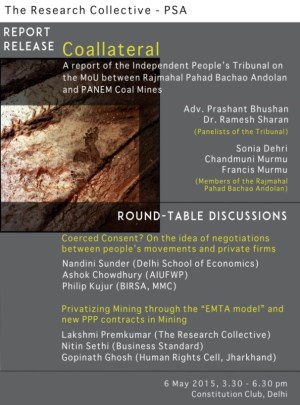
Executive Summary by RESEARCH COLLECTIVE of Programme for Social Action, of the Report of the Independent People’s Tribunal on the MoU between Rajmahal Pahad Bachao Andolan and PANEM Coal Mines.
Release of the Report and Panel Discussion on May 6, 2015 at Constitution Club
The Independent People’s Tribunal, held on 16 November 2014 in Ranchi, established that PANEM Coal Mines repeatedly violated human rights of Adivasis, used violence against them to force their consent to operationalise the project, and has not adequately resettled and rehabilitated project affected families. PANEM Coal Mines, which acquired Adivasi lands in 2002 in Pakur district of Jharkhand, violated the Santhal Parganas Tenancy Act, 1949 and the rights of Adivasi (indigenous) people granted under the fifth schedule of the Indian Constitution.
PANEM Coal Mines, a Joint Venture company between Punjab State Electricity Board (now PSPCL) and EMTA Group, required land from Adivasi communities in Alubera and Pachwara panchayats in Pakur to operationalise the Pachwara Central Coal Block mining project. Fearing that the large-scale mining project would ultimately destroy their homeland, the Santhal and Pahadia people did not consent to the acquisition of their land. They organized themselves as the Rajmahal Pahad Bachao Andolan (RPBA) and militantly opposed the project between 2000 and 2006. In an unexpected turn of events, on 30 November 2006, RPBA signed a Memorandum of Understanding (MoU) with PANEM and allowed the company to acquire land and mine coal.
Until now suicides happened in an almost invisible ‘intimate’ ‘psychic’ space of the farmer and his (almost always it was a male) loneliness and pain and anguish; we only got to know of it after the act was committed. But for the first time, a farmer committed suicide in full public view, and his body was consumed by the world at that moment of his committing the act. In a leading Hindi newspaper, the following day, there was a photograph, on the front page. The images showed the gradual metamorphosis of a living man, with a profession (that of a farmer), with a history and a family turning into a mere dead body. The photographer had actually recorded this metamorphosis, image by image in sequence, second by second. Not a moment had been left out. (See Amar Ujala, dated 23rd April 2015) With one loop the man, named Gajendra, became yet another body; yet another dispensable body, to be consumed by the entire nation through photographs and TV images. It was the signifier of our times: an act in the theatre of the absurd that democracy has come to be. The farmer will increasingly be ‘seen’ when he dies. Continue reading The Body-politic and Death of the Farmer: R Umamaheshwari→
Though the US has seemingly bounced back from the 2008 financial crisis, southern European countries like Portugal and Greece are currently dealing with debt situations that were once only characteristic of the “developing world”. In order to stabilize their economies after the 2008 crisis these European countries took on a series of IMF and European Central Bank loans in which rates of interest were higher than the countries’ rates of GDP growth, thus stagnating their economies for the foreseeable future.
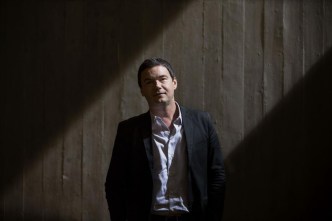
This situation that currently befalls these countries’ economies was explained by Thomas Piketty in a recent interview he gave for the major Portuguese newspaper, PÚBLICO. Piketty, who has become a prominent public intellectual due to the popularity of his recent work, “Capital in the 21st Century”, was in Portugal this week in order to discuss the economic future of the country with some of its political figures. Besides outlining the problem, he discusses possible courses of action for the countries to release themselves from perpetual debt and austerity. These ideas ironically enough come out of the paths once carved by those now economically dominant countries in the Euro Zone, specifically France and Germany. Continue reading Piketty and the Economic Crisis in the Euro Zone: Cenan Pirani→
Lost on the high seas? Image courtesy CPI(M) 21st Congress site
Far from transparently and decisively resolving the issues which plague the Party and the Left movement in India, the twenty first Congress of the CPI(M) has yielded a schizophrenic outcome. The purported ‘political line’ adopted by the Party Congress and the ‘unanimous’ choice of the new general secretary are quite contradictory, which will only perpetuate the ideological-political incoherence that has gripped the CPI(M) and may further contribute to its organizational disarray.
When the central committee of the CPI(M) met in October 2014 to discuss a medium term ‘review of the political tactical line’ (PTL) in the light of the electoral reverses suffered by the Party, a politbureau (PB) member had moved a dissent note on the document presented by the PB. That note had argued against the very need to review the PTL and had instead held faulty implementation of the political line driven by ‘subjectivism’ of the leadership mainly responsible for the setbacks suffered by the CPI(M), alongside persistent organizational deficiencies. The elevation of the dissident voice within the outgoing politbureau as the new general secretary of the party raises the question whether the ‘review of the political tactical line’ and ‘political resolution’ adopted in the Congress have the support of the majority within the party? Or will the ‘political line’ adopted in the Party Congress give way over time to political opportunism in the name of ‘flexible tactics’, with the CPI(M) joining hands with the discredited, anti-people Congress in the name of fighting the communal, big corporate-backed, reactionary Modi regime? Continue reading CPI(M)’s 21st Congress – A Schizophrenic Outcome: Prasenjit Bose→
[Against the background of Spain’s recent criminalizing of public protests and the first ever hologram demonstration (see Kafila post by Geeta Seshu) against it, this article revisits the major eruption in 2011, that eventually laid the ground for the emergence of a new political force in Spanish politics]
15M, image courtesy El Tecolote
Spain, seems to be a country that is still shaping itself. Somewhat like a nation that wants to come to terms with its past, unlike many other countries that have gone through a traumatic history and have finally emerged through the political passions – admittedly misdirected – of their distant past. Spain seems like it is yet to come to terms with a civil war that forged its legacy in millions of Spanish minds and the future generations of the country. The fascist forces that staged a coup, and consequently, went on to purge about 150,000 of its citizens in summary executions, far surpassed some of the worst dictatorships that the world has witnessed, including that of Pinochet’s in Chile and of Videla’s in Argentina.
Korsa Subba Rao, a man from Koya tribe, cultivates about three acres of forest land in a village in Khammam district. His family has been doing so for several generations. Subba Rao has a ration card, voter identity card, Aadhar Card and a NREGA job card. However, for the land that he tills, he has no papers whatsoever. Ironically the only evidence he has is an FIR issued by the Forest department. For committing a forest offence of encroaching into the forest – cutting down trees and putting it to podu cultivation.
Like Korsa Subba Rao, in Khammam district, there are thousands of farmers belonging to Koya, Konda Reddis and Lambadi tribal communities cultivating one to four acres in forest lands. Most of them have been cultivating since the times of their forefathers. Often this is their only income. However, factors such as scanty rain, untimely rain or pest can drastically reduce this income. The prevalence of malaria and other mosquito borne diseases also adds to the toll.
Here, it needs to be understood that forest lands do not always imply green forests. A forest land can be dense forest, moderate forest, shrub growth and also barren land. In Khammam district, thousands of acres of forest lands have been put to cultivation since several decades. But any cultivation of forest land is considered to be illegal, as it is an offence as per the AP Forest Act, 1967. In this scheme of things, the tribal farmers are seen as “encroachers”. The irony is that they are encroachers inspite of being the original inhabitants of the land. Because of this illegality and because of the power of the Forest Department to register criminal cases, the tribal farmers live in a constant fear of eviction from their lands. Continue reading Why are we always Encroachers? Tribal farmers in Khammam District, Telangana: Vasudha Nagaraj→
…it takes an error to father a sin. ─ J. Robert Oppenheimer[1]
Future historians of India may well describe the past year as a year of political sin. This was the year in which the man who had earlier presided over the Gujarat Carnage was awarded the ultimate prize. The year saw an election that touched a new low marked by shallowness, vulgarities and lies – in no small measure by the labors of the man himself. Equally appalling have been the exertions of a large class of literati and glitterati to portray philistinism and inanities spouted by the most powerful mouth as wisdom of a visionary leader.
An entire country seems to have gone blind – unable to see that the emperor has no clothes. In this age of incessant television it should be obvious to anyone that the supreme leader does not carry conviction even when enunciating relatively higher banalities. He is at his natural best only when he mocks someone as a shehzada or slanders and vilifies an entire community through phrases such as ame paanch, amara pachees. It is an irony of history that the republic which had Nehru as its first prime minister has one now for whom even common mythology is too cerebral. He must vulgarize Pushpak Viman and Ganesha and reduce them to quackeries of aviation and surgery.
Misfortune of the nation goes beyond the man. Forces of the diabolic housed in the hydra-headed Parivaar can now accomplish the impossible. They can now occupy the political center stage without leaving off the lunatic fringe. They can adopt Gandhi without renouncing Godse; erect world’s tallest statue of a leader who had punished their forefathers for assassinating Gandhi; even co-opt Bhagat Singh without batting an eyelid about what he stood for and what he had to say about ideologies like theirs. They can further refine the art of doublespeak. Their “statesmen” can pave the way for corporate plunder and call it sab ka vikas (development for all). Their “ideologues” can advocate sab ka saath (inclusion of all) by exhorting Hindu women to give birth to a minimum of four children each, lest Hindus are reduced to a minority “in their own country”. Continue reading The Sin and the Error : Ravi Sinha→
Two days ago, Finance Minister Arun Jaitley sought to make a special mention of “poor, dalits, tribals, backwards, those who are landless.” The occasion was the the Land Acquisition Bill, which,
“we are bringing, as per that the industrial corridors which would be set up in the country, those backward people, the 300 million landless people would get employment opportunities,”
First, Mr Jaitley, what exactly is the mechanism your government proposes by which the “backwards” released from the land will be absorbed into industry? Is there a guarantee by the industry owners? Is there a provision for skill training in the same industrial corridors? Are there ITI institutes being set up? Forget these, is even primary or secondary education going to be expanded so that farmers’ children, at some point in the distant future can take advantage of the supposed industrial boom? Continue reading “Those Backward People” – Arun Jaitley and a Long Ugly History→
..Government is set to defer indefinitely the implementation of notification for increasing the size of pictorial warning on tobacco products beyond April one, when it was to come into force. ..The notification regarding amendment to the Cigarettes and Other Tobacco Products (Packaging and Labelling) Rules, 2008 sought increase in the size of specified health warning from the current 40 per cent to 85 per cent of the principal display area of the package of tobacco products.
The week gone by has brought back smiles on the face of Tobacco Corporates.
Thanks to the latest U turn by the Modi government, Acche Din would continue unabated for them. The non-transparent manner in which the decision was taken and the media was kept in the dark has raised further eyebrows. It was only on the evening of 24 th March that while talking to the media, the health minister J P Nadda had assured them that there is no rethink in the government on introducing pictorial warnings covering 85 per cent of packaging for tobacco products from April 1 and within few hours of this interaction he left for Beijing. Continue reading Acche Din Are Here Again!→
Drive through any road in Kerala, one sees enormous showrooms of silks and jewellery, glittering with all the riches they contain.
Who says that the Kerala model of development is slow on growth and only high on human indicators? The most literate ‘progressive’ state is evidently doing well enough in business and investment too it would seem. We are also an expanding consumer market now, willing to finally shed some of that humility and simplicity once perceived to be characteristic of us. We have what claims to be Asia’s biggest mall, and other international chains setting shop here. In Maveli’s land, there really appear to be no poor or oppressed who would destroy this image of perfection. Continue reading Bread and Roses in Kerala today – the Kalyan Sarees Women Workers’ Struggle, and an Appeal on Women’s Day-Eve: Malavika Narayan→
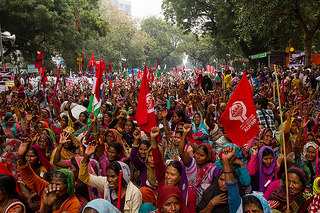
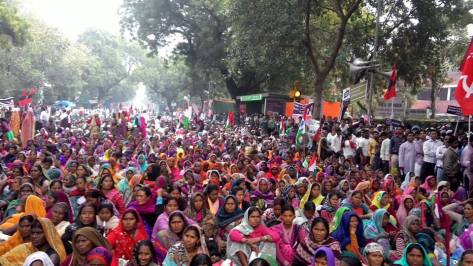
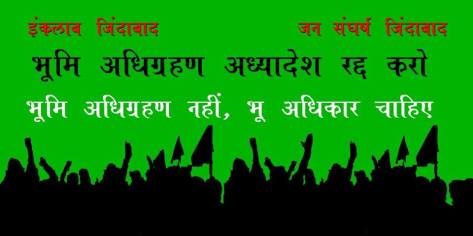
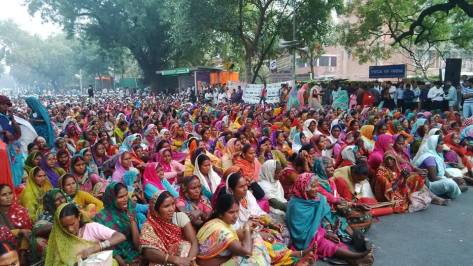
Forcible land acquisition has always been an issue of life and death for millions of people in India, not only farmers but also agricultural laborers and fish workers. With the Land Ordinance it has become a political hot potato. More than 350 people’s organizations gathered at Parliament Street on February 24th, with 25,000 people from Gujarat to Orissa to Assam, and from Himachal Pradesh to Tamil Nadu and Kerala. This show of strength has forced the political parties to take a stand on the issue, leading to heated debates and discussion on the floor of the Parliament. The Ordinance, now Bill, reflects the anti-farmer and anti-poor move of un-democratically amending the 2013 Act on Land Acquisition and Rehabilitation, killing its very spirit and purpose.
The Ordinance brought in by the NDA government just after the Winter session of the Parliament came to an end was an obvious imposition on the country’s common people, of the colonial legacy of a perverted vision of development through an unjust and undemocratic modus operandi. The Ordinance is an attempt to open up the land that is the life support, source of livelihood and shelter for India’s toiling masses, to wealthy investors, including big corporations and builders. Its intention is to forcibly divert India’s agricultural land at the cost of food security, giving a free hand with no ceiling to the private companies as well as private entities i.e. private trusts and expensive profit-making educational and health institutions. The intention is to benefit private interests in the name of public interest. Continue reading The Land Ordinance (now Bill) is Bringing Back the Colonial Legacy: NAPM→
Report produced by PEOPLE’S UNION FOR DEMOCRATIC RIGHTS
Between December 26th and 31st 2014, a PUDR fact-finding team visited 9 villages of Bijapur district, Chhattisgarh to ascertain reports of arrests, intimidation and harassment, including sexual abuse by security forces who are stationed there to fight the Maoists. Predominantly Adivasi villages, the residents of Basaguda, Kottaguda, Pusbaka, Lingagiri, Rajpeta, Timmapur, Kottagudem, Korsaguda and Sarkeguda, narrated the daily acts of violence and violations committed by armed personnel residing in security camps. Apart from documenting the continuance of ‘area domination’ by the security forces, the report draws particular attention to:
The large number of ‘permanent warrants’ issued against the populace, of which a significant number is declared as ‘absconders’. A rough estimate indicates that as many as 15-35,000 people live under the threat and fear of these warrants in Bijapur alone.
The lawless conduct of the armed personnel and Special Police Officers (SPOs) who routinely raid, beat, loot, detain and compel the Adivasi villagers to perform ‘begar’ (free labour) at the security camps. Instances of sexual torture were also noted.
For those who don’t like Modi-Sangh politics, February 10th was a day of joy. When this note was drafted a month ago, the provisional title was “This is No Time for Despair.” But last Tuesday has not only dented Modi’s invincible image – it has also dented the sense of being besieged. Since May 2014, almost every progressive force in the country has been on the defensive. The AAP’s politics and the popular tsunami that drove it to power have shattered this gloom.
But the key question at this point – is the eventual defeat of the NDA in an election the only goal? I argue that here that that is just the beginning. The end of this period – which, notwithstanding February 10th, is obviously some time away – will offer a space that has not existed in Indian politics in decades. Whether that space gets used or not will depend on how the struggle develops in the interim period.
The potential of this period is rooted in three basic flaws that the current ruling coalition (between big business and the Sangh) suffers from. First, its key forces are fundamentally myopic and delusionary in character. Second, it is internally contradictory – the two pillars of this formation will undercut each other in organisational (not just political or rhetorical) terms. Finally, it embodies a peculiar combination of organisational strength and political weakness. Continue reading A Chance for Social Change Like Never Before: Shankar Gopalakrishnan→



 Guest post by CENAN PIRANI