Category Archives: Culture

Carpets and kebabs in Isfahan: Marryam H Reshii

Guest post by MARRYAM H RESHII

iran67

I could write a book about my week in Iran, but will restrict myself to captioning these photographs I took.

The only two cities I visited were Mashad and Isfahan. Mashad is famous for two things. The shrine of the Eighth Imam of the Shia sect of Islam, Imam Reza, the only one out of all twelve Imams to actually be buried in Iran (all the others are buried in Saudi Arabia and Iraq) and saffron that grows far, far more plentifully than it does in Kashmir.

Mashad sells carpets woven/produced elsewhere. While the large carpets are traditionally Iranian, the small ones in frames are too suspiciously perfect to be made with human hand. Most of them have a plethora of shades of white in them, making the weaver something of a genius! Continue reading Carpets and kebabs in Isfahan: Marryam H Reshii

Sahibs, Pandits and the Scholarship on Caste: Manish Thakur and Nabanipa Bhattacharjee

Guest post by MANISH THAKUR and NABANIPA BHATTACHARJEE

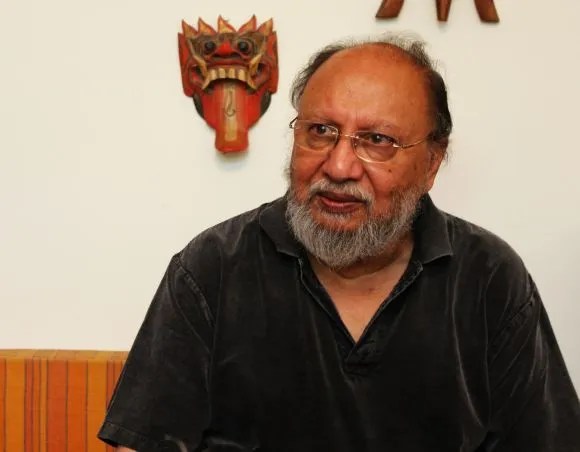
Scholarship on caste has always been much more than merely about caste. At stake has been the very idea of India, and the production of knowledge about it. Expectedly, whenever academic knowledge on caste spills over in the public domain (and it does so often, as in the recent Ashis Nandy case), politically charged contestations about the idea of India inevitably follow. In the academy, the privileging of Brahmanical worldview in sociological discourses on India continues to be a source of deep-seated resentment. ‘Indian Critiques of Louis Dumont’s Contributions’ (Khare 2006) notwithstanding, the figure of ‘the learned Brahman’ (Alamgir 2006) looms large in the voluminous corpus of anthropological knowledge about India. So much so that Richard Burghart(1990) views modern anthropological knowledge primarily as a function of multiple dialogues between modern day anthropologists and the Brahmanical tradition of knowledge.

Continue reading Sahibs, Pandits and the Scholarship on Caste: Manish Thakur and Nabanipa Bhattacharjee

Why was Ram Singh killed in Tihar jail?

The chief accused in the Delhi gang rape “found dead” in his cell? Killed with his own shirt? Hanging from a grill, with his three cell mates sound asleep all the while? The moment I heard the news  on Monday, every conspiracy theory-oriented cell in my body did a quick cartwheel. Promptly I sent out a mail to the sisterhood on the Feminists India e-list:

I’m wondering whether there is something more than police negligence involved here. I have always felt that the role of the police on that night was more than simply their usual laparwahi – that bus may have been used often in the past for such activities, remember they didn’t follow up the complaint of the man who had been earlier that night robbed by the same guys? And how they located the bus from their hafta diaries? I’m wondering – and going to sound paranoid and like a loony conspiracy theorist – whether the key accused in court would have revealed more about police complicity in rapes and other activities on buses like Yadav’s than we imagine. Prisoners in jail often carry out attacks on other prisoners on the orders of the police themselves.

Yes, Indian prisons are violent and brutal, and the police callous and vicious. Yes, there should be an enquiry to assign responsibility. But I’m pretty certain I know who killed Ram Singh – some other prisoners. And I think that they did it on orders from the police. Continue reading Why was Ram Singh killed in Tihar jail?

Class Feminism vs. Classy Feminism … Or, Everybody Loves the Governable Woman!

A few weeks ago, I mentioned on Kafila a certain gentleman who delivered a memorable address in Government Women’s College, Thiruvananthapuram, which contained sage advice on how to bring under control the unruly bodies of ungovernable women.  After that I have been receiving unsigned letters from his admirers who feel that their innocent hero has been most unfairly criticized. Like the grumpy ground-lubber types who are either incapable of ascending or simply unable to climb coconut trees and do not appreciate the free services rendered by the chivalrous heroes high above, I have erred in judgment, they claim. Continue reading Class Feminism vs. Classy Feminism … Or, Everybody Loves the Governable Woman!

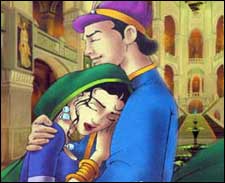
The love story of Quli Qutub and Bhagmati, and other tragic endings

Still from an animation film, 'Bhaggmati'
Still from an animation film, ‘Bhaggmati’

For some strange reason, all, or almost all love legends have a tragic end. I cannot recall too many that end with “and they lived happily ever after”. In fact, Romeo-Juliet, Laila-Majnun, Heer-Ranjha, Sohini-Mahiwal, Sassi-Pannun, Dhola-Maru, Saif-ul-Malook-o-Badi-uj-Jamaal – the list of unhappy lovers separated by the cruel hands of society, scheming relatives, jealous rivals, misunderstandings and plain simple divine design is endless.

Amidst such tears and tragedies, poison-tipped swords and daggers, deceit and chicanery, there is a story of love that makes you believe that this world can’t be all bad. The most fascinating and enduring quality of this legend of love is that it is not a legend, it is fact, well mostly. And this is how it goes. Continue reading The love story of Quli Qutub and Bhagmati, and other tragic endings

Meanderings of a Female Atheist Muslim Indian: Samina Motlekar

This is a guest post by SAMINA MOTLEKAR: I come with baggage, with tags not all of my own making. I was born female, and as much as I want to be acknowledged as a person, I learnt early that it was pointless to deny so physical a part of my identity. I was born to Muslim parents, but that does not make me Muslim, a distinction that is unfortunately far too subtle for many minds to comprehend. Complacent in their own inherited identities, they pile on the labels smothering me into little  boxes of their making. Female, Muslim, Indian – all accidents of birth. But not all of me is accidental. By age eleven, the idea of a deity in the sky, concepts of heaven and hell, were at best stories, at worst ramblings of deluded minds to me. Not for me the fence sitting of agnosticism. I was an atheist before I hit my teens, and my belief system has endured the trials and tribulations of time. Yet they call me Muslim.

Continue reading Meanderings of a Female Atheist Muslim Indian: Samina Motlekar

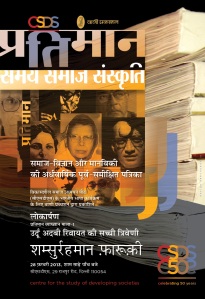
Leaping Across a Troubled History – Launch of Pratiman

Poster of the launch event  for Pratiman
Poster of the launch event for Pratiman

A new research journal in Hindi, Pratiman – Samay, Samaj, Sanskriti, was launched on 28 February 2013, at the Centre for the Study of Developing Societies, Delhi. The occasion was historic in many ways. Given the long and troubled history of the great language divide between Hindi and Urdu and the lost traditions of Hindustani, the fact that the launch was marked by a public lecture by noted Urdu scholar-poet Shamsur Rahman Faruqi cannot but be anything but historic. There is a certain impertinence and perhaps even insolence, in the move to leap across that history of over a century and a quarter, in complete disregard of the custodians of purity on both sides, in the insistence that language is not what the custodians make of it but what lives in the world of creativity and exchange.

It was only befitting of this occasion that Faruqi chose to speak on “Urdu Adabi Ravayat ki Sachchi Triveni.” In what turned out to be a remarkable and breathtaking tour de force, Faruqi turned his scholarly apparatus to the task of dissecting the Urdu poetic and aesthetic tradition in a manner that revealed its three currents (the ‘triveni’) – namely, Arabi, Persian and Sanskrit.Through the metaphor of the Triveni at Allahabad, where the Ganga and Yamuna meet the third river Saraswati, which is invisible but nonetheless ‘present’, Faruqi too perhaps wanted to stress the significance of the third but invisible current of Sanskrit poetics.

Continue reading Leaping Across a Troubled History – Launch of Pratiman

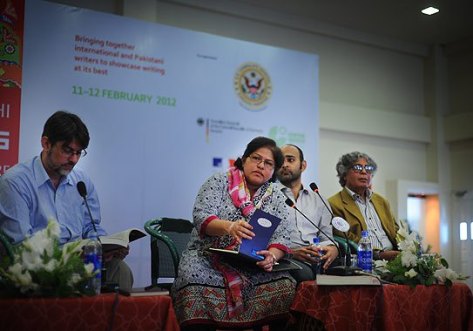
Who’s afraid of the Karachi Literature Festival?: Ayesha Siddiqa

Guest post by AYESHA SIDDIQA

Photo via Dawn.com

Here we are seemingly in an age of intellectual freedom, burgeoning media industry and literature festivals. There are numerous festivals held all over South Asia celebrating books new and old, bringing people together for exchange of ideas. But these festivals seem to be wrapped in their own politics. In some cases, certain cliques that want to encourage a peculiar perspective dominate the show. I understood this through my interaction with the Karachi Literature Festival. Continue reading Who’s afraid of the Karachi Literature Festival?: Ayesha Siddiqa

Illegal Antiquities: Vishes Kothari

Guest post by VISHES KOTHARI

As a collector of Indian antiquities wanting to set up an antiquities dealership in the future, I had heard of the wholesale illegal export of Indian art treasures and antiquities out of India- sometimes through newspaper reports, but mostly through word of mouth. This summer I decided to explore this market further. Nothing could really have prepared me for what I was to see over the course of the next month spent between Delhi and Rajasthan.

Contrary to my imagination of the Delhi businesses operating in a very shady and dubious manner out of musty, hidden godowns in obscure corners of Old Delhi, and run by people with barely any idea of what they were handling, what I found instead was that almost all these businesses were located in localities which epitomize mainstream “cosmopolitan Delhi” and run by extremely wealthy upper middle class families. Connaught Place, Greater Kailash, Green Park, Sunder Nagar- these were just some of the places where I was able to locate an open sale of antiquities- happening not through dodgy godowns or via clandestine networks- but instead conducted out of posh showrooms and sold openly to anyone who cared to buy.

Continue reading Illegal Antiquities: Vishes Kothari

राष्ट्रवादी न्याय से करुणा की विदाई

“अगर हम ‘लोकतांत्रिक सरकारों के छिपे इरादों और गैरजवाबदेह खुफिया शक्ति संरचनाओं की जांच करने और उन पर सवाल उठाने से इनकार करते हैं तो हम लोकतंत्र और मानवता, दोनों को ही खो बैठते हैं.” पत्रकार जॉन पिल्जर का यह वाक्य आज हमारे लिए कितना प्रासंगिक हो उठा है! हमें नौ जनवरी को खुफिया तरीके से अफज़ल गुरु को दी गयी फांसी के अभिप्राय को समझना ही होगा. काम कठिन है क्योंकि इसे लाकर न सिर्फ़ प्रायः सभी संसदीय राजनीतिक दल एकमत हैं बल्कि आम तौर पर देश की जनता भी इसे देर से की गई सही कार्रवाई समझती है.

नौ जनवरी के दिन के वृहत्तर आशय छह दिसम्बर जैसी तारीख से कम गंभीर नहीं क्योंकि इस रोज़ भारतीय राज्य ने गांधी और टैगोर की विरासत का हक खो दिया है.अगर अब तक यह साबित नहीं था तो अब हो गया है कि भारत की ‘संसदीय लोकतांत्रिक राजनीति’ का मुहावरा उग्र और कठोर राष्ट्रवाद का है. और राजनीतिक दलों में इस भाषा में महारत हासिल करने की होड़ सी लग गयी है.

Continue reading राष्ट्रवादी न्याय से करुणा की विदाई

The Languages of Sexual Violence: Anupama Mohan

Guest post by ANUPAMA MOHAN

I teach a big word in my critical theory classes: phallogocentrism. It is the idea that our societies are centred by the phallus and language (logos) and is a word that often scares, perplexes, and disturbs my students, but I unpack it using an example. In English, the word seminal, which means something important and path-breaking, derives from “semen” and in contrast, the word hysterical or hysteria, which is a word that has for long been associated with peculiarly female physical and mental disorders (and often used for recommending women’s confinement), derives from “hystera” or the womb. What does such loading of the language – what a 20th century Russian thinker, Mikhail Bakhtin, called the formation of the verbal ideological world  – in terms of the perspective, validation, and supremacizing of one gender over the other do to/in our varied lives? Think of the word vanilla that, at least since the 1970s, has meant the ordinary and bland: its etymology derives from the Latin word for vagina (vaina) or “little vagina” for the pods of the plant that reminded someone of women’s genitals. The word porcelain – a thin, fragile kind of clay – too comes from the word for “cowrie shell” whose Italian links to porcella or young sow (a female pig) for someone recalled the shape of a piglet’s orifice. One more: the word amazon which refers to a legendary race of female warriors and has come to mean a strong woman derives possibly from many sources: from the Classical Greek a-mazos or breastless to the Iranian *ama-janah or “virility-killing” – a meaning that interprets the idea of women’s strength as both a mutilation of her physical self and/or as a threat to men. Continue reading The Languages of Sexual Violence: Anupama Mohan

A crumbling fourth pillar, and the forgotten politics of boycott: Manav Bhushan

Guest post by MANAV BHUSHAN

Assaulted as we are by the deafening cacophony of India’s 24-hour news channels (183 of them, as Manav Bhushan tells us below), there are some of us who for a long time now, have simply refused to appear on TV “debates”, to give them sound bytes to be seamlessly incorporated into their endlessly looping mindlessness. Essentially, we have exercised a politics of refusal – we will not add to the din. At a recent meeting on media ethics at the Indian Women’s Press Corps, I had expressed a fervent desire that every single 24-hour news channel should shut shop for one week while they went into deep introspection – one week of blessedly blank screens, one week of healing quiet in which people could once again learn to listen, to remember that there can be more than 2 or 3 sound-bytes through which to capture the complexities of the world in which we live. MANAV BHUSHAN makes a more radical suggestion below –   that we exercise the only power we have under capitalism, our power as consumers, and exercise a week-long boycott of a news channel for specific reasons, to force drastic changes to its policy and style of functioning. “In an age where each channel depends more on our TRPs than we do on any one of them, we hold enormous, albeit unrealized power,” he says. Over to Manav:

In a speech delivered at the Reuters memorial lecture in November 2012 at Oxford University discussing the Indian news industry, Prannoy Roy candidly said that ”Indian news is currently in a race to the bottom”. He further added that upon comparing the average TV viewership in India (1 hour) to that in the US (5 hours), one is led to the utterly dismal conclusion that this race is far from over. Of course, this is nothing new, and anyone who has followed the ‘debates’ (if you can call them that) on the extremely unfortunate incidents at the LOC can testify that the shows conducted by Arnab Goswami and Barkha Dutt were less news and more war-mongering. In fact, the brutal truth about the flourishing news industry- which has gone from one state-run news channel to 183 independent news channels in just 25 years- is that many of its members are in the business of blackmail, of selling sex, violence and are prepared to go to any lengths for the sake of advertising revenues. And there is a difference, though subtle, between advertising revenues and television rating points (TRPs).  Continue reading A crumbling fourth pillar, and the forgotten politics of boycott: Manav Bhushan

A rare victory for freedom of speech and expression in India

Times of India photo

In a country where freedom of speech and expression is under assault every day, where scholars and cartoonists increasingly have to regularly face the law to defend their statements and works of art,  where the government gives in to anyone and everyone demanding censorship, where the government conduct stealth censorship of online speech, finally comes a rare piece of good news.

For once the police is not asking to shut down an exhibition citing ‘law and order’ issues to appease protestors, but instead giving protection to the exhibition.

The Times of India reports: Continue reading A rare victory for freedom of speech and expression in India

Is Prof Nandy a Holy Cow?: K Satyanarayana

We are posting below an interview of Dr K SATYANARAYANA on the issues arising out of the ‘Ashis Nandy case’. The interview was conducted by DALIT CAMERA and sent to us by RAVICHANDRAN

The interview raises some important issues that call for a reasoned public debate and we welcome this opportunity provided by this interview.

Ashis Nandy’s Predicament and Ours

For the past few days I have been preoccupied in one part of my mind in dealing with two reasons for anguish. The first reason has to do with the profound sense of disappointment and anger with which I heard Prof. Ashis Nandy, a man I consider to be a great teacher, friend and in possession of one of the finest minds of our time, commit himself in public to a flippant and vulgar position when speaking of the relationship between caste and corruption at the Jaipur Literary Festival.

I was saddened because Prof. Nandy’s statements do a great disservice to the suppleness and ethical integrity of his thinking, and represent one of those sadly paradoxical situations where an intellectual can become their own worst adversary. I am unambiguously critical of the Nandy who chooses to be pompously opinionated and misinformed at a forum like the Jaipur Literary Festival or while riding the hot-air currents of television especially because I remain a partisan of the Nandy who can be (when he chooses to be) one of the most thoughtful and insightful witnesses to our time in his writing. Continue reading Ashis Nandy’s Predicament and Ours

Ageless chisel: The rock-cut caves of Ellora

Cross-section of a frieze in Cave 16, or the Kailasa Temple

The Ellora caves, locally known as ‘Verul Leni’ and located on the Aurangabad-Chalisgaon road, were, like the Ajanta caves,carved out of the terraces that were formed as a result of the great movements in the crust of the earth that began millions of years ago. A part of land that had broken off the Australian landmass drifted north and began to push against the Laurasian plate about 65 million years ago, giving birth to the Himalayas at one end and triggering hectic volcanic activity at the point of contact. The resulting waves of lava flow solidified into layers, or terraces, spread across hundreds of miles. Both Ajanta and Ellora are located on this massive lava flow known as the Deccan trap. Incidentally, the Deccan trap is full of man-made caves. Maha-rashtra alone has about 1,200 big or small caves or big and small cave clusters and close to 75 per cent of them (about 900) are Buddhist caves. Continue reading Ageless chisel: The rock-cut caves of Ellora

Many authors missing at Jaipur Lit Fest: Sajan Venniyoor

Guest post by SAJAN VENNIYOOR, our cultural correspondent

Threats from Hindu, Muslim and other cultural organizations may derail the Jaipur Literature Festival set to begin on Thursday, 24 January.

The BJP and RSS have threatened not to allow seven Pakistani authors to attend the event. “Looking at present Indo-Pak relations, it is unacceptable to allow Pakistani writers to be here as guests. We will make sure they are not allowed to enter Rajasthan. If they come, they will meet the fate of many others who have met similar fates,” said Suman Sharma, BJP state vice-president.

The Pakistani authors included in this blanket ban are British-Pakistani Nadeem Aslam, Canadian-Pakistanis MA Farooqi and Sharmeen Ubaid Chinoy and plain old garden variety Pakistanis Mohammed Hanif, Jamil Ahmad, Fahmida Riaz and Ameena Saiyid. Continue reading Many authors missing at Jaipur Lit Fest: Sajan Venniyoor

Learning gender, learning caste: two reflections

We received two brief submissions separately sent by two women, reflecting on incidents in their childhood or youth that returned to haunt them more recently. Rethinking, reworking their own sense of self, they present before us questions both timely and urgent.

AYSHWARIA SEKHER looks back on her ignorance of caste, PRANETA JHA revisits a childhood game that taught her about sexual violence.

AYSHWARIA SEKHER

I was seventeen, and an undergraduate when I met this friend at hostel.  She was from a southern district of Tamilnadu almost near Kanyakumari. I was always amused by her southern dialect and teased her immensely, for it was very different from what I was used to speaking, being a northerner. She lived next door at hostel, so we got into conversations every time we bumped into each other. One evening she was sweeping her room and cleaning it.  I stopped by to see the way she swept so I could bully her.  As I observed I did realise that she was so much better than me at it and did it with ease. As we got talking, she revealed that she always did it at her home, and it was not a task for her.

Ignorantly I enquired why they did not have a help at home, which according to me was something that every household possessed. She looked at me, and brushed aside the question plainly, saying simply that they just didn’t have any help. I pestered with the question giving her no space. She stopped sweeping and rested her hand against the wall and said that people would not come to her house to work. I was amazed at why people would not go to a home for work.  So my cross questions persisted and she had no choice but to answer.

Continue reading Learning gender, learning caste: two reflections

Remembering Laxmi Orang and the Gender Question in Assam: Mayur Chetia and Bonojit Hussain

Guest post by MAYUR CHETIA AND BONOJIT HUSSAIN

The Delhi gangrape case has led to country-wide outrage, with young women and men still pouring out on to the streets to protest against the widespread culture of sexual violence. The outrage has not just stopped at Jantar Mantar, India Gate or university campuses; it has also led to a wave of intellectual reflection on the issue. For most protesters the demand for justice has not stopped with the Delhi gang rape victim, but has led to a demand for justice for all victims of sexual violence. These protesters have forced us to remember a litany of names that get buried by the TRP driven media and a public with a notoriously short attention span of memory. It is time to remember names that we are losing to public amnesia, names like Soni Sori, Manorama, Asiya and Neelofar. It is time we remember another forgotten name – Laxmi Orang.

 In the Interest of Remembering: Who is Laxmi Orang?

On 24th November 2007, Laxmi Orang, a young adivasi woman, was forcibly stripped naked, thrashed and paraded by a violent mob of “mainstream” Assamese [1] men. This took place just 100 meters away from State Legislative assembly, in the very heart of Guwahati, in the full glare of the media and police forces. As with her fellow protesters, it was her first trip to the city, the mythical land where the modern day Swargodeo’s [2] listen to their subjects, where appeals are heard, where miracles happen, where riches and wonders thrive. She had come to the city as participant of a protest organized by the All Adivasi Students’ Association Assam (AASAA) to demand Schedule Tribes status for the Adivasi community of Assam. Continue reading Remembering Laxmi Orang and the Gender Question in Assam: Mayur Chetia and Bonojit Hussain

Harassment by Times Now: Statement by Shabnam Hashmi

[The following is a public statement issued by Shabnam Hashmi regarding her harassment by Times Now. The report is truly alarming and shows the extent to which this form of ‘media vigilantism’ – Arnab Goswami/ Times Now style can go. It is of course, another matter that when confronted by a Raj Thakre, the same macho anchor can turn into a small and helpless mouse. We are reproducing this statement in public interest.] 

I was in Gujarat for over six months and returned to Delhi two weeks ago. While in Gujarat I was asked to appear on different television channels constantly. On one such talk show on Times Now I felt that I was especially being pushed into a corner and it was an absolutely unbalanced panel, I told the Times Now guest coordinator that I will not come on the channel any longer. It continued for about a week or so. Then a representative came from Mumbai and met me in Gujarat office and ensured that it will not happen in future and requested me to come for the Talk Shows.

I agreed and went again whenever I was called.

On December 28, 2012 I released a public statement in Delhi regarding the Gujarat Verdict 2012 and resigned from various UPA committees that I was part of. On the same day I was invited to Times Now and I found the same attitude of being highly aggressive towards me.

January 2, 2013, I filed a police complaint against Mr Akbaruddin Owaisi in Parliament Street Police Station against the hate speech which he made in Andhra Pradesh. I was called on Times Now and met the same uncivilized and aggressive behavior.
Continue reading Harassment by Times Now: Statement by Shabnam Hashmi

The Country With A ‘Balancing Office’: Suvaid Yaseen

Guest Post by Suvaid Yaseen

Of late there has been a rising trend of Kashmiris – professionals, artists, writers, musicians et al presenting their works on Kashmir on a much wider level than before. The larger impression that comes out of it all is that the narrative has been taken up by the people for themselves. A welcome contrast to outsiders flying in and telling us what we want, how we think, and what is actually good for us.

So, every time a Kashmiri artist is presenting his/her work on Kashmir, the expectations among Kashmiris tend to go up. People start feeling that finally their narrative, of how they saw the things, what they went through, would be told to the world, bereft of the lenses of security paradigm through which Kashmir has been usually viewed  –  a strategic territory, with not-so-strategic, dispensable people.

This can be fortunate as well as unfortunate. On one hand there is a ready audience to appreciate and applaud your work. On the other hand there are expectations to ‘perform’. For the artists themselves, there are additional pressures of ‘balancing’ and having a ‘non-biased’ view from the other side.

Continue reading The Country With A ‘Balancing Office’: Suvaid Yaseen