Category Archives: Culture

Ashis Nandy’s Predicament and Ours

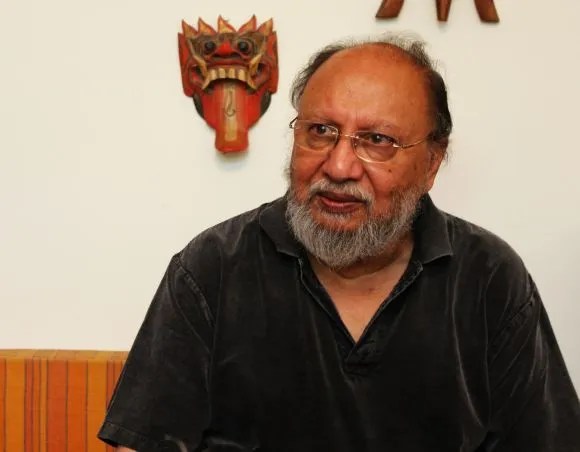
For the past few days I have been preoccupied in one part of my mind in dealing with two reasons for anguish. The first reason has to do with the profound sense of disappointment and anger with which I heard Prof. Ashis Nandy, a man I consider to be a great teacher, friend and in possession of one of the finest minds of our time, commit himself in public to a flippant and vulgar position when speaking of the relationship between caste and corruption at the Jaipur Literary Festival.

I was saddened because Prof. Nandy’s statements do a great disservice to the suppleness and ethical integrity of his thinking, and represent one of those sadly paradoxical situations where an intellectual can become their own worst adversary. I am unambiguously critical of the Nandy who chooses to be pompously opinionated and misinformed at a forum like the Jaipur Literary Festival or while riding the hot-air currents of television especially because I remain a partisan of the Nandy who can be (when he chooses to be) one of the most thoughtful and insightful witnesses to our time in his writing. Continue reading Ashis Nandy’s Predicament and Ours

Ageless chisel: The rock-cut caves of Ellora

Cross-section of a frieze in Cave 16, or the Kailasa Temple

The Ellora caves, locally known as ‘Verul Leni’ and located on the Aurangabad-Chalisgaon road, were, like the Ajanta caves,carved out of the terraces that were formed as a result of the great movements in the crust of the earth that began millions of years ago. A part of land that had broken off the Australian landmass drifted north and began to push against the Laurasian plate about 65 million years ago, giving birth to the Himalayas at one end and triggering hectic volcanic activity at the point of contact. The resulting waves of lava flow solidified into layers, or terraces, spread across hundreds of miles. Both Ajanta and Ellora are located on this massive lava flow known as the Deccan trap. Incidentally, the Deccan trap is full of man-made caves. Maha-rashtra alone has about 1,200 big or small caves or big and small cave clusters and close to 75 per cent of them (about 900) are Buddhist caves. Continue reading Ageless chisel: The rock-cut caves of Ellora

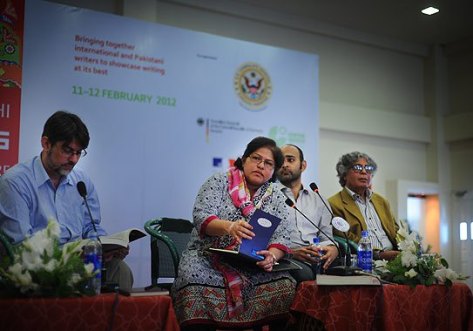
Many authors missing at Jaipur Lit Fest: Sajan Venniyoor

Guest post by SAJAN VENNIYOOR, our cultural correspondent

Threats from Hindu, Muslim and other cultural organizations may derail the Jaipur Literature Festival set to begin on Thursday, 24 January.

The BJP and RSS have threatened not to allow seven Pakistani authors to attend the event. “Looking at present Indo-Pak relations, it is unacceptable to allow Pakistani writers to be here as guests. We will make sure they are not allowed to enter Rajasthan. If they come, they will meet the fate of many others who have met similar fates,” said Suman Sharma, BJP state vice-president.

The Pakistani authors included in this blanket ban are British-Pakistani Nadeem Aslam, Canadian-Pakistanis MA Farooqi and Sharmeen Ubaid Chinoy and plain old garden variety Pakistanis Mohammed Hanif, Jamil Ahmad, Fahmida Riaz and Ameena Saiyid. Continue reading Many authors missing at Jaipur Lit Fest: Sajan Venniyoor

Learning gender, learning caste: two reflections

We received two brief submissions separately sent by two women, reflecting on incidents in their childhood or youth that returned to haunt them more recently. Rethinking, reworking their own sense of self, they present before us questions both timely and urgent.

AYSHWARIA SEKHER looks back on her ignorance of caste, PRANETA JHA revisits a childhood game that taught her about sexual violence.

AYSHWARIA SEKHER

I was seventeen, and an undergraduate when I met this friend at hostel.  She was from a southern district of Tamilnadu almost near Kanyakumari. I was always amused by her southern dialect and teased her immensely, for it was very different from what I was used to speaking, being a northerner. She lived next door at hostel, so we got into conversations every time we bumped into each other. One evening she was sweeping her room and cleaning it.  I stopped by to see the way she swept so I could bully her.  As I observed I did realise that she was so much better than me at it and did it with ease. As we got talking, she revealed that she always did it at her home, and it was not a task for her.

Ignorantly I enquired why they did not have a help at home, which according to me was something that every household possessed. She looked at me, and brushed aside the question plainly, saying simply that they just didn’t have any help. I pestered with the question giving her no space. She stopped sweeping and rested her hand against the wall and said that people would not come to her house to work. I was amazed at why people would not go to a home for work.  So my cross questions persisted and she had no choice but to answer.

Continue reading Learning gender, learning caste: two reflections

Remembering Laxmi Orang and the Gender Question in Assam: Mayur Chetia and Bonojit Hussain

Guest post by MAYUR CHETIA AND BONOJIT HUSSAIN

The Delhi gangrape case has led to country-wide outrage, with young women and men still pouring out on to the streets to protest against the widespread culture of sexual violence. The outrage has not just stopped at Jantar Mantar, India Gate or university campuses; it has also led to a wave of intellectual reflection on the issue. For most protesters the demand for justice has not stopped with the Delhi gang rape victim, but has led to a demand for justice for all victims of sexual violence. These protesters have forced us to remember a litany of names that get buried by the TRP driven media and a public with a notoriously short attention span of memory. It is time to remember names that we are losing to public amnesia, names like Soni Sori, Manorama, Asiya and Neelofar. It is time we remember another forgotten name – Laxmi Orang.

 In the Interest of Remembering: Who is Laxmi Orang?

On 24th November 2007, Laxmi Orang, a young adivasi woman, was forcibly stripped naked, thrashed and paraded by a violent mob of “mainstream” Assamese [1] men. This took place just 100 meters away from State Legislative assembly, in the very heart of Guwahati, in the full glare of the media and police forces. As with her fellow protesters, it was her first trip to the city, the mythical land where the modern day Swargodeo’s [2] listen to their subjects, where appeals are heard, where miracles happen, where riches and wonders thrive. She had come to the city as participant of a protest organized by the All Adivasi Students’ Association Assam (AASAA) to demand Schedule Tribes status for the Adivasi community of Assam. Continue reading Remembering Laxmi Orang and the Gender Question in Assam: Mayur Chetia and Bonojit Hussain

Harassment by Times Now: Statement by Shabnam Hashmi

[The following is a public statement issued by Shabnam Hashmi regarding her harassment by Times Now. The report is truly alarming and shows the extent to which this form of ‘media vigilantism’ – Arnab Goswami/ Times Now style can go. It is of course, another matter that when confronted by a Raj Thakre, the same macho anchor can turn into a small and helpless mouse. We are reproducing this statement in public interest.] 

I was in Gujarat for over six months and returned to Delhi two weeks ago. While in Gujarat I was asked to appear on different television channels constantly. On one such talk show on Times Now I felt that I was especially being pushed into a corner and it was an absolutely unbalanced panel, I told the Times Now guest coordinator that I will not come on the channel any longer. It continued for about a week or so. Then a representative came from Mumbai and met me in Gujarat office and ensured that it will not happen in future and requested me to come for the Talk Shows.

I agreed and went again whenever I was called.

On December 28, 2012 I released a public statement in Delhi regarding the Gujarat Verdict 2012 and resigned from various UPA committees that I was part of. On the same day I was invited to Times Now and I found the same attitude of being highly aggressive towards me.

January 2, 2013, I filed a police complaint against Mr Akbaruddin Owaisi in Parliament Street Police Station against the hate speech which he made in Andhra Pradesh. I was called on Times Now and met the same uncivilized and aggressive behavior.
Continue reading Harassment by Times Now: Statement by Shabnam Hashmi

The Country With A ‘Balancing Office’: Suvaid Yaseen

Guest Post by Suvaid Yaseen

Of late there has been a rising trend of Kashmiris – professionals, artists, writers, musicians et al presenting their works on Kashmir on a much wider level than before. The larger impression that comes out of it all is that the narrative has been taken up by the people for themselves. A welcome contrast to outsiders flying in and telling us what we want, how we think, and what is actually good for us.

So, every time a Kashmiri artist is presenting his/her work on Kashmir, the expectations among Kashmiris tend to go up. People start feeling that finally their narrative, of how they saw the things, what they went through, would be told to the world, bereft of the lenses of security paradigm through which Kashmir has been usually viewed  –  a strategic territory, with not-so-strategic, dispensable people.

This can be fortunate as well as unfortunate. On one hand there is a ready audience to appreciate and applaud your work. On the other hand there are expectations to ‘perform’. For the artists themselves, there are additional pressures of ‘balancing’ and having a ‘non-biased’ view from the other side.

Continue reading The Country With A ‘Balancing Office’: Suvaid Yaseen

Engendering the Sovereignty of the Islamic Republic of Pakistan: Afiya Shehrbano Zia

Guest post by AFIYA SHEHRBANO ZIA

431247-zafaraslamisl-1346769071-809-640x480

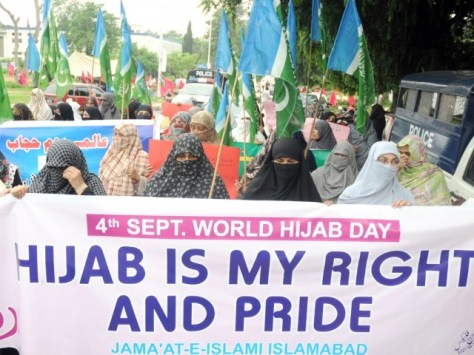
The Islamia College in Karachi is the hub of the Islami Jamiat-e-Tulba (IJT) [1]. Last year, the nationalist banners displayed near the college to mark Pakistan Defense Day (6th Sept), were strategically flanked by two complementary gendered messages. One such banner publicized the event (in Urdu) as ‘Hejab Numaaish’ (Parade of the Hejab – 4th Sept) and below it, in English ran the claim ‘Hejab is My Right and Pride’. The other banner declared simply, ‘Afia[2] is our Pride’. Both messages are signifiers and comments on the re-visitation of the themes of religious and nationalist agendas, played out across the body politic of women, in a post 9/11-Pakistan.

This essay discusses the resurgence of a new form of religious nationalism and its impact on the narrative of gendered politics in Pakistan. It also examines the worth of a recent body of Pakistani scholarship[3]that opposes the misguidedness of liberal-secular resistance to religious politics. Instead, such academic work invests hope in something termed, ‘Islamist secularization’. Continue reading Engendering the Sovereignty of the Islamic Republic of Pakistan: Afiya Shehrbano Zia

Notes from a bachelorette party in New India: Swathi Sukumar

Guest post by SWATHI SUKUMAR

Last week, I went to a bachelorette party. The party props were unbelievable to the point of being ridiculous—shot-glasses shaped like body parts, kinky trinkets, balloons in unmentionable shapes and sizes—and other items that would have made many women of another generation collapse in horror.

At the end of the party, everyone was slightly drunk and a good deal of time had been spent asking the bride-to-be embarrassing questions and cracking dirty jokes.  I realized that our revelry had a close parallel in the cult classic “The Hangover”, a story of four men who go to Las Vegas to celebrate a very eventful bachelor’s party. Our party shared common themes from the script of the movie, including inebriation and the obsession with bodies, both perfect and imperfect. We missed the tiger and the stripper from the movie, but I am told that strippers are a very common feature in bachelorette parties in India.

Tigers are not common, I hope. Continue reading Notes from a bachelorette party in New India: Swathi Sukumar

Naye Saal Mein Azaadi – Freedom from Fear in the New Year

[ Click to play above Youtube video of young women and men, led by Com.Lokesh (‘Lucky’) of Stree Mukti Sangathan (Women’s Liberation Organization) articulate their desires on the ‘Take Back the Night’ night walk and street party from Anupam PVR Complex to the road outside Select City Walk in Saket, New Delhi on the night of the last night of 2012 and into the early hours of 2013. ]

Delhi took back the night as we moved into the new year. Took it back from fear, from patriarchy, from misogyny and a stupid state. They said it loud and clear. This is what I remember, roughly in this order. Continue reading Naye Saal Mein Azaadi – Freedom from Fear in the New Year

What Do Men Have To Do With It?: Rahul Roy

Guest post by RAHUL ROY

I have been sitting quietly trying to finish my new film and had promised myself that I would not get side tracked and concentrate on the task at hand. But enough is enough. I am shocked and disappointed at the way men high jacked a protest that could have been and probably still is the most significant pouring out of women who may never have thought in their wildest dreams that they would be facing water cannons and cops giving them a chase with iron tipped sticks. I am sure it is a coming of age moment for many young women of the city of Delhi.

I am aware that there has been a fair bit of cynicism about middle class women running up and down Raisina Hill and whether it adds up to anything. It damn well does. The next time they see adivasis being chased down by the police in Chattisgarh or in Orissa a penny will drop. It already is, today there is an article by a 19 year old student form Lady Sri Ram College narrating her brush with Delhi Police at the Parlaiment Street Police station and quite significantly she adds that if they are capable of behaving the way they did with a group of ‘well connected’ college students in Delhi then what must be happening in the more remote areas of non metropolitan India. Continue reading What Do Men Have To Do With It?: Rahul Roy

Misogyny, Politics and Zombiedom: From Sonia Gandhi to Botsa Satyanarayana

After Sushma Swaraj called a rape survivor a zombie – ‘Zinda Laash’,  it is now the Congress Party’s turn to field its prime misogynists and women haters. If the stalwarts of the BJP have unleased their righteous blood-lust by calling for capital punishment (which they do routinely for many things)  how can the good men and women of the Congress party allow themselves to be left behind in the competition for civilised discourse?

The Times of India has a report which I am quoting below that spells out Andhra Pradesh Congress Chief Botsa Satyanarayana’s thoughts on women’s safety.

“Andhra Pradesh Congress chief Botsa Satyanarayana on Monday opened his mouth to put his foot right in, saying women are asking for trouble if they venture out at night. Worse, he described the assault on the physiotherapy student as a “minor incident” for which party president Sonia Gandhi had reached out to agitating people. Continue reading Misogyny, Politics and Zombiedom: From Sonia Gandhi to Botsa Satyanarayana

To the Young Women and Men of Delhi: Thinking about Rape from India Gate

Dear young women and men of Delhi,

Thank you for the courage and the honour you have brought to Rajpath, the most dishonorable street in our city. You changed Delhi yesterday, and you are changing it today. Your presence, of all twelve thousand of you, yesterday, on Rajpath, that street that climbs down from the presidential palace on Raisina Hill to India Gate, getting soiled by the excreta of the tanks and missiles on Republic Day each year, was for me a kind of purificatory ritual. It made a claim to the central vista of ‘Lutyen’s Delhi’ as a space for democratic assertion in contravention of the completely draconian, elitist and undemocratic prohibitory orders that make the heart of this republic, a zone of the death, not the life and sustenance, of democracy.

From now onwards, consider the heart of Delhi to be a space that belongs, first of all, to its citizens. Yesterday, when thousands of you gathered peacefully, intending to march up Raisina Hill to the president’s palace, you were charged with batons, tear gas and subjected to jets from water cannons. The violence began, not when protestors threw stones, but when the police started attacking people. Stones were thrown in retaliation. The television cameras that recorded what happened show us the exact chronology. The police were clearly under orders not to let people up Raisina Hill. Why? What is so sacred about Raisina Hill? Why can a group of unarmed, peaceful young people not walk to the gates of the president’s palace? So, lets be clear. Violence began when the state acted. Of course, the protest got hijacked by hooligans. But of course it had to be. When hooligans in uniform are let loose on an unarmed crowed, there can be no possibility of averting the possibility that hooligans out of uniform will respond in kind. Continue reading To the Young Women and Men of Delhi: Thinking about Rape from India Gate

Mowgli meets the Maoists: Satya Sagar

Guest post by SATYA SAGAR

Hello folks! I need your help and hence this appeal to all of you!

I have been a journalist for a long time but never managed to write a full book on my own all these days. One reputed publisher has now approached me to write a book about the Maoists and I am very excited about it. The publisher thinks that the Maoists are a very ‘sexy’ topic and I should write about them because as a veteran journalist I am qualified to write on anything under the sun.

Let me give you some background. Basically publishers have figured out there seems to be lots of money in printing anything penned by an Indian writer. Novels, plays, travelogues, diaries, memoirs, collections of old essays, homework notes from school, whatever- because the entire world is willing to read anything written by Indians. It seems people around the planet had assumed all these decadesthat Indians were completely illiterate and now that has been finally proven untrue they want to read EVERYTHING they write. Continue reading Mowgli meets the Maoists: Satya Sagar

Moditharam at IFFK 2012 : An Open Letter to the Young People Who Volunteered at IFFK

 Dear Friends

Writing this to you to share the pain, the insult, the deep sense of deprivation that I feel at the end of IFFK 2012.

I am sure many of you would be surprised by this statement. I expect a barrage of irritated questions: didn’t the IFFK 2012 present a most delectable selection of films, and that too, of impeccable political correctness? Weren’t the passes delivered promptly? Weren’t the theaters all spruced up and respectable? Were the loos great this time? So what more do you want, you crude, loud-mouthed female, who was shouting and protesting most of the time? And in any case, why should you write at all to the volunteers,  and not to the authorities if you plan to complain?

Continue reading Moditharam at IFFK 2012 : An Open Letter to the Young People Who Volunteered at IFFK

A City’s Pride

This Sunday, Delhi walks in its fifth annual queer pride parade. Each year at this time the question arises again: why a pride parade? Transgender, lesbian, gay, bisexual, hijra, kothi, and intersex people still have too many answers to give. While a decision on the appeals against the 2009 Naz judgment still remains pending, stories of continuing violence on the bodies of those deemed different do not wait for the Supreme Court. Queer people continue to have no legal protections against discrimination in the workplace; to be forcibly dragged to psychologists; to be forced to lie, cheat and conceal their lives; to be victims of familial, domestic and public violence and to feel, in so many ways both in their own minds and in the eyes of many others, like lesser citizens.

What this past year has reminded us is that they are not alone. The fundamental pillars of what enables this violence – fear, prejudice, intolerance – seem to have dug themselves deeper into our cities just as the institutions and democratic safeguards meant to combat them seem to have floundered. The ranks of urban residents who have experienced that deeply queer moment of exclusion and otherness – whether or not it speaks the particular idiom of sexuality – have grown. This year, as people once again take to the streets, they must do so not just for themselves but for the cities they inhabit and, increasingly, must protect.

Continue reading A City’s Pride

Amitabh Bachchan in Gaza

T shirt from shop in Ramallah. The Arabic text reads, “My life is an Indian film”. Photo by Sunaina Maira.

Radhika Sainath writes:

Palestinians in Gaza love Indians. They love Indian dancing, they love Indian music, they love Indian clothes. Whenever I walk out of the house, someone inevitably asks “hiyya hindeyee?” Is she Indian? ”I knew it!” they say when the response is in the affirmative. “Bheb al Hind,” I love India….

So Amitabh, Abhishek, Aishwarya, Amir, Hrithik, Kareena, Salman, Shahrukh, if you’re reading this, how about a shout out to 1.5 million of your biggest fans in the Gaza Strip? Israel has forbidden pasta, tea, cement and freedom flotillas from entering Gaza, but it hasn’t stopped Bollywood. We watch you under the Israeli drones and the F-16s, after being shot at by the Israeli navy and army while fishing, picking olives or going to school. You bring a sliver of joy to people living under the world’s longest occupation in the world’s largest prison, and for that we thank you.

Read the rest of this post by Radhika Sainath at Notes from Behind the Blockade Life: politics and nonviolent resistance inside the Gaza Strip.

Ek Tha Tiger: Death and Bal K. Thackeray

We have reasons to be grateful that Bal K. Thackeray has died, a normal, natural death. Several of those whom he admired, didn’t. Adolf Hitler, the fellow ‘artist’ he often invoked, killed himself, his mistress and his dog. Indira Gandhi, and her son Sanjay, the mother and son firm of despots that Bal Thackeray endorsed, didn’t go gently into the night either. Sanjay Gandhi, the ‘bold young man’ whom Thackeray recognized as a fellow spirit came spiraling down in his own airplane, demonstrating that the indifferent sky does occasionally listen  to the prayers of the earth to alleviate its burden. Indira Gandhi and her son Rajiv both fell to the forces that their own ruling dispensation had nurtured, Khalistani zealots and the LTTE.  Bal Thackeray was lucky to have lived as long as he did, sipping his lukewarm beer, spitting out his bile. Very lucky. As for us, we are fortunate that Thackeray did not get to go down as a Maratha martyr, just as a lapsed cartoonist, a would-be caudillo and a has-been demagogue. Continue reading Ek Tha Tiger: Death and Bal K. Thackeray

हिंदी का संकट: कुलदीप कुमार

जनसत्ता के 23 सितम्बर, 2012 के अंक में प्रकाशित कुलदीप कुमार के स्तंभ “निनाद” को हम थोड़े संशोधन के साथ छाप रहे हैं.

दक्षिण अफ्रीका के जोहान्स्बर्ग शहर में विश्व हिन्दी सम्मेलन हो रहा है। पहला सम्मेलन 1975 में नागपुर में हुआ था जिसमें जवाहरलाल नेहरू विश्वविद्यालय की ओर से एक प्रतिनिधिमंडल शामिल हुआ था। मैं उन दिनों विश्वविद्यालय की साहित्य सभा का सचिव था और पंकज सिंह उसके अध्यक्ष थे। कवि मनमोहन भी प्रतिनिधिमंडल में शामिल थे। तब तक इमरजेंसी नहीं लगी थी। अगर मेरी स्मृति धोखा नहीं दे रही तो वह जनवरी का महीना था। देश में जेपी आंदोलन ज़ोरों पर था और प्रधानमंत्री इन्दिरा गांधी ख़ासी अलोकप्रिय हो चुकी थीं। हम इस सम्मेलन को तमाशा समझते थे और उसका विरोध करने ही नागपुर पहुंचे थे। दिल्ली से ही एक बयान साइक्लोस्टाइल कराके ले गए थे। जैसे ही इन्दिरा गांधी ने अपना उदघाटन भाषण देना शुरू किया, हम सबने उठकर विरोध में नारे लगाने शुरू कर दिये और उपस्थित प्रतिनिधियों के बीच विरोध-वक्तव्य की प्रतियाँ बांटने लगे। सुबह-सुबह कुछ प्रतिनिधियों के कमरों में दरवाजे के नीचे से हम अपने बयान की प्रतियाँ खिसका आए थे। जैसा कि होना था, बाद में हमें पुलिस ने धर लिया। Continue reading हिंदी का संकट: कुलदीप कुमार

Memory: An Act of Forgetting

“Where Memory Resides”: Bridgette Guerzon Mills

Memory: An Act of Forgetting

Right now, just like that
I let a memory of you
Slip through my sleeve
And drop, plop, on the floor.
It had sniveled
Sniveled long
Long up my sleeve!

Really? How did you do it? 

Nothing!
Continue reading Memory: An Act of Forgetting

Stuck Between Gandhi and Cultural Crap: Papilio Buddha Reveals Much

Sometimes a minor cut on the surface of the skin will do to reveal the rot beneath. This is precisely what the film Papilio Buddha, made by the New York-based Malayalee film-maker Jayan Cherian, which draws broadly upon contemporary caste politics in Kerala, has achieved for us. In fact, its achievement on this count is simply amazing. At a single stroke, it has brought to light several stinking sores above which Malayalees, especially many Malayalee intellectuals who  occasionally don the garb of public intellectuals, strut. Continue reading Stuck Between Gandhi and Cultural Crap: Papilio Buddha Reveals Much