Category Archives: Culture

Playback of a golden voice

In this country of almost a billion and a quarter you might find some people who have not heard of Mohammed Rafi. In such a scenario, My Abba: A Memoir, a book on the great singer written by his daughter-in-law Yasmin Khalid Rafi in its stream of conscience kind of technique, connects one to his life like no other book. Yasmin is writing about someone she idolised and loved, like only a daughter can. When she talks of him, a jumble of memories comes rushing back and surrounds her—the songs she liked, the music directors who worked with Rafi Saheb, his simplicity, his generousness, his love for his family, his insecurities, his inability to be flamboyant, the metamorphosis that transformed him into a great performer the moment he set foot on the stage. Continue reading Playback of a golden voice

On the social fabric in Narendra Modi’s Gujarat: Nilanjan Mukhopadhyay

This is an excerpt from the chapter, ‘The Enemy Within’ in NIIANJAN MUKHOPADHYAY’s book, Narendra Modi: The Man, The Times.

20130420-121828.jpg
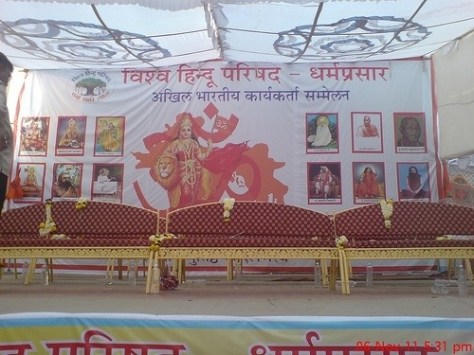
Stage set for a Vishwa Hindu Parishad function next to the Pirana shrine in Ahmedabad, 2011. Photo via twocircles.net

From the label of “Master Divider” in India Today in January 2003 to the tag of “The Great Polariser” in the Outlook in July 2012 — Narendra Modi’s image remained static: self-declared champion of one community of people. But the strain Gujarat faced in the course of his tenure has increased manifold. Wherever I travelled in Gujarat, there was a clear distinction between “us” and “them”. This difference was articulated by several Hindus every time the conversation veered in this direction. In contrast, counterparts among Muslims denied this. The disagreement with the hypothesis stemmed not from a belief and perception that they faced no discrimination but because of a “fear” that accepting such a viewpoint could be interpreted as levelling an allegation that they were being targeted — a risk no Muslim is willing to take after the post-Godhra violence.

Continue reading On the social fabric in Narendra Modi’s Gujarat: Nilanjan Mukhopadhyay

Debating the Attack on Presidency University: Pratyay Nath

Guest post by PRATYAY NATH.

This piece is in response to Waled Aadnan’s post on Kafila titled ‘Because Presidency is an Idea – All You Need to Know about What Happened at Presidency University’ (dated 15 April 2013). Mr. Aadnan’s well-written and succinctly argued piece is not an isolated voice; it echoes a dominant way of thinking that has been noticeable among the various protests against the recent incident of vandalism in the Presidency University (erstwhile Presidency College). Let me begin by stating, like many others already have, that the vandalism that happened in Presidency on 10 April 2013 should be condemned in the harshest of terms. My discomfort lies in some of the ways in which these condemnations are being articulated in the public domain over the past few days. I would suggest that the majority of the protests emanate from a sense of hurt delivered to the idea of eliteness of the educational institution in question, which cannot unfortunately be supported because it tries to detach this incident from the broader socio-political forces of our times by sensationalising the issue.  Continue reading Debating the Attack on Presidency University: Pratyay Nath

Spin Doctors, Propagandists and the Modi Make-over

Elsewhere on Kafila, we have published a 7000 word long response by Madhu Kishwar to Zahir Janmohamad’s open letter to her which appeared on 15 January, followed by Zahir Janmohamad’s response. Perhaps a few things need to be stated here clearly with respect to her ‘response’. It seems to me to violate every tenet of reasoned debate and argument and is replete with name calling and stereo-typing of not just the secularist ‘other’ [who is her real other, not the Muslim] but even of the adversary she is arguing with. So if Zahir is a  Muslim, he has to be X, Y, Z and has to be believing in A, B, C. Everything starts and ends in bad faith. But then that is what distinguishes Madhu Kishwar from others. She is in her element especially in relation to those whom she disagrees with. With her there can be no disagreement – you have to be sneered and jeered at, irrespective of whether you are a Medha Patkar or an Aruna Roy. I suppose these are matters of personal style and I shall not dwell on them further.

Let me rather, turn to some of the more substantive issues raised in Madhu’s response. Zahir has answered most of them but it seems to me that a couple of vital questions still remain. Even here, though, a caveat is necessary. I have great admiration for Madhu Kishwar’s battle in defense of the rikshaw pullers in Delhi and have often said so openly to her as well as others. However, I do know that it is possible to talk to her when only we agree, which is very rare. On matters that we disagree about, I have decided that I do not want to enter into any kind of an argument with her. In any case, large parts of her ‘response’ are like Modi’s PR handouts, served to us without any sense of critical examination. Therefore, what follows below is not my reply to her but my reactions to a set of allegations she has raised about whosoever is opposed to Narendra Modi – all lumped together in a breathtaking move of reductio ad absurdum, first as secularists , who are reduced to Leftists/ NGO activists and finally to Congress-supporters (because, she says in her Modinama1, the Congress has been equally responsible for all the riots till date). I therefore, lay my cards on the table at the outset: I am an inveterate Modi-hater (and a Congress-hater as well, if that makes sense to anyone in her dichotomized universe) and Kafila is a forum with a certain, if very broad, politics that, at the minimum rules out being pro-Modi. Continue reading Spin Doctors, Propagandists and the Modi Make-over

We are all Hari Sadu: Veena Venugopal

VEENA VENUGOPAL writes: Saw the ad about the horrible boss? The one in which the employee comes in with a new idea and in return he gets a load of sarcasm? And even when the boss likes the idea, he reveals it with an air of impudent superiority. Seen that one? What was it called? Hari Sadu?

Well, no. This ad is for a new brand of cookies; Gold Star, it is called. A male “attendant”/“peon”/“employee” comes in to a plush white room and serves a plate of cookies to Amitabh Bachchan. On biting into one, he realizes these are not his regular cookies. “Arre suno,” he calls because come on, he isn’t expected to know the name of all the people who serve him cookies at home. The employee admits they are new. “Maine socha ki…” (I thought…) he says at which Bachchan rolls his eyes and says, “aaj kal aap sochne bhi lag gaye?” (you have even started thinking now?). But then he realizes he likes the new ones and instructs the man, “ayenda yeh sochna band karo,” (please stop thinking in the future). Continue reading We are all Hari Sadu: Veena Venugopal

When the Vishwa Hindu Parishad went time travelling: Ilija Trojanow and Ranjit Hoskote

3_3

This is an excerpt from Confluences: Forgotten Histories of East and West by ILIJA TROJANOW and RANJIT HOSKOTE (Yoda Press, 2012). In defiance of the current tide of national and cultural neo-tribalism, the authors argue that the lifeblood of culture is confluence. No culture has ever been pure, no tradition self-enclosed, no identity monolithic. Employing a variety of approaches, ranging from the essayistic to the poetic, from rigorous historical analysis to the playfulness of fiction, they follow the journeys of stories, ideas, people and songs, and trace the umbilical connections between Europe and Asia, Zoroastrianism and Christianity, Western revolutionary thought and the annihilatory politics of Jihad and Hindutva. In this particular section, titled ‘Travelling Back in Faith’, history is presented through the prism of science fiction:

vhp2The Vishwa Hindu Parishad (VHP) is a powerful organization founded on the belief that the Hindu religion is eternal and unvarying, that it has existed in India for thousands of years (the VHP’s chronological estimates vary between 8,000 and 50,000 years), and that its essence has never been affected by any foreign influence or borrowing. Hinduism is unique to India, and India is a uniquely Hindu country: such is the logic of the VHP. And yet, occasionally, the VHP is assailed by a sense of doubt. It is all very well to thunder at Muslims and Christians in self-congratulatory public meetings, its leaders say to themselves, but it would be nice to have some proof with which to fight off the scoffing scientists. And so, as documents recently made available to researchers reveal, the high command of the VHP decided to sponsor a time travel project, sending a fact-finder back to the glorious Vedic age to collect evidence of how the ancestors of the Hindus performed their rituals, worshipped their gods, and conceived of their relationship to the Divine. Continue reading When the Vishwa Hindu Parishad went time travelling: Ilija Trojanow and Ranjit Hoskote

Nellie, Me and Impunity: Uddipana Goswami

This is a guest post by Uddipana Goswami

I was born around the time the Assam Movement started and grew up in an atmosphere of intense xenophobia. Everywhere, we heard anti-Bangladeshi slogans – which often translated into expressions of anti-Bengali sentiments. Our parents tried their best at home to protect us from such influences. We were sent to convent schools which often isolated us from whatever was going on outside the school walls. But we felt the tensions in the air and tasted the fear. We heard the names of places and people, killed, maimed, tortured.

Nellie was one such name we grew up with. There were others – Dhula, Gohpur, Phulung Sapori – where other genocides happened, but the name Nellie stayed with me. It fascinated me and brought to my mind the image of a distraught woman. Many years later, when I started researching the Muslim community of East Bengali origin in Assam, this amorphous image of Nellie started taking a definite shape. And it translated into a poem one day – ‘If Nellie Was the Name of the Woman’ (Northeast Review).

As I wrote the poem, I realized that I could myself be Nellie, a woman, battered, bruised and abused because of my ‘otherness’, because I could – and would – not sacrifice my ‘otherness’ in my quest for oneness within the institution of marriage.

Continue reading Nellie, Me and Impunity: Uddipana Goswami

Carpets and kebabs in Isfahan: Marryam H Reshii

Guest post by MARRYAM H RESHII

iran67

I could write a book about my week in Iran, but will restrict myself to captioning these photographs I took.

The only two cities I visited were Mashad and Isfahan. Mashad is famous for two things. The shrine of the Eighth Imam of the Shia sect of Islam, Imam Reza, the only one out of all twelve Imams to actually be buried in Iran (all the others are buried in Saudi Arabia and Iraq) and saffron that grows far, far more plentifully than it does in Kashmir.

Mashad sells carpets woven/produced elsewhere. While the large carpets are traditionally Iranian, the small ones in frames are too suspiciously perfect to be made with human hand. Most of them have a plethora of shades of white in them, making the weaver something of a genius! Continue reading Carpets and kebabs in Isfahan: Marryam H Reshii

Sahibs, Pandits and the Scholarship on Caste: Manish Thakur and Nabanipa Bhattacharjee

Guest post by MANISH THAKUR and NABANIPA BHATTACHARJEE

Scholarship on caste has always been much more than merely about caste. At stake has been the very idea of India, and the production of knowledge about it. Expectedly, whenever academic knowledge on caste spills over in the public domain (and it does so often, as in the recent Ashis Nandy case), politically charged contestations about the idea of India inevitably follow. In the academy, the privileging of Brahmanical worldview in sociological discourses on India continues to be a source of deep-seated resentment. ‘Indian Critiques of Louis Dumont’s Contributions’ (Khare 2006) notwithstanding, the figure of ‘the learned Brahman’ (Alamgir 2006) looms large in the voluminous corpus of anthropological knowledge about India. So much so that Richard Burghart(1990) views modern anthropological knowledge primarily as a function of multiple dialogues between modern day anthropologists and the Brahmanical tradition of knowledge.

Continue reading Sahibs, Pandits and the Scholarship on Caste: Manish Thakur and Nabanipa Bhattacharjee

Why was Ram Singh killed in Tihar jail?

The chief accused in the Delhi gang rape “found dead” in his cell? Killed with his own shirt? Hanging from a grill, with his three cell mates sound asleep all the while? The moment I heard the news  on Monday, every conspiracy theory-oriented cell in my body did a quick cartwheel. Promptly I sent out a mail to the sisterhood on the Feminists India e-list:

I’m wondering whether there is something more than police negligence involved here. I have always felt that the role of the police on that night was more than simply their usual laparwahi – that bus may have been used often in the past for such activities, remember they didn’t follow up the complaint of the man who had been earlier that night robbed by the same guys? And how they located the bus from their hafta diaries? I’m wondering – and going to sound paranoid and like a loony conspiracy theorist – whether the key accused in court would have revealed more about police complicity in rapes and other activities on buses like Yadav’s than we imagine. Prisoners in jail often carry out attacks on other prisoners on the orders of the police themselves.

Yes, Indian prisons are violent and brutal, and the police callous and vicious. Yes, there should be an enquiry to assign responsibility. But I’m pretty certain I know who killed Ram Singh – some other prisoners. And I think that they did it on orders from the police. Continue reading Why was Ram Singh killed in Tihar jail?

Class Feminism vs. Classy Feminism … Or, Everybody Loves the Governable Woman!

A few weeks ago, I mentioned on Kafila a certain gentleman who delivered a memorable address in Government Women’s College, Thiruvananthapuram, which contained sage advice on how to bring under control the unruly bodies of ungovernable women.  After that I have been receiving unsigned letters from his admirers who feel that their innocent hero has been most unfairly criticized. Like the grumpy ground-lubber types who are either incapable of ascending or simply unable to climb coconut trees and do not appreciate the free services rendered by the chivalrous heroes high above, I have erred in judgment, they claim. Continue reading Class Feminism vs. Classy Feminism … Or, Everybody Loves the Governable Woman!

The love story of Quli Qutub and Bhagmati, and other tragic endings

Still from an animation film, 'Bhaggmati'
Still from an animation film, ‘Bhaggmati’

For some strange reason, all, or almost all love legends have a tragic end. I cannot recall too many that end with “and they lived happily ever after”. In fact, Romeo-Juliet, Laila-Majnun, Heer-Ranjha, Sohini-Mahiwal, Sassi-Pannun, Dhola-Maru, Saif-ul-Malook-o-Badi-uj-Jamaal – the list of unhappy lovers separated by the cruel hands of society, scheming relatives, jealous rivals, misunderstandings and plain simple divine design is endless.

Amidst such tears and tragedies, poison-tipped swords and daggers, deceit and chicanery, there is a story of love that makes you believe that this world can’t be all bad. The most fascinating and enduring quality of this legend of love is that it is not a legend, it is fact, well mostly. And this is how it goes. Continue reading The love story of Quli Qutub and Bhagmati, and other tragic endings

Meanderings of a Female Atheist Muslim Indian: Samina Motlekar

This is a guest post by SAMINA MOTLEKAR: I come with baggage, with tags not all of my own making. I was born female, and as much as I want to be acknowledged as a person, I learnt early that it was pointless to deny so physical a part of my identity. I was born to Muslim parents, but that does not make me Muslim, a distinction that is unfortunately far too subtle for many minds to comprehend. Complacent in their own inherited identities, they pile on the labels smothering me into little  boxes of their making. Female, Muslim, Indian – all accidents of birth. But not all of me is accidental. By age eleven, the idea of a deity in the sky, concepts of heaven and hell, were at best stories, at worst ramblings of deluded minds to me. Not for me the fence sitting of agnosticism. I was an atheist before I hit my teens, and my belief system has endured the trials and tribulations of time. Yet they call me Muslim.

Continue reading Meanderings of a Female Atheist Muslim Indian: Samina Motlekar

Leaping Across a Troubled History – Launch of Pratiman

Poster of the launch event  for Pratiman
Poster of the launch event for Pratiman

A new research journal in Hindi, Pratiman – Samay, Samaj, Sanskriti, was launched on 28 February 2013, at the Centre for the Study of Developing Societies, Delhi. The occasion was historic in many ways. Given the long and troubled history of the great language divide between Hindi and Urdu and the lost traditions of Hindustani, the fact that the launch was marked by a public lecture by noted Urdu scholar-poet Shamsur Rahman Faruqi cannot but be anything but historic. There is a certain impertinence and perhaps even insolence, in the move to leap across that history of over a century and a quarter, in complete disregard of the custodians of purity on both sides, in the insistence that language is not what the custodians make of it but what lives in the world of creativity and exchange.

It was only befitting of this occasion that Faruqi chose to speak on “Urdu Adabi Ravayat ki Sachchi Triveni.” In what turned out to be a remarkable and breathtaking tour de force, Faruqi turned his scholarly apparatus to the task of dissecting the Urdu poetic and aesthetic tradition in a manner that revealed its three currents (the ‘triveni’) – namely, Arabi, Persian and Sanskrit.Through the metaphor of the Triveni at Allahabad, where the Ganga and Yamuna meet the third river Saraswati, which is invisible but nonetheless ‘present’, Faruqi too perhaps wanted to stress the significance of the third but invisible current of Sanskrit poetics.

Continue reading Leaping Across a Troubled History – Launch of Pratiman

Who’s afraid of the Karachi Literature Festival?: Ayesha Siddiqa

Guest post by AYESHA SIDDIQA

Photo via Dawn.com

Here we are seemingly in an age of intellectual freedom, burgeoning media industry and literature festivals. There are numerous festivals held all over South Asia celebrating books new and old, bringing people together for exchange of ideas. But these festivals seem to be wrapped in their own politics. In some cases, certain cliques that want to encourage a peculiar perspective dominate the show. I understood this through my interaction with the Karachi Literature Festival. Continue reading Who’s afraid of the Karachi Literature Festival?: Ayesha Siddiqa

Illegal Antiquities: Vishes Kothari

Guest post by VISHES KOTHARI

As a collector of Indian antiquities wanting to set up an antiquities dealership in the future, I had heard of the wholesale illegal export of Indian art treasures and antiquities out of India- sometimes through newspaper reports, but mostly through word of mouth. This summer I decided to explore this market further. Nothing could really have prepared me for what I was to see over the course of the next month spent between Delhi and Rajasthan.

Contrary to my imagination of the Delhi businesses operating in a very shady and dubious manner out of musty, hidden godowns in obscure corners of Old Delhi, and run by people with barely any idea of what they were handling, what I found instead was that almost all these businesses were located in localities which epitomize mainstream “cosmopolitan Delhi” and run by extremely wealthy upper middle class families. Connaught Place, Greater Kailash, Green Park, Sunder Nagar- these were just some of the places where I was able to locate an open sale of antiquities- happening not through dodgy godowns or via clandestine networks- but instead conducted out of posh showrooms and sold openly to anyone who cared to buy.

Continue reading Illegal Antiquities: Vishes Kothari

राष्ट्रवादी न्याय से करुणा की विदाई

“अगर हम ‘लोकतांत्रिक सरकारों के छिपे इरादों और गैरजवाबदेह खुफिया शक्ति संरचनाओं की जांच करने और उन पर सवाल उठाने से इनकार करते हैं तो हम लोकतंत्र और मानवता, दोनों को ही खो बैठते हैं.” पत्रकार जॉन पिल्जर का यह वाक्य आज हमारे लिए कितना प्रासंगिक हो उठा है! हमें नौ जनवरी को खुफिया तरीके से अफज़ल गुरु को दी गयी फांसी के अभिप्राय को समझना ही होगा. काम कठिन है क्योंकि इसे लाकर न सिर्फ़ प्रायः सभी संसदीय राजनीतिक दल एकमत हैं बल्कि आम तौर पर देश की जनता भी इसे देर से की गई सही कार्रवाई समझती है.

नौ जनवरी के दिन के वृहत्तर आशय छह दिसम्बर जैसी तारीख से कम गंभीर नहीं क्योंकि इस रोज़ भारतीय राज्य ने गांधी और टैगोर की विरासत का हक खो दिया है.अगर अब तक यह साबित नहीं था तो अब हो गया है कि भारत की ‘संसदीय लोकतांत्रिक राजनीति’ का मुहावरा उग्र और कठोर राष्ट्रवाद का है. और राजनीतिक दलों में इस भाषा में महारत हासिल करने की होड़ सी लग गयी है.

Continue reading राष्ट्रवादी न्याय से करुणा की विदाई

The Languages of Sexual Violence: Anupama Mohan

Guest post by ANUPAMA MOHAN

I teach a big word in my critical theory classes: phallogocentrism. It is the idea that our societies are centred by the phallus and language (logos) and is a word that often scares, perplexes, and disturbs my students, but I unpack it using an example. In English, the word seminal, which means something important and path-breaking, derives from “semen” and in contrast, the word hysterical or hysteria, which is a word that has for long been associated with peculiarly female physical and mental disorders (and often used for recommending women’s confinement), derives from “hystera” or the womb. What does such loading of the language – what a 20th century Russian thinker, Mikhail Bakhtin, called the formation of the verbal ideological world  – in terms of the perspective, validation, and supremacizing of one gender over the other do to/in our varied lives? Think of the word vanilla that, at least since the 1970s, has meant the ordinary and bland: its etymology derives from the Latin word for vagina (vaina) or “little vagina” for the pods of the plant that reminded someone of women’s genitals. The word porcelain – a thin, fragile kind of clay – too comes from the word for “cowrie shell” whose Italian links to porcella or young sow (a female pig) for someone recalled the shape of a piglet’s orifice. One more: the word amazon which refers to a legendary race of female warriors and has come to mean a strong woman derives possibly from many sources: from the Classical Greek a-mazos or breastless to the Iranian *ama-janah or “virility-killing” – a meaning that interprets the idea of women’s strength as both a mutilation of her physical self and/or as a threat to men. Continue reading The Languages of Sexual Violence: Anupama Mohan

A crumbling fourth pillar, and the forgotten politics of boycott: Manav Bhushan

Guest post by MANAV BHUSHAN

Assaulted as we are by the deafening cacophony of India’s 24-hour news channels (183 of them, as Manav Bhushan tells us below), there are some of us who for a long time now, have simply refused to appear on TV “debates”, to give them sound bytes to be seamlessly incorporated into their endlessly looping mindlessness. Essentially, we have exercised a politics of refusal – we will not add to the din. At a recent meeting on media ethics at the Indian Women’s Press Corps, I had expressed a fervent desire that every single 24-hour news channel should shut shop for one week while they went into deep introspection – one week of blessedly blank screens, one week of healing quiet in which people could once again learn to listen, to remember that there can be more than 2 or 3 sound-bytes through which to capture the complexities of the world in which we live. MANAV BHUSHAN makes a more radical suggestion below –   that we exercise the only power we have under capitalism, our power as consumers, and exercise a week-long boycott of a news channel for specific reasons, to force drastic changes to its policy and style of functioning. “In an age where each channel depends more on our TRPs than we do on any one of them, we hold enormous, albeit unrealized power,” he says. Over to Manav:

In a speech delivered at the Reuters memorial lecture in November 2012 at Oxford University discussing the Indian news industry, Prannoy Roy candidly said that ”Indian news is currently in a race to the bottom”. He further added that upon comparing the average TV viewership in India (1 hour) to that in the US (5 hours), one is led to the utterly dismal conclusion that this race is far from over. Of course, this is nothing new, and anyone who has followed the ‘debates’ (if you can call them that) on the extremely unfortunate incidents at the LOC can testify that the shows conducted by Arnab Goswami and Barkha Dutt were less news and more war-mongering. In fact, the brutal truth about the flourishing news industry- which has gone from one state-run news channel to 183 independent news channels in just 25 years- is that many of its members are in the business of blackmail, of selling sex, violence and are prepared to go to any lengths for the sake of advertising revenues. And there is a difference, though subtle, between advertising revenues and television rating points (TRPs).  Continue reading A crumbling fourth pillar, and the forgotten politics of boycott: Manav Bhushan

A rare victory for freedom of speech and expression in India

Times of India photo

In a country where freedom of speech and expression is under assault every day, where scholars and cartoonists increasingly have to regularly face the law to defend their statements and works of art,  where the government gives in to anyone and everyone demanding censorship, where the government conduct stealth censorship of online speech, finally comes a rare piece of good news.

For once the police is not asking to shut down an exhibition citing ‘law and order’ issues to appease protestors, but instead giving protection to the exhibition.

The Times of India reports: Continue reading A rare victory for freedom of speech and expression in India

Is Prof Nandy a Holy Cow?: K Satyanarayana

We are posting below an interview of Dr K SATYANARAYANA on the issues arising out of the ‘Ashis Nandy case’. The interview was conducted by DALIT CAMERA and sent to us by RAVICHANDRAN

The interview raises some important issues that call for a reasoned public debate and we welcome this opportunity provided by this interview.