Category Archives: Culture

यशपाल समिति पर बहस और दिमाग़ों के ताले

उच्च शिक्षा को लेकर यशपाल की अध्यक्षता में बनी  समिति की रिपोर्ट को लेकर चल रही  बहस से भारत के पढ़े -लिखे समाज के बारे में कुछ दिलचस्प नतीजे निकाले जा सकते हैं. सबसे पहले तो यह, जो कोई नई खोज नही  है कि   यदि आपको इनके राजनीतिक झुकाव का पता है तो आप इनकी प्रतिक्रिया का सहज ही अनुमान कर सकते हैं.  वे बुद्धिजीवी भी, जो अपने आप को राजनीतिक प्रतिबद्धताओं से ऊपर बताते और समझते हैं, इस बीमारी से आजाद नहीं हैं. ऐसा लगता है, प्रतिक्रियाएं तैयार रखी  थीं और उनका उस रिपोर्ट की अंतर्वस्तु से कोई लेना – देना नहीं जिसकी वे बात कर रही हैं.
जो प्रौढ़ हो चुके, यानी जिनके कई प्रकार के स्वार्थ उनके राजनीतिक आग्रहों से बंधे हुए हैं, उनकी बात छोड़ भी दें तो नौजवानों में इस राजनीतिक मताग्रह से दूषित विचारक्रम को देख कर चिंता होती है. नौजवान दिल -दिमाग आजाद होने चाहिए . किसी भी घटना या विचार पर प्रतिक्रिया देते समय उन्हें उसे ठीक-ठीक समझने की कोशिश करनी  चाहिए. दुर्भाग्य से ऐसा होता नहीं दीखता. अगर सिर्फ  शिक्षा से उदाहरण लें तो पांच साल पहले स्कूली शिक्षा के लिए बनाई गयी राष्ट्रीय पाठ्यचर्या पर हुई बहस में इस विचारहीन मताग्रह के अच्छे नमूने मिल जायेंगे. चूंकि उस प्रक्रिया का संचालन एक ऐसा व्यक्ति कर रहा था जिसे वामपंथी नहीं माना जाता, वामपंथी समूहों ने   २००५ की पाठ्यचर्या पर संगठित आक्रमण किया. प्रखर इतिहासकारों और अन्य  क्षेत्र के विद्वानों ने जिस तरह इस दस्तावेज पर हमला किया उससे इसका अहसास हुआ कि इसकी आज़ादी तो कतई नहीं कि आप बने-बनाए वैचारिक दायरों से निकल कर कुछ सोचने -समझने का प्रयास करें.
Continue reading यशपाल समिति पर बहस और दिमाग़ों के ताले

On Thinking Pakistan—Rambles and Recollections of an… upon Intezar Husain’s ‘Chiraghon ka Dhuvan’

Once it is granted that in India we practise a different kind of secularism, a secularism which is unique to us, it becomes very difficult not to grant the same status to Pakistan, Bangladesh, Sri Lanka and Nepal. This may seem bizarre given the fact that religion seems to pervade life in all these places, and a struggle over the definition of the state continues everywhere. However, defining oneself is different from the way one may be read. Many an avowed Muslim appears highly heretic to others. In fact the contemporary state, given the kinds of tasks of enumeration, surveillance, discipline and welfare that it is asked to command can only ever be secular, a fact that the Emory based legal scholar Abdullah Bin Naimi has been trying to hammer home to different kinds of Muslims over the last decade. For more of his works one can go to here and here.

The reason I bring this up in particular relates to the case of Pakistan. An avowed Islamic state, it has found it difficult to satisfy the urgings of different kinds of Islamists. And indeed it never can do so simply because protecting its citizens and assuring them equality is also one of its declared goals. The clash between the principle of treating each citizen as an individual, equal before the state, and the demands of different kinds of communities which may be ethnic, linguistic, regional or religious is precisely the playground of struggle that all South Asian, and now some European, states grapple with in their pursuit of secular goals. Continue reading On Thinking Pakistan—Rambles and Recollections of an… upon Intezar Husain’s ‘Chiraghon ka Dhuvan’

Ai Weiwei’s (Chinese Artist) Statement: Guest Post from Monica Narula

Dear All,

I would like to share with all Kafila readers something that my friend Monica Narula posted recently on the Reader List about the intimidation that the well known Chinese contemporary artist, Ai Weiwei has faced, in connection with his support for the currently detained dissident rights activist Tan Zuoren in Chengdu. This is an introduction to Ai Weiwei in the current context and a text of his recent statement released in the context of the harrassment (including beatings by police) that he has had to go through. Please read and share widely.

best

Shuddha

—————

Avant-garde artist Ai Weiwei, one of China’s foremost public  intellectuals, was recently detained and beaten by police when he  attempted to testify at the show trial of dissident Tan Zuoren in  Chengdu. Harassment and threats are connected, in part, to his “Names  Project,” a performative intervention which aims to compile, publish,  disseminate, and memorialize the names of the thousands of children  who were crushed to death en mass in their “crumbling tofu  construction” schools (the rotten fruits of official corruption and  kickbacks) during the May 12, 2008 Wenchuan Earthquake, while  neighboring government buildings stood intact. The State has strong- armed bereaved parents into silence, refused to investigate government  corruption, and barred the victims’ names from public release. Ai  Weiwei’s vocal defiance has led to his censorship, intimidation,  threats and now arrest and beating.

Having spent the first 2 decades of his life with his father, the  revolutionary poet Ai Qing, in a cadre labor reform camp for errant intellectuals, Ai Weiwei understands that no one in China, no matter  how “high profile” is ever “safe. Thus, he has chosen to push the  State as far as he can in an attempt to reclaim the public sphere for  critical discourse, and champion the cause of free speech and genuine  citizen and human rights in China. As such, he has willingly put  himself in a great deal of danger. His recent statement merits  reposting. I hope that you will pass this on and share it with others  who believe in the need to nurture and support critical public intellectuals, especially in places like China, where there are so few
such clarion and courageous voices.

Ai Weiwei’s Statement

“Watch out! Have you prepared yourself?” —

Ai Weiwei: “I am ready.  Or, perhaps I should say that there is nothing to prepare, no way to  prepare myself. A person–this is all of me–is something that can be  received by others. I offer up all of myself. When the time comes when  it is necessary, I will not hesitate, I won’t be ambiguous about it.  If there is anything that I am reluctant to leave behind it is the  wondrous miracle that life has brought me. And that miracles are that  every one of us is the same, that people are equal in this game, as  well as the fantasies that come along with playing it, and our  freedom. I regard every kind of intimidation, from any kind of  ‘authority or power’ [sic – the character is for quanli as in  ‘rights’, but from the context this appears to be a typo, perhaps?],  as a threat to human dignity, rationality and reason–a threat to the  very possibility of opposition. I will learn to face and confront this.”

Striving for Magic in the City of Words

By LAWRENCE LIANG and SIDDHARTH NARRAIN

(Published as Magic in the ‘City of Words’ in the August 2009 issue of Himal)

After agitating for many years against the existence of Section 377 of the Indian Penal Code, which criminalised homosexuality, it is understandable that the Delhi High Court’s 2 July decision in the Naz Foundation case, decriminalising homosexuality, has been welcomed and celebrated by the LGBT (lesbian, gay, bisexual and transgender) community. But to see this decision as a victory of the LGBT community alone would be to do injustice to the Delhi High Court’s remarkably progressive and well-reasoned decision, and the immense potential this judgement has for changing the course of equality jurisprudence in India. It would also display a very narrow understanding of the relationship between constitutional change and social movements striving for a more just and democratic society. Continue reading Striving for Magic in the City of Words

The horror, the horror: India’s new IT act

An article from last week’s Outlook magazine on the new cyber law makes the following points:

Rakhi Sawant Ka Swayamvar!

“Yeah yeah, take a good show and spoil it by theorizing” said my labour lawyer/bollywood-gossip-junkie flat mate. All I said was that I thought Rakhi Sawant Ka Swayamvar was an “Interesting phenomenon that comments on the articulations of the notion of marriage within the context of fixed notions of culture among upper middle class north Indian families and within that the tropes of gender, normativity and melodrama! And so I should write about it on Kafila”.

Her comment wasn’t entirely unjustified.

The way in which one watches these shows in itself raises a range of questions. The show has taken over my life as of now. The final decision of who she will marry will be made soon and the restlessness and anxiety about it is immense and requires effort to contain. Continue reading Rakhi Sawant Ka Swayamvar!

SAHMAT press statement on prayers in protected monuments

SAHMAT
29, Ferozeshah Road, New Delhi -110001
Telephone-2 3070787,23381276
e-mail: sahmat@ vsnl.com

29.7.2009

Press Statement Continue reading SAHMAT press statement on prayers in protected monuments

धारा 377, यौनिकता और नेहरू – संतानोत्पत्ति से परे

[अगर आप मोज़िल्ला फायरफ़ॉक्स के ज़रिए नेट देखते हैं तो पढ़ते वक़्‍त फ़ॉंट बढ़ाने के लिए Ctrl + का इस्‍तेमाल करें]

धारा 377 अब स्वेच्छा से यौन संबंध बनाने वाले समलैंगिकों पर लागू नहीं होगी. दिल्ली उच्च न्यायालय के इस निर्णय ने भारतीय समाज की नैतिकता की परिभाषाओं की चूल हिला दी है. फैसला आने के बाद हिन्दू , मुस्लिम और अन्य धार्मिक समूहों के कई नेताओं ने इसे खतरनाक बताया है और इसके खिलाफ उच्चतम न्यायालय तक जाने की धमकी दी है. कुछ तो जा भी चुके हैं। सरकार को भी कहा जा रहा है कि वह इस फैसले को चुनौती दे. अब तक के सरकार के रुख से ऐसा कुछ नहीं लग रहा कि वह इस दबाव के आगे झुकेगी.

फैसला ऐतिहासिक है. इसका सबसे महत्वपूर्ण पहलू यह है कि यह एक विशेष संविधान को स्वीकार करके अपने-आपको एक राष्ट्र-राज्य के रूप में गठित करने वाले जन-समुदाय के रहने-सहने और जीने के तौर-तरीकों को निर्णायक रूप से उसके पहले के सामाजिक आचार-व्यवहार से अलगाता है. यह आकस्मिक नहीं है कि न्यायाधीश ने अपने फैसले के लिए जिन राष्ट्रीय नेताओं के दृष्टिकोण को आधार बनाया , वे हैं जवाहरलाल नेहरू और भीमराव  अम्बेडकर.  नेहरू औपनिवेशिक शासन से मुक्ति के बाद एक नए भारत के लिए आवश्यक  नैतिक और सांस्कृतिक बुनियादी तर्क खोजने की कोशिश कर रहे थे. इस खोज में सब कुछ साफ–साफ दिखाई दे रहा हो, ऐसा नहीं था और हर चीज़ को वे सटीक रूप से व्याख्यायित कर पा रहे हैं, ऐसा उनका दावा भी नहीं था. नेहरू के जिस वक्तव्य को फैसले में उद्धृत किया गया है, उसमें  भी शब्दों की   जादुई ताकत के  उल्लेख करने के साथ यह भी कहा गया है कि वे पूरी तरह से एक नए समाज की सारी आकांक्षाओं को व्यक्त कर पाने में समर्थ नहीं. वे निश्चितता से भिन्न विचार और मूल्यों के एक आभासी लोक की कल्पना करते हैं. राजनेता का विशेष गुण माना जाता है, फैसलाकुन व्यवहार. नेहरू, इसके बावजूद कि एक तानाशाह बन जाने के लिए उनके पास सारी स्थितियां थीं , हमेशा इससे बचते रहे कि चीज़ों को साफ-साफ और  अलग-अलग खाचों में डाल दिया जाए.
Continue reading धारा 377, यौनिकता और नेहरू – संतानोत्पत्ति से परे

My son Jane: Moira McDonald

Guest post by MOIRA MCDONALD (Written three years ago).

“I want to be Jane,” repeats my two year old, this time bringing his face very close to mine for special emphasis.  “He has to be Michael. Michael is the boy” says his nearly four year old sister Naomi who is oh-so aware of her budding gender identity.  “Honey, you know in our family, anyone can pretend to be anything.  Someday you may want to pretend to be boy, or a cow for that matter,” I explain. She shrugs agreeing to his choice as long as she can be Mary Poppins.   I wish the contradictions surrounding gender identity were as easily resolved for the other adults in our lives.

Continue reading My son Jane: Moira McDonald

Why I Feel For B.P. Singhal

In the aftermath of the Delhi High Court judgement reading down Section 377, the initial euphoria and celebration is now being increasingly met with an equally strong backlash. Some of this has of course come from the religious right of all denominations (Hindu,Muslim, Sikh, Isayi Apas mein sab bhai bhai), the army, politicians, conservative commentators in the press. Underlying much of the oppositions seems to be a sense that somehow the decriminalization of homosexuality is going to turn everyone gay, a sentiment that sounds bizarre to us.

But now that I have been thinking about this I think I am beginning to understand the fear that is articulated in this “homosexuality-as-contagious-virus” position. Because in one sense they are right. In his post Lawrence speaks of the radical politics of impossibility – the change in the law suddenly makes possible a new set of imaginary possibilities that we could not dream of hitherto. And so BP Singhal and Dominic Emmanuel and everyone else who is saying that the presence of the law performs a stellar function against the rise of a virtual army of gay people and must remain on the books, even if, and indeed especially because, it is never used against actual real gay people, have a point. Continue reading Why I Feel For B.P. Singhal

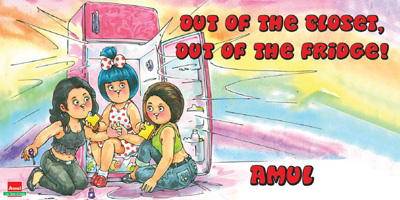
The Amul girl comes out of the closet

Via amul.com
Via amul.com

Home, house

I entered Yunus’s house. He was allotted 150 square meters of land to build his home. Parts of the house were done up with brick and cement. The roof was still kutcha, raw – in the process of construction. You could see the incompleteness of the roof from the opening around the right hand side from which rain likely comes into the house (as does sunshine). I asked Yunus,

Ghar mein barsaat ka pani aata hai kya? Baarish se pareshaani nahi hoti? Continue reading Home, house

“Two friends who have but one life”: Hope from the 19th century

I came across this delightful piece of information in the historian K P Padmanabha Menon’s History of Kerala (vol.3, AES reprint,2001, pp.498-500) which was written in the early 20th century. He quotes from “a paper published in the Madras Review (vol.2, p.250)”; we do not know which year this was published, but there is good reason to think that it was in the early 20th century. The paper is about a truly exciting institution – ‘marriage’ which produced not a heterosexual conjugal couple, but a same-sex  (male) couple bound by ‘friendship’! Continue reading “Two friends who have but one life”: Hope from the 19th century

Spaces of Forgetting

[Part of a Series. Introduction: For Movement]

Lisbon, June 2009

From the outside, it looks like a lovely building. Broad and imposing, with a certain faded but still palpable elegance. Like all buildings are at some point in their lives in all cities, it is surrounded by construction gates. The sign says that it is to become, like more and more buildings in more and more cities, luxury condominiums. I think of a friend’s words at a conference a few days before. In the contemporary, he said, inequality is made through making the city. The Portuguese word for “building” is edificio, from the Latin aedis, or dwelling, which itself comes from the Sanskrit inddhh – to burn. Aedis and facere [to make] together make aedificium, to build a dwelling around a hearth, around fire. The word is close to aedes, or temple. It also skirts around aedificare and hence the English “edify” – to improve spiritually. A lot is built in building a building. Continue reading Spaces of Forgetting

Habib Tanveer and the Gond Myth of Creation

Several years ago while shooting for “Urdu Hai Jiska Naam” Subhash Kapoor, the director of the series and I had gone to Bhopal because we wanted Habib Saheb to anchor the series. While location hunting we went to see the Museum of Man – a sprawling open-air campus, spread on one side of the famous Shaamla hills in Bhopal. One area of the museum is dedicated to tribal myths and their theories of creation. The Gond myth of creation fascinated me greatly and I narrated it to Habib Saheb in the evening. Habib Sahib liked the story and took it down in as much detail as I could remember. Sometime later when I saw a performance of Zahreeli Hawa, Habib Saheb’s play on the Bhopal Gas tragedy, I realised that he had woven the Gond myth in the preamble of his play and had very effectively incorporated contemporary environmental concerns and the pillage of MNCs in this primordial tale of great simplicity and beauty. Continue reading Habib Tanveer and the Gond Myth of Creation

The Empire’s Old(er) Clothes

[Part of a Series. Introduction: For Movement]

Porto, Portugal, June 9th, 2009

Porto, the second city of Portugal, reminds me constantly of Bombay. Not in the way I thought it would, or the way I think the Portuguese would like it to. Mothership cities of Empires past are moments of origin. Origins in search of which the colonies were to be re-made. We are post-colonial now, though my fingers would rather type past-colonial in a Freudian slip that I wish was true. Still, the edges of empire have frayed since Indian began shining, Singapore and Dubai became newer horizons and the peripheries of the cities at the centres of Empire became more visible. Yet cracked original moulds are moulds still. Even as no mothership city – Paris, London – ever manages on closer examination to be the origin we once imagined it to be, their centres still hold inklings of the moulds. A sweep, a façade, a boulevard, a constant air of entitlement, a setting of terms, an unthinking confidence. Cracked moulds are moulds still. Enough, at least, for an slightly-unresolved-though-vaguely-global Indian imagination like mine to lower its gaze and hunch its shoulders just a little. Then, of course, I catch myself, remember to think rather than feel, auto-critique my moment of doubt, intellectually collect several counter-arguments and shine once more. And this is why I avoid, whenever possible, traveling to Europe – the baggage allowance isn’t enough to cover all the shit it rakes up inside me.

Continue reading The Empire’s Old(er) Clothes

For Movement

Reading Fernando Pessoa in Portugal [being the good traveller I am], I get chided on page three itself. Writing about Soares, one of Pessoa’s heteronyms, and Pessoa himself, the translator writing the preface says to me as I sit on the train from Porto to Lisbon staring at the country going by:

“Like Pessoa, Soares never goes anywhere, for he can journey to the infinite in a ride across town on the tram. “If I were to travel,” he says, “I’d find a poor copy of what I’ve already seen without taking one step.”

I look up from The Book of Disquietitude to my laptop screen where I’ve begun writing the first of a series of pieces for Kafila on travel, the cities that I have just left behind and those I am headed towards. I think of a boy in another city by another bay who once said the same thing to me. I think of the hours I spent planning this trip. I realize that I’m already dreaming of the next one even as I’m on this one. I sulk for a moment. I feel bereft of imagination; a victim-consumer of a Lonely Planet travel guide that I do not even own. The backpack on the luggage rack above stares at me accusingly. I plead guilty.

It occurs to me that there is a need for another preface. A because. An I travel because. To silence Pessoa’s baleful glare at me that has become my baleful glare at myself. So here goes.
Continue reading For Movement

Information Access and Transparency

In the recent national elections, we saw several initiatives that were implemented to provide more information to people about their elected representatives. The purpose of providing this information was to enable people to make more informed choices about who they cast their votes for. Some among these initiatives aim at achieving the larger goals of transparency, accountability and good governance i.e., their goal in providing information about elected representatives is not only to help people to vote more responsibly; it is also expected that citizens will use this information to monitor the performance of their elected representatives and hold them accountable after they have been voted in. Consequently, there is an attempt to collate information beyond that which is made available through candidate affidavits, i.e., about the state of development in parliamentary constituencies, election manifestoes and promises, news about elected representatives and constituencies, etc. These initiatives fulfill one aspect of the larger discourse about transparency i.e., providing access to information about “the state”. It is presumed that providing such information will encourage people to engage with the state and participate in monitoring its activities. My aim in this post is to dissect this logic somewhat further and to highlight some of the political dynamics which complicate any simple understandings of transparency and information access. I will conclude this post by making some tentative remarks on the possible ways in which information access can be configured in order to serve certain local needs. Continue reading Information Access and Transparency

Faith, religion, ritual, identity, dogma – how do I understand this?

I walked into Anjali’s  house. She lives in one of the Rehabilitation and Resettlement colonies in Bombay which were developed to provide housing for slum dwellers and railway slum dwellers affected by the creation of roads infrastructure in Mumbai. Her house is a one-room tenement. She has created a litte bedroom space by placing a large showcase unit which separates the living room and the bedroom. I sat down to talk with her when my eyes fell on the Mecca-Medina mosque photograph which was placed on the wall facing her kitchen, above her newly purchased washing machine. For a moment, I was not sure if I had seen correct. Then, while continuing the talking, I glanced carefully again. It was the Mecca-Medina mosque photograph which is usually found in the homes of Bohra Muslims, Shias, Iranis and Sunnis as some kind of a visible mark of religion or show of faith and practice (or perhaps something else, I am not sure). I was both intrigued and amused. Continue reading Faith, religion, ritual, identity, dogma – how do I understand this?

A desk of her own. Farewell to Kamala Das

Kamala Das (Madhavikutty, Kamala Suraiya), died this morning, May 31, 2009, aged 75.

Virginia Woolf wrote in A Room of One’s Own (1929):

“A woman must have money and a room of her own if she is to write fiction; and that, as you will see, leaves the great problem of the true nature of woman and the true nature of fiction unsolved.”

In an interview in 1996, the interviewer Shobha Warrier reminds Das of something she had once said “about the pathetic condition of a woman writer who does not even have a writing table. The dining table has to serve as her writing table once it is cleared.”
Kamala Das replies:

Continue reading A desk of her own. Farewell to Kamala Das

साधारण की उदात्तता यानि जनादेश 2009

2009 के लोकसभा चुनाव के नतीजों ने कुछ लोगों को हतप्रभ किया है और अनेक को चमत्कृत. इस जनादेश की व्याख्या इस रूप में की जा रही है कि भारत की जनता ने विकास को तरजीह दी है और इस बडी मंदी के दौर में अपेक्षाकृत सुरक्षित चुनाव किया है. हमारे एक मित्र का कहना है कि इस असुरक्षा के समय में जनता जो हाथ में है , उसे ही संजोए रखना चाहती थी. भारतीय जनता पार्टी और तथाकथित तीसरे मोर्चे के ऊपर कांग्रेस के नेतृत्व वाले गठबंधन को चुनने के पीछे बिजली-पानी –सडक और जान-माल की हिफाजत की रोज़मर्रा की चिंताएं ज़रूर रही होंगी, लेकिन क्या यह इतना ही था? साधारण जनता क्या सिर्फ मामूली सवालों में ही उलझी रहती है और कभी अपने रोज़मर्रेपन से ऊपर नहीं उठती? बार-बार उसे इसी हद में बांधकर देखने की कोशिश की जाती हैहालांकि उसने कई बार यह बतलाया है कि उसके मुद्दे सिर्फ वही नहीं हैं जो व्याख्याकार बताते रहे हैं. साधारण जनता की उदात्तता की आकांक्षा आखिर किस रूप में व्यक्त होती है?

भारत में मोहनदास करमचंद गांधी ने शायद सबसे पहले साधारण के भीतर छिपी इस उदात्तता को ठीक-ठीक पहचाना था और उसका आदर किया था. क्रांतिकारियों या फिर कम्युनिस्ट विचार रखने वालों को साधारणता पर सन्देह ही था.
क्रांतिकारियों ने इसीलिए चुने हुए लोगों के दस्ते बनाए और कम्युनिस्ट खुद को जनता के एक अगुआ दस्ते के रूप में पेश करते रहे. शास्त्रकारों या सिद्धांतकारों को भी साधारणता को समझने में काफी दिक्कत होती रही है. इसलिए उनकी दिलचस्पी उन कोटियों के निर्माण में रहती है जो आसानी से सामूहिक आचरण की व्याख्या करने में सहायक हों. पिछले बीस वर्षों में भारतीय जनता के सारे निर्णयों को पहचान की कोटि के आधार पर समझने की कोशिश की गई है. यहां यह नहीं कहा जा रहा कि यह कोटि या इस तरह की सैद्धांतिक कोटियां बिलकुल अप्रासंगिक हैं, सिर्फ यही कहने की कोशिश की जा रही है कि इस प्रकार की किसी एक कोटि में किसी समूह को शेष कर देने से हम उसके भीतर छिपी सारी सम्भावनाओं को नज़रअंदाज़ देते हैं.
Continue reading साधारण की उदात्तता यानि जनादेश 2009