This is a guest post by ARITRA CHATTERJEE: In his response to the article by some students of St. Stephen’s College, Thane Richard has raised a set of questions about the college, about the students participating in the present movement, about education in India and students’ voice in shaping education. He is critical about what he calls the lack of quality education, of a system where education is primarily about rote learning and conformity to structures of authority; in such a situation the promise of a good liberal arts education remains a mere promise and students migrate to the West in search of it. He also rues the lack of students’ voice in the education system, rhetorically asking, “Do students have any right?” He welcomes the students’ fight against the oppressive regime at St. Stephen’s College but views it as a movement that is too little too late and even that in “the wrong direction”. I shall respond to his views at two levels – at the level of education in the country as a whole, and that of the present movement at St. Stephen’s College. Continue reading Of Angry Young Students and Education in India – A Response to Thane Richard: Aritra Chatterjee
Category Archives: Debates
Let us declare that a state of war exists
“Let us declare that the state of war does exist and shall exist so long as the Indian toiling masses and the natural resources are being exploited by a handful of parasites.” Those are not the words of a member of the Central Committee of the Communist Party of India (Maoist), though the film has that too. These words are of Bhagat Singh, revolutionary freedom fighter who has today been appropriated by everybody for their own purposes.
The most remarkable thing about Sanjay Kak’s new film Red Ant Dream is Punjab. Occupying more than a third of the film, its use of the revolutionary sentiment in today’s Punjab takes forward the debate on the Maoist and other resistance movements in India. Instead of getting into the debates around the Maoist movement in central India, the film makes for a powerful document of the how and why the revolutionary ideal lives in India 2013. Continue reading Let us declare that a state of war exists
Is there anything like ‘copying’ fairly?: Rajshree Chandra

Guest post by RAJSHREE CHANDRA: In the backdrop of the on going battle in the Delhi High Court, between publishers (OUP, CUP and Taylor and Francis) and Rameshwari photocopiers-Delhi University (next hearing 8th May, 2013), there are two perspectives to which attention needs to be drawn. The first, of course, is a legal one which allows for course pack to be compiled for dissemination of course and research material, provided they adhere to stipulated norms. What are these stipulated norms? Have DU, and its network of photocopying, infringed these legal guidelines or even transgressed internationally evolved, legally acceptable norms of “fair use”. Continue reading Is there anything like ‘copying’ fairly?: Rajshree Chandra
Academic Excellence and St. Stephen’s College: A response by Thane Richard
This is a guest post by THANE RICHARD
I recently read an article in Kafila – more like an angry, reflective rant – written by some students from St. Stephen’s College in Delhi. To quickly summarize, the piece criticized the draconian views of the Principal of St. Stephen’s College regarding curfews on women’s dormitories and his stymying of his students’ democratic ideals of discussion, protest, and open criticism. More broadly, though, the article’s writers seemed to be speaking about the larger stagnant institution of Indian higher education, overseen by a class of rigid administrators represented by this sexist and bigoted Principal, as described by the students. The students’ frustration was palpable in the text and their story felt to me like a perfect example of what happens when an unstoppable force meets an immovable object. Except Indian students are not an unstoppable force. Not even close. Continue reading Academic Excellence and St. Stephen’s College: A response by Thane Richard
Why Delhi University’s Four Year Undergraduate Programme Should Not be Implemented with Irresponsible Haste
A Note Prepared at the Request of the Department of Higher Education, MHRD, Govt of India
Preamble:
Universities are meant to educate, that is, to teach students how to identify, understand and evaluate multiple points of view. Therefore, dissent, debate and argument are the core concerns of a University – they cannot be regarded as irrelevant irritations or acts of sedition. Debate cannot continue indefinitely, and must be responsible. But what constitutes responsible and well-considered criticism is inevitably a matter of judgement – it cannot be decided through assertion and counter-assertion. It is also inevitable that motives will be called into question. This is once again a matter of judgement, based on available evidence on who is speaking (what is their wider credibility beyond the immediate dispute?) and why (what do they stand to gain or lose by what they are saying?), and an overall sense of what is at stake in the issue. We invite such judgements.
Facts which are NOT disputed:
1. The proposed FYUP is the biggest, most far reaching change of curriculum in the recent (i.e., last 30-40 years) history of DU – it will replace every existing undergraduate course of study in every college and every discipline (professional courses & some other low-enrolment courses may be exceptions).
2. The first time that the FYUP was placed before any statutory body of the University was at the Academic Council meeting of Monday, 24 December, 2012. This meeting – to discuss the biggest curricular reform in several decades – was an Extraordinary meeting, called at 3 days’ notice, which was issued on Friday, 21 December, 2012 and delivered over the weekend, giving Departments no time to consider the proposal and formulate an informed response.
3. The structure of the FYUP presented to the Academic Council on 24 December had not been sent to the Committees of Courses at the Faculties or Departments, or to the Staff Councils of Colleges.
4. The Academic Council meeting of 24 December approved the FYUP with 6 dissents, including a written submission by the Dean, Faculty of Social Sciences, specifically requesting that the University take more time to think through this major change, and that a detailed White Paper on the FYUP be prepared and made public to enable the University community to respond to it.
5. The Executive Council meeting at which the AC approval of the FYUP was presented was held on Wednesday, 26 December, 2012, i.e. the next working day after the AC meeting of 24 December.
Dismiss the Delhi Police Commissioner
It is surreal watching leaders from Sushil Kumar Shinde to Sushma Swaraj make tough statements, one after another, on television. Statements about taking strong measures, the latter even demanding, as is her wont, death sentence to rapists. I felt like asking, do you even realize what the people are angry about? Do you even know what is at issue here? Who will you hang? Case after case, even after December 16, it is being revealed, suffers from the same problem: the refusal of the police to even register a case! What is the meaning of this high histrionics then, when you do not even have a culprit to punish? I am not even raising the question of the ethics of death penalty because that is a redundant question at the moment. Except for the raving right wingers who – like Sushma Swaraj and Shinde – have to make some song and dance about the issue merely for effect, no one else really believes that at the moment there is any issue other than the criminality of Delhi Police. Continue reading Dismiss the Delhi Police Commissioner
Debating the Attack on Presidency University: Pratyay Nath
Guest post by PRATYAY NATH.
This piece is in response to Waled Aadnan’s post on Kafila titled ‘Because Presidency is an Idea – All You Need to Know about What Happened at Presidency University’ (dated 15 April 2013). Mr. Aadnan’s well-written and succinctly argued piece is not an isolated voice; it echoes a dominant way of thinking that has been noticeable among the various protests against the recent incident of vandalism in the Presidency University (erstwhile Presidency College). Let me begin by stating, like many others already have, that the vandalism that happened in Presidency on 10 April 2013 should be condemned in the harshest of terms. My discomfort lies in some of the ways in which these condemnations are being articulated in the public domain over the past few days. I would suggest that the majority of the protests emanate from a sense of hurt delivered to the idea of eliteness of the educational institution in question, which cannot unfortunately be supported because it tries to detach this incident from the broader socio-political forces of our times by sensationalising the issue. Continue reading Debating the Attack on Presidency University: Pratyay Nath
Spin Doctors, Propagandists and the Modi Make-over
Elsewhere on Kafila, we have published a 7000 word long response by Madhu Kishwar to Zahir Janmohamad’s open letter to her which appeared on 15 January, followed by Zahir Janmohamad’s response. Perhaps a few things need to be stated here clearly with respect to her ‘response’. It seems to me to violate every tenet of reasoned debate and argument and is replete with name calling and stereo-typing of not just the secularist ‘other’ [who is her real other, not the Muslim] but even of the adversary she is arguing with. So if Zahir is a Muslim, he has to be X, Y, Z and has to be believing in A, B, C. Everything starts and ends in bad faith. But then that is what distinguishes Madhu Kishwar from others. She is in her element especially in relation to those whom she disagrees with. With her there can be no disagreement – you have to be sneered and jeered at, irrespective of whether you are a Medha Patkar or an Aruna Roy. I suppose these are matters of personal style and I shall not dwell on them further.
Let me rather, turn to some of the more substantive issues raised in Madhu’s response. Zahir has answered most of them but it seems to me that a couple of vital questions still remain. Even here, though, a caveat is necessary. I have great admiration for Madhu Kishwar’s battle in defense of the rikshaw pullers in Delhi and have often said so openly to her as well as others. However, I do know that it is possible to talk to her when only we agree, which is very rare. On matters that we disagree about, I have decided that I do not want to enter into any kind of an argument with her. In any case, large parts of her ‘response’ are like Modi’s PR handouts, served to us without any sense of critical examination. Therefore, what follows below is not my reply to her but my reactions to a set of allegations she has raised about whosoever is opposed to Narendra Modi – all lumped together in a breathtaking move of reductio ad absurdum, first as secularists , who are reduced to Leftists/ NGO activists and finally to Congress-supporters (because, she says in her Modinama1, the Congress has been equally responsible for all the riots till date). I therefore, lay my cards on the table at the outset: I am an inveterate Modi-hater (and a Congress-hater as well, if that makes sense to anyone in her dichotomized universe) and Kafila is a forum with a certain, if very broad, politics that, at the minimum rules out being pro-Modi. Continue reading Spin Doctors, Propagandists and the Modi Make-over
A conversation that didn’t take place in Juhapura: Madhu Purnima Kishwar and Zahir Janmohamed
On 15 January, Kafila published an open letter to MADHU PURNIMA KISHWAR by ZAHIR JANMOHAMED. Three months later, Kishwar has sent us a response. Given below her response are comments by Zahir Janmohamed.
*
Dear Zahirbhai,
My apologies for the delay in responding to your “Open Letter” addressed to me through Kafila on January 11 2013.
Unlike most of those upset at my articles on Gujarat, you have been remarkably measured in your tone and tenor and also respectful in questioning my observations. However, the content of your letter annoyed me no end. I kept postponing my response in the hope that my annoyance at the absurdity of your chargesheet would subside over time. I honestly did not want to give you an angry or discourteous response so that the dialogic mode you established remained undisturbed.
However, as I began processing the enormous load of material I had gathered from Gujarat, my annoyance kept increasing at your jaundiced viewpoint. Therefore, I thought of letting the series of articles I am writing answer some of your questions. I had made it a point to ask all the questions you raised from Gujaratis I interviewed. At the end of my first series on Gujarat I would have written to ask you if you got your answers. Continue reading A conversation that didn’t take place in Juhapura: Madhu Purnima Kishwar and Zahir Janmohamed
Because Presidency is an Idea – All You Need to Know About What Happened at Presidency University: Waled Aadnan
Guest post by WALED AADNAN: On 10th April, 2013, an unprecedented incident happened at Presidency University (erstwhile Presidency College), Kolkata. Now, unprecedented is a strong term when it relates to Presidency College, because it has, over its 196- year- long history, seen much. It has been broken in by rioting mobs in 1926; in the 1960s and 70s, it was the so-called headquarters of the Naxal movement in Bengal; it has nurtured Indian Nobel Prize and Oscar winners and consistently over its history. It has been one of India’s elite colleges and a hotbed of left-wing politics.
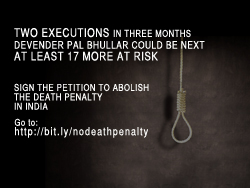
Sign this petition to abolish death penalty in India
AMNESTY INTERNATIONAL lists some reasons why death penalty should be abolished in India:

Inconsistency: Three people, Harban, Kashmira and Jeeta were sentenced to death for a crime in which they played similar roles. But they met different fates. Kashmira Singh’s petition to the Supreme Court was accepted and his sentence commuted to life imprisonment. Harbans Singh was recommended by the court for clemency from the President. Jeeta Singh’s petition was dismissed and he was hanged.
Flaws: In August 2012, 14 retired judges wrote to the President of India, pointing out that the Supreme Court had wrongly awarded the death sentence to 13 people. They called the execution of two wrongly sentenced prisoners in 1996 and 1997, “the gravest known miscarriage of justice in the history of crime and punishment in independent India”.
Bias: “I thought I should get all these (capital punishment) cases examined from a normal citizen’s point of view in terms of the crime, intensity of the crime and the social and financial status of the individuals who were convicted and awarded capital punishment. This study revealed to my surprise that almost all the cases which were pending had a social and economic bias.” APJ Abdul Kalam.
To sign their petition to the Prime Minister of India, go here.
On the Supreme Court of India’s rejection of the mercy plea of Devinder Pal Singh Bhullar: PUDR
Press statement put out by the PEOPLE’S UNION FOR DEMOCRATIC RIGHTS on 12 April 2013.
PUDR strongly denounces the Supreme Court’s dismissal this morning of Devinder Pal Singh Bhullar’s plea for commutation of the death sentence awarded to him to life. The issues at stake in this dismissal are multiple, that of clemency, death penalty, miscarriage of justice and precedence.
Bhullar was sentenced to death in 2003 for carrying out a bomb blast outside the Delhi Youth Congress office which killed nine people in 1993. He has been deemed mentally unstable. The High Court’s decision of upholding the death sentence was not a unanimous decision. After he was given the death sentence by the Supreme Court, he appealed to the then President of India for clemency in 2003. The President, after a lapse of over eight years, dismissed his mercy plea in 2011. Bhullar had sought commutation of his death penalty to life sentence by the Supreme Court on the ground that there was inordinate delay by the President over his plea for clemency. Continue reading On the Supreme Court of India’s rejection of the mercy plea of Devinder Pal Singh Bhullar: PUDR
Lethal Lottery: A study on death penalty in India, 1950-2006
DU’S 4-year degree course: Reforms at reckless speed
(This piece has been published by the Times of India in its Delhi City section on 14 April, 2013. We are reproducing it here, given the importance of the issue involved. It is somewhat disappointing that it is being treated as a local , internal issue by the media. What we read there are uninformed reports and stories which do not give us the real picture of the academic scene of DU.
Please read and react. We are looking for solidarities of all kinds, Apoorvanand)
When an April Fool’s Day joke is not funny: Zahir Janmohamed

This is a guest post by ZAHIR JANMOHAMED: This morning, April 1, Google announced its latest product: Gmail blue. It is email except for one critical difference—everything is blue.
“I can’t believe I waited so long for this,” a hilarious Google video says.
It works because it is funny and so obviously absurd—you would have to be, well, a fool to believe this April fool’s day joke. But the Google prank is also something else: harmless. It does not hurt anyone nor it does not trigger painful memories.
When does an April fool’s day cross the line? Continue reading When an April Fool’s Day joke is not funny: Zahir Janmohamed
Reject the National Food Security Bill: Right to Food Campaign
This release was put out by the RIGHT TO FOOD CAMPAIGN on 19 March 2013
More than 500 people of the Right to Food Campaign sitting at Jantar Mantar in New Delhi rejected the National Food Security Bill 2013 which was passed by the cabinet of the UPA Government today evening and will now be placed in the Parliament in this session.
NO TIME FRAME FOR IMPLEMENTATION
People were shocked to learn that according to the Bill that was passed, the law will not be applied in one stroke. The language of the law is that different dates may be appointed for different states and different provisions for the implementation of the Act. This clearly means that there is no time frame for full implementation or objective criteria for phased implementation. It means the government in power has the choice to decide which state and what provisions need to be implemented. We condemn this as being against the fundamental rights of the people and the federal nature of the Indian state. This also clearly shows that the Government is not really committed towards ensuring the end of food insecurity of the teeming millions of the country. Continue reading Reject the National Food Security Bill: Right to Food Campaign
India, International Law and an Act of Hypocrisy: JKCCS
Press release put out 24 March by the JAMMU AND KASHMIR COALITION OF CIVIL SOCIETY
Srinagar: The 21 March 2013, United Nations Human Rights Council [UNHRC] resolution is a welcome initial step in the ongoing struggle to hold countries responsible for human rights violations, ranging from Genocide, Crimes against Humanity and War Crimes to Enforced Disappearance, Torture, Rape and Extra-judicial executions. The watered down resolution, moved by the United States, and India’s support for the resolution, requires both commendation and severe criticism at the same time.
There can be no selective morality when it comes to standing against the commission of human rights violations by State’s. Every country must be held to the same standards, as Sri Lanka has been in the instant case, regardless of economic or geo-political concerns. In this regard, the United States and India stand accused of hypocrisy in their dealings with human rights violations in their regions or across the world. Similarly, Pakistan’s vote against the resolution raises serious questions on its own approach to human rights violations in the region or elsewhere. Continue reading India, International Law and an Act of Hypocrisy: JKCCS
Alan Rusbridger on Open Journalism and the Looming Threat of Supra-Regulation: Saurav Datta

Guest post by SAURAV DATTA
“Open” Journalism – it’s all about transparency, challenging, correction and clarification.
Marking a refreshing departure from the hackneyed “economic model” analysis of digital journalism, Alan Rusbridger, The Guardian’s Editor-in-Chief recently held forth on its effects and manifestations from the perspective of “journalistic practices”. Whether to fortify stories and content behind “gigantic (pay)walls” or not, is the wrong starting point, because one has to see if actions are “journalistically right,” he said. Continue reading Alan Rusbridger on Open Journalism and the Looming Threat of Supra-Regulation: Saurav Datta
The Delhi University Four Year Structure – Myths and Reality
This document has been prepared by the JOINT ACTION BODY OF DELHI UNIVERSITY.
Myth 1
The four-year system is a measure of reform that is necessitated by the state of higher education in India today.
Reality
There is no clarity in the objective of why Delhi University is moving to a four-year undergraduate system. Is it to introduce more value based courses, or is to elevate the university to “global standards”? Unless the issue is understood, debated and discussed publicly and democratically, reforms will be ill-conceived and not in general public interest as the following sections will show. Continue reading The Delhi University Four Year Structure – Myths and Reality
Lok Sabha committee tells Kapil Sibal to re-examine the Information Technology Rules 2011
SFLC.in has a quick summary:
The Thirty-first Report of the Committee on Subordinate Legislation (2012-2013) was presented in the Lok Sabha today on 21 March, 2013 by Shri P. Karunakaran, Chairman of the Committee.
The Committee examined the following rules:-
(i) The Information Technology (Reasonable security practices and procedures and sensitive personal data or information) Rules, 2011[GSR 313(E)]
(ii) The Information Technology (Intermediaries
Guidelines) Rules, 2011[GSR314 (E)]
(iii) The Information Technology (Guidelines for Cyber Cafe) Rules, 2011[GSR315(E)]
(iv) The Information Technology (Electronic Service Delivery) Rules, 2011[GSR316 (E)]
The Committee made the following observations: Continue reading Lok Sabha committee tells Kapil Sibal to re-examine the Information Technology Rules 2011
Appeal from Tamil Civil Society to the International Community on Sri Lanka
This appeal was published in groundviews.org and has been sent to us by V. Geetha. We are publishing it here to give a different view from the kind of view that dominates now. Even though the appeal was made before the voting took place in the UN Human Rights Council, it is nevertheless an important view.
This appeal, signed by civil society activists who live and work in the North and East of Sri Lanka, seeks to state our position with regard to the resolution on Sri Lanka to be tabled at the 22nd sessions of the UN Human Rights Council. We understand that the resolution will seek to provide more time to the Government of Sri Lanka to implement the recommendations contained in the Lessons Learnt and Reconciliation Commission and that it will fall short of calling for an international independent investigation to hold to account those responsible for the Crime of Genocide, War Crimes and Crimes Against Humanity. If this resolution would contain only the above and no further, in our opinion, it would be truly unfortunate. Read the full statement here.