Category Archives: Empire/ Imperialism

Nandini Sundar – Will counting caste reduce inequality?

Nandini Sundar’s recent Op-Ed for The Hindu on caste-enumeration in the latest round of the census. Read the entire article here.

But come back with your comments – what do you think about caste–enumeration?

Yesterday when the census enumerator visited, I asked him how he felt about the current debate on counting caste in the census: “Not comfortable at all”, he said, “I don’t even like asking whether someone is SC/ST or Other, leave alone what their caste is.” But, he added, “caste is an inescapable reality of Indian society.”

The debate on counting caste in the census has not moved on from 2001, when opinion was equally divided. Supporters of caste enumeration argue that census categories merely reflect existing classifications, and that only the census can provide the figures necessary to map inequality by caste. Opponents argue that the census does not mirror but actively produces social classifications and ways of thinking. They point to the history of mobilisation around caste in the census and the consequent dangers of both distorted data and increased social tensions. In neither case has much thought been given to how the data might be used, the different kinds of figures needed for different purposes, or alternative ways of collecting the required data. Read the rest of the article here

‘Nice. Nice. Good shot. Thank you.’

‘constitutional’ Realities: Priya Thangarajah

Guest post by PRIYA THANGARAJAH

The piece is unfinished, consciously so. The thought is unfinished and needs to be fleshed out and thus posting this, so that this important idea can be evolved collectively. It raises a range of questions and contributes to existing debates on constitutional law from a social change/human rights perspective. (consciously the words ‘constitution’ and ‘india’ are not capitalised. ) It contributes significantly to an understanding, not just of north east india but the realities of chattisgarh, jharkhand, bihar, kashmir to name a few. It helps us understand all the wars fought within the country – ‘constitutionally’ about which much is being said in the media and elsewhere by state and non-state actors.

The constitution, some argue, is an aspirational document. Baxi states that it is created to protect the rights of the impoverished. Created to protect the weaker sections of society and that’s how the Dworkinian trumping of rights works. Rights of the weaker parties always trumps that of the stronger. But whatever the aim of the constitution maybe, its sacrosanct. Sacred. Amendments can be made with great difficulty but the constitution per se cannot be done away with for a new one. Continue reading ‘constitutional’ Realities: Priya Thangarajah

The Headley Trail

I

Have you had a chance to browse through the latest media interaction of the US ambassador to India, a gentleman called Mr Timothy Roemer? (US wants Headley to be brought to justice: Roemer, February 18, 2010 17:53 IST, rediff.com ) And could anyone decipher that it was a response to the growing clamour in a section of the media about seeking access to American terror suspect Headley whose name has surfaced in the light of his links with the 26/11 plot and who is at present lodged in the US jail. There were also reports about Headley’s visit to India in March 2009 and his survey of the Osho Ashram, Chabad House as well as the German Bakery in Pune, which became a site of the bomb explosion in second week of February 2010. Continue reading The Headley Trail

‘Non-violent terrorism’ and India’s dirty war in Kashmir

Guest post by MOHAMAD JUNAID

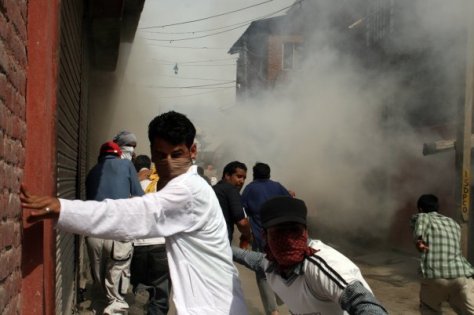
Dozens of young boys have been arrested across Kashmir under draconian laws over the last few weeks. The charges that have been filed against them range from “waging war against the state” to defiling “state honor”. In recent months Indian military and police commanders have described protests in Kashmir as “agitational terrorism” and “non-violent terrorism” in order to justify violent clampdown on protests by Kashmiris.

As the headlines go, Stone-pelting an act of war: J-K gov.

In the same period around 8 people, mostly teenagers, have been either shot to death or fatally injured by indiscriminate use of tear-gas shells. Over the last two years the number of dead in shootings is more than a hundred. Meanwhile thousands of people have been injured. Many of them will be left with permanent physical disabilities. The police authorities have banned any peaceful assembly of people. Many places in downtown Srinagar and other towns have reported police brutalities. Even the villages are not being spared. Only yesterday, mourning villagers were attacked by CRPF troopers in Redwani in South Kashmir. Dozens of them were injured by CRPF’s indiscriminate firing. Most of the injuries were inflicted above the waist showing an intention to kill Continue reading ‘Non-violent terrorism’ and India’s dirty war in Kashmir

Vote! Or else…

In Lingagiri, it didn’t take long to tally the results of the recently concluded panchayat elections. On January 31 this year, a sum total of four people voted in this remote village in Chhattisgarh’s Bijapur district. The polling booth opened on time, the polling officers were present, and then the force arrived.
Pujari Rajamma, 35, was combing her hair in her courtyard. “I was getting ready to walk down to the polling office, when the uniformed men stormed in,” she said. “They checked my fingers for the voting mark.” When they didn’t find it, they beat her with sticks. The bruises are still visible on Rajamma’s back; she can barely move her swollen left arm.

Green Hunt: The Anatomy of An Operation

An operation is underway in Central India, but no one really knows what it is. Variously described as a media myth, a comprehensive hearts and minds strategy, and an all-out offensive by paramilitary forces and the state forces along the borders of Chhattisgarh, Jharkhand, Andhra Pradesh and Maharashtra, Operation Green Hunt has become a shoebox of news clippings, police reports, public demonstrations and armed encounters.

Depending on the definition, Green Hunt either began in July 2009, September 2009 or November 2009. Speaking off record, senior policemen confirmed that the intensification of “search and comb” operations in Chhattisgarh began as early as July last year. In September 2009 the press reported on the progress of “Operation Green Hunt”: a massive 3 day joint operation in which the central CoBRA force and state police battled Naxal forces in Dantewada. Continue reading Green Hunt: The Anatomy of An Operation

Uncanny parallels between Beg’s and Shah’s deaths

This is a guest post by Akhilesh Upadhyay

The gruesome murder on Sunday of media entrepreneur Jamim Shah, 47, has brought back chilling memories of June 29, 1998. On that day, Mirza Dilshad Beg, a sitting lawmaker, was gunned down outside his home in Siphal, Kathmandu. It was a dark night and the hillside neighbourhood looked darker still due to load-shedding, when we (reporters and photographers from Kantipur and The Kathmandu Post) arrived at the scene, soon after the 9.30 hit-and-run incident.

The newsroom had received a tip-off from a local who had heard what he suspected were gun-shots. It was an innocent world in many ways. Nepalis were still unfamiliar with sounds of bombs and gun-shots, the Maoist-waged “people’s war” was still in its infancy, violent deaths still shook everybody, and political assassination was unheard of. But what shocked the Nepalis most was how ugly games from powerful external forces could play out in Nepal, as it watched haplessly. The incident also gave many of us in the newsroom a first-hand lesson on forces which operate from behind the scene. Two of the theories that made the rounds then clearly pointed at the cross-border nature of the operation; the third one was that Beg’s death had to do with “family problems,” which turned out to be false. Continue reading Uncanny parallels between Beg’s and Shah’s deaths

Debating “Political Islam”

A number of activists from the South Asia Solidarity Initiative (SASI) in New York have initiated a reading group on South Asia.  The notes below are the second in a series of commentaries following reading discussions that some members of the reading group are posting on Kafila.  This is an attempt to broaden the discussions and in the process make it a productive dialogue to understand developments in the region and deepen our solidarity.

Debating “Political Islam”

– Svati Shah, Biju Mathew, Sumitra Rajkumar, Prachi Patankar and Ahilan Kadirgamar

The recent debate between Samir Amin and Tariq Amin-Khan on a left perspective on “political Islam” in the context of imperialism, published in Monthly Review (December 2007 and March 2009), provides an opportunity to reflect on a number of issues that have vexed the anti-war movement and the left with respect to the on-going wars in Iraq and Afghanistan.  The most vexing of these issues has been the question of whom the left should target as its allies in those countries, and what position the left should take toward so-called “political Islam,” represented by Islamist groups calling for an end to foreign occupation.  The definition of “political Islam” is presented below in relation to each critique.  Both Amin and Amin-Khan are in agreement that both “political Islam” and imperialism have to be challenged simultaneously.  There are no strategic questions here, in terms of joining one to fight the other.  The defeat or withdrawal of both is desirable in the interests of a people-centred politics.  In imperialism’s projection of capitalism and reactionary Islam’s comfort with capitalism (that class and gender do not trouble it) they are objective allies even if on the ground their adherents are military enemies.  This initial agreement then delves into a number of nuanced questions that must be considered in order to foster the return to a people centred politics in both of these countries, and the regions as a whole.

Continue reading Debating “Political Islam”

Reading Land and Reform in Pakistan

A number of activists from the South Asia Solidarity Initiative (SASI) in New York have initiated a reading group on South Asia.  The notes below are the first in a series of commentaries following reading discussions that some members of the reading group hope to post on Kafila.  This is an attempt to broaden the discussions and in the process make it a productive dialogue to understand developments in the region and deepen our solidarity.

Reading Land and Reform in Pakistan

— Svati Shah, Prachi Patankar and Ahilan Kadirgamar

“…any strategy to stem the tide of Taliban-Al Qaida led militancy cannot ignore the issue of land rights…. Any reforms that revalue and formally recognize the local management of common property resources, therefore, will elevate the authority of tribal leaders over religious clerics or TAQ militants.”
Haris Gazdar, ‘The Fourth Round, And Why They Fight On: An Essay on the History of Land and Reform in Pakistan’

Given the escalation of a multifaceted war in Pakistan, and given our own commitment to a peace with justice in South Asia, we have started reading and discussing issues of importance in Pakistan and South Asia more broadly.  This inquiry is informed by the alarming and rapidly changing situation in Pakistan, and by an interest in interrogating the category ‘South Asia’ itself.  While all are agreed that the term ‘South Asia’ is indispensable, we wonder how ‘South Asia’ could be used to describe more than a region or a set of places outlined by shared borders. We wonder how we can move beyond the limitations of finding historical unity in South Asia primarily through the lens of British colonialism?  We wonder how we could describe the political unities and potential solidarities of ‘South Asia’ in this moment?  We find it particularly helpful to approach these questions by seeing common issues in the region relating to labour, land and the role of the state in societies in South Asia.  At the same time, we want to move away from the received notions of South Asia, whether they be the statist conceptions of SAARC, South Asia as seen by the US State Department or, for that matter, as a region defined by area studies.

Continue reading Reading Land and Reform in Pakistan

“China should break up India”

That’s the view of a Chinese strategic expert. The funniest part is:

China can give political support to Bangladesh enabling the latter to encourage ethnic Bengalis in India to get rid of Indian control and unite with Bangladesh as one Bengali nation; if the same is not possible, creation of at least another free Bengali nation state as a friendly neighbour of Bangladesh, would be desirable, for the purpose of weakening India’s expansion and threat aimed at forming a ‘unified South Asia’. [DS Rajan]

The Old Fort

(First published in Landscape. Photographs by HIMANSHU JOSHI.)

sized3
The South Gate as seen from within the fort. This became the back drop for the staging of Tughlaq

The Old Fort, popularly known as Puraana Qila, was known to both the Author of Asaar-us-Sanadeed- Syed Ahmad Khan and the author of Waqeyat-e-Daar-ul-Hukoomat Dehli- Bashir Ahmad as Qila-e-Kuhna. The three terms Old Fort, Puraana Qila and, Qila-e-Kuhna mean exactly the same thing, The first is English, the last is Persian and the second is Urdu. Somehow the Hindi equivalent Pracheen Durg has never been in use despite the popular, though as yet historically unsubstantiated claim that this is the site of the legendry Indraprasth or Inderpat built by the mythological Pandavas. Continue reading The Old Fort

And that is why your neighbors don’t like you: Anurag Acharya

Guest post by ANURAG ACHARYA, student from Nepal at Jawaharlal Nehru University.

Peaceful coexistence among nations does not encompass coexistence between the exploiter and the exploited, the oppressor and the oppressed.

– Ernesto ‘Che’ Guevara

The 1800 km open border between India and Nepal has always been a matter of dispute between the two countries. While India has glorified the open border as its grace and gratitude towards a landlocked nation, Nepal has had to accept the miseries of sharing an open border with a bigger and powerful nation as a price for a trade transit. It goes without saying that whenever there has been a proposal or a debate within Nepal about the possibility of opening a trade route across the Himalayas to our north to tap the world’s largest market for Nepalese goods, it has attracted serious concerns from the South block. Bound by the unfair Indo-Nepal treaty of 1950 which prevents Nepal from independently conducting its international affairs and thwarts Nepal’s ambition to exploit the huge trade potential with China, an end to Nepal’s historical dependence on India has not materialized yet. While the treaty gives India a free hand to interfere in Nepal’s foreign affairs, citing its own domestic security, it has seriously impaired Nepal’s right to trade access, as a landlocked nation under the International Law. The treaty also stands in clear violation and entrenchment of a sovereign nation’s  right to conduct its external and internal affairs independently. However, weak diplomacy on Nepal’s part and unsympathetic attitude on the Indian side has ensured that Nepal stays dependent on India for all its exports and imports.

Continue reading And that is why your neighbors don’t like you: Anurag Acharya

The Snub

[Part of  Series. Introduction: For Movement]

Tanger, Morroco, June 2009

Sometimes you just have to seek the travel moment. Yes, the best moments are unexpected, everyday, hidden. Sometimes though, the textbook travel guide moments, mass produced as they are, still work. Try this for a classic travel guide must-do: you drive down to the south of Spain, get to a ferry, put your car in the hold and cross the water in an hour long ride from Europe to Africa. West to.. well… not West. Continent to Continent. Universe to Universe. It’s a [good] travel writer’s worst nightmare and a travel publisher’s wet dream.

Continue reading The Snub

The Empire’s Old(er) Clothes

[Part of a Series. Introduction: For Movement]

Porto, Portugal, June 9th, 2009

Porto, the second city of Portugal, reminds me constantly of Bombay. Not in the way I thought it would, or the way I think the Portuguese would like it to. Mothership cities of Empires past are moments of origin. Origins in search of which the colonies were to be re-made. We are post-colonial now, though my fingers would rather type past-colonial in a Freudian slip that I wish was true. Still, the edges of empire have frayed since Indian began shining, Singapore and Dubai became newer horizons and the peripheries of the cities at the centres of Empire became more visible. Yet cracked original moulds are moulds still. Even as no mothership city – Paris, London – ever manages on closer examination to be the origin we once imagined it to be, their centres still hold inklings of the moulds. A sweep, a façade, a boulevard, a constant air of entitlement, a setting of terms, an unthinking confidence. Cracked moulds are moulds still. Enough, at least, for an slightly-unresolved-though-vaguely-global Indian imagination like mine to lower its gaze and hunch its shoulders just a little. Then, of course, I catch myself, remember to think rather than feel, auto-critique my moment of doubt, intellectually collect several counter-arguments and shine once more. And this is why I avoid, whenever possible, traveling to Europe – the baggage allowance isn’t enough to cover all the shit it rakes up inside me.

Continue reading The Empire’s Old(er) Clothes

Another sort of touch

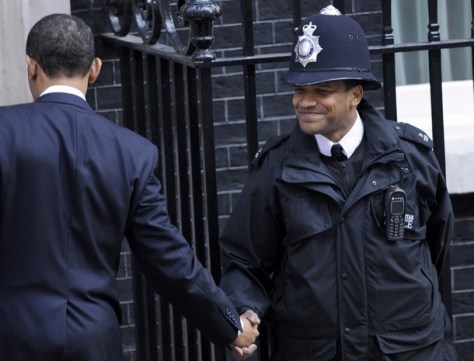
The British queen placed a royal hand around the American First Lady’s waist, who graciously reciprocated, and a million words and images were launched in the world media on that historical moment.

How come we never got to see  this other Touching Moment in London involving another Obama? Thanks to Dilip Simeon, who was sent this by a friend, I received this picture of what happened when Barack Hussein was entering 10, Downing Street on April 1, 2009.

There he is, a British police officer joyously breaching protocol while ushering a black American president into the British corridors of power. As the caption in the forwarded message said – “the two brothers couldn’t resist the historic moment!”

(Reuters/Toby Melville)

That’s it for now, folks.

That day in 2003

Look who’s blogging at GVO. Salam Pax.

Tens of Thousands Protest G20 Summit

‘They hoped for ten thousand, but in the end more than three times that number turned out on London’s streets today for the biggest mass demonstration since the beginning of the economic crisis’, writes a report in the Guardian.
London march, courtesy Associated Press

According to another report: Tens of thousands of people marched across central London Saturday to demand jobs, economic justice and environmental accountability, kicking off six days of protest and action planned in the run-up to the G20 summit next week.

More than 150 groups threw their backing behind the “Put People First” march. Police said around 35,000 attended the demonstration, but there were large gaps in the line of protesters snaking its way across the city toward Speaker’s Corner in Hyde Park.

Read the full report here.

What is significant about the protests this time round, is that ordinary people are not ready any more to be the sacrifiical lambs while the big corporations are bailed out. ‘Capitalists, you are the crisis’ and ‘We won’t pay for their crisis’ are in fact some of the important and key slogans of the current round of protests.

Evangelist Zizek and the End of Philosophy – II

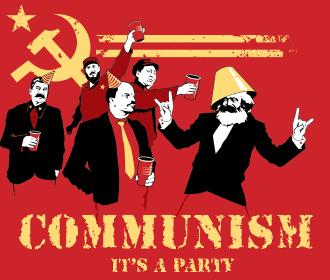
Idea of communism? Courtesy Oscar's global blog
Idea of communism? Courtesy Oscar’s global blog

Today was the third and final day of the ‘Idea of Communism’ conference and it was the truly most bizarre experience – bizarre philosophical experience, I should say – of my life. Let me start backwards today.

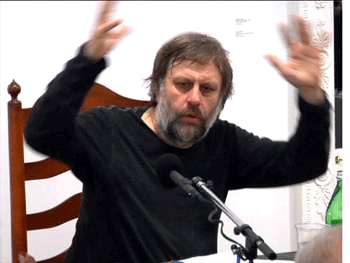
The preacher from Ljubliana was in full form and he closed his own hour-long (or was it 55 minutes) presentation ‘To Begin from the Beginning, Over and Over Again’ with the following: “If the rumour that Gilles Deleuze was writing a book on Marx before he died, is true then this should be seen as a sign that after having spent a life time away from the Church he wanted to come back to its fold…We welcome all those anti-communist Leftists who have spent their lifetimes attacking us to come and join us.” Continue reading Evangelist Zizek and the End of Philosophy – II

Re-booting Communism Or Slavoj Zizek and the End of Philosophy – I

Zizek - the postmodern Lenin?

Today, 13 March, a whole galaxy of philosophers and theorists got together for a three-day conference “On The Idea of Communism” under the auspices of the Birkbeck Institute for the Humanities, London University. The Conference opened to a jam-packed hall where all tickets had sold out (no jokes, this was a ticketed show where the likes of Alain Badiou, Slavoj Zizek, Jean Luc-Nancy, Toni Negri, Jacques Ranciere, Terry Eagleton and many many others are to perform on the ‘idea of communism’). The huge Logan hall with a capacity of about 800-900 was so packed that the organizers had made arrangements for video streaming in another neighbouring hall – and that too was half full! Very encouraging in these bleak days.

The conference began in the afternoon with brief opening remarks by Alain Badiou and Slavoj Zizek. Badiou made his general point (see below) about the continuing relevance of the ‘communist hypothesis’. Staid and philosopherly. Continue reading Re-booting Communism Or Slavoj Zizek and the End of Philosophy – I

Kashmir Tribunal Memorandum to CM Omar Abdullah

To: Mr. Omar Abdullah
Chief Minister
Jammu and Kashmir

From: The International People’s Tribunal on Human Rights and Justice in Kashmir Continue reading Kashmir Tribunal Memorandum to CM Omar Abdullah