Category Archives: Empire/ Imperialism

Why India Needs the Death Penalty

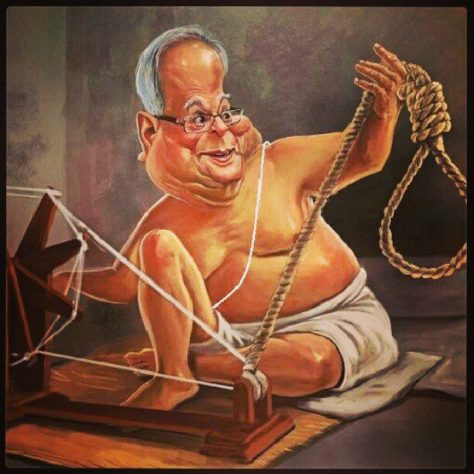
poltu-hangman-gandhi-india

So, The Law has been taking its Own Course, without any help from the political bankruptcy of the Kangress party. The Law took its Own Course and hanged Ajmal Kasab before a Parliament session and co-incidentally Afzal Guru before another Parliament session. The Law’s Own Course is stranger than the river Kosi which changes direction at will (actually, even the Kosi river changes directions because of corruption in the unnecessary embankments the Bihar government builds). Continue reading Why India Needs the Death Penalty

Punishment by Procedure: Saurav Datta

Guest post by SAURAV DATTA

“An advocate, by the sacred duty which he owes to his client, knows in the discharge of that office but one person in the world- the client, and no other…to protect that client at all hazards and costs to all others, and among others to himself, is the highest and most unquestioned of his duties…..Nay, separating even the duties of a patriot from those of an advocate, and casting them if need be to the wind, he must go on reckless of the consequences…” – Lord Brougham, “Law and Other Things”, Cambridge University Press (1937)

“Beneath this face that appears so impassive hell’s tides continually run.” – Walt Whitman,“You Felons on Trial in Courts”

“Nothing rankles more in the human heart than a brooding sense of injustice.” Justice Brennan’s words keep on ringing in my ears when I see the manifestly violent injustice meted out to Mohammad Afzal- the Courts tore to smithereens his inalienable right to a fair trial. The Parliament attack case was the first litigation I had been part of – I was a student intern in the chambers of Ms. Kamini Jaiswal, who was briefing Mr. Ram Jethmalani. I got to see and understand the case from the closest of quarters, and that maybe that exacerbates my indignation at this egregious miscarriage of justice. Continue reading Punishment by Procedure: Saurav Datta

Capital Punishment – An Agenda for Abolition: Yug Mohit Chaudhry

This is (a slightly modified) text of the second Shahid Azmi Memorial Lecture, delivered at the Indian Law Institute on 9 February 2013 by advocate YUG MOHIT CHAUDHRY. The lecture and its topic had been scheduled days in advance, but co-incidentally, Mohd. Afzal Guru was hanged in the morning of the day of the lecture. The Shahid Azmi Memorial Lecture has been instituted by his friends, comrades and students, who want to keep alive the memory of his inspiring work. Advocate was shot dead in his office on 11 February 2010, at the age of 32. At the time of his murder, Shahid was fighting several terrorism cases, including of those falsely accused in the Malegaon blasts and the 26/11 Mumbai attacks.You can read tributes to Shahid Azmi in Kafila archives by Mahtab Alam, Arvind Narrain and Saumya Una, and Susan Abraham.

In Furman v. Georgia (1972), where the U.S. Supreme Court struck down the death penalty, Justice Marshall said that if citizens were fully informed about how people are sentenced to death, they would find capital punishment shocking, unjust and unacceptable. However, research on the death penalty and public awareness of the exact nature of the death penalty have been the most neglected areas in the abolition campaign in India. The last three challenges to the constitutionality of the death penalty in India were rejected by the Supreme Court, inter alia, on the grounds that there is no empirical data to support the abolitionists’ claims. Unfortunately, the situation has not changed at all, and even now there is hardly any research on this subject. Therefore, the highest priority in any abolition campaign is to produce empirical research on the death penalty. That, and doing our utmost to stop each proposed execution and, failing that, to make it as difficult as possible for the state to carry out an execution, adopting all legal, political and social means at our disposal.   Continue reading Capital Punishment – An Agenda for Abolition: Yug Mohit Chaudhry

I love the winter in your eyes: Uzma Falak

Guest post by UZMA FALAK

Winter of my eyes
took flight
Did you see?
These are not the same eyes
colors of which you would patiently decipher
sitting under the sun
for hours
gray dreams refusing to dissolve
in waters of Lethe. Continue reading I love the winter in your eyes: Uzma Falak

PUCL statement on the President’s rejection of the mercy pleas of four Veerappan associates

Press release put out on the evening of 16 February by the PEOPLE’S UNION FOR CIVIL LIBERTIES

CHENNAI: The PUCL strongly condemns the rejection by the President of India of the commutation petitions of Simon, Meesakara Mathayan, Bilavendran and Gnanaprakasam. Equally condemnable is the action of the Prison Authorities of Belgaum Central Prison, Karnataka who in the morning of 13.2.2013 merely intimated orally to the convicts of the rejection of their mercy petitions without giving them the written orders of rejection. In sharp contrast, signed acknowledgements of receipt have been obtained from all 4 convicts! Continue reading PUCL statement on the President’s rejection of the mercy pleas of four Veerappan associates

Who’s afraid of the Karachi Literature Festival?: Ayesha Siddiqa

Guest post by AYESHA SIDDIQA

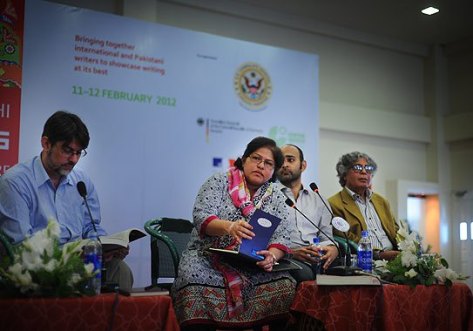
Photo via Dawn.com

Here we are seemingly in an age of intellectual freedom, burgeoning media industry and literature festivals. There are numerous festivals held all over South Asia celebrating books new and old, bringing people together for exchange of ideas. But these festivals seem to be wrapped in their own politics. In some cases, certain cliques that want to encourage a peculiar perspective dominate the show. I understood this through my interaction with the Karachi Literature Festival. Continue reading Who’s afraid of the Karachi Literature Festival?: Ayesha Siddiqa

‘Death penalty in India is a legal lottery’

Justice Ajit Shah says that it has been proven beyond doubt that death sentence does not serve as a deterrent against crime; the reason why two third of the world has abolished it all together. He explains the bizarre nature of how the death sentence in India is judge centric and how under the same set of circumstances, some have received the death sentence, while others have been given life and still others acquitted. Death sentence is judge centric with many judges having a history of doling out death penalties and other being kind. Death sentence is thus nothing but a ‘legal lottery’ where if you are lucky you get a lenient judge you survive, else you end up at the gallows. He talks about the caste and class connection to death sentence, where the lower castes and lower classes are usually the ones sent to the gallows because they cannot afford proper legal aid. He says that this discriminatory nature renders death penalty unconstitutional and that there is the need for a larger debate on the same.  Continue reading ‘Death penalty in India is a legal lottery’

Death Penalty – an agenda for abolition: Yug Mohit Chaudhry

This is the audio of the Shahid Azmi Memorial Lecture delivered on 9 February 2013 by YUG MOHIT CHAUDHRY at the Indian Law Institute in Delhi. While the lecture date and topic – death penalty – were scheduled weeks in advance, it co-incidentally happened that Mohd Afzal Guru was hanged on the morning of the lecture. Shahid Azmi was a lawyer in Mumbai. He was 32 when he was shot dead on 11 February 2010.

On Shahid Azmi from Kafila archives:

Previously in Kafila by Yug Mohit Chaudhry:

See also:

More on Afzal Guru from Kafila archives:

When the Indian nation’s ‘conscience’ was satisfied: Gazala Peer

Guest post by GAZALA PEER

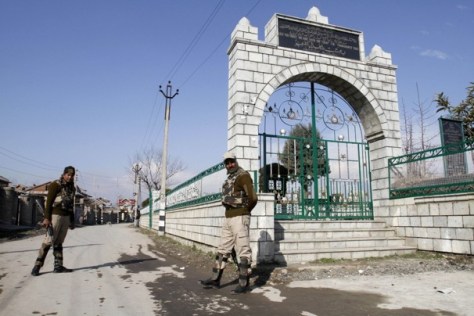
CRPF personnel stand guard at the martyrs' graveyard in Srinagar,preventing entry. The graveyard has a new empty grave, that of Afzal Guru. A similar empty grave waits for Maqbool Bhat, also buried in Tihar jail. Photo credit: Mukhtar Khan/Associated Press
CRPF personnel stand guard at the martyrs’ graveyard in Srinagar, preventing entry. The graveyard has a new empty grave, that of Afzal Guru. A similar empty grave waits for Maqbool Bhat, also buried in Tihar jail. Photo credit: Mukhtar Khan/Associated Press

People who mourn under siege are not supposed to write. We cry and beat our chests. Kashmiris have long faced such predicaments, always forced to find alternatives for everything. Anything that is normal and fair is denied to them! Like a fair trial, for instance. I am not sure if everybody knows Mohd. Afzal Guru’s story. I am not sure if I can be fair to him, but whatever I could gather from legal documents, commentaries and articles, is summarised here. Continue reading When the Indian nation’s ‘conscience’ was satisfied: Gazala Peer

‘In the land of Buddha and Gandhi, death penalty has no place’: 83 feminist activists

This public statement was put out on 13 February by a group of 83 feminist activists; names of signatories at the end.

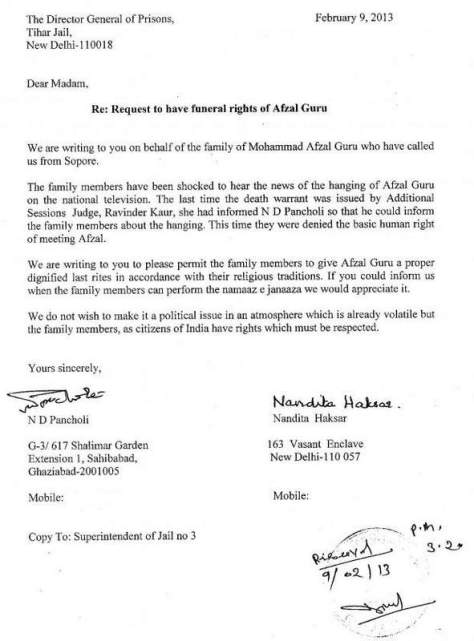
We, women from various organizations in India, condemn the hanging of Afzal Guru in Tihar Jail early on the morning of 9.2.2013.

The tearing hurry and secrecy with which Afzal Guru was hanged, accompanied by the flouting of all established norms by not giving his family their legal right to meet him before taking him to the gallows, clearly indicates that there were political considerations behind taking this step. More shameful is the explanation of the Home department that the wife and family of Afzal Guru were intimated of the hanging by a mail sent by Speed Post and Registered Post. Decency and humanity demanded that the Union Government give prior intimation to the family and an opportunity to meet him. Such surreptitious action of the government also deprived the family of Afzal Guru to right to seek legal remedy. Continue reading ‘In the land of Buddha and Gandhi, death penalty has no place’: 83 feminist activists

A letter of protest to the President of India against the execution of Afzal Guru: JTSA

This letter, signed by 202 citizens whose names are given at the end, has been put out by the JAMIA TEACHERS SOLIDARITY ASSOCIATION

To,
The Hon’ble President of India

Respected Sir,

We write to you in deep anguish, despair but in outrage as well. Afzal Guru was hanged on Saturday (9th February 2013) in secrecy. We have been told – after the hanging – that you rejected the mercy petition filed by Guru’s wife Tabassum, on 3rd February. We believe that you made a grave error in rejecting the mercy petition. If you had perused the trial records and the lengthy documentation put together over the years by lawyers and civil rights activists, or even the Supreme Court judgement which sentenced Afzal to death, you would have known, that his guilt was never established beyond reasonable doubt. The fact that the Court appointed as amicus curiae (friend of the court) a lawyer in whom Afzal had expressed no faith; the fact that he went legally unrepresented from the time of his arrest till his so-called confession, the fact that the court asked him to either accept the lawyer appointed by the Court or cross examine the witness himself should surely have concerned you while considering his mercy petition. Continue reading A letter of protest to the President of India against the execution of Afzal Guru: JTSA

Freedom of speech in India is for the rich and the powerful

While freedom of speech and expression in India is under attack from all sides, have you noticed how the rich and the powerful can say what they like without getting arrested, facing FIRs and courts, hiring lawyers and so on?

While an innocuous tweet or Facebook status update can land you in police lock-up on a Saturday night or Sunday morning 5 am, a Digvijaya Singh can say sexist crap against Rakhi Sawant and get away with it.

Here’s another example from Twitter recently. Lalit Modi of IPL infamy, who wants us to believe his coming to India and facing the law is a security threat to him, tweeted that the BJP’s  Arun Jaitley would lose his deposit if he contested the Lok Sabha seat from Jaipur. (Lalit Modi thinks he’s the Maharaja of Rajasthan.) In response to that, one Ankush Jain replied… Continue reading Freedom of speech in India is for the rich and the powerful

The Day Afzal Died: Nirmalangshu Mukherji

Guest post by NIRMALANGSHU MUKHERJI

There are days in which streaks of hope shine through dark clouds of misery. The 9th of February, 2013, was such a day.

The day broke with the news that the noose of the Indian state had finally seized the throat of Mohammad Afzal Guru after years of careful conspiracy. With ill-concealed admiration, the television screens reported the military swiftness, the secrecy, and the perfection with which a nuclear-powered state with one of the largest armies in the world escorted an unarmed, hapless Kashmiri to the gallows, performed its rituals, and pulled the bolt. As the murder was officially videographed with full legal sanction, the body was kept dangling for thirty minutes before it was pulled down and immediately buried in an ‘unmarked’ grave, protected by layers and layers of impenetrable walls. The case of Afzal Guru was thus brought to a ‘closure’. So hoped the state. Continue reading The Day Afzal Died: Nirmalangshu Mukherji

Some questions for comrade Karat on the killing of Afzal Guru: Satya Sivaraman and Manisha Sethi

Guest post by SATYA SIVARAMAN and MANISHA SETHI

Shri Prakash Karat,

General Secretary,

Communist Party of India (Marxist)

Dear Comrade,

Afzal Guru was hanged yesterday in utter secrecy, denied in his last moments the right to meet his wife and children one final time. Denied to him also was the ultimate judicial resort, due to every condemned convict after his/her mercy petition has been rejected.

The entire legal proceedings against Afzal were shot through with contradictions, fabrications and travesties of legal procedure. The Supreme Court bench that finally sentenced him to death did so to ‘appease the national conscience’ despite inadequate evidence of his role in the Parliament attack case.    Continue reading Some questions for comrade Karat on the killing of Afzal Guru: Satya Sivaraman and Manisha Sethi

Afzal Guru’s family demands his body

Theories of Oppression and another Dialogue of Cultures: Ashis Nandy

This is the text of the Ambedkar Memorial lecture delivered by ASHIS NANDY at the India International Centre on 14 April 2012, under the auspices of Ambedkar University, Delhi.

It was published in Economic and Political Weekly, July 28, 2010

Every generation likes to believe that it is living in momentous times, witnessing the death of one world and the birth of another, negotiating what pre-war Bengali writers used to grandly call yugasandhikshana, the moment when two epochs meet. This generation of Indians too believes that it is seeing such changes and even participating in them. Perhaps they are. However, I shall argue here that, along with transitions in society and politics to which they like to stand witness, there are transitions in cultures of knowledge and states of awareness of which they may be gloriously innocent. And they perhaps try to protect that innocence. The categories we deploy to construe our world images are parts of our innermost self and to disown them is to disown parts of ourselves and jeopardise our self-esteem. Even when we struggle to shed these categories, they survive like phantom limbs do in some amputees. Or perhaps they survive the way one of Freud’s three universal fantasies, the one about immortality, does. When you imagine yourself dead, you are still there, fully alive, looking at yourself as dead. Continue reading Theories of Oppression and another Dialogue of Cultures: Ashis Nandy

Our memories come in the way of our histories: Gowhar Fazili

Guest post by GOWHAR FAZILI

Our Moon Has Blood Clots by Rahul Pandita; Pages: 258; Vintage Books, Random House, India; Price: Rs 499

Rahul Pandita’s book Our Moon Has Blood Clots must be looked at both as a personal account of suffering as well as a political project that implicitly and explicitly makes use of that suffering towards a particular end. The undertaking is a legitimate one on both counts.  What the book manages to achieve on each, warrants a fair and dispassionate assessment.

His narration of events experienced by the Pandits is a welcome exposition of subjectivity around a range of traumatic events, humiliations, killings and betrayals undergone prior to and after the outbreak of mass political rebellion in Kashmir in 1989. The events thus narrated, especially the account of the personal experiences of trauma do make one strongly identify with the suffering of the families involved and agree with the wide swathes of subjective anger and hurt shared by the community.  The chilling accounts of individual and mass killings and the circumstances that made them possible, call for collective self-reflection, remorse and atonement. This account also calls for serious reflection on the fragility of human associations and trust in exceptional circumstances that we normally take for granted.

The book as well as the promotional interviews around the book push the claim that not only certain militants but also many ordinary people, including those personally known to the victims, were responsible for the exodus through their acts of omission and commission.  This claim is substantiated through a range of indictments based on personal encounters with individuals, shared nuggets of information, as well as the interpretation of the larger political symbolism and slogans which were seen as a deliberate attempt to intimidate Pandits, and Pandits alone.  While it is difficult to deny that a number of individuals took advantage of those anarchic times to gratify personal hate and lust for loot, it makes for an overstatement to underplay the equally frequent narrative of mutual support between individuals that one gets to hear during conversations between the members of the two communities privately. Such underplay does violence to those aspects of shared memory.  Continue reading Our memories come in the way of our histories: Gowhar Fazili

Suran: A poem by Uzair

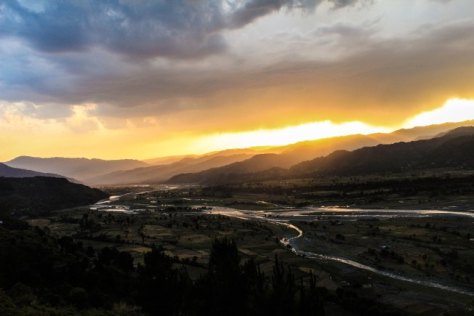
This guest post is a poem by UZAIR, who grew up near the Indian side of the ‘Line of Control’ in Poonch

The poet took this photograph in Poonch by the river Suran last summer.Across the second ridge lies the Line of Control. Taken from the Indian side, the photo captures the sun setting on the Pakistani side.
The poet took this photograph in Poonch by the river Suran last summer. Across the second ridge lies the Line of Control. Taken from the Indian side, the photo captures the sun setting on the Pakistani side.

The river carries with it
Snow of distant peaks,
Floating memories
Twigs, leaves.

Only a few miles west
it would be stripped
at the border, asked
to produce a permit,
shot dead or may be not.

Waters were negotiated upon;
so the river travels seamlessly
only a few miles west
to another country.

On its bank, I heard
a cuckoo speak
“The sun shines during day
and stars illuminate the night sky
even across the border”

“And a few collect the twigs
like memories of childhood;”

“smell of dead wood, so familiar
grief and longing, so natural
decades of hope; still alive,
even across the border”

One day the river would flow
eastwards, said the old man
whose corpse floated across,
only a few miles west
and met his children
across the border.

(Uzair blogs at Untitled Untitled.)

See also:

The Country With A ‘Balancing Office’: Suvaid Yaseen

Guest Post by Suvaid Yaseen

Of late there has been a rising trend of Kashmiris – professionals, artists, writers, musicians et al presenting their works on Kashmir on a much wider level than before. The larger impression that comes out of it all is that the narrative has been taken up by the people for themselves. A welcome contrast to outsiders flying in and telling us what we want, how we think, and what is actually good for us.

So, every time a Kashmiri artist is presenting his/her work on Kashmir, the expectations among Kashmiris tend to go up. People start feeling that finally their narrative, of how they saw the things, what they went through, would be told to the world, bereft of the lenses of security paradigm through which Kashmir has been usually viewed  –  a strategic territory, with not-so-strategic, dispensable people.

This can be fortunate as well as unfortunate. On one hand there is a ready audience to appreciate and applaud your work. On the other hand there are expectations to ‘perform’. For the artists themselves, there are additional pressures of ‘balancing’ and having a ‘non-biased’ view from the other side.

Continue reading The Country With A ‘Balancing Office’: Suvaid Yaseen

January 6, 1993 – A Town Torched: Remembering the Sopore Massacre Twenty Years After: Sameer Bhat

Guest post by SAMEER BHAT

In Memory of the Massacre in Sopore, Kashmir, by the 94th Battalion of the Border Security Force on January 6, 1993.

[YouTube Video – Compiled from various sources – including a report by Savyasachi Jain, now with NDTV, for Eyewitness – a VHS delivered video news magazine active in the early 1990s.]

There was sound of a huge bang that morning, like someone blowing up a cartful of dynamite. Just before the cockcrow. Most of the townspeople were asleep. The dawn prayers had thin attendance, mostly because it gets very cold in January. By nine o’clock a military patrol was out, doing rounds of the main marketplace. Suddenly gunmen emerged from a narrow alley and shot random bullets at the party before quickly disappearing in the maze that old Sopore is. Taken rather off guard, the security detail ran back to their barracks only to emerge again as Frankenstein’s monsters, spitting hell fire. In the next fifty odd minutes, they murdered fifty five people in cold blood. And burnt the town down. Continue reading January 6, 1993 – A Town Torched: Remembering the Sopore Massacre Twenty Years After: Sameer Bhat

A review of human rights in Jammu & Kashmir in 2012: JKCCS

This brief has been put out by the JAMMU AND KASHMIR COALITION OF CIVIL SOCIETY

TOTAL KILLINGS

The year 2012 has just passed, and yet again like previous years, the government of Jammu and Kashmir has disgracefully claimed the year to be peaceful. This hyped peace is void of justice & peace and is packed with violence & injustice. In the year 2012 the people of Jammu and Kashmir in routine have witnessed unabated violence, human rights abuses, denial of civil and political rights, absence of mechanisms of justice, heightened militarization and surveillance. The figures of violent incidents suggest that 2012 as usual has been the year of loss, victimization, lies, mourning and pain for the people. Continue reading A review of human rights in Jammu & Kashmir in 2012: JKCCS