Category Archives: Excavation

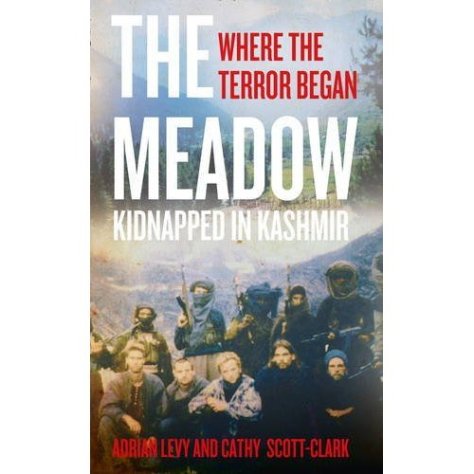
Who killed four foreign tourists in Kashmir in 1995?

Given below is the text of a petition submitted to the Jammu & Kashmir State Human Rights Commission by the INTERNATIONAL PEOPLE’S TRIBUNAL ON HUMAN RIGHTS AND JUSTICE IN INDIAN-ADMINISTERED KASHMIR (IPTK) together with the ASSOCIATION OF PARENTS OF DISAPPEARED PERSONS. A Division Bench of the SHRC will hear the case on 17 April 
To,
Mr. Tariq Ahmad Banday,
Secretary,
Jammu and Kashmir State Human Rights Commission,
Srinagar

Date: 6 April 2012

Dear Mr. Banday,

The International People’s Tribunal on Human Rights and Justice in Indian-administered Kashmir [IPTK] (a brief on the Tribunal’s premise and objectives may be found here) and the Association of Parents of Disappeared Persons [APDP], present before you the following submission:

  1. In July 1995, during a trekking expedition, six persons were reportedly kidnapped by a group that referred to itself as “Al-Faran” [a front of the Harkat-ul-Ansar]. The six persons kidnapped were: John Childs [Simsbury, Connecticut, USA], Dirk Hasert [Bad Langensalza, Germany], Don Hutchings [Spokane, Washington State, USA], Keith Mangan [Teesside, Middlesbrough, England], Hans Christian Ostrø [Oslo, Norway], and Paul Wells [Blackburn, Lancashire, England]. Continue reading Who killed four foreign tourists in Kashmir in 1995?
Reflections of a Refugee from Modi’s Gujarat: Reza Noorani

Guest post by REZA NOORANI

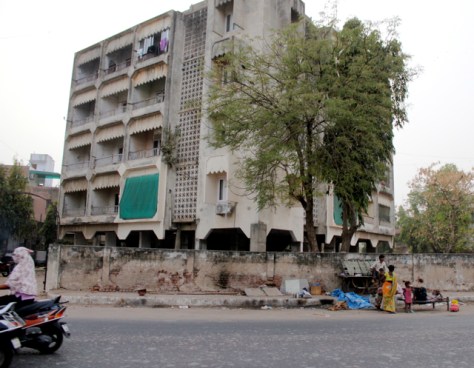
Kashana Flats, Paldi, Ahmedabad, as they stand today. Photo credit: Prateek Gupta

When the riots broke out in 2002 in Ahmedabad, after the burning of the Godhra coach, I was in the tenth standard. I remember listening to the news in the morning, just after which my best friend Ketan had called me and asked “Why did you guys do this?” I didn’t know how to respond to that. I think I just laughed it out and we began discussing what was happening in the city. My father took the phone away from me. I was preparing for my board exams and was just about to leave for one of the last days of school, after which we would go on a study leave. My father, who had experience with riots, told my two elder sisters and me to not go to school and stay at home that day. Continue reading Reflections of a Refugee from Modi’s Gujarat: Reza Noorani

Let’s not count the poor (seriously)

As someone recently commented on a Kafila post, we live in a post-fact world where there are no facts. Everyone believes what they want to. So depending on your  ideology, poverty in India has reduced or increased. But such is the debate on poverty that the definition of poverty itself is subject to debate. How poor do you have to be, so that the government will say you are poor? This poverty debate has been on around the same lines for about ten years now, with the economic left arguing that India isn’t shining, and the economic centre-right arguing that millions of people have been lifted out of poverty by India’s super-successful economic growth. The debate will go on forever, there will be no certainty in numbers, and perhaps there shouldn’t be – perhaps counting the poor cheapens the issue of poverty. Counting the poor leads us to ask, what about the only -slightly-better-than-the-poor? Counting the poor leads us to compare poverty numbers and give us relief. Ah, only 30% Indian poor now, as opposed to 50% in such and such decade, nice! Great job India! No, this is not what the poor deserve, whether they are 30% or 50%. Perhaps we should stop counting the poor. Continue reading Let’s not count the poor (seriously)

Some thoughts on the “hawa” in Indian elections

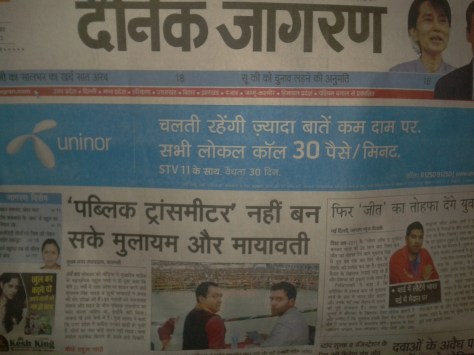
‘Public transmitter’ nahi ban sakey Mulayam aur Mayawati. (Mulayam and Mayawati could not become public transmitters.)

In the Hindi original of that line, the phrase public transmitter is in single quotes only because they are English words in a Hindi paper. The entire sentence is not in quotes. A sentence like this, if it were the title of a text, would count as an expression of opinion. And yet, it was a news headline in the Varanasi edition of UP’s largest selling daily, Dainik Jagran. In case you could not guess who it was trying to help, there was the photo of Rahul Gandhi below the headline. This was the lead story. Continue reading Some thoughts on the “hawa” in Indian elections

Defending Narendra Modi: An Exercise in Obfuscation

In Outlook magazine last week, its web editor Sundeep Dougal asked 25 questions of Narendra Modi about the 2002 Gujarat pogrom and the subversion of justice since then. Predictably, the army of Narendra Modi Defenders began to spill outrage at such blatant compilation of true charges against Mr Modi. Doing the rounds of the internet is a point by point rebuttal to Dougal’s questions by a blogger, Shashi Shekhar, who goes by the name Offstumped, and is a known online Modi defender. Offstumped’s answers have been responded to by Dougal, and yet Offstumped’s rejoinder is being circulated all over the internet by Modi defenders in the hope of persuading public opinion that Mr Modi is a spotlessly clean man whose actions and inactions did not result in any loss of life, property or dignity of anyone in 2002 and later. The rather large army of Narendra Modi Fans on the internet hopes that by repeating their standard lies again and again, they will one day become accepted truth. Continue reading Defending Narendra Modi: An Exercise in Obfuscation

In the name of sovereignty: APDP

This release comes from the ASSOCIATION OF PARENTS OF DISAPPEARED PERSONS, the Bund, Amira Kadal, Srinagar – 190001, Jammu and Kashmir

Press Statement, 25th January 2012: On 17th October 2011, Association of Parents of Disappeared Persons (APDP) submitted an application for information under Right to Information Act 2009 to the office of the Public Information Officer of State Department of Home. The application was regarding unmarked graves and mass graves in all the districts of Jammu and Kashmir. The State Home Department vide its letter no: Home/RTI/2011/1659 dated: 24th October 2011, transferred the application to the office of Director General of Police, Jammu & Kashmir. Later Director General of Police, Mr. Kuldeep Khoda sent communiqué vide no. legal/RTI/III/98/2011-5590-91 dated 10th December 2011 to the SSP CID Headquarters, asking him to furnish a detailed report on this issue.

Today, on 25th January 2012, we have received a response from the SSP CID Headquarters vide letter no: CID/GB/RTI/2011/8756-58, in which the CID Department has informed us that the information regarding the unmarked graves and mass graves in all the districts of Jammu and Kashmir cannot be shared as the disclosure of the information, according to Jammu and Kashmir Police would be “prejudicial to the maintenance of public peace and tranquility, as the anti-national elements may use the same for incitement of commission of offence in the state”. The SSP CID Headquarters further states, “In the present security scenario it is quite imminent that consequences of such a situation would be highly prejudicial to the sovereignty, integrity and security of the state”. Continue reading In the name of sovereignty: APDP

This is the story of the monkeys of Delhi

From 2009 to early 2011, I lived in a south Delhi barsati which had an enormous terrace area. When I moved in, this open space looked sad and empty, so I spent many thousands of rupees doing it up with all kinds of plants. Then came the monkeys. A team of five to ten. On finding the kitchen locked, they would break the pots, and sometimes eat the plants. No flower was allowed to bloom.

I replaced the mud pots with heavy cement ones. The monkeys broke fewer of them but ate more shoots and leaves. They would come at night. Soon they’d come at dawn, and make such a commotion I’d wake up terrified. Mild banging on the door wouldn’t ward them off, nor would the other tactics I tried. I was afraid of them. They could be aggressive and strong and these traits were multiplied because they operated in gangs. I felt caged in the small room of my large barsati. All I could do was share my misery on Facebook. “Be careful,” a friend warned in a comment, “they once killed the deputy mayor of Delhi.” Read more…

Amitav Ghosh on Goa

Some musings here about the liberation of Goa from Portugese rule by India:

But the interaction between Portugal and India also produced vibrant cultural hybrids in architecture, music and food. Among the state’s most famous dishes is the spicy vindaloo, a curry whose name is thought to be a contraction of the Portuguese phrase “vinho de alho,” or garlic wine. Besides, as Mr. deSouza pointed out, Goa was where the influence of the Enlightenment and the Renaissance in Europe was felt much before it reached other parts of India. As a result, the practice of sati – or widows immolating themselves on their husbands’ funeral pyres – was abolished in Goa 200 years before the British banned it in the rest of India. [Naresh Fernandes]

And on Portugese language, 50 years after the Portugese were sent back to Portugal:

The popular history of the Portuguese period in Goa has largely been restricted to the gory tales of the initial conquest of the island of Goa, of the Inquisition, and the dramatization of the anti-colonial episodes in the territory’s history. To a large extent, this nationalist history dissuades Hindus from subaltern castes from studying the language. This has ensured that it is solely dominant-caste narratives that are incorporated into the histories of the territory, preventing alternative and liberatory narratives to emerge from a re-reading of the texts and narratives of the period of Portuguese sovereignty over the territory.  It is little known for example, that the knowledge of Portuguese is critical to the bahujan challenge to Hindu upper-caste groups’ monopolistic control of the Goan temples. This monopolistic control of the temples was forged in particular through these latter groups’ knowledge of Portuguese. [Jason Keith Fernandes]

Human Rights Review – Jammu and Kashmir in 2011: JKCCS

This release comes from the JAMMU AND KASHMIR COALITION OF CIVIL SOCIETY, the Bund, Amira Kadal, Srinagar 190001, (www.jkccs.net)

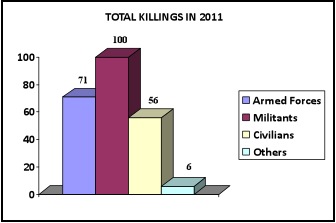
TOTAL KILLINGS

Year 2011 has just passed, and many have declared this year, a peaceful year in Jammu and Kashmir. Of course assertions of peace by various quarters are relative. Enforced silence cannot be construed as peace. Despite the hype of peace, people of Jammu and Kashmir have witnessed unabated violence, human rights abuses, denial of civil and political rights, absence of mechanisms of justice, heightened militarization and surveillance. The figures of violent incidents suggest that 2011 as usual has been the year of loss, victimization, mourning and pain for the people. Continue reading Human Rights Review – Jammu and Kashmir in 2011: JKCCS

When the Wandering Falcon came to Delhi: Pragya Tiwari

Guest post by PRAGYA TIWARI

Nilanjana Roy moderating the prize ceremony; Jamil Ahmad in the background via Skype. Photo courtesy: The Shakti Bhatt Foundation

There is this world among the many worlds of Delhi, the world of book events. You show up for a reading followed by a conversation between the author and some other prominent member of the fraternity. Afterwards you drink wine and exchange news with everyone you know there. And you know everyone there. The scale of some of these events would make you think books actually sell. But the greater riddle for those of us who show up is this: Why do we show up? To see friends, to socialise and occasionally to celebrate books, or perhaps the very existence of books irrespective of quality; to register our support for words and stories bound by charming jackets; to toast these objects of desire in a simulated bubble where they shine on undeterred. Debatable as their meaning might be, for most part these events are mere rituals. On the 21st of December, however, for a brief moment I was made to see that they could be more than that. The man who made that apparent was not even physically present in the room. Continue reading When the Wandering Falcon came to Delhi: Pragya Tiwari

The Year of the Coup D’état: Fawzia Naqvi

Guest post by FAWZIA NAQVI

Imran Khan was not the first one to be obsessed with both cricket and politics. Saira and I beat him to it 20 years ago. We spent 50% of our time swooning over him and the other 50% worshipping Mr. Bhutto. 20 years later I believe it was I who got over Imran Khan and Saira who got over Mr. Bhutto. Although I must confess, it was Imran who adorned every inch of wall and closet space in my dressing room, the “shrine” as my brother labelled it. And it was Imran’s picture which popped out of the inside cover of my high school notebook. During moments of boredom and droning lectures I would stare at his picture for an hour straight and muse and sigh over the fact that one could see his house from the balcony of our school and perhaps today might be the day when he would come to pick up his sister from our school. The God, the Adonis, Imran was it for both of us.

I don’t know how Saira became an Imran groupie. I do recall well how I did. I was taken to my first ever live cricket match in 1976. My brother’s best friend pointed toward the field from high up in the spectator stands to what looked to me like white dots, and told me with much seriousness in his voice, “there over there is the most handsome man you’ll ever see…” and then he made his most remarkable claim, “he’s so handsome you’ll forget about Izzy!” Continue reading The Year of the Coup D’état: Fawzia Naqvi

Does the Universal Declaration of Human Rights impose Western values?: Gita Sehgal

The Indian freedom fighter was a key drafter

Guest post by GITA SEHGAL

10 December was Human Rights Day, anniversary of the Universal Declaration of Human Rights. Does the idea of human rights with their firm assertions, their belief in the ‘rule of law’ and their globalised vision, remain relevant in the world? The idea that there are absolute standards has come under attack from both the left and the right. The philosopher Alasdair MacIntyre , author of ‘After Virtue’, said, Natural rights and self evident truths proclaimed in the American declaration of independence are tantamount to belief in witches and unicorns. While from the left,  in ‘Human Rights and Empire’, Costas Douzinas has called human rights the political philosophy of cosmopolitanism and argued that human rights now codify and ‘constitutionalise ‘ the normative sources of Empire. Continue reading Does the Universal Declaration of Human Rights impose Western values?: Gita Sehgal

From Dehli to New Delhi, it wasn’t 1911

Amidst the cacophony of celebrating 100 years of Delhi, several details seem to have escaped the attention of our ever vigilant media, both print and electronic. This post is to draw your attention to a few of these ‘details’ in an attempt to place the celebrations in what appears to this author to be the correct perspective.

The 12th of December, 2011, can not by any stretch of imagination be described the centenary of Delhi, because there were at least 7 Dehlis before New Delhi came up, in fact 9 Dehlis if one were to add Kilokhri and Kotla Mubarakpurpur, Dehlis in their own right, to the generally accepted list of Qila Rai Pithora, Siri, Tughlaqabad, Jahan Panah, Firozeshah Kotla, Din Panah or Sher Garh or Purana Qila and Shahjahanabad. All of these came up at different times from the  11th century to the 17th century and all of these were more than a 100 years ago.

All that the 12th of December 2011 can claim to be the centenary of, therefore, is New Delhi. Let us look at even that claim a little more closely. What exactly transpired on the 12th of December 1911 that is causing so much excitement a 100 years later? Continue reading From Dehli to New Delhi, it wasn’t 1911

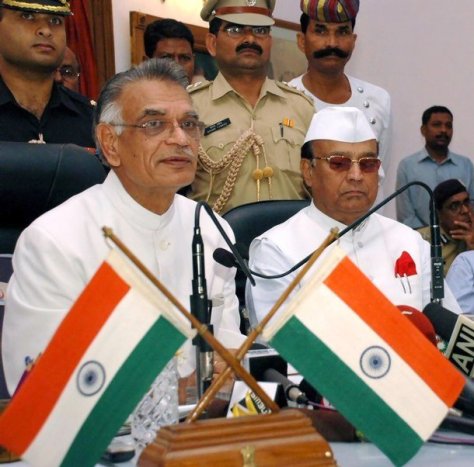
Shivraj Patil hath no mercy! Why could he not pardon an old, ailing Ram Kumar?: PUCL

This statement has ben issued by the PEOPLE’S UNION FOR CIVIL LIBERTIES

Ram Kumar died of cancer in Jaipur Central Jail, waiting for the Governor to grant him mercy and Dr. Khalil Chishty waits in Ajmer Jail while his file sits with the Governor for several weeks now!

The Governor of Rajasthan Sh. Shivraj Patil’s attitude towards exercising his powers of granting mercy to convicted prisoners is absolutely negative. Article 161 of the Constitution of India confers “on the Governor of a State the right to grant pardons, remissions, reprieves or commute the sentence of any person convicted of any offence against any law relating to a matter to which the executive power of the State extends.” Continue reading Shivraj Patil hath no mercy! Why could he not pardon an old, ailing Ram Kumar?: PUCL

हिन्दी फ़िल्म अध्ययन: ‘माधुरी’ का राष्ट्रीय राजमार्ग

(ये लेख स्रोत-चिंतन जैसा है, जिसे पीयूष दईया के कहने पर मैंने लोकमत समाचार, दीवाली विशेषांक, 2011 के लिए लिखा था। अपनी आलोचनात्मक टिप्पणियों से नवाज़ेंगे तो अच्छा लगेगा।)

This slideshow requires JavaScript.


बहुतेरे लोगों को याद होगा कि टाइम्स ऑफ़ इंडिया समूह की फ़िल्म पत्रिका माधुरी हिन्दी में निकलने वाली अपने क़िस्म की अनूठी लोकप्रिय पत्रिका थी, जिसने इतना लंबा और स्वस्थ जीवन जिया। पिछली सदी के सातवें दशक के मध्य में अरविंद कुमार के संपादन में सुचित्रा नाम से बंबई से शुरू हुई इस पत्रिका के कई नामकरण हुए, वक़्त के साथ संपादक भी बदले, तेवरकलेवर, रूपरंग, साजसज्जा, मियाद व सामग्री बदली तो लेखकपाठक भी बदले, और जब नवें दशक में इसका छपना बंद हुआ तो एक पूरा युग बदल चुका था। [1] इसका मुकम्मल सफ़रनामा लिखने के लिए तो एक भरीपूरी किताब की दरकार होगी, लिहाजा इस लेख में मैं सिर्फ़ अरविंद कुमार जी के संपादन में निकली माधुरी तक महदूद रहकर चंद मोटीमोटी बातें ही कह पाऊँगा। यूँ भी उसके अपने इतिहास में यही दौर सबसे रचनात्मक और संपन्न साबित होता है। Continue reading हिन्दी फ़िल्म अध्ययन: ‘माधुरी’ का राष्ट्रीय राजमार्ग

Hindi and Urdu: Sa’adat Hasan Manto

This is MUHAMMAD UMAR MEMON‘s translation of an article by SA’ADAT HASAN MANTO. The translation first appeared in The Annual of Urdu Studies.
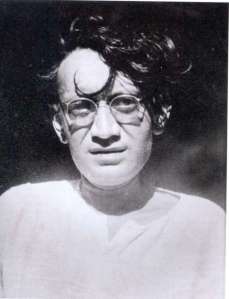
The Hindi-Urdu dispute has been raging for some time now. Maulvi Abdul Haq Sahib, Dr Tara Singh and Mahatma Gandhi know what there is to know about this dispute. For me, though, it has so far remained incomprehensible. Try as hard as I might, I just haven’t been able to understand. Why are Hindus wasting their time supporting Hindi, and why are Muslims so beside themselves over their preservation of Urdu? A language is not made, it makes itself. And no amount of human effort can ever kill a language. When I tried to write something about this current hot issue, I ended up with the following long conversation:

Munshi Narain Parshad:  Iqbal Sahib, are you going to drink this soda water?

Mirza Muhammad Iqbal: Yes, I am.

Munshi: Why dont you drink lemon?

Iqbal: No particular reason. I just like soda water. At our house, everyone likes to drink it.

Munshi: In other words, you hate lemon. Continue reading Hindi and Urdu: Sa’adat Hasan Manto

Pundit Manto’s First Letter to Pundit Nehru

This is M. ASADUDDIN‘s translation of a letter written by SA’ADAT HASAN MANTO to Jawaharlal Nehru in 1954. This translation first appeared in The Annual of Urdu Studies (volume 11, 1996).

Pundit-ji, assalamu alaikum!

This is the first letter I’m sending you. By the grace of God you’re considered very handsome by the Americans. Well, my features are not exactly bad either. If I go to America, perhaps I’ll be accorded the same status. But you’re the Prime Minister of India, and I’m the famed story writer of Pakistan. Quite a deep gulf separating us! However, what is common between us is that we are both Kashmiris. You’re a Nehru, I’m a Manto. To be a Kashmiri is to be handsome, and to be handsome … I don’t know. Continue reading Pundit Manto’s First Letter to Pundit Nehru

Everything you wanted to know about Suhel Seth but didn’t know who to ask

Suhel Seth, adman, actor, lobbyist, news TV pundit and god knows what else (the Facebook page for his book describes him as that know-all of our age, “marketing guru”), has published a self-help book that Mihir Sharma set out to review for The Caravan magazine. It is not Mr Sharma’s fault that this review became a profile of Seth, because he found that in the garb of a self-help book Seth had written an autobiography!

Mr Sharma notes:

Seth says his most important rule is: “Don’t make clients out of friends. But make friends out of clients.” Yet Suhel is friends with “almost everyone there is to know in the country”, or so the book’s jacket informs us. This may finally provide the explanation for why Get to the Top exists: he’s made friends at such a phenomenal rate that he must be running out of clients. [Must read – the full review.] Continue reading Everything you wanted to know about Suhel Seth but didn’t know who to ask

Arrested Development – a comparative study of Delhi’s schools and prisons: Sajan Venniyoor

Guest post by SAJAN VENNIYOOR

“Schools are prisons,” sang the Sex Pistols. “Another brick in the wall,” raged Pink Floyd, “Teacher, leave them kids alone!” Schools and prisons have been so frequently equated in the popular imagination that it has become a cliché almost never held up to scrutiny. But even a cursory study of Delhi’s schools and prisons belies the comparison.

Sure, Delhi’s schools and prisons are both dreadfully overcrowded. Delhi’s jails, built for 6250 prisoners, house 10500 on an average.  We cannot say with any statistical certainly just how overcrowded our schools are, as the Dept. of Education has no idea how many schools it runs or the actual number of teachers and students therein.

But in almost every major indicator of human development, the penal system far outperforms the public school system in Delhi. Continue reading Arrested Development – a comparative study of Delhi’s schools and prisons: Sajan Venniyoor

Dilli

Dilli, the name most people of Delhi use for their city, is “a multiple-award winning documentary that has played in over 50 international film festivals across North America, South America, Africa, Europe and Asia”. Recently released online.

Continue reading Dilli

In The Indian Express, a statistical Nehru-Gandhi oddity

Over at the Indian media blog Sans Serif, Pritam Sengupta counts the number of advertisements by the Government of India on the holy occassion of the late Prime Minister Indira Gandhi’s birth anniversary, and discovers a statistical oddity:

While it is natural that ToI and HT should garner so many ads given their large circulations in the national capital, the second place for the Express group is revealing considering it sells less than five per cent of market-leaders ToI and HT in the Delhi market, which both sell in excess of 5 lakh copies.

The tabloid Mail Today, which has the third highest circulation among the Delhi newspapers, too gets fewer ads than the Indian Express. [Read the full post]