
The ZeTo campaign organisers responded to Althea’s concerns expressed in an earlier post. We are delighted by and thankful for their willingness to dialogue, for we do believe that such an exchange of views is absolutely necessary for common ground to evolve on this issue, precisely because our readings of the political and social present in Kerala, are different.
Continue reading Zero Tolerance or Restorative Justice? Althea responds to ZeToCategory Archives: Feminism
Zero Tolerance, Democratic Responsibility, and the Question of Feminist Praxis: MJ Vijayan
Guest post by MJ Vijayan
The recent statement issued by members of the Althea Feminist Friendship Collective on the forthcoming Zero Tolerance (ZeTo) campaign in Kerala[1] deserves a serious and thoughtful response. I hope it will not be taken as a hostile document. Far from that, it is, in many ways, an anxious one – anxious about the state, about punitive excess, about the global history of ‘zero tolerance’ policies and campaigns, and about the risk of reinforcing authoritarian or brahminical patriarchies in the name of justice.
Those anxieties are not frivolous. Feminist history teaches us to be wary of state power. Yet feminist history also teaches us that structures do not shift without public contestation, moral clarity, and organised political pressure.
As a cis male articulating within feminist and progressive left traditions, I do so with caution. I am conscious that feminism is not my intellectual inheritance to define. It is a movement and epistemology built by women and gender minorities through struggle, often against men like me. Yet it is precisely because feminism is not merely identity but political practice that it demands engagement across genders, including critical engagement. Continue reading Zero Tolerance, Democratic Responsibility, and the Question of Feminist Praxis: MJ Vijayan
Response to the Zero Tolerance Campaign against Sexual Violence in Kerala: Althea Women ‘s Friendship
Althea supports DrAsha Achy Joseph’s efforts to oppose the shielding of powerful men so that they may get away with the most egregious sexual violence and harassment.
However, we are wary of the implications of ‘zero tolerance’, given its ambiguous global history. Zero tolerance is not the same as “ending gender-based violence.” It can very quickly devolve into a superficial checkbox for institutions that sounds good on paper and in theory.
Support the Rojava Revolution, Condemn Syrian Interim Government’s and IS Offensive: Kurdish Women’s Foreign Relations Office
We are publishing this statement by the KURDISH WOMEN’S FOREIGN RELATIONS OFFICE in support of the valiant struggle of the Rojava Revolution to defend itself.

The Syrian Interim Government under interim president al-Shaara, has declared war on the Democratic Autonomous Administration of North and East Syria and its achievements for women. Since 6 January, the situation in the region has been escalating. After militias of the so-called Syrian Interim Government launched a military attack on predominantly Kurdish neighbourhoods in Aleppo, forcing hundreds of thousands of residents to flee and committing brutal massacres, they turned their attacks towards northern and eastern Syria, surrounding them on all sides. Through a genocidal campaign of destruction against the Kurdish people – especially women – the Democratic Autonomous Administration of North and East Syria, a democratic project based on women’s liberation, grassroots democracy, ecology, and pluralism, is now under threat of destruction.
These attacks represent a massive escalation of systematic violence against women and their hard-won rights. Jihadist groups driven by a deeply misogynistic and patriarchal mindset are targeting, killing, kidnapping and subjecting women to sexual violence. In doing so, they are terrorising women as a means of destroying entire communities. In recent days, we have received horrific videos and reports from the region showing women’s bodies being deliberately desecrated by being thrown from houses and mutilated. Continue reading Support the Rojava Revolution, Condemn Syrian Interim Government’s and IS Offensive: Kurdish Women’s Foreign Relations Office
Crime Foretold? Part 2 – Dileep Movies and the Normalisation of Putrid Jokes: Gayatri Devi
I am very fond of the movies, especially Malayalam movies. Particularly, comedy films in Malayalam. I was born in a family in which humour was cherished. There are jokes from my childhood which still make me laugh — for example, the one told by my maternal uncle who was a medical student back then, fifty years ago. His best friend, also a medical student, was a chap who seemed to specialise in unfailingly failing in every single exam he appeared for. One day, my uncle visited his friend’s home — it was an old ancestral seat. In the yard of that stately home, a well-fed billy goat was grazing calmly. The friend’s father sat on the veranda of the house and gazed at the animal chewing at the jackfruit leaves and said, “We need to make a good biriyani out of this fellow, after my son passes his exam!” Apparently, the goat heard this; he lifted his head and offered a wry smile! When I recreate this scene in my mind years after I first heard it, I still burst out laughing.
Continue reading Crime Foretold? Part 2 – Dileep Movies and the Normalisation of Putrid Jokes: Gayatri DeviCrime Foretold? Part 1 – Dileep Movies, Conspiracies, “Quotation Rapes”, and Rape Culture
[This is part of the series of analyses that Althea Women’s Friendship is circulating that takes a close and critical look at the movies by the actor Dileep so that the public memory about the atrocious exoneration of the Malayalam movie actor in the actor-assault case of 2017 by the Ernakulam Principal Sessions Court does not fade into oblivion, like so many earlier cases of patriarchal violence. On social media, the tide of anger continues to swell with the unbelievably crude mocking that Dileep engages in against the survivor in the new piece of dirt that he throws at the Malayali public, calling it a ‘movie’. This is the first segment in the series in which Gayatri Devi takes apart Dileep’s movies — and reminds us that this crime was, in a way, foretold. The signs that the depravity were there much earlier. Just that we did not see well enough.]
I belong to that group of Malayalis who have not been watching Dileep’s movies. But his notoriety as the eighth accused in a case in which an actor was kidnapped while returning from work, threatened to the point of immobilization from shock, and subjected to gang rape made me change my resolve not to watch his movies. On December 8, the Ernakulam Sessions Court acquitted him. That is but a temporary reprieve. The Kerala State’s Special Prosecutor has declared that the State will move against the verdict with an appeal at the High Court. This is very welcome indeed.
News from the world of Malayalam cinema indicates that Dileep is being protected by a section of his colleagues. It is not possible to discern the motives of these people from the news — whether it is sympathy, camaraderie, gratitude, love, respect, or fear. For example, a new movie starring Mohanlal along with Dileep has just been released — titled Bha-Bha-Ba. This is apparently an abbreviation of sorts for the Malayalam words Bhayam-Bhakti-Bahumanam (Fear-Devotion-Respect) but it sounds like the (cruel) caricature of stuttering. That makes one think that this movie must surely be about their own lives. There are many reports in the Malayalam press that point to the difficulties encountered by all individuals who attempted to challenge him and his ways. The Hema Committee Report itself mentions the split in film industry bodies like MACTA, and how technicians who questioned his ways were banned by such bodies as FEFKA and AMMA. Describing the latter issues, it mentions without naming him, the tensions between him and the directors Thulasidas and Vinayan. He emerges from these reports as a vindictive personality who would seek revenge as a way of getting past differences.
But in his movies, he is recognized as the funny guy. He employs many different vocal tones; imitates people; dresses in female clothes; delivers egregious patriarchal nonsense in ways that project it as humorous. The last type of ‘joke’ in Dileep movies has been noticed and widely critiqued. For example, the unbelievably crude and insensitive rape joke his character makes in the hit movie Meesha Madhavan — in which he sneaks up to the sleeping female lead, and says, kedanna kedappiloru rape angottu vachu thannaalondalla! Literally that means ” … and what if I shove a rape on you when you are lying here supine and senseless!” This does not make sense in English, but the emphasis is important: rape is an instrument that can be thrust at a woman when she is least anticipating it. After spitting out this filth, Dileep’s character continues his jest waddling around awkwardly saying, “In ten months, you’ll have a belly sticking out and [you’ll be moaning] Amme… Amme— caricaturing a heavily-pregnant woman walking with difficulty. This is supposedly, humour — in any case when this movie appeared in 2002, by all reports, audiences enjoyed it thoroughly, hooting and laughing in theatres. Meesha Madhavan was the biggest hit of the year. Our people, the Malayalis love rape jokes. This joke and the laughter it elicited shows that what we have here is indeed a rape culture. But it is doubtful if the scene will elicit the same kind of mirth in 2025, even though he has been acquitted in the gang rape case.
But I decided not to begin from his commercial movies, but from the ‘high cinema’ in which he has appeared. I started watching his filmography from the movie Pinneyum (Once Again) (2016) directed by none other than the leading figure in ‘high’ Malayalam cinema, Adoor Gopalakrishnan. In it, he played the role of a notorious criminal who once fascinated Malayalis : Sukumara Kurup. His notoriety stemmed from the peculiarly-cruel crime that he committed. Faking his own death for the sake of a fifty-lakh insurance payout in 1984, Kurup strangled to death in his car a man called Chacko near Karuvatta in the Alappuzha district, who had asked for a lift. He burned his body and tried to make it look like it was he who died. This crime was apparently planned by him and his family. Adoor Gopalakrishnan tries to retell the story of this warped mind as the tale of intensely-twisted love. It is one of Adoor’s least-watchable films, and the screenplay and dialogues are so bad and brash that one wonders if it were really written by Adoor at all. One would even think that the usual fare in his movies — long-drawn-out shots of women cooking and serving food to useless men who cram down endlessly — was so much better.
But then, this is indeed the same man who had the temerity to try to dismiss the critical remarks of the well-known singer and the Vice-Chairperson of the Kerala Sangeetha Nataka Akademi, P R Pushpavathi in the film conclave organised by the Kerala government early this year against his obviously-casteist claims: his actual words were, reportedly: “Who is this woman? The film conclave is not some marketplace where any woman who passes by can just step in and talk!” I fear that his wrath might land on me too. However, I am an address-less ‘just-a-woman’ and so it may bypass me.
Adoor may think poorly of marketplaces in general, but he is surely on the side of the man who holds the levers of commercial cinema in Malayalam, Dileep. After all, cinema is indeed a high-level, sophisticated market place where human beings are bought and sold. Adoor directed Pinneyum in 2016; just a year after, in the wake of the actor-assault case, he stated publicly that he believed in Dileep’s innocence. It is of course a total coincidence that Sukumara Kurup’s and Dileep’s real names are the same: if one is Gopalakrishna Kurup, the other is Gopalakrishna Pillai. Thus the movie involved three Gopalakrishnan’s. The wife of the protagonist in the movie, Devi, was played by Dileep’s present partner, Kavya Madhavan. This was her last movie; she married Dileep that year. The attack on the actor happened the next year, in February 2017. Ms Madhavan’s last outing on screen was as the wife of a notorious and unrepentant criminal. Just months later, her husband was accused of conspiracy to organise a hair-raising gang rape. What a coincidence, or maybe fate!
The court has dismissed the case against Dileep, but in the above-mentioned movie, he is indeed the master-conspirator. Though it is all highly coincidental, anyone watching the scenes in Pinneyum in which the criminal and his wife and their relatives gather around make a plan to find a dead body and burn it cannot helping thinking about the accusations against him in the 2017 case. When they watch the scenes in which they strangle Chacko to death in the car and pack straw to set him alight will surely recall the actor trapped in a moving vehicle being sexually assaulted by six thugs. (It is worth remembering that the actor-assault case differs quite significantly from the Nirbhaya case of 2012. If the latter was about a young woman mistaking an off-duty private bus for a DTC bus, this was about a young woman being trapped in the very vehicle arranged for her by her own employer. This, then, is a workplace crime). We can also hardly help remembering the testimony of the late film director Balachandrakumar who witnessed Dileep and his family members gathering together to watch the recording of the assault. “The Cruel Deeds of Pulsar Suni,” Dileep reportedly joked.
From now on, we cannot help seeing all his ‘family movies’ differently.
Of course, that raises the question whether these ‘family movies’ can be viewed within family contexts — if that means social spaces shared by people bound by love, care, notions of equal worth, and mutual respect. They are stuffed with not just cheap, salacious humour and rape jokes (as mentioned earlier) — more than that is a kind of obsession with rape that surfaces repeatedly in his movies. After Pinneyum (2016), I watched a commercial movie of his that predated it, Mr Marumakan (Mr Son-In-Law). It was released in 2012, the same year as the Nirbhaya case.
In this movie, the villain (played by Baburaj) who had a score to settle with the lead character played by Dileep, hires a thug (played by Suraj Venharammood) to rape his sister. The movie describes this as ‘quotation rape’. The thug receives his payment, touching the villain’s hand reverentially, as though to acknowledge the auspicious nature of the deal. These scenes are stuffed with filthy dialogues like: “Until now, I had to pay so that I could do this; this is the first time I am getting paid to do it!” The plan is to lure the young woman to a room in a lodge, then rape her, simultaneously inform the police of sex trafficking happening there so that the matter becomes public, and the lead character’s family drowns in shame.
The villain’s sister assists in this crime; she draws the other girl into the lodge on the pretext of introducing her to her parents. She is about to lock her in a room — when Dileep arrives and rescues her. Then, to extract revenge, he pushes the villain’s sister into the room and locks the door, knowing that the thug would soon arrive and rape her. Before he locks the door, he tells his sister to deliver a sharp slap on the other girls’ face. And smiles, seeing woman punish woman. Then he invites the villain and the local sleaze-sheets and the police to uncover the illicit goings-on in the lodge. The villain arrives, expecting to find Dileep’s sister, but finds his own sister and the thug trying to hide under the cot. Some people try to sneak away; others take photos. A girl tries to cover her breasts weeping as the cameras wink around her.
Wow, what a ‘family movie’!! But wonder if you remember any instance of ‘quotation rape’ in Kerala in the recent times?
There are bursts of laughter when Suraj Venharammood’s rapist-character appears on screen. They are our favourite jokers, aren’t they? Mr Marumakan was a bumper hit of 2012. The rapists who tore out the intestines of that young woman known as Nirbhaya and Dileep’s Mr Marumakan share something in common: the phenomenon called rape culture. Through deeds and words, characters and narrative styles, they make rape feel absolutely normal, trivial, and palatable to our sensibilities. That is what Dileep’s cinema has been doing.
Anyway, watching these two movies gave me a sense of what ‘Dileep’s cinema’ is. The man himself peeps out from behind them. ‘Dileep’s cinema’, ‘conspiracy’, and ‘quotation rape’ — these seem to be expressions made in the same breath. In his movies, he seems to have explored them quite thoroughly. This is the ‘comedy’ that has brought him wealth and fame.
I will write more about his other movies soon. Let the awful taste that these two films have left in me subside.
[Gayatri Devi is a scholar of English based in the US. She is part of Althea Women’s Friendship. Translated by J Devika.]
An Open Letter to Bhavana and Some Reflections on the Hostile Responses to it: Althea Women’s Friendship
[This letter was written by Gayatri Devi, as the opening segment of the series of analyses that Althea hopes to collectively publish in the wake of the atrocious judgement passed by the Ernakulam Principal Sessions Court, written by the controversial judge Honey M Varghese, exonerating Dileep aka Gopalakrishnan in the actor assault case of 2017. The reflections on Dileep-supporters’ responses to it were written by J Devika.
In 2017, a leading female actor was kidnapped on her way back from work and raped by six men in a moving vehicle on the roads of the city of Kochi. The lead-rapist claimed to her that he was hired to do it. The alleged role of the actor Dileep in commissioning the horrifying act of violence, which was also filmed, has been at the centre of public outrage from 2017 to this day. Dileep’s role seemed to be strongly indicated by circumstantial evidence, however in the course of the trial, the advantages that he enjoyed seemed to surface repeatedly. The whole trial appeared to be an extended punishment of the survivor, and the culmination of it therefore was hardly unexpected. Nevertheless, the public, overwhelmingly with the survivor, has not taken the judgment lightly.
We believe that it is our feminist political responsibility to develop a critical discourse on on the normalization in Kerala of the insecure masculine that Dileep and his supporters represent, over the past three decades. The material we hope to examine includes the judgement itself as well as the many films that Dileep starred in, from the so-called ‘serious’ film he acted in directed by Adoor Gopalakrishnan, to his many slapstick comedies which became popular. The series is anchored by Gayatri Devi, and others will also contribute. This is the first in the series.]
Dearest Bhavana:
When I first heard the verdict in your 2017 case, in my mind, I silently thanked the fortuitousness of your name, “Bhavana.” Your name “Bhavana” means “imagination.” I thanked your name, because I believed that the strength to process the disillusionment and dissatisfaction that beset you upon hearing the wrong verdict was contained in your name. You must remember this fact. You must not forget this fact. You own a precious name. Your name embodies a precious truth.
Continue reading An Open Letter to Bhavana and Some Reflections on the Hostile Responses to it: Althea Women’s FriendshipThe Elite Criminal Man and the Self-Curated Criminal Man: Criminality and Misogyny in the Dileep Case
The verdict in the actor-assault case of 2017, delivered a few day back in the Ernakulam Principal Sessions Court, did not surprise anyone, except the extremely naive. Not just because of the difficulties in proving conspiracies, but also because the trial court seemed so unbelievably biased against the survivor all through and actually in favour of the accused. The man accused of conspiring against the female actor and hiring a gang of thugs to abduct and rape her in a moving vehicle, Dileep aka Gopalakrishnan, is an actor in the Malayalam industry. But he is also accused of being a notorious fixer in the Malayalam movie industry, the go-to person for people who want to get things done — someone who bends things to their will, cuts through all institutional procedure and safeguards using invisible chains of influence and violence. The verdict convicted the six men who actually committed the crime – and declared that the prosecution had not proven Dileep’s involvement in the crime. In other words, the man escaped for entirely technical reasons — or the blind spots of the law.
Continue reading The Elite Criminal Man and the Self-Curated Criminal Man: Criminality and Misogyny in the Dileep CaseCountering Propaganda against the ASHA Workers’ Struggle in Kerala: A Response by Anamika A. and others
Rejoinder written collectively by Anamika A, Archana Ravi, Ayana Krishna D, J Devika, Divya G S, Gayatri Devi, Shraddha Jain, Shradha S and Srimanjori Guha
[This piece was written in response to a flagrant misrepresentation of the ASHA workers’ ongoing struggle in Kerala, by Binitha Thampi and Varsha Prasad, which appeared in the Economic and Political Weekly early this month, titled “Labouring on the Margins: ASHA Workers’ Protests in Kerala and Working-class Solidarities” (Oct.4, 2025, LX, 40, 13-17). A group of us — scholars, activists, artists and others who have been closely following the struggle since its beginning — wrote a rejoinder to it. The EPW editor verbally agreed to consider it, but the edit desk insisted that it be subjected to the same peer-review process (as their special articles, it seemed). Commentary pieces, as those who have published in the EPW earlier know, were dealt with at the editorial desk, and the editor was back then obviously competent to judge whether a rejoinder to a commentary piece was a fair one or not. Now that seemingly requires a review process! That does not suit us simply because this atrocious piece of slander is aimed at an ongoing struggle, at the lives of struggling women workers, by other women steeped in academic, social, and political privilege. There is, then, the need to respond quickly, to defend the struggle from the verbal equivalent of a shower of stones thrown at it. At the same time, the very fact that B Thampi’s and V Prasad’s piece, which parrots the CPM troll position in each line and trips over themselves several times empirically and theoretically, has clearly not been subjected to peer-review by the same EPW editorial, for it would definitely would not have got published like it is now — biased in the extreme.
Continue reading Countering Propaganda against the ASHA Workers’ Struggle in Kerala: A Response by Anamika A. and othersLeft, Right, Left – Notes on Radical Post/De-Coloniality: Gita Chadha

[This post is the ninth – and penultimate – essay of the series in Kafila titled Decolonial Imaginations. Links to the previous essays are given at the end.
The terms ‘decolonization’ or ‘decolonial’ have become quite critical now, given that the impulse of justice lies at the core of these concepts. Neither postcolonial nor decolonial perspectives are compatible with right-wing ideologies but the fact that Hindutva ideologues in India and the rightwing globally are now trying to appropriate that language makes it seem to some that the very idea of the postcolonial or decolonial is suspect. We believe that this demonizing of decolonial theory from a position defensive of the European Enlightenment needs to be unpacked in the interests of a mutually productive debate. Kafila has been publishing a series of interventions on what the idea of the decolonial imagination involves, locating decolonial theory as speaking from the margins, drawing attention to identities which the orthodox Left subsumed under ‘class’ and which the rightwing in India seeks to assimilate into Brahminism. Additionally the orthodox Left’s rejection of spiritual beliefs and inability to engage with them is also a factor that may have produced the space for right wing appropriations of a field marked “religion”.
We hope that these interventions will clear the ground for productive conversations on the Left rather than polarised and accusatory claims that mark some spurious claims to ‘correctness’.]
Much has already been said in this set of essays on the difference between two kinds of Indian responses to colonial western modernity. These responses can be classified as the left leaning post(de)-colonial theories and the right-wing responses that may also be classified, by some, as post(de)-colonial theory. This set of essays are in conversations around the allegation that the former feeds into the latter. It is evident to many of us doing post(de)-colonial theory on the left that the difference between the two is unmistakable. Yet, this is missed by many on the left, leading to much misrepresentation; and by many on the right, leading to much appropriation. We also know that the responses to modernity from post(de)-colonial theories on the left are fractured on multiple axes, religion and faith being a major one. Due to the common worlds we inhabit, it is indeed possible for much confusion to occur. I think the act of demarcating the players, the fields, and the actions of the oeuvres, the right and the left is important, especially for a pedagogic purpose. Each generation seeks clarification in the classroom on several of these confusions and debates. While demarcating the difference regularly and rigorously is an important intellectual exercise for everyone in the discourse, doing this is also an ethical responsibility, particularly for those who do not wish to be either misrepresented or appropriated, which is basically those who are not bedfellows with the orthodox left and definitely not with the orthodox right. The demarcation is required to be done in multiple domains of theory as well as practice. This set of essays seeks to precisely do that. Continue reading Left, Right, Left – Notes on Radical Post/De-Coloniality: Gita Chadha
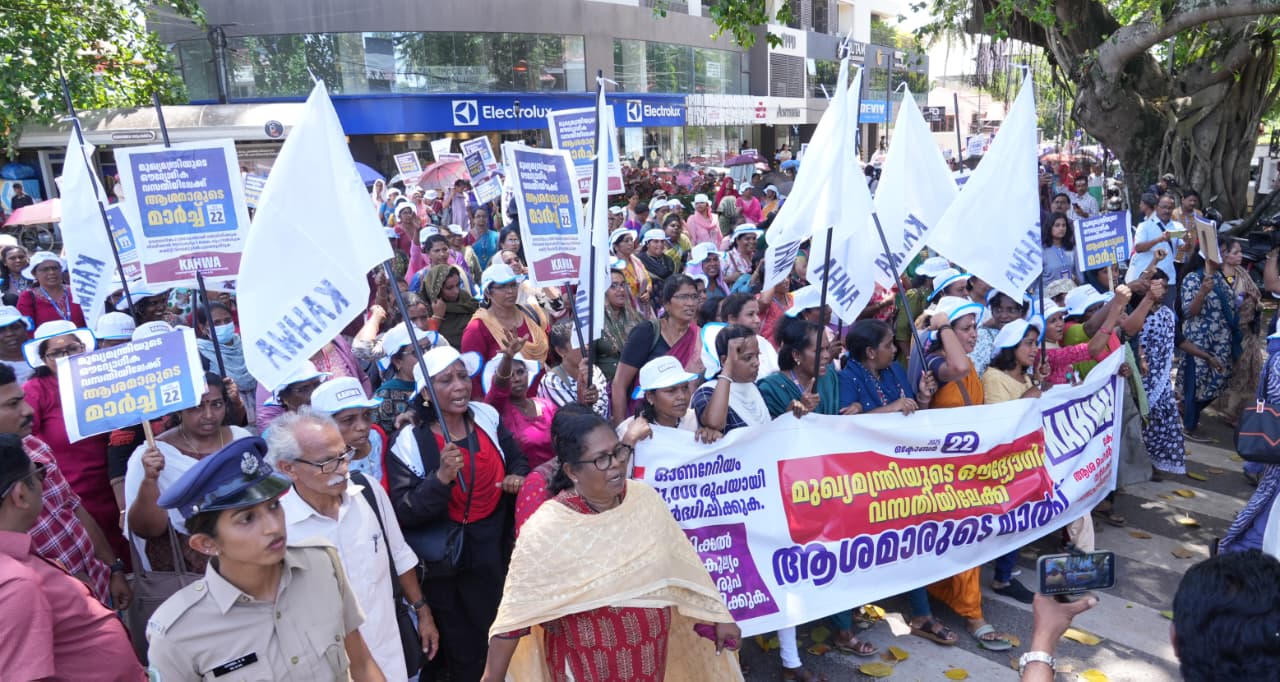
Do not Steal Our Voices, Mr Vijayan! The ASHA Workers’ March to the Chief Minister’s Residence
Dear Mr Vijayan
Yesterday, the protesting ASHA workers marched to your residence in the pouring rain, seeking to rouse you from your utterly inexcusable stupor. Yes, over the past eight months, you tried to first crush the strike, and then to kill it by ignoring it. Who does not know that the worst form of violence is indifference?
Photo credits : Shradha S, Harsh, Ashna Thambi, Santhosh Nilakkal.
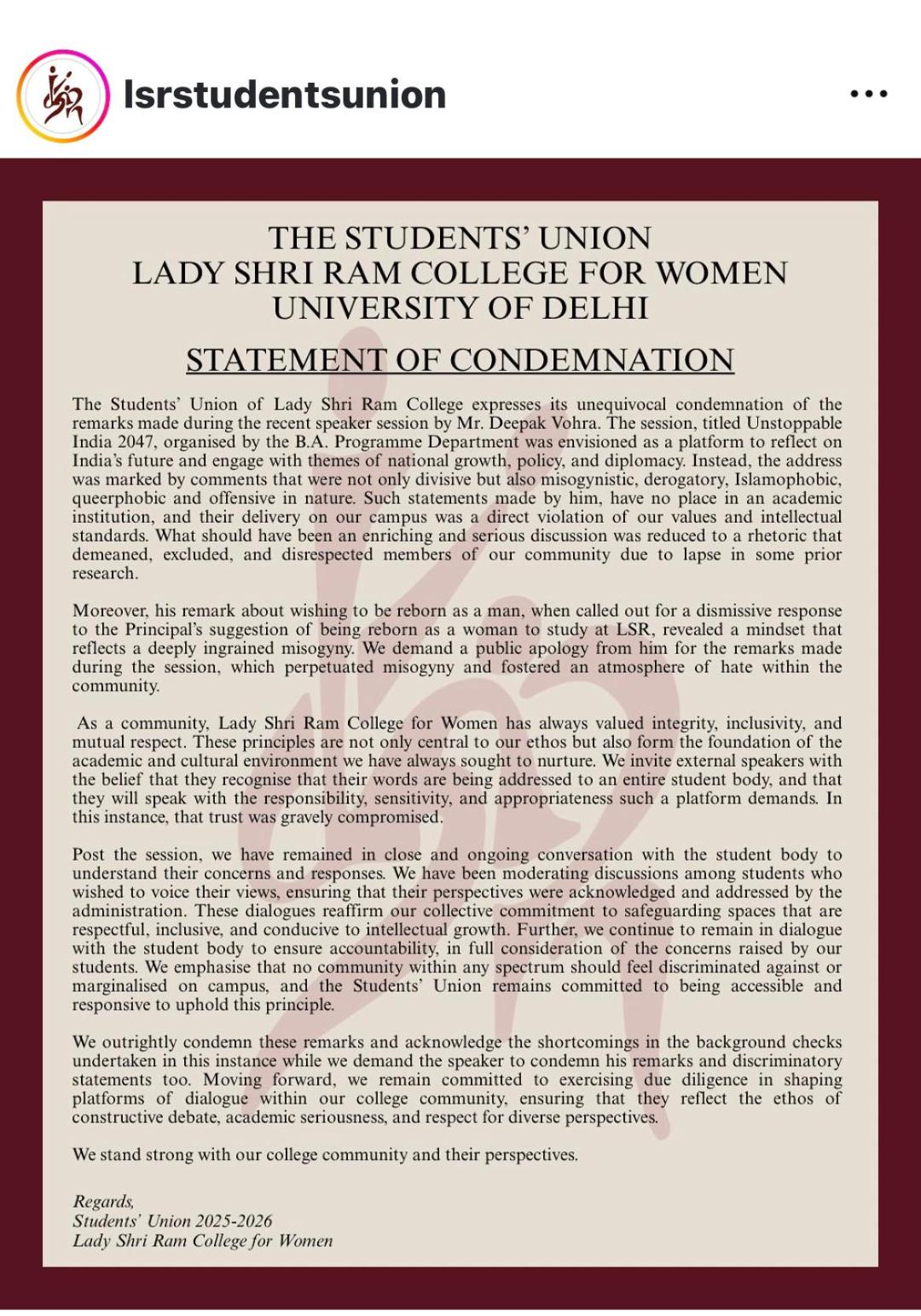
Lady Shri Ram College Students’ Union statement on former diplomat’s remarks
LSR graduates express outrage at former diplomat’s comments at the college
Over 500 graduates of Lady Shri Ram College (University of Delhi), released a statement of outrage at the communal and misogynist statements of former IFS officer Deepak Vohra at an event held at the college on September 11, 2025
The statement and full list of signatories is below.
As proud alumnae of Lady Shri Ram College across the globe, we condemn the recent episode concerning Deepak Vohra in the strongest possible terms and call upon the college, and its senior management to explain how this came to happen.
This week, Lady Shri Ram College invited a retired diplomat Deepak Vohra, who freely articulated misogynist and communal views without being challenged at a lecture on college premises. He made openly anti-Muslim comments, told the young women in the audience that their roles were primarily that of mothers of future citizens, directed wholly inappropriate remarks to the principal of the college from the stage thereby insulting also the institution she heads. And yet, there was no censure or objection expressed at the event itself and students were not even allowed to walk out in protest.
Lady Shri Ram College (LSR) is not simply an undergraduate women’s college, it stands for a vision of a world in which women have space to explore their interests and capabilities and rests on the legacy of a newly democratic India that chose to make world class higher education accessible to women from a diversity of backgrounds. LSR as an institution exists to actively enable such a vision. Despite the deeply patriarchal contexts many students come from, LSR gives them the space to experiment with ideas, explore freedoms, be inspired by other women, all outside the constant censorious gaze of men. The teaching in the classroom has always been of an excellent standard, and outside it, there are a host of enrichment activities that makes an LSR education the well-rounded experience it should be. Continue reading LSR graduates express outrage at former diplomat’s comments at the college
Not Another Salacious Sex Scandal, Please: Althea Women’s Collective Statement on Mainstream Public Discussions of Complaints against Rahul Mankoottathil
[ A translation of the statement from the Kerala Feminist Forum is appended to ours. Both are translated by Gayatri Devi, a member of Althea.]
The way political parties and mainstream media in Kerala have framed the public discussion on the complaints against Rahul Mankoottathil comes as a real shock to anyone who sees Malayali women as citizens with equal rights and equal dignity, and to those who are committed to the welfare of children.
Continue reading Not Another Salacious Sex Scandal, Please: Althea Women’s Collective Statement on Mainstream Public Discussions of Complaints against Rahul MankoottathilThe Denigration of Women Workers Fuels State Neglect: Complaint Against the CITU (Kerala) to the WFTU
Attention:
General Secretary, WFTU secretariat@wftucentral.org
Women’s Committee women@wftucentral.org
Asia Pacific Regional Office wftuasiapacific@gmail.com; c.srikumaraidef@gmail.com
Subject:
Complaint against CITU and AITUC (Kerala, India) for their sexist remarks and non-cooperation with
KAHWA women workers in violation of WFTU Constitution
Reference (WFTU Constitution):
Urgent Call for Peace by Indian and Pakistani Feminists
The ceasefire is just the first step in the long walk to justice and peace
In a show of historic cross-border feminist solidarity for peace, over 10 organizations and approximately 1000 people have come together to issue a powerful statement calling for immediate de-escalation, dialogue, and justice in the wake of renewed hostilities between the two nations. The signatories include feminists, peace activists, artists, journalists, academics, students, grassroots organizers and other professionals from India and Pakistan.
11 May 2025
We, feminists from India and Pakistan, unequivocally welcome the ceasefire declared by our two nations today. The tension and escalation of the last fortnight remind us of how fragile peace is. The ceasefire is also a vindication of calls for de-escalation and peace by lakhs of ordinary people on both sides of the border. Even as we hope this indicates an absolute cessation of hostilities, we recall the recent events.
We condemn the terror attack in Pahalgam that killed 25 tourists visiting Kashmir from different parts of India and one from Nepal. One local person also lost his life in the Pahalgam attack. The targeted attacks deepened the communal divide between Muslims and Hindus in India and were exploited to incite hatred, fear, and calls for collective punishment.
In the aftermath of the Pahalgam terror attack, it is the women—including as mothers, daughters, sisters, wives—who are left holding the unbearable weight of grief. Instead of respecting and sharing it, it has been weaponized and policed—especially when it refuses to follow the script of hate. Himanshi Narwal, the young widow of one of the slain victims, was among the survivors who amid unimaginable pain still found the strength to appeal for peace. She asked people not to direct their rage against Kashmiris and Muslims who, like her, are trapped in a cycle of violence they did not create. For that simple act of humanity, she has been trolled, vilified, and attacked by chest-thumping nationalists more committed to blood lust than truth.
Continue reading Urgent Call for Peace by Indian and Pakistani FeministsOpen Letter to the Members of the Indian Association of Women’s Studies
Dear Colleagues
I am writing to you about the dire situation in Kerala with reference to the strike of the Kerala ASHA Health Workers’ Association for minimum wages and a five-lakh one-time retirement benefits, which has been continuing since the past two months.
Continue reading Open Letter to the Members of the Indian Association of Women’s StudiesSupport the ASHA Workers’ Strike in Kerala: Sign-on Petition
[Recirculating]
We write to you out of serious concern about the precarity of the lives of the Kerala ASHA workers on strike and the hostility shown to them by the elected government of Kerala. The ASHA workers’ strike has entered its 50th day and the twelfth day of their indefinite hunger strike. Hundreds of workers are outside the Secretariat building striking for the demands to be heard by the left-led State government, braving the heat stress, sporadic thundershowers, and the humiliation from the government and mainstream party workers.
They have been ridiculed and accused of being puppets of the “fascist, fundamentalist” right-wing trying to jeopardize the elections in 2026. Their backing from SUCI and AIDSO has provoked mainstream left politicians and intellectuals even further, accusing them of being too radical to understand the need to be united at this time. Yet the CPM and its allied organizations, unions have declared unconditional support to ASHA and Anganwadi workers in other states, declaring a nation-wide strike on 20 May.
We reject this apathy and accusations against the workers on strike. We also request that you sign-on to this petition to be submitted to the Chief Minister’s Office as a testament to the broader support that the workers have from the public and civil society in Kerala and across the country.
Please sign the petition for the workers demands to be accepted by the Kerala State Government and circulate this in your networks.
A Proposal for a Brahmanical Governance Index (in the background, the chorus: ‘Kerala Number One!’)
Today morning, the newspapers reported that the Kerala government has increased the dearness allowance of state government employees from twelve per cent to fifteen per cent. This group includes government employees, teachers, staff of aided schools, private colleges, polytechnic training colleges, full-time contingent employees and employees of local self-government. Dearness allowance increase is also applicable to service pensioners, family pensioners, ex gratia pensioners and ex gratia family pensioners…
I am told that people are jumping for joy in whatsapp groups of retired teachers etc.
Land purchase facilitation committees are going to be set up at the local-body level to identify land to build houses for families identified as ‘extremely poor’ (64,006 houses).
Yet another report in The Hindu, Thiruvananthapuram edition, claims that inflation rates are highest in Kerala and TN, and one of the chief reasons is the influx of migrant labour (who are clearly purchasing food and other essentials).
The ASHA workers on strike have been demanding their elected government’s attention to two things: their inability to survive on a daily wage of Rs 232 at a time of soaring inflation, and the disgusting feudal-colonial culture of the Kerala Health Department which treats them like female servants under the brahmanical order, the bhrtyas.
The government can quickly turn budget promises into government orders, it seems. It will feed the well-off and make alluring promises of welfare to the (reliably-docile) poorest. But it will not respond to workers demanding fair pay — only they must slave under feudal conditions.
———————
Yes, our government scores high on two indicators of brahmanical governance: ashritha vatsalyam and daanadharmam. Benevolence to the King’s dependents, and giving unto the indigent.
Maybe we should create an index of brahmanical governance too, and start our measuring exercises soon. Our government scored high, in 2017 (during the Hadiya case) and in 2021 (the Anupama Chandran case) on a third indicator of brahmanical governance, pratiloma naashaka, or the annihilating of hypogamy. The only indicator we fall behind is the mleccha naashaka, or the destruction of muslims/ historically underprivileged groups of christians. But given that our handling of ongoing ASHA workers’ struggle has increased our bhrtyaa-mardana rates, and as we have done middling-to-well in our twisting and mishandling of the WCC’s pleas, and so our kulina-damana rates are not so bad, we could be in the race for at least one of the top five slots in Indian brahmanical governance, unless some envious RSS fellows assign an impossible high weight to the mleccha-naashaka indicator!!
Nevertheless, it is tough. Other Indian states are ahead of us in most of these, what we can do is hang tight to aashritha vatsalya and daanadharma, and protect our progresss on bhrthyaa-mardana and kulina-damana. If we can convince the UN that the first two must be assigned a total of ninety per cent weight in the BGI, then it is YAY! Kerala Model Version 2!
In the protest-site, three women are on indefinite hunger strike.
One of the workers gathered there tell me: When I came here first, I was weeping all the time… afraid but not knowing what to do if the government refused us … now that it’s been over a month, my fear has vanished. We have nothing to lose. I prefer to die than live like this. Once you have nothing to lose, you too, won’t be afraid.
Another worker told me about her superior: I am an educated person. I have a college degree and I am trained in accounting software. Now, once when we had to do a survey in the local school with the JPHN, I remember, I suggested that we divide up the work, and that I will write down in the notebook all the data that we need… to which she said, no, you shouldn’t , as we have to give it to the superiors… hinting that I can’t write well…! It stung me, but I didn’t respond, but no more… I am not that meek person anymore.
A third worker recalled : It was a polio day, and I had gone to the booth straight from church that morning, and was wearing a plain white salwar suit. The JPHN looked at me and got all riled up. Why was I wearing a white suit, she wanted to know. That was the nurse’s uniform, she insisted — and that we shouldn’t wear it! There’s no such rule, for sure — it is this feeling in her that we are just ‘workers’, unworthy creatures! I swear, from now, I will not be silent …
From ASHA to Aparajitha, I thought. Just what we need to smash brahmanical patriarchal governance.
[Tearful apologies to Dr K N Raj and all the others who taught us to hold knowledge and empathy together in social research and Srinarayana Guru who showed us that arivu and anukamba can only go together and that in the absence of the other, the one gets irretrievably corrupted.]
Breakthrough in the Technology of Lie-Recycling: News from the ASHA workers’ strike in Kerala
I am not particularly fond of reviewing the writing of party-hacks or hired guns or mediocrities trying to fill their bellies. But citizens watching the struggle of the striking ASHA workers in Kerala’s capital city might be interested in how the ruling government’s toadies engage in logic- and plain fact-denying gymnastics to serve their masters. That is the only reason why I am taking apart this Facebook post by the (future) Secretary of the (yet to be formed) CITU-affiliated Kerala Fallacy-Peddlers and Outright and Recycled Lie Vendors Union (a post that surely must be reward for the production of such egregiousness-guaranteed discourse in ample quantities).
Continue reading Breakthrough in the Technology of Lie-Recycling: News from the ASHA workers’ strike in KeralaKerala’s Disgrace: ASHA workers to begin indefinite fast in Kerala
Yesterday, the summer rain struck Thiruvananthapuram city with the fury of thunder and lightning and wind. Those of us whose hearts are in that small protest-space in front of the State Secretariat open to the skies, where the police forbid even a temporary tarpaulin shelter, trembled as lightning tore through the skies and the skies poured, each drop a bucket. The striking workers continued to sit under the branches of old trees by the roadside. What if one of those ageing branches collapsed? What if lightning struck? The roads filled up with rainwater rapidly. The workers sat with their feet in the rushing rivulets of rainwater on the ground under the branches of great old trees, with the lightning swishing above.
Continue reading Kerala’s Disgrace: ASHA workers to begin indefinite fast in Kerala KAFILA - COLLECTIVE EXPLORATIONS SINCE 2006