Category Archives: Frontiers

A Contested line – Implementation of Inner Line Permit in Manipur: Deepak Naorem

This is a guest post by DEEPAK NAOREM

Violence and the accompanying disruption of everyday life in Manipur is not a recent phenomenon. This year too, the state was plunged into a spiral of violence following demands for the implementation of Inner Permit Line, a law originating in the colonial period. This demand is based on real or imagined fears that Manipur, like Sikkim and Tripura, would be overwhelmed by the ‘outsiders’ and that the ‘indigenous people’ of Manipur would become a minority in their homeland. Such demands are neither new nor surprising in this part of the world, where a nearly-unfathomable ethnic, demographic and political jigsaw puzzle was created by British colonialism; one that was deepened by even more myopic and inconsistent policy in the post-colonial years. However, this year, following the death of a young student by police firing during a student protest in Imphal, the movement demanding the Inner Line Permit (ILP) gained considerable momentum in Manipur. Subsequently, the legislature was forced to introduce three bills in the Manipur State Legislative Assembly on 28th August, 2015, ensuring the implementation of Inner Line Permit in the state. This in turn triggered another wave of violence with the ‘tribals’ and tribal organizations opposing the three bills, eventually bringing life to a standstill in the state.

Continue reading A Contested line – Implementation of Inner Line Permit in Manipur: Deepak Naorem
Much Better to Run Over the Poor Than to Speak Up for Them

Yesterday, the 9th of May, one day after the court granted what must be the fastest bail and suspension of sentence in the history of India to India’s favourite Dabangg, a diminutive woman stood under the blazing Delhi sun and spoke of her husband who had been in jail for the past one year. In May 2014, lecturer in English at Ramlal Anand College, Delhi University, G. N Saibaba was returning home after evaluating answer scripts when he was abducted by unknown men, who later identified themselves as Maharashtra Police.

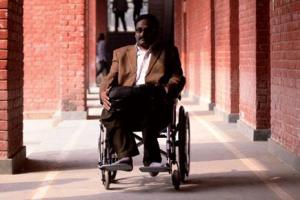
Professor Saibaba. Image Courtesy FRS Blog

Saibaba was not produced before a magistrate in Delhi but taken directly to Aheri, a small town in Maharashtra and then to Nagpur, to be put in solitary confinement in the famous anda cell of Nagpur jail. Let’s call this cell famous instead of the usual epithet “notorious” because all over the country, children are probably playing with each other right now saying to each other, “saale main tujhe anda cell mein daal doonga“, while their parents look on indulgently, congratulating themselves on the kid’s excellent G.K.

Continue reading Much Better to Run Over the Poor Than to Speak Up for Them

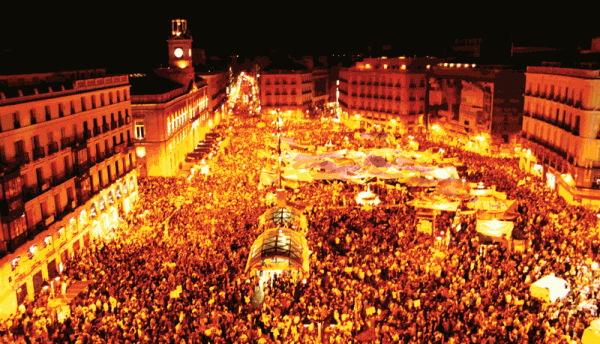
Whatever happened to 15-M Movement? Atharva Pandit

Guest post by ATHARVA PANDIT

[Against the background of Spain’s recent criminalizing of public protests and the first ever hologram demonstration (see Kafila post by Geeta Seshu) against it, this article revisits the major eruption in 2011, that eventually laid the ground for the emergence of a new political force in Spanish politics]

15M, image courtesy El Tecolote

Spain, seems to be a country that is still shaping itself. Somewhat like a nation that wants to come to terms with its past, unlike many other countries that have gone through a traumatic history and have finally emerged through the political passions – admittedly misdirected – of their distant past. Spain seems like it is yet to come to terms with a civil war that forged its legacy in millions of Spanish minds and the future generations of the country. The fascist forces that staged a coup, and consequently, went on to purge about 150,000 of its citizens in summary executions, far surpassed some of the worst dictatorships that the world has witnessed, including that of Pinochet’s in Chile and of Videla’s in Argentina.

Continue reading Whatever happened to 15-M Movement? Atharva Pandit

Enabling Dissent, Defying Silence – In Memory of Sabeen Mahmud: Yaminay Chaudhri and Mariam Sabri

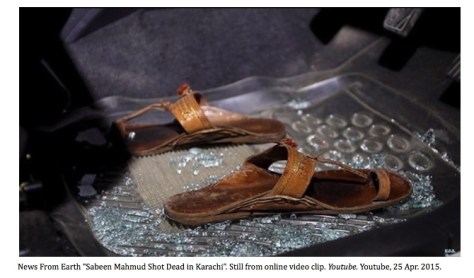
Sabeen Mahmud's Slippers

Guest Post by Yaminay Chaudhri and Mariam Sabri

[ This is a post from two friends in Pakistan responding to the tragic assasination of Sabeen Mahmud, activist and director of ‘The Second Floor’ (T2F) – a space that hosted many wonderful conversations and brave events. Sabeen was killed as she was going home after an event dedicated to a public discussion of disappearances and human rights violation in Balochistan.]

A normally quiet and desolate gali is packed with camera crews and hundreds of attendees for the funeral of Sabeen Mahmud. While there is a steady trickle of mourners entering and exiting the premises of the vibrant community space Sabeen created, the crowd waiting in the gali outside seems to be arrested by a mixture of disbelief, anger and grief.

Similar emotions paralyze us as we write about Sabeen in the past tense. It is difficult to believe she is gone, infuriating to think about the way she went, and, perhaps, the hardest to accept the beginning of her absence.

While watching her interview with PBS NewsHour last month, one is struck by how her cavalier attitude to fear and security, reverberates eerily in the wake of her murder.

“I grew up playing cricket on the streets” she said, “I just feel when the time comes, the time will come”.

Continue reading Enabling Dissent, Defying Silence – In Memory of Sabeen Mahmud: Yaminay Chaudhri and Mariam Sabri

Innocence Interrupted: Arshie Qureshi

Guest post by ARSHIE QURESHI

For a child born in Kashmir, the chances of living a normal life and even survival vary greatly from one region to another. Suppose you are born in the seemingly volatile stretch of Downtown. You may well turn out to be someone whose pictures are flashed on social media as the epitome of bravery, someone whose demise is imminent, and someone ready to wear the ‘Shaheed’ label. I arrived at this place at 4:30 on a cold evening. The room was crowded by women sitting with only one recognizable face; Shehzaad’s mother, Rubeena Akhter. Nobody spoke. The air smelled like rain. After a short while, a tall man in a brown-checkered pheran appeared. Leaning on the walls, he helped himself to one corner of the dimly lit but spacious room. He did not want himself to be identified as a ‘victim of conflict’.

For Shehzaad, life had been altogether different before. He had spent happy summers with his family in the town where violence, as it existed, had never appeared to him naked. By now, he is 23. He has become larger and properly bearded. The one thing which you can’t miss about Shehzaad is that he has giant brown eyes like a dairy cow. That’s what prompts my most idiotic lines of inquiry. Could someone who looks like that really pelt stones on streets? Idiotic, I know. “Do I have to tell you how I was supposed to have been killed that day?” he says, sounding like a gull. I hear a slow whimpering strangled with ache. This soon changes into full-throated babbling—a cascade of terrible, terrified pleading wails as he continued naming those who had been killed during the 2010 agitations.

Continue reading Innocence Interrupted: Arshie Qureshi

Storm in a Kahwa Cup: Organizers of the Kashmiri Food Counter at the International Food Festival, JNU 2015

Guest Post by Organizers of the Kashmiri Food Counter at the International Food Festival, JNU 2015

Universities are supposed to be the centers of free inquiry, speech and expression. However, in the recent months universities and other democratic spaces have been under attack from right wing fascist elements across India. University authorities under the influence of right wing forces have increased surveillance on sections of students and have started to monitor and control campuses. As a premier institute of learning Jawaharlal Nehru University (JNU) has always has preserved its democratic culture and has resisted such attacks tooth and nail. However, in recent days even JNU is experiencing pressures from the right wing fascist forces.

Every year, JNU organizes an International Food Festival (IFF) where students from diverse cultures and nations displaying their flags come together to offer global cuisines. This year on 20thJanuary, a group of students from Kashmir booked a counter at the IFF. After completing necessary formalities and depositing security amount the festival organizers allotted space for Kashmir food counter along with the Tibet food counter. However, International students association (ISA), body that organizes the festival started receiving threats from the ABVP goons. The president and other members of the organization were harassed and intimidated. The organizers received open warnings from ABVP threatening them with disrupting the festival in case Kashmiris were allowed to open their food counter. International students who organize the festival were threatened with legal action and deportation. Just two days before the festival the booking for Kashmiri food counter was cancelled by the organization. Continue reading Storm in a Kahwa Cup: Organizers of the Kashmiri Food Counter at the International Food Festival, JNU 2015

Harvest of Innocent Blood – The Democracy Deficit in Bodoland, Assam: New Socialist Initiative

Statement by New Socialist Initiative

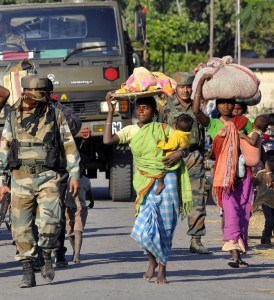
Photo courtesy: PTI
Photo courtesy: PTI

Once again, and very soon after the last instance of mass killings and displacement, another series of bloodshed and violence has rocked Bodoland Territorial Autonomous Districts (BTAD) – Assam. On 21st December 2014, two suspected militants of the National Democratic Front of Bodoland- Songbijit Faction (NDFB-S) were killed by the security forces in an alleged cold blooded encounter in the Chirang district of BTAD-Assam. In retaliation, on 23rd December, armed militants of NDFB-S attacked Adivasi villages in Kokrajhar, Chirang and Sonitpur districts. Since then it has resulted in the death of 81 people – 73 Adivasis including many women and children as well as 3 Adivasis killed in police firing on protestors.  As a mode of retaliation Adivasi mobs killed at least 8 Bodo civilians.  Since 23rd December, the entire BTAD and adjoining areas like Sonitpur district have been extremely volatile and under curfew. On 25th December, the Home Minister Mr. Rajnath Singh, in a meeting with the top security top brass, which was also attended by the Assam chief minister Mr Tarun Gogoi, declared Government of India’s resolve to fight terrorism and reportedly asked the security and intelligence apparati to ensure the elimination of the top leadership of NDFB-S within the next six months. Around 50 additional companies of paramilitary forces are being sent to Assam. The Army has also reportedly launched major operations in the Assam-Arunachal border region, in search of the NDFB-S militants.

 The NDFB-S massacre of Adivasi civilians is not a pre-modern tribal savagery. In fact such violence is justified by notions of exclusive ethnic-homelands and nations, and their corollaries like aspiration for spatial homogenization and monopolization of resources by particular communities. The Northeast of the country is home to many armed mobilisations against the domination of Indian state that are driven by an ethnic conception of political community in a contiguous territory. The Bodos of the Assam valley started an armed movement for Bodoland in 1980s against their marginalisation by the dominant non-tribal Assamese. Following the time tested carrot and stick policy, the Government of India managed to win over a faction of the armed groups in exchange for internal autonomy under the Sixth Schedule of the Constitution. The BTAD was formed in 2003. Curiously, even while the majority of citizens under the BTAD area identify themselves as non-Bodos the distribution of seats under the BTAD agreement is so designed that Bodos enjoy majority in the elected body.  While a faction of the Bodo leadership settled to run the BTAD, the seeds were sown for inter-ethnic clashes and violence. Continue reading Harvest of Innocent Blood – The Democracy Deficit in Bodoland, Assam: New Socialist Initiative

Statement on David Bergman Case in Bangladesh: Concerned South Asian Journalists and Others

Guest Post. Statement by Concerned South Asian Journalists, Writers, Historians and Activists

We, the undersigned journalists, writers, historians and activists from South Asia,  are deeply concerned about the use of ‘contempt of court’ law to curb freedom of expression. The conviction and sentencing on December 2, 2014, of Dhaka-based journalist David Bergman by the International Crimes Tribunal 2 on charges of “contempt of court” for citing published research on killings during the Bangladesh Liberation War of 1971, is a serious set-back to Bangladesh’s commitment to free speech and independent scholarship.

At the outset, we reiterate our belief that those responsible for genocide and international crimes during the Liberation War must be prosecuted and punished through an open and transparent process.

Continue reading Statement on David Bergman Case in Bangladesh: Concerned South Asian Journalists and Others

The Class Politics of Blasphemy in Pakistan: Fatima Tassadiq

Guest Post by FATIMA TASSADIQ

The brutal murders of Shehzad and Shama, a Christian couple in the village of Kot Radha Kishan in Kasur district on 4th November, spawned predictable outrage in the press and social media. The rush of horror, the diagnoses and prescribed course of action against such violence involved the familiar paternalistic discourse of the ‘illiterate masses’ whose ‘ignorance’ evidently leaves them particularly vulnerable to the manipulation of the much maligned mullahs. Such a narrative serves the dual function of reducing religious violence to the faceless masses while at the same time reaffirming the educated urban upper class as the rightful custodian of Islam and Pakistan. This construction conveniently ignores the role played by the state and the elite in producing religious violence and feeds the class-based blind spots that exist in our understanding of what constitutes religious extremism.

Continue reading The Class Politics of Blasphemy in Pakistan: Fatima Tassadiq

On The Recent Communal Disturbances in Trilokpuri: People’s Alliance for Democracy and Secularism

Guest Post by People’s Alliance for Democracy and Secularism (P.A.D.S)

NOVEMBER 2, 2014

(Members of P.A.D.S. have been interacting with and visiting residents of Trilokpuri ever since the communal disturbances started on Oct 23. Along with many other citizens we are involved in efforts to re-establish peace and in providing legal aid to those wrongfully arrested. This statement is based on the experiences of P.A.D.S members.)

The inhabitants of Trilokpuri, a densely populated neighbourhood of working people in Delhi, went through a harrowing week after Diwali night on 23 October. A brawl around two places of worship that night proved to be the first event. Although the situation appears to have settled down that night, some motivated planning and mobilisation must have taken place that night itself, because the next day it was a full scale communal clash. Armed mobs from outside the locality are reported to have joined the rioting that involved brick throwing. Firearms were also used and two boys suffered critical bullet injuries.  Inhabitants are emphatic that the police fired into the crowd. The police first denied firing at all. Its latest claim is that it fired only in self defense. One apparel show room owned by a Muslim resident was gutted. Police intervened in force only two days after the clashes started. It turned the neighbourhood into an occupied war-zone. More than fifty men and minor boys were arrested randomly, many picked up forcibly from their houses amid verbal abuse and physical violence. Road intersections were barricaded and entry and exit points were closely monitored. Drones were used in surveillance and houses systematically searched. Essential supplies were in short supply. Daily wage earners, contract workers, and self employed who could not go out lost their source of livelihood. Seriously wounded and ill had no access to medical aid. While the entire neighbourhood suffered in one form or another, inhabitants of three blocks in particular, nos 15, 27 and 28, and attached  jhuggi clusters, mainly occupied by citizens who are Muslims bore the brunt of police action.

Unwrapping the Soldier from the Flag – Kashmir after the Flood: Chirag Thakkar

Guest Post by Chirag Thakkar

Witnessing a culture of wounds trying to put itself together in times of a grave catastrophe is a difficult pursuit. For the archivist of State violence, the horror with which TRP-hungry television studios build a spectacle that is acutely wedded to a deep-rooted, pungent nationalism around catastrophe and relief in Kashmir, is frustrating. The insensitivity with which the Indian media has rubbed salt in the wounds of a people is appalling. One wonders if ours is a culture of calculated amnesia or of sightless apathy.
There is something very unique about the way in which we relate with the pain of the other. What is unique is the precision with which we reproduce perceptions about the masculine, hardened sons of soil – the security forces – and yet, at the same time, remain unmoved in failing to recognise the state of exception Kashmir has been in. What is also unique is how measured and stingy we are with our sympathy. Continue reading Unwrapping the Soldier from the Flag – Kashmir after the Flood: Chirag Thakkar

Remembering Maqsood Pardesi

Shiite_Calligraphy_symbolising_Ali_as_Tiger_of_God

On 23rd September 2014 Maqsood Pardesi lost his life. He had gone to the National Zoological Gardens in Delhi to meet a tiger. The tiger killed him. He was 20 years old. Maqsood worked as a daily wage laborer and lived with his family under the Zakhira flyover in central Delhi. He is survived by his father Mehfuz Pardesi, his mother Ishrat, his brother Mehmood and his wife Fatima.

There are conflicting reports as to how Maqsood found himself en face a tiger. Several reports state that, despite being discouraged by a guard on two occasions, he managed to climb into the tiger’s enclosure when the guard’s attention wavered. Some reports suggest that he accidentally fell into it. The authorities have vigorously denied the possibility of accidental entry and contested the assignation of blame on the zoo, or the tiger, for Maqsood’s death. Other reports have dwelt on Maqsood having a history of mental illness. Some state that he was drunk when he entered the enclosure. Some claim that he threw stones at the tiger, lost his balance and fell. Like the dissection of Maqsood, there has been speculation about Vijay, the tiger. The zoo authorities defend against charges that Vijay is aggressive. The tiger is not at fault many say: how can it be held responsible for the death of a man who enters its enclosure? The head zoo keeper has said, “Maqsood was mentally unstable otherwise why would a sane person jump into the tiger’s enclosure.” Why indeed? Continue reading Remembering Maqsood Pardesi

Sailaab Nama – An Insider’s View of the Flood in Kashmir from the Outside: Gowhar Fazili

Guest Post by Gowhar Fazili

The floods in Kashmir can provide an outsider a momentary glimpse into the reality of Kashmir behind the corporate media propaganda smokescreen that is fumbling at the moment and like Truman Show (1998) exposing bits of the backstage. At the moment there are three key actors in Kashmir. There are the floods, the state and the people. Each one is on its own. One limb of the state—the state government was the first to crumble before the approaching waters.   The other limb—the mammoth military apparatus that has already inundated Kashmir since several decades, took two days to wake up to the crisis and when it finally did, its priority was to fish out the rich Indian tourists and the people close to the establishment out of the state. In the initial days, local people had to risk their own lives to get their marooned relatives to safety. Some hired local boats, some swam or waded through water, some made makeshift rafts out of anything that floats, including water tanks, car tubes, foam sheets, inflated baby bathtubs, so on and so forth to save their dear ones. The rest either drowned or kept moving up the floors of their houses as the waters kept rising until they reached their attics.

Continue reading Sailaab Nama – An Insider’s View of the Flood in Kashmir from the Outside: Gowhar Fazili

The Anatomy of a Massacre: The Mass Killings at Sailan, August 1998

This was sent to us by Shrimoyee Nandini Ghosh

front cover_final

On the night of 3-4 August 1998, 19 people including 11 children ranging in age from about 4 to 15 years old, and 5 women (including one woman in an advanced state of pregnancy) were shot at point blank range in their homes in Sailan, in the highly militarized ‘border district’ of Poonch, which is divided by the Line of Control between Pakistani and Indian Administered Kashmir. The bodies were thereafter mutilated with axes and sharp instruments. A total of thirteen female and six male members of three closely related families were killed by personnel of 9 Paratroopers, Indian army, and ‘SPOs’ (Special Police Officers) armed state back local operatives recruited to the police and affiliated to the 9 Para Army Camp. The police establishment was involved with attempting to bury the dead clandestinely, registration of a fabricated FIR, destruction of evidence, and the criminal cover up of the case. The Anatomy of a Massacre recounts the dismembered and silenced history of the Sailan Massacre through voices of family members, eye witnesses, local residents and the analysis of court, police and Right to Information documents. The legal and oral histories of Sailan illustrate how the Indian occupation of Jammu and Kashmir is made real, not just through the control of physical territory, but by deep social penetration, acts of spectacular violence and collective terrorisation, and the active collaboration of all state institutions in the illusion of legal procedures and rule of law. The Report is part of the struggle of all victims of human rights violations in Jammu and Kashmir, to articulate their demands for truth and justice in their own words, when the very language to speak of the truth has been rendered anti-national, and therefore unspeakable. It commemorates the lives lost in the massacre at Sailan, and is dedicated to them, on the anniversary of their untimely deaths.

Read the statement about the release of the report in Srinagar, by JKCCS and the Survivors of the Sailan Massacres as well as the full text of the report here.

Breaking the Silence about Gaza from Israel: Yehuda Shaul

Guest Post by YEHUDA SHAUL

In November 2012, Israel launched a military operation in the Gaza Strip called “Amud Anan”, the literal English translation of which is, “Pillar of Clouds”. Though, the official name in English was deemed, “Pillar of Defense”. A few days ago we launched another operation named, “Mighty Cliff”, which is officially called, “Protective Edge”. Both chosen titles are highly defensive in their essence. When I hear the names given to military operations in Gaza – especially the versions chosen for an international audience – I am reminded of my military service as a combatant in the Israeli army, whose full name (both in Hebrew and English) is: the “Israel Defense Forces” (IDF).

Continue reading Breaking the Silence about Gaza from Israel: Yehuda Shaul

Concerned Public Health Professionals on the Israeli attack on Gaza

The following is a statement issued by some concerned public health professionals in New Delhi, on 21st July, 2014

The world is once again witness to the macabre dance of death in Gaza unleashed by the Israeli aggressors, and once again the news of scores of innocent Palestinian deaths, including those of a number of women and children, is flooding in. The tragedy is compounded many-fold by the conspiracy of silence on this issue entered into by all the major powers of the world, who have singularly failed to take any effective measure to restrain the Israeli aggressors. The only exception to this silence is USA, Israel’s long time sponsor, which has once again blocked efforts at the United Nations to pass any motion of censure against Israel.

Israel’s alibi for the latest attack – to punish perpetrators of abduction and murder of three Israeli boys, holds little merit when Israel is the occupying force in first place and its leaders are belligerently calling for annihilation of ordinary Palestinian lives without discretion in accordance with their doctrine of ‘collective responsibility.’ The deputy speaker of Israeli Knesset, Moshe Feiglin has called Arab people “a gang of bandits” and has argued in favor of Israeli government cutting off electricity supply to Gaza in order to paralyze its hospitals. His reported statement is – “The blood of a dialysis patient in Gaza is not redder than the blood of our IDF (Israeli Defense Forces) soldiers who will, God forbid, need to enter Gaza.” Continue reading Concerned Public Health Professionals on the Israeli attack on Gaza

Last of Warsaw Ghetto Survivors Calls for Rebellion Against Israeli Occupation

Rebel against the Occupation. No–it is forbidden for us to rule over another people, to oppress another [people].  The most important thing is to achieve peace and an end to the cycle of blood[letting].  My generation dreamed of peace.  I so want to achieve it.  You have the power to help.  All my hopes are with you.  If only [you could]. – Chavka Fulman-Raban, arrested and imprisoned at Auschwitz, two of her family members died as resistance fighters.

Last year, long before this current round of blood-lust, Chavka Fulman-Raban, among the last of the Warsaw Ghetto survivors delivered, On Yom Ha-Shoah (Holocaust Remembrance Day), “a fierce denunciation of evil and injustice, including the Israeli Occupation. Her speech was offered to guests at the ceremony of Beit Lohamey Ha-Getaot (the Ghetto-Fighters House)”, says Richard Silverstein, who has translated the speech into English.

The once-invincible Nazism did not last. Zionazism too will not last, however invincible it might appear today. And we must say it loud and clear: Zionism is not about Jews and Judaism. To oppose Zionism is not anti-Semitism. As if this simple fact needs to be stated. But it seems it does, over and over again. Just as Judith Butler had to recently, contesting Lawrence Summers, President, Harvard University. So virulent is the mobilization of the Zionist fascists, especially inside Israel, that what David Shulman recently referred to as “lynch gangs” and “organized fascist groups”, have been on the prowl attacking, killing Palestinians and protestors against the bombings. And cheering the lynch mobs and fascists gangs are spectators of the kind we see below:

Israeli viewers enjoy the spectacle of Gaza

Continue reading Last of Warsaw Ghetto Survivors Calls for Rebellion Against Israeli Occupation

Life in a ‘Sterilized’ Zone, Hebron, Palestine: Ravinder Kaur

Guest Post and Photograps by RAVINDER KAUR

Map of Hebron, Courtesy ‘Breaking the Silence

On 12th June, 2014, the kidnapping of three Israeli teenagers near Hebron resulted a massive military search operation in the area. Since 30th June when their dead bodies were found north of Hebron, a Palestinian teenager has been abducted and killed in a revenge attack in East Jerusalem, and concerted air strikes have been launched on Gaza by the Israeli forces as punishment to Hamas who Israel holds responsible for the abduction and murder of the teenagers. In ten days of Israeli air strikes more than 216 have been killed in Gaza, and rocket firing by Hamas has claimed one life in Israel. A ground invasion began yesterday evening. Even as talks of a possible ceasefire, and resuming normal life, take shape, one might consider what ‘normality’ constitutes in a place like Hebron that has been at the center of the current conflict. It is in the normal, the routine that the spectacular violence takes shape.

Continue reading Life in a ‘Sterilized’ Zone, Hebron, Palestine: Ravinder Kaur

Scholar David Shulman on the Gaza Bombings

The following is a report from the indefatigable Prof David Shulman, who teaches at the Hebrew University of Jerusalem. Prof Shulman works on the history of religion in South India and poetry and poetics in Tamil, Telegu and Sanskrit. David Shulman writes as protests inside Israel increase, as do right-wing attacks on the protestors. This report has been circulated by Prof Louise Bethlehem of the Hebrew University of Jerusalem.

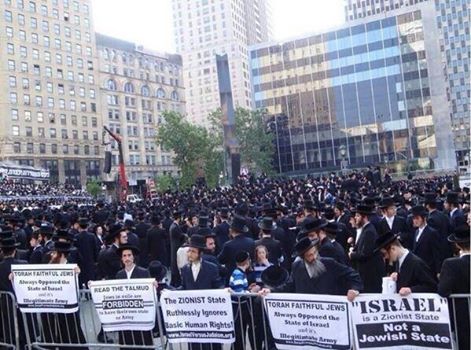
Jews demonstrate in New York Against Bombings

July 12, 2014 Umm al-Ara’is, Susya, Bi’r al-‘Id, Ma’asara

Business as usual in the South Hebron hills. There’s a war on in Gaza, but that too is business as usual, the meaningless biannual ritual in which both sides gleefully smash one another before reverting to the status quo ante. The Israeli media are drowning us in words, a vast and raucous flood, and the government is putting out its familiar, mendacious statements; perhaps in recent days only Abu Mazen has spoken the truth. The only solution, he said, is a political one, and Netanyahu is no partner. Meanwhile, rockets are flying, the Air Force is bombing, children are dying, soldiers are doing what soldiers mostly do, that is, wait around, and in South Hebron the land-grab proceeds apace, as always. Nothing, it seems, can stop that.

But wait a minute, some things have changed. Since the horrible murder of three Israeli teenagers, followed by the equally abominable revenge killing of the Palestinian boy from Shuafat, Israel has witnessed a wave of racist hatred on a scale perhaps not known before. Part of it has to do with the near-infinite opportunities of the internet: tens of thousands of virulent hate messages sent by ordinary Israelis have clogged the major sites; thousands of them call openly for revenge. I remember a time somewhat like this one, in the summer and autumn of 1982, the days of the first Lebanon War; the nadir came when a hate-filled nationalist threw a grenade into a Peace Now demonstration, killing my student, Emil Grunzweig. Some of the internet sites these days have called for the execution of leftists. Perhaps most striking of all is the utter shamelessness of this wave. Probably people used to have these same feelings but were not so ready, or eager, to state them in public. Decades of demagoguery and xenophobic incitement by the right, including, famously, by Netanyahu himself, have had an effect. The sluices are open. Continue reading Scholar David Shulman on the Gaza Bombings

A Renegade’s People: Rupam Sindhu Kalita

This is a guest post by Rupam Sindhu Kalita

What unites anti-homophobia campaigners, defenders of the poor’s right to clean water, university student collectives, women rights’ groups and academics under a premature summer sun in New Delhi on the 30th of March earlier this year? It is the unacceptable means employed by the Indian state in response to armed rebellions in North east India and the threat to civilian life that it has precipitated. The contagion of a military approach to a largely political problem was promulgated as an ordinance in 1958 under the presidency of Dr Rajendra Prasad to help quell the Naga movement and was developed into the Armed Forces Special Powers Act (Assam and Nagaland) later in the same year. The Armed Forces Special Powers Act (from here on AFSPA) persists in violating human rights in Kashmir and North east India despite its incompatibility with national and international human rights declarations. Over the years this Act has been sanctified in the inner sanctum of India’s centralised quasi-military administration. The government has been extremely guarded in its approach to growing popular demands for annulling this Act. The civil leadership’s reluctance to temper with the ritualized provisions of this Act has raised the disquieting question of who runs the country.

On 30th March central Delhi woke up to a motley group of protestors unified by a concern for violation of human rights under AFSPA. [Photo credit: V Arun Kumar].

Continue reading A Renegade’s People: Rupam Sindhu Kalita

Report of a Protest by Students at UP Bhavan in Delhi against Harrassment and Slapping of Sedition Charges on Kashmiri Students at SVSU, Meerut: Kashif Ahmed Faraz

Guest Post by KASHIF AHMED FARAZ

Several students protested on the 7th of March in Delhi against the harassment and eviction of Kashmiri students in SVSU (Swami Vivekanand Subharti University), Meerut and the slapping of sedition charges against 67 Kashmiri students. The protesters included activists, students from universities, mostly from JNU and also Kashmiri Students residing in Delhi. The protest took place at Uttar Pradesh Bhawan, New Delhi.

Signs at Protest at UP Bhavan against Harrassment of Kashmiri Students in Meerut

Continue reading Report of a Protest by Students at UP Bhavan in Delhi against Harrassment and Slapping of Sedition Charges on Kashmiri Students at SVSU, Meerut: Kashif Ahmed Faraz