Category Archives: Genders

Interview with Ins Kromminga, German intersex activist and artist

Below are excerpts from an interview I did with a fascinating artists and activist who initiated a process in me, simple and obvious, and yet complicated and hardly ever embarked upon- vis-a-vis the politics of gender and sexuality. Ins has challenged the routine of the politics we engage in and the world view we sometimes unintentionally take for granted and thus make static, Hoping for an engaging discussion on the issues Ins lays out below.

Also, something to think about: how we write articles in popular media about difficult, unspoken of issues to just put them out there. To bring about some visibility but at the cost of some of the complexity? Sometimes visibility even at the cost of compromise on our politics of how we speak of pain and pleasure in all our lives and in the context of the frameworks of oppression? I see myself having done this below in my fleeting account of Ins’s life and work. How then do we engage with the mainstream media and find the language to articulate complexities approachably and regularly? It’s the eternal question but lets ask it again because, as we all know, we have to. :) Continue reading Interview with Ins Kromminga, German intersex activist and artist

Ultra Violet:A feminist blog

I came across this blog a couple of months ago, and have been wanting to bring it to the attention of kafila-readers who may not have visited it yet. Always something interesting and provocative going on there.

Its self-definition:

Ultra Violet is a place for Indian feminists.
It’s a place for sharing stories and views and questions. It’s a place for exploration, opinion and information (not necessarily in the order). It’s a place where we can come together to understand what other feminists around the country–or around the world–are saying…
Ultra Violet does not represent any school, wave, organization, institution or categorization. We do not belong in a box. We do not huddle together in a tank. We do not fly in formation like a flock of geese. We are all free people, approaching feminism from different locations, backgrounds and personalities…
Anand Jon wants to be tried in India – I would too, if I were him

Fashion designer Anand Jon has been sentenced by a Los Angeles court to 59 years in prison for violent sexual assault on seven young women, some of them under-age. His defence tried to move for a mistrial on the grounds that one of the jurors had contacted Jon’s sister during the trial, but a new trial was not granted by the judge. The concerned juror delivered a “guilty” verdict along with the other 11 jurors in the case.

A month ago, his sister Sanjana had pleaded with the Indian government to extradite him as he would not get a fair trial in the US, being Indian. She claimed then, and did so again after the verdict on September 1, that Jon is a victim of racist discrimination.

Would Anand Jon have been acquitted of such charges in an Indian court? Almost certainly, yes. In a justice system in which alleged rapists are routinely acquitted for “lack of evidence” and proven rapists given a reduced sentence because of their youth and the promising life ahead of them, Sanjana is right to insist that he be tried in an Indian court. In an Indian court, the testimony of women who had willingly gone to his home on the promise of jobs in the fashion business, and then claimed they were raped, would be dismissed out of hand. Especially if the women are white. Gratuitous references to “western women” and their supposed attitudes to sex, pepper judgements and statements by officials on rape in India.

Continue reading Anand Jon wants to be tried in India – I would too, if I were him

Remembering Rajani and Re-Reading The Broken Palmyrah

I am posting below a much longer version of an article that is published in Himal SouthasianThe Broken Palmyrah is out of print, but the entire book is on the UTHR(J) website.

Remembering Rajani and Re-Reading The Broken Palmyrah

September this year many will remember Rajani Thiranagama, a feminist, an activist, a Marxist, a scholar, a doctor and a teacher assassinated twenty years ago on September 21st, 1989.  Among the reasons for her assassinations was the publication of that profoundly grounded work, The Broken Palmyrah, which she co-authored with three other academics from the Jaffna University.  While we commemorate the life and work of Rajani at a time when the war has come to an end, in many ways the Palmyrah is still broken.  It is in this context that I return to that inspiring work, which has much to teach us, in particular for those of us belonging to the younger generations of activists after Rajani.  Inspiring, for despite the worst cruelties of war, it carried a message of hope, an analysis of possible ways forward and faith in the resilience of ordinary people. Continue reading Remembering Rajani and Re-Reading The Broken Palmyrah

‘It will lead to the commodification of homosexuals’

(I had conducted this interview while working on a story on the Delhi High Court judgement on the 377 case. While that story didn’t materialise, I thought I should post this interview now.)

PURUSHOTHAMAN MULLOLI is general secretary of the Joint Action Council, Kannur-India (JACKINDIA) which intervened in the Section 377 case in the Delhi High Court. In an interview he explains his opposition to the case.

What is JACKINDIA? Continue reading ‘It will lead to the commodification of homosexuals’

Rakhi Sawant Ka Swayamvar!

“Yeah yeah, take a good show and spoil it by theorizing” said my labour lawyer/bollywood-gossip-junkie flat mate. All I said was that I thought Rakhi Sawant Ka Swayamvar was an “Interesting phenomenon that comments on the articulations of the notion of marriage within the context of fixed notions of culture among upper middle class north Indian families and within that the tropes of gender, normativity and melodrama! And so I should write about it on Kafila”.

Her comment wasn’t entirely unjustified.

The way in which one watches these shows in itself raises a range of questions. The show has taken over my life as of now. The final decision of who she will marry will be made soon and the restlessness and anxiety about it is immense and requires effort to contain. Continue reading Rakhi Sawant Ka Swayamvar!

My son Jane: Moira McDonald

Guest post by MOIRA MCDONALD (Written three years ago).

“I want to be Jane,” repeats my two year old, this time bringing his face very close to mine for special emphasis.  “He has to be Michael. Michael is the boy” says his nearly four year old sister Naomi who is oh-so aware of her budding gender identity.  “Honey, you know in our family, anyone can pretend to be anything.  Someday you may want to pretend to be boy, or a cow for that matter,” I explain. She shrugs agreeing to his choice as long as she can be Mary Poppins.   I wish the contradictions surrounding gender identity were as easily resolved for the other adults in our lives.

Continue reading My son Jane: Moira McDonald

Right Hand, Wrong Hand

I have two daughters, born 1984 and 1988. As they grew up we noticed that both of them were ambidextrous but gradually the 84 born started favouring her right hand over the left but the 88 born did the exact reverse. She began to rely more and more on her left hand to do things like eating, opening doors, picking up things, writing etc,things that “normal” people including my elder daughter do with their right hand.

A couple of interfering neighbours tried telling us to ‘teach’ our daughter to do things properly and not to eat or touch ‘saraswati’ with her dirty hand. Luckily we told these busy bodies to mind their own business and let her be. Continue reading Right Hand, Wrong Hand

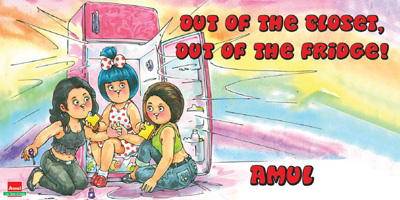
The Amul girl comes out of the closet

Via amul.com
Via amul.com

“The Magic of the Human Spirit and of a Nation’s Passion”: Three Queers for the Delhi High Court!

So – here we are folks, in a historic judgement this morning, Delhi High Court has read down Section 377 of the Indian Penal Code to exclude consensual sex among adults. Congratulations to the group of tireless activists who have helped to bring this about, and congratulations to all of us who count ourselves as part of the queer community. Continue reading “The Magic of the Human Spirit and of a Nation’s Passion”: Three Queers for the Delhi High Court!

“Two friends who have but one life”: Hope from the 19th century

I came across this delightful piece of information in the historian K P Padmanabha Menon’s History of Kerala (vol.3, AES reprint,2001, pp.498-500) which was written in the early 20th century. He quotes from “a paper published in the Madras Review (vol.2, p.250)”; we do not know which year this was published, but there is good reason to think that it was in the early 20th century. The paper is about a truly exciting institution – ‘marriage’ which produced not a heterosexual conjugal couple, but a same-sex  (male) couple bound by ‘friendship’! Continue reading “Two friends who have but one life”: Hope from the 19th century

On the Eve of Pride. Are We Going the Right Way: Akhil Katyal

This is a guest post by AKHIL KATYAL

Topicality is a homage one pays to the short-term memory that the new media both triggers and complains against in its customers. In the long-term of course, where trend is all important, the topical is only a category of the banal. But it is under the shelter of such a necessary topicality – the topical is always necessary – that I hope to sneak in a scandal.

Everyone is talking about the queer pride marches that are going to happen in four cities in India at the end of this month. Most liberal reportage is obviously supportive, if not triumphant. For these cities themselves, it is seen as a step into a liberal urban culture which tolerates, even enjoys difference. All the talk about the ‘gay community’ or ‘lgbt community’ that the Indian media – and the activists – have been dabbling in for at least a decade now, seems to be reaching its logical climax: the community is expressing itself. Every city seems to have its own pet lgbt community or at least aspires to.

Continue reading On the Eve of Pride. Are We Going the Right Way: Akhil Katyal

Reservations for Women: ‘Am I That Name?’

[I am posting here the chapter from my book – Recovering Subversion. Feminist Politics Beyond the Law – that I referred to in response to demands for references on my previous post on the WRB.  I do apologize to those (including fellow-kafilaites!) who may rightly feel I have said enough on the topic.

The title of this chapter is a tribute to Denise Riley’s question “Am I that name?” referring to the label “Woman.” Am I That Name? Feminism and the Category of ‘Women’ in History Minneapolis, University of Minnesota Press, 1988].

When the Women’s Reservation Bill (WRB) first appeared as the 81st Amendment Bill in 1996, proposing to reserve 33% of seats in Parliament for women, it burst into public discourse full-blown as a “women’s” (indeed, a feminist) issue, and continues to be debated largely in terms of women’s rights. It is becoming increasingly clear however, that the questions thrown up by the timing of the Bill and the responses to it cannot be understood solely within the framework of women’s rights. This chapter attempts to relocate these questions in a complex matrix of political identities in order to realize their full significance. I also argue that the debates around the Bill reveal a more fundamental set of questions about the issues of citizenship, representation, and the subject of feminist politics.

Continue reading Reservations for Women: ‘Am I That Name?’

And aren’t OBC women “women”? Loud thinking on the Women’s Reservation Bill

The career of the Women’s Reservation Bill in Parliament since it first appeared in 1996 as the 81st Amendment Bill, has been striking for the high drama and rhetoric of women’s rights that has accompanied it, the passionate opposition to the proposed 33% reservation for women in Parliament, generally being characterised by its supporters as anti-women and patriarchal. However, if we try to organize the welter of arguments that have been flying around for 13  years, we would find that while the proponents of the measure certainly base their claims on the idea of gender justice, the opposition to the Bill does not come from an anti-women position.  Rather, the latter arguments stem from either

1) a generally anti-reservation position (which I am not interested in here) or

2) a claim that reservations for women should take into account other disempowered identities within this group – that is, the “quotas within quotas” position, which says that there should be reservation within the 33% for OBC and Muslim women. (The 22.7% reservation for SC/ST women would come into operation automatically.)

In other words, the sharp opposition to the Bill cannot simply be dismissed as anti-women. Continue reading And aren’t OBC women “women”? Loud thinking on the Women’s Reservation Bill

A desk of her own. Farewell to Kamala Das

Kamala Das (Madhavikutty, Kamala Suraiya), died this morning, May 31, 2009, aged 75.

Virginia Woolf wrote in A Room of One’s Own (1929):

“A woman must have money and a room of her own if she is to write fiction; and that, as you will see, leaves the great problem of the true nature of woman and the true nature of fiction unsolved.”

In an interview in 1996, the interviewer Shobha Warrier reminds Das of something she had once said “about the pathetic condition of a woman writer who does not even have a writing table. The dining table has to serve as her writing table once it is cleared.”
Kamala Das replies:

Continue reading A desk of her own. Farewell to Kamala Das

Afghan Women Protest New Law on Home Life

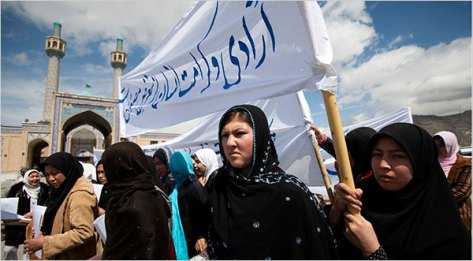
About 300 Afghan women, facing an angry throng three times that number, walked the streets of Kabul on Wednesday to demand that Parliament repeal a new law that introduces a range of Taliban-like restrictions on women, and permits, among other things, marital rape.

Afghan women demonstrate against new law, courtesy NYT

‘The young women stepped off the bus and moved toward the protest march just beginning on the other side of the street when they were spotted by a mob of men.’

‘”Get out of here, you whores!” the men shouted. “Get out!”….It was an extraordinary scene. Women are mostly illiterate in this impoverished country, and they do not, generally speaking, enjoy anything near the freedom accorded to men. But there they were, most of them young, many in jeans, defying a threatening crowd and calling out slogans heavy with meaning.’ Read the full story by Dexter Filkins here.

[Courtesy: SACW]

Dignifying Jade Goody, or, What Jade Goody actually connotes: D. Parthasarthy

guest post by D. PARTHASARTHY

When newspaper columnists become self-righteous, it is usually because they see a good way of capturing reader interest by moralizing about an issue. After all, tabloids around the world regularly make fortunes by generating a false sense of moral outrage and indignation through stories of the indiscretions and ineptitudes, sufferings and misfortunes of celebrities and of not so famous people. It is a sign of irony as well as an indication of the way in which neo-liberal capitalist media works, that the consequences of alienation engendered by an individualist ideology is fodder for sensationalist reporting, but also a tool for mobilizing collective conscience against alienated individuals, and for preventing communities from understanding the real reasons for alienation.

Continue reading Dignifying Jade Goody, or, What Jade Goody actually connotes: D. Parthasarthy

Where have they disappeared?

Aman Kachroo is not the first teen to die of ragging. But there is one curious first: this time the death has not led to any ‘public debate’.

This time the defenders of ragging are silent. Who knows, maybe some of them have changed their views and are now lighting candles at Jantar Mantar. There are no TV debates calling ragging fun. This time no one is arguing that a murder case should not be used to defame the socially productive ‘tradition’ of ragging. This time nobody is asking how boys will become men unless they are ragged, and nobody is calling the victims sissies.

What has changed? Continue reading Where have they disappeared?

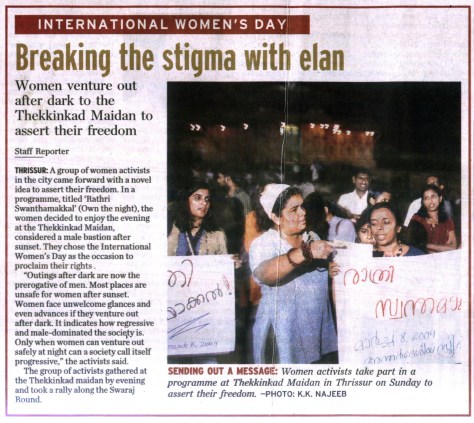
Women’s Day 2009, Thrissur

securedownload

Caste/gender in a poem by Varavara Rao

I’m posting below a poem by Varavara Rao and a response to it by Rochelle Pinto. Comments and debate welcome, but trolls will strictly not be allowed regardless of caste and gender! Comments are regulated here by a disclaimer to maintain sanity. Not repeating your position ad nauseum helps, unless you desperately want to have the last word.

Merit

by VARAVARA RAO

Lucky
You are born rich
To say in your language
“Born with silver spoon in the mouth”

Your agitation sounds creative
Our agony looks violent
Continue reading Caste/gender in a poem by Varavara Rao

Pink Panties – With Love to Muthalik

Today is Valentine’s day and it is only befitting of the changing times that the Ram Sene chief Pramod Muthalik and his cohorts should receive huge consignments of pink chaddies. Responding to the call of the ‘Consortium of Pub-Going, Loose and Forward Women’, pink chaddies, we are told, “kept pouring into the Sene office all through the day. The parcels came mainly from Punjab, Rajasthan, Mumbai, Bangalore and Kerala”, according to reports.

V-day love pours in for Muthalik

Many of us who wanted to be part of the open and vigorous demonstration of love but couldn’t, would like to send many more panties to the members of this monkey gang (Ram’s sena was after all, Hanuman’s!). And wherever we are, we will drink in pubs and make merry. Muthalik, you will always remain in the hearts and minds of all the ahle-junoon-i-ishq. Har ghoont sharaab ke saath tujhe yaad karenge…Aakhir kaun hai is duniya mein tere siva, jise jalaane ke liye ek bosa-e-gul, ek chaddi ya ek ghoont sharaab bas kaafi hai? Hamaare halaq se utri har ghoont teri chita ki aag hogi goya…