Category Archives: Genders

Will we overcome? Pramada Menon

This is a guest post by PRAMADA MENON

Sundays are days for doing nothing much. Often I sit in front of the television and surf and watch many, many movies until all the story lines start merging into one. It’s fun because it does not require you to think. If one switches on a news channel, the chances are that you will start to splutter like mustard seeds in oil, since there is so much to splutter about – Nirmala Venkatesh, a member of the central government’s National Commission for Women, was put in charge of a three-member panel to investigate the attack on the women at a pub in Mangalore at 4pm in the evening. The way she sees it, Venkatesh is supposed to have said, women have the right to enjoy themselves but should also recognize societal limits. As part of her inquiry, she said, she plans to meet with the attackers, the bar owner and the families of the young women to see whether their parents
allowed them to go out to pubs every night at midnight. “My personal advice: Women should be very careful,” she said. “I can’t just roam after midnight.”

Continue reading Will we overcome? Pramada Menon

Surrogacy Politics: Imrana Qadeer & Mary E. John

This guest post has been sent by IMRANA QADEER and MARY E. JOHN

Surrogacy is suddenly front-page news. First there was the uncertain future of baby Manji, following the divorce of her Japanese commissioning parents; then the happy pictures of an Israeli gay couple with their son born to a Bombay-based surrogate mother. India is becoming a cheap location for foreigners wanting to use ‘assisted reproductive technologies’ (ART) and local clinics are promoting surrogacy arrangements because they are seen as lucrative ventures. While there is hardly any public debate on the ethical, social, epidemiological and medical questions around infertility and surrogacy, the extremely problematic ART Regulatory Bill (2008) is being hurried through. It barely addresses important concerns and ignores national health and population norms. It permits, for instance, three surrogate pregnancies to a woman.

Continue reading Surrogacy Politics: Imrana Qadeer & Mary E. John

Families and Dynasties, Lettered and Unlettered – Monobina Gupta

Minister in the Rajasthan government
Golma Devi, Minister in the Rajasthan government

Guest Post by MONOBINA GUPTA

It is jarring, to put it mildly, that Times of India, a leading daily, engaged in a high-profile ‘Teach India’ campaign should publish a front page story mocking the unlettered. This story exhibits a strange callousness in its reporting about the very constituency of people the campaign is hoping to address…or ‘uplift’…
The story published in the TOI on December 20, smacks of arrogance as it speaks disdainfully of an unlettered woman legislator recently elected in Rajasthan’s assembly elections. Golma Devi, elected from the Mahuwa constituency is the butt of ridicule and lament in this article authored by P J Joychen. The author, it seems, cannot get over the fact that an unlettered person like Golma Devi has been elevated to the rank of a minister in the Ashok Gehlot government.

No, she is not a history sheeter; nor does she have a scam hot on her heels. She is nevertheless an offender – in the sense of ‘offending’ your ‘sensibilities’ – in the supercilious eye of the media; an object of ridicule. Her offense: her of lack of reading and writing skills.

Continue reading Families and Dynasties, Lettered and Unlettered – Monobina Gupta

Reflections on the Great Unexpected Auto Debate

Little did I think when I put up this image, that it would lead to such a rich set of comments on class, caste and gender.

The picture had been circulating on the web, in blogs and email lists for some time, and without comment, as a funny, jokey kind of thing. Autos and trucks (in Delhi anyway,) are renowned, as Aman pointed out in his comment, for pithy, witty, quirky, dolorous, amorous etc. comments on life. Briefly glimpsed, their ability to linger in our minds is a reflection of their literary quality.

When this one was sent to me, the reason I posted it on kafila was initially light-hearted too, since we consider autos to be our mascots, as representing kafila’s philosophy and relationship to the city in some way – small, cheeky, full of “attitude”, winding nimbly through the mass of traffic, a resistant challenge to the idea of a shiny, “world-city-like-paris-and-singapore” that our various governments want to turn all our cities into, by neatly removing the poor, the workers, the slums etc.

Continue reading Reflections on the Great Unexpected Auto Debate

When you’re OUT, you’re IN

Since Gay is in, currently, for the Indian media, Sonali Gulati, film-maker, out lesbian and gay rights activist, knows what it is to be hotly pursued for sound-bites. She has posted on youtube a recorded conversation with a reporter from IBN 7 pressing her for her take on a “lesbian” issue. Her quiet , insistent questioning reduces him to confused gibberish, but more importantly, makes the point that “lesbians” are no more and no less newsworthy than straight people – At one point she asks him, “Agar yeh ek heterosexual couple ke saath ho jaata, tab aap kis se comment lete?”

(If this had happened with a heterosexual couple, then to whom would you have gone for comments?)

Meaning of course, that any and every heterosexual would not be considered “expert” enough to comment on any and every heterosexual issue. The bemused reporter starts all over again with his insane drivel – he simply does not get it. Can she really be giving up an opportunity to appear on television? Naaah.

But go on – listen to Sonali.

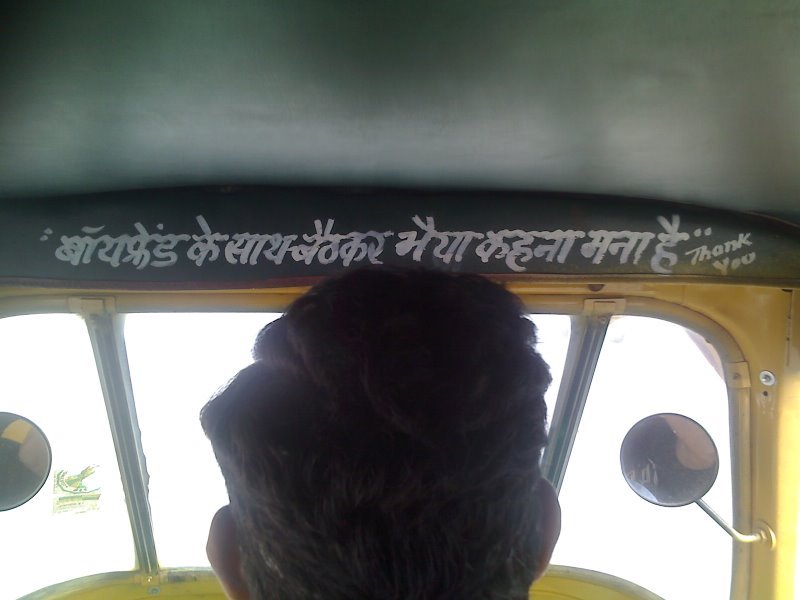
Moral police in OUR autos!

“It is forbidden to sit with your boyfriend and claim he is your brother”

My sister sent me this one…

Judging Women

The honourable judges of the honourable judiciary are on an honourable roll…

Anuradha Roy of Permanent Black sent out the following:

On the 9th of February 2008, remarks by two eminent judiciary members the Chief Justice of Karnataka, Cyriac Joseph and State Human Rights Commission Chairperson Justice S.R.Nayak, stating that immodest dressing was the cause of increasing crimes against women were reported in the press.

The Hon’ble Chief Justice further elaborated his statement by mentioning that “Nowadays, women wear such kind of dresses even in temples and churches that when we go to places of worship, instead of meditating on God, we end up meditating on the person before us” and that the “provocative dresses that women wear in buses” put the “men travelling in the buses” in awkward situations and hence “women must dress modestly.”

The Chairperson, State Human Rights Commission, speaking on ‘Human Rights and the Lawyers Role’, gave his opinion on the Mumbai New Year molestation issue, when two women had their dresses torn off by a mob
of men outside a nightclub: “Yes, men are bad… But who asked them (the women) to venture out in the night…Women should not have gone out in the night and when they do, there is no point in complaining that men touched them and hit them. Youth are destroying our culture for momentary satisfaction.”

Anuradha sent this out without comments. I understand her mood. I’m done too. No witty commentary, no smart asides. I’m just plain exhausted.

giving girls orgasms
olsen twins still virgins
birthday party for ninety years old
chubby young girls
old guy ffm
cute little boobs
stock option exercise stock swap vs self funding tax benefit
furry artwork adult
sylvia saint interracial
toronto district school board
ffm threesome picture galleries
massive female bukkake squirt orgy
smoking zyban
msn photo swap messenger problem
lolitas blog
hidden up skirt pics
drawstring nylon bag
ashley olsen naked
adult halloween party ideas
horny collage girl
milwaukee county zoo ala carte
fatman scoop cartoon
tattoo skull art
free nude midgets pics
tiffany towers mpeg
double cock suck
dp anal
sex flexible
cfnm handjob movie galleries
hairy pussy closeup
premature ejaculation and zoloft
fertile cunt orgasming sperm
interracial fuck orgy
naruto fighting dirty
my wifes clit
oral whores
gay male videos
squirt lessons
bi porn incest
moms wearing thongs
horniest twinks
money over bitches
easy pornstars
gay male bondage
women masturbating alone
enormous cum shots
sexy toys
Obscene Behavior CD-1
filipina escorts
deep vaginal contractions at 35 weeks
reality sex outdoor
handjob pantyhose
horny mom get banged
Private Life Of 43 Life of Maria Belucci CD-1
enormous penis gallery
teen femdom
backseat blowjobs
clit erection
female masturbate
shit asian
lesbian threesome orgy
chief executive officer ceo
the big swallow brandi
animated teen chat rooms
hot hunks in the shower
cute dog names
sexy piercing
youn girl and big stud
jamaican pussy
dog obedience school
free pantyhose samples
crazy sluts
Squirt Queens-12 CD-2
forced sex stories
big breast amateurs 4
my girl korean tv series
nude female celebs
facial rejuvenation ct
nude stud factory
rachel weisz paparazzi
naked chick videos
bad girls short skirts
nude athletes
vagina images
slutty chicks
student apartment search
anel sex
2 dicks in 1 chick
effects of masterbation
young girls oral sex
free paris hilton porno
black moms id like to fuck
anal sex beads
free wives gallery
college coeds in thongs
silvia saint hardcore gallery
blowjobs in public free
gothic hairy vaginas
jackass party boy
marine sight navigation cd
kelly handjob
swallow jism
my first sex teacher videos
fuck the shit out of her
teen girls sucking cock
hentai rape porn
free galleries pregnant nude women
lauren lane nude paparazzi pictures
women have sex with dog
nude swim
free classic and retro porn video mpegs
monster cock anime
first anal pain
fat indian girl
slut wife glory hole
home video xxx
free college sluts
anime school sex
adult spanking free video
ca military relief fund

Mother

Have you ever guzzled
the last drop of alcohol
and raped your mother?

This is what we do
when we read
the morning news
about a woman’s rape
and sip our tea
leisurely.

© 2006 Dan Husain

Monobina Gupta on Inconvenient Women

Recently Kiran Bedi, the country’s first woman police officer, sought voluntary retirement after being in the eye of a storm following her allegations of gender discrimination in the police force. Bedi, who had transformed Tihar jail from filthy dungeons to a clean and livable place and has had an outstanding career, was superseded for the post of Delhi’s police commissioner. Because she was a woman.

Women in civil service have come up against sexism time and again. Madhu Bhaduri, who joined the Indian Foreign Service (IFS) in 1968, recalls how women IFS officers launched their first protest against blatant gender discrimination in this elite branch of service, which was at that time wrapped up in layers of  discriminatory codes.

Here is an account of how it all started…

Continue reading Monobina Gupta on Inconvenient Women

Charu Gupta on Om Shanti Om and Saawariya

Like many other lovers of Bollywood cinema, I too was caught up since October this year in the countdown to the battle of all battles, with the release of Om Shanti Om (OSO) and Saawariya on 9 November 2007. Reams have been written, debated and analysed on the two films in newspapers, television networks, and everyday discussions. They have been depicted as films catering to very different sensibilities, and representing vastly diverse forms. The verdict seems to have declared both as average films, though OSO seems to be faring better than Saawariya at the box office. I enjoyed the first half of OSO particularly and thought Saawariya as a film with great form, but not much content. 

However, as a fan of Bollywood popular cinema, what struck me most was one striking similarity between the two films. I thought both the films offered great visual pleasure and feast for the female spectators, where the spectacular and stylish nude male bodies and images of both Ranbir Raj Kapoor and Shahrukh Khan, though very different from each other, were the prime objects of desire and erotic spectacle. Both OSO and Saawariya have urban heroes, whose bodies are produced and carved, rooted in providing a voyeuristic visual treat especially to most straight women and gay men. The identity of both the heroes in these films in centrally tied to the consumption of their nude bodies by the viewer. The films in some senses signify the coming of age of a new genre of Bollywood cinema, where it is not so much the female body but the male body which circulates and is on display, offering a sexualised imaginative anatomy. They also signify that the language of discourse of Hindi films has undergone a dramatic post modernist change in its conception of desire, where most of it is conducted not through the soul but through the body. There is no central heart, but a decentring of emotions at play here. In the recent past too, nude male bodies of Hrithik Roshan and Salman Khan have been offered to the viewer. It perhaps is also a reflection of the fact that more and more women are crowding the cinema halls and form at times the major chunk of spectatorship, and they are a vital part of the cinematic experience. 

Continue reading Charu Gupta on Om Shanti Om and Saawariya

Beaten — By a Woman!

[Below is a chapter from my translation of N P Muhammed’s wonderful retelling of folk tales about Malabar’s best-loved folk hero and one of the earliest songsters of the Mappillapattu song tradition of Malabar, Kunhaayan Musaliar. The book, Kunhaayante Kusritikal (Kunhaayan’s Capers), which won the Kerala Sahitya Akademi’s award for the best children’s writing in 1973, is almost forgotten now. In the stories of the Mappila Muslim community of north Kerala, Kunhaayan figures as the quintessential humble-born person who grows in stature through his wit and quick thinking, rising to eminence in royal courts of late 17th- early 18th century Malabar. In these times in which the Mappila traditions of Malabar are clearly under threat, I thought that it was necessary to reclaim this figure for our children and ourselves – and translating NP’s sensitive rendering of the tales, which reverberates with the folk wisdom of the Mappilas of Malabar, seemed the best way to do it. The best thing about Kunhaayan, who impresses all of Malabar, is that he is no saint. Thus he does get puffed up a bit with all the glory, and has to be brought down a peg or two – it is his young wife who fells him, finally. This chapter is about how she does it!]

There was time when she used to brim with joy, proud to be introduced as ‘Kunhaayan’s wife’.

Not anymore.

Tears welled up in Aisakutty’s eyes.

Continue reading Beaten — By a Woman!

Another Supreme Court

Even as our own dearly beloved Supreme Court repeatedly shows contempt of the people by handing over tribal lands to corporations and urban spaces to mall developers, the judges across the border seem to be on a radically different track. As is well known by now, the initial dismissal of Chief Justice Iftikhar Choudhary by General Musharraf – an action that launched a million mutinies – was at least partly to punish him for his order preventing the sale of Pakistan Steel Mills to a private group.

As the democratic upsurge in Pakistan carries on unabated, here is a lesser known story, sent to me about a month ago by Nighat Said Khan (better known as Bunny) Women’s Action Forum activist. It is an eye-witness account of the hearing in June 2007, in the Supreme Court of Pakistan, on the appeal by the ‘she-couple’, as a story in Dawn dubbed them, seeking dismissal of a High Court decision sentencing them to three years’ imprisonment for perjury. Not only is the order by the Supreme Court exemplary for its commitment to individual rights, Bunny’s account highlights the extraordinary sensitivity and awareness shown by both the lawyer representing the couple, Babar Awan, and the judges hearing the case.

If this is Pakistan’s judiciary, no wonder the general is a little lost in his labyrinth…

Over to Nighat Said Khan.

Continue reading Another Supreme Court

‘Kalbela’, Naxalbari and Radical Political Cinema

Gautam Ghose’s Kalbela is a film set against the background of the Naxalite movement. Based on a 1980s novel by Samaresh Majumdar, the film sets itself up, quite self-consciously, within a certain tradition of films, namely radical political Bengali cinema of the 1970s and 1980s. It thus establishes an intertextuality and a certain connection with them.

The casting sequences take us through a rapid tour of some of the more emblematic moments of that cinema and that time:

  • The shot from Mrinal Sen’s Calcutta 71 of the young man on the run jumping off a wall, running through the lanes, pursued by the police and finally shot in an open field. You can almost hear Akashvani’s signature tune as it begins its news bulletin to announce the discovery of yet another anonymous dead body in those troubled times.

You are barely through with it and in quick succession you see two, now somewhat iconic, scenes representing the 1970s angry young Bengal:

  • Ranjit Mallik in the final sequence of Interview, flinging a stone to break open the showcase of a shop. He would denude the mannequin and remove the suit it is wearing, and take it for his interview the next day. It is a stylized ‘trial’ of this character for the offence of disrobing the mannequin that becomes the opening sequence of Sen’s ‘Chorus’.
  • The other sequence is also equally iconic: Dhritiman Chatterjee ‘turning the tables’, literally, as it were, on his interviewers. This is a sequence from Ray’s Pratidwandi. Satyajit Ray, who has all too often been accused of ‘evading politics’, however captures, in this sequence, an important mood of rebellion that marked the 1970s.

Continue reading ‘Kalbela’, Naxalbari and Radical Political Cinema

Does the ‘girl-child’ exist?

Does the ‘girl-child’ exist? What is it other than empty officialese, a smoke-screen that obscures, almost erases, little girls and the dismal little lives most of them lead? The ‘skewed sex-ratio’ has become a fetishized object for policymakers and governments in India, and improving those numbers a goal in itself. In the pursuit of good-looking sex-ratios, the minister for women and child development has come up with one alarming scheme after the other.

Earlier this year, Renuka Chowdhury announced a government scheme to open centres where people can abandon unwanted daughters rather than aborting them. Can you imagine the girl-children growing up in these doomed institutions? What fates can they expect, unwanted by their parents and kept on by the State only to boost sex-ratios? Chowdhury said at the time that the government was treating the drop in sex-ratio as an issue of national emergency. She also said that through this scheme, the government would “at least ensure that the gene pool is maintained”! In effect, these institutions would be collections of little girls unwanted by all but the census-takers, dropping by periodically to correct the skewed sex-ratio with a quick look at the office records.

Continue reading Does the ‘girl-child’ exist?

This Is Not A Story About Binayak Sen

This is not a story of the fifty plus Children’s doctor Binayak Sen from Raipur, Chattisgarh who is at present languishing in jail under draconian provisions of a law which has declared him a ‘terrorist’ because he had the courage to speak truth to power.

This is not meant to be a story of two young daughters of this man who are eagerly waiting for their father who is one of their closest friends and with whom they have shared all secrets of the world. Continue reading This Is Not A Story About Binayak Sen

Queer Images

Sunil Gupta is a renowned photographer whose work over the last three decades has spanned images of the body, migration, exile, HIV and sexuality. He also has a lot to say about the need for an art history centred on sexuality. See his work on www.sunilgupta.net. Also, see his jointly curated exhibit, autoportraits, as part of The Nigah QueerFest ’07. Details at www.thequeerfest.com.

Sunil’s work will come out in a book by Yoda Press in 2008. I had a chance to speak to Sunil recently for an interview that was published in Time Out Delhi. Excerpts:

G: Today, Sunil, you are known as a photographer who has a significant body of work on sexuality, and especially on gay and lesbian lives. How did sexuality first enter your work?

S: I moved to Canada from Delhi when I was 15. I arrived in September, 1969, literally a month after the Stonewall uprising in New York, so you could feel the effects of gay liberation everywhere. I went to a very liberal junior college. Everyone came out then. So being gay was very cool, unlike being Indian which was not cool at all. There were no Indians around me at the time. I started shooting gay news items for a fledgling campus newsletter. Those were my first photographs on sexuality. We were trying to find positive images in those early days. It was about taking happy picture of people happily being gay to counter all the negative imagery around us. Continue reading Queer Images