Category Archives: Government

‘Swacch Bharat Abhiyan invisibilises the linkage of Caste and Sanitation and glamourises broom among Scavenging Communities’ – Bezwada Wilson

In Conversation with Bezwada Wilson, National Convener of Safai Karmachari Andolan

The 125 day Bhim Yatra which started from Dibrugarh and traveresed 30 states and 500 districts to reach Delhi is now over.  As everybody knows it culminated in a big rally coupled with people’s hearing where families of those victims who died while cleaning sewers and septic tanks shared their plight at the hands of state as well as civil society. The call of this Bhim Yatra raised by Safai Karmacharis – ‘Stop Killing Us’ – would could keep reverberating for quite some time. (https://kafila.org/2016/04/14/bhim-yatra-so-that-there-are-no-more-killings/)

Here follows an interview with Bezwada Wilson, National Convener of Safai Karmachari Andolan

 How do you see the impact of  ‘Bhim Yatra’ ?

As far as those people who are still condemned to do scavenging is concerned, the 125 day Bhim Yatra has made two significant impacts :

– It has made people aware that a new act (2013 act) has come into existence for elimination of manual scavenging and they should make use of it for their liberation.

– Second significant impact is that people are realising that we should not do this work, we should leave this work altogether. Babasaheb’s teachings that depressed classes should leave all such professions which are stigmatised and which further help stigmatise them has reached broader cross sections of people engaged in cleaning and scavenging. The slogan ‘ Leave the Broom, Take the Pen’ is slowly reverberating across people especially the younger ones. Continue reading ‘Swacch Bharat Abhiyan invisibilises the linkage of Caste and Sanitation and glamourises broom among Scavenging Communities’ – Bezwada Wilson

Suicide of a Worker: Shankar Gopalakrishnan and Trepan Singh Chauhan

Guest post by SHANKAR GOPALAKRISHNAN and TREPAN SINGH CHAUHAN

On April 11th, a memorial meeting was held at Gandhi Park, Dehradun. You probably haven’t heard of Sadhuram, the person for whom it was held. Thousands of people have indeed heard of him. But it reflects the divided world we live in – the world that Sadhuram fought to change – that it’s very unlikely that you are one of them.

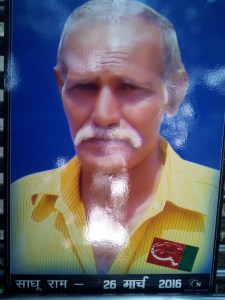
Sadhu Ram
Sadhu Ram

Sadhuram was a Dalit, a mason and a resident of Jakhan, Dehradun. He was also the vice president of the Uttarakhand Nav Nirman Mazdoor Sangh, a union of unorganised sector workers. To the daily wage workers of Jakhan, he was a daily presence at the mazdoor chowk, the place where people stand for work in the morning; some of them affectionately referred to him as “mantri-ji.” Late on the night of March 26th, Sadhuram committed suicide.

Why did he do it? That question has many partial answers. On December 5th, 2014, his wife Geeta Devi died of kidney failure. Geeta was not one to give up easily; her death came after a long battle against a painful disease and the extortions of private doctors. That very night, Sadhuram’s younger son, Ravi, lay down on the tracks outside Dehradun station and committed suicide. Sadhuram was left an angry, saddened man, having lost the two most important people in his life. His remaining son cared little for either the union or Sadhuram. They had frequent fights, and his son often beat him. Nor was that the only atrocity in Sadhuram’s life. After Ravi’s death, he was entitled to Rs. 50,000 in compensation under the Building Workers’ Act; that 50,000 might have meant the difference between continuing abuse and independence. But for an entire year the Labour Department sat on the application, notwithstanding at least twenty meetings and even a personal direction from the CM.

Continue reading Suicide of a Worker: Shankar Gopalakrishnan and Trepan Singh Chauhan

Statement of Solidarity with Hyderabad Central University from Columbia University, New York

This is a statement of March 29, 2016 from students, faculty and affiliates of Columbia University. We publish it below with apologies for the delay.

We, students, faculty and affiliates of Columbia University, strongly condemn the violation and atrocities brought upon the students and faculty of the Hyderabad Central University (HCU) on March 22, 2016. Since Professor Appa Rao Podile was on leave and under investigation for the institutional murder of Rohith Vemula, his return to the campus to resume duties as the Vice Chancellor was unacceptable. The students justifiably organized a peaceful protest in the campus that day. The institutional responses to that, by the University authorities, the Andhra and Telangana police force, Rapid Action Force personnel, the media, and the members of the Akhil Bharatiya Vidyarthi Parishad (ABVP) on campus, were outrageous, inhuman, and fascist. The University authorities, instructed by Prof Podile, shut down the Internet connection, dining hall and drinking water facilities in retaliation to the peaceful student protest. The Andhra and Telangana police force lathi-charged students and faculty, violently beat up and severely injured them, molested and threatened to rape female students, targeted Muslims and Dalits, abused them verbally, and eventually arrested 24 students and 3 faculty. The ABVP members resorted to violence and aggressive sloganeering from the very beginning of the students’ peaceful protest and also attacked and injured them. The mainstream media has been ignoring these atrocious events at a Central university campus and has decidedly turned away from its responsibility and its accountability to the public. This is ironic, at the very least, when some of the news anchors just last month were so focused on fabricating stories of “terrorist” and “anti-national” activities at the Jawaharlal Nehru University, Delhi. The media ultimately failed to demonize the students then. Now, yet again, the media is unabashedly siding with the authoritarian regime of corporate and state power; this time by ignoring the brutality of the police and the HCU authorities.

We strongly condemn

–       the fascist abuse of power by the University authorities, who decided to deprive the students of basic facilities as ‘revenge’ for the peaceful demonstration

–      the violence, the targeting and the brutality of the police force

–   the irresponsibility of the media for not reporting this on prime time and for effectively siding with the tyrannical regime in power

–       the atrocities unleashed by the casteist, capitalist, Hindu fundamentalist government and its affiliates, especially ABVP.

Continue reading Statement of Solidarity with Hyderabad Central University from Columbia University, New York

How to be free of Caste – Guest Post by Suhas Borker

Guest Post by Suhas Borker

This year, India has sponsored the observation of the birth anniversary of Babasaheb Ambedkar at the United Nations for the first time. The Permanent Mission of India to the UN shall commemorate the 125th birth anniversary of the Dalit icon on April 13 at the UN headquarters, a day before his date of birth, with an international seminar on ‘Combating inequalities to achieve Sustainable Development Goals (SDGs)’. A note circulated by the Indian mission says that the “national icon” remains an inspiration for millions of Indians and proponents of equality and social justice across the globe. “Fittingly, although it’s a matter of coincidence, one can see the trace of Babasaheb’s radiant vision in the SDGs adopted by the UN General Assembly to eliminate poverty, hunger and socio-economic inequality by 2030.”

Juxtapose this with a recent report on caste-based discrimination by the United Nations Human Right Council’s Special Rapporteur for minority issues that has stung the Indian government, provoking it to raise questions about the lack of “seriousness of work” in the UN body and the special rapporteur’s mandate. Ambedkar, the architect of the Indian Constitution, would definitely not be pleased. Nor are the Dalit rights activists in India and abroad.

( Read the rest of the piece here : http://www.thehindu.com/opinion/op-ed/how-to-be-free-of-caste-in-india/article8467518.ece?homepage=true)

Fifty Shades of Grey – Without the Thrills

[This is a response to Shourajenda Nath Mukherjee’s open letter on Kafila by Prof Makarand Paranjape]

Mr. Shourjendra Nath Mukherjee’s “Open Letter” of April 5, 2016 makes only one substantive point, concerning the agency of students, which needs attention. The rest of it, as the Dormouse said to Alice, is “much of a muchness” – confusion, rigmarole, and thumb-twiddling over precious little, which scarcely need be dignified by serious confutation. Continue reading Fifty Shades of Grey – Without the Thrills

Shoot to Kill: Standard Operating Procedure in Kashmir

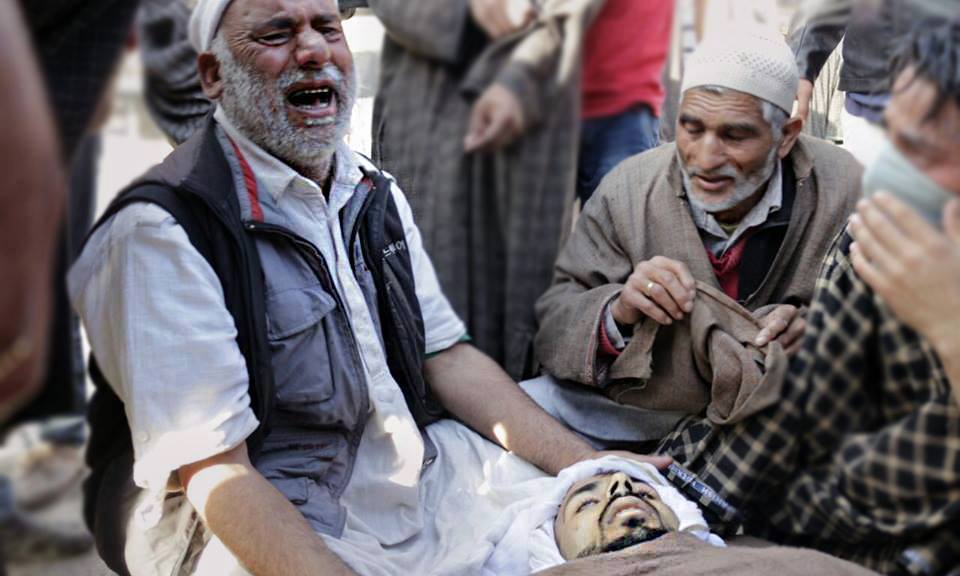
Nothing unusual has happened in Handwara. The Indian state has once again proved to be a killer  in Kashmir. Three people have lost their lives because the Indian armed forces and the J&K Police decided to defend themselves against people protesting against what they perceived to be a soldier’s harassment and molestation a Kashmiri woman.

Blood on the streets of Handwara
Blood on the streets of Handwara, Kashmir

The troops that defend India’s honour, unity and integrity and other such stuff have been trained to shoot to kill rather than answer a town’s questions about the sense of impunity that the Armed Forces Special Powers Act and the entire apparatus of a de-facto military occupation gives to Indian soldiers in the Kashmir valley. Lets stop pretending this is an exceptional situation, an excess, an anomaly, or even an instance of troopers going rogue. Whatever be the facts of the case, if the name the village of Kunan Poshpora, or of two women called Nilofar and Asiya mean anything to you, you will know that a predatory sexual profile is part of the operational signature of the Indian armed forces and local police in Kashmir.

Continue reading Shoot to Kill: Standard Operating Procedure in Kashmir

NIT and the Never Ending Story of Kashmir: Jagjit Singh

Guest post by JAGJIT SINGH

[The incidents in NIT Srinagar follow those in a number of universities and institutions of higher education and at one level, reflect a similar pattern. Yet, at another level, they – and the forces active behind them – play on a very different template of politics to achieve the same result. The story is similar and yet, radically different. The key dramatis personae are, understandably, the same. How do we make sense of what is happening in NIT Srinagar? Today’s Indian Express story by Nirupama Subramanian gives a sense of one part of the backdrop – life in NIT Srinagar before the incidents. The piece below gives us another sense of the larger history.]

NIT Srinagar non-Kashmiri students demonstrate
NIT Srinagar non-Kashmiri students demonstrate, image courtesy The Hindu

I remember when I was kid and was trying to make sense of a sport which looked very dull and boring but generated passions I had never seen in my hometown. Every time the game ends, the streets would be flooded by countless people with music and firecrackers and slogans in the background. Sometimes we could see fireworks even from our balcony, and some other times we would be locked inside our homes. Only thing we knew was ‘situation is tensed outside’. The game was Cricket and my hometown was Jammu. Jammu has always been RSS’s stronghold, and there are two Muslim-majority areas in Old City, Jammu. The whole tension surrounded these two areas only. Even that time slogan shouting was the test of your love for your country. The more violent and high-pitched your slogan is the more cheers you receive from the crowd. Continue reading NIT and the Never Ending Story of Kashmir: Jagjit Singh

Statement of Solidarity for Hyderabad Central University from UK-based academics

STATEMENT OF SOLIDARITY FOR HYDERABAD CENTRAL UNIVERSITY STRUGGLE

We, the undersigned, who are UK-based concerned scholars, express our deep dismay over the police brutality directed at students and faculty members of Hyderabad Central University, starting on March 22, 2016. We are alarmed that students and staff calling for justice at the University have had charges pressed against them, have been disappeared from the campus, and that there are reports of assaults on them in custody. We condemn the police presence on campus, the authorities’ denial of water, electricity, and food to those remaining in student accommodation, and the brutal attack on a PhD scholar for cooking in University premises.

These actions, coming in the aftermath of events culminating in the suicide of a Dalit scholar Rohith Vemula, constitute a severe assault on democratic rights of free expression and thought, assembly and association. They go against the very purpose of universities as places for critical thinking, and damage the international reputation of HCU. As scholars who admire the work of many academic colleagues and alumni at HCU, we are concerned that HCU seems to be fast descending into a campus of unrestrained repression of dissenting voices among students and staff. Continue reading Statement of Solidarity for Hyderabad Central University from UK-based academics

An Open Letter to Prof Makarand Paranjape

Guest post by SHOURJENDRA NATH MUKHERJEE

Please note that this response was first sent to Swarajya Mag, where Prof Paranjpe’s Open letter appeared, but was not published. It was then sent to Kafila.

Dear Prof Paranjape

I am Shourjendra, an MPhil research scholar in the Department of History, DU. I write this letter as a rejoinder to your open letter in response to Maitreyee Shukla. Your open letter was not addressed to me and therefore you can feel free to not reply to my letter.

You sir, seem to reflect a lot of the opinions expressed very strongly by a section of the urban middle classes. Granted, these views are by their very nature not ‘fascist’ but nonetheless they help perpetuate and legitimate the regime in power. You are also one of the most eminent academicians to have sought to engage in these raging debates in the public sphere, and I very strongly appreciate you for this. Your open letter is one such statement and I would like to take this up as an opportunity to critically engage with some of the issues that you have raised. (Since, your statements are mostly uncritical appreciation and endorsement of these ideas, I would regard your statements as statements made by an academician who has paused to think academically.) Continue reading An Open Letter to Prof Makarand Paranjape

Apropos Fetishizing Higher Education and University Politics

This is a guest post by PRATIK ALI.

[This article summarizes quite well the very many criticisms that have been raised from broadly the left of the political spectrum, about the Standwithjnu campaign. We do hope it generates a lively debate that will enlarge our horizons and strengthen the struggle against fascism]

Whether it has been the scrapping or stagnancy of the Non-NET Fellowship, the increased interference of the State in student activity in universities of higher-education, or merely the (routine) introduction of symbols of the ruling party in cultural institutions (of which universities are a part), a dangerous, and even strange trend is seen emerging in the student response: asserting their isolation from other sections of society as valuable uniqueness. Continue reading Apropos Fetishizing Higher Education and University Politics

University of Minnesota Stands in Solidarity with the University of Hyderabad

We, the undersigned at the University of Minnesota, strongly condemn the current onslaught on protesting students and faculty at the University of Hyderabad. Following the tragic death of Dalit scholar Rohith Vemula earlier this year, the UoH community has been questioning the role of the university administration in the circumstances leading to his suicide. Days before he took his life, five Dalit scholars including Vemula were expelled by the university administration. At the behest of the ruling government, they were punished for screening a film which documents the frightening spread of Hindu fundamentalism in India today. In the wake of their expulsion and then Vemula’s suicide, the UoH community spearheaded a nation-wide movement which draws attention to the horrific normalization of caste discrimination and the growing criminalization of dissent in universities in India. Instead of responding to the concerns raised by the movement, the university administration recently reinstated P Appa Rao to the office of the Vice Chancellor. As P Appa Rao has been charged for abetting Vemula’s suicide, this amounts to an utter mockery of the movement and also threatens the integrity of the on-going judicial enquiry about his death. This has rightfully angered the UoH community which registered its protest by peacefully occupying the office of the Vice Chancellor on 22 March 2016.

Continue reading University of Minnesota Stands in Solidarity with the University of Hyderabad

Stand With UoH: Statement by Concerned Members of the IIT Bombay Community


We, the undersigned members of IIT Bombay community, strongly condemn the police repression that has been unleashed on students and faculty of University of Hyderabad who seek justice for Rohith Vemula, with the active connivance of the University administration. The testimonies of the events have been singularly disturbing. We cannot let educational institutions become play fields of state repression. Continue reading Stand With UoH: Statement by Concerned Members of the IIT Bombay Community

Medico Friend Circle Welcomes Report of Parliamentary Standing Committee to Clean up Medical Education Regulation

A statement from MEDICO FRIENDS CIRCLE

Mfc (Medico Friend Circle) wholeheartedly welcomes the 92nd Parliamentary Committee Report on the Functioning of the Medical Council of India (MCI) that was presented to the Rajya Sabha on March 8, 2016.

The Report is comprehensive, wide ranging and has come out with sound recommendations. Implementing these recommendations is in the best interests of the health of the people of India and the medical profession.

The MCI was expected to be the regulator with everything related to medical education but has ended up being the single major factor in the country responsible for the commoditization and corruption of medical education. Successive occupants of top posts at the MCI have perfected the MCI as an ATM. Every requirement of approval of a private (and public) medical college had a price and still does. We agree with the Report that unless there is a whole sale exit of vested interests that have clogged the MCI, nothing can change and it will be ‘business’ as usual. Continue reading Medico Friend Circle Welcomes Report of Parliamentary Standing Committee to Clean up Medical Education Regulation

JNUTA Statement on Suspension of Dr Shreya Bhattacharji in Jharkhand Central University

The Following is a statement from JNUTA

30 March 2016

On actions of the VC of Central University of Jharkhand

The JNUTA condemns in the strongest possible terms the suspension of Dr. Shreya Bhattacharji and her removal from administrative positions by the Vice Chancellor of Central University of Jharkand. What is simply outrageous is the action on her part that has been deemed as ‘misconduct’ – namely, inviting an eminent academic to be a Guest of Honour at a function in the University. She was assigned the responsibility to organize the event. The presumption underlying the accusation – that the credentials of the invited scholar, Professor M.N. Panini, were questionable as he is considered to be “mentor of the group of students of JNU, who were involved in anti-national activities in JNU campus recently” – would be laughable if it were not a scandal.

Clearly, the maligning of Professor Panini is simply on account of his association with JNU, where he served on the faculty with distinction for many years before his retirement, and has absolutely no relation with recent incidents in JNU.

Continue reading JNUTA Statement on Suspension of Dr Shreya Bhattacharji in Jharkhand Central University

Bhagat Singh Then and Now: Harsh Mander

Guest post by HARSH MANDER

Eighty five years ago, on 23 March 1931, Bhagat Singh walked bravely, proudly to the gallows, his two young colleagues Rajguru and Sukhdev by his side. His lustre continues undimmed as an icon for succeeding generations, so that it is easy to forget he was only 23 years old. Subhash Bose spoke then of Bhagat Singh as a ‘symbol of the new awakening among youth’. Nehru saw in him ‘a spark that became a flame in a short time and spread from one end of the country to another dispelling the prevailing darkness everywhere’. His popularity rivalled that of Mahatma Gandhi.

In the decades after his passing, in times of public ferment, despair, confusion and anger, successive generations in India have found their own inheritors of young Bhagat Singh’s mantle, men and women embodying defiant youthful idealism and dissent, young people battling for social and economic equality, for true freedom, sparks that once again set aflame a beleaguered wearied country battling the darkness of the times.

Continue reading Bhagat Singh Then and Now: Harsh Mander

University of Hyderabad Alumni Teachers Protest the Brutal Police Acts on Campus


We are deeply pained to see the heinous attack by the state police and paramilitary force on students who are protesting the activities of Appa Rao Podile, the controversial Vice Chancellor of Hyderabad University. As the alumni of one of India’s premier educational institutions, presently teaching in various universities in India, and abroad, we strongly feel that such high handed actions and state sponsored police violence on students – both young men and women – must be condemned. This is crucial in an age of extensive authoritarian silencing. In this open communication with the higher ups in UoH, we would like to reiterate the fact that your dealing with the students has been miscalculated and has provided no reassurance at all. Blinded by a casteist mindset and a resurgent confidence in the wake of a political regime change, the university has failed miserably to instill much needed assurance in the students whose protests have been intensified since the forced suicide of Rohith Vemula.  To our utter dismay, we realise that the failed university administration has begun to work hand in glove with the police in order to silence students’ demands, which should have merited a careful hearing and meaningful resolution. However, the VC and his entourage in the university feel that such sustained efforts have no value in a democracy. The shameful activities of the Police-raj, and the subsequent choreographies of complacency at the university clearly display an abysmal misreading of subaltern issues and concerns about the every day survival of students from marginalised backgrounds. Continue reading University of Hyderabad Alumni Teachers Protest the Brutal Police Acts on Campus

Let us not be little Arnolds in these times : Sudha K F

This is a guest post by SUDHA K F

“His right to march where he likes, meet where he likes, enter where he likes, hoot where he likes, threaten who he likes, smash as he likes. All this I think tends to anarchy. (Mathew Arnold, Culture and Anarchy, 1866)

….It certainly does. Nothing is stranger, in Arnold’s often scrupulous, often self-consciously charming and delicate prose, than the escalation, the coarseness of these Hyde Park verbs…It is a point of view. Certainly it contrives to forget the start of the disorder: the defeat of the reform legislation, the locking of the gates against the reform meeting (for which, as it happens, there were no legal grounds). As so often, it picks up the story at a convenient point: at the point of response, sometimes violent, to repression; not at the repression itself. Even so, it is a point of view and a familiar one.”


The above excerpt is from an essay by the British Marxist thinker Raymond Williams “One Hundred Years of Culture and Anarchy”, which is part of his path-breaking collection of essays Culture and Materialism. The first paragraph is a quotation that Williams makes from Mathew Arnold’s essay Culture and Anarchy written in the 1860s in response to the workers’ demonstration at Hyde Park asking for voting rights for workers. Arnold’s argument and language is all too familiar to us now, as that is the language available to us through mainstream media and in general the middle class public sphere, while talking about the brutal deployment of force and violence on the students at the University of Hyderabad. Many seem to be in the business of picking up stories at convenient points. Continue reading Let us not be little Arnolds in these times : Sudha K F

Break the Blockade: A Message from a Faculty Member at UoH

[I just got this message from a friend who teaches at UoH and has been trying to support students there. The situation sounds so serious, I asked her permission to post part of the email on Kafila]

 … It has been a very crazy time for us here. However, at this point, in my personal opinion the highest priority is to remove the blockade of entry into the campus. Let me document for you what is still happening in the campus.


1. Parents of students arrested and sister of Thathagata, the arrested faculty member are also not being allowed into campus.

2. Bhim Rao who is the currently acting lawyer of the Velivada students was also not allowed into the campus yesterday. Two of us faculty went and fought with the security officer and told him to give in writing that following the orders of the registrar, he is refusing entry of the lawyer into the campus. Then, he talked to the Registrar, went and got approval and allowed the lawyer in.

3. Rohith’s mother has attempted entry into the campus alone and with the help of civil society multiple times and has been refused entry always. On March 26th morning she was coming to the univ. and fell ill due to her high BP and her right hand going numb. She needed immediate medical attention. When a faculty member attempted to bring her into the campus so she can be looked at by the doctors in the health centre, she was not allowed. Then, doctors went out of the main gate and measured her vital parameters and got her shifted to a hospital. She was under observation for 24hrs.

4. There is still police patrolling on campus.

5. We hear now that new names have been added to an existing FIR in which students are named but not yet arrested.

So, the harassment continues. Students are standing strong despite the extreme intimidation by the administration.

I am sorry to say this and I may be accused of overstating it. However, I feel we are in Chattisgarh when I see the mainstream newspapers. We are in a war without witnesses too, it seems. No reporter is even attempting entry into the campus. There is no media outrage at what is happening on campus. There are no opinion pieces on what is happening on campus from any of the intelligentia of this country in the newspapers. I remember seeing a piece every day about JNU and we were with them. But, we now feel utterly abandoned by all. Is there no way to pressure at least the print media to cover what is happening? Maybe we do not know how to be publicity savvy?! We are stretched so thin trying to protect students – whenever there is any demo by students and so on, at least two of us faculty are around to be at least a witness if not to stop any attacks.

Appreciate any help/advice from you people on this. But, our appeal is that civil society with political parties HAS TO BREAK THE BLOCKADE OF ENTRY. The Registrar’s order states: political parties, politicians, external student organisations and media ONLY. How come lawyers are not being allowed inside? How come parents and families of affected students and faculty are not being allowed inside? What is happening in this country?

Continue reading Break the Blockade: A Message from a Faculty Member at UoH

Solidarity Statement from Concerned EFLU Alumni Against State Crackdown in UoH


We, the alumni of English and Foreign Languages University, Hyderabad, condemn in the strongest possible words the brutality unleashed by the police with the cooperation of the university administration on 22 March 2016, after the Vice Chancellor, Prof Appa Rao Podile, ‘took charge’. We are disturbed seeing the chain of events that the VC triggered to ensure ‘his smooth return’, in spite of being accused of abetting the suicide of research scholar, Rohith Vemula. In the wake of an ongoing case, the VC chose to orchestrate his return with the aid of the police so that any voice of dissent opposing his return is crushed mercilessly. As former students of this university, we are extremely angry seeing this State sponsored violence inside a university and disturbed seeing students become victims to it. An ideal university must exist as a space for dialogue, dissent and strive to be devoid of power structures inherent in relationships that students have amongst themselves, with the university workers and the teachers. However, like the world outside of the university space, all of our classrooms have not in effect been a ‘clean space’. Rather, it has been a microcosm of the realities that exist outside of our pristine gates. Thus, when ASA activist and research scholar, Rohith Vemula took his life, what was thrown open to this nation was the bare truth of caste that the intellectual and political class has been avoiding for long. Instead of interrogating this systemic problem that has been a part and parcel of this nation since its formation, the UoH administration under VC Prof Appa Rao sought to suppress a student movement, unleasing a first of its kind seeking justice for Vemula and all other Dalit, Adivasi and Bahujan students that were ruthlessly harassed and humiliated by universities. Triggering nation-wide protests, the movement had also become a topic of discussion in the center where news such as the death of a Dalit student had often been blacked out.
It is in the wake of this two months long peaceful student protest that the VC used the might of the police and the RAF to ‘protect himself’ from the democratically protesting students. Alleging that the protesters vandalised the VC’s residence (with zero evidence), the police came down heavily on the student protesters and went onto assault faculty members who were trying to protect these students. Arresting 30 students and 2 faculty members and taking them to ‘unknown’ locations, the police managed to create an atmosphere of terror for the students of UoH, wherein possibilities of fake encounters creeped on everyone’s mind. If this wasn’t enough, the VC also managed to convince workers to go on strike and leave the student community without food for 48 hours. Power and internet were subsequently cut off and women students who tried to hold their ground were threatened with rape by the RAF. When there was no food, a few students who took the initiative of cooking food at the university premises were beaten and detained, all the while when the UoH VC had taken ‘steps’ to store milk and water at his residence. Now, with reports of the police particularly picking and beating up the Muslim students badly, among those who were arrested, we are forced to believe that what happened at UoH is the ugliest face of this regime with respect to student community in India. Even more so with the Telengana government standing as mute spectator to the protest, fully knowing how students across universities in Hyderabad had supported the Telengana movement. The police has also released a fresh list of students to be arrested.
This is a planned and systematic attempt to break down the students movement demanding action against the VC and the implementation of Rohith Act. In the wake of such brutalities, we are amazed seeing the spirit of the students of UoH in standing up to the bullies and goons who have taken law into their hands. We stand in solidarity with them, their struggle and condemn the violation of their rights and dignity by the VC and the state government. We condemn the branding of students as ‘antinationals’ and vandalisers, the physical and emotional abuse of the arrested students and faculty, the assault on women students, faculty and media persons and the ruthless targeting of Muslim students by the police and the RAF. We condemn in strong words the rape threats and the police rule that was implemented on campus violating basic human rights. We demand the immediate withdrawal of cases against the students and faculty and the withdrawal of the police from the campus. We demand that the VC be removed from inflicting further harm to the students and that Rohith Act be implemented with immediate effect.
We have also seen photos and videos of the police brutally attacking student protesters in Chennai, Calicut and Mumbai who raised their voices against the atrocity meted by the UoH students. We condemn the act of the state government in the respective places and their draconian attempts of charging the protesters with IPC 153 etc to silence any voice of dissent.
In solidarity

Continue reading Solidarity Statement from Concerned EFLU Alumni Against State Crackdown in UoH

Insurgent Ambedkar and a New Moment in Politics

Both the Hyderabad Central University (HCU) and Jawaharlal Nehru University (JNU) events were “ultra-Left movements” also involving a small section of “jihadis”, Finance Minister Arun Jaitley contended on Sunday.

In the case of JNU, the predominant section of those involved in the agitation was “ultra-Left” barring a small section of “jihadis”, who had their faces masked during a demonstration on the campus on February 9 in which anti-national slogans were raised, Mr. Jaitley said.

The name of Dr. B.R. Ambedkar was “unfairly used” in the case of HCU, where protests erupted after the suicide by research scholar Rohith Vemula, he told PTI. (emphasis added. See full report in The Hindu here)


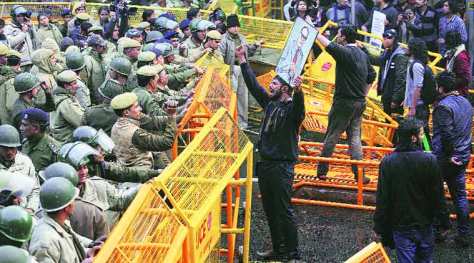
Ambedkar at the barricades, Express photo, courtesy Tashi Tobgyal

Ambedkar has become an insurgent figure today, breaking out of all the pre-set molds in which he was sought to be confined all these decades. He is no longer neither a mere Dalit leader, nor is he simply the Constitution-maker and constitutionalist who taught us to have faith in the law – the two comfortable and domesticated roles in which he has been presented to us so far by all interested parties and the powers-that-be. In the face of the new Sanghist/ fascist assault, he has broken his chains to come out on the streets, as universities and colleges across the country begin to reverberate with his spirit of rebellion. Ambedkar, the name and the face, is ubiquitous by his presence in all the struggles that mark this moment. Even as the struggle of the HCU students for justice for Rohith Vemula continues and the news of the first victory – their release on bail – trickles in, the figure of Ambedkar at the barricades gives the lie to Finance Minister Arun Jaitley’s claim above: that HCU and JNU movements were ‘ultra-Left movements’ and ‘jihadis’, and that “the name of Dr Ambedkar was ‘unfairly used’ in the case of HCU. How easy it would be, Mr Jaitley, to thus pronounce the dog mad and go about your business, and how embarrassing to have to confront Ambedkar facing your police and lathis, your courts and prisons. Continue reading Insurgent Ambedkar and a New Moment in Politics

Police Attack on SIO March in Support of UoH in Calicut: Students Approach Child Rights Commission

The students arrested during the march conducted by Students Islamic Organisation in Calicut, Kerala on 26 March in protest of the police brutality in Hyderabad University filed a petition to the Kerala State Commission for Protection of Child Rights. The Calicut Town Police lathicharged the peaceful protesters near the Calicut Head Post Office. About 40 were injured and about 30 protesters were arrested. SIO leaders who visited the police station were also arrested. Several of the protesters who faced violence were school students. Worst, the arrested students have been charged with Section 153 for instigating communal riots!

Continue reading Police Attack on SIO March in Support of UoH in Calicut: Students Approach Child Rights Commission