
Dastangoi performed by Mahmood Farooqui and Danish Husain as part of Justice on Trial for the Free Binayak Sen Campaign, at the Alliance Francaise de Delhi on 6 April 2011. Video credit: Nicky Chandam.
Category Archives: Government
At the Risk of Heresy: Why I am not Celebrating with Anna Hazare
At the risk of heresy, let me express my profound unease at the crescendo of euphoria surrounding the ‘Anna Hazare + Jan Lokpal Bill’ phenomenon as it has unfolded on Jantar Mantar in New Delhi and across several hysterical TV stations over the last few days.
This time around, I have to say that the print media has acted (upto now) with a degree of restraint that I think is commendable. Partly, this has to do with the different natures of the two media. If you have to write even five hundred words about the Jan Lokpal bill, you run out of platitudes against corruption in the first sentence (and who can speak ‘for’ corruption anyway?) and after that you have to begin thinking about what the bill actually says, and the moment you do that, you cannot but help consider the actual provisions and their implications. On television on the other hand, you never have to speak for more than a sound-byte, (and the anchor can just keep repeating himself or herself, because that is the anchor’s job) and the accumulation of pious vox-pop sound bytes ‘against corruption’ leads to a tsunami of ‘sentiment’ that brooks no dissent. Continue reading At the Risk of Heresy: Why I am not Celebrating with Anna Hazare
Dastan-e-Sedition
Free Binayak Sen Campaign
Justice on Trial:
three days of cultural events
April 4 – 6, 2011
@ Alliance Francaise de Delhi
72, Lodhi Estate, New Delhi 110003
Justice on Trial (Facebookers RSVP here) is a collaborative programme put together by leading contemporary artists, photographers, film makers, musicians, performers, and activists to commemorate struggles for democracy, freedom and rights. An exhibition of photographs and art works, talks performances and screenings all are directed at drawing renewed attention to the trial of Dr. Binayak Sen, who has emerged in recent times as a symbol of courageous resistance, and a reminder of the many injustices that surround us. Our aim is to provoke a dialogue with the colours and sounds that emerge from the idea of what Dr. Sen represents. Continue reading Dastan-e-Sedition
Hundreds of lives reduced to rubble in Delhi: Paul Divakar
Guest post by PAUL DIVAKAR
This was written yesterday, 24 March 2011: Today we witnessed most humiliating, fascist nature of pulverising already vulnerable communities – most of whom are Dalits and backward castes in Gayatri colony near Faridpur of Baljit Nagar. Continue reading Hundreds of lives reduced to rubble in Delhi: Paul Divakar
The Earthquake and Japan: Kojin Karatani
[We are posting below a piece by Japanese philosopher and literary critic Prof Kojin Karatani, sent to us by a friend. Karatani has authored a number of works, including a very important recent book Transcritique: On Kant and Marx (MIT Press 2003). In this brief but thoughtful piece, Karatani talks about the ways in which the experience of the earthquake is forcing many Japanese people to rethink the whole idea of becoming a world economic power and its concomitant idea of development. AN]
I was on the streets of Tokyo when the earthquake struck. The ground shook violently, while buildings swayed around me for a long time. It was beyond anything I had experienced before, and I sensed that something terrible had happened. My first thought was of the Kobe earthquake that killed more than 6,000 people in 1995. Although I did not experience the Kobe earthquake first hand, it hit the region of my hometown where many close relatives lived, and so I headed immediately to the scene of the disaster. I walked the streets where building after building had collapsed into rubble.
Clearly, the scale of the current disaster far surpasses that of the Kobe earthquake. For it also includes the damage caused by the tsunami to coastal regions across hundreds of kilometers as well as the danger of nuclear catastrophe. Yet these are not the only differences. The Kobe earthquake was completely unexpected. Aside from a small number of experts, no one had imagined the possibility of an earthquake there. The recent earthquake, on the other hand, had been anticipated. Earthquakes and tsunamis have struck the Northeastern region of Japan throughout its history, and frequent warnings had been sounded in recent years. Meanwhile, nuclear power had always given rise to strong opposition, criticism, and warnings. Yet the scale of the earthquake went far beyond any prior anticipation. It was not that anticipating the scale of such a disaster was impossible, just that people had purposely avoided doing so.
The full article can be read in Counterpunch.
Anti-Nuclear Parliament March on 25th March, 2011
Organized by Anti-Nuclear Struggles Solidarity Forum
Mandi House to Parliament. Assemble in front of the Sahitya Academy Lawns at 12.00 noon.
This protest march is to state our stand that we oppose all forms of nuclearisation of India, including nuclear (fission) power and weaponisation plans and programmes.
We further demand an immediate moratorium on all new projects, and a stringent review of existing plants by independent experts.
We demand investment in exploring sustainable alternative forms of energy.
Continue reading Anti-Nuclear Parliament March on 25th March, 2011
It’s Here, The Privatisation of Higher Education In India
I do not exaggerate. I am not being hasty. The writing is on the wall. What started as a glimmer in the eyes of the IIC-frequenting bureaucrat, the industrialist with profit-making dreams and the politician with an obscenely large government house in Lutyens’ Delhi is now a raging reality. Pick up any newspaper or magazine and check out the number of advertisements for private universities. Do a google search for the latest news reports on committees on higher education. If you have the time and patience, go through all the government documents on higher education in the past five years, almost neatly coinciding with the exit of Arjun Singh as Human Resources Minister and the entry of Kapil Sibal. Speaking of Mr. Sibal, if his cheerfully unapologetic blundering on the 2G scam is anything to go by, we should have an idea of the kind of subtle and layered approach he has in mind when he speaks of ‘reforming the education system.’
Continue reading It’s Here, The Privatisation of Higher Education In India
What does it mean to be a Muslim in India today?: Mahtab Alam
Guest post by MAHTAB ALAM
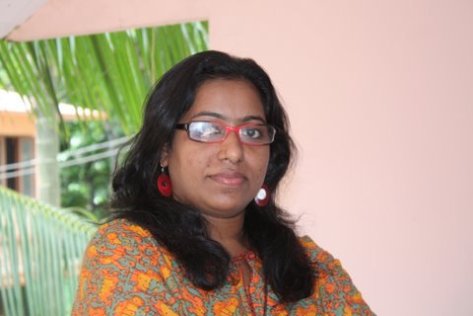
Recently, Shanina K K, a journalist from Kerala, who worked with Tehelka news weekly and now works with Open magazine, received the Chameli Devi Award for being an outstanding woman journalist. While receiving the award she said, “See, I happen to be a Muslim, but I am not a terrorist.” What made her say that and what was she trying to convey or explain? It means, as she explains, “If you belong to the minority community, they will also profile you. It is very difficult to prove that you are not a terrorist. It is equally difficult to prove that you are not a Maoist in our life and times.” Continue reading What does it mean to be a Muslim in India today?: Mahtab Alam
The Day India Will Shut Down the Internet
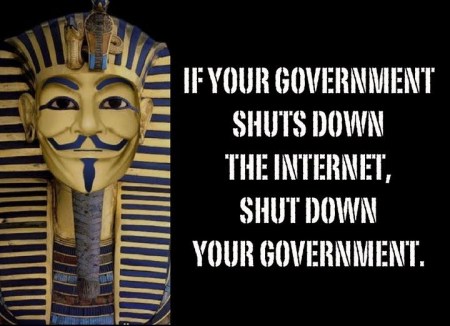
Sounds alarmist? Perhaps. But under the IT Amnedment Act of 2008, the Government of India gave itself the power to do so. The Economic Times reports: Continue reading The Day India Will Shut Down the Internet
Wikileaks: The India Cables – At Long Last
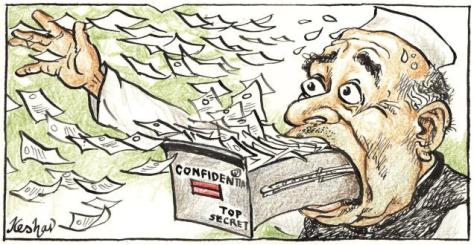
Mr. [Murli] Deora’s “long-standing connection” to the Reliance industrial group, which includes significant energy equities, was described by the cable as his “only vulnerability.” Besides Mr. Deora, the new entrants with strong pro-U.S. credentials, according to the cable, included Mr. Saifuddin Soz, Mr. Anand Sharma, Mr. Ashwani Kumar, and Mr. Kapil Sibal. [Link]
Gems like the one above should keep readers of The Hindu entertained for days. Congratulations to them on getting the whole set of 5,100 India-related cables from WikiLeaks. They’ve created a sub-site for this. Here’s N. Ram on how they got the cables. Makes you wonder if others tried.
Here’s what India’s Communications and IT Minister thinks about online freedom
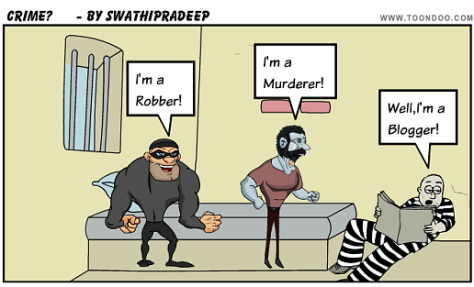
Kapil Sibal said the following at a conference on social media in Delhi recently:
We’ve seen the power of the medium in the last six months or so seeking to perform a transformational role, but in the absence of a balance… this is really the danger of sites like these. What happens in the process is that all kinds of opinion get both elicited and taken forward, without the necessary wherewithal, and there’s a great danger, because this, I believe, is a part of freedom of speech. Continue reading Here’s what India’s Communications and IT Minister thinks about online freedom
The Murder of Niyamat Ansari
In the video above, Niyamat Ansari, NREGA/RTI activist in Jharkhand, speaks of the threats to his life. Ansari was murdered on 2 March 2011. You can watch more videos of him here.
Given below are facts of how and why Niyamat Ansari was killed, and the follow-up threafter. You can follow the campaign to get justice for Niyamat Ansari on this Facebook page set up in his memory and in pursuit of justice for him. Please share these links widely, because Your Channel will not organise a candle-light vigil at India Gate. See this statement calling for justice.
The struggle of the NREGA is regularly chronicled at Nrega.net.in. NREGA, the world’s largest rural employment guarantee scheme, recently completed five years.
Think Freely, but Obey: Indu Vashist
Guest post by INDU VASHIST
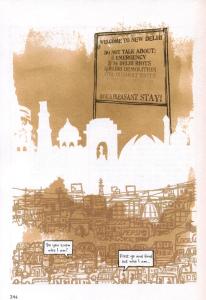
In recent years, we have seen a number of filmic representations of Delhi, (Love Aaj Kal, Delhi 6, Band Baaja Baraat, to name a few.) Amit Trivedi has even given Dilli a new anthem. All of these artist representations have been trying to capture or at least showcase the contemporary social, political and economic layers of India’s Powerpolis. Implicit within these depictions is that Delhi is actually Dilli, a place mired in contradictions and tensions, but still dil wali, a city with heart.
Vishwajyoti Ghosh’s graphic novel Delhi Calm (Harper Collins Press, 2010) recounts the 21-month period from 25 June 1975 – 21 March 1977 that is known in this country as the Emergency. This book shows another side of the city, one that does not talk about or acknowledge the atrocities committed in the name of the nation. In fact, Ghosh’s Delhi functions on the principle that silence or “self-censorship” is the key to survival in this city and by extension the mythical nation. Continue reading Think Freely, but Obey: Indu Vashist
Updated: Get Ready for India’s Blogger Control Act
The Internet in India is regulated by the Information Technology Act (2000) to which amendments were passed in 2008 and in 2009 the IT (Amendment) Act 2008 was passed. The Ministry of IT has now gotten down to notifying additional rules for the Act. Amongst the set of rules is one specifically for cyber cafes, about which I’ll write another post, and there’s one on ‘due diligence on intermediaries’. Intermediaries in the context of internet means that if you post any comment on this blog, I am legally responsible for your comments too. Intermediary liability is a favourite tool of internet censorship by repressive regimes the world over.
To those familiar with Indian laws, this will appear to be routine stuff, the sort of laws that regulate newspapers, for instance, or freedom of expression in India in general. However, three main problems here: one, the over-emphasis on blogs and bloggers, indicating the government’s anxiety over controlling blogs; two, the vagueness and vast scope of the reasons for which the government can block websites; and three, the utterly regressive move of introducing ‘intermediary due-diligence’, a favourite tool of repressive regimes against bloggers.
It is interesting that while “Blogs” and “Blogger” are defined in the Definitions section of this rule, the words aren’t used in the rules per se. In other words, they had blogs in mind while making the rules. These rules, if notified, will basically be India’s Blogger Control Act.
Continue reading Updated: Get Ready for India’s Blogger Control Act
Updated: Crazy internet censorship time in India, again
Update: Please see bottom of the post for several updates.
*
“Shivam!” Nikhil Pahwa of Medianama called this morning. “It’s 2006 all over again. They’ve blocked Typepad.” I instantly knew what this meant. They’ve done this at least twice before, the fellas at CERT-IN. In 2003, 2006 and now 2011.
Typepad.com is a blogging service, much like Google Blogger (Blogspot.com) or WordPress.com that this site, Kafila.org runs on. Now. Airtel users who go to Typepad.com find this:

Users of most ISPs can see this, but government-owned MTNL has ironically not caught up :) Continue reading Updated: Crazy internet censorship time in India, again
You Fill in the Rest: Dilip D’Souza on the Godhra verdict
Guest post by DILIP D’SOUZA
Here’s a crime: February 27 2002, 59 people killed when a train is set on fire in Godhra. 90+ people are arrested and accused of the slaughter. Bail is denied to them all. The trial takes nine years, the trial verdict acquits 63 of them, finds the other 31 guilty. The judge sentences 11 of those 31 to death, the other 20 to life in prison.
Here’s another crime: February 28 2002 (the next day), 69 people killed when a building called Gulberg Society is set on fire and its residents attacked in Ahmedabad.
You fill in the rest. How many arrested and accused of this slaughter? How many denied bail? How long does the trial take? How many are acquitted? How many are found guilty? How many are sentenced to anything at all? Continue reading You Fill in the Rest: Dilip D’Souza on the Godhra verdict
The myth of India’s Hajj subsidy: Muhammad Farooq
Guest post by MUHAMMAD FAROOQ
Recently the Supreme Court of India upheld the constitutional validity of extending subsidy on air fare to the Hajj Pilgrims. This year Rs.280 Crores were reportedly spent by the Government of India to subsidise the air fare of one lakh pilgrims. This amounts to a subsidy of Rs.28000/- per pilgrim. The subsidy provided to the pilgrims has understandably generated a lot of debate within political and social circles in India. While the right wing political parties, when not in power, consider it as an unnecessary appeasement of Indian Muslims, the governments formed by any party have always seen it as a necessary expenditure to help Muslims perform their religious obligation of Hajj.
Since I have also performed my Hajj this year, I decided to do some quick calculations to check the veracity of the tall claims made by the GoI and the Hajj Committee regarding the subsidy amount (see box). The results were quite shocking. I checked with one of the service providers —‘makemytrip.com’— and it showed up the Saudi Airline’s fare of a little over Rs.26000/- for a return Delhi-Jeddah ticket with a gap of around forty days. It was amazing to find that the total airfare of Rs.26,000 for a hajj pilgrimage is even lower than the subsidy amount of Rs.28,000 thousand which is allegedly paid by GoI to airlines to subsidise the “high cost” of the air tickets. Continue reading The myth of India’s Hajj subsidy: Muhammad Farooq
What do the Maoists want?
The media has by and large focused on the Maoist demand of release of some of their own in exchange of the Malkangiri collector and junior engineer. The list of the total 8 of 14 demands of the Maoists that the Orissa government has agreed to makes for interesting reading:
(1) Orissa government will write to Jharkhand and Chhattisgarh to take action on the extremists demand for release of Maoist central committee members Sheela di (jailed in Jharkhand) and Padma (in Chhattisgarh) owing to their ill-health; (2) ST status for the Konda Reddy and Nukadora communities categorized as OBCs; (3) stopping the multi-purpose Polavaram project of Andhra Pradesh; (4) ‘pattas’ (record of rights) to tribals dispossessed of their land in Malkangiri and Koraput; (5) irrigation in Maribada and Maniamkonda villages in Malkangiri; (6) compensation based on HC order to Tadangi Gangulu and Ratanu Sirika who died of disease allegedly due to torture; (7) relevant laws for mining operations in Mali and Deomali bauxite mines; (8) minimum displacement of tribals and adequate compensation. [ToI]
The ‘Viral’ Revolutions of Our Times – Postnational Reflections
The Arab Turmoil
According to a report in The Guardian, the movement in Egypt that overthrew the regime of Hosni Mubarak is “a movement led by tech-savvy students and twentysomethings – labour activists, intellectuals, lawyers, accountants, engineers – that had its origins in a three-year-old textile strike in the Nile Delta and the killing of a 28-year-old university graduate, Khaled Said”. It has emerged, says the report, “as the centre of what is now an alliance of Egyptian opposition groups, old and new.” The April 6 Youth Movement (primarily a Facebook network), came into existence in in 2008, in support of the ongoing workers’ struggle in the industrial town of El-mahalla El-Kubra primarily on issues related to wages. The struggle in the past few years, also moved towards a restructuring of unions with government appointed leaders. The list of demands for the April 6 strike also included a demand for raising the national minimum wages that had remained stagnant for over two and a half decades. Increasing workers militancy over the past few years was a direct response to the World Bank imposed ‘reforms’ that had pushed lives of industrial labour to the brink. It was this sharpening conflict, consequent upon the serious impact of structural adjustment policies, that provides the backdrop in which the middle class youth decided to rally in support of the April 6 2008 strike. It was they who converted the call for an industrial strike into a general strike, according to some reports. It is virtually impossible to get a sense of any of this in the ecstatic reports of the ‘networking babalog’ making a revolution that is now all over the Indian media.
Continue reading The ‘Viral’ Revolutions of Our Times – Postnational Reflections
On the fuzziness of Personal Identity: UIDAI and the national identity card of India: Taha Mehmood
Guest post by TAHA MEHMOOD
I – The spread of Identity cards in Southasia:
An identity card virus seems to be spreading across south-Asia. The pathogen emerged long ago in 1971, when Pakistan established a paper based personal identity system. !971 was also the year when Pakistan was engaged with India in a military conflict which led to the creation of Bangladesh. In 1972, a year later, the Department of Registrations of Persons located at Colombo, Sri Lanka, was entrusted with the responsibility of issuing a national identity to citizens who were over sixteen years of age. In 1972 the name of the island was changed from Ceylon to Sri Lanka and Tamil Tiger leader Velupillai Prabhakaran formed the Tamil New Tigers (TNT), which later became LTTE or Liberation Tigers of Tamil Eelam. The state of Sri Lanka was at war with LTTE for the next three decades. Nothing new happened on the national identity card front for the next two decades. Continue reading On the fuzziness of Personal Identity: UIDAI and the national identity card of India: Taha Mehmood
The Virtues of Waiting Patiently: Arnav Das and Soumik Mukherjee
Guest post by ARNAV DAS SHARMA and SOUMIK MUKHERJEE. Photographs by SOUMIK MUKHERJEE
Peepalguda, Koraput, Odisha: “You see, for the bridge over that rivulet, forty thousand rupees were sanctioned”, the sarpanch of Mossigam gram panchayat starts off emphatically. It is only after a good amount of probing that he confesses that it was foolish of the Public Works Department (PWD) to sanction Rs 40,000 for a bridge when a similar bridge was built seven years ago in another village for Rs 43 lakh. In any case, a slight bureaucratic nudge resulted in even this amount to get diverted to another village in the Lima panchayat. Continue reading The Virtues of Waiting Patiently: Arnav Das and Soumik Mukherjee
 KAFILA - COLLECTIVE EXPLORATIONS SINCE 2006