I remember, as a young child, going with my father one Onam in our ancestral home to watch the local Onam sports-and-games.My admittedly-fuzzy memory is of a large crowd of men gathered in an open paddy field or ground (I remember a lovely cloud of dragon-flies hovering above doing some sort of crazy-excited dance), getting ready for Onathallu — physical combat between
two men. Continue reading Onathallu Redux? Some thoughts on Onam
Category Archives: Identities
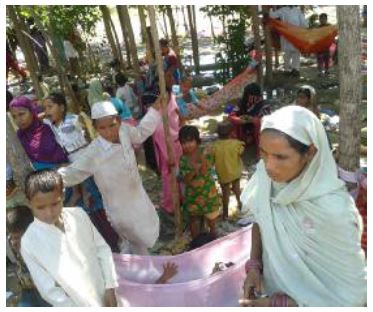
In the relief camps of Muzaffarnagar and Shamli
This report was prepared by a group of citizens (whose names are given at the end), and released on 20 September 2013.

A human tragedy unfolds, as the State watches, In the relief camps of Muzaffarnagar and Shamli Districts
A Preliminary Citizens’ Report
September 20, 2013
A. On September 17-18, 2013, an 11 member team consisting of both independent activists as well as activists affiliated with 5 organizations based in Lucknow, Chitrakoot, Muzaffarnagar and Delhi visited relief camps in two affected districts of Muzaffarnagar (3 Relief Camps – Madrasa camp at Bassi Kalan, Madrasa camp at Tawli and camp at Haji Aala’s house, Shahpur) and Shamli (3 Relief Camps – Madrasa camp on Panipat Road in Kairana, Malakpur camp in Kairana, and the Idgah camp in Kandhla). In Shamli District the team also met with senior members of the district administration – the District Magistrate and the Superintendent of Police.
B. This was not conceived of as a fact-finding visit, but was a recce visit to determine the human needs on the ground in the relief camps, and to see how we might plan to help survivors in initiating procedures towards criminal justice (lodging of FIRs and complaints), accessing compensation for death, injury, destruction of property, planning rehabilitation, and also to confirm unverified news reports of sexual violence against women. Continue reading In the relief camps of Muzaffarnagar and Shamli
In Delhi’s defence

By SHIVAM VIJ: The census counts ’urban agglomerations’, and the Census of India says that Mumbai is India’s largest urban agglomeration. This includes Mumbai’s suburbs. In counting Delhi, the suburbs are not added because They are separated by state boundaries. If you were to add suburbs of the ’National Capital Region’, Delhi’s population would be not 16 million but over 22 million, making it the world’s largest urban agglomeration after Tokyo. This bustling urban centre is made of its people. Today’s Delhi cannot be stereotyped as just the seat of power. There is more to Delhi than the endless roundabouts of Lutyens’ capital.
Delhi’s core – the Partition refugee Punjabi – is not xenophobic like the Marathi ’manoos’ of Mumbai. In fact Delhi today is what Bombay once was, India’s foremost cosmopolitan metropolis. It is the city of choice for people from across India to migrate to with dreams of riches.
A lot has been written about “the Delhi gang-rape”. 16 December 2012 started a conversation that doesn’t seem to end. This conversation has largely been about rape, not about Delhi.
Continue reading In Delhi’s defence
Goodbye Sunila Abeysekara
Sri Lanka’s top UN Human Rights award winner Sunila Abeysekara died at a private hospital in Colombo on Monday afternoon after a long battle with cancer.
A founder of Sri Lanka’s feminist movement, Ms. Abeysekara was a leading socialist activist for minority rights, women’s, workers and peasants rights. Recently she was prominent on Lankan human rights issues at the UN Human Rights Council in Geneva. She was also a noted Sinhala folk and opera singer. Ms. Abeysekera, daughter of the late Charles Abeysekara, a noted human rights and social activist, founded Inform, a rights-based NGO. – Ends-
(Sunday Times ,Sri Lanka, Monday, 09 September 2013 19:02)
It was late 2002 when Delhi witnessed a public meeting of a different kind at Rajendra Bhavan. Hundreds of people from different walks of life – activists, writers, political workers, young students – had gathered there to witness the unveiling of an interim report prepared by an international panel of feminist activists which had visited Gujarat between 14th and 17th December, investigated the violence – particularly the physical and sexual – inflicted upon women since 27th February 2002.
The interim report prepared by the ‘International Initiative for Justice in Gujarat’ unequivocally stated : “this violence, which reflects a longer and larger genocidal project, in our view constitutes a crime against humanity and satisfies the legal definition of genocide, both of which are crimes of the most serious dimension under international law.” (http://www.onlinevolunteers.org/gujarat/reports/iijg/interimreport.htm)
The panelists included leading feminist scholars and activists from different parts of the world.
It was the first time that one had a chance to listen to Sunila Abeysekara. Continue reading Goodbye Sunila Abeysekara
Report of the Fact Finding Investigation conducted to ascertain facts in the case of alleged rape and murder of Dalit girl in Jind district of Haryana
Report of Fact Finding Team put together by ALL INDIA DALIT MAHILA ADHIKAR MANCH. Received via Kalyani Menon-Sen

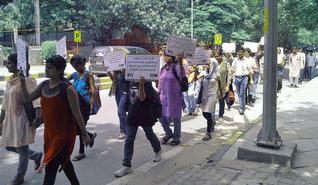
Women activists protest outside Haryana Bhavan in Chandigarh on September 1 demanding a CBI probe into the death of the Dalit girl in Jind. Image from The Hindu
On 24th August, a 20 year old Dalit girl was brutally raped and murdered in Jind, Haryana, while she was on her way to write an examination. Her body was found near a canal the next day by the police. There were cigarette burn marks on her body and significant indications of sexual violence. It is clear that she was kidnapped, raped and then murdered.
However, at the time of the fact finding, even after four days the culprits had not been identified or arrested, and there was no progress on the investigation beyond sending the body for post mortem. In fact, the parents of the girl, members of her village and various Dalit activists refused to cremate the body and were sitting on dharna in front of the Jind Civil Hospital to protest against police and administrative apathy and callousness. It was very clear that the Haryana police and administration was exhibiting gross negligence in this case, ignoring the law and evading established investigative procedure.
It is at this point that the All India Dalit Mahila Adhikar Manch (AIDMAM) decided to put together a fact finding committee to visit the area, meet the key people involved and ascertain the facts of the case. Continue reading Report of the Fact Finding Investigation conducted to ascertain facts in the case of alleged rape and murder of Dalit girl in Jind district of Haryana
A Burden of Proof: A Response to “White Woman’s Burden” by Ameya Naik
This is a guest post by AMEYA NAIK
[On the 26th of August 2013, Newslaundry carried a piece by Rajyasree Sen titled “White Woman’s Burden“. This post is offered as a rebuttal of the views expressed in the essay.]
Dear Rajyasree,
Michaela Cross, aka RoseChasm’s CNN blog piece about her experience of India is, as you say, currently unavoidable on the internet. It does seem to be provoking a dialogue on women and safety in India – at least in social media circles. If the result is that Indian girls and women acknowledge and share their own negative experiences, perhaps thereby to make some Indian men re-examine their perceptions and behaviour, it would still be a step forward.
Unfortunately, some responses represent two steps backwards instead. Your writing (“White Woman’s Burden”, 26 Aug, 2013) is one such; it made me profoundly uncomfortable. The gist of your argument appears to be this: Michaela was not suitably prepared, and she *SHOULD* have known better. Indeed, given her account of her actions and experiences, and the trauma she has experienced therein, it is surprising (to you) how unprepared she was.
Did I just read a young, educated Indian woman entrepreneur – from the hospitality industry, no less – say that an exchange student left traumatised after experiencing molestation (and worse) because she was unprepared? I describe myself as a cynic, but surely this is a new low!
What, pray tell, would suggest she was sufficiently prepared? That she came here, had the experiences she did, and considered them “par for the course” in India? Or that she came here aware of (what you call) the skewed psycho-sexual dynamic between Indian men and women in all its rich and diverse forms, behaved in the most conservative and appropriate fashion – only dancing in “safe places”, avoiding public transport entirely, staying only with trusted hosts or in one of Goa’s five star hotels – and left having experienced only milder forms of violation, like the persistent gaze (which she would know to expect)?
This assertion of yours does have one unexpected benefit – it lets us ignore the fair skin debate. If complexion plays no role, she should still be at least as careful as any Indian woman. If complexion does play a role, she should be even more careful! As silver linings go, though, this is pewter on a thundercloud.
How, pray tell, would the students or the University prepare for their visit to the land of the skewed psycho-sexual dynamic? With little docu-dramas of all the kinds of harassment you can expect, and how to be safe at all times? Would you not seed the most pernicious mistrust in your potential visitors? In fact, why would any of them come at all? Surely the University would simply cancel the trip!
And, while you seem to suggest that this is precisely what the “easily traumatised” should do, we would be the first to protest. Already we cry ourselves hoarse over travel advisories saying India is unsafe for women. That, apparently, is an insult to our national pride. And that seems to be the source of this article: “how dare this unprepared white girl write about India this way?” Only Indian writers can suggest that India has a skewed psycho-sexual dynamic, right? (An interesting dynamic which, of course, makes some – but not all – lechers or potential rapists. And on current evidence, I shudder to ask you who these corrupted ones are, and why only they succumb to this taint.) Because Indian women are prepared for such behaviour, and they know – even when they face it abroad – that it is only an aberration.
Too many responses, too many comments, seem to be in this vein. Why this parochial-with-my-fingers-crossed-so-as-not-to-offend-gendered-perspectives reply at all? My thesis is that it is because Michaela’s account makes us ask a few uncomfortable questions. Such as, how many aberrations to make a norm? How much preparation is enough?
Answering those questions is not a White Woman’s Burden – the onus to answer to them lies on us. Discrediting the person who asked them as “easily traumatised” – and really, as someone who says she has lived through incidents enough of her own, how dare you! – is a thoroughly inadequate reply.
[Ameya Naik is currently in a graduate programme in Boston. A psychologist and lawyer by qualification, he worked in New Delhi across 2012-13.]

Why is Sachin Pilot in My Dreams? Or, Three Visas, and No More, to India: Fawzia Naqvi
Guest Post by Fawzia Naqvi
Sachin Pilot was in my dreams last night, with all due apologies to his wife, because I swear, I am not secretly fantasizing at all about India’s youngest cabinet minister. He just showed up. I think it was in Srinagar, though I’ve never been there, I swear. And why Srinagar? Well that’s another matter, requiring numerous sessions of therapy. But the good Minister made a cameo appearance and told me quite categorically that I had already been granted three visas to India and should expect no more. Don’t get me wrong. I like Minister Pilot. I admired the way he handled corporate America when he visited New York to deal with all the whining and complaining about Indian reforms and that pesky CSR Bill. But why is he in my dreams? An Indian friend tells me it’s because I’m constantly nervous about going to India. And herein lies the truth. I observe, analyze, obsess about, pontificate upon, call, email and travel to India more than most Pakistanis, without actually being a spy. Yes. Really. And I resent how easy the spooks have it. I’m guessing they aren’t dreaming about a finger wagging minister, ok Sachin Pilot, telling them they can’t get a visa! But such are the incessant covert and overt anxieties of Pakistanis like me who have careers involving India. And if Sachin Pilot, he of the new generation of Indian leaders is also telling me (in my dreams of course) that I can’t get a visa, then surely the news for Indo-Pak and hence my career, is not good. The twain of course is twinned.
Continue reading Why is Sachin Pilot in My Dreams? Or, Three Visas, and No More, to India: Fawzia Naqvi
The Unknown Fate of Thousands in Sri Lanka: Leena Manimekalai
Guest post by LEENA MANIMEKALAI
‘By the wayside’
“This wreath/ with no name attached /is for you/who has no grave/ As the place of earth/ which embraced you/ could not be found/this wreath was placed by the wayside/Forgive me/ for placing a memorial for you/ by the roadside.”
…writes Basil Fernando about the memorial constructed by families of disappeared at Radoluwa Junction in Seeduwa, a town near the city of Negombo, Srilanka. When I visited the memorial with lingering faces of the disappeared, it signified an important attempt to keep the memories alive, a yearning to prevent recurrence of mass disappearances and seek justice on behalf of the victims of disappearances and their families. Srilanka which has a deep and complex history of political violence is struggling to redeem the past with a frozen present and a black hole future. Communal riots, political assassinations and ethnic conflict have been an element of the socio-political landscape of this tear nation for more than a century. Two heads of State, dozen national political leaders and numerous regional and local politicians, journalists, activists and artists have been assassinated by groups representing virtually every shade of political spectrum. The Srilankan state deploys disappearances and extra judicial killings as an instrument of public policy in the name of State Emergencies, Prevention of Terrorism Act, dubbing of persons as terrorists, unpatriotic, enemies of state. Brutal suppression of two armed insurrections in the Sinhala South in 1971-72, 1987-89 led by Peoples Liberation Front (JVP) and an armed Tamil Separatist Movement since 1970s led by the Liberation Tigers of Tamil Eelam (LTTE) in the Tamil North and East of the island had spotted Srilankan state guilty of horrific human rights abuses. Now the nation is the world leader in number of disappeared crossing millions who have no date of death, no place of death, no body, and no grave or funeral rites. Obviously there is no shelling, no bombing in the island since 2009 and the State wants the world to believe that war is over but who will bring peace to the families who continue to lose their members to State Terror and also been denied their basic right to even open their mouth about the injustice. Continue reading The Unknown Fate of Thousands in Sri Lanka: Leena Manimekalai
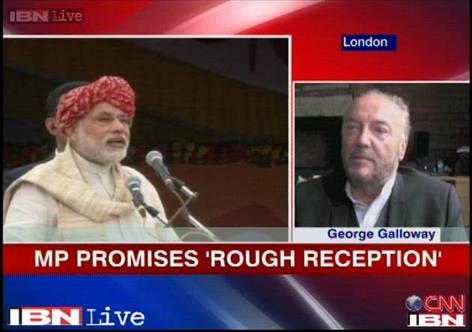
Modi Goes To London
Good news is followed by a flood of bad news.
Narendra Modi, the ‘architect’ of today’s Gujarat, must be realising the truth of this dictum despite the fact that the corporate media – to quote an analyst – ‘loves’ him.
Whether it is the growing resistance of the peasantry inside the state to his vision of development, compelling him to withdraw a major chunk of villages from the much discussed Mandal-Becharaji Special Investment Region (SIR), or the crude manner in which his government’s anti Dalit stance is coming to the fore, the signals are definitely ominous. Continue reading Modi Goes To London
To the German ambassador in India, a letter from Kashmir
This letter was faxed from Srinagar on 26 August 2013 to the German embassy in New Delhi and the Bavarian State Opera. List of signatories given at the end.
To,
Ambassador Michael Steiner,
German Embassy,
New Delhi, India.
Subject: URGENT Protest Letter to German Embassy on scheduled Zubin Mehta concert in Srinagar, Jammu and Kashmir on 7 September 2013
On 22 August 2013, a press release was issued by the German Embassy that Zubin Mehta would be conducting an orchestra on 7 September 2013 at Shalimar Bagh, Srinagar, Jammu and Kashmir.
The press release quoted you as stating that the concert was for the people of Jammu and Kashmir by way of a cultural tribute. The press release also reads that the concert was intended to give a message of hope and encouragement to the people of Jammu and Kashmir. The concert, said to be a part of a “broader engagement” is being organized by the German Embassy and supported by the “competent authorities both at Central as well as at Union State level”. The costs of the concert are covered by “benevolent sponsors mainly from the business world in India and Germany, as well as “Incredible India‟ and the German Foreign Office”. Continue reading To the German ambassador in India, a letter from Kashmir
Communalisation in the name of Security and Sovereignt: JKCCS
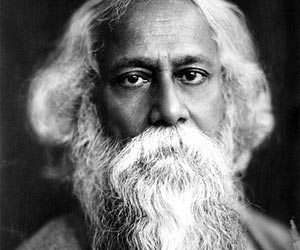
Nationalism in India: Rabindranath Tagore
From RABINDRANATH TAGORE‘s lectures on Nationalism, 1917
Our real problem in India is not political. It is social. This is a condition not only prevailing in India, but among all nations. I do not believe in an exclusive political interest. Politics in the West have dominated Western ideals, and we in India are trying to imitate you. We have to remember that in Europe, where peoples had their racial unity from the beginning, and where natural resources were insufficient for the inhabitants, the civilization has naturally taken the character of political and commercial aggressiveness. For on the one hand they had no internal complications, and on the other they had to deal with neighbours who were strong and rapacious. To have perfect combination among themselves and a watchful attitude of animosity against others was taken as the solution of their problems. In former days they organized and plundered, in the present age the same spirit continues—and they organize and exploit the whole world. Continue reading Nationalism in India: Rabindranath Tagore
The Sunset of the Century: Rabindranath Tagore
The eve of India’s 66th Independence Day is a time as good as any to read this poem by RABINDRANATH TAGORE, even as India gets ready to sing to martial tune another Tagore poem, Jana Gana Mana. This English translation was published at the end of Tagore’s 1918 book, Nationalism.
THE SUNSET OF THE CENTURY
(Written in the Bengali on the last day of last century)
1
The last sun of the century sets amidst the blood-red clouds of the West and the whirlwind of hatred.
The naked passion of self-love of Nations, in its drunken delirium of greed, is dancing to the clash of steel and the howling verses of vengeance. Continue reading The Sunset of the Century: Rabindranath Tagore
The Curious Case of Hamid Ansari

You may think he is a spy or a saboteur. If he is one, would he have spent months trying to reach Kohat from Mumbai and then get caught in just two days?
Sitting in Mumbai, Hamid Ansari fell in love with a Pakistani Pashtun girl over Facebook. He was a 26 year old management teacher, she was a B.Ed. student. After over a year of obsessing about each other over the internet, phone and phone messengers, she called him one day, crying. She had confided in her sister about this online affair, but the sister told the parents, who decided it was time to find her a husband. It was the last phone call. She soon disappeared from Facebook too. Continue reading The Curious Case of Hamid Ansari
Manmohan Singh must visit Pakistan

By SHIVAM VIJ: Which Indian or Pakistani premier has not desperately wanted to be the one to clinch peace between the two countries? Prime Minister Manmohan Singh has reportedly been keen, for years now, to go on a state visit to Pakistan.
Before the political climate could be conducive to Manmohan’s visit to Islamabad, 26/11 took place. Pakistan’s refusal to give Dr Singh even breathing space on the 26/11 investigations, followed by the LoC tensions in January and August this year, means that in his 10 years of prime ministership, Manmohan Singh will never have visited the country of his birth. Continue reading Manmohan Singh must visit Pakistan
Good Muslim, Bad Muslim – A Response to Ashish Khetan on the ‘IM’: Warisha Farasat
Guest Post by Warisha Farasat
The recent opinion piece by Ashish Khetan in the Hindu has yet again reiterated the false and malicious stereotype: that Muslims somehow have something or the other to do with terror, either when they are directly involved or when they are silent about others of the community being involved. It is disappointing that the debate is framed in the stereotypical, “good Muslim”, “bad Muslim” tenor rather than a real engagement with issues of shoddy investigation and communal bias that marks terror investigations in the country. Perhaps the greatest disservice that has been done to idea of justice has been linking an entire community to terrorism.
Continue reading Good Muslim, Bad Muslim – A Response to Ashish Khetan on the ‘IM’: Warisha Farasat
Minority Report – Deaths followed by Executions : Ramray Bhat
This is a guest post by RAMRAY BHAT
The collective conscience of our prominent democracies works in very strange ways. India is yet to come to terms with the killing of a nineteen-year-old Mumbaiite student Ishrat Jahan in an encounter by officers of the Gujarat Police in collaboration with the Intelligence Bureau. Along with three other individuals, Javed Sheikh (for whom Ishrat worked as a secretary), Amjad Ali Rana and Zeeshan Johar, Ishrat was first announced to have died in police firing and the alleged plan hatched by these four individuals to assassinate prominent politicians of India, thereby thwarted. Inquiries at the level of the Ahmedabad metropolitan magistrate court as well as by the Central Bureau of Investigation (CBI) as directed by the Gujarat High Court confirmed what had been suspected all along, that Ishrat had been murdered in cold blood while she was in police custody. Continue reading Minority Report – Deaths followed by Executions : Ramray Bhat
The Affective Claims of Violence – Reflections on the JNU Campus Tragedy: Pratiksha Baxi
Guest Post by Pratiksha Baxi
Many competing frameworks have given expression to shock, disbelief, rage, grief, guilt and fear after the violence witnessed as the new semester kicked in, with a monumental tragedy, on the JNU campus. Everyone is stunned by the tragic turn of events that has resulted in a young woman battling for her life in a neuro–ICU in Safadarjung hospital. Confusion gripped the campus as the classroom became a scene of crime, a classmate became a bloodied body and the familiar transformed into the incomprehensible. It was devastating that the assailant, who succeeded in extinguishing his own life, aimed to unite in death the object of his obsession through a planned and highly performative act of violence in the routine setting of a classroom.
GUANTANAMO II : K Satchidanandan
This is a guest post by K SATCHIDANANDAN
A poem by Ibrahim al-Rubaish, a Guantanamo Bay prisoner written in the tragic circumstances of illegal incarceration has given rise to a baseless controversy in Kerala as it was included in a section titled ‘Literature and Contemporary Issues’ of the English text book for the third semester undergraduates in the University of Calicut. The poem was recommended for inclusion by the Board of Studies chaired by Dr K. Rajagopalan, and rightly so as the section dealt with creative writing based on contemporary issues including the issue of human rights. The poem goes like this: Continue reading GUANTANAMO II : K Satchidanandan
Lok Sabha elections, software imperialism and the Urdu language: Anant Maringanti
Guest post by ANANT MARINGANTI. Kapil Sibal may have unwittingly erased a whole historical geography of pre-windows software development in India. If the Times of India report on the release of Urdu fonts developed by National Council for Promotion of Urdu Language ( NCPUL) last week is accurate, Sibal said that India developed Urdu Software and fonts and thereby ended a longstanding dependency on Pakistan. This, according to him is beneficial to the 15 crore Urdu language users. There is a ‘pre-election Muslim wooing’ feel to the story which nicely blends with the ‘massaging of Indian (read Hindu) nationalist pride’ feel. The sense of triumph and pride at this historic achievement by Indian programmers would have been justified even if it could be read as symptomatic of the postcolonial condition that Amitav Ghosh captures in his recounting of the breakdown of conversation between himself and the Imam of Lataifa and Nashawy. Unfortunately however, Urdu language users in India were never dependent on Pakistan for software and fonts. This can be said in two different senses: first that Indian Urdu language computing originated in Hyderabad almost 25 years ago and has contributed significantly to local cultural economy. Second, to the extent that there has been exchange between India and Pakistan in Urdu language computing, the participants in that exchange have seen it primarily in terms of exchange. Afterall, people cannot help making language tools even if nation states do not pay them much attention. Continue reading Lok Sabha elections, software imperialism and the Urdu language: Anant Maringanti
What Indian school children learn about the Partition
I wrote recently about the surprising political maturity with which NCERT textbooks teach Indian students about the Partition. These textbooks were prepared under the National Curriculum Framework of 2005. This is of course not limited to the Partition chapter or indeed just the history textbooks. But I was particularly moved to see the Partition chapter. As you read it you realise what school textbooks can do in shaping how future generations see themselves, their own history and identity. I think a lot of people in both India and Pakistan would like to read it. Here it is: