Category Archives: Identities

Carpets and kebabs in Isfahan: Marryam H Reshii

Guest post by MARRYAM H RESHII

iran67

I could write a book about my week in Iran, but will restrict myself to captioning these photographs I took.

The only two cities I visited were Mashad and Isfahan. Mashad is famous for two things. The shrine of the Eighth Imam of the Shia sect of Islam, Imam Reza, the only one out of all twelve Imams to actually be buried in Iran (all the others are buried in Saudi Arabia and Iraq) and saffron that grows far, far more plentifully than it does in Kashmir.

Mashad sells carpets woven/produced elsewhere. While the large carpets are traditionally Iranian, the small ones in frames are too suspiciously perfect to be made with human hand. Most of them have a plethora of shades of white in them, making the weaver something of a genius! Continue reading Carpets and kebabs in Isfahan: Marryam H Reshii

Modi and me: Sharad Mathur

This is a guest post by SHARAD MATHUR

1999

In the summer of 1999, practising our family tradition, we were availing a government LTC that my father was entitled to, being a senior central government officer.  Since we could travel by air, we decided to take a trip to Darjeeling, while halting at Allahabad, Varanasi, Lucknow, and Calcutta for some sight-seeing. Those were the days when flying was an experience for most Indians; yet the emotional memory of this trip did not record much of the excitement induced by flying, but took vivid account of disappointment – with a chance conversation and of missing another.

It was on our flight from Lucknow to Calcutta, I was sitting with my younger brother while my parents were sitting together in a row behind us. I was on the window seat and was too occupied with the process of luggage sliding inside the plane, to notice two gentlemen who came and sat next to my parents and my brother respectively. My gawking was however interrupted by my father excitedly introducing me to one Devi Singh ji, who I was told happened to be Personal Assistant to Shri Bhairon Singh Shekhawat. Being a big BJP enthusiast, partly because of their mesmerizingly bright coloured flags, I looked up to this BJP heavyweight and was elated to meet his personal assistant. My excitement was doubled when Devi Singh ji introduced us to a gentleman sitting next to my brother, on the aisle seat, as Modi ji who was accompanying Bhairon Singh ji to the Bihar convention of BJP. However, this excitement remained short lived.

Continue reading Modi and me: Sharad Mathur

Pakistan ka Jugraafiya: Kyunki Patras

This guest post by KYUNKI PATRAS is in Roman Urdu.
KYUNKI PATRAS ka yeh mazmoon Roman Urdu mein hain.

Pakistan samundr-e-kufr mein aik roshan jazeera hai. Continue reading Pakistan ka Jugraafiya: Kyunki Patras

An undivided history of Punjab’s Partition: Ajay Bharadwaj

This is a book review by AJAY BHARADWAJ of an authoritative new book on the Punjab’s Partition by Prof Ishtiaq Ahmed. If you have any questions about the book or about the Partition in general, please leave them in the comments section and we will soon put them to Prof Ahmed.

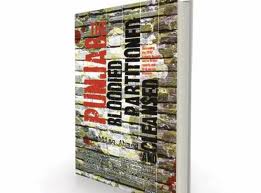
images
The Punjab Bloodied, Partitioned and Cleansed
By Ishtiaq Ahmed
Rupa Publishers, Delhi; 2011, 754 pp., Rs 995

Ishtiaq Ahmed claims that his work is “the first holistic and comprehensive case study of the partition of Punjab” (p.xlv); he has lived up to it admirably.  A study of rigorous scholarship, with painstaking fieldwork on both sides of the divide, The Punjab Bloodied, Partitioned and Cleansed’ offers unbiased insights into a minefield called the Partition of Punjab. As the title itself suggests, the book delves deep into the most difficult aspect of Partition history which has come to define it — the scale and magnitude of the killings at that juncture.

The primary sources that Ahmed has accessed in his endeavour are equally interesting for a number of reasons. While the historian draws extensively from the classified fortnightly reports (FRs) of the Punjab governors and chief secretaries to the viceroys, he simultaneously pays heed to oral history or the personal narratives of individuals — “witness to or victim of traumatic events” — that he has recorded over a decade and a half. The coming together of the two strands creates an intricate web of high politics and everyday life, which contributes to a layered, richly detailed and immensely moving account of the partition of Punjab — leaving a permanent imprint on the mind of the reader. Continue reading An undivided history of Punjab’s Partition: Ajay Bharadwaj

Ilyas Masih wants to stay in the dustbin: Saad Sarfraz Sheikh

This slideshow requires JavaScript.

SAAD SARFRAZ SHEIKH sends us this photo essay from Lahore: On 9th March, 2013, I saw an entire neighborhood burn right in front of my eyes. All I could do was watch, as the houses fell and their residents watched in vain.

And now, there are burnt teddy bears and dolls, broken doors and melted buckets stuck on the floor. It seems I am on fire.

Nasreen’s defunct washing machine is now as black as the night. Her child sits on it and weeps. Like a surgeon, she salvages the motor and tells me that it could still work. But her microwave, she tells me, is a painful puddle on the floor. Continue reading Ilyas Masih wants to stay in the dustbin: Saad Sarfraz Sheikh

Sahibs, Pandits and the Scholarship on Caste: Manish Thakur and Nabanipa Bhattacharjee

Guest post by MANISH THAKUR and NABANIPA BHATTACHARJEE

Scholarship on caste has always been much more than merely about caste. At stake has been the very idea of India, and the production of knowledge about it. Expectedly, whenever academic knowledge on caste spills over in the public domain (and it does so often, as in the recent Ashis Nandy case), politically charged contestations about the idea of India inevitably follow. In the academy, the privileging of Brahmanical worldview in sociological discourses on India continues to be a source of deep-seated resentment. ‘Indian Critiques of Louis Dumont’s Contributions’ (Khare 2006) notwithstanding, the figure of ‘the learned Brahman’ (Alamgir 2006) looms large in the voluminous corpus of anthropological knowledge about India. So much so that Richard Burghart(1990) views modern anthropological knowledge primarily as a function of multiple dialogues between modern day anthropologists and the Brahmanical tradition of knowledge.

Continue reading Sahibs, Pandits and the Scholarship on Caste: Manish Thakur and Nabanipa Bhattacharjee

The Jamaat factor in Bangladesh politics: Jyoti Rehman

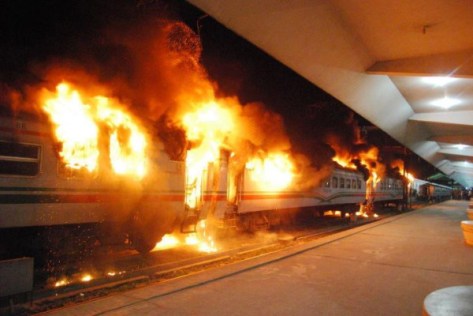
jamaat-train
A train in Bangladesh set on fire by activists of the Jamaat-e-Islami Bangladesh

This is a guest post by Bangladeshi commentator JYOTI REHMAN: Delwar Hossain Sayedee, an Islamic preacher and a senior leader of Jamaat-e-Islami Bangladesh, the country’s largest Islam-pasand party, was sentenced to death on 28 February for war crimes committed during the 1971 Liberation War. Within hours, Jamaat cadres and activists clashed violently with police and law enforcement agencies. Scores have been killed in some of the worst political violence the country has experienced in recent years.

Five other senior Jamaat leaders, including its current and former chiefs, are being prosecuted for war crimes committed in 1971. Another leader was sentenced to life imprisonment on 5 February. That sentence triggered what has come to be called the Shahbag Awakening—a month of largely peaceful gathering of tens of thousands of people in the middle of Dhaka. A key demand of the largely government-supported Awakening is to ban Jamaat. Continue reading The Jamaat factor in Bangladesh politics: Jyoti Rehman

A Curfew in Spring: Rich Autumns

1-rich-autumns2
Photograph by Rich Autumns

RICH AUTUMNS writes from Srinagar: The capital of Kashmir is under tight curfew. Tight does not qualify curfew. It qualifies Srinagar. Srinagar is tight under curfew. The city has stopped breathing. It is an enforced exercise that the Valley undergoes regularly for the sake of law and order. On the deserted streets of Srinagar, Indian Army men stand in army issued jackets nursing rifles under the fresh green leaves of the Chinar. Occasionally a milk man cycles by. Sometimes, he is stopped and turned back. Sometimes he is allowed to pass, after an identity check. Continue reading A Curfew in Spring: Rich Autumns

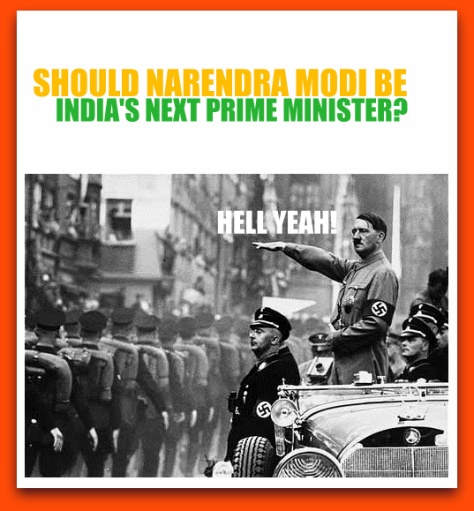
Should Narendra Modi be India’s next Prime Minister?

MODI-HITLER

Sheela Bhatt writes: Continue reading Should Narendra Modi be India’s next Prime Minister?

Wave of violent attacks against Hindus in Bangladesh: Amnesty International

Press release put out on 6 March by AMNESTY INTERNATIONAL: A wave of violent attacks against Bangladesh’s minority Hindu community shows the urgent need for authorities to provide them with better protection, Amnesty International said.

Over the past week, individuals taking part in strikes called for by Islamic parties have vandalised more than 40 Hindu temples across Bangladesh.

Scores of shops and houses belonging to the Hindu community have also been burned down, leaving hundreds of people homeless. Continue reading Wave of violent attacks against Hindus in Bangladesh: Amnesty International

A Modest Proposal from EFLU Students, Hyderabad: Anonymous

Anonymous Guest Post

[This is a response to the recent political developments in the English and Foreign Languages University, Hyderabad. On 1nd March, 2013, Mudasir Kamran, a Kashmiri Muslim PhD scholar of the university was taken to the police station by the Proctor and some other professors of the university in pretext of a personal enmity between Mudasir and his erstwhile room-mate, where he was detained throughout the night without any written complaint being filed. Mudasir came back broken, asking why he was treated like a thief and a criminal. On 2nd March, he committed suicide. A section of the students since then has been demanding for the suspension of the Proctor, an apology from the university, and compensation to the family. The university administration dealt with this in a fiercely draconian manner. They refused to meet the students, they enforced police protection, they threatened a null semester, even a total shut-down of the university. They did not issue a single apology, they appeared in front of media and produced false versions of the events hand in glove with the police (that was subsequently refuted by the alleged eye-witnesses), they constituted a faculty-only Fact-Finding Committee without removing the accused from his administrative position. Rumours have been floated about the alleged homosexuality and the mental instability, thus inciting the cultural stereotype of social aberration and criminality. One unofficially Leftist section alleged that the students are spreading rumours and contacting their “Kashmiri friends” to ignite the fire of unrest in Kashmir (although there has been and still is no connection between student’s demand and what is happening in Kashmir). On 8th March, they finally succeeded in coercing the students enough to make them ask for a resumption of normalcy on the campus. The Vice-Chancellor has threatened that any political activity on the campus will result in a null semester. She has ensured that classes will commence under heavy ‘police protection’ on Monday. A section of the teachers who has refused to accept the responsibility for Mudasir’s unfortunate death has demanded for criminal cases to be filed against the protesting students. Since the protesting side has been majorly comprised of dalits, OBCs, minorities, this is an attempt from their side to allegorically (and satirically, in the tradition of Jonathan Swift who once wrote his ‘modest proposal’ that the British landed aristocracy simply eat Irish children as a way to end the problem of poverty in Ireland) express some of the horrors they have to go through to even stage a basic minimum democratic protest in a so-called elite university.]

[This text has been slightly edited and modified, mainly to allow for easier reading, and to correct a few syntactical slips, but the general tone and style, including capitalization and some archaisms have been maintained so that it is clear that this is a legitimate work of satire, written in the public interest. Kafila]

​​A MODEST PROPOSAL FOR PREVENTING THE DALITS, MINORITIES, AND IN GENERAL THE POOR AND THE MARGINALIZED FROM BEING A BURDEN ON THE GLORY OF THE ENGLISH AND FOREIGN LANGUAGES UNIVERSITY, HYDERABAD AND FOR MAKING THEM BENEFICIAL TO THE UNIVERSITY.

Continue reading A Modest Proposal from EFLU Students, Hyderabad: Anonymous

Why I need feminism

Here’s wishing all men and women across borders and boundaries, in New Delhi and New Haven, Ranchi and Russia, Dublin and Damascus, Srinagar and Sri Lanka, Bhutan and the Bermudas, a very happy International Women’s Day. These images are from the ‘I Need Feminism’ Campaign at the Lahore University of Management Sciences

This slideshow requires JavaScript.

On the Death of Mudasir Kamran: Achuth Ajit and Ria De

This is a guest post by RIA DE and ACHUTH AJIT: English, the language of a united collective; but also a language that found itself wanting today, as if unable to express the most basic of needs, the most just of demands. Of all days today English was at its banal best.  As if clichés had eaten into it, gnawed the life out of it, bent it into prosaicness. Like “We Want Justice.” As we gather here today, at the English and Foreign Languages University – an institution that is just 5 years old with already four student deaths to its tally – to protest the high-handed and insensitive treatment of Mudasir Kamran, to honor his memory, and most of all to claim on his behalf, and on the behalf of all of us, the students at this University demand and urge “We Want Justice”. The prosaic cliché of this oft-repeated slogan was unable to state on our behalf the bare life of it as well as the spontaneity and the enormity of it. Continue reading On the Death of Mudasir Kamran: Achuth Ajit and Ria De
The love story of Quli Qutub and Bhagmati, and other tragic endings

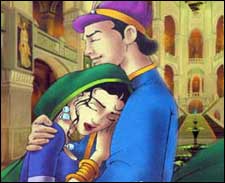
Still from an animation film, 'Bhaggmati'
Still from an animation film, ‘Bhaggmati’

For some strange reason, all, or almost all love legends have a tragic end. I cannot recall too many that end with “and they lived happily ever after”. In fact, Romeo-Juliet, Laila-Majnun, Heer-Ranjha, Sohini-Mahiwal, Sassi-Pannun, Dhola-Maru, Saif-ul-Malook-o-Badi-uj-Jamaal – the list of unhappy lovers separated by the cruel hands of society, scheming relatives, jealous rivals, misunderstandings and plain simple divine design is endless.

Amidst such tears and tragedies, poison-tipped swords and daggers, deceit and chicanery, there is a story of love that makes you believe that this world can’t be all bad. The most fascinating and enduring quality of this legend of love is that it is not a legend, it is fact, well mostly. And this is how it goes. Continue reading The love story of Quli Qutub and Bhagmati, and other tragic endings

Meanderings of a Female Atheist Muslim Indian: Samina Motlekar

This is a guest post by SAMINA MOTLEKAR: I come with baggage, with tags not all of my own making. I was born female, and as much as I want to be acknowledged as a person, I learnt early that it was pointless to deny so physical a part of my identity. I was born to Muslim parents, but that does not make me Muslim, a distinction that is unfortunately far too subtle for many minds to comprehend. Complacent in their own inherited identities, they pile on the labels smothering me into little  boxes of their making. Female, Muslim, Indian – all accidents of birth. But not all of me is accidental. By age eleven, the idea of a deity in the sky, concepts of heaven and hell, were at best stories, at worst ramblings of deluded minds to me. Not for me the fence sitting of agnosticism. I was an atheist before I hit my teens, and my belief system has endured the trials and tribulations of time. Yet they call me Muslim.

Continue reading Meanderings of a Female Atheist Muslim Indian: Samina Motlekar

Elements of Bomb (Blast) Making – Understanding Dilsukhnagar: Biju Mathew

hydblast2

This is a guest post by BIJU MATHEW: The story is always the same, isn’t it? A perfectly ordinary day becomes extraordinary. A day when the daily tribulations of thousands of workers and small merchants is instantly transformed into tragedy. 15 dead, 5 still critical and over 100 others injured– some of them maimed for life – thinking of what recovery might mean. Ravinder, a farm hand from a Nalgonda village has lost a leg. His wife, Lakshmi might still yet lose her foot. Their 1 year old is missing. And they were in Dilsukhnagar for a hospital visit because the 1 year old has a congenital heart condition. There is no justice to be had here. Continue reading Elements of Bomb (Blast) Making – Understanding Dilsukhnagar: Biju Mathew

Kai Po Che and the reduction of 2002: Zahir Janmohamed

Guest post by ZAHIR JANMOHAMED

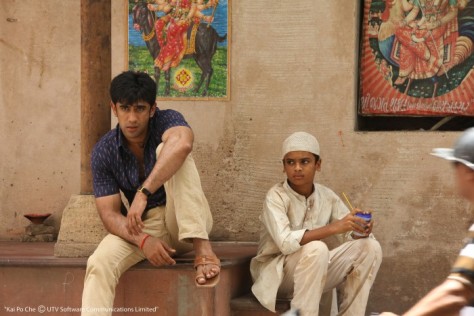
A still from Kai Po Che

When I started conducting research in Gujarat two years ago, I kept being asked the same question among middle class youth in Ahmedabad: “Have you read Chetan Bhagat?” When I asked what other books they have read, I often heard, “Actually I only read Chetan Bhagat.”

So I started to read Bhagat because I wanted to relate to many of the young people I was interviewing. But it was not an easy task.

I understand the frustration with Bhagat’s writing. Unlike other young adult authors like JK Rowling or Suzanne Collins, Bhagat’s books rarely reward a second reading (and yes I have tried). Continue reading Kai Po Che and the reduction of 2002: Zahir Janmohamed

The sickening political opportunism of Chetan Bhagat

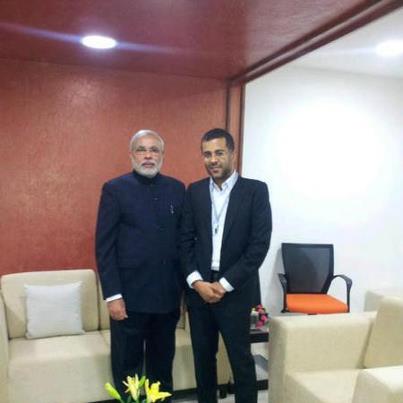
modi-chetan-bhagat

Snigdha Poonam watches Kai Po Che, whose script was written by Chetan Bhagat, based on his book The Three Mistakes of My Life:

In the film adaptation, Mr. Bhagat has also added what seems like justification for some Hindus to turn violent, like the death by burning of both of the parents of one of the three protagonists in the Sabarmati Express; in the novel, it was his nephew. We all know the level of vengeance with which Bollywood heroes respond to the targeting of their mothers: “Teri maa mari hai kya (Is it your mother who has died?),” the bereaved son explodes at a sensible friend trying to stop him from losing control of himself.

In his book, Mr. Bhagat clearly showed the 2002 riots as a state-sanctioned exercise (“Whatever it takes to quench the hurt feelings,” says a “senior Hindu Party leader”). But he excised that from the film completely. [Read]

That image above is via DeshGujarat.com, where an article quotes Bhagat as saying in a TV debate:

“It has been discussed much that Modi ji has done well in Gujarat, but what I believe is that he is a very good politician. A politician has to change with public mood. When communal issue mood was there in the country, that was Modi version 1, when he elected for the first time. And when he won the election for second time, he won it on development agenda.”

Clearly, Mr Chetan Bhagat is also a good politician.

The colonial legacy of capital punishment

G Mohan Gopal writes:

The British and their collaborators had made a similar mistake. They thought that the common people of India would be deterred and cowed down by the violence of the state. A young scholar from Columbia recently shared with me data collected from the National Archives showing that the British were hanging on average three people daily in the 1920s in a desperate bid to frighten Indians into obeying British rule. We know how that ended. The government should know how this will end too. [Frontline]

And Fahad Shah meets Maqbool Butt’s mother:

“Both Maqbool sahib and Guru sahib were innocent and on the right path. India thinks that this freedom movement will stop but it won’t stop. It will continue. There are so many Maqbools in Kashmir” [The Kashmir Walla]


Sanjay and me: Zahir Janmohamed

Guest post by ZAHIR JANMOHAMED

House of a Naroda Patiya massacre survivor. Photo by Zahir Janmohamed

It was 2002. The week before I left for India, my father invited his Gujarati Hindu colleague Rupa Aunty for dinner at our house in California. When I was a kid, I tied the rakhi brotherhood bracelet on her son. When my mom was diagnosed with cancer, Rupa Aunty was the first to spend the night with us at the hospital.

“If you need anything at all,” she told me just before I left for India, “my family is from Ahmedabad and we will be there for you.”

I grew up in California mispronouncing names of Gujarati dishes like thepla and my trip to Ahmedabad in 2002 was the first time anyone in my family had returned since my grandparents left Gujarat for Tanzania in the 1920s. This – my father kept reminding me – was my trip “home”. Continue reading Sanjay and me: Zahir Janmohamed

22 Years after Kunan and Poshpora, Rethinking Kashmir: Abhijit Dutta

Guest post by ABHIJIT DUTTA; all photographs by the author unless otherwise mentioned

1-kunan 4

It looks like any other village in Kashmir.

You go past a wooden bridge, past open fields winter-barren and wet with rain. Past mountains with snow on their chin. Past wistful looking poplars. Past a brook with clear water. Past grumpy apple trees gnarled like a grinch.

Then the road narrows, and homes – of timber and brick – come into view. Some have fences, unpainted wood. Heaps of hay, dung cakes, piles of dried leaves left to smoke. Ditches and dykes choked with snowmelt. Leafless walnut trees and brunette willows. The chinars, wild redheads just months ago, now old and arthritic. There is a government school on the right, a madrassa on the left. A few houses of stone, fewer of concrete, tin roofs over all.

Before you walk any further, the village ends. The next village is Poshpora. Like Kunan before it, it looks like any other village in the valley. The two villages are so close that people no longer call them by their individual names. Everyone knows this two-in-one village as Kunan Poshpora. Continue reading 22 Years after Kunan and Poshpora, Rethinking Kashmir: Abhijit Dutta