Category Archives: Identities

India Slept Through a Revolution in Bangladesh: Richa Jha

Guest post by RICHA JHA

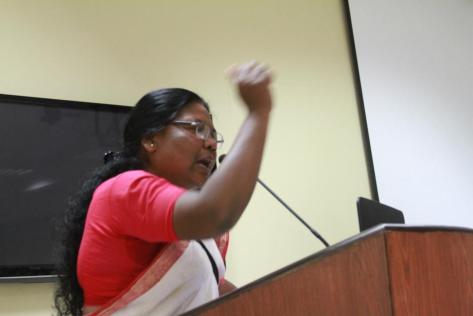
Dhaka, Bangladesh. 18th February 2013 -- A woman shouts on a microphone. -- A demonstration for the death penalty to be given to war criminals, is continuing at Shahbag crossroads, and has reached its fourteenth day,.
Dhaka, Bangladesh. 18th February 2013 — A woman shouts on a microphone. — A demonstration for the death penalty to be given to war criminals, is continuing at Shahbag crossroads, and has reached its fourteenth day,.

This morning, I changed the ‘sleep’ in the heading of this article to ‘slept’. I woke up to the news that Bangladesh’s nearly twenty days long mass uprising was now getting a structured exit. The most moving and visually spectacular part of the Shahbag movement was coming to an end. India, of course, slept through most of it. The past tense, suddenly, paints our selective insularity in even starker shades. Continue reading India Slept Through a Revolution in Bangladesh: Richa Jha

Shahbagh: The Forest of Symbols: Naeem Mohaiemen

This is a guest post by NAEEM MOHAIEMEN

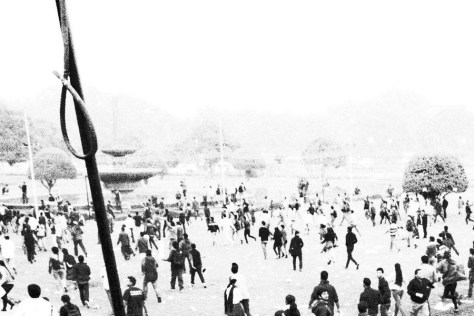
Shahbagh_SyedLatifHossain
© Syed Latif Hossain

There is a particular way of lensing mass movements, when we are observing from within immediate tactics. In a fast moving situation, with opponents and allies squared off, the first thing to shrink is the space for internal critique. Professor Azfar Hussain uses the term “critical solidarity” for his approach to Shahbagh. A critique that seeks to help the movement, but also a critique some are not ready to hear yet.

For the last sixteen days, Bangladesh has been in an intense new political phase. The ground has shifted and been recast by the scale of the Shahbagh movement. The flash point was the sentencing of the “Butcher of Mirpur” (a war criminal who collaborated with the Pakistan army in 1971). But, by now, the demands have expanded to a call for a ban on the main Islamist party Jamaat-e-Islami, or even Islamist politics altogether. Older leftist thinkers like Badruddin Umar are daring to ask questions of the hallowed place of “state religion” in the constitution. Younger bloggers are urging all to make it clear that the movement is about war criminals, not religion. But of course, with war criminals conflated with the Jamaat-e-Islami, and that party eager to present themselves as standing for “Islam,” category errors will happen. Continue reading Shahbagh: The Forest of Symbols: Naeem Mohaiemen

Footprints on a Timeline: Gayatri Ugra

Guest post by GAYATRI UGRA; photographs by JAYANT UGRA

1-20 _MG_2200

“I travel so that people will lose track of me. Then I write, so they can find me again.”

I read these lines by Pierre Foglia, and I know nothing else about him. I do know more about why I travel: to retrace lost tracks. And why I write: not for people to find me but for me to find my own self. The last journey I made was just that. A long walk back into my past, and from there to the present in Kashmir, a living, growing, tense reality that I had to visit.

Facebook never served a better cause than ours when we planned our trip last June. On the spur of a moment of nostalgia, I posted this message on my page: “A family holiday in Kashmir. Any takers? All we need now is a travel agent and a motivator.” I could not have anticipated the response: so many of us wanted to come, hoped to come. My brother Gopal took up the task of making travel plans, reservations, bookings for accommodation, and ultimately made it happen for the eight of us that finally went. Continue reading Footprints on a Timeline: Gayatri Ugra

Dalit and Adivasi Women Warriors Question Caste and Gender Oppression: Sujatha Surepally

Posted at Round Table India

SUJATA SUREPALLY shares her impressions from the first National Dalit and Adivasi Women’s Congress held on February 15-16, 2013, at Tata Institute of Social Sciences, Mumbai.

We live in nature! We die in Nature! It’s our life, if you occupy our land where should we go and how do we live? Whose land is this?

dayamani

The hall is echoing with the furious voice of Dayamani Barla, veteran Adivasi activist from Jharkhand. She is trying to unite people against mining in Jharkhand, around 108 mining companies are waiting to destroy Adivasi life in the name of mining, first they come for coal, next they say power houses, it continues, we are pushed out and out further. How do we live without our land? Spectacular speech for an hour, pin drop silence all around, everyone is identifying with her pain and agony. At the end of it, what is she is trying to convey?

Humko Jeene Do! Let us live our own life! If this is called development, we care a damn about it!  Blanket statement. [Continue reading]

Prof VK Tripathi and the fight for Schools in Juhapura: Zahir Janmohamed

Guest post by ZAHIR JANMOHAMED

A school in Juhapura. Photo credit: Atish Patel

On Tuesday, February 19, the Ahmedabad Municipal Corporation ratified its budget and elected to build the first municipal school in Juhapura, the largest ghetto of Muslims in Ahmedabad. Juhapura was incorporated into the Ahmedabad Municipal Corporation five years ago and many residents wondered why the AMC took so long to build a school to serve Juhapura’s 350,000 residents. At the forefront of this struggle is IIT Delhi physics professor VK Tripathi. It was during a chance meeting with a sandwich shop owner in Washington DC that Professor Tripathi first learned about Juhapura. Continue reading Prof VK Tripathi and the fight for Schools in Juhapura: Zahir Janmohamed

I love the winter in your eyes: Uzma Falak

Guest post by UZMA FALAK

Winter of my eyes
took flight
Did you see?
These are not the same eyes
colors of which you would patiently decipher
sitting under the sun
for hours
gray dreams refusing to dissolve
in waters of Lethe. Continue reading I love the winter in your eyes: Uzma Falak

Raining Rape-Speech in Kerala

It is hardly news in Kerala by now that its been raining misogynists, rape-talkers, and swollen-rotten masculine egos in these early days of 2013. The PJ Kurien controversy has been a trigger of course. But I am astounded at the collective frenzy of Congress stalwarts. Kerala today is like a coconut garden taken over by a bunch of supremely drunken … well .. simians. Here we are, helplessly watching the tipsy horde ascend the fruit-laden coconut palms, pulling down ripe fruit and raw ones, tender leaves and drying ones, with  nary a care for all of us down here! Everyone, from senior leaders,  many insecure dumb ass-males on FB and Youtube, to minor lawyers in small-town courts with sadly dessicated minds but hugely swollen male-egos, to elected MLAs on the floor of the Kerala State Assembly, and judges whose guardian-angelic misogynist aura glints a bit more menacingly in private conversations,each of them seem to be up their own coconut tree throwing down various half-witted, asinine comments,venting their immense distrust of women who don’t fit into the homely-comely-motherly stereotype. Continue reading Raining Rape-Speech in Kerala

What Afzal Deserves: Chandan Gomes

20130212-185109.jpg

Guest post by CHANDAN GOMES

Ever since the news of Afzal Guru’s execution broke out on the 9th, I have witnessed my personal space descend into a state of chaos. I woke up that morning to a number of emails/facebook messages by friends requesting me to join them at Jantar Mantar to protest against Guru’s execution. Many called that particular protest farcical, some even going to the extent of labelling these young men and women as traitors. Battle lines were drawn and a country stood divided. The more I thought about the execution, the more it saddened me. I could see myself and people like me (the ordinary citizens of this great nation) as pawns in a game of ugly power play, waiting to be sacrificed at the altar of ‘opportune moment’. Continue reading What Afzal Deserves: Chandan Gomes

Newslaundry ki dhulai: Kashif-ul-Huda

Guest post by KASHIF-ul-HUDA

In just a year, Newslaundry has achieved quite a following for its in-depth and hard-hitting interviews.  “Welcome to newslaundry – Sabki dhulai. You watch. We’re watching,” says the “About Us” page of this website. But the question is who will do dhulai of Newslanudry?

Newslaundry’s interview of eminent Islamic Scholar Asghar Ali Engineer makes you wonder what kind of preparation did Madhu Trehan did before doing this interview? How is this interview, asking stupid questions on the topic of women’s education, Salman Rushdie, purdah, etc., any different than idiots that play journalists on news channels? Continue reading Newslaundry ki dhulai: Kashif-ul-Huda

Theories of Oppression and another Dialogue of Cultures: Ashis Nandy

This is the text of the Ambedkar Memorial lecture delivered by ASHIS NANDY at the India International Centre on 14 April 2012, under the auspices of Ambedkar University, Delhi.

It was published in Economic and Political Weekly, July 28, 2010

Every generation likes to believe that it is living in momentous times, witnessing the death of one world and the birth of another, negotiating what pre-war Bengali writers used to grandly call yugasandhikshana, the moment when two epochs meet. This generation of Indians too believes that it is seeing such changes and even participating in them. Perhaps they are. However, I shall argue here that, along with transitions in society and politics to which they like to stand witness, there are transitions in cultures of knowledge and states of awareness of which they may be gloriously innocent. And they perhaps try to protect that innocence. The categories we deploy to construe our world images are parts of our innermost self and to disown them is to disown parts of ourselves and jeopardise our self-esteem. Even when we struggle to shed these categories, they survive like phantom limbs do in some amputees. Or perhaps they survive the way one of Freud’s three universal fantasies, the one about immortality, does. When you imagine yourself dead, you are still there, fully alive, looking at yourself as dead. Continue reading Theories of Oppression and another Dialogue of Cultures: Ashis Nandy

Azaadi (Freedom) for ‘Pragaash’, an All Female Band from Kashmir

20130206-113749.jpg

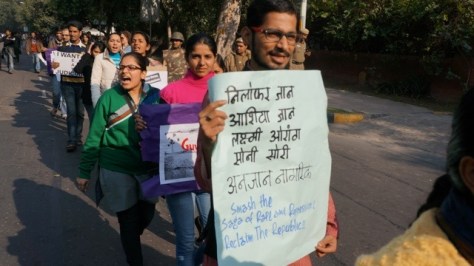
In the last month the streets of Delhi have echoed with a slogan familiar to many in Kashmir – ‘Hum Kya Chahtey ? – Azaadi !’ (‘What do we want ? – Freedom !’). Thousands of young women and men have chanted this slogan in Delhi while protesting against rape and sexual violence, and while doing so, they have also spoken out, with great courage and integrity, and carried explicit banners and signs about the fact that women in Kashmir have had to face rape and sexual assault by the AFSPA protected armed forces (the army, police, irregular counter-insurgents and paramilitary forces) of the Indian state. And no, the young people carrying these signs, and chanting these slogans, that talk about Nilofar and Aasiya Jaan, that name the atrocities and rapes that took place in Shopian and Kunan Poshpora have not been all Kashmiris. Some of them are Kashmiri students studying in Delhi University, JNU and Jamia Millia Islamia. But along with them, several of the young people who have been weaving the reality of Kashmir into the fabric of the protests in Delhi are not from Kashmir. Each time that they have walked with these signs and chanted these slogans – (and I have seen them in every gathering and every demonstration – their numbers are growing – as more young people in Delhi use the protests as sites of learning about the many complex realities of power and oppression) – they risk being branded as ‘traitors’ by the mainstream of Indian nationalist opinion, which can never question the Indian state’s conduct in Kashmir. They have tempered their sense of justice and deepened it with the substance of solidarity. Continue reading Azaadi (Freedom) for ‘Pragaash’, an All Female Band from Kashmir

जहाँ वे सेतु बनते हैं: मिहिर पंड्‌या

Guest post by MIHIR PANDYA

गणतंत्र दिवस की सुबह। अौर उस सत्र का शीर्षक था ‘विचारों का गणतंत्र’। अशिस नंदी पहले उदाहरण द्वारा विस्तार से समझाते हैं कि क्यों एक सवर्ण एलीट का भ्रष्टाचार हमारी बनायी ‘भ्रष्टाचार’ की मानक परिभाषाअों में फिट नहीं होता अौर क्यों सिर्फ दलित का भ्रष्टाचार ही ‘भ्रष्टाचार’ नज़र अाता है। इसलिए जब वे यह कहते हैं कि भ्रष्टाचारियों का बहुमत वंचित जातियों से अाता है तो वह यह कहते हुए वापिस पुरानी बात दोहराना ज़रूरी नहीं समझते कि यहाँ दोष उनका नहीं, ‘भ्रष्टाचार’ की उस भ्रामक परिभाषा का है जिसमें एलीट का भ्रष्टाचार फिट ही नहीं होता। इसे वह अंत में जवाब देने के लिए मिले दो मिनट के समय भी दोहराते हैं कि उनके उक्त कथन को दो मिनट पहले कही बात के संदर्भ में देखा जाए। जैसा नंदी ने बाद में भी कहा, अौर उनकी अध्ययन शैली से परिचित लोग यह जानते भी हैं, वे किसी भी वक़्त यह नहीं कह रहे थे कि भ्रष्टाचार की कोई जाति होती है, बल्कि वे भ्रष्टाचार को पहचानने अौर निर्धारित करने की जो प्रचलित समाजदृष्टि है, उसके पीछे छिपी जातिवादी मानसिकता को पहचानने की अोर इशारा कर रहे थे। यह तर्क प्रणाली समझने में थोड़ी जटिल हो सकती है, लेकिन इसकी कोई वजह मुझे फिर भी नज़र नहीं अाती कि ठहरकर, ज़रा सा समय देने पर भी यह बात समझ न अाए। Continue reading जहाँ वे सेतु बनते हैं: मिहिर पंड्‌या

On the arrest of Nilim Dutta

The Times of India reports that Nilim Dutta has been arrested by the police in Assam on charges of financial fraud and impersonation. The Indian Express reports:

“While there are now six cases registered against him in Guwahati, what we have gathered is that the Delhi Police had also registered a case against him last year,” Assam DGP J N Choudhury told The Indian Express. [Link]

Dutta announced his own arrest on Twitter some days ago, claiming the police had assaulted his family and him, and so on.

I first discovered Nilim Dutta on Twitter in July or August last year. Bodo groups in Kokrajhar and other BTAD area of Assam had killed Muslims and driven them out, many of whom still live in refugee camps there, too afraid to go home. Intellectual cover to this pogrom was being given not only by the mainstream media but also in social media by Hindutva fanatics, with the excuse that all Mulims in Assam are illegal Bangladeshi immigrants. Dutta had been tweeting against this claim, and published a rebuttal to one such claim by a Bodo IAS officer in the Indian Express.

I thus invited Dutta to write a long piece for Kafila, which was published here on 16 August. “The Myth of the Bangladeshi” became a very popular piece, initiating many discusssions and disagreements in Assam, Delhi and elsewhere. Hindutva fanatics who were unsettled by Dutta’s excellent piece in Kafila and similar pieces elsewhere, and his appearance in TV channels and so on. Now that Dutta is arrested on charges of financial fraud, these people are saying on Twitter and elsewhere that this nullifies Dutta’s claims about Muslims/’Bangladeshis’ in Assam. Continue reading On the arrest of Nilim Dutta

A petition demanding the ‘Grand Mufti’ of Kashmir to step down

This petition has been put out by OMAR BASHIR

This is in context with your recent fatwa against the girl band Pragaash. This is less a fatwa and more a direct threat to silence young girls who have chosen for themselves a career path untrodden by women of Kashmir because of your misogynist approach. Your nefarious and illogical fatwas have caused more harm than they have done any good.

Mr Grand Mufti you have forgotten that Kashmir has a long tradition of Kashmiriyat and Kashmiriyat is an expression of solidarity and resilience regardless of religious differences. It embodies an ethos of harmony and a determination of survival of the people and their heritage. Women in music industry is nothing new in Kashmir, we have stalwarts like Raj Begum, Shameema Azad, Kailash Mehra and Mehmeet Syed singing for the past so many years. You must be aware that Raj Begum has been awarded the Padma Shri award in 2002. Continue reading A petition demanding the ‘Grand Mufti’ of Kashmir to step down

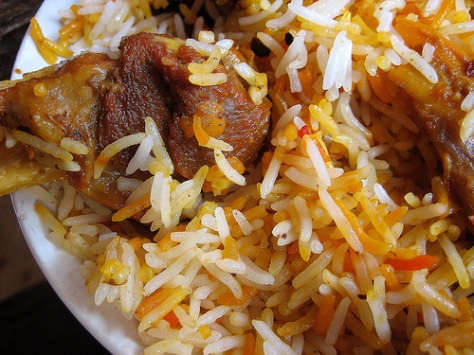
Ajmal Kasab, Tajinder Pal Singh Bagga, biryani and me

biryani-kafila

A large number of people have been asking me on Twitter over the last few days why I had signed a petition asking for Ajmal Kasab to be granted mercy and spared capital punishment. Kasab was hanged 21 November, why have all these people woken up to that petition now? That’s thanks to a belated but concerted online campaign initiated by the Tajinder Pal Singh Bagga-led Bhagat Singh Kranti Sena (BKSS), a rag-tag vigilante organisation which goes around threatening and committing violence against people it has political disagreements with. Continue reading Ajmal Kasab, Tajinder Pal Singh Bagga, biryani and me

Dear Pakistani friends, Put yourself in my shoes

I did not want to write this post.

There are enough Indian voices, from Times Now to Hindutva Online, who point fingers at Pakistan. Like M Ziauddin of the Express Tribune newspaper, I think that the two countries need more unpatriots – not people who ‘hate’ their own countries but who question their own nationalist narratives. People who ask: could we be wrong? Asking questions of yourself is difficult, and blaming the other is instant gratification of ego. Questioning yourself has long-term rewards in helping you make peace with yourself.

I am forced to write this piece because I continue to see well-meaning Pakistanis online continue to complain about the Bad Hospitality given by India to the Pakistani women’s cricket team in Cuttack in Orissa. The complainants online have included some of my Pakistani friends whom I know to be liberal, peace-loving and well-meaning, and who have clearly been influenced by some clever propaganda that is deliberately not showing them the full picture. Continue reading Dear Pakistani friends, Put yourself in my shoes

Ashis Nandy, Media and the Work of Acceleration: Anirban Gupta Nigam

Guest post by ANIRBAN GUPTA NIGAM

The hornet’s nest stirred by Ashis Nandy’s comments at the Jaipur Literature Festival might – hopefully – be dying down, but certain questions raised by the occurrences on the 26th probably require a little reflection on everyone’s part.

In the corporate and social media blitz, a lot of the details have been forgotten, excised and overlooked. Till yesterday it was not clear what his entire speech consisted of. The most quoted line from his talk at the festival is: “it is a fact that most of the corrupt come from the OBC, the Scheduled Castes and now increasingly the STs and as long as it is the case, the Indian republic will survive.” None of those attacking Nandy for being casteist or spewing hate-speech have in fact even attempted to explain the latter part of the quote: “as long as it is the case, the Indian republic will survive.” How is that a casteist statement? More importantly, media reproductions of his statement have excised a crucial disclaimer he himself gives at the beginning: “It will be an undignified, even vulgar statement, but it is a fact that most of the corrupt come from the OBC, the Scheduled Castes and now increasingly the STs and as long as it is the case, the Indian republic will survive.” Continue reading Ashis Nandy, Media and the Work of Acceleration: Anirban Gupta Nigam

Our memories come in the way of our histories: Gowhar Fazili

Guest post by GOWHAR FAZILI

Our Moon Has Blood Clots by Rahul Pandita; Pages: 258; Vintage Books, Random House, India; Price: Rs 499

Rahul Pandita’s book Our Moon Has Blood Clots must be looked at both as a personal account of suffering as well as a political project that implicitly and explicitly makes use of that suffering towards a particular end. The undertaking is a legitimate one on both counts.  What the book manages to achieve on each, warrants a fair and dispassionate assessment.

His narration of events experienced by the Pandits is a welcome exposition of subjectivity around a range of traumatic events, humiliations, killings and betrayals undergone prior to and after the outbreak of mass political rebellion in Kashmir in 1989. The events thus narrated, especially the account of the personal experiences of trauma do make one strongly identify with the suffering of the families involved and agree with the wide swathes of subjective anger and hurt shared by the community.  The chilling accounts of individual and mass killings and the circumstances that made them possible, call for collective self-reflection, remorse and atonement. This account also calls for serious reflection on the fragility of human associations and trust in exceptional circumstances that we normally take for granted.

The book as well as the promotional interviews around the book push the claim that not only certain militants but also many ordinary people, including those personally known to the victims, were responsible for the exodus through their acts of omission and commission.  This claim is substantiated through a range of indictments based on personal encounters with individuals, shared nuggets of information, as well as the interpretation of the larger political symbolism and slogans which were seen as a deliberate attempt to intimidate Pandits, and Pandits alone.  While it is difficult to deny that a number of individuals took advantage of those anarchic times to gratify personal hate and lust for loot, it makes for an overstatement to underplay the equally frequent narrative of mutual support between individuals that one gets to hear during conversations between the members of the two communities privately. Such underplay does violence to those aspects of shared memory.  Continue reading Our memories come in the way of our histories: Gowhar Fazili

Corruption and Political Correctness: A Severe Case of Intellectual Laziness: Meera Ashar

Guest post by MEERA ASHAR

Ashis Nandy has been called, rather, accused of being, many things—sociologist, historian, political theorist, public intellectual, philosopher, psychoanalyst, leftist, centrist, right wing, Dalit, Christian, Brahmanical, casteist (he describes himself, more poetically, as an intellectual street fighter and reason buster)—but ‘politically correct’ has never been one of them.

This time, Nandy’s political incorrectness has cost him more than before. As in the past, he has been attacked by politicians and the popular media for presenting his analysis of social phenomena—for doing his job well. The response of the Indian intelligentsia to Nandy’s threatened arrest by the right wing government of Gujarat in 2008 was markedly different from the response now. The difference this time, of course, is that Nandy has not offended the right people. He is seen to have betrayed the marginalized. This time, he has been unfashionably politically incorrect. The similarity between the two episodes is the ‘freedom of speech’ brigade, which has dutifully stood by Nandy. But I shall turn to them later.

Continue reading Corruption and Political Correctness: A Severe Case of Intellectual Laziness: Meera Ashar

A Guide to Infantalising and Trivialising the Public sphere

It is no  coincidence that Salman Rushdie who remains the poster child of the censorship debate in India begins his celebrated Midnight’s Children with the twin image of the birth of a child and that of a nation. The rest of the novel traces the intertwined stories of the child’s growth with the political history of independent India. But if one were to extend this allegory taking into account the kind of public sphere that seems to exist in India 65 years after independence there seems to be something amiss about this metaphor of birth and subsequent growth into maturity. A strange malaise pervades the public sphere in India today, where it seems almost as if we have turned the natural cycle of growth around and the children of midnight appears to suffer from the malady of the protagonist in David Fincher’s film “The Curious case of Benjamin Button” where a man is born a mature adult but ages backwards and slowly slides into infantile regression. If we were to consider the unreasonable response to Ashis Nandy’s talk at the Jaipur literary festival as one in a long continuum of such cases where individuals are hounded for hurting sentiments of communities, the Indian public sphere sadly appears as a weak and sickly child suffering from irony deficiency. Continue reading A Guide to Infantalising and Trivialising the Public sphere

India and Pakistan – Peace Now, a global vigil today

Events are planned today in Lahore, Delhi, Mumbai, Karachi, Cambridge MA, Washington DC, New York and Toronto to observe a vigil for India-Pakistan peace. More details given at this Facebook page. Event created by SAMIR GUPTA and disseminated by Aman ki Asha. Given below is a statement.

India – Pakistan Peace Now – Global Vigil

January 27, 2013

Lahore – Lahore Press Club, Shimla Pihari at 6 pm
Mumbai – Gateway of India 7 pm
Delhi – Gandhi Peace Foundation 5:30 pm
Karachi – Karachi Press Club, 5:30pm
Cambridge, MA – Harvard Square Pit, 4-5 pm
Washington, DC – Chutney Restaurant, Springfield, Virginia, 6 p.m
New York – Near Gandhi statue at Union Square, 5 pm
Toronto – 365 Bloor St. East, outside Indian Consulate, 5 pm

The hate mongers have had their moment of fame. It’s time to tell the political leadership of India and Pakistan what we stand for. We, peace-mongers around the world, are gathering on January 27, 2013, in different cities as part of a series of peace events. All we have is some candles, some placards and many hearts full of love. We want the governments of India and Pakistan know that people in dozens of cities across six continents want them to continue the dialogue and take forward the peace process. Continue reading India and Pakistan – Peace Now, a global vigil today