Category Archives: Law

Freedom of speech in India is for the rich and the powerful

While freedom of speech and expression in India is under attack from all sides, have you noticed how the rich and the powerful can say what they like without getting arrested, facing FIRs and courts, hiring lawyers and so on?

While an innocuous tweet or Facebook status update can land you in police lock-up on a Saturday night or Sunday morning 5 am, a Digvijaya Singh can say sexist crap against Rakhi Sawant and get away with it.

Here’s another example from Twitter recently. Lalit Modi of IPL infamy, who wants us to believe his coming to India and facing the law is a security threat to him, tweeted that the BJP’s  Arun Jaitley would lose his deposit if he contested the Lok Sabha seat from Jaipur. (Lalit Modi thinks he’s the Maharaja of Rajasthan.) In response to that, one Ankush Jain replied… Continue reading Freedom of speech in India is for the rich and the powerful

The Day Afzal Died: Nirmalangshu Mukherji

Guest post by NIRMALANGSHU MUKHERJI

There are days in which streaks of hope shine through dark clouds of misery. The 9th of February, 2013, was such a day.

The day broke with the news that the noose of the Indian state had finally seized the throat of Mohammad Afzal Guru after years of careful conspiracy. With ill-concealed admiration, the television screens reported the military swiftness, the secrecy, and the perfection with which a nuclear-powered state with one of the largest armies in the world escorted an unarmed, hapless Kashmiri to the gallows, performed its rituals, and pulled the bolt. As the murder was officially videographed with full legal sanction, the body was kept dangling for thirty minutes before it was pulled down and immediately buried in an ‘unmarked’ grave, protected by layers and layers of impenetrable walls. The case of Afzal Guru was thus brought to a ‘closure’. So hoped the state. Continue reading The Day Afzal Died: Nirmalangshu Mukherji

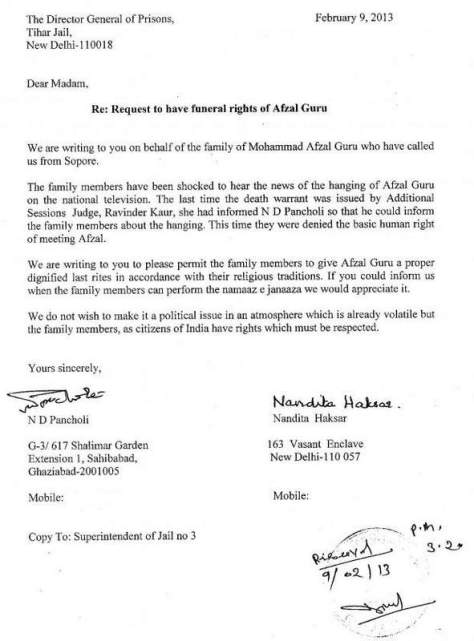
Afzal Guru’s family demands his body

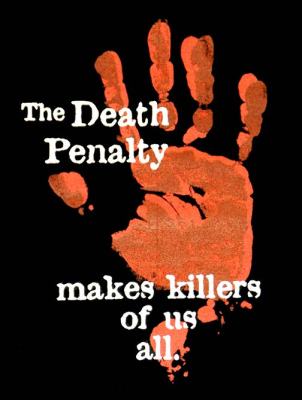
Four statements on the execution of Afzal Guru

Statement from the PEOPLE’S UNION FOR CIVIL LIBERTIES

The PUCL condemns the hanging of Afzal Guru in Tihar Jail early in the morning (9.2.2013) today.

The tearing hurry with which Afzal Guru was hanged, accompanied by the flouting of all established norms by not giving his family their legal right to meet him before taking him to the gallows, clearly indicates that there were political considerations behind taking this step. More shameful is the explanation of the Home department that the wife and family of Afzal Guru were intimated of the hanging by a mail sent by Speed Post and Registered Post. Decency and humanity demanded that the Union Government give prior intimation to the family and an opportunity to meet him. Such a surreptitious action of the government also deprives the family of Afzal Guru to right to seek legal remedy.

PUCL also condemns the repressive stand of the Delhi police in not allowing a group of people who were protesting against the hanging and detaining them in police stations. We are equally concerned by reports that right-wing goons were permitted by the police to use violence against the protestors. PUCL asserts the right of citizens to dissent and express their opposition to capital punishment in a peaceful manner. Continue reading Four statements on the execution of Afzal Guru

Child sexual abuse in India: the police blames the victims

This is a press release put out by HUMAN RIGHTS WATCH on 7 February; link to full report towards the end


India: Child Sex Abuse Shielded by Silence and Neglect Police, Doctors, Courts Need to Change Policies and Mindset to Support Victims

New Delhi, February 7, 2013:  The Indian government should improve protections for children from sexual abuse as part of broader reform efforts following the gang rape and murder of a student in New Delhi in December 2012, Human Rights Watch said in a new report released today. Continue reading Child sexual abuse in India: the police blames the victims

On the arrest of Nilim Dutta

The Times of India reports that Nilim Dutta has been arrested by the police in Assam on charges of financial fraud and impersonation. The Indian Express reports:

“While there are now six cases registered against him in Guwahati, what we have gathered is that the Delhi Police had also registered a case against him last year,” Assam DGP J N Choudhury told The Indian Express. [Link]

Dutta announced his own arrest on Twitter some days ago, claiming the police had assaulted his family and him, and so on.

I first discovered Nilim Dutta on Twitter in July or August last year. Bodo groups in Kokrajhar and other BTAD area of Assam had killed Muslims and driven them out, many of whom still live in refugee camps there, too afraid to go home. Intellectual cover to this pogrom was being given not only by the mainstream media but also in social media by Hindutva fanatics, with the excuse that all Mulims in Assam are illegal Bangladeshi immigrants. Dutta had been tweeting against this claim, and published a rebuttal to one such claim by a Bodo IAS officer in the Indian Express.

I thus invited Dutta to write a long piece for Kafila, which was published here on 16 August. “The Myth of the Bangladeshi” became a very popular piece, initiating many discusssions and disagreements in Assam, Delhi and elsewhere. Hindutva fanatics who were unsettled by Dutta’s excellent piece in Kafila and similar pieces elsewhere, and his appearance in TV channels and so on. Now that Dutta is arrested on charges of financial fraud, these people are saying on Twitter and elsewhere that this nullifies Dutta’s claims about Muslims/’Bangladeshis’ in Assam. Continue reading On the arrest of Nilim Dutta

The Criminal Law Ordinance 2013 on Sexual Assault – Cut, Paste and Shock! Pratiksha Baxi

Guest post by PRATIKSHA BAXI 

Once the Criminal Law Ordinance 2013 was uploaded, circulated and read many times, an overwhelming desire to mark the ordinance to all one’s students as an example on how not to frame laws has grown. Yet, explain one must, why the current law on sexual assault is so bizarre, even if we do not bring in the so-called controversial elements and keep to the text of the ordinance.

The Criminal Law Ordinance 2013 begins with the definition of sexual assault as a gender-neutral offence. It does not make an exception to state that women do not rape men in everyday contexts under s. 375. Since such an exception is not added, and the ordinance specifies that ‘sexual intercourse or sexual acts by a man with his own wife, the wife not being under sixteen years of age, is not sexual assault’, we are faced with a confounding and deeply misogynist legal consequence. Wives, we are told cannot prosecute husbands for sexually assaulting them. But since sexual assault is gender neutral without any exceptions and the marital rape exemption is not extended to husbands, now husbands can accuse wives of sexual assault but wives can never prosecute husbands for sexual assault!  Continue reading The Criminal Law Ordinance 2013 on Sexual Assault – Cut, Paste and Shock! Pratiksha Baxi

A rare victory for freedom of speech and expression in India

Times of India photo

In a country where freedom of speech and expression is under assault every day, where scholars and cartoonists increasingly have to regularly face the law to defend their statements and works of art,  where the government gives in to anyone and everyone demanding censorship, where the government conduct stealth censorship of online speech, finally comes a rare piece of good news.

For once the police is not asking to shut down an exhibition citing ‘law and order’ issues to appease protestors, but instead giving protection to the exhibition.

The Times of India reports: Continue reading A rare victory for freedom of speech and expression in India

Why the law on sexual offences must be changed: Madhu Mehra

Guest post by MADHU MEHRA

The public outrage in the wake of the Delhi gang rape has been as much a reaction to the brutality of the case, as it has been against the pervasiveness of sexual violence in our society. Instead of condemnation and action, rape cases frequently evoke public statements blaming the victims, and calls to reign in women’s freedom. That our social structures and mindsets remain patriarchal is well known. The question however is, to what extent does the law counter societal misogyny in the way it frames and responds to sexual violence? Do the criminal laws establish norms that uphold women’s bodily integrity and dignity in all situations, against all offenders without selectivity or discrimination? Continue reading Why the law on sexual offences must be changed: Madhu Mehra

Ajmal Kasab, Tajinder Pal Singh Bagga, biryani and me

biryani-kafila

A large number of people have been asking me on Twitter over the last few days why I had signed a petition asking for Ajmal Kasab to be granted mercy and spared capital punishment. Kasab was hanged 21 November, why have all these people woken up to that petition now? That’s thanks to a belated but concerted online campaign initiated by the Tajinder Pal Singh Bagga-led Bhagat Singh Kranti Sena (BKSS), a rag-tag vigilante organisation which goes around threatening and committing violence against people it has political disagreements with. Continue reading Ajmal Kasab, Tajinder Pal Singh Bagga, biryani and me

The Official Emergency Continues – The Ordinance on Sexual Assault: Pratiksha Baxi

Guest post by PRATIKSHA BAXI

The reform of rape law, which was not a priority for more than two decades, seems more like a 20-20 match now. The spectacle of judicial reform has all the elements of cinematic imagination built into it—violence, voyeurism, repression, tears, scandal, redemption and betrayal. We are all consumers and participants of this judicial spectacle. We veer between manic hope and dark despair as we are left conjecturing how this theatre of judicial reform will enact equality and dignity for survivors of sexual assault. The latest twist in the tale is the introduction of an ordinance, following the Justice Verma Committee (JVC) report.

Continue reading The Official Emergency Continues – The Ordinance on Sexual Assault: Pratiksha Baxi

Why the Govt’s Ordnance is Fraud & Mockery of the Justice Verma Committe Recommendations: Bekhauf Azaadi Campaign

Guest post by BEKHAUF AZAADI CAMPAIGN

The UPA Govt, in a Cabinet meeting held on 1 February, has introduced an ordinance that it claims will address the most urgent concerns on sexual violence. In fact, the Government has been completely reluctant to acknowledge and implement the Justice Verma Committee recommendations: the PM refused to accept it from Justuce Verma, the Ministry of Home Affairs removed it from their website, the Govt never adopted any transparent process of discussion to decide the way forward on implementing the recommendations, rather they said Justice Verma ‘exceeded his brief’. Now, they claim that their ordinance has ‘implemented’ the Justice Verma recommendations. Is this true?

The fact is that the Government’s ordinance is a mockery of the letter and spirit of the Justice Verma recommendations. Why? Let us take a closer look.

Continue reading Why the Govt’s Ordnance is Fraud & Mockery of the Justice Verma Committe Recommendations: Bekhauf Azaadi Campaign

Water Cannons, Tear Gas, Ordinance: How the State Responds to Protests Against Rape and the Justice Verma Committee

20130203-075541.jpg

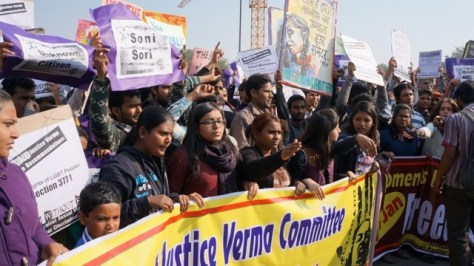
  • [ Protestors from the Bekhauf Azaadi/Freedom Without Fear Campaign Demanding Complete Implementation of the Justice Verma Committee Recommendations during the Freedom Parade to Reclaim the Republic on Republic Day, 26 January, 2012 in New Delhi. ]

So, first they come with water cannons and tear gas, and then they come with an ordnance.

Yesterday, the Union Cabinet decided to rush drafting an ordinance in response to the massive protests against rape and sexual violence that have been occurring ever since the 16th of December, 2012. According to preliminary reports, the ordnance, which will be signed into law by the President of India before Parliament even meets, flies in the face of the detailed and exhaustive list of recommendations made by the Justice Verma Committee (JVC) which had been hailed by the protesting young people and a large number of women’s organisations. In other words, the government feels no need to discuss the JVC in parliament. It feels no need to even give time and an opportunity for its recommendations to sink in, for there to be more thinking, more ideas, more awareness of the issues and questions at stake. No wonder, the government had so hastily pulled down the JVC report from its own websites after it had been released. Continue reading Water Cannons, Tear Gas, Ordinance: How the State Responds to Protests Against Rape and the Justice Verma Committee

Ashis Nandy’s Predicament and Ours

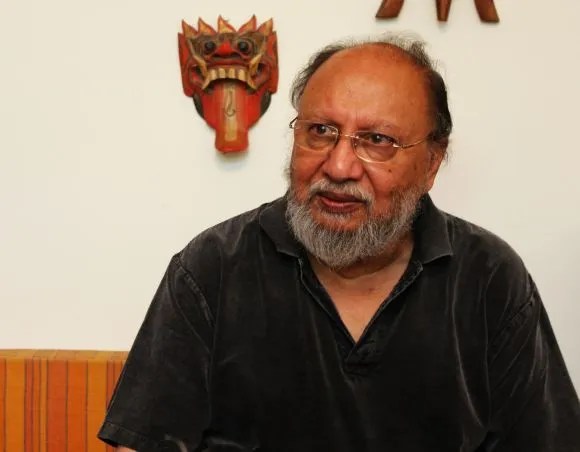
For the past few days I have been preoccupied in one part of my mind in dealing with two reasons for anguish. The first reason has to do with the profound sense of disappointment and anger with which I heard Prof. Ashis Nandy, a man I consider to be a great teacher, friend and in possession of one of the finest minds of our time, commit himself in public to a flippant and vulgar position when speaking of the relationship between caste and corruption at the Jaipur Literary Festival.

I was saddened because Prof. Nandy’s statements do a great disservice to the suppleness and ethical integrity of his thinking, and represent one of those sadly paradoxical situations where an intellectual can become their own worst adversary. I am unambiguously critical of the Nandy who chooses to be pompously opinionated and misinformed at a forum like the Jaipur Literary Festival or while riding the hot-air currents of television especially because I remain a partisan of the Nandy who can be (when he chooses to be) one of the most thoughtful and insightful witnesses to our time in his writing. Continue reading Ashis Nandy’s Predicament and Ours

A Guide to Infantalising and Trivialising the Public sphere

It is no  coincidence that Salman Rushdie who remains the poster child of the censorship debate in India begins his celebrated Midnight’s Children with the twin image of the birth of a child and that of a nation. The rest of the novel traces the intertwined stories of the child’s growth with the political history of independent India. But if one were to extend this allegory taking into account the kind of public sphere that seems to exist in India 65 years after independence there seems to be something amiss about this metaphor of birth and subsequent growth into maturity. A strange malaise pervades the public sphere in India today, where it seems almost as if we have turned the natural cycle of growth around and the children of midnight appears to suffer from the malady of the protagonist in David Fincher’s film “The Curious case of Benjamin Button” where a man is born a mature adult but ages backwards and slowly slides into infantile regression. If we were to consider the unreasonable response to Ashis Nandy’s talk at the Jaipur literary festival as one in a long continuum of such cases where individuals are hounded for hurting sentiments of communities, the Indian public sphere sadly appears as a weak and sickly child suffering from irony deficiency. Continue reading A Guide to Infantalising and Trivialising the Public sphere

Free Naveen Soorinje

This is a public statement; names of signatories given at the end.

As editors and senior journalists representing a cross-section of the print, television and online media, we wish to bring to your notice a matter of serious professional concern for the journalist fraternity.

Naveen Soorinje, a district reporter with the Kannada channel Kasturi Newz 24, was arrested by the Karnataka police on 7 November 2012 for the role he played in covering the 28 July 2012 attack by Hindutva vigilantes on innocent boys and girls who were celebrating a birthday at a homestay in Mangalore. In the two months that Naveen Soorinje has been in judicial custody in Mangalore, his mental and physical health has deteriorated drastically. He was recently discharged from the jail ward of the district hospital after suffering a bout of chickenpox. Continue reading Free Naveen Soorinje

On Hindutva terrorism

This joint public statement, signed by 34 citizens whose names are given at the end, was put out on 25 January

Swami Aseemanand (second from right): Terrorist?

While one may or may not agree with the terminology employed by the Home Minister in his recent speech at Jaipur, we feel that for long prejudice has ruled investigations, obscuring the role of organizations and their multiple affiliates in planning and executing of attacks and bombings in the country. The veneer of ‘nationalism’ — narrow, exclusionary and based on hatred for minorities as it is– cannot hide the violence that Sangh and its affiliates beget and peddle.  Continue reading On Hindutva terrorism

PUCL Rajasthan condemns FIR against Ashis Nandy

This release was put out by the Rajasthan unit of the PEOPLE’S UNION FOR CIVIL LIBERTIES on 26 January

PUCL condemns the FIR lodged under sec. 506 IPC, criminal intimidation and 3-1(10) of prevention of atrocities against SC,ST 1989 against Prof. Ashis Nandy for his statements in a discussion at the Jaipur Literature Festival 2013 and the protest demanding his arrest.

From the reports we have received, he was not exhorting hate and not being casteist and was only making an academic point which means that nobody is free from corruption.

Proceeding criminally against him and arresting him is restricting academic freedom and academic debate. Now that he has apologised and regretted  what he has said the matter should be closed.

Prem Krishan Sharma, President
Kavita Srivastav, General Secretary

See also: Most of the corrupt come from SC/ST, OBCs: Ashis Nandy
Below: Video report from CNN-IBN and ABP TV video of Nandy’s press conference Continue reading PUCL Rajasthan condemns FIR against Ashis Nandy

The Justice JS Verma committee report

For a summary with commentary, see this guest post by Arvind Narrain.

The Verma Committee: Alchemizing anger to hope: Arvind Narrain

ARVIND NARRAIN has an op-ed in today’s Hindu about the Justice Verma Committee. This is a longer version of the article

The public discourse post the brutal rape of Nirbhaya has witnessed a persistent degrading of the public discourse. Having been subjected to crudely offensive remarks by members of the political establishment, right from belittling a serious movement for equality as led by  ‘painted and dented ladies’ to ostensibly sympathetic responses which belittle women who have suffered a serious violation of their bodily integrity as nothing  more than ‘zinda laash’, we finally have a document authored by a Committee set up by the state which honours Nirbhaya.

The Verma Committee Report most fundamentally alters the public discourse on crimes against women by placing these crimes within the framework of the Indian Constitution and treating these offences as nothing less than an egregious violation of the right to live with dignity of all women. What is particularly moving and inspiring about the Report is that it does so by placing the autonomy and indeed the sexual autonomy of women at the very centre of its discourse.

Continue reading The Verma Committee: Alchemizing anger to hope: Arvind Narrain

Implement Justice Verma Committee Recommendations Immediately: Freedom Without Fear Campaign

Guest Post from BEKHAUF AZAADI / Freedom Without Fear Campaign

UPA Government: Implement Justice Verma Committee Recommendations Without Delay!

The Report submitted by the Justice Verma committee marks an important measure of victory for the ongoing people’s movement against sexual violence, as well as for the decades of the women’s movement and democratic movement in India.

Continue reading Implement Justice Verma Committee Recommendations Immediately: Freedom Without Fear Campaign