Category Archives: Law

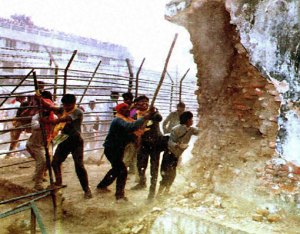
The Second Demolition: Ayodhya Judgement September 30, 2010

December 6, 1992

A shameful and shocking judgement.

I am shattered by what it does, by its implications for democracy, and by the statement it makes about what we can expect for the future.

My rage is growing with every statesman-like pronouncement from one pompous man after the other in the media, gravely holding forth on the maturity of the compromise that has been reached.

Continue reading The Second Demolition: Ayodhya Judgement September 30, 2010

How to Not Read the Ayodhya Judgement: Hilal Ahmed

Guest post by HILAL AHMED

There are three areas which I think we need to underline.

A. Technical problem: The question of applied principles

I ask a very fundamental question: How could a modern secular judiciary- technically an institutionalized ‘interpreter’ of the Constitution- determine the legal disputes related to religious places of worship on the grounds of ‘faith-based’ evidences?

All the three judges seem to recognize the fact that the Hindu beliefs should be (must be) taken as legal facts. Interestingly, these beliefs are supported by archeological report of 2003 to form an argument of judicial nature.

However, and quite astonishingly, the Sunni Wakf Board’s (SWB) case was dismissed on legal-technical grounds following a very mechanical interpretation of the Limitation Act.

But for Nirmohi Akhara and VHP case (referred as Ram Lalla virajman) the principle of faith was given primacy and in order to substantiate it further ASI report which is full of contradictions, is expanded to arrive on a conclusion.

Continue reading How to Not Read the Ayodhya Judgement: Hilal Ahmed

Dressing and Death-Threats in Kerala : Re-former Man’s Second Coming?

(cross-posted on www.countermedia.in)

Shamshad Hussain, J. Devika

The death threats received by a young woman student of engineering, Rayana R Khazi, a native of Cherkalam in Kasaragod, over a period of the past ten months, have been in the news in Kerala recently. The threats which were issued over the phone, on the streets, and by letters, have demanded just one thing: Rayana should comply with ‘Islamic dress-norms’; she should don the purdah. She has received four threatening letters. Of these, three issue death-threats, outright. The fourth is in the form of a warning that offers lengthy advice. One of these says: you have not heeded many warnings issued. We, Muslim brethren, will now decide your fate. This letter, which begins and ends in the name of Allah, is unsigned. Continue reading Dressing and Death-Threats in Kerala : Re-former Man’s Second Coming?

On torture in India and China

Guest post by FAHAD MUSTAFA

On 31st May, the Chinese government released guidelines that banned the admissibility of evidence obtained under torture in criminal convictions. This came a few weeks after the revelation of the seemingly bizarre, yet not completely uncommon, case of Zhou Zuohai.  Zhuo was released after being imprisoned for 11 years in Shanqqi, on charges of murder, when his alleged victim was found alive in his village. He was imprisoned on the basis of his confession of the crime.  A couple of days after he was released the authorities admitted that the confession was obtained under torture. Zhuo described his beatings: the pouring of chilli water in his eyes, the bursting of firecrackers over his head, and how he thought he would not survive. When he said what he was expected to say, the torture stopped, and he was convicted.

Lawyers, police, and governments in most countries, including China, understand that torture is counterproductive in extracting evidence. Indeed, China has issued several directives earlier to say that evidence under torture is unacceptable. As in the case of Zuohai, most confessions of this sort are false or misleading, and are given only to make the immediate suffering stop. Why then do police forces continue to use torture or the threat of it as a means to extract evidence? Continue reading On torture in India and China

Godhra, arson, terrorism, stone-pelting, Dalits and Muslims, and other such issues in village Lehna

A fact-finding report released today by PUCL Uttar Pradesh

Fact Finding Report on the murder of MNREGA and labour activist Shri Hari Lal, Village Lehna, Block Manjhanpur, District Kaushambhi on 15.08.2010

A fact finding committee to investigate the incident was formed with the following: members

  1. Mr. S.R.Darapuri, Retired IPS, Vice President UP PUCL.
  2. Mrs. Arundhuti Dhuru, Consultant to Commissioner Right To Food Committee of Supreme Court.
  3. Mr. Ram Kumar, Vice President UP PUCL.
  4. Mr. Jawed Rasool, Dyanmic Action Group.
  5. Dr. Nisha Srivastav, Professor  (Deptt. of Economics ), Allahabad University .
  6. Mr. Rajni Kant Rai, HRLN, Allahabad .
  7. Mrs. Bindu Singh, Convener UP Right To Food Campaign .
  8. Mr. Sanjay Singh, convenor, Parmarth, Oriye, Jalaun

The committee visited the site of incident in village Lehna  on 21.08.10 .The fact finding committee met the family members of the late Hari Lal, other residents of the village, and workers and officials of Voice of People’s (VOP). The committee also met the district magistrate and spoke to the superintendent of police. The following facts about the incidents came to light through this enquiry:

Background to the Incident

The main issue behind this incident was of MNREGA and payment of labour wages. According to the available evidence, a pond was dug in the village by 250 labourers from the panchayat quota of MNREGA in April, May and June 2007. However, the gram pradhan, Tirath (Dhobi), did not pay the labourers full wages. The gram pradhan is a mere puppet in the hands of a former gram pradhan, Bassan, and his son Fateh and a criminal named Nakkan. Continue reading Godhra, arson, terrorism, stone-pelting, Dalits and Muslims, and other such issues in village Lehna

Have I Joined the Popular Front?

In the past few weeks, I have been asked over and over again, not always in jest, if I had joined the Popular Front. I am not surprised. The police investigation around the violence against the college teacher at Muvattupuzha has broken all previous records in not only the violation of human and civil rights, but also in the silence of Kerala’s enlightened intellectuals. If I recall right, only Nandigram evoked such a dense and deliberate silence from them. No wonder, anyone who speaks up against the manner in which the police is being armed and authorized against ‘bad muslims’ is immediately dubbed a supporter of the Popular Front. But I am intrigued by this simple question, by which the entire history of that person’s engagement with discussions around religion and the state is erased. Continue reading Have I Joined the Popular Front?

The Great Incendiary Hunt Takes Off in Kerala

I have been watching the whole drama that has been unfolding after the unspeakable and utterly condemnable act of violence at Muvattupuzha in central Kerala early this month, which has been widely interpreted as the first instance of ‘Talibanist’ violence here, with a sinking feeling in the pit of my stomach. A whole manhunt has followed it and this continues to be front-page news in many Malayalam newspapers, especially the Mathrubhumi. Continue reading The Great Incendiary Hunt Takes Off in Kerala

Courage Craft and Contention: Human Rights and the Judicial Imagination

On the 12th of June, the Alternative Law Forum (ALF) celebrated its tenth anniversary with a public lecture by Justice A P Shah and Prof. Upendra Baxi on the topic Courage Craft and Contention: Human Rights and the Judicial Imagination.

We are happy to share the transcript of the lectures.

Social Profiling – Indian Style

“The Muslim is not wanted in the armed forces because he is always suspect – whether we want to admit it or not, most Indians consider Muslims a fifth column for Pakistan” [Vengeance! India after the assassination of Indira Gandhi (New Delhi, Norton, 1985), pp. 1995-96]
-George Fernandes

Amnesty International  defines racial profiling as the targeting of individuals and groups by law enforcement officials, even partially, on the basis of race, ethnicity, national origin, or religion, except when there is trustworthy information, relevant to the locality and timeframe, that links persons belonging to one of the aforementioned groups to an identified criminal incident or scheme.

I

Is racial/social profiling practised in India? Continue reading Social Profiling – Indian Style

‘The Moral Obligation of Indian Civil and Political Society’: Rekha Chowdhary on Fake Encounters in Kashmir

Guest post by REKHA CHOWDHARY

With another incident of fake encounters in Kashmir, it is a moment of introspection for the political and civil society of India. For all those who are proud of Indian democracy, it is a moment to reflect as to how this democracy fares for the people in Kashmir. It is important to note that democracy does not remain limited to the electoral choices and the extent and intensity of competition in the formation of government – it also involves the political and civil rights of people. Even when democracy has been restored in Kashmir in its procedural form and is kicking in the form of intensely competitive politics, its substantive effect is missing. The right to life is the minimum that is provided by any democracy, the range of rights however goes much beyond this and involves the basic civil liberties as well. However, the way the hapless innocent persons were cruelly murdered in Nadihal in north Kashmir and declared as militants – it is the denial of the minimum. It is not only the murder of three people, it is also the murder of Indian democracy! Continue reading ‘The Moral Obligation of Indian Civil and Political Society’: Rekha Chowdhary on Fake Encounters in Kashmir

There’s a khap panchayat next to your house

So when he khap panchayats of Haryana got Kurukshetra MP Navin Jindal to air their views to the Parliament, as he likes to put it, the story became simpler. Now it was one individual (Jindal) vs. modern India. Now it was an educated babalog neta letting us down. How could you? Now one didn’t have to enagage with the khap panchayats themselves. It could now be given more ai time and column space than when the khap panchayats were getting same-gotra couples killed.

Now, a ‘section’ of the Arya Samaj in Haryana says it won’t allow Arya Samaj temples to be used for marriage of same-gotra couples, or for any marriage without the consent of not only both sets of parents but also the entire village. Outrage is in order, though perhaps “shocker” is not a great word. Continue reading There’s a khap panchayat next to your house

A Media Simulated Ecstasy?

Amidst the blood lust evident in the mass media in the run up to and especially the aftermath of the judgement on Kasab, comes a slight relief in the form of the following story in The Telegraph, Calcutta.  Sociologist Andre Beteille, not particularly known for his radical and loony views, said “It appears that people want vengeance — not justice,” underlining that  “the media’s role is crucial in whipping up passions. I’m not really surprised”.

A photograph and some extracts:

Special public prosecutor Ujjwal Nikam outside the court after the death sentence was delivered on Thursday. (PTI)

May 6: Special public prosecutor Ujjwal Nikam was asked outside court this afternoon: “Sir, what’s your score?”
Nikam figured out the question in a split second, beamed like a gladiator and replied with a chilling echo of Ab Tak Chhappan: “Thirty-eight death penalties and over 600 life terms.”

Clap, clap, clap….

The crowd, not entirely made of journalists, could not resist the temptation to celebrate. Crackers were burst, drums beaten, cheers whooped, effigies hanged and mock funerals held in an outbreak of exultation. “Death to Kasab! Hang him! Hang him!” they cried; Nikam waved heroically and flashed more Vs — the prize fighter who’d delivered the knockout punch for India…

The ban on SIMI and Indian democracy

Dr Shahid Badar, national president of Students Islamic Movement of India, recently decided not to contest any more the ban on SIMI, his stated reason being:

“to put an end to this mindless, futile, unequal, unethical and unjust exercise in which the Government has shamelessly used the Judiciary to achieve its ends of casting a shadow of criminality on the entire muslim community.  I have therefore chosen not to contest the declaration of the central govt.”

This is the full text of the affidavit filed by him before the Unlawful Activities (Prevention) Tribunal.

Continue reading The ban on SIMI and Indian democracy

Statement on the death of Dr Srinivas Ramachandra Siras under suspicious circumstances

FOR IMMEDIATE RELEASE – 7th April, 2010

News reports on several media channels have just reported the death of Dr Srinivas Ramachandra Siras, 64, Reader and Chair of Modern Indian Languages at Aligarh Muslim University. According to reports, Dr Siras’ body was found “in mysterious circumstances” with bleeding from the mouth in his home in Aligarh.

Dr Siras, as is known, had recently fought against his unlawful and unethical suspension from AMU on the grounds of “gross indecency”. After decades of teaching, he was suspended merely a few months before his retirement on the basis of videotapes filmed by intruders into own home without his consent in a blatant and homophobic violation of his privacy. Right after, he said: “I have spent two decades here. I love my University. I have always loved it and will continue to do so no matter what. I wonder if they have stopped loving me because I am gay.” Continue reading Statement on the death of Dr Srinivas Ramachandra Siras under suspicious circumstances

Arrests of Activists in Gujarat

PRESS RELEASE
Date: 22nd March 2010

“Is it a crime to work in a democratic and peaceful way for the empowerment and development of Adivasis”?
– Adivasi Mahasabha Gujarat & People’s Union for Civil Liberties, Gujarat.

Mr. Avinash Kulkarni and Mr. Bharat Pawar, activists of long-standing repute, have been working relentlessly for the rights of the Adivasis of Gujarat, over the past 15 years. Based in Ahwa, Avinash and Bharat have been actively involved on issues pertaining to the empowerment and development of Adivasis, through the Dangi Lok Adhikar Samiti and the Dangi Mazdoor Union, in Dang district. Avinash and Bharat have played a significant role in the struggle for the Forest Rights Act and for people’s rights to use, manage and control forests and forest resources as part of the leadership of Adivasi Mahasabha Gujarat, both in the advocacy and struggle that brought about the Forests Rights Act and the monitoring of its implementation across the Adivasi areas of Gujarat. It is a well known fact that they have always worked for democratic and peaceful means of securing the rights and entitlements of the Adivasis and have stood by non-violent means of working for social change.
In the afternoon of 21st March, 2010, about 2 P.M  Avinash  was picked up by Dy. S. P.  Shri Patil under the pretext of questioning and took him to an undisclosed location, without giving any information to his family members or colleagues as to where they were taking him or giving him the right of contacting his advocate. Bharat Pawar also was detained the same evening in a similar fashion by policemen from the DSP office of Ahwa, Dangs. This is a clear violation of Justice D. K. Basu Guideline of Supreme Court.
Continue reading Arrests of Activists in Gujarat

Integration of the Army and New Constitutionalism in Nepal: Menaka Guruswamy

This post comes to us from Menaka Guruswamy

Constitution-making is a process involving a contested terrain and this is reflected in Nepal’s political situation today, particularly
on the question of integration of rebel combatants into the army and its “democratisation”. It is important for Nepal’s political parties and forces to leave aside their past mistrust and come together to reach an equitable settlement while integrating combatants. Political foresight is also needed to appreciate that democratisation of all institutions, including the army, is imperative for creating the new constitutional democracy that is Nepal.

This piece originally appeared in the Economic and Political Weekly, February 2010, Vol. XLV No.9

Guruswamy EPW Nepal

‘constitutional’ Realities: Priya Thangarajah

Guest post by PRIYA THANGARAJAH

The piece is unfinished, consciously so. The thought is unfinished and needs to be fleshed out and thus posting this, so that this important idea can be evolved collectively. It raises a range of questions and contributes to existing debates on constitutional law from a social change/human rights perspective. (consciously the words ‘constitution’ and ‘india’ are not capitalised. ) It contributes significantly to an understanding, not just of north east india but the realities of chattisgarh, jharkhand, bihar, kashmir to name a few. It helps us understand all the wars fought within the country – ‘constitutionally’ about which much is being said in the media and elsewhere by state and non-state actors.

The constitution, some argue, is an aspirational document. Baxi states that it is created to protect the rights of the impoverished. Created to protect the weaker sections of society and that’s how the Dworkinian trumping of rights works. Rights of the weaker parties always trumps that of the stronger. But whatever the aim of the constitution maybe, its sacrosanct. Sacred. Amendments can be made with great difficulty but the constitution per se cannot be done away with for a new one. Continue reading ‘constitutional’ Realities: Priya Thangarajah

Point Forty Five

Dear Mr P. Chidambaram,

On 8 March last year, Aman Kachroo was lynched to death in a college hostel in Himachal Pradesh. It was just another case of ragging. It happened nearly eight years after the Supreme Court of India banned ragging in May 2001. In fact, since May 2001, there has been at least one ragging death every other month, as reported by the English language media. You can imagine how many cases are hushed up, blamed on academic pressure and ‘depression’, and never investigated. We are also not going into the much larger number of cases of attempted suicides, drop-outs, and not even measuring the psychological impact on freshers.

In 2001, the Supreme Court’s orders said that an educational institution that is unable to control ragging would face grant cuts or even disaffiliation by affiliating bodies such as the UGC, AICTE, Medical Council of India and a host of others. Not one of them ever found any college unable to control ragging. Their bureaucrats issued circulars and thought their signatures on the circulars were good enough. Years later, some of them told the Supreme Court that they did not have the powers to act against institutions – even though a Supreme Court order had empowered them to do so!

Such matters clearly concern your colleague Kapil Sibal, so why am I writing to you? We shall come to that, just let me tell you what happened thereafter. Continue reading Point Forty Five

Three Years of Nandigram Firing: An Appeal

Sumit Sarkar, Tanika Sarkar, Dilip Simeon, Aseem Srivastava, Amita Baviskar, Amit Sengupta, Nandini Sundar, Satya Sivaraman and others

Nandigram: Punish the guilty, Pay compensation to victims now!

On the third anniversary of the horrific police firing in Nandigram, which occurred on 14 March 2007, we strongly condemn the failure of various state institutions to do justice to the victims and survivors of this violent attack on a peaceful mass movement.

Till date not a single police official, government bureaucrat or CPI (M) politician involved in the wanton massacre of peasants resisting forcible takeover of their land has been prosecuted. At least 14 people were killed in the incident and hundreds injured. Several independent inquiries and tribunals found that more than a dozen women had been sexually assaulted or raped. It is a matter of deep shame for Indian democracy that the men who were responsible for the barbaric violence – including persons in uniform and out of it – continue to roam with impunity.

The Calcutta High Court’s direction to the CBI to inquire into the violence in Nandigram on 14 March and to prosecute those responsible has not been carried out under various pretexts. These include litigation in the Supreme Court against this order, launched by the West Bengal government. That no clear judgment has been pronounced on this important issue till now only serves to lower the credibility of our judicial institutions. In light of the aftermath of the anti-Sikh carnage of 1984, we fear that as time goes on, evidence will be lost and witnesses intimidated. After some years, lip service will be paid to judicial procedure and the criminals will go scot-free. Such a sabotage of justice has happened before in West Bengal.
Continue reading Three Years of Nandigram Firing: An Appeal

While we thank A.P.Shah, some reflections

The text below was written as an email on many LGBT lists in India. Followed by the text of the email are a few after thoughts on the email itself and the reaction to it.

Dear all,
It’s been interesting to watch all the reactions to A.P.Shah’s unfair retirement. This has been from various quarters including the LGBT community.
One must admit, among all the communities whose lives his judgments have attempted to change, we have been rather vocal in thanking him profusely. This is a good trend to set in general as sometimes I feel others working on various issues whose work has been vindicated rather literally by him have not taken the time out to do an analysis and express their gratitude towards the existence of a judge like him, in the otherwise difficult judiciary in this country. This might make a difference to him. He is hurt by the judiciary which he dedicated his life to which has now slighted him through opaque, undemocratic processes, thus going against all that he stands for and what the judiciary claims to stand for. So am glad we are doing this! Continue reading While we thank A.P.Shah, some reflections

An Aid to Surveillance

Guest post by USHA RAMANATHAN

The air is thick with schemes that will enable the state, and its agencies, to identify every resident, and to track what they are doing. A Home Ministry project for creating a National Population Register which will be prepared along with the 2011 Census has been propelled through its pilot stage. Now, an ambitious programme has been launched to load all the residents of the country on to a data base, providing each of us with a unique identity number. What  distinguishes this exercise from any other undertaken so far?

First of all, the intention is provide a Unique Identity Number to the whole population, including the just born.  The state is to have data on each individual literally from birth to death; and beyond, for a person’s UID is not destroyed at death, merely dis-abled. The numbers are to be so generated that it will not have to be repeated for between a hundred and two hundred years. Continue reading An Aid to Surveillance