Category Archives: Metropolis

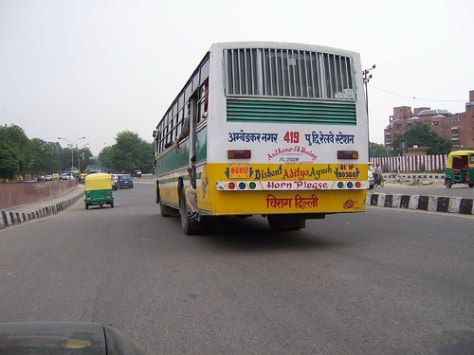
यहाँ से शहर को देखो …..

[यह लेख “बस्ती तो बसते बसती है” शीर्षक से आउटलुक हिंदी  के  स्वाधीनता विशेषांक में छपा है.]

अब जबके हर तरफ यह एलान हो चुका है के दिल्ली १०० बरस की हो गयी है और चारों ओर नई दिल्ली के कुछ पुराने होने का ज़िक्र भी होने लगा है, इन दावों के साथ साथ कि “दिल्ली तो सदा जवान रहती” है और “देखिये ना अभी कामनवेल्थ खेलों के दौरान यह एक बार फिर दुल्हन बनी थी”, वगेरह वगेरह, तो हमने सोचा के क्यों न इन सभी एलाननामों की सत्यता पर एक नजर डाल ली जाए, और इसी बहाने उस दिल्लीवाले से भी मिल लिया जाए जो इस अति प्राचीन/ मध्यकालीन/ आधुनिक नगरी का नागरिक होते हुए भी वैशवीकरण के झांसे में इतना आ चुका है के वो अपने आप को २१वीं शताब्दी के पूर्वार्द्ध में आने वाले आर्थिक संकट को पछाड देने वाले चमचमाते भारत देश की राजधानी का शहरी  होने का भरम पाले हुए है.

अब सब से पहले तो यह फैसला कर लिया जाए के नई दिल्ली है किस चिड़िया का नाम? पाकिस्तान के मशहूर व्यंग कार इब्न-ए–इंशा ने अपनी विख्यात पुस्तक उर्दू की आखरी किताब में एक अध्याय लाहौर के बारे में लिखा है.  इस अध्याय में इंशा कहते हैं “ किसी ज़माने में लाहौर का एक हुदूद-ए–अरबा (विस्तार) हुआ करता था अब तो लाहौर के चारों तरफ लाहौर ही लाहौर वाके (स्थित) है और हर दिन वाके-तर  हो रहा है”

एक फर्क है, इब्न-ए-इंशा के लाहौर में पुराना लाहौर और नया लाहौर दो अलग अलग चीज़ें नहीं हैं मगर दिल्ली के मामले में ऐसा नहीं है, एक समय था के नई दिल्ली में बाबू बसा करते थे और नई दिल्ली के पास शाहजहानाबाद था जो शहर था, अब नई दिल्ली वालों के हिसाब से पुराना शहर सिर्फ शादी के कार्ड, आचार मुरब्बे और हार्डवेअर खरीदने की जगह है, या उसे इस लिए बनाया गया है के उनकी पार्टियों के लिए बिरयानी, चाट, कुल्फी वगेरह मुहैया करवाए और जब उनके विदेशी मित्र या एन आर आई सम्बन्धी यहाँ आयें तो उन्हें इस जीते जागते संघ्राल्य के दर्शन करवा सकें. मुसलमान और सिख वहाँ धार्मिक कारणों से भी जाते हैं, मगर उनकी बात अलग है वो तो अल्प संख्यक हैं हम तो आम लोगों की बात कर रहे हैं.
Continue reading यहाँ से शहर को देखो …..

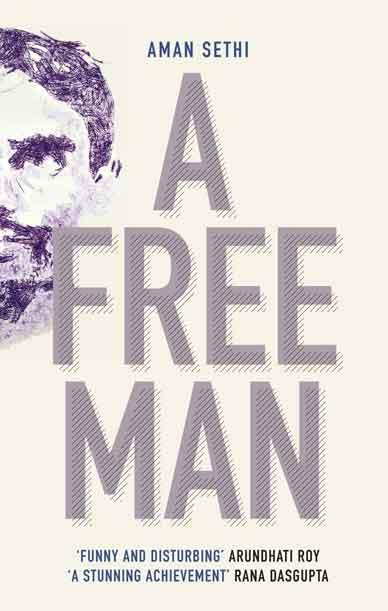
A Free Man

Mohammed Ashraf is short and stubby, with a narrow but muscular chest and small, broad hands balanced on strong, flexible wrists. But Ashraf does not grudge the throw of the dice that has made him a safediwallah with a mazdoor’s body. A small man’s body can do things that a slenderchamak-challo cannot even contemplate.

A small man carries the ground close to him wherever he goes, even as he hangs along the side of a building three storeys high. The memory of the ground that allows him to crawl into crevices, perch on narrow ledges and balance on wobbly parapets. A short man knows the limits of his body, the extent of his reach, the exact position of his centre of balance. Unlike the tall man, he holds no illusions regarding his abilities or his dimensions; he will never overreach, overextend or overbalance.

A Free Man, my first book, should be in stores this July. Read the rest of the excerpt

Mediation, Middle Grounds and Meddling – The Medley of Middlemen

[Dedicated to Sankarshan Mukhopadhyay on account of “receiving ends”]

Couple of weeks ago, I was attempting to rent out the apartment that my mother and I own in an urban sprawl in South Bangalore. Among others, a broker – referring to himself as a ‘property consultant’ – approached me with a client. I met the client and conducted some negotiations. Eventually, however, I rented the apartment to persons who had approached me before the broker and his client saw our place. I politely refused the broker’s client. The broker contacted me soon thereafter and began issuing threats for not renting the place to his client. He threatened that it would be dangerous for me to spoil my business with him. Initially, I was also nervous and upset because I was unsure if the broker had an office in the neighbourhood and whether he was powerful enough to spread false rumours about our property which could potentially devalue the property and/or spoil my relations with the new tenants who had just come in. He then came to the apartment complex where the flat is situated and created a small ruckus. Finally, failing on all counts, he threatened to lodge a false police complaint against me for allegedly taking a deposit from his client without issuing a receipt. The broker’s threats turned out to be empty and damp squib as him. He never showed up after that dramatic afternoon of back-and-forth(s). Continue reading Mediation, Middle Grounds and Meddling – The Medley of Middlemen

Seeking the Apadhasanchaarini/ The Malayalee Flâneuse

So, the moral police has struck again. The papers in Kerala have been full of news about how a young IT sector employee, Thasni Banu, was confronted by a group of goons while she was being dropped to work at night by a male friend, insulted, slapped several times, and warned that they will not allow Kerala to “become Bangalore”. She did not take it mildly and complained to the police, who rolled their eyes, hummed, and hawed, and as to be expected, went slower than usual. One of the goons who was apprehended was let off. The papers have indeed taken the issue very seriously — and so have the state government, which suspended the policeman who handled the affair shoddily. Continue reading Seeking the Apadhasanchaarini/ The Malayalee Flâneuse

Of Fakes, Duplicates and Originals – the Tale of Ration Cards and the Trail of Transparency in Governance

On 2nd May 2011, the front page of the Times of India (TOI) beamed and screamed: “Don’t pay a bribe, file an RTI application – Equally Effective in Ensuring Service”. Two doctoral candidates at Yale University’s political science department had conducted field experiments in the bastis in Delhi in the year 2007 regarding poor people’s experiences in making applications for ration cards. The researchers – Leonid V Peisakhin and Paul Pinto – found that persons who paid bribes had their ration cards processed faster. However, those who filed an RTI request to know about the status of their ration card application, were “almost as successful”, the TOI report claimed. (The details of the study and the outcomes can be accessed through Peisakhin and Pinto’s paper “Is transparency an effective anti-corruption strategy? Evidence from a field experiment in India.” The paper was published in 2010 in Regulation and Governance Journal, volume 4, pp 261-280.) The researchers had also put people in two other control groups – one which neither paid a bribe nor followed-up and a second group which had filed their applications along with a letter of recommendation from the local NGO. Both these groups were not as successful as the former two groups in obtaining their ration cards. The researchers’ analyses veered towards two conclusions: first, that the RTI Act serves the poor who are usually denied/deprived of information. Secondly, reforms/laws which give more ‘voice’ to citizens and allow them to scrutinize the functioning of officials and elected representatives are more effective in ensuring transparency and gaining access to public services. Continue reading Of Fakes, Duplicates and Originals – the Tale of Ration Cards and the Trail of Transparency in Governance

Hundreds of lives reduced to rubble in Delhi: Paul Divakar

Guest post by PAUL DIVAKAR

This slideshow requires JavaScript.

This was written yesterday, 24 March 2011: Today we witnessed most humiliating, fascist nature of pulverising already vulnerable communities – most of whom are Dalits and backward castes in Gayatri colony near Faridpur of Baljit Nagar. Continue reading Hundreds of lives reduced to rubble in Delhi: Paul Divakar

Death of a River

This was first presented as a paper in a seminar on “The River” organised by the Max Muller Bhawan on 11 and 12 December 2010. Photo credits: Gigi Mon Scaria, Himanshu Joshi and Sohail Hashmi. Maps: The coloured map of Delhi is the restored version of an 1850 map; restoration is by E Ehlers and T Krafft. The black and white map is based on an 1807 map of the draingage of Delhi, made by a British cartographer. The three current three maps have been drawn by Shela Hashmi Grewal. You can stop at any image in the silde show above, by using the controls that you will discover once you hover the cursor over the slideshow.

This slideshow requires JavaScript.

The Final scene in the epic tragedy of the Jamna is being enacted at these very moments and the agencies that have wrought this havoc continue to initiate decisions that will permanently erase all signs of the river that has sustained the city that you and I call Hamari Dilli.

Before coming to my understanding of what needs to be done to save the Jamna, instead of what is being done to destroy it. I would like to draw your attention to certain geographical features of the land around Delhi, in order to better understand the factors that contributed to the location of the several Delhis and their relationship to the river. Continue reading Death of a River

The Republic of Exploitation

On this Republic Day, while armoured tanks muscle across Rajpath in New Delhi, little ossified museums of culture called tableaux charm the assembled pass-holding citizenry and the Prime Minister sits like a barely-sentient caricature of himself behind a bullet-proof screen, it may do well to think about the other republic that remains hidden within the bosom of Superpower India – the republic of unfree labour.

This is a world where the laws of the upside world are inverted – where the more you work, the less you are paid, the more your company profits, the poorer you end up and if you find yourself the victim of an injustice and god forbid complain about it, the police put your family in jail. It’s a great irony of our times that we believe the choice before us is between loving the Nation and loving the Corporation, not realising that most of the time its the same person wearing two grotesque masks.  All those who believe that the world begins with their newspapers and television sets and ends at their white picket fences (and all those who don’t), please take a minute to go through the excellent documentation of the war that is raging for workers in this country, put together by the Gurgaon Workers’ Solidarity Group, the Faridabad Mazdoor Sangathan and several other exemplary organisations.

GurgaonWorkersNews – Newsletter 35 (February 2011)

Continue reading The Republic of Exploitation

Ab Bhi Dilli Dur Hain: On ‘No One Killed Jessica’: Kartik Nair

Guest post by KARTIK NAIR

Why does No One Killed Jessica open with the execution of Jessica Lal but rush so quickly to the windswept altitudes of Kargil? And why, when she first blasts on to the screen as embedded journalist Meera reporting on the war, does Rani Mukerji look more like she’s embedded inside an SNL skit on Barkha Dutt? I let out a little laugh then, but the laughs only got bigger from there. Here is a film that knows nothing about how the media works; worse, it fails to pass off its version of the media as believable. Here are a few lessons I learned watching the film:

1. Aspiring reporters will be glad to note that though journalists generally fight tooth-and-nail at press conferences to get their questions heard, a helpful “Yaar, please, mujhe poochne do!” will elicit total co-operation and rapt attention.

Continue reading Ab Bhi Dilli Dur Hain: On ‘No One Killed Jessica’: Kartik Nair

New Delhi – A Heritage Zone at 80!

[This article by Sohail Hashmi was earlier inadvertently posted under the name of Shivam Vij. The error is regretted.]

Connaught Place renovation for the Commonwealth Games, September 2010. Photo credit: AP

In 1988 Lutyen’s Delhi, was declared a heritage zone by prohibiting building activity within the 26 square kilometre area out of the 43 Sq. Km. area that falls within the civic control of New Delhi Municipal Committee (NDMC). A move has now been initiated to get the entire area declared a UNESCO World Heritage site.

The very logic of an area being declared a Heritage Zone should preclude any interference with the layout and design of the entire zone. Non-interference also means that, future building and development activity, if at all permitted, has to conform to the original parameters of design, materials, fittings and fixtures used, building techniques, landscaping and the kinds of trees planted in the heritage zone.

Even before the 1988 freeze on construction, there was a master plan for Delhi and it clearly identified the Lutyen’s Bungalow Zone as an area where high rises were not to be permitted. Continue reading New Delhi – A Heritage Zone at 80!

Who is a Dilliwala?

Chhat Puja at India Gate, Delhi. Photo credit: S. Subramanium / The Hindu

For most residents of New Delhi, the region known as Old Delhi falls within the realm of the unknown. Aside from business people and those who earn a living inside the walled city only a few from outside the walled city used to venture into, what is derisively called Dilli 6. At least this was the picture till very recently.

With the introduction of the Metro entry into and exit from the heart of the city, it has become less daunting. More and more people from outside the “walled city area” have begun to tentatively explore the narrow winding lanes of Shahjahanabad. Except for those who come to explore ‘history and heritage’ and their numbers are small, consisting mostly of fair skinned tourists, most others arrive to explore the fabled flavours of the street food of Old Delhi or Shahjahanabad to give the place its correct name.

Continue reading Who is a Dilliwala?

The Blue Line Bus Saga: Aman Trust

The article is based on AMAN Trust‘s research on informal labour in Delhi.
Sent by Jamal Kidwai

The Delhi government has announced a phasing out of nearly 3000 blue line buses from the streets of Delhi in the next few months. These buses will be replaced by nearly new 1000 low floor buses purchased to ferry athletes and dignitaries for the Commonwealth games. According to the Delhi Transport minister Arvinder Singh Lovely the phase out will be enforced under section 115 of the Central Motor Vehicle Act that deals with the emission norms. The decision has been taken even despite a petition pending in the Delhi High court regarding the decision to phase out 600 routes. According to Lovely “We will apprise the High Court about the decision and I am confident that the court will accept our proposal.”

Continue reading The Blue Line Bus Saga: Aman Trust

Notes from a Beautiful City


Research and Edit:
Rintu Thomas

Photography and Sound:
Sushmit Ghosh

Produced by:
Open Space & Black Ticket Films

Creative Destructions

Part of a Series. See here.

In January of this year, I had taken a friend to Mumbai. One of the places we went to was Lower Parel – I wanted to show him what I could of the Mills. You could still see the Mills then, if not in the same form. The same compounds now housed small galleries and boutiques. There were advertisements for a ‘mills culture tour’, sold as something in between a bar hop and an art gallery cruise. I knew big clubs had opened here, as had malls. Phoenix Mills was Mumbai’s version of Delhi’s DLF Emporio – all the major global brands were there. Even here, however, I remember laughing and pointing out to him that some of Bombay’s stubborn egalitarianism remained. Armani was next to Addidas. Rohit Bal next to a paper store. Unlike in Delhi where no non-hyper-elite brand could get near DLF Emporio, in Bombay, even Armani couldn’t buy space away from Adiddas.

Continue reading Creative Destructions

Maya Bazaar

Its 6.30 am on a mid-May Sunday morning in Bombay, India’s favourite metropolis-on-the-sea. Like a sudden gift from a dying relative, an unseasonal chilled breeze is blowing in from the ragged beaches of the city. I put my sandals on and go downstairs from my flat to meet three friends; all of us having decided to do what Bombay dwellers do periodically – use a Sunday to make friends with the city again, to momentarily cease the war that rages, unbidden, every other day of the week. Continue reading Maya Bazaar

Two Overheard Conversations, Delhi 2010

Guest post by ANAND VIVEK TANEJA

Conversation One. I’m sitting in a barber-shop in Sector 34, Noida, getting a haircut. The older guy sitting next to me, getting a shave, asks this younger fellow who’s just got up from a haircut –

  • Tu kahaan se hai bhai? Where are you from?
  • Main to Noida se hi hoon. I’m from Noida only.
  • Noida ka to na laage hai. You don’t look like you’re from Noida.

The young man in question was slight and skinny, and was dressed in what could be described as  generic global college student/hipster style. The conversation continued. The barber said, no he’s definitely not from Noida. The young man turned on him and said, Tum kaunse Noida ke ho, Well, you’re not from Noida either. The barber says, Main to Bihar se hoon. Main thodai hi chhupa ke rahkta hoon. I’m from Bihar. I don’t hide the fact. Then the barber says, Yeh to lawaris hai ji. He has no parentage, sir.

The Truth Behind the Strike

In a recent guest post, SIMON HARDING of Delhi’s AMAN Trust had explained why Delhi’s autowallah is not the villain he is made out to be but a victim of the Delhi government’s policies, the Supreme Court’s whims and the financier mafia’s greed. In this post he writes about the strike by Delhi’s auto drivers yesterday and why a majority of the drivers were not in support of it.

Yesterday there was an auto strike in Delhi. The city was crippled. Taxis tripled their fares and buses ran full to bursting. The strike, called by Rajendra Soni of the Dilli Autorickshaw Sangh (DAS) and supported by many other auto unions, was well observed with few drivers plying the streets. The striking unions demanded that Sheila Dikshit retract her recent comments about “phasing out” autos. They also called for a raise in the meter fare (Rs.4.5 per km) following an increase in the price of CNG. Continue reading The Truth Behind the Strike

Johannesburg – Notes from a Mother City

Mother City?!? What is a Mother City?

We arrived at the Tambo airport, waiting to be received by the taxi driver. The taxi driver, also the initiator of the taxi services company led us from the arrival hall into the parking lot. He was an old, white man, with a completely white beard. He looked a bit like Santa Claus. Upon reaching the car, he opened the door to the boot and started lifting our heavy bags, one by one, to load into the boot. I said I would lift my bag myself (because somewhere inside my conscience, it seemed incorrect for an elderly person, my grandfather’s age, to lift my bags and put into the boot). He looked up and said,

In this country, we are all slaves. Let me do this. Continue reading Johannesburg – Notes from a Mother City

Drop A Beat, Turn Up My Symphony

This is a guest post by John Bevan

Nearly half the 8 million population of Haiti, (the size of Wales, Belize and El Salvador— seems that was one of the standard sizes for countries at the time) lived in the Capital Port-au-Prince.  So the elimination of the Capital approximates to the loss of half the country’s entire infrastructure, limited as it was.  The loss of many of its intellectuals and elected politicians, few enough in the first place, given the brain-drain northwards, with some third of Haitians living in the US, adds to the knock the country has taken.

In 2006, the main Port-au-Prince daily proudly lead with the story- “Haiti there at World Cup Final”- referring not to their football team but Wyclef  Jean who sang a duet with Shakira before the France-Italy final in Berlin.  Wyclef boosted the image and self-image of Haitians a few years earlier when he won a Grammy for the 1996 Fugees album, The Score, and accepted it while wearing a Haitian flag, Haitians still being at the bottom of the pile of all US immigrant groups.  He rarely appears on videos without the flag somewhere about his body. Continue reading Drop A Beat, Turn Up My Symphony

The Suicide of Sense

Mumbai has been in the grip of a wave of student suicides this past month. According to the Mumbai Mirror, as many as 25 suicides have taken place in the city in the new year, most of which have been by students. As expected, the media has tripped over itself reporting every sordid and tragic detail of the students’ personal lives, and public anxiety in Mumbai is climbing to the level of all-round hysteria. The general consensus is that there is too much pressure on young minds from schools and parents; the Maharashtra State government has reacted by issuing directives to all eight regional education boards in the state asking principals to arrange workshops to identify depressed students and urge them to seek psychiatric help. State education minister Balasaheb Thorat has promised a stress-free curriculum in school boards, and followed this up by a new rule that allows failure in one subject for an overall pass result in the SSC. A south Mumbai hospital has recruited a former depressive who has a history of three suicide attempts to counsel others against suicide. The Thane Mental Hospital has in the meanwhile gone one step ahead and created what they call a ‘20-minute anti-suicide psycho drama skit’ to be performed on the streets and in educational institutions. According to hospital superintendent Dr. Sanjay Kumavat, the skit will focus on the trauma that family members go through when a child commits suicide, and the ‘problems created by such a situation’ (Mumbai Mirror Jan 18th 2010) – this will hopefully prevent them from taking the proverbial ‘drastic step’.

Continue reading The Suicide of Sense

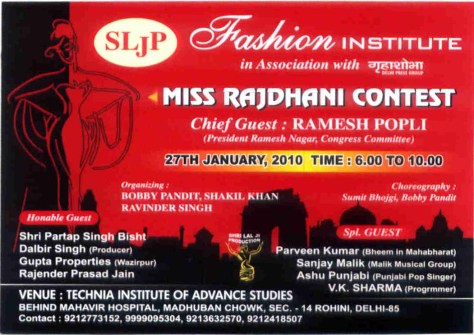
Miss Rajdhani Contest

You are cordially invited