
When people are marching to barricades, I go back to my library . I know that streets across India are now re-educating many of us and we are keen to get enrolled in this university of action. Yet I want first to understand this moment of action we are being advised to be part of.
Category Archives: Politics
Why Jai Karan supports Anna Hazare
My own feelings about the Anna Hazare movement are mixed, or you could say confused. I like the way the movement is bringing an arrogant government to its knees, and though I don’t know if their version of the Lokpal Bill is the best way to fight corruption, I appreciate how they have exposed the UPA’s farce of a bill. I get the point that fellow-travellers Nivedita Menon and Aditya Nigam are making about democracy and political movements, but as one unit of ‘the people’, I don’t see why I should support a movement just because it is popular. Perhaps it is my elitism and naivete and cynicism. Or perhaps I’m just confused by now. The taste of the pudding is in the eating, and I’d like to see where this takes us.
While I sort out my confusion, I see a message on Facebook, attributed to Anu Ramdas, that says:
Resisting The Popular
The drama that is being enacted in Delhi for the last one week, rather five months, has thoroughly exposed the intellectual hollowness of the political life of India. This moment would also be remembered as the lowest to which collective intelligence of a people can descend to. Critiquing people is not the job of the politicians or the media, not in our times at least . Gone are the days when you had a Mohan Das Karamchand Gandhi who could stand up to the masses and withdraw a popular movement risking their wrath or a Jawaharlal Nehru who commanded the authority to chide his own people. The days of Rabindra Nath Tagore are also over who had the courage to openly challenge, criticize a saint like Gandhi and write ‘anti-people’ novels like Ghare baire. If we have time and patience to turn the pages of our history , we would find that their criticism was an integral part of their long and continuous engagement with their people. Theirs was not a utilitarian relationship . People knew that they love them and care for them and that is why they never turned away from them.
The names we have mentioned above belong to an era when the grammar and vocabulary of popular politics were being transformed. They refrained from simplifying things and devised a language which people were challenged to learn. It was their inexhaustible trust in the intelligence of their people that encouraged them to constantly innovate and complicate rather than simplify. It was this air which a young man Bhagat Singh was breathing, who, going against the grains, wrote that violent methods were no substitute to popular political mobilisation, who knew that the appeal of Subhas Chandra Bose was dangerous and it was Nehru, with a scientific and internationalist outlook, he advised the youth to follow.
NAPM Extends Support to Anti-Corruption Movement and Demand for an Effective Lokpal
[The statement was issued by the National Alliance of People’s Movements on 14 August. Much has happened since then – the arrest of Anna Hazare – accopanied by silence and often ridicule poured by the radical elite, but in the face of what is perhaps one of the most widespread mass movements in India after Independence. Over the past few days, we have been witness to innumerable demnstrations and marches in almost every colony in Delhi – where no TV camera ever reached or was even expected to when the ‘real’ action is going in in central Delhi. Contrary to the general propaganda and even our own earlier impression, this is no more simply a middle class movement. I am reproducing it here, somewhat belatedly, because it still touches on some of the post important points at issue in the ongoing struggle. – AN]
Anna Hazare Ji and manyothers across India will be starting their fast from August 16th in Delhi demanding an effective Lokpal. NAPM supports the people’s movement for a corruption-free India and urges the citizens of the country to plunge into this struggle. NAPM, along with other organisations is holding relay fast, human chains, public meetings and other programmes, in Chennai, Pune, Mumbai, Narmada Valley, Hyderabad, Guwahati, Bhubaneshwar, Bangalore, Mysore, Mou, Balia, Allahabad, Muzzafarnagar and other places. We urge our members and supporters to join this call and challenge the corrupt and defensive governments at the Centre and the states.
We strongly disapprove of the way in which government has been trying to put severe restrictions on holding peaceful protests in the capital, and Delhi Police under the garb of implementing the Supreme Court’s Guidelines is imposing unnecessary conditions on protests, as it did early this month on SANGHARSH anti-land acquisition protest, AISA-DYF anti-corruption protest and others. For an independent democratic country like ours, imposition and insistence on police permission and strict guidelines for holding peaceful protests and Sataygraha seems completely contradictory and only shows shrinking spaces for democratic freedom of expression and curb on fundamental rights of its citizens.
Continue reading NAPM Extends Support to Anti-Corruption Movement and Demand for an Effective Lokpal
Benaam Shahidon ke Naam – शेहला मसूद के लिए: Tanzil Rahman
Guest post by Tanzil Rahman*
Benaam shaheedoN ke naam (बेनाम शहीदों के नाम )
तंजील रहमान
For Shehla Masood, Niyamat Ansari , Amit Jethwa and many like them who are killed everyday across the world for daring to speak out the truth.
Ye Jang ruki thi kab ये जंग कब रुकी थी
Ye jang to jaari hai ये जंग तो जारी है
Ye jang hamaari hai ये जंग हमारी है
Ye jang hamee’at ki ये जंग हमी’अत की
Insaan ki qeemat ki इंसान की कीमत की
Har ahl-e-hawas se hai हर अहले-हवास से है
Har ahl-e-hakam se hai हर अहले-हकम से है
Har zuml-o-sitam se hai हर ज़ुल्म-ओ-सितम से ही
Har jhoot se, nafrat se हर झूठ से, नफरत से ही
Auhaam se dahshat se औहाम से दहशत से है
Har rang ki zulmat se हर रंग की ज़ुल्मत से है
Ye jang to jaari hai ये जंग तो जारी है
Ye jang hamaari hai ये जंग हमारी है
Continue reading Benaam Shahidon ke Naam – शेहला मसूद के लिए: Tanzil Rahman
Songs After Independence
Guest Post by Indu Vashist
Click here for full broadcast: Songs After Independence
Acknowledging Independence day without nationalism, the hosts of Desi Dhamaka use Independence Day as a platform to explore contemporary social and political issues in South Asian. Featured are songs in Urdu, Hinglish, Tamil, Bengali, Punjabi, English, just to name a few. The artists featured range from Iqbal Bano singing to Faiz Ahmed Faiz’s lyrics to Indian Ocean, from Alisha Chinoy to Mohd Rafi, and much more.
Montreal based Indu Vashist and Srinath Baba are the hosts of Desi Dhamaka, a South Asian music show with a political and social twist. It airs on CKUT, a non-profit, campus-community radio station based at McGill University. CKUT provides alternative music, news and spoken word programming to the city of Montreal and surrounding areas, 24 hours a day, 365 days a year. Hear us at 90.3 MHz on the FM dial, 91.7 by cable, or listen on-line.
What caste do you think the Financial Times is?

See update below.
So… I get a phone call yesterday. It’s a reporter from the Financial Times who wants to know what I feel about the recent ban on the movie Aarakshan in certain states, and also what do I feel about caste-based reservations in general, whether caste is still relevant in the India of today, the theory that quotas just increase inequality etc.. I tell her I haven’t seen the movie, and if she still wants to know what I feel about caste-based reservations we could talk for a bit. She says she absolutely wants to know. So I say fine, and we have a 45-minute conversation. Allow me to reproduce a very simplified version of that conversation (in Q&A forrmat):
1. Q: Do you believe movies like Aarakshan can be provocative or controversial; as in, are certain groups justified in taking offence and asking for a ban? Continue reading What caste do you think the Financial Times is?
In Defence of Asif Ali Zardari: Abdullah Zaidi
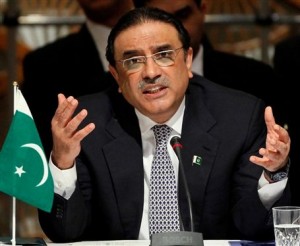 Guest post by ABDULLAH ZAIDI
What comes to your mind with the mention of Asif Ali Zardari? “A cunning, vile, and corrupt man,” said my 19 year old cousin. This was a good summation of what the urban middle-class thinks of him. The more I hear people talking about him the more I am convinced of the power of propaganda. “Give the dog a bad name and hang him,” Zardai once said about himself. That is what is at work here.
Despite what has been said about him, Zardari did have a political background. His father Hakim Ali Zardari entered politics well before Partition and was a member of the Khaksaar Tehreek in 1931. He was first elected to the National Assembly in 1970s. All this talk of Zardari as a political orphan who hogged the Bhutto dynasty upon marriage with Benazir, is a non-starter. In Benazir’s husband, the Bhutto family wanted someone who would remain loyal to her. That is exactly what they got in him. For Zardari, family would always come first. This was the case at the time of Benazir’s death, when he kept the family together. Benazir would often tell close aides that despite his failings, Zardari always remained loyal to the family. Continue reading In Defence of Asif Ali Zardari: Abdullah Zaidi
Parliamentary Sovereignty or an Active Citizenry? V. Krishna Ananth
Guest post by V. KRISHNA ANANTH*
The political class, cutting across the spectrum, is now being haunted by a spectre. Anna Hazare has captured the imagination of a cross section of the people and his campaign is certainly gathering support. It remains to be seen if this support translates into a movement on the streets and more so against the state machinery that is threatening to pull all the stops. The people have shown such courage in the past. That is another matter.
Team Anna’s decision to go ahead with protests against the draft Lok Pal Bill, as approved by the Union cabinet, has spurred a debate. The proponents of the draft bill as well as sections in the political arena who claim to oppose the Government are united against another round of fast by Anna Hazare; they call it blackmail and an attempt to usurp Parliament’s power to legislate. They also claim that the principles of democracy shall not be sacrificed.
A number of them are on record that the draft proposals are subject to amendments and that the power to propose amendments and decide on them shall rest with the elected representatives of the people. It is another matter that the Prime Minister, who heads the cabinet, qualifies as a representative of the people only because membership of the Rajya Sabha is considered as good as being a member of the Lok Sabha to remain a minister under Article 75(5) of the Constitution. In any case, the fact is that Dr. Manmohan Singh has claimed, in an affidavit, that he is ordinarily a resident of Assam! We all know the truth but that too is besides the point.
Continue reading Parliamentary Sovereignty or an Active Citizenry? V. Krishna Ananth
Democracy, Populism and the ‘Middle Class’: The Return of ‘Anna Hazare’
[This is a considerably expanded version of an article that was published in Himal May 2011. It is being re-published, elaborated and updated, in the context of the farcical draft of the Lokpal Bill roduced by parliament and the threatened round 2 of the movement. – AN]
Corruption – a Systemic Affair?
Let me start with an ’emperor’s new clothes’ kind of question: What is a systemic understanding of ‘corruption’? What is a political understanding about corruption as opposed to say, a touchy-feely ‘moral’ problem? Yes, some of these phrases are straight from Arundhati Roy’s ‘When Corruption is Viewed Fuzzily’, published in the Indian Express on 30 April. But my question is not directed only at her. She represents – at least on this issue – a much wider consensus among sections of the radical intelligentsia.
Roy herself has left nothing to the imagination as to what she means:
“Among the millions of understandably furious people who thronged to Jantar Mantar to support Anna Hazare and his team, corruption was presented as a moral issue, not a political one, or a systemic one — not as a symptom of the disease but the disease itself. There were no calls to change or dismantle a system that was causing the corruption. Perhaps this was not surprising because many of those middle-class people who flocked to Jantar Mantar and much of the corporate-sponsored media who broadcast the gathering, calling it a “revolution” — India’s Tahrir Square — had benefited greatly from the economic reforms that have led to corruption on this scale.”
To her, the system that lies at the root of corruption is embodied in the ‘economic reforms’, which have led to corruption on this scale. I have no way of measuring the scale – though I might be inclined to agree with her that in my living memory, I have not seen so much compressed into such little time-space – from CWG to l’affaire Niira Radia to Adarsh Housing scam and the Bellary brothers – not to speak of the daily corruption in land acquisitions that dot the landscape of the country. Nonetheless, I do remember that something like the Bofors scandal or the ‘irresistible rise’ of Dhirubhai Ambani – all predate the ‘economic reforms’. And of course, I will not even try to mention the innumerable cases of corruption from Nagarwala onwards – including political corruption that led to big mass movements in Gujarat and Bihar in the 1970s. Those were the days when Mrs G proclaimed that ‘corruption is a global phenomenon’. To me saying corruption is systemic and must be analyzed ‘politically’ (whatever that means), sounds pretty much the same. So, if neo-liberalism is responsible for corruption, how do we explain the instances mentioned above? How do we understand the great socialist states which secreted corruption from every pore? What does a ‘systemic analysis’ of corruption really tell us?
However, Arundhati Roy was making this point, it seems to me, not in order to analyze the phenomenon of corruption but to comment on the Anna Hazare movement and its ‘character’:
“When corruption is viewed fuzzily, as just a touchy-feely “moral” problem then everybody can happily rally to the cause — fascists, democrats, anarchists, god-squadders, day-trippers, the right, the left and even the deeply corrupt, who are usually the most enthusiastic demonstrators.”
Continue reading Democracy, Populism and the ‘Middle Class’: The Return of ‘Anna Hazare’
Deconstructing The NAC : Ruchi Gupta
Guest post by RUCHI GUPTA
The past couple of months have seen a renewed attack on the National Advisory Council (NAC). The NAC has been decried as an unconstitutional, undemocratic, “super-cabinet” where unaccountable “jholawalas” hatch harebrained schemes guaranteed to run the government aground. Another line of criticism has focused on the process of the formation of the NAC, its space within the Indian Constitution, and its capacity to influence policy. The two criticisms merge with the demand to disband the NAC on the count that the NAC does not have to face the outcome of its recommendations, and by virtue of it being chaired by the head of the ruling Alliance, can arbitrarily force the implementation of its recommendations.
There is however, a need to examine how the NAC has functioned, what it has done, as well as understand the space it occupies in the policy-making paradigm of the country. While the concerns about the legitimacy of the NAC relate to important issues of Constitutionality, the criticism about the nature of its policy recommendations is motivated by ideology and is of much less relevance to its impact on democratic processes.
It is true that the NAC is an entity created to give the leader of the ruling alliance a role in policy making. Nevertheless, partly through the kind of members chosen, and the norms of functioning it has evolved, it has opened up the otherwise closed and secretive processes of formulation of law and policy, beyond its own membership to citizens groups and people with expertise. It can, in fact with some effort become a platform to further a more just and participative democracy. In this essay, we deconstruct the NAC and situate it in its political context to understand both its pitfalls and potential.
Statement of Indian Women’s Rights Activists in Solidarity with Women in Sri Lanka
It’s been more than two years since the supposed end of the war in Sri Lanka. The issues of concern are many, particularly with regard to the period after the end of direct combat. The Sri Lankan government has been abysmal in acknowledging the range of human rights violations that have been committed by the armed forces, which has been documented without a kernel of doubt by the United Nations report as well as the Channel 4 documentary. This documentation has been made in spite of circumstances where any neutral observation of the last stages of the conflict was made impossible by the Sri Lankan government and its army.
Continue reading Statement of Indian Women’s Rights Activists in Solidarity with Women in Sri Lanka
New Phase in Struggle for Release of Political Prisoners in West Bengal: Biswajit Roy
Guest post by BISWAJIT ROY
Civil society, including human rights groups, in Bengal are now divided on Mamata Banerjee government’s ‘open and hidden’ conditions regarding the release of political prisoners who have been jailed during the Left front rule as well as talks with Maoists and Maoist-backed Peoples Committee against Police Atrocities in Bengal’s tribal hinterland, known as Junglemahal.
Mamata and her ministers have rejected the demands for unconditional release of all political prisoners, immediate withdrawal of joint forces from Junglemahal and public announcement on non-enforcement of the draconian central law, the Unlawful Activities Prevention Act. Maoists and PCPA have accused Mamata of eating up her pre-poll words on those demands. A large section in the human rights movement including the intellectuals and activists who actively joined the Mamata-led campaign for regime-change now supported these demands. But some of their fellow travellers have differed on political and legal grounds.
The differences revealed contradictions between the pre-poll and post-poll positions of Mamata as well as chinks in the armour of human rights groups on the attitude to the new government, Maoists and PCPA. Tension among all the stakeholders in the process— Mamata, Maoists, human rights groups and individuals— was well-known within the concerned circles for quite some time. But none of the stakeholders dwelt on it in public before the assembly polls when they had made common cause against the CPM, particularly, the atrocities by CPM-joint forces combine.
I would like to dwell on post-poll dilemmas and fissures in the pro-Paribartan civil society in Bengal later. But this piece is primarily aimed at reporting the increasing manifestations of the hitherto latent tension.
Continue reading New Phase in Struggle for Release of Political Prisoners in West Bengal: Biswajit Roy
Delhi Police solve Mumbai blasts case
The Times of India reported today that Delhi Police intercepted a call immediately after the Mumbai blasts on Wednesday, which has given them crucial clues to solving this case.
Read the full report here
Basically, immediately after the blasts, the ever alert Delhi police intercepted a call from Mumbai to the NCR to ask the person in the NCR if ‘the work had been done’ and whether ‘Sharif” had been informed. On getting the answer ‘yes’, the caller hung up, and not just hung up, but ‘immediately’ hung up. The call lasted for about a minute.
This brief call was not too brief for the Delhi Police’s keen forensic skills.
The Values of Property
The recently announced Rajiv Awaas Yojana (RAY) has brought back an old ghost to debates on how to allow the urban poor a foothold into the city and the possibility of upward mobility. The central policy initiative of the Ministry of Housing and Urban Poverty Alleviation is the most significant contemporary attempt to address urban poverty through providing housing to the urban poor. The “slum-free city” is back. Now more than ever, then, it is time to ask: what is a “slum-free city”?
Solidarity letter to anti-POSCO movement from Korean jail: Sung-Hee Choi
Madhumita Dutta has sent us this powerful letter in solidarity with the people of Jagatsinghpur opposing the POSCO project, written by a South Korean activist SUNG-HEE CHOI, in prison for opposing a naval base.
Dear residents in Jagatsinghpur,
I am a woman and activist living in South Korea, the country of the POSCO you oppose. I am currently being jailed in the Jeju prison, under the charge of ‘interruption of business’, because of my resistance against the enforcement of the naval base construction in the Jeju Island located in the south of South Korea. As of today, July 3, I met 46th day since my arrest and 44th day since my being restrained.
I accidently happened to see two of your struggle photos and a photo in the Korean Times, June 13, 2011 had a caption underneath it:
‘Anti POSCO action in India: A village sprays water to relieve children lying with other villages along the entry point to prevent policemen and officials from entering their area at Jagatsinghpur district, about 140 kilometers(87 miles) east of eastern Bhubareshwary India, Saturday. The villagers have been protesting against turning their farmland into an industrial developed area for a $12 billion steal plant of South Korean conglomerate POSCO (AP-Yonhap).’
Continue reading Solidarity letter to anti-POSCO movement from Korean jail: Sung-Hee Choi
Don’t let Mumbai blasts investigations fall victim to prejudice and shortcuts: JTSA
Statement by Jamia Teachers’ Solidarity Association
JTSA offers its heartfelt sympathies to the bereaved and the injured in the Mumbai serial blasts. We sincerely hope that the perpetrators of this mindless violence will be brought to justice swiftly. There are early indicators though that this investigation will be marred by prejudiced investigating agencies. There are news items appearing in various media outlets which cite the interrogation report of Md. Salman, a supposed operative of the Indian Mujahideen (IM) to establish that Mumbai was on IM’s sights.
Already we see that, though the Home Ministry has restrained from holding any group culpable, the investigation is being gently pushed in one direction. But even if one leaves aside for a moment the criticism that investigators react in stereotypical ways, their compass needle invariably pointing towards Azamgarh, there are serious issues arising out of this reliance on Salman’s interrogation report for getting to the bottom of the Mumbai serial blasts conspiracy.
Continue reading Don’t let Mumbai blasts investigations fall victim to prejudice and shortcuts: JTSA
To Manmohan Singh from a Bangladeshi: Jyoti Rahman
Guest post by JYOTI RAHMAN
In a Q&A session with five newspaper editors recently, India’s Prime Minister Manmohan Singh had this to say about the Indo-Bangladesh relations:
With Bangladesh, we have good relations. Bangladesh government has gone out of its way to help us in apprehending the anti-Indian insurgent groups which were operating from Bangladesh for a long time. And that is why we have been generous in dealing with Bangladesh. We are not a rich country. But we offered it a line of credit of one billion dollars, when Sheikh Hasina came here. We are also looking at ways and means of some further unilateral concessions. We are also looking at ways and means of finding a practical and pragmatic solution to the sharing of Teesta waters. I plan to go there myself. The external affairs minister is planning to go later this week. So, Bangladesh, our relations are quite good. So with Bangladesh, our relations are quite good. But we must reckon that at least 25 per cent of the population of Bangladesh swears by the Jamiat-ul-Islami and they are very anti-Indian, and they are in the clutches, many times, of the ISI. So, a political landscape in Bangladesh can change at any time. We do not know what these terrorist elements, who have a hold on the jamiat-e-islami elements in Bangladesh, can be upto.
There are more errors here than one would have found in the balance sheets of Lehman Brothers. Let me note a few. Continue reading To Manmohan Singh from a Bangladeshi: Jyoti Rahman
Cities and Infrastructure – The Road Widening Saga in Bangalore
This evening, I was sitting in a coffee shop and writing about the sociology of information, how information is mired in relationships and how trust, suspicion and social relations develop in the course of circulation and exchange of information. As I was beginning to disentangle the complex web of legitimacy and regulations surrounding information, a friend called to inform that some activists and citizens had been arrested for protesting against the tree felling and road widening at Sankey Road in the northern part of Bangalore. In the last few days, the conflict regarding road widening and tree felling at Sankey Road got strong coverage in the media because citizens began gathering around the trees and the roads to prevent authorities from felling the trees. Despite this, the authorities went about felling the trees for widening the roads. The activists and protestors were clearly becoming a nuisance for the government officials and institutions who have not been able to execute the works. Hence, today, at some point, some of our activist friends were arrested on the false charges that they had assaulted public officials in their conduct of ‘government’ duty. The charges were filed under section 343 or 353 CrPC which also implied that the arrest was non-bailable. Over the course of the evening, news went about on FaceBook and Twitter about these arrests, and people from in and around Sankey Road were called to silently protest at the Aiyyappa Temple where the trees were being felled for enabling the road widening. The arrested activists and citizens were released from jail and all the charges against them were ‘dropped’ at about 6 PM. The court also granted a stay order on the tree felling around the same time, with further hearings and orders to arrive on Monday. Continue reading Cities and Infrastructure – The Road Widening Saga in Bangalore
Mediation, Middle Grounds and Meddling – The Medley of Middlemen
[Dedicated to Sankarshan Mukhopadhyay on account of “receiving ends”]
Couple of weeks ago, I was attempting to rent out the apartment that my mother and I own in an urban sprawl in South Bangalore. Among others, a broker – referring to himself as a ‘property consultant’ – approached me with a client. I met the client and conducted some negotiations. Eventually, however, I rented the apartment to persons who had approached me before the broker and his client saw our place. I politely refused the broker’s client. The broker contacted me soon thereafter and began issuing threats for not renting the place to his client. He threatened that it would be dangerous for me to spoil my business with him. Initially, I was also nervous and upset because I was unsure if the broker had an office in the neighbourhood and whether he was powerful enough to spread false rumours about our property which could potentially devalue the property and/or spoil my relations with the new tenants who had just come in. He then came to the apartment complex where the flat is situated and created a small ruckus. Finally, failing on all counts, he threatened to lodge a false police complaint against me for allegedly taking a deposit from his client without issuing a receipt. The broker’s threats turned out to be empty and damp squib as him. He never showed up after that dramatic afternoon of back-and-forth(s). Continue reading Mediation, Middle Grounds and Meddling – The Medley of Middlemen
The Singur Act and the Deontological Reaction: Prasanta Chakravarty
Guest post by PRASANTA CHAKRAVARTY
The remarkable Singur Land Development and Rehabilitation Bill, passed in the West Bengal Assembly on June 14 became an Act on June 20. The Act scrapped the previous Left Front government’s deal with Tata Motors and has provisions to return land to unwilling farmers. Consequently, Singur land was taken over by the State government prompting Tata Motors to legally challenge the whole Act and a judicial battle has ensued between them and the newly elected State government. The State government may continue to return land in right earnest since there is no legal bar to that as of now. One would think that by many standards, this is a landmark bill that challenges and confronts policy consensus in issues of land transfer, models of enclosing and a concomitant notion of development that marks our nation at this point of time.
Reactions to this enactment have been thick and fast—alarmist and cautious to generous and triumphant. Continue reading The Singur Act and the Deontological Reaction: Prasanta Chakravarty
 KAFILA - COLLECTIVE EXPLORATIONS SINCE 2006