Category Archives: Sex

Taming of The Vamp: Suchitra Vijayan

This is a guest post by Suchitra Vijayan

When I first read the Myth of Sappho, I was reasonably troubled that a famed Greek poetess would jump off the Leucadian cliffs for love of Phaon, a deeply flawed man. Why would a woman like Sappho kill herself over unrequited love? Did she not realise that she deserved better than the love of a loathsome man? Rationality dictates that no life is worth giving up for another. But the prudent pragmatist in me would beg another version, a rethinking. It was not unrequited love that made Sappho’s leap – a mainstay of our myth – it was something else. It was a comforting misogynistic tale attached as an afterthought, many hundred years after her death. First it suggested that a “woman” who had dared to trespass, and be different had to be mad all along. Second, the subversives always had to be reclaimed. Political rebels, internal subversives and non ideal types had to be tamed or done away with. In Shakespeare’s Taming of the Shrew, a man “acquires” a headstrong woman as his bride. Minus the comedic sub-plots and slapstick humour, the bare bones of the story include “notoriously aggressive” Katherine and her “tamer” husband Petruchio. But Katherine is neither aggressive nor notorious, she wears her indescribable naivety and sheer straightforwardness with the innocent integrity of a woman who is comfortable in her skin. This sits uncomfortably with the author, readers and commentators. Later Petruchio drags Katherine away from her own wedding celebrations, insisting she is his “chattel”, he deprives her of food and sleep until she learns to bend her will to his entirely. Some have argued that Katherine subverts patriarchy by acting like a submissive wife, manipulating Petruchio to her ends. Whatever interpretation you choose to favor, the fact remains that the woman had to be tamed, she had to manifestly re-fashion her self to comply with the new set of realities. To win she had to transform herself into something else, someone she is not.

Continue reading Taming of The Vamp: Suchitra Vijayan

The Savage Greed of The Civilized – AAP, Moral Posturing and Ordinary Racism

The savage greed of the civilized stripped naked its own unashamed inhumanity’

Africa, Rabindranath Tagore

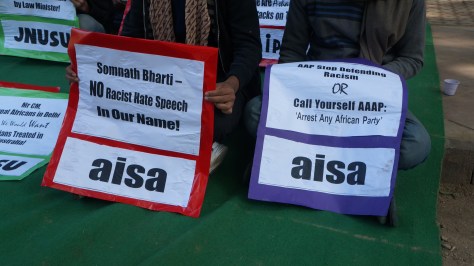
SIGNS AT ANTI RACISM PROTEST IN JANTAR MANTAR

Delhi Law Minister and Aam Aadmi Party leader Somnath Bharti’s midnight raid in Khirki village, during which he ordered policemen to search and enter houses, arrest people without warrants, and allegedly said that “black people, who are not like you and me, break laws” –  strips naked the unashamed inhumanity of the Aam Aadmi Party regime’s moral posturing. Underneath the holier-than-thou mask of that moral posture lies the unmistakably horrible sneer of the ordinary racist thug. This is the real face of Somnath Bharti. I hope it is a face that the Aam Aadmi Party can turn itself away from.

Continue reading The Savage Greed of The Civilized – AAP, Moral Posturing and Ordinary Racism

The Conundrum of Agency in Sexual Violence

This is a revised version of an article that appeared in Seminar January 2014.

The past year is bookended by two extraordinary moments, both of them inspired by the courage and determination of young women who refused to take sexual violence as routine.

December 2012 – a young paramedic fought till her last breath for justice.

November 2013 – a law intern exposed the sexual assault she faced from a retired Judge and a Tehelka journalist taught Tarun Tejpal a long deferred lesson – No Means No.

The massive mobilization of public opinion around these incidents has reopened the question of ‘agency’ in familiar and unfamiliar ways.

Feminists have long asserted women’s agency in contexts of sexual violence by attempting to desexualize rape – in law and in everyday life. Taken out of patriarchal discourses of honour, rape is merely an act of violence that violates bodily integrity. This delicate balance between two opposing notions – on the one hand, that sexual violence has a distinctive character, it is more humiliating, more paralyzing than physically less harmful actions; and on the other, that sexual violence is merely another kind of physical violence – this is the razor’s edge occupied by feminist understandings of rape. Continue reading The Conundrum of Agency in Sexual Violence

Why I prefer the company of homophobic people: Anonymous

Guest post by ANONYMOUS

It may be a strange thing for a gay man to say, but I welcome the Supreme Court judgement re-criminalising the sexual acts I feel naturally inclined to engage in.

As someone who chooses to admit to his sexuality only before other gay men, and that too very selectively, you could call me closeted. Which means that I don’t feel as unfortunate as the ‘out’ lot which feels as though Indian law is asking it to go back into the closet.

I personally welcome the Supreme Court judgement because it will drill some sense of reality into my straight liberal friends who keep pestering, taunting, hinting, trying to make me say, ‘I am gay’. They will realise that there’s enough homophobia out there, enough of it for the Indian Supreme Court, considered a liberal institution, to re-criminalise ‘unnatural sex’. That gives me some semblance of an excuse, or so I hope, to remain closeted. Continue reading Why I prefer the company of homophobic people: Anonymous

Homosexuality and Islam – Indian Muslims’ Responses: Abhay Kumar

Guest Post by ABHAY KUMAR 

No sooner had the Muslim minority of India come to terms with a sudden surge of the Hindu right BJP in four assembly elections, seen as the ‘semi-final’ ahead of the General Election scheduled for early 2014, than their attention was gripped by yet another controversy. On December 11, 2013, the Supreme Court recriminalized homosexuality, overruling the three-year old  judgment of Delhi High Court.[1] The bench comprising Justice G.S. Singhvi and S.J. Mukhopadaya ruled that homosexuality or unnatural sex between two consenting adults under section 377 of Indian Penal Code (IPC) is an offence.[2] The judgment has evoked mixed response. The political elites and parties[3] along with religious leaders have responded in more than one way and some have supported the Supreme Court judgement while others are against it.[4]  But a strong protest against the verdict has been lodged by progressive, left circles backed up by English language media.[5]

Contrary to this, Muslim religious leaders and those politicians whose primary constituency is the Muslim belt, have wholeheartedly welcomed the ruling. While the English language media has acted as a ‘torch-bearer of liberal’ values, the Urdu press, on the other hand, has fought a spirited battle against the western ‘disease’. [6]

However, unlike these ‘guardians’ of the community, there are some other Muslim voices, who have broadly opposed criminalising people on the basis of their sexual orientation. This paper attempts to discuss the responses of Indian Muslims on the question of homosexuality. Continue reading Homosexuality and Islam – Indian Muslims’ Responses: Abhay Kumar

Sex and the courtroom

A politician is exposed using State surveillance to allegedly woo his love interest. An editor tells a reporter his daughter’s age that the easiest way for her to keep her job would be to have sex with him. A godman and his son are both arrested for sexual assault and rape. A riot in Muzaffarnagar over false rumours of inter-religious ‘eve teasing’ left 48 dead and 15,000 homeless. The debate on rape, consent, gender relations sparked by December 16, 2012 continued throughout 2013. And by the end of it the Indian Supreme Court decided that the Indian Constitution’s letter and spirit were not being violated by criminalising consenting adults for having sex, in case the sex happened to be anything other than peno-vaginal.

India 2013 is like a pubescent 13 year old realising there’s something about the body that the mind needs to grapple with. There’s something about power, pleasure, social mores, class, law and so on, that comes together in the body and negotiates its way through bodily desire. There’s a sexual churning out there, and it’s not as titillating as the annual sex surveys news magazines do, nor is it as literary and profound as the language an incarcerated editor wields. Continue reading Sex and the courtroom

In Tragic and Tough Times – Thoughts in the Wake of A Rape Charge and a Suicide: Sucheta De and Shivani Nag

Guest Post by SUCHETA DE and SHIVANI NAG

In Tragic and Tough Times, Let Us be True to Our Democratic and Gender-Just Principles.

We are confronted by a painful episode involving a rape charge and a suicide, that poses many tough and tangled questions to us – as the JNU community and also as individuals and activists committed to secularism, democracy and gender justice. Let us, for a moment, reiterate what one of the late Khurshid Anwar’s friends has said in his recent post on Kafila: the suicide does not prove him guilty of the charge of rape, and it does not prove his innocence either.

The suicide is a horrible, tragic occurrence – and it is a tragedy we should not compound with irresponsible utterances. A charge of rape does not necessarily turn the accused into a convicted rapist. True. And equally truly, it does not turn the woman making the charge, overnight, into a slut, a murderer, or a communal/political conspirator. Continue reading In Tragic and Tough Times – Thoughts in the Wake of A Rape Charge and a Suicide: Sucheta De and Shivani Nag

On the Death of Khurshid Anwar: Kalyani Menon Sen and Kavita Krishnan

Guest Post by KALYANI MENON SEN & KAVITA KRISHNAN

(Find Hindi translation below the English statement)

We are deeply shocked and saddened by the death of Khurshid Anwar.

As activists committed to ending violence against women, we have been trying to ensure the due process of law and justice in relation to the allegations against Khurshid Anwar. Continue reading On the Death of Khurshid Anwar: Kalyani Menon Sen and Kavita Krishnan

खुर्शीद अनवर की आत्महत्या और कुछ सवाल

आखिर खुर्शीद अनवर ने ज़िंदगी से बाहर छलांग लगा ली.यह असमय निधन नहीं था. यह कोई बहादुरी नहीं थी. और न बुजदिली. क्या यह एक फैसला था या फैसले का अभाव? अखबार इसे बलात्कार के आरोपी एक एन.जी.ओ. प्रमुख की आत्महत्या कह रहे हैं. क्या उन्होंने आत्महत्या इसलिए कर ली कि उनपर लगे आरोप सही थे और उनके पास कोई बचाव नहीं था? या इसलिए कि ये आरोप बिलकुल गलत थे और वे इनके निरंतर सार्वजनिक प्रचार से बेहद अपमानित महसूस कर रहे थे? Continue reading खुर्शीद अनवर की आत्महत्या और कुछ सवाल

Dear Supreme Court: Inder Salim

Guest Post by INDER SALIM

Dear Supreme Court,

I am personally glad that your recent verdict on Article 377 has sparked a debate on the nature of “SEX “in India.

Continue reading Dear Supreme Court: Inder Salim

Queering Christianity: Janice Lazarus

Guest Post by JANICE LAZARUS

While there have been several writings, posts and comments on the web and in the print about the connection between homosexuality and Hinduism, there has been almost nothing said about the outlook of Christianity on homosexuality. One of the petitioners in Kaushal vs. Naz case is the Utkal Christian Council represented by its Secretary; and so I feel that it is crucial to write about Christianity and the way in which in many parts of the world a Queer Theology is embracing those previously deemed sinful by the Church. While I am in no way a theologian, I do feel that the Bible is open to be read by all and can be interpreted differently by many (as do the different sects within Christianity).

Continue reading Queering Christianity: Janice Lazarus

As a religious minority, I empathize with sexual minorities: M Reyaz

This is a guest post by M. REYAZ

The Apex Court judgment of December 11, putting aside the Delhi High Court order on decriminalisation of homosexuality, pertaining to Section 377 of the IPC has clearly divided into two ‘queer’ camps, where on one side besides LGBTS are those liberals extending their support to the LGBT cause, and on the other side, there are religious leaders and groups, who otherwise would not even see eye to eye with each other (what is ‘queer’ about this second camp is not so much its sexual orientation, as the strangeness of its banding together against queer people despite their antagonism toward each other).

Continue reading As a religious minority, I empathize with sexual minorities: M Reyaz

Ganguly Must Go – Chairs of Rights Bodies Must be Above Reproach

Statement from Women’s Groups Across India on 16 December 2013

Exactly one year ago, the gang-rape of a young woman triggered immense outrage across the board, putting freedom from rape and sexual assault at the forefront of public debate. From law reform to overhaul of institutions of justice delivery, from media sensitization to public awareness, women’s safety is now squarely on the public agenda, thanks to mass protests. Ironically, during those very protests, on 24 December 2012, a young lawyer revealed that a retired judge of the highest court in land had sexually harassed her while she was working with him as an intern, and that she was unable to speak about it only ten months later.

According to her statement, Justice (Retd) A.K. Ganguly currently the Chairman of the West Bengal Human Rights Commission said, “’You know that I’m attracted to you, don’t you? You must be thinking, what, this old man is getting drunk and saying such things. But I really like you, I love you’. When I tried to move away, he kissed my arm and repeated that he loved me.” This is not merely inappropriate behavior by a senior over junior staff or interns; it is not merely over-stepping of boundaries; it is not merely friendly overtures: such acts constitute a clear case of abuse of power and sexual harassment at the workplace.  Continue reading Ganguly Must Go – Chairs of Rights Bodies Must be Above Reproach

JTSA extends support to the LGBT community, calls for committed judicial activism: JTSA

Guest Post by JAMIA TEACHERS’ SOLIDARITY ASSOCIATION

On 11 December, 2013 a two judge bench of the Supreme Court of India (SC) ruled that section 377 of the Indian Penal Code (IPC), which considers homosexuality a criminal offence, does not ‘suffer from the vice of unconstitutionality’ and hence, legally valid.  By this highly regrettable ruling the apex court astounded and disappointed not only the LGBT community but the wider public at large.

Continue reading JTSA extends support to the LGBT community, calls for committed judicial activism: JTSA

Suresh Koushal v. Naz Foundation: Pratiksha Baxi

Suresh Koushal v. Naz Foundation directs law’s violence on the body of the Constitution of India. Proclaiming colonial law as constitutional, the Supreme Court negates its role in the making of postcolonial constitutionalism. It departs from the theatres of comparative constitutionalism in the post–colonies, which used Naz to strengthen their battles against Macaulay’s legacies. Today the Supreme Court is cited amongst the infamous precedents of injustice that mark Indian legal history. Dubbed as ADM Jabalpur 2, the judgment declares sexual emergency on LGBT communities. By breathing life into s. 377, the Supreme Court attaches a badge of stigma on the body of Constitution.

Taking a jurispathic turn, the Supreme Court asserts that equality is subservient to scale by claiming that the LGBT community is a “miniscule fraction of the country’s population”. Inventing the category of a miniscule minority, the Supreme Court implies that equality provisions will apply only to numerically preponderant body populations. Thereby, overwriting equality jurisprudence by the insidious politics of numbers.  Continue reading Suresh Koushal v. Naz Foundation: Pratiksha Baxi

The Anti-Rape Movement -The Political Vision of ‘Naari Mukti/Sabki Mukti’: Kavita Krishnan

Guest Post by KAVITA KRISHNAN

Anti Rape Protest at CM Shiela Dixit's House, Photo by Vijay Kumar
Anti Rape Protest at CM Shiela Dixit’s House, Photo by Vijay Kumar

A year ago, a massive movement erupted on the streets of Delhi and the country – against the brutal gangrape of a young woman on a bus, leading to her death. Looking back at that movement a year later, it is clear that the questions, concerns and above all the tensions and debates embedded in that movement are with us still – and are quite crucial to the political discourse around us.

Continue reading The Anti-Rape Movement -The Political Vision of ‘Naari Mukti/Sabki Mukti’: Kavita Krishnan

Section 377 and India Shining: Pronoy Rai

Guest Post by PRONOY RAI

It is 2004 all over again. India is shining. Such a difference a decade can make. BJP is on the verge of returning to power, Modi could be India’s next Prime Minister, and the many failures of the UPA could give a new lease of life to Hindutva, if it was dead at all. As India shines, the state (its judicial arm, in this case) has abandoned the queers, questioning their claim to the status of “minority”, rendering them vulnerable to brutality at the hands of the hetero-normative society and other arms of the state (police, for instance), in equal measures. Other minority groups, strangely, or perhaps not so strangely, fought against the claim to citizenship of a (sexual) minority group, decisively defeating them at the altar of justice. 

Some of us queers, who stuck to every single word that was written in 2004 that went on to show how agrarian distress, farmer suicides, and saffronization of education didn’t quite add up to a shining India, were left puzzled by the reaction of the BJP to the Supreme Court verdict upholding section 377 in its original, pristine self. You’d think that the shrewd right-wing would take on the first opportunity to invoke a very obvious ancient Indian “culture of homosexuality” to make a progressive argument in favor of decriminalization. You’d assume that in a ravaging hunger to return to power, they would try to bring on board every single group that they can, maybe only later to abandon them, but at least carry them along through elections. Alas, no. For the BJP, India is still shining, and this shining confidence is perhaps sufficient to help them march into 7 Race Course Road, next year.  Continue reading Section 377 and India Shining: Pronoy Rai

An anti-constitutional judgement: Johannes Manjrekar

Guest Post by JOHANNES MANJREKAR

The ruling by a two-member bench of the Supreme Court, striking down the judgement of the Delhi high Court which had held that Article 377 – a pre-Constitution, 19th century colonial-era law – violated the spirit and directive principles of the Indian Constitution, seems to break new ground in jurisprudence. In an era where governments worldwide have been engaged in systematically rolling back hard-won civil liberties and individual rights and violating constitutionally guaranteed freedoms and principles, one might be excused for believing that the most urgent duty of an independent judiciary endowed with a reasonable degree of conviction and courage, would be to curb the transgressions of governments against the principles laid down in their own constitutions. The recent ruling of the SC does little to encourage such a belief. Continue reading An anti-constitutional judgement: Johannes Manjrekar

Contempt of Citizens: Mayur Suresh

MAYUR SURESH   finds the Supreme Court guilty of contempt (of citizens)

Contempt: – The word ‘contempt’ comes from the Latin word “contemptus” and much like its modern counterpart, is the feeling that a person or a thing is worthless or deserving scorn.

Contempt is a feeling that is often felt by Lesbian, gay, bisexual and transgender people in India. It’s been meted out to LGBT people equally by the British who aimed to civilise us, and those today who seek to ‘preserve our culture’. An 1838 report on the Draft Penal Code called homosexual acts a “revolting subject” and said that the “frequency” of homosexuality in India “remained a stain on this land.” In 1934, the High Court of Sindh called a man who had consensual sex with another man “a despicable specimen of humanity”. Not to be left behind, those appellants who approached the Supreme Court reserved the choicest of contemptuous words for LGBT people in India: “disgusting”, “filthy”, “delinquents”.

Continue reading Contempt of Citizens: Mayur Suresh

Crimes of Unreason: Danish Sheikh

A post on the cowardly judgment of the Supreme Court by DANISH SHEIKH. I term it a cowardly decision because if it had said that we are homophobic then it would at least have been admirable for its honesty if not for its belief. It instead chooses to mask its homophobia with crimes of unreason

Now you’re legal – Now you’re not!

With the ease of a particularly sadistic magic trick, a 98 page document has sent millions of LGBT individuals time-warping back into pre-2009 criminality. If there were any constitutional justifications for this act, they are not to be found lurking in the pages of this shockingly poorly reasoned decision. The Supreme Court has taken a chainsaw to one of the most beloved court decisions of our time, and surgically extracted everything that made it such an important verdict. Besides, of course, that little side business of equal-moral-citizenship granting. A broader walkthrough the shoddiness of the judgment can be found  here, (http://kafila.org/2013/12/12/we-dissent-siddharth-narrain/) I’m presently looking at some of the more egregious of its violations. Continue reading Crimes of Unreason: Danish Sheikh

We Dissent: Siddharth Narrain

A preliminary walk through the unreason of the Supreme Court in the 377 judgment by SIDDHARTH NARRAIN

We hope to see many more pieces which exposes the judgment for what it is- an example of judicial non application of mind. I have also written a short piece looking at the judgment in the context of the Mandela moment

The Supreme Court’s decision in Suresh Kumar Kaushal & Another v. Naz Foundation & Others is an unprecedented ruling, deciding to turn the clock back to pre-July 2009, when LGBT persons were criminalized by section 377 of the Indian Penal Code. On close reading, the judgment is based on a narrow and blindfolded interpretation of the law, ignoring the momentous changes in society and notions of morality that India is witnessing. Further, the judgment, in many parts, relies on shaky precedent, does not explain the logic of its conclusions, and is surprisingly dismissive of substantial evidence that was placed before it. Continue reading We Dissent: Siddharth Narrain