Category Archives: Violence/Conflict

We remember Gujarat 2002. And we know you’re lying about development.

Gujarat Riots-Sanjiv Bhatt Arrest-Tehelka

Don’t tell us stories about development, Narendra Modi. Your Vibrant Gujarat and claims of development are shameless hollow lies, and even if they were true, it would still be an unethical and blood-stained development.

But they are lies, Modi, lies.

Here’s a report by Pranjal Sharma in Business World that sees through the working of your  aggressive PR machinery:

The Centre for Monitoring Indian Economy (CMIE) recently examined the investment statistics flaunted by the Gujarat.  The Vibrant Gujarat investment summit held by the chief minister has been projected to have earned billions of dollars of fresh investment into India. But a closer look at the figures reveals a different story. Only a small percentage of projects announced in Vibrant  Gujarat (VG) summits in 2009 and 2011 have actually moved on the ground. The details of many grand projects are missing… Continue reading We remember Gujarat 2002. And we know you’re lying about development.

Bhag Modi Bhag: Three eyewitness accounts from a protest in Delhi University

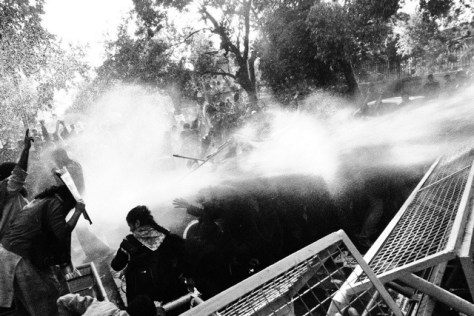
Guest posts by CHANDAN GOMES, AKHIL KUMAR and an ANONYMOUS student; photographs by CHANDAN GOMES, SHAFAQ KHAN and MUKUL DUBE

Photo credit: Chandan Gomes

No Space for Dissent

by CHANDAN GOMES

On 6th January, 2013 the usually quaint Delhi University transformed into a battle ground of ideologies. The road leading to Sri Ram College of Commerce (SRCC) where Narendra Modi was invited to speak at the Sri Ram Memorial Oration stands witness to all that went wrong day before yesterday. Continue reading Bhag Modi Bhag: Three eyewitness accounts from a protest in Delhi University

Child sexual abuse in India: the police blames the victims

This is a press release put out by HUMAN RIGHTS WATCH on 7 February; link to full report towards the end


India: Child Sex Abuse Shielded by Silence and Neglect Police, Doctors, Courts Need to Change Policies and Mindset to Support Victims

New Delhi, February 7, 2013:  The Indian government should improve protections for children from sexual abuse as part of broader reform efforts following the gang rape and murder of a student in New Delhi in December 2012, Human Rights Watch said in a new report released today. Continue reading Child sexual abuse in India: the police blames the victims

All India Protest Day in Support of Maruti Suzuki Workers: MSWU

Guest post by MARUTI SUZUKI WORKERS UNION (Provisonal Working Committee)

[This is a statement issued by the MSWU – Provisional Working Committee on the All India Protest Day held on the 5th of February in many cities and industrial areas in Solidarity with the workers of the Maruti Suzuki Factory in Manesar, Gurgaon, Haryana. Predictably this important statement and report was not carried by the mainstream media.]

MSWU, Registration No. 1923, IMT Manesar, Gurgaon, Date: 5 February 2013

Today, 5th February 2013, the great response to our appeal to all trade unions, workers, democratic organizations and progressive forces to hold an ALL-INDIA PROTEST DAY in solidarity with our struggle, against the continued exploitation, repression and injustice by the Maruti Suzuki company and Haryana Government, has further strengthened our resolve. 147 of our fellow workers are arrested and have not got bail for last 7 months, 66 more have non-bailable arrest warrants against them, 546 permanent and 1800 contract workers terminated from our jobs have not been reinstated, and we continue to face continued police repression, anti-worker administration and a state which has nakedly sided with the company-management. Even thus we are determined to carry forward our struggle to release all jailed workers, reinstate all terminated workers, impartial probe into the 18 July incident, implementation of labour laws and abolition of contract worker system.

Continue reading All India Protest Day in Support of Maruti Suzuki Workers: MSWU

On the arrest of Nilim Dutta

The Times of India reports that Nilim Dutta has been arrested by the police in Assam on charges of financial fraud and impersonation. The Indian Express reports:

“While there are now six cases registered against him in Guwahati, what we have gathered is that the Delhi Police had also registered a case against him last year,” Assam DGP J N Choudhury told The Indian Express. [Link]

Dutta announced his own arrest on Twitter some days ago, claiming the police had assaulted his family and him, and so on.

I first discovered Nilim Dutta on Twitter in July or August last year. Bodo groups in Kokrajhar and other BTAD area of Assam had killed Muslims and driven them out, many of whom still live in refugee camps there, too afraid to go home. Intellectual cover to this pogrom was being given not only by the mainstream media but also in social media by Hindutva fanatics, with the excuse that all Mulims in Assam are illegal Bangladeshi immigrants. Dutta had been tweeting against this claim, and published a rebuttal to one such claim by a Bodo IAS officer in the Indian Express.

I thus invited Dutta to write a long piece for Kafila, which was published here on 16 August. “The Myth of the Bangladeshi” became a very popular piece, initiating many discusssions and disagreements in Assam, Delhi and elsewhere. Hindutva fanatics who were unsettled by Dutta’s excellent piece in Kafila and similar pieces elsewhere, and his appearance in TV channels and so on. Now that Dutta is arrested on charges of financial fraud, these people are saying on Twitter and elsewhere that this nullifies Dutta’s claims about Muslims/’Bangladeshis’ in Assam. Continue reading On the arrest of Nilim Dutta

The Criminal Law Ordinance 2013 on Sexual Assault – Cut, Paste and Shock! Pratiksha Baxi

Guest post by PRATIKSHA BAXI 

Once the Criminal Law Ordinance 2013 was uploaded, circulated and read many times, an overwhelming desire to mark the ordinance to all one’s students as an example on how not to frame laws has grown. Yet, explain one must, why the current law on sexual assault is so bizarre, even if we do not bring in the so-called controversial elements and keep to the text of the ordinance.

The Criminal Law Ordinance 2013 begins with the definition of sexual assault as a gender-neutral offence. It does not make an exception to state that women do not rape men in everyday contexts under s. 375. Since such an exception is not added, and the ordinance specifies that ‘sexual intercourse or sexual acts by a man with his own wife, the wife not being under sixteen years of age, is not sexual assault’, we are faced with a confounding and deeply misogynist legal consequence. Wives, we are told cannot prosecute husbands for sexually assaulting them. But since sexual assault is gender neutral without any exceptions and the marital rape exemption is not extended to husbands, now husbands can accuse wives of sexual assault but wives can never prosecute husbands for sexual assault!  Continue reading The Criminal Law Ordinance 2013 on Sexual Assault – Cut, Paste and Shock! Pratiksha Baxi

A petition demanding the ‘Grand Mufti’ of Kashmir to step down

This petition has been put out by OMAR BASHIR

This is in context with your recent fatwa against the girl band Pragaash. This is less a fatwa and more a direct threat to silence young girls who have chosen for themselves a career path untrodden by women of Kashmir because of your misogynist approach. Your nefarious and illogical fatwas have caused more harm than they have done any good.

Mr Grand Mufti you have forgotten that Kashmir has a long tradition of Kashmiriyat and Kashmiriyat is an expression of solidarity and resilience regardless of religious differences. It embodies an ethos of harmony and a determination of survival of the people and their heritage. Women in music industry is nothing new in Kashmir, we have stalwarts like Raj Begum, Shameema Azad, Kailash Mehra and Mehmeet Syed singing for the past so many years. You must be aware that Raj Begum has been awarded the Padma Shri award in 2002. Continue reading A petition demanding the ‘Grand Mufti’ of Kashmir to step down

Why the law on sexual offences must be changed: Madhu Mehra

Guest post by MADHU MEHRA

The public outrage in the wake of the Delhi gang rape has been as much a reaction to the brutality of the case, as it has been against the pervasiveness of sexual violence in our society. Instead of condemnation and action, rape cases frequently evoke public statements blaming the victims, and calls to reign in women’s freedom. That our social structures and mindsets remain patriarchal is well known. The question however is, to what extent does the law counter societal misogyny in the way it frames and responds to sexual violence? Do the criminal laws establish norms that uphold women’s bodily integrity and dignity in all situations, against all offenders without selectivity or discrimination? Continue reading Why the law on sexual offences must be changed: Madhu Mehra

Ajmal Kasab, Tajinder Pal Singh Bagga, biryani and me

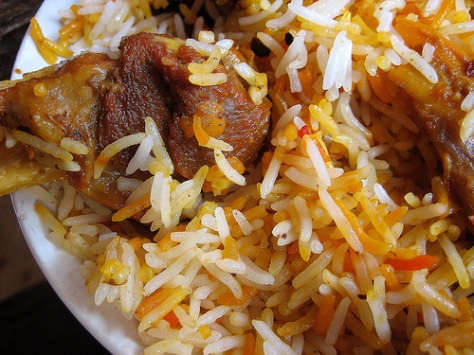
biryani-kafila

A large number of people have been asking me on Twitter over the last few days why I had signed a petition asking for Ajmal Kasab to be granted mercy and spared capital punishment. Kasab was hanged 21 November, why have all these people woken up to that petition now? That’s thanks to a belated but concerted online campaign initiated by the Tajinder Pal Singh Bagga-led Bhagat Singh Kranti Sena (BKSS), a rag-tag vigilante organisation which goes around threatening and committing violence against people it has political disagreements with. Continue reading Ajmal Kasab, Tajinder Pal Singh Bagga, biryani and me

“The impunity of every citadel is intact” – the taming of the Verma Committee Report, and some troubling doubts

Legal activist Vrinda Grover said in the FeministsIndia e-list about the Ordinance: “The impunity of every citadel is intact – family, marriage, public servants, army, police.” In effect, she said, the Ordinance is simply the pending Criminal Law Amendment Bill 2012, widely criticized by women’s organizations, which has been sneaked in as law without debate or consultation, in Parliament or outside. Feminists activists are rightly suspicious of the sudden sense of “emergency” that has gripped the government, when it has ignored our demands for criminal law reform on sexual violence for over twenty years.

Here I will document two press releases issued by women’s groups, and draw attention to some troubling and unresolved debates within the women’s movement in India today. The post will conclude with a useful table comparing the Ordinance and the JVC Report, issued by the Ministry of Home Affairs. Continue reading “The impunity of every citadel is intact” – the taming of the Verma Committee Report, and some troubling doubts

The Official Emergency Continues – The Ordinance on Sexual Assault: Pratiksha Baxi

Guest post by PRATIKSHA BAXI

The reform of rape law, which was not a priority for more than two decades, seems more like a 20-20 match now. The spectacle of judicial reform has all the elements of cinematic imagination built into it—violence, voyeurism, repression, tears, scandal, redemption and betrayal. We are all consumers and participants of this judicial spectacle. We veer between manic hope and dark despair as we are left conjecturing how this theatre of judicial reform will enact equality and dignity for survivors of sexual assault. The latest twist in the tale is the introduction of an ordinance, following the Justice Verma Committee (JVC) report.

Continue reading The Official Emergency Continues – The Ordinance on Sexual Assault: Pratiksha Baxi

Dear Pakistani friends, Put yourself in my shoes

I did not want to write this post.

There are enough Indian voices, from Times Now to Hindutva Online, who point fingers at Pakistan. Like M Ziauddin of the Express Tribune newspaper, I think that the two countries need more unpatriots – not people who ‘hate’ their own countries but who question their own nationalist narratives. People who ask: could we be wrong? Asking questions of yourself is difficult, and blaming the other is instant gratification of ego. Questioning yourself has long-term rewards in helping you make peace with yourself.

I am forced to write this piece because I continue to see well-meaning Pakistanis online continue to complain about the Bad Hospitality given by India to the Pakistani women’s cricket team in Cuttack in Orissa. The complainants online have included some of my Pakistani friends whom I know to be liberal, peace-loving and well-meaning, and who have clearly been influenced by some clever propaganda that is deliberately not showing them the full picture. Continue reading Dear Pakistani friends, Put yourself in my shoes

Delhi Gang Rape – Understanding the Structure of Violence: Esha Shah

Guest post by ESHA SHAH

The social, political and legal debates that have followed the gruesome incident of gang rape in Delhi on 16 December – including the debates on the recently published report of Justice Verma Commission widely hailed for its revolutionary character – have not sufficiently engaged with the structure of violence perpetrated in the act of brutality. In forging the solidarity against the suffering, there is a popular tendency to externalise the act of barbarity causing this suffering as demonic and hence out of this world. For instance, one of the posters in the protests that followed the incident read “your suffering is my suffering” – in the same poster it was demanded that those who caused this suffering were narpishach and should be hanged. The pain of the victim is shared collective pain, but the brutality of the act is certainly not the shared collective responsibility. In the preliminary remarks below I want to argue that we need to revise the nature of power asserted in the act of brutality, and in doing so we need to not only convert the demonic caricatures as flesh and blood human beings produced by this world but also to embed their acts into deep-rooted structures of violence in our society.

Continue reading Delhi Gang Rape – Understanding the Structure of Violence: Esha Shah

Our memories come in the way of our histories: Gowhar Fazili

Guest post by GOWHAR FAZILI

Our Moon Has Blood Clots by Rahul Pandita; Pages: 258; Vintage Books, Random House, India; Price: Rs 499

Rahul Pandita’s book Our Moon Has Blood Clots must be looked at both as a personal account of suffering as well as a political project that implicitly and explicitly makes use of that suffering towards a particular end. The undertaking is a legitimate one on both counts.  What the book manages to achieve on each, warrants a fair and dispassionate assessment.

His narration of events experienced by the Pandits is a welcome exposition of subjectivity around a range of traumatic events, humiliations, killings and betrayals undergone prior to and after the outbreak of mass political rebellion in Kashmir in 1989. The events thus narrated, especially the account of the personal experiences of trauma do make one strongly identify with the suffering of the families involved and agree with the wide swathes of subjective anger and hurt shared by the community.  The chilling accounts of individual and mass killings and the circumstances that made them possible, call for collective self-reflection, remorse and atonement. This account also calls for serious reflection on the fragility of human associations and trust in exceptional circumstances that we normally take for granted.

The book as well as the promotional interviews around the book push the claim that not only certain militants but also many ordinary people, including those personally known to the victims, were responsible for the exodus through their acts of omission and commission.  This claim is substantiated through a range of indictments based on personal encounters with individuals, shared nuggets of information, as well as the interpretation of the larger political symbolism and slogans which were seen as a deliberate attempt to intimidate Pandits, and Pandits alone.  While it is difficult to deny that a number of individuals took advantage of those anarchic times to gratify personal hate and lust for loot, it makes for an overstatement to underplay the equally frequent narrative of mutual support between individuals that one gets to hear during conversations between the members of the two communities privately. Such underplay does violence to those aspects of shared memory.  Continue reading Our memories come in the way of our histories: Gowhar Fazili

On Hindutva terrorism

This joint public statement, signed by 34 citizens whose names are given at the end, was put out on 25 January

Swami Aseemanand (second from right): Terrorist?

While one may or may not agree with the terminology employed by the Home Minister in his recent speech at Jaipur, we feel that for long prejudice has ruled investigations, obscuring the role of organizations and their multiple affiliates in planning and executing of attacks and bombings in the country. The veneer of ‘nationalism’ — narrow, exclusionary and based on hatred for minorities as it is– cannot hide the violence that Sangh and its affiliates beget and peddle.  Continue reading On Hindutva terrorism

Reclaiming the Republic from the Alleged Perpetrators of Violence

As I sit writing this, on the 26th of January, 2013, in various parts of the territory of the Republic of India, soldiers either already have, or are about to begin marching in formation. In New Delhi, the capital of India, their parade is accompanied by tanks, heavy artillery and replicas of nuclear warheads. In the part of the province of Jammu & Kashmir administered by the Indian Union, in several provinces of the north-east, and other areas where the writ of the state runs entirely on the basis of its armed might, Republic Day, as this date is called, is an occasion for search and cordon operations, ‘crackdowns’ and the creation of a Potemkin village like ambience in the zones (usually heavily guarded stadia) where the republic insulates itself from the public. In New Delhi, the naked, obscene exhibitionism on the axial avenue of Rajpath of a nuclear weapons power that maintains the second largest armed forces in the world, even as millions of its subjects subsist at sub-Saharan levels, is an annual ritual. Apparently, this ritual is conducted to commemorate the founding of the Indian republic through the coming into force of its constitution in 1950.

Continue reading Reclaiming the Republic from the Alleged Perpetrators of Violence

The Verma Committee: Alchemizing anger to hope: Arvind Narrain

ARVIND NARRAIN has an op-ed in today’s Hindu about the Justice Verma Committee. This is a longer version of the article

The public discourse post the brutal rape of Nirbhaya has witnessed a persistent degrading of the public discourse. Having been subjected to crudely offensive remarks by members of the political establishment, right from belittling a serious movement for equality as led by  ‘painted and dented ladies’ to ostensibly sympathetic responses which belittle women who have suffered a serious violation of their bodily integrity as nothing  more than ‘zinda laash’, we finally have a document authored by a Committee set up by the state which honours Nirbhaya.

The Verma Committee Report most fundamentally alters the public discourse on crimes against women by placing these crimes within the framework of the Indian Constitution and treating these offences as nothing less than an egregious violation of the right to live with dignity of all women. What is particularly moving and inspiring about the Report is that it does so by placing the autonomy and indeed the sexual autonomy of women at the very centre of its discourse.

Continue reading The Verma Committee: Alchemizing anger to hope: Arvind Narrain

Condemn Police Repression on Maruti Suzuki Workers’ Protest Rally: MSWU

Guest post from Provisional Working Committee (MSWU)

We from the Maruti Suzuki Workers Union (MSWU) and our families continue to face not only an exploitative company management but also continous state repression since we started our agitation demanding justice and legitimate rights of workers.

This morning, Imaan Khan, one of the members of the Provisional Working Committee, MSWU, was picked up by the Haryana police while a Press Conference was underway, from outside the union office of Sarva Karmachari Sangh in Civil Lines, Gurgaon near Puspanjali Hospital.

Continue reading Condemn Police Repression on Maruti Suzuki Workers’ Protest Rally: MSWU

Photographs from Ejipura Demolition : Mirno R. Pasquali

Mirno Pasquali  is a photographer who has been documenting the EWS evictions in Ejipura Bangalore. Gautam Bhan has written about the evictions here

I spent the past few days photographing in the Ejipura slum which has been the focus of many activists working here in Bangalore. This has been my first attempt at documenting these types of issues, and being a foreigner has made it particularly interesting. I hope to have done so in a way that is fair, unbiased and ultimately insightful.

A number of activist have referred me to this forum as an intellectual space to post stories, issues and ultimately begin a dialogue about a number of different topics. I am happy to have found a place to place these photographs, and I hope doing so will aid to this goal.

Please feel free to use them for any publication, write up or other purposes. I only ask for acknowledgement and the passing along of my contact information.

mirno.pasquali@gmail.com

http://indiathough.blogspot.com

Mobile (+91) 8197862434

Jan 23 morning 060

Continue reading Photographs from Ejipura Demolition : Mirno R. Pasquali

Seven Propositions and One Challenge from Ejipura

The recent eviction of over 1500 Economically Weaker Section (EWS) households from Ejipura in Bangalore (see here, here and here) to make way for a high-end mixed-use development (with some EWS housing for “original residents”) is just one a series of millennial evictions that have scarred the landscape of Indian cities and yet another instigated by an order of a High Court. Below are seven quick propositions on how to understand these evictions, how to respond in the immediate and near-term.

Continue reading Seven Propositions and One Challenge from Ejipura

Remembering Laxmi Orang and the Gender Question in Assam: Mayur Chetia and Bonojit Hussain

Guest post by MAYUR CHETIA AND BONOJIT HUSSAIN

The Delhi gangrape case has led to country-wide outrage, with young women and men still pouring out on to the streets to protest against the widespread culture of sexual violence. The outrage has not just stopped at Jantar Mantar, India Gate or university campuses; it has also led to a wave of intellectual reflection on the issue. For most protesters the demand for justice has not stopped with the Delhi gang rape victim, but has led to a demand for justice for all victims of sexual violence. These protesters have forced us to remember a litany of names that get buried by the TRP driven media and a public with a notoriously short attention span of memory. It is time to remember names that we are losing to public amnesia, names like Soni Sori, Manorama, Asiya and Neelofar. It is time we remember another forgotten name – Laxmi Orang.

 In the Interest of Remembering: Who is Laxmi Orang?

On 24th November 2007, Laxmi Orang, a young adivasi woman, was forcibly stripped naked, thrashed and paraded by a violent mob of “mainstream” Assamese [1] men. This took place just 100 meters away from State Legislative assembly, in the very heart of Guwahati, in the full glare of the media and police forces. As with her fellow protesters, it was her first trip to the city, the mythical land where the modern day Swargodeo’s [2] listen to their subjects, where appeals are heard, where miracles happen, where riches and wonders thrive. She had come to the city as participant of a protest organized by the All Adivasi Students’ Association Assam (AASAA) to demand Schedule Tribes status for the Adivasi community of Assam. Continue reading Remembering Laxmi Orang and the Gender Question in Assam: Mayur Chetia and Bonojit Hussain