Category Archives: Violence/Conflict

செங்கொடி மூட்டிய தீ

Guest Post by PREMA REVATHI
An English translation, with a background note, is available here.

மனித மனம் விசித்திரமானது. செங்கொடியின் மரணச்செய்தியை கேட்டதும் ஆறாத இயலாமையின் இருள் சூழ்ந்துகொண்டுவிட்ட மனதில் எப்போதொ ஒரு காலத்தில் மனதில் ஆழப்பதிந்துபோன

“ இந்த பூமியின் தேசங்களில்

ஒளி வீசுக செங்கொடியே…”

என்ற பாடல் வரிகள் மீண்டும் மீண்டும் அலையாடியது.

புரட்சிகர போராட்டத்தால் இந்த பூமியையே மாற்றிவிடும் ஒரு பெருங்கனவு இன்று முள்ளாய் உறுத்தும் ஒரு பழங்கனவாய் விடைகள் இல்லாத திசைவழிகள் இல்லாத நம்பிக்கைதரும் தலைமைகள் இல்லாத இத்தனிமையான அரசியல் இரவில் துறுத்திக்கொண்டிருக்கும் வேதனை முகத்தில் அறைகிறது.

ஆயிரமாயிரம் வார்த்தைகள் செங்கொடி பற்றி எழுதப்பட்டுவிட்ட, எழுதப்பட்டுகொண்டிருக்கும் இக்கணத்தில் நெஞ்சுருக்கும் இந்த இன்மையும் புகைப்படத்தில் தீர்க்கமாயொளிர்ந்து கொண்டிருக்கும் அவள் விழிகள் கேட்கும் கேள்விகளும் அலைகழித்துக் கொண்டே இருக்கின்றன.

Continue reading செங்கொடி மூட்டிய தீ

‘Every eye-witness said there was no death before the police intervened’

This release comes from the PEOPLE’S UNION FOR CIVIL LIBERTIES, Rajasthan

Gopalgarh (Bharatpur, Mewat) Police Firing Incident
Preliminary Findings of the Fact Finding Team released in the Press Conference on 19th Sept, 2011

Photo credit: PUCL Rajasthan

This preliminary report of the PUCL team pertains to the incident of the police firing in Gopalgarh, district Bharatpur, Rajasthan. As per the media reports, the police resorted to firing to quell rioting mobs. The government has acknowledged eight deaths and 23 injured in this incident. Following this, the PUCL, Rajasthan constituted a Fact Finding Team to conduct independent inquiry into this incident. The team comprised Kavita Srivastava, National Secretary, PUCL, Professor Shail Mayaram (Delhi), Professor Yogendra Yadav(Delhi), Ms. Nishat Hussain (Vice President, PUCL, Rajasthan) Mr. Sawai Singh (Organising Secretary PUCL, Rajasthan), Mr. Noor Mohammed (PUCL, Alwar), Mr Virendra Vidrohi (PUCL, Alwar), Adv. Ramjan Chowdhary (PUCL, Mewat district, Haryana), Mr Gaurav Srivastava(PUCL intern). Mr. Neelabh Mishra, Editor, Outlook (Hindi) and a section of progressive members of the Gurjar and Meo community also accompanied and assisted the fact finding team. Continue reading ‘Every eye-witness said there was no death before the police intervened’

Lessons from Malegaon: JTSA

This is a statement put out by the JAMIA TEACHERS’ SOLIDARITY ASSOCIATION

Punish those guilty of misleading probes
Compensate the victims NOW!

13 September 2011: The NIA has finally put the official seal on what many activists, the families of the accused and the people of Malegaon had been saying for long: that the arrest of nine Muslim men for the 2008 Malegaon blast was a result of a communal witch-hunt, which passes for investigations into terror charges. As a consequence of the investigating agencies’ hubris and prejudice, nine innocent men had to spend five long years in jail, while their families suffered and they were stigmatized.  Continue reading Lessons from Malegaon: JTSA

Prominent Indian journalist beaten up by Jammu and Kashmir Police

Is the Jammu and Kashmir Police a private, leaderless, unaccountable militia force that can go about beating up anyone they like in the name of saving Kashmir for India?

Well known Indian author and journalist David Devadas, a fellow with the Nehru Memorial Museum and Library in Delhi and author of a book on Kashmir, was beaten up by personnel of the Jammu and Kashmir Police in Srinagar on September 5. Sheela Bhatt reports on Rediff.com:

In a letter written to Jammu and Kashmir Chief Minister Omar Abdullah, Devadas said that on September 5, when he was crossing the Rambagh bridge in his car in evening in heavy traffic, he heard a loud bang at the back of his car. His car was hit by another car. Continue reading Prominent Indian journalist beaten up by Jammu and Kashmir Police

On a Lit Note: Hilal Mir

Guest post by HILAL MIR

I woke up this morning in an utterly confused state of mind. During the night I dreamt about having the tour of the Harud Literary Festival. My first astonishment came while in a queue outside the venue. Like the French streaming Parisian streets in teary-eyed joy at the sight of American liberators after having secreted themselves in root cellars for months from the sniffing gaze of Nazi jackboots, I felt similar joy at observing Indian soldiers not hurling ritual abuses from vehicle rooftops while asserting the right to overtake from any side and any crevice on the busy Panthachowk intersection.

The venue, Delhi Public School, is stone’s throw away from the intersection and within the earshot of any moist abuse hurled from those ubiquitous army trucks. Kashmiris finally had a dry day. Continue reading On a Lit Note: Hilal Mir

Harud Literary Festival: The Misrepresentation Continues

In a post on the Wall Street Journal’s India Realtime blog, journalist Tom Wright says at one point:

In the open letter, the signatories said it was impossible to have a literary festival in Kashmir [Link]

I asked him on Twitter as to where the open letter says that. He replied:

the opening graph says you can’t hold a literary festival in the context of kashmir [Link]

Given that he was being specific about the location of the “impossible to hold” claim in the open letter, I wondered for a moment if I was wrong. I checked the first two paragraphs of the open letter I had posted but found no such claim: Continue reading Harud Literary Festival: The Misrepresentation Continues

Killing poetry and other possibilities of life

The news of the ‘postponement’ of Harud, a literary festival scheduled to be held in Kashmir in September, should be read with concern by those who believe in, and fight for, the right to express themselves freely. How the self-righteousness of some fighters for democracy actually forecloses any possibility of democracy can be seen from this incident.

In a statement last week, the organizers of Harud explained that they were forced to put off their festival as there was a concerted campaign by some people on the Internet, on  Facebook and some other sites attacking the festival. According to these critics, “We fear, therefore, that holding such a festival would, willy-nilly, dovetail with the state’s concerted attempt to portray that all is normal in Kashmir. Even as the reality on the ground is one of utter abnormality and a state of acute militarisation and suppression of dissent, rights and freedoms.” Continue reading Killing poetry and other possibilities of life

Bring Dr Chishty home – alive

An elderly, bed-ridden man sentenced to life imprisonment in an ‘enemy’ country for a murder he didn’t commit awaits the signature on his clemency petition. By Beena Sarwar and Shivam Vij

Human rights activists in India are renewing their efforts for the release of the elderly Pakistani prisoner Dr Khalil Chishty lodged in Ajmer prison hospital, whose mercy petition awaits just one signature from the Rajasthan Governor Shivraj Patil. The mercy petition had earlier been approved by the state government and had reached Patil in June this year. At that point, it was expected that Dr Chishty, 78, a renowned virologist bed-ridden with various illnesses in jail, would soon be released.

Instead, Governor Patil raised a set of questions for the state government to answer. The Rajasthan government has answered all the queries, but has not submitted the file to the Governor again – perhaps because, according to sources, the Governor has already indicated that he will not sign the petition. Continue reading Bring Dr Chishty home – alive

No One Killed Meena Khalkho?: Akhil Katyal

Guest post by AKHIL KATYAL

Now that the Anna Hazare Show is over, will the Indian media go back to looking at India as also existing outside Delhi? On 6 July 2011, Meena Khalkho, a sixteen year old tribal girl from Karcha village in the state of Chhattisgarh was raped and murdered by the local police and it barely made a dent on our news universe. A search for her name on most television news websites returns nothing. The police in Chattisgarh immediately hit upon a strategy that has now long been in circulation. They subsume Meena’s horrible rape and murder within what goes these days as a laudable mission, one that manages to neutralize all rage against police atrocities, by claiming Meena to be a Naxal and by claiming her to be fatally wounded in an encounter that night against a larger party of Naxallite cadres.

Continue reading No One Killed Meena Khalkho?: Akhil Katyal

On the Harud Literary Festival, setting the record straight

It is sad that a literature festival that was to be held in Srinagar later this month has been indefinitely postponed. What is even sadder is that while announcing its postponement on HarudLitFest.org, the organisers of the Harud Literature Festival (the same team that puts up the acclaimed Jaipur Literature Festival) have sought to blame those who signed an “open letter” expressing a set of concerns about the festival. The statement reads, “A few people who began the movement to boycott the festival have no qualms in speaking on and about Kashmir across international forums, but have refused to allow other voices, including writers, poets and theatre people from the Valley and across India to enjoy the right to express themselves at the Harud festival.”

As one of the over two hundred signatories of the open letter posted on Kafila.org, I am dismayed at the deliberate and disingenuous misrepresentation of the open letter as a “movement to boycott” What does such deliberate misrepresentation of dissent by the organisers of a literature festival say about them, their honesty and intent?

Two news reports appeared on 28 July 2011. One, by Agence France-Presse, quoted organiser Namita Gokhale as saying, “it will be an apolitical dialogue concerning literature”. The other report, by Randeep Singh Nandal in The Times of India, datelined Srinagar, did not quote anyone, and claimed: “There is speculation that Salman Rushdie might drop by…”

The term “apolitical” offended Kashmiris, who were seen objecting to it widely on Facebook and Twitter. Some of these were also aghast with the idea of Salman Rushdie, who they consider a blasphemer against Islam, sitting on a stage in Srinagar. Even though some of those named in these and subsequent news reports had told the festival organisers even before the news was in the papers that they would not be able to attend, their names were falsely put out in the media. They were thus forced to publicly state they would not attend a lit-fest termed “apolitical”.

Kashmir is a place where people live under the shadow of the gun, their political grievances against the Indian state silenced with draconian laws, criminalisation of dissent and heavy militarisation. You can get two years in jail without charge for a Facebook status update, a pamphlet, a mass gathering, a call for strike. Around the time the Harud controversy was gaining momentum, the Jammu and Kashmir Police beat up over several hours a photojournalist, allegedly because they didn’t like his work on the Al-Jazeera website.

Now, a group of people from the Indian capital decide to go to the place described above, to hold a literary festival, and announce that the festival would be “apolitical”. Were Kashmiri writers and journalists, including some acclaimed ones, wrong in feeling offended?

On 12 August 2011, Namita Gokhale was quoted as saying in the London-based newspaper The Guardian (no relation to this publication), “There was perhaps some misinterpretation of my use of the word ‘apolitical’.” She chose not to withdraw the word. If by apolitical she meant non-partisan, the choice of venues, Delhi Public School’s Srinagar franchise and the Kashmir University, was not seen as non-partisan in Srinagar. If your intent is to be neutral in a conflict zone, surely, you must attempt to be seen to be neutral?

he open letter, signed initially by fourteen people, including me, was published on 25 August. It said, “Our concerns are also heightened by reports that the festival is sought to be denoted as being an ‘apolitical’ event, that, yet, people will be free to speak what they want and that no one has the right to deny Kashmiris a chance to listen to writers. Beyond the absurdity of asserting that art and literature has nothing to do with politics, our issue is precisely that people are not allowed to speak their minds in Kashmir.” The open letter did not use the word boycott, did not urge anyone to not attend it, did not ask for it to be cancelled. It did say, “We would firmly support the idea of a literary/artistic festival in Kashmir if we were convinced that its organising was wholly free from state interference and designs, and was not meant to give legitimacy to a brutal, repressive regime.”

Two days later, their response on Kafila.org said, “We wish to categorically state that the Harud literature festival is not government sponsored.” It did not withdraw the word ‘apolitical’. An expanded version of this 27 July release, sent to the media, mentioned false rumours spread by a Facebook group about Rushdie coming to attend. Why did it put the blame of the Rushdie rumour on Kashmiris and not on The Times of India, and on themselves for choosing to not deny the rumour for a whole month?

Then, suddenly, on 29 August they announced indefinite postponement of the festival, in a dishonest release that blamed the signatories of the open letter for being against free speech! It also cited security threats emanating from that Facebook page with nearly 5,000 ordinary Kashmiris supporting the boycott call on account of Rushdie’s rumoured attendance.

Given that so many Kashmiris have expressed reservations about the festival’s intent, including many Kashmiri writers and journalists, even young, aspiring, as yet-unpublished ones, it is surprising that we are hearing patronising comments about how Kashmiris have been ‘denied an opportunity’. It is high time Kashmiris started their own literary festival, something they have tried to do before but were not allowed to by the state government. They should do it in Delhi or Jaipur, giving Indian writers an opportunity to learn what it means to be political.

(First published in The Sunday Guardian, Delhi, and The Friday Times, Lahore.)

From Kafila archives:


Hypocrisy in Any Season: Mridu Rai responds to Rahul Pandita on the Harud Literature Festival

Guest post by MRIDU RAI

Rahul Pandita has written a misleading piece—in the tone of high dudgeon and ethical outrage no less—in the ‘essays’ section of the 3 September 2011 issue of Open magazine titled “The Autumn of Hypocrisy”. I think it is a piece that, nevertheless, requires some examination mostly because it makes several assertions in ways that queer any possibility of debate around the important question of what a literary festival held in Kashmir today might mean. Whether or not it was the author’s intention to do so, its effect is also to discredit, off-hand, several literary and artistic voices whose greatest sin would appear to be to have disagreed with the kind of literary festival in Kashmir Rahul Pandita and his fellow organizers had in mind. Of course, it is also troubling to hear from Mr. Pandita on this question since he is both an aggrieved party, deprived of his right to express himself at the festival, and also, as the credit at the bottom of his piece elaborates, a former “member of the advisory committee for the Harud literary festival”. I wonder if this conflict of interest bothers anyone other than me. Continue reading Hypocrisy in Any Season: Mridu Rai responds to Rahul Pandita on the Harud Literature Festival

Harud Literature Festival ‘postponed’

I think it is sad that the Harud Literature Festival has been “postponed“. Sadder still is that the organisers are blaming those who asked very valid questions. All they needed to do was answer those questions and allay those concerns. Their response, two days after the release of the open letter, did not address those concerns. They even refused to withdraw, leave alone apologise for, the offensive word “apolitical”, or explain how they planned to be “apolitical” while “celebrating” literature in the midst of unmarked graves, militarised bazars and lanes, draconian laws, imprisoned teenagers and the state’s refusal to dispense justice. Continue reading Harud Literature Festival ‘postponed’

A Response to SHRC’s Report on Unknown and Unmarked Graves of Kashmir: IPTK

This press statement comes from the INTERNATIONAL PEOPLE’S TRIBUNAL ON
HUMAN RIGHTS AND JUSTICE IN INDIAN-ADMINISTERED KASHMIR (IPTK) 
together with the ASSOCIATION OF PARENTS OF DISAPPEARED PERSONS

29 August 2011: We welcome the report of the State Human Rights Commission of Jammu and Kashmir (SHRC) on unmarked graves in north Indian-administered Kashmir (dated July 2011 and recently released; download 3.2 MB .pdf here), taking suo moto cognizance of the matter, and appreciate the courage and labour that this work signifies.

The SHRC’s report acknowledges and corroborates the research documented in the report, BURIED EVIDENCE, released by the International People’s Tribunal on Human Rights and Justice (IPTK) in December 2009. The SHRC investigated unmarked graves in Bandipora, Baramulla, Kupwara, and Handwara districts across 38 graveyards and verified 2156 unidentified bodies in unidentified graves.

Based on investigative research conducted between November 2006-November 2009, BURIED EVIDENCE had documented 2700 unknown, unmarked, and mass graves, containing 2943+ bodies, across 55 villages (in 62 sites within these villages) in Bandipora, Baramulla, and Kupwara districts of Kashmir. Of these, 2373 were unidentified and unnamed graves.   Continue reading A Response to SHRC’s Report on Unknown and Unmarked Graves of Kashmir: IPTK

An open letter on the ‘Harud’ literary festival

Srinagar-based photojournalist Showkat Shafi is seen in this photograph being assaulted by the Jammu and Kashmir Police on 19 August 2011. He was carrying out his professional duties, as is clear from the camera in his hand that the police is trying to snatch away. He and his Mexican photographer colleague were detained at the police station and beaten up, allowed to go and be hospitalised only five hours later. The police said they mistook them for stone-pelters. Photo credit: Faisal Khan

*
Given below is an open letter signed by fourteen of us. Should you want to add your name to it, please do so in the comments section of this post. I shall update the names of the signatories on the post itself. Please clearly indicate that you want your name added, and write your full name and profession.

Continue reading An open letter on the ‘Harud’ literary festival

Reading Ur-Fascism in our times

When people are marching to barricades, I go back to my library . I know that streets across India are now re-educating many of us and we are keen to get enrolled in this university of action. Yet I want first to understand this moment of action we are being advised to be part of.

Continue reading Reading Ur-Fascism in our times

Resisting The Popular

The drama that is being enacted in Delhi for the last one week, rather five months, has thoroughly exposed the intellectual hollowness of the political life of India. This moment would also be remembered as the lowest to which collective intelligence of a people can descend to. Critiquing people is not the job of the politicians or the media, not in our times at least . Gone are the days when you had a Mohan Das Karamchand Gandhi who could stand up to the masses and withdraw a popular movement risking their wrath or a Jawaharlal Nehru who commanded the authority to chide his own people. The days of Rabindra Nath Tagore are also over who had the courage to openly challenge, criticize a saint like Gandhi and write ‘anti-people’ novels like Ghare baire. If we have time and patience to turn the pages of our history , we would find that their criticism was an integral part of their long and continuous engagement with their people. Theirs was not a utilitarian relationship . People knew that they love them and care for them and that is why they never turned away from them.

The names we have mentioned above belong to an era when the grammar and vocabulary of popular politics were being transformed. They refrained from simplifying things and devised a language which people were challenged to learn. It was their inexhaustible trust in the intelligence of their people that encouraged them to constantly innovate and complicate rather than simplify. It was this air which a young man Bhagat Singh was breathing, who, going against the grains, wrote that violent methods were no substitute to popular political mobilisation, who knew that the appeal of Subhas Chandra Bose was dangerous and it was Nehru, with a scientific and internationalist outlook, he advised the youth to follow.

Continue reading Resisting The Popular

THREE MEN FACE IMMINENT EXECUTION: Urgent Action petition from Amnesty International

Two Sri Lankans and an Indian national convicted for the assassination of India’s former Prime Minister, Rajiv Gandhi, are facing imminent execution in Vellore prison in Tamil Nadu, India. This follows the rejection of their mercy petitions by the President of India. If carried out, these would be the first executions in India since 2004.

Murugan and Santhan, both 41, and Arivu alias Perarivalan, 37, were sentenced to death in January 1998 by a Special Anti-Terrorist Court on grounds of involvement in the assassination of India’s former Prime Minister Rajiv Gandhi. Their sentence was confirmed by the Supreme Court of India in May 1999. According to information received by Amnesty International and reports in the Indian media, their mercy petitions were rejected by the President in August 2011, following the advice of the Government of India.

The rest of the petition is available here. The petition opens in German, but you can use the option on the top right to change to English.


The Banality of Bengal: Jyoti Rahman on the Tribulations of the Bangladeshi Hindus

Guest post by JYOTI RAHMAN

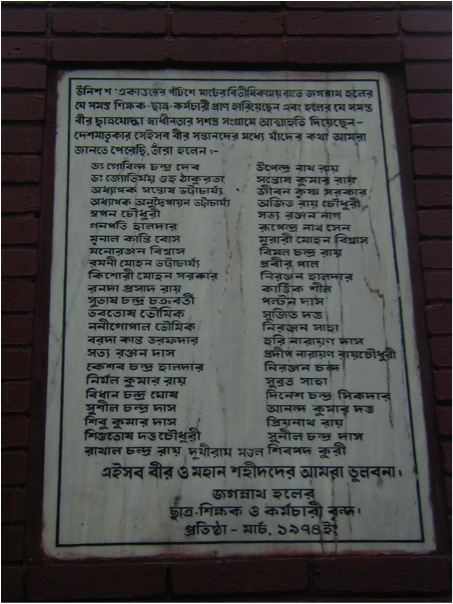
List of names of Hindu students and professors massacred at Jagannath Hall on night of 25th March, 1971 by the Pakistani Army. Click to enlarge. Photo credit: Udayan Chattopadhyay.

Nirad C Chaudhuri and Jatin Sarker were both born in Hindu families in the Mymensingh district of eastern Bengal, now Bangladesh. Chaudhuri, about four decades older than Sarkar, wrote his autobiography before India held its first election, and ceased to be an unknown Indian. Sarker also wrote his life story. Unlike Chaudhuri, Sarker’s was in Bangla, published in Bangladesh, never translated in English, and not available in India or beyond. He remains unknown. Which is a pity, because if you want to know what has happened to the land where both these men were born, Sarker is a far, far better guide than Chaudhuri.

Sarker, of course, stopped being an Indian on 14 August 1947, when Mymensingh became part of East Pakistan — the eastern wing of Jinnah’s moth-nibbled land of the pure. His family didn’t move to India. They were not atypical. Many Hindu families remained in East Pakistan. Perhaps it was the presence of Gandhi. Perhaps it was the fantastical belief that Subhas Chandra Bose would return in 1957 — a century after the Great Uprising, two centuries after the Battle of Plassey — to reunite Mother Bengal.   Continue reading The Banality of Bengal: Jyoti Rahman on the Tribulations of the Bangladeshi Hindus

When the State Celebrates the People’s Independence but the People Don’t: Twelve Questions for the Press Trust of India

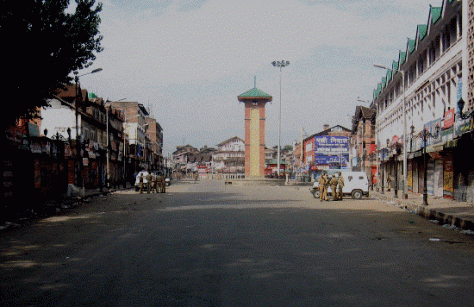
Srinagar's Lal Chowk on 15 August 2011. Photo credit: Zahoor Zargar / KashmirDispatch.com

To:

The Editor,
The Press Trust of India,
New Delhi.

Dear Editor:

This is regarding your news report, “I-Day Celebrated Peacefully in Kashmir Valley“.

While the news report tells us how the celebrations were held by the chief minister in Srinagar and the deputy chief minister in Jammu, and what arrangements were made for the celebrations to take place, there’s one line in that report that tells us:

Meanwhile, normal life was was affected in Kashmir Valley due to a shutdown called by both factions of Hurriyat Conference and tight security restrictions for the Independence Day.

I have a few questions for you.

Continue reading When the State Celebrates the People’s Independence but the People Don’t: Twelve Questions for the Press Trust of India

Issues in sri lanka today: A primer for activists in india

Originally written for the forthcoming Human Rights Forum Bulletin

Very often issues related to sri lanka are spoken in a manner that is disjointed from one another. We often do not have a clear holistic picture. Many of the problems in stands vis-à-vis sri lanka come from this lack. We need a holistic picture not just of the present situation but of past histories. The holistic picture needs to be rigorous and honest; based on continuous work on the area and gathering of knowledge. In the case of sri lanka, as in many other things in the world, the significance of this cannot be stressed enough. We barely have any reports that have come out of sri lanka that are either biased or have had to struggle to expose many things and those concerned have often paid a heavy price; sometimes the price has been their life.

A friend from sri lanka, who lives in Colombo, recently commented that, right now, the situation is worse than during the war in some senses. The surveillance and the hidden violence is so intense and widespread that it is hard to escape it and there is never enough warning. The quest to turn sri lanka into a Sinhala Buddhist nation governed by a fascist is well underway. All of this being done under the garb of democracy; a garb that has not been hard to look right through. Continue reading Issues in sri lanka today: A primer for activists in india

Why Devender Pal Singh Bhullar should not be hanged

This public statement was issued by AMNESTY INTERNATIONAL in June

India: Amnesty International calls for death sentence on Devender Pal Singh not to be carried out

AI Index ASA 20/033/2011

Amnesty International calls on the Government of India not to carry out the death sentence imposed on Devender Pal Singh in 2001 after his conviction in an unfair trial. Under international law, the execution of a person convicted and sentenced to death in an unfair trial is a violation of the right to life. Continue reading Why Devender Pal Singh Bhullar should not be hanged