Category Archives: Violence/Conflict

What if man dies in the forest, and no one is around to see it?

Last week, the  Chhattisgarh police were caught in an extraordinary encounter in the forests of Dantewada. The encounter was interesting not just in the event itself, but also in the Police’s attempts to shape media perception during and long after the encounter.

On Kafila, we devote a considerable amount of our time trying to decode how the press covers particular events. Perhaps this post shall go some way in explaining why our morning papers look the way they do.

If the police are to believed, on August 4 this year, the Koya commandos were caught in a Maoist ambush, yet through brilliant rear-guard action emerged completely unscathed, along with the body of a “Maoist fighter”, a 12 bore shotgun and two IEDs to boot.

The “ambush” caught a lot of us in the press unawares: something had happened in the forest – but what? A series of strategic leaks had primed the media to expect “major losses” among the security forces – so when the police emerged from the jungle unscathed, everyone was expected to heave a collective sigh of relief.

However, for once, the Chhattisgarh based press was skeptical.

Continue reading What if man dies in the forest, and no one is around to see it?

Have I Joined the Popular Front?

In the past few weeks, I have been asked over and over again, not always in jest, if I had joined the Popular Front. I am not surprised. The police investigation around the violence against the college teacher at Muvattupuzha has broken all previous records in not only the violation of human and civil rights, but also in the silence of Kerala’s enlightened intellectuals. If I recall right, only Nandigram evoked such a dense and deliberate silence from them. No wonder, anyone who speaks up against the manner in which the police is being armed and authorized against ‘bad muslims’ is immediately dubbed a supporter of the Popular Front. But I am intrigued by this simple question, by which the entire history of that person’s engagement with discussions around religion and the state is erased. Continue reading Have I Joined the Popular Front?

Pushing the Kashmiri to the wall, again

[An edited, shorter version of this article by me appeared last week in The Friday Times, Lahore.]

In the first week of June, I sat at a shopfront with a group of shopkeepers of Kalarus, a small town in Kupwara district in north Kashmir. In 1999, they collected money and bought land for a martyrs’ graveyard, one of many such in Kashmir. Whenever the Indian army killed militants trying to infiltrate from Pakistan to the Indian side of the Line of Control, they would hand over the bodies to the Kupwara police, who would give it to these people to bury after the autopsy.

“Look up at the mountain peak,” said one of them, “It is snow clad all twelve months. It is the LoC, 70 kms from here. Do you think anyone would cross that wearing the traditional Kashmiri Khan dress?” And yet, most of the hundred odd bodies in the graveyard had come wearing clothes unfit for snow. And, most of them had so many bullet marks on the face that they were unidentifiable. Continue reading Pushing the Kashmiri to the wall, again

Interim Report of the Independent Fact-finding Team on the Sompeta Firings on 14 July 2010

Interim Report of the Independent Fact-finding Team on the Sompeta Firings on 14 July 2010

The fact-find team (FFT), under the leadership of Justice P.K. Misra, former judge of the Orissa High Court, was an initiative of certain public-spirited individuals and organizations who were deeply concerned at the firing on the people protesting against the proposed thermal power plant by the Nagarjuna Construction Company (NCC) near Sompeta in Srikakulam district of Andhra Pradesh. The firing occurred on 14 July 2010 in which two persons died and five were injured by bullets (including a cameraman of TV-9 Telugu channel). In the events prior to the firing, about 300 people belonging to the neighbouring villages opposing the power plant and about 50-60 police personnel were injured.

During 24-25 July, the FFT visited Palasapuram, Lakkavaram, Isakalapalem and Ramaiahpatnam villages in Sompeta Mandal and talked to the local people who are resisting the proposed power plant to protect their life and livelihood. The Team met the District Collector, Mr. Srikanth (on the evening of 24 July), held discussions with the representatives and members of Sri Sri Sri Kanakadurga Taapi Mestri Sangam and Kalinga Vysya Sangam in Sompeta town, and visited the Government Community Hospital in Baruva Panchayat to meet some of the injured persons undergoing treatment. (Our effort to meet an injured police officer undergoing treatment in the Seven Hills Hospital in Vizag did not prove successful as he was discharged by the time we went there on the evening of 25 July).

Continue reading Interim Report of the Independent Fact-finding Team on the Sompeta Firings on 14 July 2010

What Went Wrong in Kashmir? Rekha Chowdhary

Guest post by REKHA CHOWDHARY

This article was also published in Kashmir Times
What went wrong in Kashmir? This is one pertinent question that needs to be addressed seriously before any corrective measures can be applied. Situation would certainly normalise after some time, but apparently ‘normal’ situation in case of Kashmir does not indicate anything. The vibrancy of ordinary life and the day-to-day routine followed for days and even months, takes only moments to break. Underneath the normalcy, the turbulence is ever present and can surface at any point of time. Every turbulent period however provides clues to the real problem, and one should hold on to these clues, if one really wants to do something about it.

So what do we see in the present turbulence? Firstly, though the crisis revolves around the stone-pelting youth, one can clearly say that the real problem is not that of the stone-pelters. Neither the theory of LeT being responsible for it, nor the issue of money being paid to stone pelters, nor the vested interests making the most of the situation explains the crisis.

Pracharak as Terrorist – On the Bhasmasur of Hindutva Terror

I.

Hindu mythology with its plethora of gods and goddesses (which according to a conservative estimate numbers around 330 millions or 33 crores) has n number of stories supposedly to show the human face of the almighty. One such story talks of the creation of a demon called Bhasmasur by one of the gods himself. The said demon had the unique power of turning everything into ash if he could touch anybody’s head. The story goes that after ‘conquering’ the world the demon tries to attack his ‘creator god’ namely Shiva himself and then Lord Vishnu intervenes and manages to eliminate the demon itself.

Whatever might have been the significance of the story then, it bears striking resemblance to the plight of the RSS – the biggest fountainhead of Hindutva politics in the country – today. And this relates to the arrest of many of its senior wholetimers (called Pracharaks in its lexicon) for their role as masterminds, instigators or patrons of terrorist acts in the country and the ongoing questioning of many other senior leaders for their role in aiding and abetting such acts. Interestingly the parent organisation has till date not formally denied their role in all these acts and nor called it witchhunting as it did when investigations into the Malegaon bomb blast II (Sept 2008) were on and the likes of Sadhvi Pragya, Lt Col Purohit and others from the larger Hindutva family found themselves behind bars. In fact, this time it appears more cautious and according to a report it has even sent few of its leaders who supposedly played some role in these acts on a compulsory leave and has plans to send few more. (Bhaskar, 7 th July 2010).

Continue reading Pracharak as Terrorist – On the Bhasmasur of Hindutva Terror

Dear Chattisgarh Police, Are You Mad?

Javed Iqbal of The New Indian Express on being targeted by the Chattisgarh Police as being on the side of the Maoists:

A High Court lawyer from Mumbai was in Dantewada a few days ago and had gone to the police station to speak to the police and understand the ground realities of Dantewada. SSP Kalluri accused him of being a Naxalite informer, and had him locked up in the police station. He was eventually let off the same evening, visibly shaken, after some frantic phone calls.

The very fact that the Chhattisgarh police would rather target civil society activists, opposition party workers and journalists than investigate the Maoists, is explicit proof of their incompetence. A kind of fascinating wife-beating syndrome, where they can’t get the Maoists, so the insecure, frustrated police will go after soft targets like journalists, activists and opposition party members.

They arrested CPI party workers for the attack on Audesh Singh Gautams home, and adivasi CPI leader Manish Kunjam confirmed the same. He, himself, has no police security. It was withdrawn by the police months ago even though there have been numerous threats to his life. He has been openly critical of the Salwa Judum that roams around Bastar, armed to its teeth, and has spoken up against corporate land grab, supporting and helping to organize the anti-displacement movements across Bastar.

Now, according to the police press release that implicated Lingaram Kodopi, Nandini Sundar, Medha Patkar and Arundhati Roy, I’ve been mentioned as someone who had gone with the Maoists, ‘videographing’ their failed assassination attempt on Audesh Singh Gautam.

Forget that they police don’t know the difference between a ‘photographer’ and a ‘videographer’. Forget that the police don’t know that at 1:00am there’s no light, and videography and photography is useless. And I believe the Maoists have infra-red cameras? Why? Because they’re ‘infra-red’? [Read the full post]

The Great Incendiary Hunt Takes Off in Kerala

I have been watching the whole drama that has been unfolding after the unspeakable and utterly condemnable act of violence at Muvattupuzha in central Kerala early this month, which has been widely interpreted as the first instance of ‘Talibanist’ violence here, with a sinking feeling in the pit of my stomach. A whole manhunt has followed it and this continues to be front-page news in many Malayalam newspapers, especially the Mathrubhumi. Continue reading The Great Incendiary Hunt Takes Off in Kerala

Remember, what the dormouse said …

Given the need to show ‘results’ in Chhattisgarh, the police are pulling some unlikely rabbits out of still stranger hats. The latest is Lingaram Kodopi, tipped by the police to be “Azad’s successor”, but as Jefferson Airplane reminds , If you go chasing rabbits…

The following piece appeared in The Hindu under the joint by-line of Aman Sethi and Smita Gupta.

In a press conference on Sunday, S.R.P Kalluri, Senior Superintendent of Police of Chhattisgarh’s Dantewada district, identified the prime suspect behind the July 6 attack on the house of Congress worker and civil contractor Avdesh Singh Gautam. According to a press release circulated by the Chhattisgarh police, “this attack was masterminded by Lingaram Kodopi, a resident of Sameli village.”
“In the last few months, Kodopi had received training in terrorist techniques in Delhi and Gujarat,” the release stated, claiming that Lingaram was “in touch” with writer Arundhati Roy, activist Medha Patkar and Nandini Sundar, a sociology professor at the Delhi School of Economics. The police also said that Kodopi was tipped to succeed Communist Party of India (Maoist) central spokesperson Azad, after the latter was killed by the Andhra Pradesh Police on July 2 this year.

In Kashmir, everyone’s losing the plot: Peerzada Aashiq

Guest post by PEERZADA AASHIQ

Everyone is losing its plot in Kashmir — be it separatists, mainstream political parties, New Delhi or Pakistan. The biggest losers in the unarmed but stone-laden street uprising are Pakistan and separatists.

The failure of Pakistan in shifting paradigm of new realities in Kashmir can be gauged from its dwindling influence over separatists’ spectrum. It failed to unite fractured separatists to its 1992-like unified forum politics despite placing in half-a-dozen interlocutors between warring factions of the All Parties Hurriyat Conference led by Sayed Ali Shah Geelani and Mirwaiz Umar Farooq.

Its influence over separatists’ spectrum has been wavering and waning. It was after former Pakistan President Pervez Musharraf pick-and-choose policy that saw separatists cocooning and ensconcing their politics as per the public mood in Kashmir. If Musharraf’s four-point formula convinced moderate Mirwaiz Umar Farooq, many hard-liners like Sayed Ali Shah Geelani and United Jehad Council chief Sayed Salahuddin rejected it. Continue reading In Kashmir, everyone’s losing the plot: Peerzada Aashiq

Curbs continue on Kashmir media; is it martial law in Srinagar?

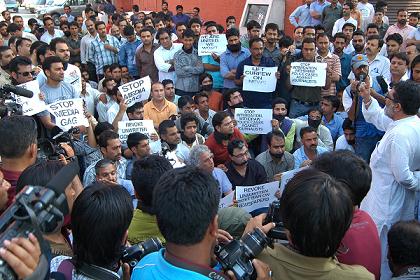
Media persons stage protest at Press Enclave in Srinagar against Government’s decision to gag media. Habib Naqash/GK

Update 2 on 11 July: As was being feared, the state has begun to crackdown on Facebook users for ‘anti-India activiies’. I can already spot one Facebook account missing. Very soon they will ban eating, drinking, breathing and shitting and offer curfew passes to some for these activities.

Update: Appeals to the Indian government by the Committee to Protect Journalists and IFJ.

In a clear signal that it continues to dictate what we get to know about the ground situation in Kashmir, curbs on the local media in the Valley continue despite government claims that they have been lifted. At the same time, Delhi journalists are able to freely move around and report in Srinagar. This is yet another blatant example of how the Indian state considers Kashmir its private property and the rights of its residents are secondary. As the Delhi media continues to do the bidding of the Home Ministry, the best sources of news on what’s happening on the ground remain Twitter and Facebook. Those updating their profiles and pages with information are doing so with the apprehension of censorship, state reprisal, blocking of these sites and suspension of internet services altogether in Kashmir. Continue reading Curbs continue on Kashmir media; is it martial law in Srinagar?

Kashmir, Lies and Audio Tape

The disinformation war is underway. Kashmir’s local media has been BANNED (not censored but BANNED!) in the world’s largest democracy, and the Delhi media is being used to spread LIES.

A Dialogue with God and Dialogues that go missing

Guest post by SUDEEP KS and BOBBY KUNHU

On Sunday 4 July 2010, T J Joseph, a college lecturer, was attacked by a group of people on his way back from the church in Muvattupuzha in central Kerala, and his right hand was chopped off. We believe this heinous act deserves to be condemned, and that such acts pose a major threat to the secular fabric of the Kerala society.

The attack has attracted immediate media attention, and it is said to be related to a recent controversy over a question paper. Joseph, in his Malayalam question paper, had asked one question that apparently hurt the religious sentiments of some people.

The Kerala society’s response to this whole episode has been equally disturbing. Pinarayi Vijayan, state head of Communist Party of India (Marxist), calls it ‘Talibanization of Kerala’. It has been made out to be a question of ‘freedom of speech’. The media, politicians and intellectuals are busy expressing serious concerns over a ‘religion’ that is intolerant and fanatic. The Police has also let out suspicions on some groups involved in this incident, and both the television and print media have been religiously reporting it. Continue reading A Dialogue with God and Dialogues that go missing

But what is a flag march?

Protest not allowed, this is Kashmir

So far in 2010, ‘security’ forces have killed 32 innocent Kashmiris, sometimes not even in a protest. Far from investigating these killings and promising justice, India has banned protest in Kashmir, which is what curfew amounts to, and even the media is not allowed to function. Curfew passes have been canceled even for journalists – there were no newspapers this morning. 12 photojournalists have been beaten up. Newspapers have been BANNED!

The Delhi media reports that the army has been brought into Srinagar for an indefinite period, and that the army staged a flag march. However, what is a flag march? It can’t be a security measure to deal with terrorists because there is complete curfew. The army has been asked to strictly impose the curfew. People are dying because they are not allowed to go to hospitals. After killing 32 innocent people what does “maximum crackdown” by 1,700 Indian troops in Srinagar mean? And if not even a bird is allowed on the streets, who or what is the flag march for? Continue reading But what is a flag march?

If you’re still wondering why Kashmir is protesting and demanding azadi…

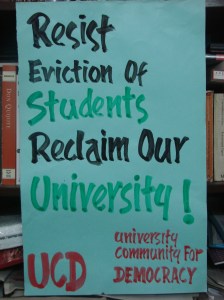
Down with Students’ Eviction from College Hostels!: University Community for Democracy

A Guest Post sent to us by BONOJIT HUSSAIN and NAINA MANJREKAR

[This is a leaflet issued by the University Community for Democracy which has come up in the wake of the arbitrary and authoritarian eviction of students from the hostels of Delhi University for the Commonwealth Games. Initially starting off as a facebook discussion among students, the anger has now snowballed into a movement that seeks to go beyond the immediate question of evictions. – AN]
Down with eviction of students from College Hostels!
Onwards to students self-activity!!
University Community for Democracy poster

The current administration of Delhi University has attempted to reshape the University through a series of sinister agendas – be it the introduction of semester system, the European Studies Programme or the biometric identification system. All of them have shared one thing in common: the thwarting of democratic debate on proposals for change, and the routine violation of regulatory protocols.

The latest episode has been the eviction of students (2,000 students according to reports) from a number of hostels in Delhi University in order to make them available for the Commonwealth Games. Hostels are being renovated and beautified for the officials and visitors of the Games, while students are scrambling around for their own accommodation. The students, like the 40,000 families on the Yamuna bank, are now among the many that have been displaced in the name of national glory. What comes into question is the fact that the University has agreed to avail of 20 crores of rupees from the Commonwealth Games project without taking any cognisance of how and where such resources are generated. It has thus become an accomplice in the larger process of reckless corporatisation that the whole city is undergoing in the bid of becoming a “global city”.

‘Mother I will make you cry today’

Dr. SYEDA HAMEED has sent us this poem

‘Mother I will make you cry today’

(On June 30th 2010, Asif Rather age nine ran out of his home in Baramulla in Kashmir to look for his older brother. As he left, he told his mother ‘I am going to make you cry today’. Minutes later he fell victim to shooting by the forces. At the time he was 150 meters from his house. – The Indian Express)

He stood at the sunlit door
A nine-year old with tousled hair
Asif Rather, student of class four,
Baramulla, 55 kms from Srinagar

‘Where is Touqeer?’
He sought his older brother.
‘Nowhere! You come back now
Here’s tea and last night’s bread
My baby, let me comb your hair’

Outside, the sounds Allah o Akbar
Chanting at once, one thousand strong Continue reading ‘Mother I will make you cry today’

A conversation in Sopore and other stories

The street that connects that Malaknag and Chheni Chowk areas of Islamabad/Anantnag in south Kashmir. Photo by Nasir Patigaru, via Facebook, posted on 27 June.

Which Indian has not heard of General Dyer? General Dyer opened fire on unarmed protesters. Hundreds died, the figures are disputed between Indian and British version to this day. A commission of enquiry was set up by the English. General Dyer told the Hunter Commission, “I think it quite possible that I could have dispersed the crowd without firing but they would have come back again and laughed, and I would have made, what I consider, a fool of myself.” Continue reading A conversation in Sopore and other stories

Three poems by Meir Wieseltier

Guest post by ADITYA SARKAR

Here are three poems by a remarkable Israeli dissident poet Meir Wieseltier. Over and above anything else, they’re beautiful poems, but they might also have something to say about the recent attacks of Gaza and the West Bank, even though they address much earlier events and times If nothing else, they might be a reminder that the kinds of issues related to Israel/Palestine that have been discussed on Kafila and elsewhere are in no sense new – each poem seems absolutely contemporary, even though they were written in 1973, 1978 and 1986 respectively. They might remind readers that far from being a ‘tragic mistake’, as the BBC and other liberal apologists have it, the attack on the flotilla represents the mainstream, indeed the only, dimension of Israeli state policy.

The last of the three poems was actually reprinted in The Nation on 15 April 2002, four days after the Israeli massacre of Palestinians at Jenin, which killed fifty people – another absolutely typical act of ‘Israeli self-defense’ that most accounts blank out. Continue reading Three poems by Meir Wieseltier

IPTK Statement on Military Governance in Indian-administered Kashmir

Military Governance in Indian-administered Kashmir

STATEMENT: FOR IMMEDIATE RELEASE
Srinagar, June 29, 2010

INTERNATIONAL PEOPLE’S TRIBUNAL ON HUMAN RIGHTS AND JUSTICE IN INDIAN-ADMINISTERED KASHMIR (IPTK) | www.kashmirprocess.org


The People’s Tribunal feels morally obligated to make this statement today. Sustained alliances between local communities and IPTK have enabled us to bear witness to the escalating conditions induced by militarized governance, and the severity of psychosocial dimensions of oppression in Indian-administered Kashmir. From our work since being instituted in April 2008, from the reports and briefs we have authored, investigations we have undertaken and are in the process of completing, we find it ethically imperative to comment on the direction in which the Governments of India and Jammu and Kashmir, and the Indian Armed Forces, appear to be headed, and the consequences they will likely effect. Continue reading IPTK Statement on Military Governance in Indian-administered Kashmir

Crossed Wires: Intelligence and Counter-intelligence in Chhattisgarh

On May 16 this year, adivasis, attending the weekly Sunday bazaar at Unchapur in Chhattisgarh’s Rajnandgaon district, found six corpses stretched out on the main thoroughfare of the village. In a note placed on one of the bodies, the CPI (Maoist) took responsibility for executing the six villagers for succumbing to “the lure of money” and serving as “police informers”.
The Rajnandgaon killings are a manifestation of the escalation of the confrontation between Maoist cadres and security forces in Chhattisgarh. As the scope of the conflict has widened from purely armed engagement to the disruption of intelligence networks, the Maoists and security forces have both enlisted civilian support for intelligence gathering. This has made the adivasis targets in a war being fought in their name.