
The latest news from Chengara is alarming. As if in retaliation to the rally taken out by dalit and human rights activists on 30 August, the very next day, a group of people who were travelling to the struggle site were attacked by the goons who continue the blockade. The whole group — eight men and thirteen women, including Omana, six months pregnant,were beaten heavily, and Omana’s two-year-child was snatched and thrown down. The injured are in hospital and activists are trying to get a case registered with the police.Intimidating posters have appeared all over Pathanamthitta town, declaring that the estate will be ‘cleared’on 3 September by the unions. All this, while the police watches, and a spineless admininstration looks the other way. Apparently, the administration now takes its orders from the CPM district committee.Meanwhile, the leadership continues to talk of the package, which will apparently come only after the protestors have been thoroughly intimidated, physically and emotionally,and reduced to cowering, nervous wrecks.
Category Archives: Violence/Conflict
The million mutinee question – Anant Maringanti
Guest post by ANANT MARINGANTI
How far is Nandigram from Chengara ? If we take media coverage and internet buzz as indicators, they are on two different planets. The heat generated by Singur and Nandigram was enough to run a chain of mini power plants. All that the families in the Chengara holdout have managed to evoke is a few approving nods from here and there. Here is a partial inventory of reasons why this might be so.
1) Singur and Nandigram are protests against disposession. The bad guys in the two instances are high profile harbingers of neoliberal globalization. No less. Chengara is about staking a claim to a welfare provision that nobody takes seriously anymore. There are no easily identifiable bad guys here.
Continue reading The million mutinee question – Anant Maringanti
A cartoon in ‘Greater Kashmir’

Meanwhile, some links to the sort of news from Kashmir that the Delhi media won’t give you:
Even expecting mother not spared during curfew
CRPF administers ‘patriotic’ dose to 56-yr old
Crippling curfew devastates fruit industry
Sikh Youth thrashed by Samiti supporters
‘Dangerous conspiracy to give communal color to movement’
While we were gagged
8 Killed, Hundreds Injured In 7 Days, Massive Clampdown On Valley
Where are pro-freedom leaders?
Geelani’s Son-In-Law Seeks Red Cross’ Intervention
Curfew relaxed, not beating
‘It is terrorism in uniform’
Yeh BBC London Ki Urdu Service Hai
News starved Kashmiris tune into popular radio program of 90’s in curfew
Curfew revives water transport on Jhelum
AMK condemns demand for ban on Kashir channel
Hindu chauvinist derails Mumbai citizens’ sit-in
Azaadi echo in Delhi
Civil right activists favour Kashmir independence
Indians against Indian repression in Kashmir
Be there or elsewhere:
Janahastakshep, PUCL and PUDR are holding a dharna on August 30 at jantar mantar from 11am to 1pm in protest against the crackdown on non violent people demanding ‘azadi’. Continue reading Indians against Indian repression in Kashmir
Update from Kerala: Blockade continues at Chengara
Despite the talks held by Ministers with the leaders of the Chengara land struggle, the situation continues to be tense,and the blockade continues for all practical purposes. The workers’ unions are hell-bent on not allowing anyone with a ‘partisan attitude’ about the issue to visit the site of the struggle.On 26 August, P.V. Rajagopal, Member of the National Land Reforms Committee, was prevented from proceeding to Chengara by workers. Just the other day, K.R.Meera, one of Kerala’s leading fiction writers, was stopped from visiting the protest.
Continue reading Update from Kerala: Blockade continues at Chengara
Red and Black
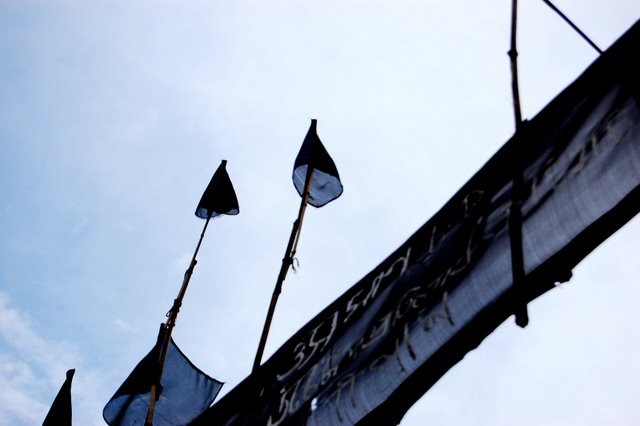
Red Flags of ‘Consent’/ Black Flags of Freedom and We, the Civil Society
guest post by TRINA NILEENA BANERJEE
(Written in Feb 2008)
The way towards Nandigram in November 2007 was fraught with a spectacle of flags.
I use the word ‘fraught’ deliberately – because as the journey progressed that autumn morning1, this proliferation of flags left me with a sense of mounting fear and apprehension. Continue reading Red and Black
The Continuing Violence Against Christians in Orissa
From John Dayal and Madhu Chandra of the All India Christian Council, an update on the continuing violence against Christians in Orissa. Continue reading The Continuing Violence Against Christians in Orissa
Statement on Censorship in Kashmir by Reporters without Borders
Censorship and violence against press in Kashmir
Reporters WIthout Borders, 25th August, 2008
Reporters Without Borders calls on the Indian authorities to put an immediate stop to the censorship and violence against the media in Kashmir that has been prompted by a wave of protests against Indian rule. At least 13 journalists were beaten by police yesterday in Srinagar, local TV stations are being censored and a curfew is making it hard for newspapers to bring out their issues.
“This latest crisis in Indian Kashmir must not be used as a pretext for subjecting the press to more violence and obstruction,” Reporters Without Borders said. “Journalists must have all the guarantees they need, including permanent passes, to be able to work freely despite the curfew. We also call on the police authorities to investigate the violence by certain elements that have led to injuries in the ranks of the press. If no sanctions are adopted, the door will be left open for more abuses. Finally, we call for an end to the censorship of local TV stations, which is a clear violation of the right of Kashmiris to be informed.”
Continue reading Statement on Censorship in Kashmir by Reporters without Borders
“I See Kashmir from New Delhi at Midnight”
(Adapted from a posting made earlier today on the Reader-List, Apologies for Cross Posting)
Even as the Indian state seems to be on the threshold of losing its grip both on hearts and minds in Kashmir and on its own wisdom, we have our own bunch of proud patriots making a heroic effort to convert the column inches of newspapers and the floor space of television studios into their own, special, battleground. Perhaps they might be consoling themselves with the hope that the turf battle of perception management in the media may yet be won, even if Kashmir is lost. Somehow, I am not so sure that this is going to be the case.
Unfortunately for them, to win in arguments, both – the state in Kashmir, and the Indian nationalist hard liners in the media and on other public fora, need some ideas, some attempt at reason, some amount of vision. I am afraid, that so far, neither the state, nor its hyper-loyal editorialists, sound-byte commandos and cyber-footsoldiers, have been able to display any. Instead, we have had bullets in Kashmir, and as I write this, news of midnight raids, arrests and the putting in place of the machinery of a major crackdown tomorrow, on those planning to assemble to protest peacefully on Lal Chowk in Srinagar, and restrictions on the freedom of expression. It is possible that a lot will happen tomorrow and in the next few days that will not filter through on television and the newspapers. It is possible that internet connections will be momentarily ‘down’ and that phone contact with the valley may be suspended. If it is not, then it is imperative that those who are in the valley, especially journalists of major international newspapers witness and report what might happen. If the worst does not come to pass, then, everyone will be relieved, and I really hope that is the case. We must remember, that in 1989-90, major massacres took place in Srinagar and in the rest of India, nobody really knew what was going on before it was too late. It is not as easy today for the Indian state to replicate the news blackout that accompanied the crackdown that took place in 1989, but certainly, the signs are that there might just be an attempt to do precisely that underway.
The PTI report quoted in a story just uploaded on the Indian Express website an hour before midnight, yesterday, 24th August, makes for chilling reading, especially if we read between the lines. It deserves being quoted in its entirety.
Continue reading “I See Kashmir from New Delhi at Midnight”
Will the Left’s’Negative Hallucination’End in Kerala?
Today, perhaps for the first time after early August, the Chengara land struggle attained some front-page space in the newspapers. It was front-page news in the Thiruvananthapuram edition of The Hindu, which reported the ongoing efforts for negotiated settlement. The Revenue Minister, K.P.Rajendran, and the Minister for the Welfare of the Scheduled Castes and Scheduled Tribes, A.K. Balan, held talks with Laha Gopalan, and other solidarity council members, and “promised them that the government would do everything within its power to meet their demand for provision of land to the landless among the Scheduled Castes and other similarly placed sections and assured them that there was no question of the government resorting to repressive measures against the agitators”. However, the Ministers revealed that” the government could promise to give them only land that is already with it or that which could be taken over without the possibility of further litigations.”
So far so good, and obviously we are in here for a long haul. The leaders of the agitation apparently made it cleared that they were not demanding the immediate assignment of the estate land but a more comprehensive package. The government has also announced that medical camps will be conducted in the struggle point and that the road bloackade will end. Relief, indeed, after so many tense days.It is clear that the real hard work begins now. Pressure will have to be kept up until the package is announced; it will have to debated, and adequate monitoring of its implementation will have to be assured through, perhaps, a national monitoring committee.
But as a historian, I’d say that that this is indeed an opportunity to attain greater clarity on the political relevance of political decentralisation and local planning. In the mid-1990s, it was projected as a panacea to all possible ills — from Kerala’s fiscal crisis, to non-sovereign forms of power. The People’s Planning Campaign shifted the focus to local-level development, promising to transform welfare recipients into small producers. In itself this was an interesting proposition in some ways: one that focused on small capitalism rather than neoliberal extractive growth, and promised to make poor citizens independent of state welfare. Continue reading Will the Left’s’Negative Hallucination’End in Kerala?
Leftist Babel in Kerala
There is still the eerie silence here about the land struggle at Chengara, but we are nearly deaf from listening to talk, talk, and more talk about the redistribution of surplus land to landless dalit people. Everyone, from Karat to Pinarayi Vijayan to VS, to even that undaunted champion of liberal ‘minimum entitlements’ welfarism, T.M. Thomas Isaac, is talking of redistributing surplus land to landless dalits (adivasis, according to some,or landless ‘poor’ according to others, ‘poor’ according to yet others…).
That seems rather odd.Talking with some minor CPM intellectual-bhikshaamdehis the other day (who are of course still patiently waiting for ‘more and accurate information’) I could see a sense of wounded innocence. “Don’t forget,” one of them told me,”it is the CPM that campaigned for redistribution of surplus land.” What they do not want to acknowledge — in the very specific present, of course — was that this promise was never fulfilled. Indeed, the so-called ‘class agenda’of the dominant left was more or less treated as over in the early 1970s;the left’s achievements after this did not touch upon redistribution of productive resources to the agricultural working classes. Indeed, we have seen the expansion of mass welfare — mass housing, fixing minimum wages, making available welfare pensions through welfare funds for unorganised sector workers, and so on.We have also seen the welfare system’s indirect acknowledgement of the rise of the consumer-citizen in Kerala — for instance, in the state-run Maveli stores.
Chengara: Letter to National Commission for Women by Delhi groups
The Chairperson
National Commission for Women
4, Deen Dayal Upadhyaya Marg,
New Delhi
Subject: Torture and Rape of Women and Other Incidents in the Land Struggle at Chengara, Kerala
Dear Chairperson,
We urge your attention to the following incidents in Chengara, Kerala as they require your urgent intervention.
In the ongoing struggle for land in Chengara, there is escalating violence against the peaceful and democratic protest of the people. Here women are the most affected as they are the targets of brutal attacks by the workers of trade unions affiliated to leading political parties and also other hired henchmen of Harrison Malayalam Ltd. Many women have testified that the attacks happened right in the presence of the police. All these events seem to indicate a total breakdown of the state’s administrative machinery to redress the situation, which makes the intervention of external bodies like yours crucial.
Continue reading Chengara: Letter to National Commission for Women by Delhi groups
Horses That Walk Backwards – Samkutty Pattomkary

Mr. Prakash Karat, how far behind are you and your crew walking?!
asks theatre director SAMKUTTY PATTOMKARY
[As the Chengara struggle reached a new phase, the CPI-M in Kerala organized a Dalit convention in Kochi – 51 years too late says the author. J Devika has posted updates on the struggle in recent days, as also a translation of Sunny Kapicadu’s speech at the historic night-vigil on 7 March 2008, in Kafila earlier.]
In more than 80 years of communist history in Kerala, for the first time, a communist chief minister has declared today (16-8-2008) that the caste system is strongly alive in Kerala! It took 51 years, starting from EMS in 1957, for the communist rulers to understand the caste system in Kerala. Anyway, on this ‘auspicious’ occasion of such a revelation for the Kerala CPM people, let them be reminded of some more facts.
Continue reading Horses That Walk Backwards – Samkutty Pattomkary
Update on Chengara
On 14 August, leading dalit activists from Kerala protested in Pathanamthitta against the continued road blockade organised by the joint front of trade unions which claim to be fighting for the rights of plantation workers. They were prevented from proceeding to Chengara and were arrested, to be released by evening. Meanwhile, the trade unions agreed to lift the blockade by 3 at noon. They however demand that the people who have occupied the plantation should all leave in 10 days’ time, and if this does not happen, the blockade will be on again.
Press coverage has improved somewhat but not much. Even the sworn enemies of the left, like the Malayala Manorama, have kept largely silent. Not surprising, though — the Congress and others, including the interests that this newspaper represents, are patiently waiting for the LDF government to dig its own grave by provoking a Nandigram-like situation. Once the calamity begins, they will of course move in, like vultures. The Centre too of course is watching and waiting for CPM to make another big mistake.
These are strange times.There is a raging debate now on within the CPM and the LDF about the pending approval to proposed SEZs, and one of the key points of the conflict has to do with trade union presence within them.While a powerful section within the CPM wants to curtail workers’ rights within the SEZs,outside, on the road to Chengara, trade unions attack their ‘enemies’ — landless and marginalised people.
The Chengara Struggle Committee has called for protest meetings all over the State on 23 August; it has also appealed for a protective human chain around Chengara on 25 August.
Gun Salutes for August 15, 2008
Anniversaries are good opportunities for reflection. I write this in the early hours of 15th August, 2008, the 61st anniversary of Indian independence.
The events of the past few months, and the past few days, in the Indian administered state of Jammu and Kashmir have demonstrated how well and how equally (or not) the police, paramilitaries and armed forces of the Indian Republic treat different kinds of protesting crowds. The facts that I am about to discuss are good measures with which to think about the relationship between acts of power, different kinds of people, sovereignty, life and death in the Indian nation state as it has evolved over the past 61 years.
The region of Jammu in the province of Jammu and Kashmir has been caught in the grip of a fierce agitation against the revocation of the land transfer to the Amarnath Shrine Board. We have all seen footage of angry SASS (Shri Amarnath Sangharsh Samiti) activists brandishing trishuls, setting up roadblocks and burning tyres, the agitation has spread to different parts of India
Flashpoint Chengara: March Against Blockade Tomorrow
AN APPEAL from the PANCHAMI DALIT FEMINIST COLLECTIVE, Kottayam, to join the march on August 14th, against sexual harassment and human rights violations at the site of the struggle for land at Chengara, Pathanamthitta, Kerala.
[Below is an urgent appeal from Chengara, Kerala, where a land struggle has been on for the past one year. There seems to be a general elite consensus about refusing citizenship to the 7500 landless families that have occupied government land there; more ominously, there seems to be also the determination to punish them. Since early August a road blockade has been going on led by the united front of trade unions defending the right of (eighty) workers in the occupied Chengara plantation. Apparently, there are also ‘criminal elements’- the trade unions and the police, poor things, know nothing of them – who have been violently stopping activists from reaching the settlement.The CPM intellectuals in Kerala are patiently waiting for ‘more and accurate’ information, as they were when some of us approached them proposing a protest around Nandigram last year. Reports of starvation, sickness,and sexual assault are reaching us from Chengara but there is no way we can get there.Now, what is this? A new form of illegal custody? A new form of sexual harassment in custody? On 14 August, dalit activists and organisations are planning a march to Chengara, and hopefully food and medical supplies can be taken there. Please circulate this appeal widely – we have to stop another Nandigram– JD]
A historic land struggle has been unfolding at Chengara in Pathanamthitta district, Kerala, involving about 7500 families, Continue reading Flashpoint Chengara: March Against Blockade Tomorrow
Quepem by the kilo: Hartman de Souza on Mining in Goa
I am posting below a requiem to Quepem by my old friend Hartman. It reads eerily like a companion piece to the curatorial essay to Manifesta 7 by Raqs, posted earlier on Kafila. Raqs wrote:
Mountains are flattened to mine bauxite, the main aluminium ore. Mountains of aluminium waste may eventually take their place…The “rest of now” is the residue that lies at the heart of contemporaneity. It is what persists from moments of transformation, and what falls through the cracks of time. It is history’s obstinate remainder, haunting each addition and subtraction with arithmetic persistence, endlessly carrying over what cannot be accounted for. The rest of now is the excess, which pushes us towards respite, memory and slowing things down.
And here’s Hartman:
As you read this, mourn the brutal rape and murder of half a dozen steep, thickly forested hills barely 12 kilometres from Quepem town in south Goa. These form an integral link of the magnificent Western Ghats that surround Goa, and as any schoolchild studying the environment will tell you, they play a crucial role in providing Goa its ecological wellbeing.
And yet, in blatant contravention of wisdom we purport to impart to children, hundreds of forests are being cut down around Quepem even as I write this. The denuded land turned inside out so fast, a hill can disappear in three months, leaving behind suppurating wounds that go down so deep the giant tipper trucks at the bottom look like the harmless toys little boys plays with.
Continue reading Quepem by the kilo: Hartman de Souza on Mining in Goa
Ahem-dabad again
Update: Yaha sab shanti hai, yeh public hai sab jaanti hai
Sheela Bhatt’s assertions that the Gujarati Muslim hasn’t been seeking retribution by a long shot are not surprising at all. What is illuminating is this:
One of the surprises of Saturday’s blasts was that except one blast in Sarkhej, all the blasts were executed in East Ahmedabad, which includes the highly communally sensitive walled city area. The accuracy of the planning suggests that a person with a complete grip on the social-political mindset of the city and its communal geography must be behind the blasts.
No one in this shaken city doubts that these blasts were planned by someone who has a thorough knowledge of the past 25 years history of communally sensitive areas and the Sangh Parivar’s role in it. Continue reading Ahem-dabad again
In the midst of blasts and fireworks across cities …
[While this post is also posted on my blog, I want to add a small qualification as to why I have put this up on Kafila as well. This post goes out on Kafila in the optimistic spirit of peace and wisdom in our hearts in the midst of the various blasts that have been taking place in different cities across India.]
(I write in the spirit of my words and in submission of myself to my vulnerabilities and to the present …)
One blast here,
One there,
One everywhere.
Today here,
Tomorrow there.
One blast here
And one blast there.
So that is what we, in various parts of the world, have been hearing about in the last two days. And yet, the indifference on my skin remains. It only thickens. But I remain sensitive to more mundane issues that concern me/bother me/sit on my mind/nag me. And what is sitting on my mind as of now, is that beautiful feeling of vulnerability and the thought of what it means to be vulnerable in the city. The feeling of vulnerability is beautiful as of now because I write in the solitude of music, my words and my difficult and vulnerable self, shut off from the noise of the blasts and of the noise of the crowds that existed in my space a while ago.
Continue reading In the midst of blasts and fireworks across cities …
“Madam, we know you’re leaving. Think wisely before coming back”
Claims and Space – Thoughts from the Feet
Fort,
Bombay – 400 001.
Clean footpaths,
Spic and span,
Bombay – 400 001. Continue reading Claims and Space – Thoughts from the Feet
 KAFILA - COLLECTIVE EXPLORATIONS SINCE 2006