Caste, Class and the ‘Classical’ – FAQs about the Urur Olcott Festival, Chennai: Nityanand Jayaraman

Guest post by NITYANAND JAYARAMAN

Print

On 15-16 January, 2015, a much talked about festival of dance and music, that intends and promises to be different, is to be held in Chennai. The Urur Olcott Kuppam Margazhi Vizha means different things to different people. But for those who do not know what Urur Olcott Kuppam is or what the Tamil phrase Margazhi Vizha means, the Vizha may have no significance. These answers to FAQs (Frequently Asked Questions) is for such people, and for those who know what it means and have sent many bouquets and a few brickbats my way for being engaged in the organising of this Vizha. The views expressed here are personal and do not reflect a consensus within the group of organisers. However, the process of organising, the event and post-event engagements are itself likely to provide a platform for discussing such views and counterviews.

Carnatic-musician-TM-Krishn_0

T.M. Krishna performs at Besant Nagar beach as a part of the Urur Olcott Kuppam Margazhi festival

What is Urur Olcott Kuppam?

Urur Olcott Kuppam is a centuries-old fishing village in South Chennai. By rights, the Kuppam ought to be the landmark for Besant Nagar as in — “You know Besant Nagar, that newly settled neighbourhood near Urur Olcott Kuppam?” But that’s not how it is. Besant Nagar’s residents are predominantly upper class, upper caste. Urur Kuppam’s are predominantly from the fisher community of Pattinavar. The hip and happening Besant Nagar is well-known; the kuppam is invisible. The injustice doesn’t stop with geography. Dominant history also begins where dominant geography begins – with Besant Nagar. Ask Besant Nagar residents what existed 40 years ago in this area, and people are likely to say “Nothing” or “Nothing but the beach.” It’s as if the fishing villages did not exist before the government decided to carve residential plots for middle and high-income people out of sand dunes carpeted with cashew, palmyra, casuarina and screwpine.  Continue reading Caste, Class and the ‘Classical’ – FAQs about the Urur Olcott Festival, Chennai: Nityanand Jayaraman

Under the Saffron Flag

The Long Forgotten battle against Hindutva Terror

Title page1
Not some time ago a very brief write-up by Younus SK had shared news items  revealing Hindus posing as Muslims to be committing mischief to whip up anti-Muslim frenzy.

If Amiya Sarkar was found to be behind putting up posters in Kolkata under the name of “Jamaat ul Mujahideen Bangladesh” threatening to bomb West Bengal, a VHP worker Deshraj Singh was arrested by police in Muzaffarnagar for placing slabs of buffalo meat in three Hindu temples, one Sushil Chaudhary was caught for sending threat mails to Rajasthan ministers under the name of ““Indian Mujahideen (IM) terrorist” , a Hindu boy adopting a fake Muslim identity was held by Bangalore police for posting threatening tweets to bomb the city.

Underlining the fact that in all the four cases, which were reported in the month of December itself from different parts of the country, and the manner in which police released them with minor rebuke, without finding any larger terror conspiracy behind their actions convincing ‘us that the men were stressed, depressed or mentally unsound’ it had posed a simple query whether they could be considered ‘random events or an RSS ploy’.

In the backdrop of ascendance of majoritarian forces at the centre and the consequent de-emphasising of battle against Hindutva terror – which had begun albeit half-heartedly under the UPA regime – it needs to be reminded that it is far from over and should be taken to its logical conclusion. Read a recent overview of the menace in ‘fountainink’,  a monthly magazine of narrative journalism.

What does one write today?

It’s the kind of moment that makes you reach for poetry, for words that convey what can scarcely be written. It’s the kind of moment where you must write for it is writing that is itself at stake.

The debates on Charlie Hebdo are wide and varied. There is, as Joe Sacco so beautifully drew, before anything else, a deep yet horrifically dull sadness. Few and fewer in the world have the privilege to still be “shocked” by violence, to not have its banality be its true horror. There is solidarity, some of the most meaningful of which comes from cartoonists in the Arab world.  There is a wide agreement that no justification is possible for returning any measure of offence with death yet there is an insistence on the ability to critique even that which one defends. As Teju Cole eloquently argues: “moments of grief neither rob us of our complexity nor absolve us of the responsibility of making distinctions.” There are important, vital debates about what it means to “insult everyone equally” when everyone is not equal, reminding us that we must begin and ask our questions in place, in history; that we must remember that the power to criticise is a freedom but also a privilege. There are the universal debates on the limits to absolute speech, pointed to by Sandip Roy who reminds us that the French Government itself banned the earlier incarnation of Charlie Hebdo for printing a mock death notice of the then French PM De Gaulle. There are fears of the Islamophobia this violence will re-incarnate as, that Hari Kunzru argues is one intent of the attackers.

I write with a different intent today. I write not to enter these debates about Charlie Hebdo but to insist on what these deaths must provoke us to do: to translate our solidarity, our empathy, our fear, and our resolve into the real work of protecting the freedoms of speech, satire, offence, and expression in India. That is the tribute to Charlie Hebdo that matters, that transcends all our debates.

Continue reading What does one write today?

‘To those who attacked Charlie Hebdo yesterday shouting Allahu Akbar’: Karima Benoune

KARIMA BENOUNE in Open Democracy

We are all Charlie!

To those who attacked Charlie Hebdo yesterday shouting “Allahu Akbar,” I would like to say that your kind of God – a God of Hate and Murder – is not Great. Nor is that God the God of most Muslims, but rather of your own Islamist cult – which so many people of Muslim heritage oppose. You are incapable of understanding satire; you openly revile the beliefs of others but brook no criticism of the medieval notions you believe. You claim to defend Islam while bringing only shame upon it. You are offended by cartoons but not by killing. You claim to have avenged the Prophet Mohamed but have instead defamed him with your cowardly attack on unarmed journalists in his name.

As a Tunisian woman wrote to me afterwards, “It is so horrible, claiming the name of God while killing these poor people. But, about which God are they speaking?”  With an ironic outrage, worthy of Charlie Hebdo itself, she insisted the deity would be “gratified” that they are “making him a God of intolerance and blood.”  In the name of tolerance and peace, and in memory of the tragically murdered victims in Paris, and of so many others – even more numerous – in places like Peshawar, let us commit after this bleak January day to make 2015 the year we finally put an end to this ghastly jihad.

While first information suggests the authors of the Paris attack may have claimed affiliation with Al Qaeda in Yemen, others suspect an “Islamic State” link. In any case, their indisputable connection is with the pernicious ideology of international Islamism and its myriad armed manifestations.  These are, to quote Algerian sociologist Marieme Helie-Lucas, “political movements of the extreme right that… manipulate religion to achieve their political aims.” We must collectively denounce that ideology and do all we can to defeat these movements.  As Helie-Lucas and Maryam Namazie wrote in an online petition in denunciation of the Charlie Hebdo attack, a statement rapidly signed by activists from Iran to Sudan, “What is needed is straight-forward analysis of the political nature of armed Islamists: they are an extreme-right political force, working under the guise of religion and they aim at political power. They should be combated by political means and mass mobilization….”

Continue reading ‘To those who attacked Charlie Hebdo yesterday shouting Allahu Akbar’: Karima Benoune

Qalam chhin gayi to kya ghum hai/Snatch my pen away, I remain defiant (Faiz Ahmed Faiz)

Post jointly authored by ADITYA NIGAM AND NIVEDITA MENON

o-BANKSY-PARIS-CHARLIE-HEBDO-570

This image celebrating the power of dissent and creativity over forces of tyranny, circulated widely after the murderous attack on the French satirical journal Charlie Hebdo and the shooting of cartoonists Charbonnier, Wolinski, ‘Tignous’ and Cabut, among others. The cartoonists of the ‘equal opportunity offender’ journal were called out by name and coldly slaughtered in the name of Islam.

It seems appropriate now to remember Faiz’s words on censorship and the violent closing of minds:

Mataa-e- lauh-o-qalam chhin gayi to kya ghum hai 

Ke khun-e-dil men dubo li hain ungliyan maine

Zuban pe muhar lagi hai to kya,

ke rakh di hai har ek halqa-e-zanjeer mein, zubaan maine.

Snatch away my ink and pen, I remain defiant,

For I have dipped my fingers in the blood of my heart.

Chain shut my lips, I don’t give a damn,

For in every link of the chain I have placed a tongue ready to speak.

After the Charlie Hebdo Massacre, Support those Fighting the Religious-Right : Statement by concerned citizens

Statement by concerned citizens

After the massacre in Charlie Hebdo in Paris on January 7, 2015, expressing indignation, as so many are doing, is not enough.

A quick look at the English-speaking media shows that whilst many condemn the violence itself, they also assert that Charlie Hebdo courted (and maybe deserved?) a strong response from “Muslims”. Charlie’s regular cartoonists did not spare Islam, any other religion, nor fanatics and bigots.

This trend in the media requires our attention. Apparently secularists, agnostics and atheists must keep silent and do not deserve the kind of respect that believers are entitled to; nor can they enjoy free speech to the same degree.

In the name of “respect” of religions and of the religious sentiments of believers, it is indeed the fanatical religious-Right that is being supported and given centre stage. Meanwhile, those who are on the forefront of countering armed fundamentalists are left to their own devices. It is high time to give these secularists prominence, to recognise their courage and their political clarity and to stop labelling them “Islamophobic”.

In October 2014, secularists – including atheists, agnostics and believers from many countries, in particular many Muslim-majority countries, met in London to denounce the religious-Right and to demand being seen as its alternative. It is high time to learn from their analysis and lived experiences.

The tragic massacre in Paris will undoubtedly give fuel to the traditional xenophobic far-Right and the immediate danger is an increase in racism, marginalization and exclusion of people of Muslim descent in Europe and further. We do not want to witness “anti-Muslim witch hunts” nor do we welcome the promotion of “moderate” Islamists by governments as official political partners. What is needed is a straightforward analysis of the political nature of armed Islamists: they are an extreme-Right political force, working under the guise of religion and they aim at political power. They should be combated by political means and mass mobilisation, not by giving extra privileges to any religion.

Their persistent demand for the extension of blasphemy laws around the world is a real danger for all. France has a long – and now growingly endangered – tradition of secularism; which allows dissent from religions and the right to express this dissent. It has had a rich tradition to mock and caricature powers that be – religious or otherwise. Let us keep this hard won right which cost so many lives in history, and, alas, still does – as Charlie Hebdo’s twelve dead and numerous wounded demonstrate.

Signed:
Marieme Helie Lucas, Algerian Sociologist and Secularism is a Women’s Issue Founder
Maryam Namazie, Iranian-born Spokesperson of Council of Ex-Muslims of Britain, One Law for All and Fitnah and Co-host of Bread and Roses TV
Karima Bennoune, Professor and Martin Luther King Jr. Hall Research Scholar, University of California, Davis School of Law
Ali al-Razi, Ex-Muslim Forum
Amel Grami, Professor at the Tunisian University of Manouba
Anissa Daoudi, Birmingham University, Head of Arabic Section
Ayesha Imam, Coordinator of the Nigerian Women’s Rights Organisation BAOBOB
Braema Mathi, Human Rights Activist, Singapore
Chris Moos, Secularist Activist and Researcher
Christine M. ShellskaPresident of Atheist Alliance International
Codou Bop, Groupe de recherche sur les femmes et les mois au Sénégal
Daayiee Abdullah, Imam of Light of Reform Mosque
Deeyah Khan, Norwegian Filmmaker and Founder/CEO of Fuuse
Esam Shoukry, Defence of Secularism and Civil Rights of Iraq and Left Worker Communist Party of Iraq
Fahima Hashim, Director of Salmmah Women’s Resource Centre in Sudan
Fariborz Pooya, Founder of the Iranian Secular Society and Co-host of Bread and Roses TV
Farzana Hassan, Writer
Fatou Sow, International Director of Women Living Under Muslim Laws
Fiammetta Venner, Writer and Filmmaker
Gita Sahgal, Founder of Centre for Secular Space
Gona Saed, Campaigner and Activist
Hala Aldosari, Women’s Health Researcher and Women’s Rights Women’s Activist
Harsh Kapoor, South Asia Citizens Web
Houzan Mahmoud, Kurdish Women’s Rights Activist
Imad Iddine Habib, Founder of the Council of Ex-Muslims of Morocco
Inna Shevchenko, Leader of FEMEN
Julie Bindel, Writer
Kate Smurthwaite, Comedian and Activist
Laura Guidetti, Marea Italian Feminist Review
Lila Ghobady, Iranian Writer and Filmmaker
Magdulien Abaida, Libyan Activist and President of Hakki (My Right) Organization for Women Rights
Meredith Tax, Centre for Secular Space
Mina Ahadi, International Committees against Stoning and Execution
Nadia El Fani, Tunisian Filmmaker
Nina Sankari, Vice President of Atheist Coalition of Poland
Nira Davis-Yuval, Founder member of Women Against Fundamentalism and the International Research Network on Women in Militarized Conflict Zones
Peter Tatchell, Director, Peter Tatchell Foundation
Ramin Forghani, Founder of the Ex-Muslims of Scotland and Vice-Chair of the Scottish Secular Society
Safak Pavey, MP for Istanbul, Turkish Parliament
Sara Hakemi, Secular Greens and Giordano Bruno Foundation
Siamak Bahari, Political Activist and Editor of Children First Publication
Sultana Kamal, Bangladeshi Human Rights Activist
Taslima Nasrin, Bangladeshi-born Writer
Tehmina Kazi, Director of British Muslims for Secular Democracy
Soad Baba Aïssa, Founder of Association pour la mixité, l’égalité et la laïcité
Terry Sanderson, President of the National Secular Society
Waleed Al-Husseini, Palestinian blogger and Founder of the Council of Ex-Muslims of France
Yasmin Rehman, Women’s Rights Advocate

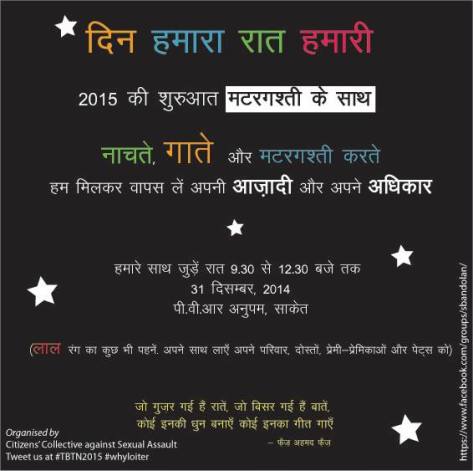
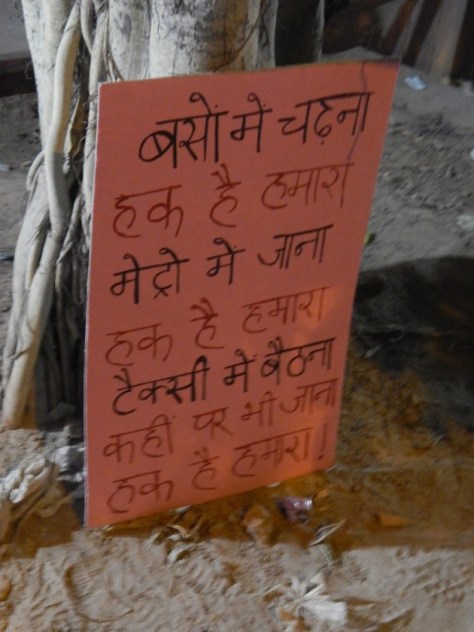
Matargashti on New Year’s Eve, Take Back the Night 2015: Citizen’s Collective Against Sexual Assault

Citizen’s Collective against Sexual Assault (CCSA) is a Delhi/NCR-based group of individuals and organisations that works towards preventing and addressing issues of sexual violence against women, girls and transgender people, including raising awareness among the public, media, administration and the police on issues of women’s rights. CCSA organized for the third year in succession, a Take Back the Night rally on December 31, 2014, ending at 12.30 am on January 1, 2015. The New Year was welcomed with songs of protest, dance, street plays, with everyone meeting at PVR Anupam Saket, walking towards Saket Metro Station. Below is the statement they produced for the occasion, and some photographs.

1507571_10152977747969913_2507326562641751106_n

Matargashti is an expression of freedom, vibrancy, happiness, consent, confidence like reaching out to the clouds and bursting them like bubbles! Matargashti (or “loitering”) should be an essential part of each one’s life. Fearlessly roam on the roads, sprawl in the park, jump on to buses, metro and trains or laze around at a chai stall. I may be anyone — woman, man or transgender. Fearlessly be out at any time, travelling by public transport or in my own car. Proudly flaunting my wheelchair or crutches or tap-tapping my way around with my white cane. Someone who lives on the streets because I have nowhere else to call home. Fearlessly wear whatever clothes I feel like. And regardless of which region of India I belong to – North, South, the Northeast or anywhere else.

DSCN2028-e1420102077264-768x1024

Continue reading Matargashti on New Year’s Eve, Take Back the Night 2015: Citizen’s Collective Against Sexual Assault

Statement Against Continued Harassment of Teesta Setalvad, Javed Anand and others

The following is the text of a statement issued in Banaras on the 3rd January 2015, by a number of intellectuals 

In Support of Teesta Setalvad, Javed Anand and others

We are deeply shocked and outraged by the continuing attempts of the Modi government and the Gujarat police to somehow implicate the human rights lawyers and activists, Teesta Setalvad, Javed Anand along with three victim survivors of the state sponsored carnage in Gujarat in 2002 on patently trumped up charges.

This is another attempt to derail justice particularly Zakia Jafri’s appeal which is now before the Gujarat High Court where she has accused the then Gujarat chief minister, Narendra Modi, the home minister of Gujarat along with 59 others which include top politicians, civil servants of conspiracy for mass murder and other serious crimes.

It is extremely significant that the amicus curiae appointed by the Supreme Court, Mr. Raju Ramachandran  has told the apex court there was enough prima facie evidence to prosecute Shri Modi. Continue reading Statement Against Continued Harassment of Teesta Setalvad, Javed Anand and others

Love Godse, Hate Tipu Sultan

Why the ‘Tiger of Mysore’ Still Troubles the Saffrons

image : http://www.tntmagazine.in

The saffrons have done it again.

They have once again showed utter contempt towards the legacy of legendary Tipu Sultan, (20 November 1750  – 4 May 1799) one of those rare kings who was martyred on the battlefield, while fighting the Britishers at the historic battle at Srirangpatnam and whose martyrdom fighting the colonials preceded the historic revolt of the 1857 by around 50 years. Not very many people even know that he had even sacrificed his children while fighting them.

The immediate reason for stigmatisation of Tipu Sultan, by the leaders of Hindutva Brigade, concerns move by the Karnataka state government led by the Congress to celebrate Tipu Jayanti or Tipu’s birth anniversary. The Chief Minister Siddaramaiah had made this announcement releasing a book ‘Tipu Sultan: A Crusader for Change’ by historian Prof B Sheik Ali.

A ruler much ahead of his times Tipu Sultan, a scholar, soldier and a poet, was an apostle of Hindu-Muslim unity, was fond of new inventions, and is called innovator of the world’s first war rocket, one who felt inspired by the French Revolution and who despite being a ruler called himself Citizen and even had planted the tree of ‘Liberty’ in his palace. History bears witness to the fact that Tipu sensed the designs of the British and tried to forge broader unity with the domestic rulers and even tried to connect with French and the Turks and the Afghans to give a fitting reply to the hegemonic designs of the British and had defeated the British army twice with his superior planning and better techniques earlier. Continue reading Love Godse, Hate Tipu Sultan

An old RC ruminates on his ‘Pseudo-Secularist’ roots: Hartman de Souza

Guest post by HARTMAN DE SOUZA

The background and context to this not-so-enigmatic title is very simple. By today’s standards, I am old – I get a hefty discount travelling by train which I am still hooked on, and I am still counting the years and sniffing my coffee. The ‘RC’ is a lot simpler:

Travelling by train from Mumbai to Delhi many, many moons ago, a man in the compartment, in his thirties, got into conversation with me. After I had answered his opening bullet shot questions – You are from? You are doing what? Your father is doing what? – he told me I spoke English like a ‘foreigner’.

I was still fresh from Kenya those days, where I was born, so I got a lot of grief from having a different accent that no one could place.

This was of course much, much before you could study for an undergraduate degree in India (where you were born) and then, if you had the means and the SATs, go and study in the US for a few years. There, in the land of beef and honey, as we now note with pride, many Indians also discovered the ‘free market’ and their ‘authentic’ Hindu roots – then came back to spew communal venom with a makeshift American accent and the dollars to back it.

As if it was stamped on my bloody forehead, he then asked: “You are Christian?” He pronounced this as “Kir-tchin’.

I pretended I hadn’t heard. So he repeated the question. I nodded, hoping he would disappear and let me get on reading my book.  He did not. Instead had a broad grin on his face, like he knew in which bag he could drop me in.  “You are RC!” he said, almost triumphantly.

For a few seconds, he almost had me stumped. I raised my eyebrows.

Ro-maan Catholic,” he offered.

I shook my head and smiled back. “No,” I replied “Retired Catholic…”

He didn’t get the joke. Guys like that still can’t. Continue reading An old RC ruminates on his ‘Pseudo-Secularist’ roots: Hartman de Souza

ചുംബനസമരവിരോധികളുടെ സംശയങ്ങളും അവയ്ക്കുള്ള സമാധാനങ്ങളും: ആലപ്പുഴയിലെ ചുംബനസമരത്തിന് അഭിവാദ്യങ്ങൾ

[പല വേദികളിൽ പല തവണ ഉത്തരം പറഞ്ഞുവെങ്കിലും ചുംബനസമരക്കാർ നിരന്തരം നേരിടുന്ന ചോദ്യങ്ങളാണിവ.  ഈ ചോദ്യങ്ങളും മറുപടികളും പല സുഹൃത്തുക്കളോടും സഹപോരാളികളോടുമുള്ള സംഭാഷണങ്ങളിൽ നിന്നുണ്ടായവയാണെങ്കിലും അവയുടെ പൂർണ്ണ ഉത്തരവാദിത്വം എനിക്കു തന്നെ.]

ചുംബനസമരങ്ങളിൽ പങ്കെടുക്കുന്നവർ കേവലം പബ്ളിസിറ്റിക്കു പിന്നാലെ നടക്കുന്നവരല്ലേ?

Continue reading ചുംബനസമരവിരോധികളുടെ സംശയങ്ങളും അവയ്ക്കുള്ള സമാധാനങ്ങളും: ആലപ്പുഴയിലെ ചുംബനസമരത്തിന് അഭിവാദ്യങ്ങൾ

Pondicherry Ashram Suicides and The Spiritual Surrender: Bobby Kunhu

Guest post by BOBBY KUNHU

On 17th December there was a dramatic sequence where, the youngest of a family of aged parents and five sisters who were inmates of Sri Aurobindo Ashram, Pondicherry attempted suicide by jumping off a water tank. The police rescued the woman, booked her and her sisters for attempt to suicide and released them on bail. This was following a Supreme Court order evicting them from the ashram at the end of a decade long struggle against the ashram. Their demand was simple that the management of the Ashram be taken over by the State to contain the corruption within. On the morning of 18th December, the family of seven decided to walk into the sea. Three died, four were rescued. Amongst the four who were rescued, one was allegedly raped by two men in her state of unconsciousness.

The South Asian spiritual landscape perhaps is the most diverse – ranging all hues and shades of spirituality cutting across religions and castes and has attracted followers internationally including celebrities like the Beatles, Isaac Tigrett (the founder of Hard Rock Café) and many others. Without exception, all of these spiritual groups ask for “total” surrender, though the terms of this surrender would differ from group to group. And many have willingly surrendered! For a non-believer it might be difficult to understand this leap of faith. But, for the believer this becomes the single most important event in her/his life. Even more important than birth marriage, love or death! And, when the terms of surrender is breached – though all hell breaks loose, people cling on to their faith. Despite “Sexy Sadie”, Paul McCartney held that Transcendental Meditation was a gift The Beatles had received from the Maharishi at a time when they were looking for something to stabilise them. In the BBC documentary The Secret Swami Tigrett stated that he believed that there was truth to the rumors of Sai Baba’s actions of pedophilia and sexual abuse towards some of his young male followers, but also such rumours would not change his belief in the Baba. Continue reading Pondicherry Ashram Suicides and The Spiritual Surrender: Bobby Kunhu

On “Scandalmongering of the Senile” – Ruminations on Tapan Raychaudhuri, Historian: Ahona Panda

Guest Post by Ahona Panda

[ One of the great losses of this year was the passing of the historian Tapan Raychauduri in November, who is remembered not just for the acuity of his scholarship, but also for his warmth, his humour and his embodiment of a certain cosmopolitan, worldly elan. In this tribute, Ahona Panda, a young scholar at the University of Chicago, remembers what it means for all those committed to the life of ideas to have shared the world with Tapan Raychaudhuri and to have lived through the years in which he sojourned through time. We thought it would be fitting to offer these reflections across generations to our readers as another turbulent year draws to a close. ]

In November 2014, the world lost an astonishing historian called Tapan Raychaudhuri. Professor Raychaudhuri’s laurels and accolades and many publications, along with his students, span the entirety of the globe. I write this obituary as a young graduate student who knew him in some personal capacity, a personal capacity that is difficult to define—my parents were his graduate students in the 1980s—thus making me a recipient of his affection (personal, intellectual) and something akin to a grandchild, no perhaps not quite that, but more what he called a (jokingly) “grand-student”.

It was when I stepped into the murky world of South Asian studies, and dabbled and read material pertaining to India in general and Bengal in particular, that I understood the great contribution that Tapan Raychaudhuri has had in the field of not only South Asian history, but also the cultural history of Bengal. This latter Bengal is not that limited, parochial and steadily shrinking ideological/geographical entity that today stands the risk of being run by a Hindu right wing party. Tapan Raychaudhuri, a tremendous celebrity in Calcutta, was not guilty of belonging to West Bengal. In fact, he was perhaps never guilty of “belonging”.

Continue reading On “Scandalmongering of the Senile” – Ruminations on Tapan Raychaudhuri, Historian: Ahona Panda

Anti-Conversion and Ghar Wapsi, Or Hindutva’s Doublespeak: Charu Gupta

Guest post by CHARU GUPTA

The synchronised vocabulary of anti-conversion by the BJP and that of reconversion by the VHP and Dharm Jagran Samiti, an RSS affiliate, reveals the intimate relationship between the two. Anti-conversion and reconversion are two sides of the same coin. Even though the Dharm Jagran Samiti dropped its plan to ‘reconvert’ 4000 Christians and 1000 Muslim families in Aligarh on 25 December, due to pressures from a parliament in session as well as other protests, the day has had strategic significance. Christmas Day has been given a different meaning by the Hindutva brigade — the birth anniversaries of Madan Mohan Malaviya, one of the stalwarts of the Hindu Mahasabha, and Atal Bihari Vajpayee, the eminent BJP leader. Equally critically, on 23 December 1926 Swami Shraddhanand, the leading ideologue of the shuddhi movement (purification; Hindu movement in the late nineteenth and twentieth centuries to reclaim those who had converted from Hinduism to other religions) was assassinated by a Muslim fanatic, and on 25 December, a condolence motion was moved at the Guawhati session of the Congress.

The twin strategies of anti-conversion and ghar wapsi have a long history and past, which saw its efflorescence in the shuddhi movement, but have become much more aggressive in the present context. As part of their community and nation making rhetoric, the Arya Samaj and the Hindu Mahasabha had launched the programme of shuddhi on a large scale in Uttar Pradesh in 1923. Though Arya Samaj had stronger roots in Punjab, shuddhi movement was more effective in UP. Various scholars have pointed to the communal character of the movement. A note prepared by the criminal investigation department at that time stated that though the movement had older origins, ‘its application to mass rather than individual conversion gave it a special prominence’ in 1923. Shuddhi came to be touted as a movement to reclaim the ‘victims’ and protect the ‘faithful’. Reconversion attempts have since been a part of agenda of various Hindutva outfits, and the present assertions should be seen in that context. Today, organisations like the VHP and Dharm Jagran Samiti have acquired a new importance and are emboldened to not only challenge conversions in an organised manner, but also to simultaneously aggressively campaign for reconversion. Just as shuddhi became an instrument for Hindu communal mobilization in early twentieth century, ghar wapsi is fulfilling the same role today. Continue reading Anti-Conversion and Ghar Wapsi, Or Hindutva’s Doublespeak: Charu Gupta

Harvest of Innocent Blood – The Democracy Deficit in Bodoland, Assam: New Socialist Initiative

Statement by New Socialist Initiative

Photo courtesy: PTI
Photo courtesy: PTI

Once again, and very soon after the last instance of mass killings and displacement, another series of bloodshed and violence has rocked Bodoland Territorial Autonomous Districts (BTAD) – Assam. On 21st December 2014, two suspected militants of the National Democratic Front of Bodoland- Songbijit Faction (NDFB-S) were killed by the security forces in an alleged cold blooded encounter in the Chirang district of BTAD-Assam. In retaliation, on 23rd December, armed militants of NDFB-S attacked Adivasi villages in Kokrajhar, Chirang and Sonitpur districts. Since then it has resulted in the death of 81 people – 73 Adivasis including many women and children as well as 3 Adivasis killed in police firing on protestors.  As a mode of retaliation Adivasi mobs killed at least 8 Bodo civilians.  Since 23rd December, the entire BTAD and adjoining areas like Sonitpur district have been extremely volatile and under curfew. On 25th December, the Home Minister Mr. Rajnath Singh, in a meeting with the top security top brass, which was also attended by the Assam chief minister Mr Tarun Gogoi, declared Government of India’s resolve to fight terrorism and reportedly asked the security and intelligence apparati to ensure the elimination of the top leadership of NDFB-S within the next six months. Around 50 additional companies of paramilitary forces are being sent to Assam. The Army has also reportedly launched major operations in the Assam-Arunachal border region, in search of the NDFB-S militants.

 The NDFB-S massacre of Adivasi civilians is not a pre-modern tribal savagery. In fact such violence is justified by notions of exclusive ethnic-homelands and nations, and their corollaries like aspiration for spatial homogenization and monopolization of resources by particular communities. The Northeast of the country is home to many armed mobilisations against the domination of Indian state that are driven by an ethnic conception of political community in a contiguous territory. The Bodos of the Assam valley started an armed movement for Bodoland in 1980s against their marginalisation by the dominant non-tribal Assamese. Following the time tested carrot and stick policy, the Government of India managed to win over a faction of the armed groups in exchange for internal autonomy under the Sixth Schedule of the Constitution. The BTAD was formed in 2003. Curiously, even while the majority of citizens under the BTAD area identify themselves as non-Bodos the distribution of seats under the BTAD agreement is so designed that Bodos enjoy majority in the elected body.  While a faction of the Bodo leadership settled to run the BTAD, the seeds were sown for inter-ethnic clashes and violence. Continue reading Harvest of Innocent Blood – The Democracy Deficit in Bodoland, Assam: New Socialist Initiative

“Welcome to the Land of Enlightenment”: Kaveri Gill

Guest post by KAVERI GILL

Bihar Tourism’s Neglected Treasures

Kesariya Stupa East Champaran

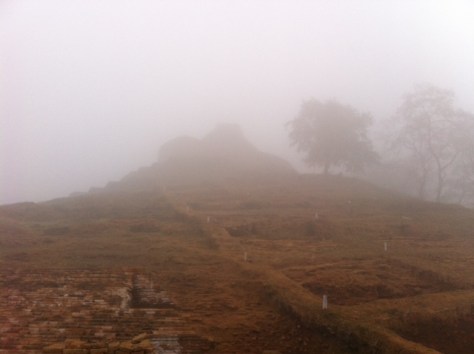
A recent work trip took me to the north-east of Bihar, the poorest region of a state with ‘critical’ poverty incidence by any measure. For instance, within the state, on NSS 2004-05 data, West Champaran is the worst-performing district on headcount ratios (76.9) in rural India (Chaudhuri and Gupta, Economic and Political Weekly, 2009). Such destitution was on ample evidence amongst the segregated group of mahadalit and minority women members of a self-help group we spoke to, in a tola with no electricity and only candles to dispel an eerie fog settled over the village at dusk. Of 13 of them, 11 had repeat experience (up to three times per woman) of losing a child in the last trimester of pregnancy, just after giving birth or of a child under 5 years of age.  It was from Champaran that Gandhi first led landless labour and tenants or ryots, in his first satyagraha against the British, protesting the coerced cultivation of the cash crop, indigo. Almost a century later, not much has changed in tangible terms for the population of this part of the democratic Republic of India. Continue reading “Welcome to the Land of Enlightenment”: Kaveri Gill

Real Estate of Religion:Satya Sagar

Guest Post by SATYA SAGAR


Several years ago a friend of mine filed a petition in the Indian Supreme Court against – believe it or not- the tenth incarnation of the Hindu God Vishnu! Or at least, against a fellow who claimed to be ‘Kalki Bhagwan’ and has in the past two decades drummed up a significant following in the southern part of India.

Blasphemous as the claim of this fake avatar was the court battle itself was not really about the finer details of Hindu mythology or theological doctrine.Based on several years of painstaking investigation and research it was my friend’s claim that ‘Kalki Bhagwan’, had taken money from the public for ‘rural development activities’ and fraudulently diverted it to his personal bank accounts as well as that of his close relatives.

From being an ordinary clerk working for the Life Insurance Corporation in Chennai thirty years ago today the ‘Tenth Incarnation of Vishnu’ is allegedly worth many million dollars and owns vast properties in many parts of South India. It is a trajectory that is tragically very common everywhere, with spurious spirituality – ironically also a form of ‘insurance’-being the fastest way to material wealth and power since ancient times. Continue reading Real Estate of Religion:Satya Sagar

Celebrating ‘Good Governance’ : Mary E John and Satish Deshpande

Guest post by MARY E. JOHN AND SATISH DESHPANDE

It seems odd to associate words like ‘mean’ and ‘petty’ with entities like states.  But it is hard to avoid them when confronted by the despicable attempt of the Modi regime to cancel or restrict the holiday for Christmas.  On the other hand, these words are far too mild to capture the poisonous malice behind this small-minded act that, despite its clumsiness, is clearly part of a systematic campaign to cultivate a culture of vicious aggression towards select “minorities”.

How should one respond to such pettiness, knowing that it is only the surface of a deep reservoir of violent hatred?  One could light heartedly point to the irony that 25th December happens to be the birthday of not only Madan Mohan Malviya (1861) and Atal Bihari Vajpayee (1924), but also a certain Mohammad Ali Jinnah (1876).

Alternatively, one could argue, in a spirit of liberal reasonableness, that Christmas has for long been much more than a holy day for Christians.  The secularisation of Christmas is apparent not only in its relentless commercialisation (much like Deepavali), but also in its longstanding status as a broader symbol of festive good cheer marked by giving and sharing.   Continue reading Celebrating ‘Good Governance’ : Mary E John and Satish Deshpande

Peace on Earth and Social Justice – Christmas greetings!

images

Protest at Delhi Police Headquarters after the burning of St Sebastian’s Church in Dilshad Gardens/ Image from The Indian Express

We observe Christmas today under the ominous cloud of Hindutvavaadi violence against minorities, which began on the very day of the BJP electoral victory seven months ago, and their determined attempt to obliterate all religious identities other than their own narrow version of Hinduism, a Hinduism that brutally excludes even large numbers of people who would consider themselves Hindu. From burning churches to physically attacking ‘Muslim-looking’ men, to trying to erase Christmas under the banal bureaucratese of Good Governance Day – Hindutvavaad has never had it so safe, never has it been so arrogant, as under the protective gaze of Modi, a Prime Minister who produces reams of flowery prose in his speeches, but through his public silence on these atrocities, satisfies both Hindutvavaad and his neo-liberal supporters – the one recognizing his benign encouragement, the other fooling itself that his silence shows displeasure. Continue reading Peace on Earth and Social Justice – Christmas greetings!

The Secular Stake- A Burden, or a Democratic Imperative? Sanjay Kumar

Guest Post by Sanjay Kumar

Mr Asaduddin Owaisi, the leader of MIM recently remarked in a media conclave that ‘Muslims are not coolies of secularism’. The statement made perfect sense for his politics. He is the leader a party that aims to mobilise voters on the basis of them being Muslim. The unprecedented success of Hindutva under Mr Modi in recent elections has upset many old electoral calculations, and opened new opportunities. Mr Owaisi is smelling a chance for the MIM to expand beyond its turf in Hyderabad, to regions where non-BJP parties have been getting the major chunk of Muslim votes with the slogan of secularism, seen principally as the promise of protection from riots. For Mr Owaisi, the remark serves multiple purposes. Average Muslim citizens are deeply disillusioned with a political process that has resulted in the utter marginalisation of their community.  For such voters, the statement is intended to clearly distinguish his party from the so-called secular non-BJP parties. It is calibrated to raise a doubt in their mind, why should only Muslims be expected to vote for such parties, when significant sections of the Hindus have sided with the communal BJP? It is also a preemptive answer to his political competitors and ideological critics, who are likely to accuse him of being communal.

Otherwise too, the secular discourse in India has largely become a minorities’ affair. It is said to be under threat when minorities are attacked. It is claimed to be flourishing when minorities rights are protected. A corollary belief among major sections of the so called majority community is that India  could have as well been non-secular if there were no minorities in the country, or if they are put in their place as the RSS political programme demands. Continue reading The Secular Stake- A Burden, or a Democratic Imperative? Sanjay Kumar

Converting Religion, Converting law: Rajshree Chandra

Guest Post by RAJSHREE CHANDRA

The right to freedom of religion  (Art. 25 of the Indian Constitution) in a country like India has a burden so extensive and a content so capacious that the same right functions both as an instrument of individual liberty As well as a mode through which the state intervenes to discipline and curtail religious freedom. It has a history so diverse and conflicted that the right often become a mode of settling quid pro quo battles between religious publics, and law often becomes hostage to the principle of ‘historical correction’.

There have been various modes of historical corrections. If the demolition of Babri Masjid was one, ghar wapasi – a return home to one’s religion – is another. The recent ghar wapasi episode in Agra, where RSS affiliate Bajrang Dal converted 57 Muslims to Hinduism; the proposed and then withdrawn conversion of Muslims and Christians in Aligarh on 25th December 2014 by the RSS’s Dharm Jagran Samiti; and the scheduled holy dip of an expected 50,000 “reconverts” (of the last five years) in the Godavari during the Kumbh at Nashik next August are instances and signs of the “re-conversion” rhetoric steadily mainstreaming itself. The question is how does the state and law respond to this?

‘Re-conversions’ are not new in Indian history. Katju & Sikand document instances of mass conversions of Muslims into Hinduism from 1947 onwards, and more forcefully and openly from the 1990s onwards, as part of the Shuddhi (purification) movement. The VHP, an adjunct of the Sangh, extols the practice of ghar wapasi and had claimed that over 200,000 Christians had been converted to Hinduism. The re-conversion argument – of shuddhi and ghar wapasi – is invoked by the various factions of the Sangh Parivar as a modus that aims to correct the history of conversions away from Hinduism.  Continue reading Converting Religion, Converting law: Rajshree Chandra

DISSENT, DEBATE, CREATE