आगमनी गा न सका!

धूप का कोण बदलने लगा है. और उसमें तीखापन भी बढ़ रहा है. क्वांर जो ठहरा. सूरज को भी अब लौटने की जल्दी रहती है. श्वेत पंखुड़ियों को नारंगी डंठल पर सजाए शिउली की नन्हीं बूंदों से सामने की ज़मीन का टुकड़ा  भरने लगा है. हवा में एक रहस्यमय गंध भरने लगी है. जैसे कोई प्रत्याशा तैर रही हो. कवि से शब्द उधार लूँ तो कह सकता हूँ, अनुभव से जानता हूँ कि यह शारदीय गंध है.

बेटी के मायके आने का मौसम. वर्ष भर की प्रतीक्षा के फलीभूत होने का समय. माँ की व्याकुलता के चरम पर पहुँचने का क्षण. बेटी आएगी तो? उमा, गौरा, पार्वती, माँ किन नामों से पुकारती रही होगी? और पिता हिमालय? कौन सा नाम दुलार का रहा होगा, डाक नाम? क्या माँ का अलग होगा और पिता का अलग?

मेना वार्षिक प्रतीक्षा करते हुए गाती है. गाते हुए रोती है और रोते हुए गाती है. बेटी पगली थी जो रीझ गई उस नंगे-बूचे पर. न घर का ठिकाना न खाने का जुगाड़. आते-जाते नज़र पड़ी और हठ पकड़ ली, रहूँगी तो उसी के साथ, नहीं तो यों ही जीवन गुजार दूँगी. खाना-पीना छोड़ दिया. क्या करते? एक ही बेटी ठहरी. ठान लिया सो ठान लिया. पिता को भी दिल कड़ा करके मानना ही पड़ा. दूल्हे के घर-बार, आगे-पीछे का कुछ पता नहीं. क्या करता है, कौन साथी-संघाती हैं! आखिर बेटी है, इतने दुलार से, जतन से पाला पोसा है, किसी भी ऐरे-गैरे के पल्ले ऐसे कैसे बाँध दें! पर नहीं साहब, बेटी ने मजबूर कर दिया. Continue reading आगमनी गा न सका!

Unwrapping the Soldier from the Flag – Kashmir after the Flood: Chirag Thakkar

Guest Post by Chirag Thakkar

Witnessing a culture of wounds trying to put itself together in times of a grave catastrophe is a difficult pursuit. For the archivist of State violence, the horror with which TRP-hungry television studios build a spectacle that is acutely wedded to a deep-rooted, pungent nationalism around catastrophe and relief in Kashmir, is frustrating. The insensitivity with which the Indian media has rubbed salt in the wounds of a people is appalling. One wonders if ours is a culture of calculated amnesia or of sightless apathy.
There is something very unique about the way in which we relate with the pain of the other. What is unique is the precision with which we reproduce perceptions about the masculine, hardened sons of soil – the security forces – and yet, at the same time, remain unmoved in failing to recognise the state of exception Kashmir has been in. What is also unique is how measured and stingy we are with our sympathy. Continue reading Unwrapping the Soldier from the Flag – Kashmir after the Flood: Chirag Thakkar

Uniform Civil Code – the women’s movement perspective

The BJP has once again raised the issue of a Uniform Civil Code (UCC) for all Indian citizens,  posed in a way that presents the BJP as ‘secular’ and pro-women, and opponents as communal or ‘pseudo-secular’ and anti-women. Since Independence, there has been very little change in the contours of the debate in the public domain, both within the BJP as well as among public intellectuals not necessarily aligned with the Hindu Right. The only change that has come about since the 1990s is that the UCC is now also posed as a ‘women’s rights’ issue and not only as a matter of national integrity, which requires the eradication of multiple legal systems. This new equation of ‘women’s rights’ with the UCC is at least partly a result of the interventions by the women’s movement in the debate in the 1990s. However, within BJP (and mainstream) discourse, it is assumed that only minority women need saving, for ‘we Hindus’ have already given ‘our’ women equal rights.

The women’s movement has developed this debate in complex and multiple directions over the decades, which this essay will briefly outline.

The debate over the UCC in contemporary India is produced by the tension between two notions of rights in the Fundamental Rights (Part III) of the constitution. The bearer of rights is both the individual citizen and the collectivity – the former is the subject of Articles 14 to 24 which ensure the individual’s rights to equality and freedom and the latter of Articles 25 to 30 which protect religious freedom and the educational and cultural rights of minorities [1]. It is from the latter that religious communities derive the right to be governed by their own ‘Personal Laws’. Since these Personal Laws cover matters of marriage, property inheritance and guardianship of children, and since all Personal Laws discriminate against women, the tension in Part III of the constitution can be read as a contradiction between the rights of women as individual citizens and those of religious communities as collective units of a democracy. Continue reading Uniform Civil Code – the women’s movement perspective

After the Flood: Sabah Hamid

Guest Post by SABAH HAMID

The pilot announces we’re approaching Srinagar. I have a window seat near the right wing, and I lean forward to look down. I always do this, trying to catch a first glimpse of the city I call home despite having lived away for more than half my lifetime now. Today, for the first time, I’m afraid of what I’ll see. The entire valley was flooded two weeks ago when the river Jhelum and then the Dal Lake spilled over. This is not the first flood to hit Kashmir, but nothing of this magnitude has been experienced in living memory. As we descend, I see a lot of large muddy tracts wherever I look. The elderly gentleman sitting in the aisle seat next to me mutters something, probably a prayer, and I turn to look at him. He shrugs resignedly, and I shrug back.

There are an unusual number of Indian passengers in the plane, and at the baggage carousel I am reminded of this again. It’s odd to have tourists so soon after the floods. I cannot make sense of it. Catching sight of a pair of fashionably dressed young women I wonder if they are the relatives of armed forces personnel stationed in the Valley.  It does not matter. I collect my lone suitcase, shoulder my backpack, and head to the pre-paid taxi counter. My parents live close by, just two kilometres away, and I am hoping to hitch a ride with someone if no taxis are available.

Exactly two Sundays ago though, when my parents, sister and young cousin landed in Srinagar, those two kilometres turned out to be very long indeed. Continue reading After the Flood: Sabah Hamid

A God by Any Other Name: Sumbul Farah

Guest Post by SUMBUL FARAH

The move from ‘Khuda Hafiz’ to ‘Allah Hafiz’, which Shireen Azam sees as a move towards Arabisation of subcontinental Islam is problematized by Nandagopal Menon when he questions if ‘Arabised’ Islam is an Islam ‘we do not like’. Menon’s argument provides some important ways of thinking about cultural assimilation, territorially bounded nationalisms and notions of piety central to Islam. However, it misses out on the important point that the project of ‘correcting’ belief is often premised on an exclusivist understanding of religious interpretation.

To emphasize the ‘correct’ usage might well in be accordance with Islamic notions of ‘islah’ and piety but unless we stop and question as to who is it that determines ‘correctness’ we risk aligning ourselves with the hegemonic narratives within Islam. The issue underlying the usage of ‘Khuda’ versus ‘Allah’ is not that the Indian version of Islam is somehow more desirable than an Arabised one owing to some notion of cultural nationalism, which is premised on modern nation-states; it is a questioning of the processes through which traditionally acceptable usages and idioms become marked out as ‘incorrect’ in the light of a hegemonic narrative. Particularly in the context of Islam, there is a tendency to seek a return to a supposedly ‘pure’ version of Islam, which in turn, means privileging the Arabian interpretation of Islamic beliefs and practices. Continue reading A God by Any Other Name: Sumbul Farah

Urgent demand to bring Normalcy to Vadodara: Letter to Commissioner of Police by concerned citizens

To Mr. E. Radhakrishan, Commissioner of Police, Vadodara.

Take concrete steps to bring normalcy in the city of Vadodara and take immediate action in the cases of assault on women by police.

Sir,

A team of social activists visited some of the affected areas on 27th September 2014 on the request of affected people.  A detailed report of our visit is under process  but after visiting the area we have personally discussed with you and informed you about the role of Police, (particularly plain clothes police, also known as D Staff). The police should prevent violence and arrest those who undertake violence. Instead many people particularly women, complained about the verbal abuse and physical assault on them by police. The marks of injury were visible on their bodies. You had promised to look in to the matter and assured us that this will not be repeated.

We are shocked to know that brutal police attacks continued on the night of 27th September 2014.

Continue reading Urgent demand to bring Normalcy to Vadodara: Letter to Commissioner of Police by concerned citizens

High Level Committee of Ministry of Environment and Forests and Climate Change walks out of Public Consultation in Bangalore: Press Release

High Level Committee of Ministry of Environment and Forests and Climate Change walks out of Public Consultation in Bangalore

The High Level Committee headed by Mr. T. S. R. Subramanian, former Union Cabinet Secretary, constituted by the Union Ministry of Environment and Forests and Climate Change to review environment, pollution control and forest conservation laws, invited the public at large for a consultation between 12 and 1.30 pm today (27th September) at Vikas Soudha, the high security office complex of the Government of Karnataka. Advertisements to this effect had been issued by the Karnataka Department of Forest, Ecology and Environment in various newspapers on 21st September 2014, followed up by various press releases inviting the public to interact with the Committee.

When various individuals and representatives of public interest environmental and social action groups turned up for the meeting, the police prevented their entry at the gates. It was only following a spot protest that the police consented to allow them to participate in the consultation. Despite this indignifying experience, all who gathered proceeded to the meeting hall with the intent of engaging with the High Level Committee.

Continue reading High Level Committee of Ministry of Environment and Forests and Climate Change walks out of Public Consultation in Bangalore: Press Release

#Hokkolorob – The Politics of Making Noise: Rajarshi Dasgupta

Guest Post by RAJARSHI DASGUPTA

We must not celebrate every time we see a movement. Movements can be very popular without being very meaningful, disturbing only the surface of society. Some can be pretty and harmless like candle light vigils; others dangerous and ugly like ‘love jihad’. Some want efficient governance like Hazaare; others regime change like Nandigram. For those tired with political apathy, it is of course good news that a spate of new movements is emerging thanks to new technologies and media coverage. But it is equally true that they seem to be going indifferent directions, without any common end. The picture is not clear. Who knows better than us how ‘change’ can be purely rhetorical? It is not difficult to imagine why people are weary of dramatic social unrest. They hardly fail to bring yet more conservative and unscrupulous sections to power. If we don’t want to get carried away, it is because of repeated disillusionments with the promise of change that everybody makes but nobody keeps. Politics is not, we better understand, about promise but manipulation, bargaining for daily needs, livelihood and resources, and so it should be. Movements may come and go like fashion, they are incidental to reality, which changes very slowly if at all. There is an institutional process of elections we have put in place, and it has proven to be resilient and reliable.

Bandh Bhengey Dao – Break All Bonds –
Lyrics and Music – Rabindranath Tagore & Asian Dub Foundation
From the Original Sound Track of ‘Tasher Desh’ a film adaptation by Q
of Rabindranath Tagore’s Joyous Anarchist Opera

Continue reading #Hokkolorob – The Politics of Making Noise: Rajarshi Dasgupta

Freedom and the University – Reflections from a Teacher: Rimi.B.Chatterjee

Guest Post by RIMI B.CHATTERJEE. Photographs by RONNY SEN.

Graffiti on Jadavpur University Walls. Photograph by Ronny Sen

There has been a lot of noise about the recent agitation at Jadavpur University, and a lot of slanted media coverage. Allow me to set the record straight on a number of points.

Continue reading Freedom and the University – Reflections from a Teacher: Rimi.B.Chatterjee

Prose of Power and the Poetry of Protest – An Outsider’s Attempt to Make Sense of the ‘Kolorob’ in Kolkata: Uditi Sen

Guest Post by UDITI SEN

51288650-29337-hokkolorob
#Hokkolorob – Embodied

It’s been more than a week since tens of thousands of students marched in a rain drenched Saturday in Kolkata, in solidarity with Jadavpur University students and their fight for justice. Much has happened since to delegitimise this mammoth, genuinely popular and student-led march. A counter-march, the co-optation of the victim’s father by the ruling party, adverse propaganda in the press and fatigue and confusion amongst the protestors have been some of the dampening developments that followed the unexpected show of student power. True to their clarion call, hok kolorob (let there be clamour), the marchers made a lot of noise. A week later, as the numbers of protestors on the streets have dissipated as fast as they had congregated, it is perhaps time to step back from the euphoria of the gathering and the intimidation and murky co-optation of protest that followed, to reflect on the political meanings and potential of this uprising.

The march was not organised by any single political party, though many with experience or background in student politics of one ilk or the other, marched. The vast majority, however, were students who had never marched before and had no experience of politics. The question therefore arises, what, if anything is the unifying ideology of this body of protestors? What goals motivate them? Above all, the question that is doing the rounds the most, on social media, on mainstream news and on the streets is what are the politics of the protestors? The question of politics is seldom posed directly. Its ubiquitous presence, however, can be clearly read in the answers provided regarding the nature of the march, the motivations of the protestors and the identity of the marchers. Unsurprisingly, diametrically opposite sets of answers emerge from members of the ruling party, inside and outside Jadavpur University; and the people who took to the streets on Saturday. From the Vice Chancellor, the Education Minister and officially ordained leaders of the ‘youth’, such as Abhishek Banerjee and Shankudeb Panda, characterisations emerge that focus on indiscipline on campus, presence of Maoist and other outsiders and deep conspiracies. From students of Jadavpur University and their sympathisers, assertions emerge that this protest is about justice and not about politics. Both characterisations fail to capture what is at stake.

Continue reading Prose of Power and the Poetry of Protest – An Outsider’s Attempt to Make Sense of the ‘Kolorob’ in Kolkata: Uditi Sen

Terror, Performance and Anxieties of Our Times – Reading Rustom Bharucha and Reliving Terror: Sasanka Perera

Guest Post by SASANKA PERERA

[ This post by Sasanka Perera is a review of  Terror and Performance by Rustom Bharucha (2014). Tulika Books, New Delhi. Kafila does not ordinarily post book reviews. An exception is being made for this post because we feel that the subject of terrorism, which has interested Kafila readers in the past, is an important one, and needs to be thought through with seriousness. We hope that this post initiates a debate on Kafila regarding terror, the state, performance, and the performances – serious, or otherwise – that typically attend to the discussions of terror, whether undertaken by the agents of the state or by non-state actors, commentators in the media, or by intellectual interlocutors. ]

When I started reading Rustom Bharucha’s latest book, Terror and Performance, it immediately became an intensely personal and gripping engagement. It was difficult to read in a single attempt as the mind kept wandering from one unpleasant moment in our recent annals of terror to another in some of which I had also become an unwitting part – mostly as a spectator. From the beginning, my reading was a conversation with Bharucha’s text through detours of my own experiences and an interrogation to a lesser extent. In 1986, as a young man when I went to the Colombo International Airport to pick up my father who was returning from the Middle East, I was shaken by a tremendously loud sound for which I had no immediate references. I had not heard such a sound before. People started running towards the sound. It was a bomb that had blown up an Air Lanka flight which had come from Gatwick. The Central Telegraph Office in Colombo was bombed in the same year. We learnt that everyone was running towards the sound and not away from it. Dry local political humor very soon informed us that people were trying to get inside the bombed out telegraph office hoping that they could get free phone calls to their relatives in the Middle East as they had heard phones were dangling from the walls with no operators in sight. That was long before mobile phones and call boxes. We were still young in terms of our experiences with terror. However, we soon had very viable references to what all this meant as the political narrative of Lanka unfolded with devastating consequences. But in 1986, when the kind of terror that was to follow in all its fury was still relatively new and quite unknown, we were acutely unaware of the dynamics of the actual act of terror and the structure of feeling it could unleash. This is why many of us in these initial years were naively attracted towards the epicenter of the act rather than being mindful to run away from it. But as the society grew in experience, people soon learned their lessons. Though an academic text in every conceivable way, I was reminded one could always find a few rare books of this kind which might personally and emotionally touch a reader in addition to whatever intellectual stimulation it might also usher in. Terror and Performance is clearly one such book. From the perspective of the writer, Bharucha himself recognizes this personal emotional engagement and investment early in the book. For him, “this writing demands stamina as it faces an onslaught of uncertainties and cruelties at the global level that challenges the basic assumptions of what it means to be human” (xi). It is the same kind of stamina that one also needs to read it as most of us in South Asia would be reading it squarely sitting in the midst of our own worlds of unfolding terror. This is why all those thoughts came gushing into my mind throughout the reading. I was not only reading Bharucha; I was also reading my own past.

Continue reading Terror, Performance and Anxieties of Our Times – Reading Rustom Bharucha and Reliving Terror: Sasanka Perera

‘Red Carpet’ in Forests: Kamal Nayan Choubey

Guest post by KAMAL NAYAN CHOUBEY

16737_32027

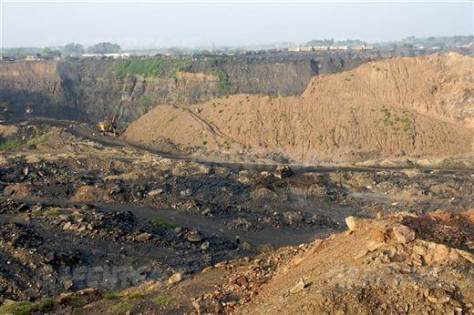
View of the Rajapur Mining Project in Jharia from Bokahapadi village

The Narendra Modi led National Democratic Front (NDA) government had promised, even before its inception, to increase investment in the country and lay down the ‘red carpet’ for investors and corporates. The process of fulfilling that promise started with the formation of NDA government and under the leadership of Mr. Prakash Javadekar, the Ministry of Environment and Forest (MoEF) working overtime to ensure huge investment in the forests for the high growth rate of the economy. Within hundred days of the formation of the government MoEF has given environmental clearance to 240 of 325 projects that had been in limbo as the previous government slowed down the process of giving clearances to various projects due to a variety of reasons. The Government has estimated that these clearances would lead to the investment of 200,000 crore rupees and it would help to revive the economy. In this whole process, the Forest Advisory Committee (FAC) decided on the diversion of 7,122 hectares of forest land into revenue land for the various development projects. It is pertinent to ask, has Modi Government followed the procedure established by law while taking these decisions? Are these decisions in consonance with the promise BJP made to the tribal population, of more decentralized power? Could these decisions empower those communities who have been facing historical injustice from both colonial and post-colonial Indian state? Can we say that this kind of development model would work as a long term strategy to control Maoist violence in the most of the tribal dominated forest areas? Continue reading ‘Red Carpet’ in Forests: Kamal Nayan Choubey

Have the Gods Fled Their Own Country? Mohan Rao

Guest Post by MOHAN RAO

kathakali-performance-in-stree-vesham-in-mumbai

I returned a few days ago after four wonderful days in Trivandrum – having gone back there after some thirty years. Looking over Trivandrum from my seventh floor hotel room was a wondrous sight for sore eyes, a thick lush greenness everywhere. Hardly any high rises, an occasional mosque, temple or church rising above the green.

Going for a walk the next morning, around the medical college area, it was vastly reassuring to still see some old bungalows, and a number of ugly new ones of course. But not that many apartment blocks. Unlike Bangalore, the ones that have come up are not named Malibu Towers or Sacramento, but Revi Apartments.

Yes, it was wondrous to see Lakshmi still spelt Lekshmi and Ramya, Remya. Continue reading Have the Gods Fled Their Own Country? Mohan Rao

Remembering Maqsood Pardesi

Shiite_Calligraphy_symbolising_Ali_as_Tiger_of_God

On 23rd September 2014 Maqsood Pardesi lost his life. He had gone to the National Zoological Gardens in Delhi to meet a tiger. The tiger killed him. He was 20 years old. Maqsood worked as a daily wage laborer and lived with his family under the Zakhira flyover in central Delhi. He is survived by his father Mehfuz Pardesi, his mother Ishrat, his brother Mehmood and his wife Fatima.

There are conflicting reports as to how Maqsood found himself en face a tiger. Several reports state that, despite being discouraged by a guard on two occasions, he managed to climb into the tiger’s enclosure when the guard’s attention wavered. Some reports suggest that he accidentally fell into it. The authorities have vigorously denied the possibility of accidental entry and contested the assignation of blame on the zoo, or the tiger, for Maqsood’s death. Other reports have dwelt on Maqsood having a history of mental illness. Some state that he was drunk when he entered the enclosure. Some claim that he threw stones at the tiger, lost his balance and fell. Like the dissection of Maqsood, there has been speculation about Vijay, the tiger. The zoo authorities defend against charges that Vijay is aggressive. The tiger is not at fault many say: how can it be held responsible for the death of a man who enters its enclosure? The head zoo keeper has said, “Maqsood was mentally unstable otherwise why would a sane person jump into the tiger’s enclosure.” Why indeed? Continue reading Remembering Maqsood Pardesi

Let the flower bloom in Jadavpur: Arindam Majumdar

This is a guest post by ARINDAM MAJUMDAR

Last week the columns of many newspapers took a comprehensive look at the imbroglio that has gripped Jadavpur University and concluded that the movement was a backdoor attempt by the beleaguered Left to crawl its way back into the political arena of the state. In doing so, they have unwillingly lend political colours to a movement that has been a silver lining amidst the dark cloud of indecency that has almost but killed the political environment of Bengal, once revered for its Bhadrolok culture and statesman leaders.

Student unrest in college campus is not a new phenomenon in Bengal. This community has always been politically aware and has not hesitated to stand up against any form of oppression or state sponsored violence. In the 1960s when the US forces invaded Vietnam, cries of Amar naam, tomar naam, Vietnam echoed in the anti-war demonstrations in the streets of Kolkata and the students were at the forefront of it. During the heydays of Naxal movement in 1970s, college students, including that of Jadavpur University, participated in the bloody street battles of Kolkata. This author does not intend to dwell on the motives behind those violent days, but it cannot be denied that brilliant students left behind their secure career and dreamt of turning a system, that they considered as oppressive, upside down. Continue reading Let the flower bloom in Jadavpur: Arindam Majumdar

Koni koni chhe Gujarat: Rita Kothari

Guest post by RITA KOTHARI

[‘Koni koni chhe Gujarat’ is a poem by Narmadashankar Lalshankar Dave, popularly known as Narmad, who is understood to have introduced the notion of Gujarat in the 19th century, by identifying the region of Gujarati-speaking people. In the poem ‘Koni koni chhe Gujarat’ Narmad wrote that Gujarat belongs to people from different religions and also to those who belong to other parts of the country or globe.]

In 2006, St.Xavier’s College in Ahmedabad (where I then taught) hosted a conference on “Ahmedabad: Past and Present.” Towards the end of the conference a panel discussion focused on religious, linguistic, and other minorities to discuss how for instance, Jews, Muslims, Christians and Parsis felt about the city. Did they feel they belonged to the city, was their experience of citizenship complete, the panel moderator had asked. It was saddeningly clear that Ahmedabad, despite being multi-religious and multi-ilingual, did not hold the same social meaning and comfort for all. The reasons why this city, like some others, has been losing its historical contours of experience and pluralism are not far to seek. Some of the answers could be found in the history of Ahmedabad by Achyut Yagnik and Suchitra Sheth. I would only be reiterating the familiar and well established story of a majoritarian hegemony that has transformed lives irrevocably. Anyway, of the many stories that emerged during this panel, one in particular stayed in mind, reappearing intensely at some times, but receding again in ‘normal’ times.

Continue reading Koni koni chhe Gujarat: Rita Kothari

#Hokkolorob – Images from a Jadavpur Solidarity Meeting in Jantar Mantar, Delhi

Here are some images from a  meeting held in solidarity with Jadavpur University Students at Jantar Mantar, New Delhi, on Thursday, September 2014. Students from Delhi University, Jawaharlal Nehru University, Jamia Millia Islamia, Indian Institute of Mass Communications, teachers and professors from different universities in Delhi, Jadavpur University Ex-Students, Workers and Professionals from the Delhi NCR Region spoke at the meeting. A signature campaign was undertaken, and the assembled people wrote their statements on to a scroll in support of their friends at Jadavpur.

All Photographs are by Akhil Kumar, Youth Ki Awaaz. 

This slideshow requires JavaScript.

Khushi Ram, a terminated worker from the Maruti Suzuki Factory at Manesar had come from Haryana to express the solidarity that the workers of the Delhi-NCR region have for the students of Jadavpur University. He read a poem at the gathering. Kafila caught up with him as the meeting was about to end. Here is a video of him reading his poem for the readers of Kafila, and a brief record of a conversation with him about solidarity between workers and students.

Indian tea is laden with pesticides: Greenpeace India

downloadTrouble Brewing – Pesticide Residues in Tea Samples is the result of an investigation carried out by Greenpeace India to understand the situation concerning the use of pesticide usage in tea, which is a quintessential part of Indian culture and critical to the economy. The study has found residues of hazardous chemical pesticides in a majority of samples of the main brands of packaged tea produced and consumed in India. Over half of the samples contained pesticides that are ‘unapproved’ for use in tea cultivation or which were present in excess of recommended limits. The report underscores possible implications for health and the environment, which is both unnecessary and avoidable. While it highlights the fact that the tea industry is stuck on a pesticides treadmill, it suggests that tea companies, which are critical stakeholders in the tea industry, take the necessary steps in moving away from pesticides while adopting a holistic approach is best way forward. Continue reading Indian tea is laden with pesticides: Greenpeace India

Missing Person Notice: Ben Zachariah

Guest Post by Benjamin Zachariah

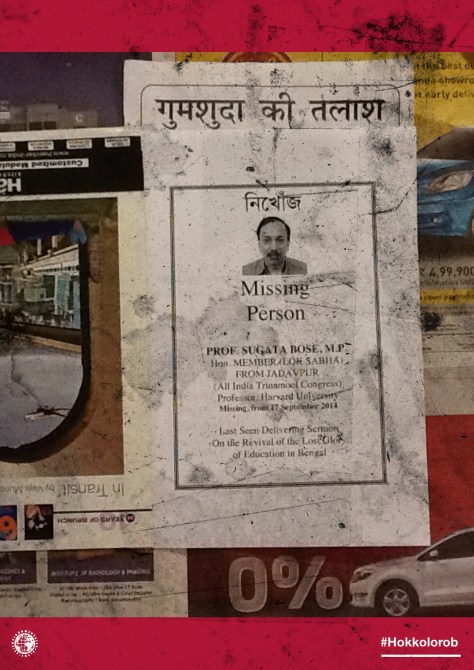
Looking for Prof. Bose

It was not so long ago that Sugata Bose, now Lok Sabha Member for Jadavpur, made his way back from Harvard to serve his people. West Bengal had voted for ‘poriborton’, ‘change’, and as everybody assumed that Bengalis loved their fellow-men who had been anointed abroad, Sugata Bose returned to conquer the heights of Bengali higher education. The plan was to use a brand name within a brand name to shore up another brand name : Harvard, Netaji, Presidency. The Trinamul Congress, Bose was confident, would not interfere with his plans. Or so he said in public; his mother, Krishna Bose, had been the Trinamul Congress’s Presidential candidate, and long regarded as the force behind the attempted bhadramahilafication of Didi, apparently a prerequisite for political acceptability in West Bengal (otherwise known as Waste Bengal or Poschimbongobongo). It was therefore no surprise that his plans did not diverge from the plans of the TMC, although ‘internal differences’ were often heard of. It was also no surprise that, as the attempts to turn Presidency ‘University’ into the font of moral and intellectual legitimation for the TMC faltered, Bose took the mantle of his great-uncle upon himself and stood as a candidate for the TMC in the Lok Sabha elections, from the Jadavpur constituency. There was not even the pretence that Sugata Bose stood on his own credentials: his campaign marches were led by a child in Netaji uniform and Netaji glasses, prompting a complaint to the National Commission for Protection of Child Rights.

Now, in the Jadavpur constituency, duly won by Netaji’s heir, and not by a hair’s breadth, developments at Jadavpur University are cause for concern.

Continue reading Missing Person Notice: Ben Zachariah

Note of Solidarity with the Students of Jadavpur University: Jagriti

Guest Post from Jagriti, Women’s Development Cell, Bharati College, Delhi University

(The authors of this post sent it to us at Kafila saying –  “…since we don’t have any direct mean of contacting them (Students of Jadavpur University), we wish to do so through, if possible, your website”. Accordingly, we are uploading this post to honour their wishes and their sense of solidarity)

Dear students of Jadavpur University (JU),

We, members of Jagriti, the Women’s Development Cell of Bharati College, University of Delhi, pledge our support to your struggle for gender justice and administrative and pedagogical accountability. We are deeply disturbed to receive news of administrative indifference to sexual harassment and of the consequent police brutality in JU campus. We unanimously and unequivocally condemn JU administration and the West Bengal police for ignoring students’ valid demands and for orchestrating violence onto students.

In iterating our support to you, we iterate also the belief that the entire administrative mechanism of JU failed to protect its own students. We hold the Vice-Chancellor (VC) and the Dean of Students responsible for not ensuring that the students’ demands were satisfactorily addressed; we also hold the Internal Complaints Committee responsible for letting what could have been only a campus-specific issue escalate into a major humanitarian and academic crisis. This incident is a lesson not just for JU but for educational institutions and workplaces globally to comprehensively commit themselves to gender justice and to accountability. University administrations are in anyway obliged to engage with their students in healthy and open dialogues on each and every issue that the students, persons whom the university is supposed to service, feel pertinent, and to do the complete opposite, to break down all communication and instead call armed police personnel to violently disperse students is totally unacceptable. JU has been known nationally as well as internationally as a hub of free and liberal thinking, and this shocking attempt to choke dissent out of it attracts our unstinting condemnation.

We support your demand for the non-extension of the tenure of Mr. Chakrabarti, the current interim VC. This issue is political, but it does not belong to any political party, and we commend your transcending political barriers in pursuance of your struggle against the JU administration. We commend your courage, strength and commitment to gender justice and to human rights, and offer our condolences for the losses which you have suffered these past few days. Through this note, we also appeal to the Governor of West Bengal to initiate a magisterial enquiry into the police brutality on JU campus, and have all officials, JU as well as police, who ordered this dismissed from service and tried in a court of law for gross dereliction of duty and for grievous injury to innocent lives.

Jagriti unanimously stands in solidarity with the complainant and the students of Jadavpur University.

This post was sent to us by Pallavi Rohatgi on behalf of Jagriti at Bharati College, Delhi University.


Jadavpur’s Infectious Autumn Thunder Goes Viral: Kasturi

Guest post by Kasturi

One of the slogans churned out of the womb of turbulent Paris in the Maydays of 1968 was ‘Don’t trust anyone over 30’. The student uprising of May ‘68 with its audacity and exaggeration might have failed. Yet the mahamichhil (grand rally) called by students which took command over the heart and pulse of Kolkata on 20th September was a literal, vivid, living embodiment of this slogan. As I stood with a video camera on a spot on the Jawaharlal Nehru Road, with hope to capture the moments and 50,000 faces that made history with each footstep, all I could see was an ocean of people most of who had perhaps not even reached their twenty fifth year, and many of who were walking their very first rally. Those slightly older, those weathered yet young at heart paced alongside them in solidarity. ‘Such a student gathering – so huge, determined and disciplined – I have not seen in my life’, wrote poet Sankha Ghosh, ‘This really moved me. It’s very early to say if this will mark the beginning of a new era but I will reiterate this is one of the biggest student rallies I have seen in my life’.

The rally was replete with slogans reflecting basic demands of the movement, but there was a unifying chant, rather a call to action, that instantly bonded with and caught the fancy of the first timers that hit the street – Hok, Hok, Hok Kolorob (‘let there be clamour’). A call, ripped off from a popular song by Bangladeshi singer Ornob and used as hashtag on social media to mobilize – was surreal, refreshing, imaginative enough to break the deafening silence, stupor and suffocation strangling students’ aspirations for democracy, freedom of expression and association across education campuses of Bengal. The other interesting aspect of this call was that unlike regular slogans where someone leads and the rest follow, here there was no single lead but many voices all chanting the four words in unison, accompanied by clapping of hands. As a comrade observed, ‘the zeitgeist and slogan of the contemporary present is #hokkolorob’!’ (‘Kolorob’/ ‘kalrav’, roughly translated here as ‘clamour’, conveys the sense of a symphony of birdsong in many Indian languages.) Continue reading Jadavpur’s Infectious Autumn Thunder Goes Viral: Kasturi

DISSENT, DEBATE, CREATE