Tag Archives: Ambedkar

Statement on the Murder of Three Young Persons in Badaun and Pune: P.A.D.S.

People’s Alliance for Democracy and Secularism (P.A.D.S.)  Statement on the murder of three young persons in Badaun and Pune
 
 
While introducing the Draft Constitution in the Constituent Assembly, Dr B. R. Ambedkar had observed, “Democracy in India is only a top-dressing on an Indian soil, which is essentially undemocratic.”  The same continues to hold true sixty four years later. A few weeks ago the people of India participated in the largest-ever election of their representatives in a largely free and fair process. However, other events since then have revealed the shallowness of this democratic top-dressing along with the tyrannical side of our society and polity.
 
On 27 May two girls aged 12 and 14 from an oppressed caste family of Katra Sadatganj in Badaun district of UP were sexually assaulted and killed when out to answer nature’s call. The rapists, belonging to the local dominant caste, hung their bodies from a tree in a public display of their power.
 
On 2 June in Pune, twenty-eight year old Mohsin Shaikh, an information technology professional was beaten to death by a group of men belonging to an outfit called Hindu Rashtra Sena. The killers even celebrated their cruelty in messages declaring that the ‘the first wicket is down’.  

Continue reading Statement on the Murder of Three Young Persons in Badaun and Pune: P.A.D.S.
1933 of 2014 ? : Time to break New Grounds in Confronting Communal Fascism

( To be published in the coming issue of ‘Critique’ a magazine published by  ‘New Socialist Initiative’s Delhi University team )

The Jew as well as the Christian, the Hindu no less than the Muslim ‘fundamentalist’ plies an ideology of superior difference. Each confronts an inferior and threatening Other . Each engages in the politics of exclusion. Hence each poses a menace to the minority communities within its boundary…For the Muslim militants the Other are the Jews, occasionally Christians and, in South Asia, the Hindus, Christians, and Ahmedis. I know of no religio-political formation today which does not have a demonized, therefore threatened, Other.

The Other is always an active negation. All such movements mobilize hatred, and often harness unusual organizational effort to do so. ..

The cult of violence and proliferation of enemies are inherent in ideologies of difference. All express their hate for the Other by organized violence. All legitimize their violence with references to religion and history. In nearly all instances the enemy multiplies. At first, the Indian Parivar had the Muslim Other for target. It has now turned on Christians.

Profile of the Religious Right – Eqbal Ahmad (1999)

I.

Masks and the Man

Child’s fantasies are endless and unimaginable.

It will wear a mask of a tiger and start ‘scaring’ it’s near and dear ones with a growl and the very next moment would imagine itself to be flying in the air with the mask of a Spiderman. Have you ever noticed any adult -may be completely stranger to the kid – getting annoyed with such tantrums of a child. Definitely not.

What will happen if you tomorrow discover the same group of adults or similar physically grown-up people moving on the streets or herding together wearing similar masks or identical masks? You will have sincere doubts about their mental faculties and if possible, would love to advise them that they consult the nearest psychiatrist. Continue reading 1933 of 2014 ? : Time to break New Grounds in Confronting Communal Fascism

Pabnava to Natham: Whatever Happened to the Struggle for Annihilation of Caste!

ImageDalit residents of Pabnava, district Kaithal, Haryana would never be able to forget this year’s birth anniversary of Dr Babasaheb Ambedkar. The intervening nights of April 13 and 14 would forever remain etched on their minds. They still shiver when they remember how a four hundred strong mob of the local landowning community called Ror Marathas, armed with spears, batons and other sharp edged weapons, attacked the basti and ransacked more than 200 houses and left 6 dalits injured. It was supposedly to avenge the ‘dishonour’ wrought on them by a dalit youth who had dared to marry one of ‘their girls’.

To quote Raji, one of the victims, ‘..they came like a tornado’.

One could easily notice simmering tension in the village since a few days, as news had come in that Meena (21) daughter of an influential Ror Maratha from the village called Pirthi Singh had married a dalit boy Suryakant s/o Mahendra Pal and had eloped with him. Continue reading Pabnava to Natham: Whatever Happened to the Struggle for Annihilation of Caste!

Communal Fascism in Action: Coopting the Dalits, Terrorising the Minorities

Ur-Fascism [Eternal Fascism] is still around us, sometimes in plainclothes. It would be much easier for us if there appeared on the world scene somebody saying, “I want to reopen Auschwitz, I want the Blackshirts to parade again in the Italian squares” Life is not that simple. Ur-Fascism can come back under the most innocent of disguises. Our duty is to uncover it and to point our finger at any of its new instances – everyday, in every part of the world.

-Umberto Eco


Introduction

Politics in this part of South Asia unfolds itself in very many ways. We have before us a spectrum of regimes ranging from electoral democracies at one end to countries which could be said to be unambiguously authoritarian at the other, and some others with varying  mixes of electoral democratic and authoritarian features ‘packed in between.’ Since early 1980s we have also been witness to an emergence of right-wing populist parties and movements throughout a growing number of these countries. Appealing to public anxieties in the wake of rapid economic change, these movements have succeeded in mobilizing and exploiting popular resentments against immigrants, minorities, and the political establishment.

The eighty seven plus year journey of Rashtriya Swayamsevak Sangh (RSS) – loosely translated as ‘National Volunteer Corps’ – an organisation of Hindu males, working for Hindutva and which wants to usher into Hindu Rashtra can also be looked at in this context. Continue reading Communal Fascism in Action: Coopting the Dalits, Terrorising the Minorities

Modi’s Social Engineering

The system of untouchability has been a goldmine for the Hindus. This system affords 60 millions of untouchables to do the dirty work of scavenging and sweeping to the 240 million Hindus who are debarred by their religion to do such dirty work. But the work must be done for the Hindus and who else than the untouchables?

– Dr. B. R. Ambedkar

 Whether Shit Collection or cleaning of gutters – which has condemned lakhs of people to a life of indignity since ages – could be considered a ‘Spiritual Experience.’ Definitely not. Everybody would yell. Well, Mr Narendra Modi, chief minister of Gujarat, has a different take on this, which he mentions in the book ‘Karmayog’ (Publication year 2007). Continue reading Modi’s Social Engineering

Theories of Oppression and another Dialogue of Cultures: Ashis Nandy

This is the text of the Ambedkar Memorial lecture delivered by ASHIS NANDY at the India International Centre on 14 April 2012, under the auspices of Ambedkar University, Delhi.

It was published in Economic and Political Weekly, July 28, 2010

Every generation likes to believe that it is living in momentous times, witnessing the death of one world and the birth of another, negotiating what pre-war Bengali writers used to grandly call yugasandhikshana, the moment when two epochs meet. This generation of Indians too believes that it is seeing such changes and even participating in them. Perhaps they are. However, I shall argue here that, along with transitions in society and politics to which they like to stand witness, there are transitions in cultures of knowledge and states of awareness of which they may be gloriously innocent. And they perhaps try to protect that innocence. The categories we deploy to construe our world images are parts of our innermost self and to disown them is to disown parts of ourselves and jeopardise our self-esteem. Even when we struggle to shed these categories, they survive like phantom limbs do in some amputees. Or perhaps they survive the way one of Freud’s three universal fantasies, the one about immortality, does. When you imagine yourself dead, you are still there, fully alive, looking at yourself as dead. Continue reading Theories of Oppression and another Dialogue of Cultures: Ashis Nandy

Learning gender, learning caste: two reflections

We received two brief submissions separately sent by two women, reflecting on incidents in their childhood or youth that returned to haunt them more recently. Rethinking, reworking their own sense of self, they present before us questions both timely and urgent.

AYSHWARIA SEKHER looks back on her ignorance of caste, PRANETA JHA revisits a childhood game that taught her about sexual violence.

AYSHWARIA SEKHER

I was seventeen, and an undergraduate when I met this friend at hostel.  She was from a southern district of Tamilnadu almost near Kanyakumari. I was always amused by her southern dialect and teased her immensely, for it was very different from what I was used to speaking, being a northerner. She lived next door at hostel, so we got into conversations every time we bumped into each other. One evening she was sweeping her room and cleaning it.  I stopped by to see the way she swept so I could bully her.  As I observed I did realise that she was so much better than me at it and did it with ease. As we got talking, she revealed that she always did it at her home, and it was not a task for her.

Ignorantly I enquired why they did not have a help at home, which according to me was something that every household possessed. She looked at me, and brushed aside the question plainly, saying simply that they just didn’t have any help. I pestered with the question giving her no space. She stopped sweeping and rested her hand against the wall and said that people would not come to her house to work. I was amazed at why people would not go to a home for work.  So my cross questions persisted and she had no choice but to answer.

Continue reading Learning gender, learning caste: two reflections

Defying Manu, Bowing to Mammon

On The Silent Emergence of Dalit Capitalism

It was 14 th April 2012, when dalits in different parts of the country (as well as abroad) were celebrating 121 st birth anniversary of Babasaheb Dr Bhimrao Ambedkar, the legendary son of the oppressed. Thousands of  people had congregated at statue of Dr Ambedkar situated near Parliament itself as they have been doing on every such occasion. It was a festive type of atmosphere where one could find book stalls on the way – where one could browse through books on different topics all geared to bring about a social transformation in India – cultural performances by small groups going on uninterruptedly, volunteers had put stalls to provide water to all the visitors.

And Delhi was no exception. One could witness similar gatherings in different parts of the country where people gather on their own to celebrate the life of Dr Ambedkar. Close watchers of such gatherings – where state patronage is not the deciding factor – would emphasise why this phenomenon need to be closely understood and comprehended by sociologists of our times that even fifty six years after his demise there has not been a let up in his popularity. In fact, he happens to be one of those rare leaders of the first half of 20 th century whose birth anniversary as well as death anniversary is still celebrated as people’s festival.

On this day at a place not very far from the ongoing celebrations in Delhi a different type of meeting was being held which was attended by a motley combination of dalit activists, dalit enterpreneurs as well as few top bureaucrats. It was an occasion to float DICCI Venture Capital Fund, (DVCF) a For-Profit company whose aim was to support India’s Dalit entrepreneurs. In fact, 121 smartly dressed Dalit entrepreneurs cut a 121-kg birthday cake in honour of B R Ambedkar, and announced the launching of the (VC) fund. Continue reading Defying Manu, Bowing to Mammon

Cast Away Caste – Breaking New Ground …

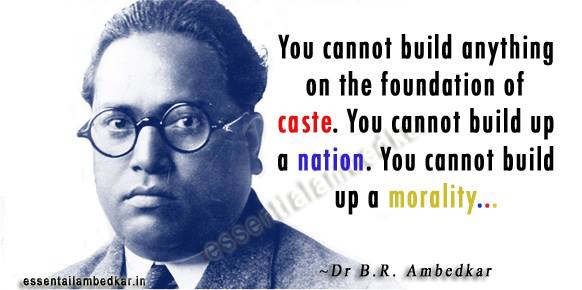
‘Turn in any direction you like, caste is the monster that crosses your path. You cannot have political reform, you cannot have economic reforms unless you kill the monster.’

Annihilation of Caste, Ambedkar

‘If Lenin was born in India , he would not have even  let the idea of revolution come to his mind before he had completely  buried casteism and untouchability’

– Ambedkar

1.

The Indian left today presents a very contradictory picture. As opposed to many left formations/movements in different parts of the world which witnessed decline/3reverses after the Soviet collapse, it has been able to sustain itself and at places even expand itself. Yes, the movement is far from united, there are ruptures and divisions at various levels, which at times even prove deadly, but if one is able to look at the cumulative impact of what is known as left and contrast it with many other countries, situation does not appear that bleak.

It’s sustenance and continuation amongst heavy odds, does not mean that it is not beset with challenges. The challenge of outlining its emancipatory vision of social transformation for 21 st century, devising innovative strategies of mobilisation and rejuvenating itself organisationally still remains. It also needs to reboot itself to address few important issues which are of key importance for any radical restructuring of Indian society and state. Undoubtedly, its failure on this count has cost it heavily. Question of dalit emancipation or the whole struggle for annihilation of caste forms one such core issues which demand serious attention. Continue reading Cast Away Caste – Breaking New Ground …

This, that and other cartoons: Prabhat Kumar

Guest post by PRABHAT KUMAR

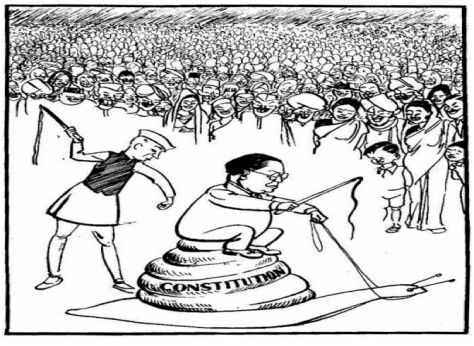
I wish to intervene in the ruckus over usage of Shankar’s cartoon in the NCERT’s political science text book. At the outset I want to clarify my personal impression (although inconsequential!) of the book and the cartoon therein. I feel the textbook in general is pedagogically superior to the previous ones for it does not infantilise young students as lacking critical ability. I also believe, as Aditya Nigam has rightly pointed out, it has accorded Ambedkar the status of a leading political and intellectual figure so far ignored. The cartoon in particular, both in the context of the narrative of the textbook as well as of its production in 1949, is not attacking Ambedkar the crusader of Dalits’ rights.

Continue reading This, that and other cartoons: Prabhat Kumar

Red Herrings, Red Rags and Red Flags – Once More on the Cartoon Controversy

With the recent article by Prabhat Patnaik, the controversy over the ‘Ambedkar cartoon’ issue has now moved into a different terrain. In this important statement, Prabhat undertakes the task of pointing out the numerous red herrings that have entered into the debate. These include  ‘freedom of expression’ and ‘sense of humour’ and the question of  whether Ambedkar had actually seen and let pass this cartoon. Prabhat’s point about the changed sensitivities and increased audibility of the dalit movement today is also well taken.

We must also be thankful to Prabhat for stating his views so candidly over the past few years, on a number of critical issues ranging from Nandigram and the electoral defeat of the Left to the ongoing cartoon controversy. We must thank him because  because in my opinion, all his positions on these disparate sets of issues are of a piece and take us to the very heart of the impasse, not merely in the Left but in our politics itself. But before I respond to some of the issues raised by Prabhat, let me restate my positions on some aspects of the ongoing controversy. This is also necessary in order to identify what exactly it is in Prabhat’s piece that is so disturbing.

 Dalit Response and Hurt Sentiments

In its initial phases, the cartoon issue was certainly a ‘dalit issue’ – even if it was raised only by a section of the dalit political leadership and intelligentsia. Very soon, however, it became clear that there was a more cynical game being played where the most corrupt and compromised sections of our politicians – especially those in parliament – were using Ambedkar as a shield, in order to deflect the blows that were actually aimed at them. The amazing unity of purpose and determination displayed by the parliament has rarely been seen in recent times; nor has the love for Ambedkar ever been expressed with such vigour.

These circumstances give enough reasons to suspect that the game had already changed by the time it reached the parliament. Not many people may have noticed but it was a Congress MP (an official spokesperson in Madhya Pradesh) who raked up a long dead issue of the book by Arun Shourie (Worshipping False Gods), demanding that it be banned. Continue reading Red Herrings, Red Rags and Red Flags – Once More on the Cartoon Controversy

An Unrecorded Festival – Pictures from Parliament Street: Siddhi Bhandari

April 14 was Ambedkar’s birth anniversary. There is no single pan-India political icon, certainly not Gandhi, whose birth and death anniversaries are celebrated as public festivals, by the public, in the way the Ambedkar’s is. Some newspapers on 15 April typically had photos of the top leaders of the country paying homage to Ambedkar but that’s about all. When historians turn these pages they will not find, in the first drafts of history, any reports about how people celebrated Ambedkar’s birthday like a festival. They will not find a record of the singing and dancing, of drums and plays, of Dalit housing socities and employees’ unions holding celebrations bang under the nose of the Indian Parliament at Parliament Street as much as in Dalit bastis is villages across India. Such is the public ignorance of this celebration at Parliament Street in Delhi that most Delhites enjoying a free holiday don’t even know about it. Parliament street is where SIDDHI BHANDARI took these photos in 2010.

This slideshow requires JavaScript.

Ambedkar – A poem by Ravikumar

Guest post by RAVIKUMAR

Under the scorching Sun
in the shadow of a tamarind tree
there assembled a small crowd
children, women and men
words about Ambedkar,
Dalit rights and Women’s rights
breezed over
sweating faces

When we sow
Some seeds fall in bushes
Some on rocks
Some on dry land
Some in ponds
Some on wet land
Who knows–
who is the wet land

(Ravikumar is a well-known activist and theoretician of the Dalit movement in Tamil Nadu. A former legislator in the Tamil Nadu legislature, he is general secretary of Viduthalai Ciruthaikal Katchi.)

Previously by Ravikumar in Kafila:

Caste and Exploitation in Indian History: Bharat Patankar

Guest post by BHARAT PATANKAR translated by GAIL OMVEDT

Introduction: The Process of Exploitation

Exploitation arising from the caste hierarchy is a particular feature of the South Asian subcontinent. There was no such exploitative system in other continents or in countries outside of South Asia. But since caste exploitation has been a reality for 1500-2000 years this shakes the belief that only class can be the basis of exploitation. And because of this we have to transcend the attempt to find a way only pragmatically and deal with the issue on a philosophical and theoretical level. Class has been theorized extensively in terms of exploitation; to some extent gender also, but not caste. Exploitation as women in various forms has also been a reality for thousands of years; this also is not through “class”. This reality from throughout the world gives a blow to the idea that exploitation can only be class exploitation. This can also be said of exploitation arising on the basis of racial and communal factors. Continue reading Caste and Exploitation in Indian History: Bharat Patankar

Gautam Book Centre

AK Gautam

It is the sort of place you will not find unless you are looking for it. Even if you find the address in Hardevpuri near Shahdara, you will not know where to knock. There is no signboard that will tell you this is Gautam Book Center. “A signboard will attract the attention of those who don’t like our books,” explains AK Gautam.

These are not books of pornography or an underground militia. These are books on caste.
Continue reading Gautam Book Centre

Bhagat Singh and the Hindu Rashtra: Mahtab Alam

Guest post by MAHTAB ALAM

“The communists’ ideologues conveniently ignore the truth that the roots of Bhagat Singh’s ideology lie in the very concept of Hindu Rashtra,” claims an article by Dipin Damodharan, published on this day last year. Damodharan, as introduced at the end of the article, is a student pursuing Masters in Communication and Journalism (MCJ) at the Calicut University of Kerala. He argues: “To my knowledge, he sacrificed his precious life for a noble cause, for the liberation of Bharat from the invaders, for nationalism. Undoubtedly Bhagat’s legacy belongs to every Bharati. But for the communists (experts in transforming sheep to dog), he died for communism and not for nationalism. They are incessantly advocating Bhagat as their poster boy, for several years they have been using Goebalsian tricks to claim Bhagat’s legacy.” The author further argues, “They are injecting fake stories about Bhagat into the blood of youth who are ignorant about Bharat’s history. Discarding the historical facts, the communists become angry with the Sangh inspired organizations for propagating Bhagat’s ideals”. Continue reading Bhagat Singh and the Hindu Rashtra: Mahtab Alam

Reflections on Sudipta Kaviraj’s ‘Marxism in Translation’

[The following is a revised version of some comments made during a discussion with Sudipta Kaviraj at the Centre for the Study of Developing Socoeties, Delhi on 21 October 2010. Kaviraj made a presentation based on a recent essay of his ‘Marxism in Translation: Critical Reflections on Indian Political Thought’ (published in Political Judgement: Essays in Honour of John Dunn, Eds Raymond Geuss and Richard Bourke) to which some of us responded. AN]

It is interesting to revisit, with Sudipta Kaviraj, the field of ‘Indian Marxism’. It is an abandoned field, a piece of haunted land where no living beings go – at least not in their senses. What is more, it is a field that ‘Indian Marxists’ themselves are afraid of revisiting. It is their past – the land of the dead, of unfulfilled ancestral spirits, where the ghosts of yesteryears hang like betaal from every tree. The terror of this forbidden territory has redoubled, after the collapse of socialism. It is as if some deep secrets of the past lie buried there which they would rather not bring back to life, for fear of what might be revealed to them of their own selves. It is strange but true that Marxists who swear by history are perhaps as afraid of it as anybody else.

Read the full post in Critical Encounters.

Bhagwan Das (1927-2010)

Bhagwan Das (23 April 1927–18 November 2010)  legendary Ambedkarite and historian of the dalit movement passed away on 18 November 2010 at the age of 83. Continue reading Bhagwan Das (1927-2010)

Happy Ambedkar Jayanti

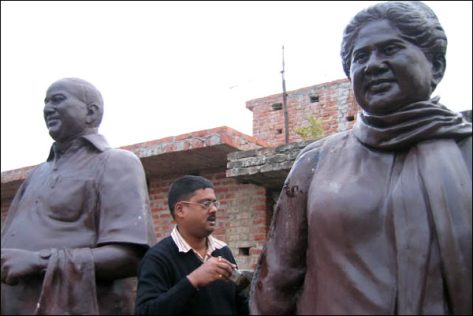
The Congress Party will use the occassion of Ambedkar Jayanti tommorow to reach out to UP’s Dalits. Commenting on this, NDTV  says, “Mayawati, who knows a thing or two about appropriating the Dalit legacy, is going on the offensive as well.”

Appropriating? Hello! You mean to say Rahul Gandhi is a Dalit and Mayawati a half-Italian, one-fourths Parsi and one-fourth Kashmiri Pandit, trying to pass off as an Allahbad Brahmin and collecting Dalit votes on the side?

Of course there will be other memorable celebrations, but they won’t be as ‘news-worthy’.

Mayawati’s India

1
(Largely ignored by the media, the BSP recently released a tract that says what the BSP’s India would be like should Mayawati become prime minister. Considering that there is such wide interest and curiosity about the BSP and its politics these days, I am posting the full text of this “appeal”. Disclaimer: I am posting this here for information, debate and discussion and the act of posting this here should not be construed as my endorsement or otherwise of this manifesto-but-not-manifesto. – Shivam Vij)

Jai Bhim !                                                                               Jai Bharat !!

Bahujan Samaj Party

” APPEAL”

For

Lok Sabha General Elections -2009


Brothers and Sisters,  Continue reading Mayawati’s India

Dalits in ‘Hindu Rashtra’

The Gujarat Earthquake in the year 2001 and the consequent relief and rehabilitation programme was an eyeopener to the outside world regarding the deep seated caste bias in the Gujarati community apart from the much talked about bias against the minorities. There were reports that at places the relief and rehabilitation work bypassed the dalits and the Muslims.

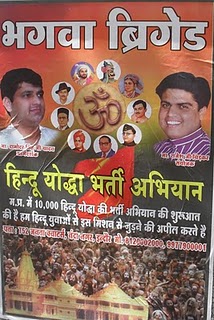
Interestingly Babasaheb Dr Bhim Rao Ambedkar had asked his followers to stop Hindu Raj becoming a reality at all costs. Continue reading Dalits in ‘Hindu Rashtra’