Ahem-dabad again

Update: Yaha sab shanti hai, yeh public hai sab jaanti hai

Sheela Bhatt’s assertions that the Gujarati Muslim hasn’t been seeking retribution by a long shot are not surprising at all. What is illuminating is this:

One of the surprises of Saturday’s blasts was that except one blast in Sarkhej, all the blasts were executed in East Ahmedabad, which includes the highly communally sensitive walled city area. The accuracy of the planning suggests that a person with a complete grip on the social-political mindset of the city and its communal geography must be behind the blasts.

No one in this shaken city doubts that these blasts were planned by someone who has a thorough knowledge of the past 25 years history of communally sensitive areas and the Sangh Parivar’s role in it. Continue reading Ahem-dabad again
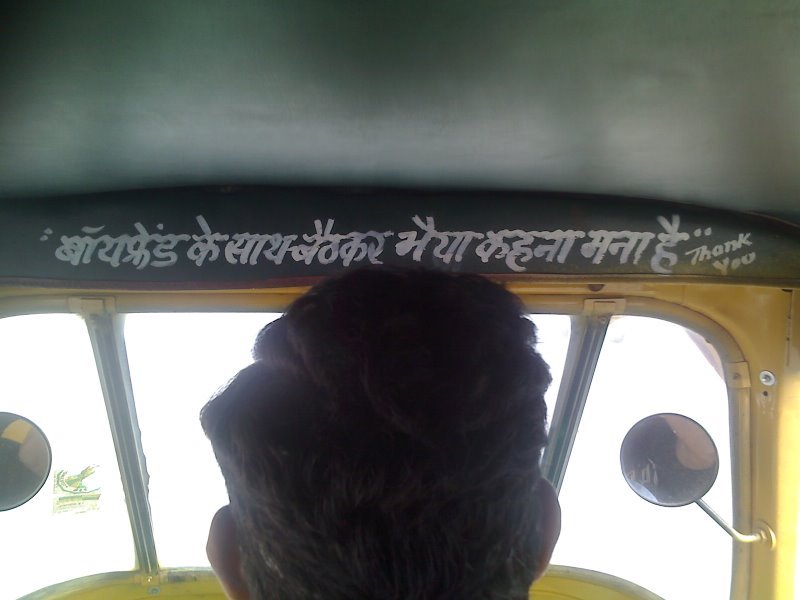
Reflections on the Great Unexpected Auto Debate

Little did I think when I put up this image, that it would lead to such a rich set of comments on class, caste and gender.

The picture had been circulating on the web, in blogs and email lists for some time, and without comment, as a funny, jokey kind of thing. Autos and trucks (in Delhi anyway,) are renowned, as Aman pointed out in his comment, for pithy, witty, quirky, dolorous, amorous etc. comments on life. Briefly glimpsed, their ability to linger in our minds is a reflection of their literary quality.

When this one was sent to me, the reason I posted it on kafila was initially light-hearted too, since we consider autos to be our mascots, as representing kafila’s philosophy and relationship to the city in some way – small, cheeky, full of “attitude”, winding nimbly through the mass of traffic, a resistant challenge to the idea of a shiny, “world-city-like-paris-and-singapore” that our various governments want to turn all our cities into, by neatly removing the poor, the workers, the slums etc.

Continue reading Reflections on the Great Unexpected Auto Debate

In the midst of blasts and fireworks across cities …

[While this post is also posted on my blog, I want to add a small qualification as to why I have put this up on Kafila as well. This post goes out on Kafila in the optimistic spirit of peace and wisdom in our hearts in the midst of the various blasts that have been taking place in different cities across India.]

(I write in the spirit of my words and in submission of myself to my vulnerabilities and to the present …)

One blast here,

One there,

One everywhere.

Today here,

Tomorrow there.

One blast here

And one blast there.

So that is what we, in various parts of the world, have been hearing about in the last two days. And yet, the indifference on my skin remains. It only thickens. But I remain sensitive to more mundane issues that concern me/bother me/sit on my mind/nag me. And what is sitting on my mind as of now, is that beautiful feeling of vulnerability and the thought of what it means to be vulnerable in the city. The feeling of vulnerability is beautiful as of now because I write in the solitude of music, my words and my difficult and vulnerable self, shut off from the noise of the blasts and of the noise of the crowds that existed in my space a while ago.

Continue reading In the midst of blasts and fireworks across cities …

Textbooks and Intolerance, Communal and Secular

Once again, religious sentiments have been hurt. This time in the God’s own Country, Kerala . And the culprit is a small portion of a lesson from the social science textbook for class vii, part i. It has been alleged by groups claiming to represent Muslims and Christians that this particular lesson preaches atheism. It sticks because the government which is getting the textbooks published is led by Marxists and there is a perception that Marxists have a pathological hatred for religion. Kerala has been witness to a bitter controversy on the faith only recently in which the church and the CPM were at loggerheads. So, there is a background to the new battle over a small lesson in a class seven textbook. But first let us try to look at the facts.

Continue reading Textbooks and Intolerance, Communal and Secular

Textbooks Yet Again

The current agitation in Kerala demanding withdrawal of the class vii social science textbook has turned murderous. James Augustine, 45, a headmaster of a primary school was killed in an attack by the Indian Union Muslim League youth activists on a training program. And this was done even after the announcement by the Kerala government that it had decided to remove the controversial portion of the textbook. Will this utterly meaningless death of the teacher at their hands stop the agitators in their track? Will we allow warriors of different shades of identity politics a free run? Or, will the sacrifice of a life turn into an occasion for all of us to once again ponder over issues related not only to the politics of textbooks but also the principles on which textbooks in a diverse country like India should be prepared?

It is very easy to see that the allegation on this particular book that it promotes atheism cannot be substantiated as the text in question closes with the response of the parents of Jeevan, who belong to different religious identities that he would be free to choose his religion when he grows up. It only shows that they are very relaxed about his identity and are ready to give him freedom to decide on his identity. Surely the agitating groups are neither sure nor relaxed about their relationship with the members of their denominations. Do they fear that texts like the one dealing with the religious identity of Jeevan can give ideas to children about their right to take decisions in the matters of marriage and identity? Even if we leave this aside, the charge leveled by the opposition that the book is substandard deserves a reasoned discussion. It needs to take into account the role textbooks are expected to play in a country like India, the process of textbook writing, the implication of the federal character of India for school education in general and textbook writing in particular.

Continue reading Textbooks Yet Again

Commissar Karat in October 1917

In his opening passage of the Eighteenth Brumaire of Louis Bonaparte, Marx attributed to Hegel (somewhat mistakenly) the idea “that all great world-historic facts and personages appear, so to speak, twice” and added sardonically that Hegel forgot to add: “First time as tragedy, second time as farce.” He went on to illustrate his comment thus: “Caussidiere for Danton, Louis Blanc for Robespierre, the Montagne of 1848 to 1851[66] for the Montagne of 1793 to 1795, the nephew for the uncle. And the same caricature occurs in the circumstances of the second edition of the Eighteenth Brumaire.”

Marx’s point was simple but profound. The tradition of the dead generations, he claimed, weighs like a nightmare on the brains of the living: “Just as they [revolutionaries, ‘men’] seem to be occupied with revolutionizing themselves and things, creating something that did not exist before, precisely in such epochs of revolutionary crisis they anxiously conjure up the spirits of the past to their service, borrowing from them names, battle slogans, and costumes in order to present this new scene in world history in time-honored disguise and borrowed language. Thus Luther put on the mask of the Apostle Paul, the Revolution of 1789-1814 draped itself alternately in the guise of the Roman Republic and the Roman Empire, and the Revolution of 1848 knew nothing better to do than to parody, now 1789, now the revolutionary tradition of 1793-95.”

Continue reading Commissar Karat in October 1917

P.S. Mandawli: Manufacturing Crime and Criminals

Mandawli is a police station area in East Delhi and covers the area I live in. As such it is the field of my ‘ethnography’. The reader may however put the name of any other police station in Delhi – rather India – and the story, I can bet, will read as true as ever. Let Mandawli then be the name of all the dens of YS Dadwal’s men (YSD being the police commissioner Delhi, who famously claimed yesterday that ‘Even in New York women are not safe…’). PC Dadwal also has the distinction of claiming, against the growing feeling of insecurity among Delhi’s denizens, that crime is actually declining in the city! A Jansatta report yesterday, however, cites many ordinary people as saying that they are more scared of the police than of criminals.

17 July 2008: The Times of India (19 July) and other newspapers reported the death of 18-year old Umesh Kumar ‘who was picked up by the police for questioning’ two days ago and who died soon after returning home at night. The incident was of Swaroop Nagar in outer district, Delhi. Umesh did not live to tell his story but his friend, Atul, ‘who too was picked up by the police said: “The police took us to Ibrahimpur police post and started beating Umesh after which he lost consciousness.” Umesh, from all accounts was not a hardened criminal – just one of those whom the police decides to make into a criminal in the long run. Unfortunately for them, he died.

Continue reading P.S. Mandawli: Manufacturing Crime and Criminals

The Web Will Not Kill Traditional Organising by Michael Connery

Is technology undermining the much-vaunted community values of Millennials and creating a generation of semi-activists clicking for change on their computers, but ultimately disconnected and disempowered from each other and from the levers of real social change? This is the thesis posited by Sally Kohn, the director of the Movement Vision Lab at the Center for Community Change in an op-ed published in the Christian Science Monitor last week: Continue reading The Web Will Not Kill Traditional Organising by Michael Connery

“Madam, we know you’re leaving. Think wisely before coming back”

Continue reading “Madam, we know you’re leaving. Think wisely before coming back”

Farewell to our Humid Weimar

Dear All,

I find it sad that all those who live in India are being sent headlong into a period of turbulence following the unilateral  decision by the so-called Left parties in response to the Indo-US  Nuclear Deal to withdraw support from the UPA government. This decision is not a response to basic issues like the rising cost of living, but in support of the chimera of ‘sovereignty’ in military affairs. It is shameful that parties that continue to call themselves communist should feel no embarassment at all in exhibiting the worst and most pathetic form of militarist nationalism, premised on the maintainance of an obscene Nuclear military policy. In all likelihood, if the government of the day fails  to pass the test of numbers on the floor of parliament, India will head straight for early elections.It will do so entirely because of the ‘Patriots’ on the so called ‘Left’. Continue reading Farewell to our Humid Weimar

When you’re OUT, you’re IN

Since Gay is in, currently, for the Indian media, Sonali Gulati, film-maker, out lesbian and gay rights activist, knows what it is to be hotly pursued for sound-bites. She has posted on youtube a recorded conversation with a reporter from IBN 7 pressing her for her take on a “lesbian” issue. Her quiet , insistent questioning reduces him to confused gibberish, but more importantly, makes the point that “lesbians” are no more and no less newsworthy than straight people – At one point she asks him, “Agar yeh ek heterosexual couple ke saath ho jaata, tab aap kis se comment lete?”

(If this had happened with a heterosexual couple, then to whom would you have gone for comments?)

Meaning of course, that any and every heterosexual would not be considered “expert” enough to comment on any and every heterosexual issue. The bemused reporter starts all over again with his insane drivel – he simply does not get it. Can she really be giving up an opportunity to appear on television? Naaah.

But go on – listen to Sonali.

Foreboding

Five years ago, in an article called “Srinagar, Four Years Later,” Suvir Kaul wrote:

A Ram Mandir is being built at the site of the ancient sun temple at Martand (Mattan). This is not simply an addition to what is already there – it is a deliberate refashioning of Kashmiri Hindu worship to obey the dictates of Hindutva practice. But worst of all are the excessive displays put on ostensibly for the benefit of the Amarnath yatris, but which actually function as a warning to local Kashmiris: all along the route past Pahalgam, and to some extent on the Baltal route, banners and wall-slogans sponsored by the CRPF and the BSF (and occasionally, the Jammu and Kashmir police) welcome the yatris. These units also make available tea and snacks, and announce them as prasad. There is no constitutional separation of temple and state to be found here – the yatris, and those who guard them, are equally, and aggressively, Hindu. [Link]

Moral police in OUR autos!

“It is forbidden to sit with your boyfriend and claim he is your brother”

My sister sent me this one…

Spiritual As Communal ?

It is really difficult to believe how an organisation which supposedly ‘aims to present religious mysticism in a scientific language for the curious and to guide seekers’ and which ‘conducts weekly spiritual meetings, discourses, child guidance classes, workshops on spirituality, training in self-defense and campaigns to create awareness of righteousness’ to further these aims can double up as an organisation which can invite prosecution under ‘laws meant for unlawful and terrorist organisations’.

But any impartial observer of the activities of ‘Sanatan Sanstha’ and ‘Hindu Janjagruti Samiti’ would concur with the view that these organisations need not be allowed to spread their venomous agenda among innocent people any further. The recent bomb blasts in Maharashtra where members of these organisations have been found to be involved is another reminder about the danger which these organisations present before the communal harmony situation in our country. Continue reading Spiritual As Communal ?