Crafting the Modi Mask – India Inc and the Big Media

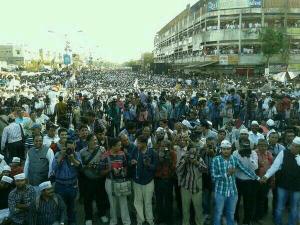
AAP Rally in Gujarat. Courtesy Mukul Sinha

Two things stand out for their sublime quality in the current round of pre-election campaigning. First, the danger to Indian democracy has assumed unprecedented proportions, and there is a clear sense of desperation in the air. The threat emanates, you guessed right, from a group of anarchists who are poised to take over Indian democracy.  This is perhaps the dirtiest and most dangerous election that India has ever seen – what with the bunch of anarchists ‘fixing the media‘, ‘spreading anarchy‘, ‘hijacking democracy‘, ‘taking foreign funds‘ for their election campaign (while the others, the impeccable democrats of the BJP and the Congress have to make do with ‘local’ capitalists like  Mukesh Ambani). What’s more, these people are ‘political mercenaries‘,  urban Maoists in disguise and they want to wreck the neatly and painstakingly built edifice of our hallowed democracy. This widespread love of democracy is touching. For someone like me who has closely watched (and participated in) politics from the mid 1970s, the panic evident in the tone of those attacking AAP is as unprecedented as it is revealing. It is revealing of the fact that the political class is thrown into disarray by this new way of doing politics that AAP represents. In BJP’s case, in particular, one can discern complete befuddlement – neither its hope to reap the benefit of the mass anger against the Congress, nor its tried and tested polarizing communal vocabulary seem to have any meaning any more.

Thus, during the days of AAP rule in Delhi, the official BJP state executive resolution came up with this claim:

“Delhi is currently being ruled by a bunch of political mercenaries hired, supported and controlled by Congress party. The words and action of AAP leaders expose the fact that it is a Maoist outfit.”

Of course, the Maoists are “hired, supported and controlled by the Congress”!

Continue reading Crafting the Modi Mask – India Inc and the Big Media

1933 of 2014 ? : Time to break New Grounds in Confronting Communal Fascism

( To be published in the coming issue of ‘Critique’ a magazine published by  ‘New Socialist Initiative’s Delhi University team )

The Jew as well as the Christian, the Hindu no less than the Muslim ‘fundamentalist’ plies an ideology of superior difference. Each confronts an inferior and threatening Other . Each engages in the politics of exclusion. Hence each poses a menace to the minority communities within its boundary…For the Muslim militants the Other are the Jews, occasionally Christians and, in South Asia, the Hindus, Christians, and Ahmedis. I know of no religio-political formation today which does not have a demonized, therefore threatened, Other.

The Other is always an active negation. All such movements mobilize hatred, and often harness unusual organizational effort to do so. ..

The cult of violence and proliferation of enemies are inherent in ideologies of difference. All express their hate for the Other by organized violence. All legitimize their violence with references to religion and history. In nearly all instances the enemy multiplies. At first, the Indian Parivar had the Muslim Other for target. It has now turned on Christians.

Profile of the Religious Right – Eqbal Ahmad (1999)

I.

Masks and the Man

Child’s fantasies are endless and unimaginable.

It will wear a mask of a tiger and start ‘scaring’ it’s near and dear ones with a growl and the very next moment would imagine itself to be flying in the air with the mask of a Spiderman. Have you ever noticed any adult -may be completely stranger to the kid – getting annoyed with such tantrums of a child. Definitely not.

What will happen if you tomorrow discover the same group of adults or similar physically grown-up people moving on the streets or herding together wearing similar masks or identical masks? You will have sincere doubts about their mental faculties and if possible, would love to advise them that they consult the nearest psychiatrist. Continue reading 1933 of 2014 ? : Time to break New Grounds in Confronting Communal Fascism

No Country for Cricket: Umang Kumar

Guest post by UMANG KUMAR
I have to confess that there are many times that I too have wanted to stop supporting the Indian cricket team and root for some other team. And this is not just with the current lineup and their losses in South Africa and New Zealand. Why, even when Gundappa Viswanath failed in inning after inning, when, in the pre-Kapil days, Indian pacers (“fast medium”) like Karsan Ghavri and Mohinder Amarnath huffed and puffed, there were times I just wanted to say good riddance. Thank you India, I think I’ll switch allegiance – I’ll go support Clive Lloyds’ West Indies or Asif Iqbal’s Pakistan. Much better teams, so much more exciting to watch!

The Indian cricketers could neither bowl well nor defend modest totals with the bat. And they were lackluster on the field save that one saving grace, Eknath Solkar.
Continue reading No Country for Cricket: Umang Kumar

Fundamentalism, Liberalism and Muslims – Review of Hasan Suroor’s ‘India’s Muslim Spring’: Abhay Kumar

ABHAY KUMAR reviews Hasan Suroor’s India’s Muslim Spring: Why is Nobody Talking about It?, Rupa Publications, New Delhi, 2014.

Hasan Suroor is a London-based veteran journalist. He began his career with The Statesman and later he worked as The Hindu’s UK correspondent for over a decade. He continues to write in newspapers on important issues such as Muslim identity, secularism, communalism and Islam. He was brought up and educated in Delhi after his family left Lucknow for the national capital post-Partition. Their new destination, at least in the beginning, did not receive its guests warmly as his parents’ identity as Muslim worked as a hurdle for them to rent a flat in New Delhi. Eventually they had to seek refuge in the Muslim-majority Ballimaran of the Walled City where his mother worked as a Communist Party activist. Suroor, who is regarded as one of the “progressive” and “liberal” voices among Muslims, has recently been in news for an interesting thesis which he offers in his new book, India’s Muslim Spring: Why is Nobody Talking about It?

He argues that for the first time since Independence a “seismic” and “tectonic” shift has taken place in Indian Muslim community with an emergence of “liberal spring” among new generations Muslims, who were born after the late 1970s. For Suroor, the elder generations of Muslim were “fundamentalist” and “emotional”, “intolerant” of freedom of speech, prioritized “cultural” and “identity” issues over substantive ones, had “contempt” for women and blamed others for the plight of Muslim community while the young Muslims are just the opposite of their elders; they, are  “tolerant”, “pragmatic”, “moderates”, “secular”, “cosmopolitan”, “optimistic” and “confident” and “forward-looking” as well as “nationalistic”. In short, he creates a binary between fundamentalist old Muslims versus liberal young Muslims. Continue reading Fundamentalism, Liberalism and Muslims – Review of Hasan Suroor’s ‘India’s Muslim Spring’: Abhay Kumar

Despatch from Ayodhya: Monobina Gupta

Guest post by MONOBINA GUPTA

Ayodhya, Faizabad: As our taxi approaches the site of the controversial Ram temple, two young men on motorcycle ride alongside our car. “ We will be your guides. Want to see the temple? Only hundred rupees,” they shout. My unofficial ‘guide’ Vineet Maurya, a fierce crusader against representing the site as the birthplace of Ram, rolls down the window and snaps back,” We are not here to see the temple.” Further down the lane, more young men run behind the car with similar offers. Temple sightseeing has turned into a veritable industry at Ayodhya.

From the narrow alley, the disputed plot, closely barricaded with high yellow railings and watched 24/7 by men from the Central Reserve Police Force (CRPF) and Provincial Armed Constabulary(PAC), images a heavily guarded fortress: one that is in danger of imminent attack. This is the holy site over whose ownership Hindus, led by the Bharatiya Janata Party (BJP), had waged such a fierce battle and spilled so much of blood. The manifestations of that unholy battle are overwhelmingly present in the form of deployment of countless security forces guarding Ram Lalla. What is lost in this murky stand-off is the sanctity of a holy place.  Ayodhya ranks among the top holy sites of India. Continue reading Despatch from Ayodhya: Monobina Gupta

The ‘Occupy Library’ Protest in EFLU, Hyderabad: Anonymous

Guest Post by a student who wishes to remain anonymous

The recent incidents in the English and Foreign Languages University (EFLU), Hyderabad, shows yet another move from the part of the administration to bypass democratic procedures and suppress the voice of the student community. Ever since she took charge, the current VC Sunaina Singh has managed to acquire infamy for her anti-student and totalitarian mode of governance. The most recent one was closing down the common reading room for students, which was functional 24*7. The initial reason given was that it was under renovation. Later, notifications were put out stating that the previous reading room will be attached to the library (which closes down at 8pm on weekdays and at 6pm on weekend). Separate reading rooms were allotted for male and female students in their respective hostels, each of which cannot accommodate more than 20 students at a time (the total strength of the university is 2500+).

This decision, in effect, meant that boys and girls had no place to study/ work together after the stipulated working hours of the library. The authorities even posed the question as to why it was necessary that boys and girls have to study together. Excuse my hyperbole, but probably the next step would be to prohibit the formation of mixed groups for class works, assignments and presentations.

This particular incident of closing down the common reading room has to be viewed by placing it in the context of the larger issue- the regulations imposed on the students over the past one year and attempts to curb the liberal values that EFLU has always held up.  Continue reading The ‘Occupy Library’ Protest in EFLU, Hyderabad: Anonymous

Report of a Protest by Students at UP Bhavan in Delhi against Harrassment and Slapping of Sedition Charges on Kashmiri Students at SVSU, Meerut: Kashif Ahmed Faraz

Guest Post by KASHIF AHMED FARAZ

Several students protested on the 7th of March in Delhi against the harassment and eviction of Kashmiri students in SVSU (Swami Vivekanand Subharti University), Meerut and the slapping of sedition charges against 67 Kashmiri students. The protesters included activists, students from universities, mostly from JNU and also Kashmiri Students residing in Delhi. The protest took place at Uttar Pradesh Bhawan, New Delhi.

Signs at Protest at UP Bhavan against Harrassment of Kashmiri Students in Meerut

Continue reading Report of a Protest by Students at UP Bhavan in Delhi against Harrassment and Slapping of Sedition Charges on Kashmiri Students at SVSU, Meerut: Kashif Ahmed Faraz

राष्ट्रवाद का मौसम

मेरठ के एक निजी विश्वविद्यालय में भारत-पाकिस्तान के बीच हुए क्रिकेट मैच में पाकिस्तान की जीत पर कश्मीरी छात्रों की खुशी जाहिर करने पर स्थानीय छात्रों द्वारा उनकी पिटाई और तोड़-फोड़ के बाद तीन दिनों के लिए छियासठ छात्रों के  निलंबन (निष्कासन नहीं) और फिर ‘उनकी हिफाजत के लिए’ उन्हें उनके घर भेजने के विश्वविद्यालय के फैसले के बाद उन छात्रों पर राष्ट्रद्रोह की धाराएं लगाने से लेकर उन्हें वापस लेने तक और उसके बाद भी जो प्रतिक्रियाएं हुई हैं,वे राष्ट्रवादी नज़रिए मात्र की उपयोगिता को समझने के लिहाज से काफी शिक्षाप्रद हैं.आज यह खबर आई है कि ग्रेटर नॉएडा के शारदा विश्विद्यालय में भी छह छात्रों को छात्रावास से ऐसी ही घटना के बाद निकाल दिया गया है जिनमें चार कश्मीरी हैं. मामला इतना ठंडा क्यों है, ऐसी निराशा जाहिर करते हुए फेसबुक पर टिप्पणी की गयी है और उसके बाद तनाव बढ़ गया है.

रोशोमन नियम के अनुसार घटना के एकाधिक वर्णन आ गए हैं और तय करना मुश्किल है कि इनमें से कौन सा तथ्यपरक है. स्थानीय (राष्ट्रीय या राष्ट्रवादी?) तथ्य यह है कि पाकिस्तानी खिलाड़ियों के प्रदर्शन और फिर उस टीम की जीत पर कश्मीरी छात्रों ने पाकिस्तान जिंदाबाद के नारे लगाए जिससे  भारतीय टीम की हार से पहले से ही दुखी स्थानीय छात्रों में रोष फैल गया. निलंबित कश्मीरी छात्रों का कहना है कि वे हर उस खिलाड़ी के प्रदर्शन पर ताली बजा रहे थे जो अच्छा खेल रहा था. बेहतर टीम पकिस्तान के जीतने पर उनका खुशी जाहिर करना कहीं से राष्ट्रविरोधी नहीं कहा जा सकता. उनके मुताबिक  इसके बाद उन्हें पीटा गया और तोड़-फोड़ की गई. Continue reading राष्ट्रवाद का मौसम

Disability Rights And Parental Activism – Can They Co-Exist? Shubhangi Vaidya

Guest Post by SHUBHANGI VAIDYA 

Parents are valuable allies in the Disability Rights Movement thanks to their intimate engagement with persons with disability. To view them as representatives of a ‘disabling’ society does them a grave injustice. However, the heated debates over the new Rights for Persons with Disabilities Bill introduced in the Rajya Sabha  have seen a confrontation of stances between two groups along these lines.

The first group consists of vocal self-advocates who point out a number of weaknesses and contradictions in the Bill from a Rights perspective, citing the provisions of the United Nations Convention on the Rights of Persons with Disability ratified by India in 2007.

The other group is a loose coalition of ‘cross-disability’ activists including lobbying for a speedy passage of the Bill, with crucial amendments, in what is the last session  of this Parliament and of the government of the day, which just happens to be UPA.

It is important to note that this Bill has not just dropped down from the heavens; it is the end result of years of protracted consultations, contestations, confrontation by stake-holders across the sector. I do not propose here to go into the pros and cons of its provisions; rather, I wish to highlight a rather disturbing trend that I discern in the frenetic exchanges between some self-advocates in the sector and parent activists on the social media.  Continue reading Disability Rights And Parental Activism – Can They Co-Exist? Shubhangi Vaidya

The Buttocks of Naked Women and Further Meditations on Sacred Art: Sajan Venniyoor

Guest Post by  SAJAN VENNIYOOR

“There is no Hindu canon,” declares Wendy Doniger in The Hindus. “The Vedas did not constitute a closed canon, and there was no central temporal or religious authority to enforce a canon had there been one.”

This is a curious argument in defence of heterodoxy. Canons don’t spring fully formed like Athena from the head of Zeus, or drop from the lips of a passing Archangel. Someone has only to do the hard work, and it’s never too late to make a nice hard canon.

As Doniger says, Hinduism as we know it today “is composed of local as well as pan-Indian traditions, oral as well as written traditions, vernacular as well as Sanskrit traditions, and nontextual as well as textual sources.” That’s good news – plenty of material there to choose a canon from.

Back in the 16th century, the Church found itself up the creek without a canon. Plagued by fifteen hundred years of heresies and heterodoxies, disagreements over the sacraments and the scriptures, not to mention a perfect storm of lusty, busty images in Renaissance religious art, the Catholic Church sat in ecumenical council between 1545 and 1563 and decided, once and for all, what was IN and what was OUT.

Index of Prohibited Books (1)

Index of Prohibited Books 

It took the Church just over 1500 years – from the crucifixion of its founder to the Council of Trent – to decide which of its written books and unwritten traditions were truly sacred and which were profane (and which were to be banned).  Continue reading The Buttocks of Naked Women and Further Meditations on Sacred Art: Sajan Venniyoor

A Letter to my Indian students on the linguistic effects of shots fired from the deck of an oil-tanker : Alberto Prunetti

This is a guest post by ALBERTO PRUNETTI

[Translated into English by Francesco Giannatiempo, Eva Salzman and Tommaso Sbriccoli]

Dear Boys and Girls,

For many months I was your teacher in Mumbai and Bangalore. Most of you came from Kerala. Some among your parents were fishermen. I remember the sacrifices of your relatives who had hopes for your future, who worked hard to help you achieve degrees in nursing or Italian. I remember that Italy and Europe represented for you a potential turning point in your lives and careers. I also remember that Italian propositions cause many problems for you, as does for many students. To introduce yourself, you would say “Sono nato a Kerala” [I was born at Kerala]. But, as I explained to you, the grammar rule foresees the use of the preposition “in [in Italian] + name of State” and “a [in Italian] + name of city”. So, one would say, “Sono nato a Roma” [I was born in Rome]. Given that Kerala is a State (to be clear, India is a confederation of States, like the US) one has to say “Sono nato in Kerala, a Trivandrum” [I was born in Trivandrum, Kerala,], as one would say “Sono nato in Colorado, a Boulder”  [I was born in Boulder, Colorado].

Continue reading A Letter to my Indian students on the linguistic effects of shots fired from the deck of an oil-tanker : Alberto Prunetti

अपराध के साथ सहजीवन Reading The Fiction of Fact Finding – Modi and Godhra

मैं 2014 की सबसे महत्वपूर्ण किताब पढ़ रहा हूँ. यह है मनोज  मित्ता की किताब  द फिक्शन ऑफ़ फैक्ट फाइंडिंग: मोदी एंड गोधरा  यह सौभाग्य बहुत कम किताबों को मिलता है कि वे अपने समाज की अंतरात्मा की आवाज़ की तरह उभरें जब ऐसा लगे कि वह पूरी तरह सो चुकी है. वे हमें खुद अपने सामने खड़ा कर देती हैं और मजबूर करती हैं कि हम अपने आपको पहचानें,खुद को दिए जाने वाले धोखे से निकल सकें और खुद को इम्तहान की खराद पर चढ़ा सकें.ऐसी किताब लिखने के लिए निर्मम तटस्थता चाहिए और सत्य के लिए अविचलित प्रतिबद्धता. इसमें तात्कालिक आग्रहों से स्वयं को मुक्त रखना एक चुनौती है.

सत्य की खोज के मायने क्या हैं? क्या यह सिर्फ इरादे से जुड़ा मसला है? अभी हम आध्यात्मिक स्तर पर सत्य की खोज की बात नहीं कर रहे.वहाँ भी यह मात्र नेक इरादे से हासिल नहीं किया जा सकता.दुनियावी मसलों में, खासकर राज्य के संदर्भ में इसका क्या अर्थ है? ऐसे अवसर आते हैं जब उसकी भूमिका और निर्णयों पर  प्रश्नचिह्न लगता है और सच जानने की मांग होती है. उस वक्त अपेक्षा की जाती है कि वह ऐसे उपाय करेगा कि  उसके सीधे प्रभाव से मुक्त प्रक्रियाओं के माध्यम से सत्य का पता किया जा सके.आधुनिक राजकीय संरचना में न्यायालय को अपेक्षाकृत स्वायत्त संस्था माना जाता है,ऐसी व्यवस्था जो कार्यपालिका के सीधे नियंत्रण में नहीं है और इसलिए जो उसके बारे में भी सच बोल सकती है. लेकिन क्या भारत में यह हो पाया है? क्या सबसे संकटपूर्ण क्षणों में न्यायपालिका से जुड़े लोग इस भूमिका का निर्वाह कर पाए हैं? Continue reading अपराध के साथ सहजीवन Reading The Fiction of Fact Finding – Modi and Godhra