
Guest post by ANANT MARINGANTI. Kapil Sibal may have unwittingly erased a whole historical geography of pre-windows software development in India. If the Times of India report on the release of Urdu fonts developed by National Council for Promotion of Urdu Language ( NCPUL) last week is accurate, Sibal said that India developed Urdu Software and fonts and thereby ended a longstanding dependency on Pakistan. This, according to him is beneficial to the 15 crore Urdu language users. There is a ‘pre-election Muslim wooing’ feel to the story which nicely blends with the ‘massaging of Indian (read Hindu) nationalist pride’ feel. The sense of triumph and pride at this historic achievement by Indian programmers would have been justified even if it could be read as symptomatic of the postcolonial condition that Amitav Ghosh captures in his recounting of the breakdown of conversation between himself and the Imam of Lataifa and Nashawy. Unfortunately however, Urdu language users in India were never dependent on Pakistan for software and fonts. This can be said in two different senses: first that Indian Urdu language computing originated in Hyderabad almost 25 years ago and has contributed significantly to local cultural economy. Second, to the extent that there has been exchange between India and Pakistan in Urdu language computing, the participants in that exchange have seen it primarily in terms of exchange. Afterall, people cannot help making language tools even if nation states do not pay them much attention. Continue reading Lok Sabha elections, software imperialism and the Urdu language: Anant Maringanti
All posts by Aditya Nigam
Boyalagudem’s Search for Water: Rajendran Narayanan
Guest post by RAJENDRAN NARAYANAN. Boyalagudem – The name sounds like one of those nondescript railway stations in south India that an express train whizzes by in utter condescension of its portly status. Except that in this case it is much worse. There are no railway tracks in a 50 kilometre radius of this village, tucked away in a corner of Mahabubnagar district in Andhra Pradesh. The landscape here is various hues of brown with not even a pretension of greenery anywhere, barring a few adamant shrubs as if standing up for their fraternity.
A not so covetous claim to fame of this region is its proneness to drought. People here spend each year in the hope that weather cannot play a prank every year. Prayers are offered each year in the second week of June to please the rain gods so that the chosen gods can have mercy this time around. But, the gods in turn haven’t been too pleased with the prayers so offered for the past few years.
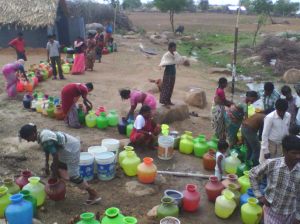
To cut to the chase, water is scarce in this region and so is electricity. Most villages in this part of the district have a central water pump connected to a storage tank that gets water when the State takes pity and provides electricity. Thus, no electricity implies no water. Electricity comes and goes at random times of the day and consequently there is no fixed schedule regarding the availability of water. Some desperate villager wakes up at 4 AM and rushes to the water pump in the hope of getting water. Another sleepy villager walking out to take a leak at that hour observes an active man with four colourful pots running to get water and rushes back to his house to join the early riser in the daily water fetching ritual. News of water availability spreads and within 30 minutes one can see majority of the villagers, from 6 year olds to70 year olds, wiping their sleep off their face, walking, running or cycling, each with four to six bright colourful plastic pots to the solitary water pump. Multicoloured fluorescent pots form a long and winding queue to usher in the day. The chaotic queue naturally lends itself to quarrels and verbal skirmishes about who came first and why somebody has come with eight pots to hoard water.
Continue reading Boyalagudem’s Search for Water: Rajendran Narayanan
Media Campaign and the Ishrat Jahan Case: Faraz Ahmad
Guest post by FARAZ AHMAD: Even after the Central Bureau of Investigations (CBI) presented of its charge-sheet in CBI special court in Ahmedabad on July 3 in the infamous Ishrat Jahan encounter case of Gujarat of 2004 charging the Gujarat police, together with the IB of faking the encounter with Ishrat and three others, the media campaign, more particularly of the Times of India to damage CBI’s credibility continued unabated, with Bharti Jain’s lament on behalf of the IB.
However it is obvious that Bharti Jain’s is neither the first nor the last spirited defence of the questionable activities of our security and intelligence officers committing all kinds of crimes under the cover of protecting the nation from supposed external and internal threat. Unmindful of this, the media campaign is so visibly influenced by the BJP, attempting to discredit the CBI investigations and label these as biased before these are examined by the rightful authority, the courts, guided by competent lawyers of both the prosecution as well as Defence. Continue reading Media Campaign and the Ishrat Jahan Case: Faraz Ahmad
The curious case of the Tamil Nadu police preventing ex-Maoists’ return to electoral path!
Guest post. A statement by Prof A. MARX and other rights activists
We, the undersigned, wish to bring to the public’s notice a curious case of doublespeak by the state. The central and state governments constantly advise Maoists to give up arms and join the mainstream. But, in Tamil Nadu, the government in collusion with the police is torturing a group of ex-Maoists who have joined the mainstream. These comrades have given up armed struggle and have come out to function in the open under a party named People’s Democratic Republic Party (PDRP). They have also accepted the electoral path to pursue their mass line. It is clear from their case that the intention of the state is not to mainstream the armed fighters but to incapacitate anyone who dares to criticize the state’s policies, without any compromise.
Background
Earlier, many PDRP members were part of CPI (Maoist). Some of them were arrested and imprisoned under POTA in 2002, on charges of undergoing arms training in Uthangarai, Tamil Nadu. They eventually came out of the prison with women getting bail in 2005 and men in 2007. Many of the comrades who came out criticized the armed struggle line of CPI (Maoist) and stressed for a mass line. The CPI (Maoist) reacted to this by dismissing them from the party towards the end of 2007. Continue reading The curious case of the Tamil Nadu police preventing ex-Maoists’ return to electoral path!
On Passport Divas, ‘We are Like That Only, But We Want to be Superpower’!
‘It happens only in India’ – so goes the refrain. Because we are extra special. Yes we are. In our smugness and in our conceit. In our bloated sense of Self that will stop short of nothing less than the status of the next ‘superpower’ – without anything to show for it though. Wonder where all this actually comes from? Chala Murari Hero Banane. Years ago, we were told, we had colonized Silicon Valley. Our software writers, the best in the world, had placed India in the world map of rising powers. So much had it impressed the leaders of this country that they decided that all their higher education would be geared to producing more and more such labour for the new global economy (no offense meant to the software people). However that is another story. Right now I want to tell a different one – partly out of frustration but partly because I consider it my duty to forewarn others who might be in for a similar experience as mine. Continue reading On Passport Divas, ‘We are Like That Only, But We Want to be Superpower’!
Shahrukh Khan, Surrogacy and Sex-Selection: Sneha Banerjee
Guest post by SNEHA BANERJEE: It was a Monday morning that didn’t bring me blues, after many weeks of sweltering heat I could keep the door to my balcony open without fearing the skin-burning ‘loo’ and my room filled with the pleasant breeze which had the promise of bringing in rains once again. I decided to keep my diligently prepared to-do list aside and embarked on staring at the neem tree observing the avian cohabitants of my neighbourhood with the radio on my phone tuned to a FM station. It was then that the unnecessarily loud, over-enthusiastic voice of a radio-jockey broke the serenity of the surroundings. His shrieky voice exhorted a promise to keep Dilliwalon up-to-date with the latest controversies in Bollywood. Now, that was not something that I was very interested in – imagined competition among biggies, who ate what, who holidayed where and with whom and after betraying whom was going to be too depressing to handle, but before I could reach out to change the station, he took somebody’s name that still makes my heart skip a beat even after couple of leap-years have come and gone since I was sweet-sixteen. Yes, any and every news about this ‘star’ interests me and I want to know it all, true or untrue, gossip or through ‘reliable sources’.
But what I heard then, broke my heart. The RJ quoted a Mumbai tabloid, that Shah Rukh Khan (SRK) is having a third child through surrogacy and that he has ensured it is a son through sex-selection. Continue reading Shahrukh Khan, Surrogacy and Sex-Selection: Sneha Banerjee
In the Belly of the Beast: Peggy Mohan
Guest post by PEGGY MOHAN: When the size and complexity of a system pass a certain threshold there is a new feature that typically and suddenly appears: self-regulation. If traffic flow through a crossing exceeds a certain amount we wake up one morning and find a traffic light. It is not there to favor any motorist: what it really signifies is that the scale of things has changed. We are no longer in the realm of the individual but of something much, much larger: a traffic system with compulsions of its own.
It is comforting to think that there is human agency behind the bewildering transitions we are now seeing the world over towards more state surveillance and control along with less regulation of big business. Clearly there are individuals who benefit from the new order. But there is another way of looking at the direction the world is taking. It is possible to see all this as evidence of a phase change, with the emergence of the megasystem itself as a new protagonist, and with human beings relegated to the status of bacteria proliferating in (and dying in) its gut. Continue reading In the Belly of the Beast: Peggy Mohan
The Military and ‘Peripheral’ Violence in Naya Pakistan
Guest post by ZEHRA HASHMI
It has been many months now since the Hazaras in Quetta were attacked. They were targeted during the month of January in 2013 and then only 36 days later in February, both times on Alamdar road where most Hazaras live – an area that has been termed an “open air jail”. Both times the banned Sunni organization Lashkar-e-Jhangvi claimed responsibility. In recent years, as many as 2000 Hazaras have lost their lives to similar acts of targeted violence in Balochistan. As power has been handed over from one civilian government to another for the first time in Pakistan’s history, the systemic nature of this kind of violence should be central to the concerns of Pakistanis – maybe even more than electricity, dare I argue? As Pakistanis think long and hard about what democratic change could mean, I write about the Hazaras now in order to point to the seemingly peripheral minorities as central to Pakistan’s issues. These attacks speak to the complex ways in which violence embeds itself into the everyday lives of some Pakistanis. In other words, the kind of structural issues that trying to wish a ‘naya Pakistan’ into existence will not assuage. Continue reading The Military and ‘Peripheral’ Violence in Naya Pakistan
Barasat Rape, Murder and the Culture of Rape in West Bengal: Soma Marik
Guest post by SOMA MARIK. [We are publishing below two articles by Soma Marik, Visiting Professor, School of Women’s Studies, Jadavpur University. The first deals with the recent case of the rape and murder of a young girl in North 24 Parganas while the second one below was written in 2003 when the Left Front was in power and documents the widespread culture of rape in the state. Between them, the two pieces alert us to the way we tend to respond selectively to such matters. This is particularly so in the case of political parties in power.]
The Barasat Rape and Murder: Some Reflections
On 8th June, a young woman, a second year college student, was returning home, Kamduni, a remote village of Barasat in the district of North 24 Parganas. She was waylaid by some criminals, who took her to a godown, where they gang raped and then proceeded to murder her. Six hours after she was seen alighting from a bus, her body was found by her brothers and other villagers. The police were forced into some action, after the family and people of the locality refused to even let them shift her body without action first. They accused a number of people, including some connected to the ruling Trinamul Congress, of being rapists. The young woman was well known, as she used to help many children of the locality in their study.
The first response from the police was to play it down, till local anger made that an impossible proposition. The first response from the government was to declare it a stray incident, and also to offer jobs and cash compensation to the family. This was angrily turned down, with the family members turning up in Kolkata, meeting Chief Minister Mamata Banerjee, and demanding the death penalty for the rapists and murderers. Continue reading Barasat Rape, Murder and the Culture of Rape in West Bengal: Soma Marik
Disinformation and Journalistic Ethics: A Letter from Harsh Mander
We are publishing below a communication received from Harsh Mander, a former member of the National Advisory Council, regarding misrepresentation of his position and his politics by no less a person than the editor-in-chief of the Indian Express. The misrepresentation could easily have been corrected, had the mistake been really a mistake but by not publishing the letter or even an editorial correction, newspaper and the editor seem to be acknowledging that the error was in fact, intended. In the language of the Cold War, acts such as these were called ‘disinformation’.
Response to Mr Shekhar Gupta’s article ‘The Bleeding Heartless’ in the Indian Express, June 1 2013
In response to an article by Mr Shekhar Gupta ‘The Bleeding Heartless’ in the Indian Express, June 1 2013, I sent the letter reproduced below on 3 June 2013, which has not yet been carried by Indian Express. I try not to respond polemically to articles which disagree with my views on public policy or other issues, as these differences are perfectly legitimate in a democracy. And who is to be sure that I am right, and my critics are wrong? But this was different, because it utterly falsely described my ideological position on Maoism as sympathetic, whereas I have always been passionately and publicly opposed to all forms of violence, including Maoist violence. Moreover it linked this to my membership in the NAC, and through that by implication to the many pro-poor agendas I sought to bring into and support within the NAC in the two years that I was a member. Finally Indian Express did not check with me the full facts reported in the opinion piece. I therefore felt I should respond formally to the report. But since this response has not been carried, and on the other hand it is being publicly referred to by others as well, I felt it would be best to place this reply in the public domain. – Harsh Mander Continue reading Disinformation and Journalistic Ethics: A Letter from Harsh Mander
The Jamhuriyat Road to Taksim Square: Shilpi Suneja
Guest post by SHILPI SUNEJA
Istanbul, 4 June

The evening of 3 June, 2013 was the first time I’d experienced the sting of pepper spray. I was walking on Cumhuriyet Caddesi near Taksim Square in central Istanbul, where, for the past five days, civilians and the Turkish police have been clashing over what the international media has called “a matter of a few trees”. Certainly, the spark of what is now a huge mass protest spanning multiple cities with over 1,000 injured, was the issue over Gezi Park, an area in central Istanbul where the Prime Minister, Tayyip Erdogan has proposed to build a shopping complex. The plan was to graze the green space and create a shopping complex. This in an area that already boasts of a Hyatt, a Hilton, a Swiss hotel and shopping centers with national and international brands. “There’s already so many shopping malls here,” said a Turkish friend speaking about the government’s decision. “Why build another?” The grazing of the park was supposed to start on Thursday, May 30th. By that time, hundreds of people gathered and occupied the park, bringing tents, books, and children. The police, in response, burned their tents and dispersed the protesters using pepper spray and tear gas. Continue reading The Jamhuriyat Road to Taksim Square: Shilpi Suneja
Workers in Maruti Suzuki Manesar plant – Justice Delayed is Justice Denied: ICLR
Preliminary report of the findings of the INTERNATIONAL COMMISSION ON LABOUR RIGHTS, released on 31 May 2013, New Delhi
The International Commission for Labor Rights (ICLR) constituted a team of lawyers and trade unionists from France, Japan, South Africa, the USA and India to investigate the incidents that led to the summary dismissal of over 500 permanent workers and over 1800 contract workers at the Manesar plant of Maruti Suzuki India Limited (MSIL) in August 2012. The team was constituted to bring international law and policy perspectives to bear on a situation that has festered for almost a year, with – at a minimum – 147 workers in jail over that period. The Commission reminds the Government of India that, under well-recognised international and domestic principles, “justice delayed is justice denied.”
The group also brings important comparative perspectives on the current or proposed role of this company in the global economy. MSIL has a parent company in Japan, substantial exports to Africa and Europe, a proposed assembly plant in South Africa, and an investor base in the United States – understanding the company’s practices in India is an imperative for those committed to corporate accountability and sustainable development jurisdictions outside India. Continue reading Workers in Maruti Suzuki Manesar plant – Justice Delayed is Justice Denied: ICLR
Rushed Reforms in Delhi University: Akshita Nagpal
Guest post by AKSHITA NAGPAL
It was only in 2012 that we got a subtle whiff of the broth brewing in the minds of the bosses of Delhi University. While this isn’t the first time that authorities have attracted opposition from everyone on the other side of the ideological fence, the repercussions of the present push for hasty implementation of the Four Year Undergraduate Programme(FYUP) might be much more damning. Refuting change is not what the displeased body of teachers and students mean to convey. The opposition is against the hasty implementation and lack of insight sharing on the workings of the new system. Keeping up with the absurd pace of implementation, procedural requisites as pivotal as UGC approval have been done away with! Continue reading Rushed Reforms in Delhi University: Akshita Nagpal
Iqbal Chacha and a Voice from the Past: Sameer Khan
Guest post by SAMEER KHAN: Mr. Chaddha lived in my neighbourhood, a tall lanky elderly gentleman who looked young for his age. I would often see Mr. Chaddha come for a morning walk in our local park, but I stayed aloof, not having an interest in the elderly gentlemen in the park who were either part of laughter clubs or the local residents union. Whenever I managed to struggle out of my bed for my morning exercise I would notice Mr. Chaddha walking ramrod straight like a soldier. He was never generous with his smiles and would simply nod his head whenever I greeted him.
One pleasant winter morning as I passed Mr. Chaddha in the park I was surprised to hear him call my name. I went towards him, and looking at me from his towering height he asked me, “Can you read and write Urdu?” Startled by the question I answered, “Uncle I can read Urdu but I am not too confident of my writing abilities.“
He said, “Well actually I want someone to write a letter for me in Urdu” Continue reading Iqbal Chacha and a Voice from the Past: Sameer Khan
Manifesto of a New Initiative: Statement by New Path
This guest post is a statement by NEW PATH, a collective of people, mostly from backgrounds in social movements and mass organisations, who have been discussing how the work of people’s struggle and revolutionary transformation can be taken forward in the Indian context. Those discussions led to the decision to found a new organisation, tentatively called “New Path”.
Below is the draft manifesto, sent to us by friends associated with the initiative. It is being circulated for comments, criticism, suggestions and observations. New Path does not aim to be a traditional revolutionary party. Rather, it seeks to be a political formation that seeks out opportunities, through struggle, to weaken bourgeois hegemony in this country.
Continue reading Manifesto of a New Initiative: Statement by New Path
The value of undergraduate education for ‘Other’ students: Sanjay Kumar
Guest post by SANJAY KUMAR.
We are a tired party after two days quick hike up to the base of IndraharPass in the Dhauladhar range. Half of the students are visually challenged, the other half have been painstakingly guiding them over tricky stretches of the trail. The bus for Delhi is three hours late. We are stretched over our carry mats, reclining on backpacks, on the pavement behind a row of buses at Dharamshala bus stand. The issue under discussion is Atheism. It hasn’t taken long for visually challenged students to split into firm believers who pray regularly, occasional/opportunist believers, agnostics and atheists. Arguments are both experiential and theoretical. During one particularly intense exchange an occasional believer asks a firm believer, “If there really is a God who is omnipotent, good and takes care of every one, then tell me why has he made us so that we can not see?” It is an old normative argument against the conception of God. Presumably Darwin turned atheist arguing similarly with himself after witnessing the pain of his infant daughter due to an incurable illness. Closer home, revolutionary Bhagat Singh gives a liberal juridical version of the argument in ‘Why Am I an Atheist?’ Believer’s reply is spontaneous, in a matter of fact way. “You know what, I find myself really fortunate in being visually challenged. Due to this I got a chance to study. Had it not been for this, I would have been selling sweets from my father’s push cart in our small town.”
Realities of life in a country like India have to be piercingly brutal for a talented young man to think that it is mainly through his physical disability that he got access to a decent education and moving out of a life of poverty. This note is intended to bring some consequences of such reality to the recent discussions on Kafila regarding education at Stephen’s College.
Continue reading The value of undergraduate education for ‘Other’ students: Sanjay Kumar
Stop the Police Brutality Against Maruti Suzuki Workers: Joint Statement
The following is a joint statement issued by ADR Punjab, PUCL Haryana, PUDR and NTUI against police repression on Maruti Suzuki workers
Kaithal, 19 May 2013: The Haryana Government yet again in a brazen and outright cowardly manner has sought to protect the interest of capital and particularly the management of Maruti Suzuki India Ltd by refusing to allow the victimised workers and their families to undertake a peaceful demonstration planned for today which was expected to draw in ten thousand people from across the state.
A short while ago, police lathicharged a peaceful demonstration of workers families outside the residence of State Industry Minister Randeep Singh Surjewala. Scores have been hurt in the lathicharge and the demonstrators are being arrested.
The Haryana Government, on the eve of this peaceful protest at Kaithal, imposed IPC Section 144 in the town and arrested close to 100 workers and their family members from the dharna site at the Kaithal Mini Secretariat at 11:30 pm last night. Several more were picked up from the entry points to the town including the bus terminus this morning. The workers and their family members have been sitting on an entirely peaceful dharna at the Mini Secretariat from 28 April 2013 demanding release of the 147 workers in Gurgaon Jail and reinstatement of the workers, both permanent and contract, terminated without enquiry following the 18 July incident. Despite the heavy police mobilisation and barricades at entry points of the town, thousands of people from across Haryana have been pouring into the city to gherao the State Industries Minister, Randeep Singh Surjewala at his residence. Wives, mothers and sisters of workers are present in large numbers at this demonstration demanding a just inquiry and an end to the state effort at criminalisation of the workers.
Continue reading Stop the Police Brutality Against Maruti Suzuki Workers: Joint Statement
End of Postcolonialism and the Challenge for ‘Non-European’ Thought
A lively debate has been going on lately in Al Jazeera, following the question posed by Hamid Dabashi in an article provocatively titled “Can Non-Europeans Think“? Dabashi’s piece, published earlier in January this year was a response to an article by Santiago Zabala, Research Professor of Philosophy at the University of Barcelona. Zabala’s article, entitled “Slavoj Zizek and the Role of the Philosopher”, was actually on an entirely different issue, as will be evident from the title. Zabala attempts, in this article, to read in Zizek’s persona and oeuvre, the possible implications for the philosopher as such. He dwells on Zizek as a figure who is at once a philosopher and a public intellectual – a role not very easily available, according to him, to academic philosophers.
If most significant philosophers become points of reference within the philosophical community, he says, “few have managed to overcome its boundaries and become public intellectuals intensely engaged in our cultural and political life as did Hannah Arendt (with the Eichmann trial), Jean-Paul Sartre (in the protests of May 1968) and Michel Foucault (with the Iranian revolution).” Zabala explains this rare ability/ possibility by invoking Edward Said on the ‘outsider’ status of the intellectual and by underlining the direct engagement of the thought of such philosophers with contemporary events. He says:
These philosophers became public intellectuals not simply because of their original philosophical projects or the exceptional political events of their epochs, but rather because their thoughts were drawn by these events. But how can an intellectual respond to the events of his epoch in order to contribute in a productive manner?
In order to respond, as Edward Said once said, the intellectual has to be “an outsider, living in self-imposed exile, and on the margins of society”, that is, free from academic, religious and political establishments; otherwise, he or she will simply submit to the inevitability of events.
Partha Chatterjee on Subaltern Studies, Marxism and Vivek Chibber
At the recent Historical Materialism conference held in Delhi from April 3-5, a panel was organized with great fanfare – an official panel by the HM editors – around Vivek Chibber’s new book Postcolonial Theory and the Spectre of Capital. This panel was billed to be a decisive refutation of Subaltern Studies and Postcolonial theory, not only by the chief theorists and organizers of Historical Materialism but by many other Indians – most of whom in any case have little more than a religious faith in ‘Marxism’ and understand little of Marxism and its history. There was glee all around and one came across the hurried announcement of a Centre for Marxist Studies that was to host further events around this book against the demon that Chibber had apparently slain. After all, Chibber was backed by the likes of Slavoj Zizek, Robert Brenner and Noam Chomsky, all of whom had endorsed his book as the death knell to Subaltern Studies and Postcolonial theory. The glee was to be short-lived.
On April 28, at the New York conference of Historical Materialism, the organizers made the mistake of inviting Partha Chatterjee (a representative of a spent force, already buried at the Delhi HM Conference!) to debate the new star on their horizon. The meticulous demolition of Chibber that followed, embarrassed even his most ardent supporters, who had hoped to see the redoubtable Partha vanquished in person. And Chhibber, let our marxist brethren note, is reduced to finally accepting that he is more inclined towards contract theory than towards Marxism!
Partha, whose years of meticulous engagement with Marxism can hardly be taken on cavalierly by any upstart on the horizon, calmly tore Chibber’s claims to shreds. Many supporters of Chibber’s book have, in social media, glumly described the 28 April event as a great setback to their cause…
Here is Partha in debate…
May Day – Let us Talk ‘Degrowth’
“I saw men on television (trade union stars, Cabinet Ministers, left-wing think tank advisers) visibly hystericized by talking economics: eyes would glaze, shoulders hunch, lips tremble in a sensual paroxysm of ‘letting the market decide’, ‘making the hard decisions’, ‘levelling the playing field’, ‘reforming management practices’, improving productivity’…those who queried the wisdom of floating exchange rate, deregulating the banks, or phasing industry protection were less ignored than washed away in the intoxicating rush of ‘living in a competitive world’ and ‘joining the global economy’.” (Meaghan Morris cited in J K Gibson-Graham, The End of Capitalism (As We Knew It), University of Minnesota Press, Minneapolis and London, 2006: 92)

Meaghan Morris is talking about Australia, but she could be talking about anywhere in the world and the description would be perfect. This is how capitalism is performed – literally and figuratively. Eyes glaze, shoulders hunch, lips tremble, as policy-makers, media personalities, economists and even those supposedly at the left end of the spectrum, talk about taking hard decisions. Manmohan Singh, Montek Singh Ahluwalia, P. Chidambaram, to be sure – but also Narendra Modi, LK Advani and even Buddhadeb Bhattacharya (now waiting in the wings, hoping his act isn’t over yet), Pinarayi Vijayan…we could go on.
This May Day, the day of international solidarity of labour, comes to us in some very special circumstances. It comes against the backdrop of heightened attacks on workers’ livelihoods and on their fundamental right to organize and their right of collective bargaining. We have covered and commented on some of the recent workers struggles in the last couple of years in particular on Kafila (here, here, here and here). The most recent post on the attack – on the NOIDA workers tells a story of the creation of luxury living amidst destitution, a story of super-exploitation by the real estate mafia, a story of non-payment of wages and of repression and violence when the workers demand no more than their rightful due.
This May Day also comes as the countdown to the impending 2014 general elections begins and there is frenetic activity in corporate circles and their media houses to determine the political agenda in keeping with their interests. The ‘policy paralysis’ that afflicts the UPA government, they all sing in chorus, needs to be quickly overcome – and of course, as has been pointed out by commentators, ‘policy paralysis’ does not mean that Food Security should be rapidly ensured or the Lokpal idea should be immediately put into practice. Rather, it means that the obstacles to growth should be immediately removed. Hard decisions must be taken!
A Report from the Protests: Kavya Murthy
Guest post by KAVYA MURTHY.
In the middle of the day a few days ago, a group of around ten people held hands and blocked the traffic on the road opposite the police headquarters at ITO, Delhi, protesting and calling for the removal of the Police Commissioner after a young, young child had been raped and the police had done nothing, not file an FIR, nor act.
In this instance, it was not only the brutality of the act that had shaken us up. A young child, five years of age, raped by neighbours, bad enough to hold one’s head in shame – yes. There was outrage. But there was also outrage that a police officer had tried to bribe the family of the girl – with two thousand rupees – to avoid filing an FIR. Then, to add insult to injury, a young woman protester slapped repeatedly by an impatient policeman, an Assistant Commissioner of Police no less, when she tried to get inside the hospital where the child was in a critical condition.
Why were we there, that afternoon outside the Delhi Police Headquarters? What had prompted people to gather at the AIIMS metro station the day the child was shifted there for care, what was being said, who was being addressed? Was it a silent vigil, in hope that this little child does not meet the same fate as the 23 year old woman gang raped just a few months ago? Was it also to say, this is not the first time it is happening after that fateful day on December 16, 2012? 363 rapes already in just around the NCR the last few months, and here we are again, not exactly happy to be standing outside in outrage thinking of a little girl with bottles in her vagina and terrible infections. Continue reading A Report from the Protests: Kavya Murthy
 KAFILA - COLLECTIVE EXPLORATIONS SINCE 2006