All posts by Aditya Nigam

Cartoons All! Politicians and Self-Seekers

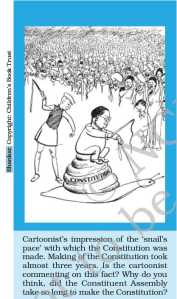
The uproar over what is being referred to as the ‘Ambedkar cartoon’ in the class XI textbook prepared by NCERT first began over a month ago, that is to say, almost six years after the books have been in circulation, been taught and received high praise for their lively style and a critical pedagogical approach (more on this below).  It was a political party – one of the factions of the Republican Party of India – that decided to kick up a ruckus over ‘the issue’ – that is, the ‘affront’ to Dr Ambedkar that the cartoon in question supposedly constitutes, and the resultant ‘hurt sentiments’ that it has caused. Very soon everyone began to fall in line, and practically every member of our august Parliament was vying with one other to prove that  they were indeed more hurt than their colleagues. One of them, Shri Ram Vilas Paswan has even demanded that the NCERT itself should be dissolved!

Good old Jurgen Habermas – and good old Habermasians  – have always invested a lot in forums like the parliament, that are to them the hallowed institutions of ‘rational-critical discourse’ where through reasoned argument people convince each other. That is how the voice of Reason ultimately prevails in democracies. I have always been suspicious of this claim and have thought that Habermas’ empirical work on the decline (‘structural transformation’) of the public sphere was more insightful than his normative fantasies. Long long ago, his empirical work on the transformation of the public sphere showed that it was the rise of political parties that had actually destroyed all possibilities of ‘rational-critical discourse’, where organized passion in the service of immediate political interests carried the day.

Continue reading Cartoons All! Politicians and Self-Seekers

Resisting Culinary Fascism: Nabanipa Bhattacharjee

 Guest post by NABANIPA BHATTACHARJEE

At the end of last month (March 2012) students of Jawaharlal Nehru University (JNU), New Delhi under the banner of a recently formed group called the New Materialists (NM) organized a public meeting to debate the issue of (dis)allowing certain kinds of food – beef and pork in particular – on the campus. The group, as one of its members Suraj Beri said, intended to petition the university administration to allow the sale of beef and pork in the canteen(s), and fight for inclusion of the same in the hostels’ menus; it was a struggle, as the NM declared, against the Brahmanical dietary impositions on Dalits and other minority community students of JNU. In fact, Francis (JNU students of the 1990’s would remember the man from Kerala) who ran a canteen at the basement of the School of Social Sciences II did serve beef curry on Saturdays, and it would not be an exaggeration to say that there would be more than a mad rush for that. However, he was pressurised – by Hindu right wing groups and other similar forces – to stop the sale of the “forbidden” food, and the canteen was eventually closed down.

Continue reading Resisting Culinary Fascism: Nabanipa Bhattacharjee

Workers Struggle in Dehradun

The following is a statement from Uttarakhand Nav Nirman Mazdoor Sangh and the Inquilabi Mazdoor Sangh received via Shankar Gopalakrishnan

Between 12 and 1 yesterday, 15 April 2012, the Uttarakhand police lathi charged more than 300 workers who have been sitting on a protest in Dehradun for the last ten days. 11 workers who have been on hunger strike (six from April 6th and five who joined them on April 9th) have been forcibly hospitalised in Doon Hospital, where they are resisting attempts to force-feed them. 326 workers have been arrested and detained in various jails in the city.

The workers have been on strike for more than three weeks now. They are employees of the Rockman and Satyam Auto plants in Haridwar, both major suppliers of Hero Motors. As in Manesar, Haryana last year, these workers are being paid extremely low wages for more than 12 hours of work a day; when they sought to form a union to demand respect for labour laws, the five leaders of the union were illegally sacked immediately and the others threatened with a similar fate. On March 19th the majority of permanent workers at Rockman came out on strike in protest at this illegal brutality, and on March 22nd they were joined by all the permanent workers at Satyam. Continue reading Workers Struggle in Dehradun

Eviction of Slum Dwellers and Repression of Anti-Eviction Demonstrators in West Bengal

[We are publishing below the following report based on materials received courtesy Sanhati, whose members were also arrested in the course of the struggle]

“If Didi could rush to the scene for one Tapashi Mallik, then she could surely hear the voices of 800 poor people and come here to see us” –Residents of Nonadanga slum in Kolkata

It is the same story once again. Cleaning up and beautification of cities in the clamour for urban space for consumption and the luxury of the rich. And as we have seen, it makes little difference whether the government/s are Leftist or Rightist, whether they claim to represent the oppressed poor or not. Thus, on 30th March, 2012 the TMC government forcefully evicted around 300 poor families from the Nonadanga slum area in South 24-Parganas, in the name of ‘development’ and ‘beautification’ of Kolkata. Their shanties were razed to ground by the Kolkata Metropolitan Development Authority. The homeless slum-dwellers have been staying in an open field and are facing constant police harassment. Despite these harsh conditions, they have refused to depart and are presently on hunger strike. Their demand has to date failed to draw any favourable attention from the government. This neglect comes on the heels of the Planning Commission agreeing to annual Bengal plan around 16 per cent more than last year’s.

Continue reading Eviction of Slum Dwellers and Repression of Anti-Eviction Demonstrators in West Bengal

Mamata’s order that stoked the media war: Independent Observer

[This is a guest post by an independent journalist journalist and in Kolkata]

How difficult is to make a choice between the Caligula and the powerful senators who plotted against him, purportedly to save Rome from the populist-turned paranoid emperor?
The question comes to one’s mind in view of the ongoing public spat between Bengal chief minister Mamata Banerjee and a powerful section of Bengal media which has virtually likened her to a female (a non-libidinous also) version of Caligula. The row, that now involves pro and anti-Mamata media blocs also, has been triggered by a recent government order asking 2500 plus state-run and aided libraries to subscribe, initially, to eight pro-government newspapers —five Bengali, two Urdu and one Hindi— barring the market leaders in these segments. The circular of the state libraries and mass education department cited the ‘promotion of free-thinking’ as the reason behind favouring the chosen newspapers.

However, the issues involved are neither limited to Mamata’s increasing attempts to browbeat critical media as the aggrieved houses are complaining about nor her well-meaning effort to support ‘small’, resource-starved newspapers against their big brothers as she herself and beneficiaries of her patronage are claiming. A closer scrutiny reveals that there are more to it beyond the binary of Oraamra (them and us), now part of Bengal’s political and media lexicon after Buddhadeb Bhattacharjee’s infamous bragging over his government’s brute majority in the state assembly in order to rubbish all opposition to his policies. Continue reading Mamata’s order that stoked the media war: Independent Observer

Life After Capitalism? A Document From Another Time

The French Marxist philosopher Louis Althusser, who perhaps reflected most on the question of ‘ideology’, once wrote that “ideology moves, but with an immobile motion that keeps it where it is”. Althusser did not make any claim about the truth or falsity of ideology. At a certain level, ideology undoubtedly refers to something that is real or true. What interested Althusser instead, was the relationship of ‘ideology’ to what he called ‘science’ – namely, that critical activity, which continuously works to take knowledge forward. Science, according to him, always lived by focusing on that which it did not know; ideology on the other hand, was that which remained with the obviousness of the already-known. Every new question that a science poses is effectively subsumed by ideology to give us something that we already knew. That is why science, he believed, was always  pursued, beseiged and occupied by ideology and had to continuously struggle to free itself from its grasp in order to live.

The CPI(M)’s ‘Draft Resolution on Some Ideological Issues’ prepared by the party for discussion and adoption at the party’s 20th Congress that began in Kozhikode today, is truly an ideological document in Althusser’s sense. It claims to move with the times and update the party thought apparatus but in reality, moves in order to stay where it is. It works to relentlessly re-present all the difficult questions of our times as if they were already known to the founders of something called ‘Marxism-Leninism’.

Continue reading Life After Capitalism? A Document From Another Time

CPI(M) shelves class struggle in action: Sankar Ray

Guest post by SANKAR RAY

[As the CPIM)’s 20th Congress began in Kozhikhode today, we bring two pieces marking the occasion. AN]

Unbelievable though it may seem even to the staunchest critic of CPI(M), ‘class struggle’ is totally missing in the 20950-plus word Draft Political Resolution (DPR) of the CPI(M), circulated and debated inside the party for over two months, that will be finalized with amendments, deletions and additions, at the 20th party Congress at Kozhikode between 4 and 9 April. The finalized political resolution is to be party’s tactical line until the 21st Congress four years later. The omission of ‘class struggle’ in the DPR, a basic document for committed struggle is stupefying as communists the world over frequently quote Marx that the history of mankind is “the history of class struggles”.

It’s not new as class struggle was omitted in the Political Resolution adopted at the 19th Congress ( Coimbatore, 29 March- 3 April 2008). But unlike at Coimbatore, the latest draft document talks of ‘people’s democracy’, CPI(M)’s main ideology, enshrined in the Updated Party Programme ( adopted at a special party conference in October 2000 at Thiruvananthapuram). But the pledge for moving forward to “a new, alternative path – towards people’s democracy and socialism” is vague.

Continue reading CPI(M) shelves class struggle in action: Sankar Ray

Politics, ‘Political Society’ and ‘the Everyday’

Politics, ‘Political Society’ and ‘the Everyday’

 Book Review 

Lineages of Political Society, by Partha Chatterjee, Permanent Black, Ranikhet, 2011. Pages: 278, hardcover, Rs 750.


Lineages of Political Society

 Over a decade ago, political theorist Partha Chatterjee embarked on what was a novel journey in the history of political thought in India and perhaps, in the postcolonial, non-Western world. Bringing together the results of decades of his own intellectual engagement with Indian politics and the question of subalternity in particular, Chatterjee began articulating a concept that has now acquired wide currency: his concept of ‘political society’. ‘Political society’, in Chatterjee’s hands, was a way of recuperating a sphere of politics that had been a permanent source of anxiety for theorists of Indian (and postcolonial) modernity and democracy – the vast domain that existed outside the designated spheres of modern politics, where the untutored masses made claims on the state and formed their own associations and organizations, unmindful of the formal grammar of rights and citizenship. A crucial part of what defines activities in this domain is ‘illegality’, or, at any rate, non-legality, where the state itself places the law in suspension in order to recognize the claims of the governed. Thus for instance, squatting by the poor on government land that is strictly speaking, encroachment in legal terms and can never acquire the status of a ‘right’, is nevertheless allowed by governments to continue through the recognition of some kind of moral claim of the poor on governments and society at large.

Continue reading Politics, ‘Political Society’ and ‘the Everyday’

FDI In Retail – What Does the Government’s Own Data Say? Shankar Gopalakrishnan

Guest post by SHANKAR GOPALAKRISHNAN

In his budget speech, Finance Minister Pranab Mukherjee declared that the government’s “decision” to allow FDI in multi-brand retail outlets “has been held in abeyance” until there is a “broad based consensus.”  In other words, it’s already a decision, but it’s just being held back until the government feels it can go ahead safely.  The question though is: why is the government so convinced of its decision?  How does Mr. Mukherjee so firmly declare that “organised retail helps in reducing costs of intermediation… benefiting both consumers and producers”?  Has the government done the homework to justify its actions?  This note looks at the government’s own data to find out.

As far as is known, there was only one study commissioned by the government in this regard (Business Standard 2007)  This was done by ICRIER in 2007, first published as a Working Paper in 2008 (Joseph et al 2008), and subsequently converted into a book – Retail in India: A Critical Assessment – in 2009, with one chapter added by other authors.[i]

Continue reading FDI In Retail – What Does the Government’s Own Data Say? Shankar Gopalakrishnan

Caste Discrimination in Cyclone Thane in Tamil Nadu and Pondicherry: NDW-NCDHR

A preliminary report of an investigation into caste discrinimation with regard to Cyclone Thane by National Dalit WatchNational Campaign for Dalit Rights  conducted on 18, 19 January 2012

Cyclone Thane

Cyclonic Storm Thane was the strongest tropical cyclone of 2011 within the North Indian Ocean. Thane initially developed as a tropical disturbance within the monsoon trough to the west of Indonesia. Over the next couple of days the disturbance gradually developed further while moving towards the northwest, and was declared a Depression during December 25, before being declared Cyclonic Storm Thane during the next day. As it was named, Thane started to turn towards the west under the influence of a subtropical ridge of high pressure before its development slowed down during December 27, as a strong outflow and marginally favourable sea surface temperatures fought with persistent vertical wind shear. After its development had slowed down during December 27, Thane became a Very Severe Cyclonic Storm during December 28, before as it approached the Indian states of Tamil Nadu and Andhra Pradesh, it weakened slightly. Thane then made landfall early on December 30, on the north Tamil Nadu coast between Cuddalore and Pondicherry and rapidly weakened into a depression.

Cuddalore and Vilipuram Districts in Tamil Nadu and Pondicherry were the worst affected due to Cyclone Thane. All roads in these three districts are line by wreckage of fallen trees including large tracts of Casuarina plantations completely wiped out. The only trees that seem to have withstood the fury of the cyclone seems to be the Borassus flabellifer or the Palmyra Palm. According to government estimates at least 39 people have been killed by this cyclone in Tamil Nadu and 7 in Pondicherry. Apart from the loss of life, the Cyclone left huge destruction in terms of livelihood, particularly agricultural livelihood and ripped apart the green cover in these already arid districts.

Continue reading Caste Discrimination in Cyclone Thane in Tamil Nadu and Pondicherry: NDW-NCDHR

उत्तर प्रदेश चुनाव 2012 और पसमांदा मुस्लिम समाज

This is the text of a pamphlet released by the PASMANDA INTELLECTUALS FORUM, Lucknow. It comes to us via Khalid Anis Ansari

पसमांदा समाज की मुख्य माँगें

हमने उत्तर प्रदेश विधान सभा चुनाव, 2012 के मद्देनज़र पसमांदा (दलित और पिछड़े) मुसलमानों   की पांच बड़ी मांगें तय की हैं. आइए, आगे बढ़ने से पहले हम इन मांगों पर नज़र डालें:

  1. पसमांदा मुसलमानों की उत्तर प्रदेश में 15% आबादी है. इस कारण सारी पार्टियां उनकी आबादी  के हिसाब से टिकट दें;
  2. सवर्ण (अशराफ) मुसलमानों को सर्वोच्च न्यायालय के मंडल (इंदिरा साहनी) फैसले (1992) के तहत आरक्षण की  परिधि से बाहर रखा जाये क्योंकि वह संविधान केअनुच्छेद 16 (4) और 15 (4) के तहत ‘सामाजिक और शैक्षिक’ तौर पर पिछड़े तबके नहीं माने जा सकते हैं;
  3. केन्द्र और उत्तर प्रदेश की ओबीसी लिस्ट को बिहार फार्मूले के तहत पिछड़ा वर्ग और अति-पिछड़ा वर्ग में विभाजित किया जाये और सारे पिछड़े मुसलमानों को सामानांतर रूप से पिछड़ी हिंदू जातियों के साथ अति-पिछड़ा श्रेणी में विधिवत शामिल किया जाये;
  4. दलित मुसलमानों / ईसाइयों को 1950 के राष्ट्रपति आदेश (पैरा 3) को रद्द कर के एससी लिस्ट में शामिल किया जाये;
  5. भूमंडलीकरण और नवउदारवादी आर्थिक नीतियों के चलते पसमांदा समाज के कारीगर/दस्तकार/मजदूर तबकों और लघु-उद्योग की बर्बादी को रोका जाए और उनको फिर से पटरी पर लाने वास्ते उचित नीतियां बनाई जाएँ.

Continue reading उत्तर प्रदेश चुनाव 2012 और पसमांदा मुस्लिम समाज

Jaypee and Mahyco as Indian Express sponsors: There is conflict of Interest here, Sir

[The following is a statement issued by concerned individuals regarding the sponsorship of the ‘Excellence in Journalism’ awards organized by the Indian Express.]

On January 10 and 11, 2012, half page advertisements in the Indian Express (IE) newspaper (at least in the Delhi edition) announced that on Jan 16, 2012 the IE Excellence in Journalism Awards will be given. The advertisement also said that the main sponsor is Jaypee Group and among other sponsors include the Mahyco Monsanto.

One may recall that Indian Express has been on a campaign mode advocating big dams in general. It has been specifically campaigning against the movements like the Narmada Bachao Andolan. In March April 2006 the paper specifically ran a campaign against NBA and also against the then Union Minister Prof Saifuddin Soz[1]. In Oct 2010 the paper ran a campaign for large hydro projects in the North East India when the then Environment Minister Jairam Ramesh held an open public hearing on these projects in Guwahati and then wrote to the Prime Minister, raising concerns about so many hydro projects being taken up in NE India and the impacts thereof.

Continue reading Jaypee and Mahyco as Indian Express sponsors: There is conflict of Interest here, Sir

A Tribute to Narahari Kaviraj (1917-2011): Sankar Ray

Guest post by SANKAR RAY

Narahari Kaviraj, eminent Marxist historian and an ideoligue of CPI, breathed his last in the wee hours of Wednesday, the 28th of December 2011. He was born on 17 February 1917 and was the last disciple of Bhupendranath Dutta,the youngest brother of Swami Vivekananda, whom Lenin had once requested, in reply to an article (draft), to devote himself to studying and writing on agrarian issues in India. As a scholar, Narahari Kaviraj was also a favourite of Puran Chand Joshi, general secretary of CPI (1935–47). The anecdote goes that when PCJ first heard that Kaviraj’s son, Sudipta ( now a scholar of international repute as a political theorist and department chair of the Middle Eastern, South Asian, and African Studies department at Columbia University) , joined JNU, he asked, ” Is he more brilliant than his father Narahari ?”

Continue reading A Tribute to Narahari Kaviraj (1917-2011): Sankar Ray

A Caste(d) Drive – Paramakudi to Pasumpon: Bobby Kunhu

Guest post by BOBBY KUNHU


Between the occasion of the memorial anniversary of Immanuel Sekharan that falls on 11th September and that of Muthuramalinga Thevar on 30th October are 30 odd road kilometers, 49 days, incalculable castiesm and this year (2011) 7 more Dalit lives. Almost the entire Big Media portrayed the 11th September, 2011 murders at Paramakudi as retaliatory State violence to an unruly and violent mob – to the convenient delight to the defenders of the State administration. Dissenting voices mostly Dalit – located the violence squarely where it belongs – in caste. In his note “Paramakudi Violence: Against Dalits, Against Politics”, inthe November 5th, 2011 issue of the Economic and Political Weekly, Muthukaruppan Parthasarathi clearly outlines the historical and current context in which the this year’s spate of violence that claimed 7 lives happened!

Continue reading A Caste(d) Drive – Paramakudi to Pasumpon: Bobby Kunhu

When Media is Nuked!: PK Sundaram

Guest post by PK SUNDARAM

After armed forces, nuclear establishment is another holy cow in the post-independence India. Our media does not only outsources all final judgements on nuclear issues to the nucleocrats, but has also happily joined them in slanders against the grassroots anti-nuclear movements.

We have seen the media discourse on nuclear weapons being shadowed almost entirely by national security and nuclear deterrence arguments. On the recent upsurge of mass protests against nuclear energy projects across the country, media is playing the official tune where people challenging these projects are reduced to illiterate crowd, foreign-funded groups, religious identities and even anti-nationals. On 24th this month, the Tamil newspaper Dinamalar published a story titled Truth and hype behind the Koodankulam row. This report is nothing but an utterly malicious piece of journalistic writing with ugly slanders against the leading activists of the ongoing anti-nuclear movement in Koodankulam – S P Udayakumar, M Pushparayan and M P Jesuraj.

Continue reading When Media is Nuked!: PK Sundaram

तिलिस्म-ए-होशरुबा, उर्फ़ पूंजी की अनकही कहानी

[यह लेख हाल में प्रभात खबर के दीपावली विशेषांक में छप चूका है  और मेरी हालिया किताब डिजायर नेम्ड डेवेलपमेंट के कुछ अंशों पर आधारित है.]

एक ज़माना था जब इंसान जिंदा रहने के लिए पैदावार किया करता था. बहुत पुरानी बात नहीं है – यही कोई सौ डेढ़ सौ बरस पहले का किस्सा है. आज जब हम जिंदा रहने के लिए नहीं बल्कि ‘जीडीपी’ या ‘सेंसेक्स’ जैसे कुछ अदृश्य देवताओं का पेट भरने के लिए पैदावार करते हैं, तब यह बात हमारी याद्दाश्त से तकरीबन गायब हो चुकी मालूम होती है की ये देवता दरअसल बहुत नए हैं. ‘जीडीपी’ की उम्र बमुश्किल अस्सी साल होगी, और ‘सेंसेक्स’ तो हमारे यहाँ १९७९ में ही वजूद में आया है. याद रखने काबिल बात है की इन दोनों का लोगों के वास्तविक जीवन से कोई रिश्ता नहीं है और यह बिलकुल मुमकिन है कि लोगों के जीवन-स्तर में लगातार गिरावट के साथ साथ आंकड़ों में हमें दोनों में अच्छी खासी बढोतरी दिखाई दे. मसलन, यह संभव है कि आप जंग के वक़्त लगातार जीडीपी में इज़ाफा देखें जब वास्तव में लोगों कि ज़िंदगियाँ बद से बदतर होती जा रही हों.

Continue reading तिलिस्म-ए-होशरुबा, उर्फ़ पूंजी की अनकही कहानी

Esther’s Story – Battling the Land Mafia in Hardwar: Sumantra Maitra

Guest post by SUMANTRA MAITRA

When you are in journalism, something that slowly builds up in you is your immunity to suprise. You can feel fear, sadness, hopelessness, impatience, and even joy, though the last emotion is increasingly becoming a rare thing in this field. But whatever you feel, one thing is for sure, that you generally don’t get surprised. So when I initially heard about a lone Canadian woman of advanced age and energetic spirits, who had come to India at the age of 19 in the 1960s, fighting the land mafia in Hardwar, without any help from anyone, I was intrigued, but NOT surprised.

I decided to chase the story.

Continue reading Esther’s Story – Battling the Land Mafia in Hardwar: Sumantra Maitra

Development in the ICU: Swagato Sarkar

Guest post by SWAGATO SARKAR

Montek Singh Ahluwalia (MSA) has taken over the English news channels [okay, perhaps not all, but two “exclusive” interviews to Headlines Today and CNN-IBN’s FTN (F stands for ‘Face’, btw)] tonight to shoot back at his opponents and detractors, the likes of Roys, Drezes, Aiyars. The discourse had three parts: the sermon, gloss and proto-penance, and the affirmation of the revealed Truth.

The Planning of Commission of the sovereign, socialist, secular, democratic republic of India is not a Stalinist Planning Commission. It has the solemn duty of finding India’s rightful place in the world at the average rate of 8% per year. But India is a poor country [exclusive news which cannot be shared at Davos]. The GDP has to enlarge. Market is what will make it happen. But market has limits. Hence, welfare. But MSA is not happy that the Growth-Decline story did not work out as he would have wished. But that is no reason to be anti-Growth [now go to the first line of the para and read it all over again.]

Continue reading Development in the ICU: Swagato Sarkar

Occupy Wall Street – An American Spring Amidst Media Blackout?

As governments across the world prostrate themselves before corporations and corporate greed takes over the daily business of governing, mass struggles are breaking out all over the world. What started as the much propagated ‘Arab Spring’ – apparently the Arab world’s yearning for American and Western values represented by ‘democracy’, has now, after spreading through Europe (France, Greece, Spain, Portugal…) engulfed the heart of Empire – the United States of America. The Occupy Wall Street movement that started almost three weeks ago, with thousands of people assembling in Zucotti Park in Lower Manhattan, New York, has now spread amdist media blackout and police repression, to other parts across the United States. A glimpse of the situation about a week ago:

Continue reading Occupy Wall Street – An American Spring Amidst Media Blackout?

The Decline of Communist Mass Base in Bihar: Jagannath Sarkar

[JAGANNATH SARKAR, who passed away in April, was among those who led the spectacular rise of CPI in Bihar in the 1960s and 1970s. He was among a handful of Bihar CPI leaders who envisioned the crisis in CPI in the mid-1970s. Today is his first birthday after he passed away – he was born on 25 September 1919.  The piece below is an important document that gives a glimpse of the debate on new caste assertions in the CPI. It was written by Sarkar in 1998, following the National Council meeting of the CPI. It has been translated by Raj Ballabh from Hindi. – AN]

The National Council of the CPI accepted, if belatedly, in its review report of March 1998 that there has been a serious decline in the basic mass base of the party and its class-based mass base has fragmented on the basis of caste. It has accepted that the party could not face the deviation of ‘social justice’ in the form of ‘backward casteism’ in its theatricality, or indeed politically and practically; that the party could not maintain its distinct identity, as a party that was politically and practically different from the Laloo-led Janata Dal Government. What is more, the toxin of casteism began to show its effects within the party as well. Indeed, it is an issue of serious concern which should be analyzed in detail.

Continue reading The Decline of Communist Mass Base in Bihar: Jagannath Sarkar

The Utopian Instinct – Aflatoon, Kiran Bedi and Nandan Nilekani: Taha Mehmood

Guest post by TAHA MEHMOOD

A pilgrimage to the cave

One day Cleinias, a Cretan invites Athenian and Megillos, a Spartan for a religious pilgrimage. Cleinias proposes to visit the cave of Zeus, just as Minos used to do. Minos was the legendary Cretan king. Every nine years Minos would walk along a path to the cave where he will hear revelations on the laws from Zeus. Perhaps the act of a man going to the cave to seek revelations from God was part of an ancient Cretian tradition. In the islandof Crete Minos played the role of a Lawgiver, in Athens– Zeus, while in Megillos’s state Sparta this role was played by Apollo.

Magnesia: The last idolum of Plato

This was the setting of the last dialog of Plato. He called it The Laws. In this dialog Plato tries to define the legal framework of an imaginary state named Magnesia. Throughout his life Plato was preoccupied with the question of how to name and define things. He believed one could even name abstract entities like numbers and define it as even or odd. In this dialog Plato makes an attempt to name various types of laws and define it.

Continue reading The Utopian Instinct – Aflatoon, Kiran Bedi and Nandan Nilekani: Taha Mehmood