All posts by Nivedita Menon

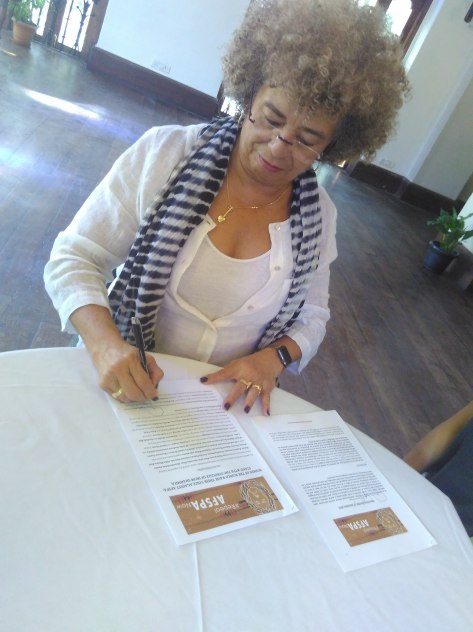
Angela Davis appeals to President to repeal AFSPA

img_20161217_105346

At an exclusive meet-the-press in Mumbai, American black feminist activist and human rights defender, Angela Davis joined feminists in India spearheading a global women’s campaign appealing to the President of India to use his Constitutional powers and repeal the draconian Armed Forces Special Powers Act (AFSPA). In doing so, she extends her solidarity to the struggles of women in India against the impunity granted to security forces under the AFSPA and the consequent widespread violation of rights in all areas where this law has been in force. In particular, Ms Davis salutes the historic struggle of Irom Chanu Sharmila whose 16 year long fast against the AFSPA helped foreground the issue both nationally, and internationally, saying “I am utterly inspired by Irom Sharmila’s strength and perseverance.”

There has been a global campaign of feminists seeking an end to AFSPA.

The full list of signatories can be seen here.

Infantilization of Women in Punjab’s Left: Nikita Azad

Guest post by NIKITA AZAD

It would be an understatement to say that apart from sexualization of young girls, society infantilizes women on a regular basis. Whether in domestic sphere where men decide what is best for the family and women, or office where men consider their women counterparts as less intelligent and inferior, such infantilization manifests itself in various forms and at various places. A similar trend can be observed in movies where men are usually portrayed as saviors whereas women are depicted as young ‘girls’ waiting to be saved. American TV serials from I Love Lucy onwards have routinely infantilized women, and contemporary Hindi soap operas too, represent and treat women as children to be taken care of by their families and husbands/lovers. Such an approach towards women not only reduces their value and identity as thinking, rational human beings, but it also provides men and the patriarchal structure an argument to justify their control over women. It strengthens the general belief that women are inferior, not only biologically but also mentally, and thus, it perpetuates male intellectual hegemony.

In recent times, many white-collar women employees and actresses have spoken against wage gap and workplace discrimination prevalent in their respective fields, which is as much a result of infantilization of women as it is that of gender discrimination. The work done by a woman, however good, is considered inferior as compared to that done by a man, based on the ground that women are more sensitive, emotional, and child-like; and are thus, there are more possibilities of their committing mistakes. Women feminists and non-feminists, who opine on social media on gender discrimination, are often seen as ones who are easily offended and are emotionally immature. Their responses are treated with sexism than with any serious arguments; the reactions are usually perceived as ‘angry’. Their Face Book and twitter accounts are filled with sexually abusive messages and their opinions are seen as having zero or less value when compared to their men counterparts. A good example would be a recent experiment done by a couple on Twitter, whereby a man and a woman, working for the same organization, The Washington Post, published two articles on similar issues but the responses they received were shockingly different. While the man’s inbox was crowded with racist comments, the woman’s inbox was filled with sexist and degrading names that the man could not bring himself to repeat on his post on Twitter.

While the consequences of the sexist practice of infantilization of women have been widely discussed in feminist circles, a study of its presence in otherwise democratic and progressive circles remains absent. Continue reading Infantilization of Women in Punjab’s Left: Nikita Azad

Hasta la victoria siempre

UNTIL VICTORY, ALWAYS…

150304151657-01-fidel-castro-0304-restricted-exlarge-169Image courtesy CNN

A Pinjra Tod Winter Afternoon In Jamia Millia Islamia, November 17, 2016

http://https://www.youtube.com/watch?v=ywVKedoofcA&feature=youtu.be

Statement by Pinjra Tod on November 19, 2016

A fiery anonymous open letter by a women resident of Jamia Millia Islamia to the VC on the arbitrary cancellation of late nights in August last year, marks the inception of Pinjra Tod as a movement. It has been an incredible year of reaching out to each other, connecting, discussing and collectivising in Jamia. Overcoming our anxieties of a repressive state machinery intent on criminalising minority voices and institutions, conquering our fear of an administration that has repeatedly targeted students (especially women) for raising their voices, we came together in Jamia last Thursday (17th Nov), drawing confidence from our collective strength, to hold our first ‘public’ event: an exhibition celebrating the struggle of women for education, and a session of poetry, songs and sharing of experiences.

Women students reiterated that the UGC circular issued on 2nd May’16 is being shamelessly flouted by Jamia administration, as in all other Universities and colleges. There are no sexual harassment complaints committee (the program was conducted beneath a huge anti-ragging banner), libraries and other facilities on campus remain inaccessible to women students after 8 PM, random show-cause notices for ‘misconduct’ are a common practice, very little democratic space for women students to organise events/discussions/screenings within hostel spaces and continuous surveillance.

Continue reading A Pinjra Tod Winter Afternoon In Jamia Millia Islamia, November 17, 2016

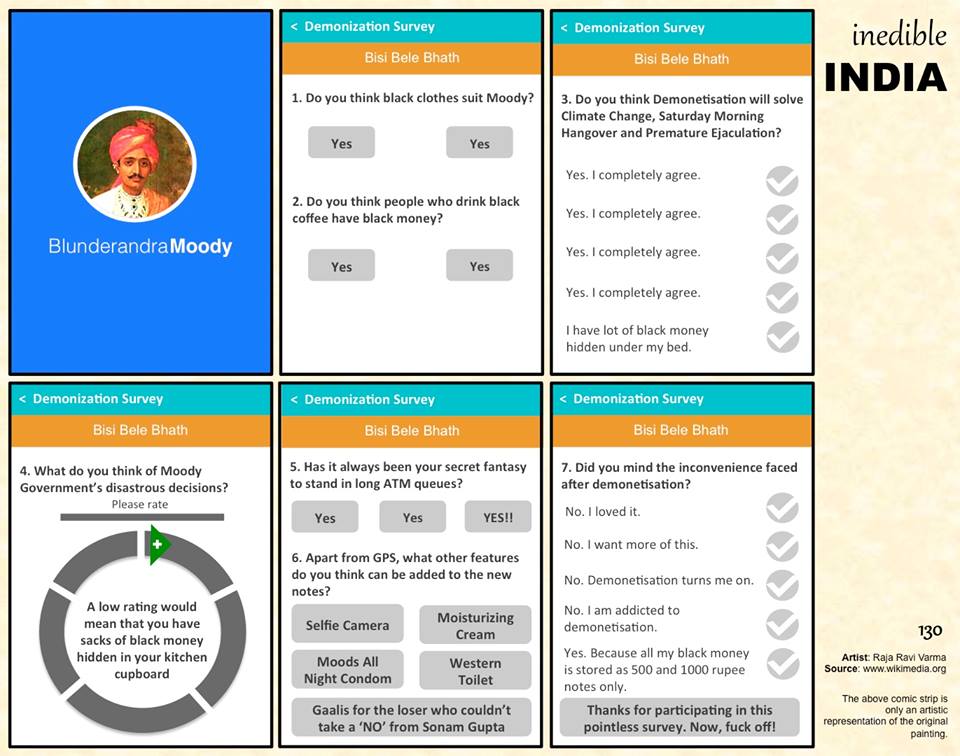
Inedible India on the NaMo App “Survey” on Demonetization

The PMO claimed that more than 93 per cent of the five lakh people who participated in a survey on Narendra Modi App have supported demonetization.

The loaded structure of the survey, the questions to which you can only “agree” or “partially agree”, with no option to “disagree”; all of it is typical of this utterly corrupt and dishonest government which holds the people of India in contempt.

The most powerful response to this government is to mock it.

Take this, Namo!

From Inedible India

15171078_1154465077940674_7199912734542558618_n

Withdraw false charges lodged by Chhattisgarh police against academics and political activists

PETITION TO THE PRESIDENT, PRIME MINISTER AND HOME MINISTER OF INDIA

We, the undersigned, are outraged by recent charges of murder that have been laid against

Delhi University professor Nandini Sundar, JNU professor Archana Prasad, Vineet Tiwari (of Joshi Adhikar Sansthan, Delhi), Chhattisgarh CPI(M) state secretary, Sanjay Parate, Mangalram Karma, and Manju Kawasi, CPI activist and Sarpanch of Guphidi in Sukma district, by the Chhattisgarh police in the killing of Shamnath Baghel.

The charges are patently fabricated, and follow a pattern of intimidation by the Chhattisgarh police every time evidence is released of their lawless prosecution of the war against the Maoists. Earlier this year, Sundar, Prasad, Tiwari and Parate were part of a fact-finding team that looked at the impact of Maoist violence and state excesses on ordinary villagers in Bastar, finding that they were victims of fake encounters, rapes, arrests, beatings, IED blasts, and killing of informers, implicating Maoists, police, and security forces. The residents of Bastar were also found to be facing the renewal of attacks by civilian militias armed by the state. At that time too, the district administration of Bastar had tried to implicate the fact-finding team on fake charges on the basis of a contrived complaint. More recently, when the police were charge-sheeted on the basis of evidence gathered by Sundar and others for carrying out arson in an operation in 2011, they retaliated by burning effigies of her and other activists and journalists in order to intimidate and incite violence against them.

Sundar and others have put on record their unequivocal condemnation of the killing of Shamnath Baghel. Their writing and interventions on the ongoing war in Bastar have consistently condemned all forms of violence, whether by the state or by the Maoists.

We are saddened by the climate of silencing of dissent that is becoming widespread in India and concerned that the work of researchers, journalists, lawyers and activists is being monitored and controlled to quell critical scrutiny of governmental actions. We believe such silencing of opposing views poses a grave danger to the democratic values of India.

Continue reading Withdraw false charges lodged by Chhattisgarh police against academics and political activists

Indian Muslim women – Caught between misogynists and hypocrites: Sanober Umar

Guest Post by SANOBER UMAR

The ugly patriarchal politics of ‘Triple Talaq’ or unilateral ‘instant divorce’ through which Indian Muslim men (specifically Sunnis who follow the Hanafi school of Islamic jurisprudence), can divorce their wives by pronouncing the word ‘talaq’ thrice in a single sentence, has appeared once again in mainstream politics. In this board game played over Muslim women, you have two main players. On the one hand you have the ever-so-vocal and self-proclaimed representatives of Muslims –  The All Indian Muslim Personal Law Board (AIMPLB) – and on the other hand, you have right-wing public figures of Hindutva, including our very own Prime Minister Mr. Modi, shedding tears of concern for Muslim women’s rights.

However Muslim women should not be deemed as agentless victims in this plot, and many are raising their voice against this practice by asserting their Koranic rights. Nonetheless, it is important to emphasize that while AIMPLB and Hindutva politics may seem to be polar opposites, the two have much more in common when it comes to curbing or denying Muslim women their rights. The male dominated AIMPLB is clearly vested in its project of misogyny even at the cost of denying Muslim women their Islamic right of longer procedures of divorce, that allow time and space for reasonable consideration before annulling a marriage. On the other hand, Hindutva men are no saviours of Muslim women either, as many instances both past and present have shown – including the recent spates of rape and murders (such as the Haryana rapes and murders by Gau Rakshaks and not to forget, the horrifying Muzaffarnagar violence not too long ago).

Continue reading Indian Muslim women – Caught between misogynists and hypocrites: Sanober Umar

End repression in Kashmir: A call from civil society

We, the undersigned, are dismayed over the ongoing crisis in Kashmir. We have watched in horror and shock the repetitive cycle of state aggression leading to violence, deteriorating state of civil liberties, violation of fundamental rights and ever escalating loss of human life and dignity in Kashmir. In the last 115 days, we have lost over 100 lives in Kashmir. More than 15,000 civilians have been injured, out of which 4500 persons have suffered grievous injuries due to pellet-guns, 4664 have been injured by bullets. Over 8000 people have been arrested out of which 434 people have been detained under the Public Safety Act (toll as on October 30, 2016).

The immediate response of the Indian state to the recent uprising in Kashmir was the imposition of curfew, which is continuing till date. A media gag where newspaper offices have been raided, copies confiscated and editors threatened with dire consequences, accompanied it. Journalists reporting the situation have been attacked, intimidated and threatened with violence by those supposedly responsible for protecting them. Most recently the government banned the publication of Kashmir Reader, a daily newspaper published from Srinagar.

Continue reading End repression in Kashmir: A call from civil society

The RSS war on thought and ABVP as foot soldiers

Ever since the present Modi government came to power, there appears to have been a clear set of orders issued from the Rashtriya Swayamsevak Sangh (RSS) headquarters to its student organization, the Akhil Bharatiya Vidyarthi Parishad (ABVP), to go on the rampage in university campuses all over India. From getting specific parts of syllabuses changed under threat of violence, disrupting events by other student organizations on campuses, to forcing university administrations to intervene to curb freedom of expression, to filing police complaints against dissenters, they seem to have been acting according to a well rehearsed script, subverting democratic processes on campuses. After its recent electoral defeats in JNU and Hyderabad Central University (HCU), however, the ABVP’s role seems to have acquired an even more virulent feature. The game plan appears to be to provoke violence wherever possible so that rather than any kind of debate, however contentious, on issues such as nationalism, minority rights and caste injustice, what we are increasingly likely to see are violent standoffs between student groups, which have to be controlled by the police. These are often represented in the media as brawls between students, as if there were no ideology or political content involved, just two groups of students “clashing.” But of course, in each case ABVP is involved, and in some kinds of reporting it can even be made to appear that ABVP was somehow the victim.

This is the moment at which teachers need to finally accept that ABVP is not just another student organization. We have tended to take the position in our universities that we must not condemn or directly address ABVP, since we must not directly involve ourselves in student politics. Teachers must talk to administration, be publicly critical of its lapses, take all measures necessary to display and enact our solidarity with students under attack by this regime. While students take their own decisions on modes of struggle and so on, teachers see our role as supportive but with a critical distance.

However, now we may need to start thinking of ways in which we  recognize the organization of the ABVP as a serious threat to Indian democracy. I don’t mean individual students, who would also be in our class-rooms, and with whom it may still be possible to continue a conversation, and whose examinations we will continue to grade with utmost probity. as we have always done.

But the ABVP as an organization has a specific role to play, as storm-troopers in the project of Hindu nationalism, and we cannot afford any longer not to face up to this fact frontally.

Continue reading The RSS war on thought and ABVP as foot soldiers

Seven of Us – The Other Side of the Armed Forces: Sanjeev Kumar

Guest Post by SANJEEV KUMAR

Seven of us in my family including me, along with 90% of the young men from my village, have tried to join the army at least once in our lives. Here I am using the term ‘army’ to include all armed forces and paramilitary forces.

Three members of my family succeeded and are now in the army along with around a hundred others from my village. More than two-thirds of them gave bribes of 1-2 lakh rupees, either by selling land or using family savings, to join the army. There are others who were cheated by dalals.  Hardly any of them would claim that they joined the army to serve the nation; rather, they joined the army to bring some relief to their starving families. Most of them teased and molested girls while travelling ticketless in trains to army recruitment centres in different parts of the country. Most of them including my brother, took 7-12 lakh rupees as dowry for marriage. Hardly any one of them wants their children to be in the army in preference to other civilian jobs.

My father also tried once to join the Indian army in the early 1980s but my grandfather hid his joining letter from him because my grandfather believed farming was better for him and for the family. Whenever they quarrelled in the early 2000s, I always heard my father blaming his father for the poverty of the family, because he did not allow him to join the army. It was around the same time that I first heard of anyone giving a bribe to join the army. It was my own uncle who was barely 5 to 7 years older than me, who  sold his agricultural land to pay 1 lakh rupees to a dalal as bribe through his mamaji who was also in the army. I also heard of two young boys in my village who had earlier given around 40000 rupees as bribe to join Bihar Police but lost all their money to a  dishonest agent. It was courageous of my uncle to risk his money even though the news of how two other village boys were cheated was fresh in the air. He had the courage to do that because his secondary dalal was his own mamaji. He had the courage to do that also because he had no other alternatives.

Continue reading Seven of Us – The Other Side of the Armed Forces: Sanjeev Kumar

Indian and Pakistani citizens speak out against war

article-sbhlockykc-1452406888

Images from #ProfilesforPeace (Scroll.in)

This petition will be delivered to:

  • Prime Minister Of India Narendra Modi
  • Prime Minister of Pakistan Nawaz Sharif

We, the people of India and Pakistan, stand in solidarity with each other to speak out against war in any form because, in war, we are all losers regardless of who might appear to win.

We hope that the elected representatives of both countries will exercise restraint, and act with wisdom, in the interests of lasting peace in our region, which alone can ensure economic progress and political stability.

We urge our leaders to come up with creative diplomatic solutions instead of engaging in a violent display of military might that threatens to destroy precious human life and natural resources.

We are determined to end the hostility that has festered between our nations since 1947, so that we can collectively work on the challenges that our common to us: climate change, terrorism, and widespread social injustice.

We want India and Pakistan to make a joint commitment to promote a culture of peace and non-violence, in keeping with the United Nations Sustainable Development Goals, and our vision for a better future for the young people of this planet.

Extra-Judicial Killings in Bijapur, Chhattisgarh: Women Against Sexual Violence and State Repression

Press release from WSS – Women Against Sexual Violence and State Repression – a nationwide platform of feminist activists and women’s organizations working to expose, challenge and resist sexual violence and its use as a tool of systemic repression.
Challenging State Impunity – A PIL on Extra-Judicial Killings in Bijapur, Chhattisgarh
Even as the Bastar police celebrate their “success” in having killed over a hundred alleged Naxalites this year, a Public Interest Litigation challenging the spate of encounters in Bijapur has been filed before the Chhattisgarh High Court in Bilaspur. The petitioners are two young women from Korcholi with extra-ordinary grit and determination –Suneeta Pottam (19 years old).and Munni Pottam (18 years old), who have been supported in this effort by a national women’s organization, the WSS (wssnet.org) as the third petitioner.

 The Petitioners, Suneeta Pottam and Munni Pottam, with a copy of their petition, in their lawyer’s office
The Petition

This petition highlights the extra-judicial executions of 6 people, which took place in the villages of Kadenar, Palnar, Korcholi and Andri in Bijapur district over the course of the last year. The police acknowledge only three of these incidents as encounters, and in each one of these, they providean almost identical story to the media –that these “encounters” occurred when combined teams of local police and paramilitary forces had gone out on combing operations after receiving “verified information” about the presence of Maoists in the area. In each one of these cases –  Kadernar, Palnar and Korcholi – the police claim that they first came under fire, forcing them to return fire – and it was only on searching the area in the aftermath that they stumbled onto the bodies of dead Maoists who had been killed in the exchange of fire. All of these dead Maoists, as per the police accounts, were found conveniently clad in uniforms and lying next to arms, spent ammunition and Maoist literature.
However, the villagers have something completely different to say.  Accompanying this petition are sworn affidavits of ten villagers who are family members of the deceased or eye witnesses of the incident, who challenge the police versions.  In Kadenar, the villagers talk about how a married couple, Tati Pande and Manoj Hapka, were forced out of their home in the evening at gunpoint, on the pretext of getting them “surrendered” in the Gangaloor police station. In Palnar, Seetu Hemla was dragged from the fields which he was ploughing, with his hands tied behind him, in full view of his young wife, mother and other villagers. In Korcholi, the womenfolk witnessed Sukku Kunjam of Itavar being shot point-blank, while he was visiting his relatives house in November 2015.

Continue reading Extra-Judicial Killings in Bijapur, Chhattisgarh: Women Against Sexual Violence and State Repression

International Scholars Condemn the Attack on Faculty and Students of Central University of Haryana

Over 70 UK and Europe-based scholars concerned with South Asia have written a letter to the Vice Chancellor of the Central University of Haryana. They have condemned the September 21, 2016 attack on a group of staff and students of CUH who were involved in putting together a performance based on the award-winning writer Mahasweta Devi’s acclaimed short story “Draupadi”. The attack and threats of charges of sedition against those involved in the performance were instigated by the BJP-affiliated student group ABVP as well as by the local press, which has falsely and maliciously spread the view that the play is anti-national and represented an attack on Indian soldiers. The letter appeals to the Vice Chancellor of CUH to protect the freedom of expression of the university’s staff and students, and to encourage the democratic exchange of ideas through means of debate and discussion.


Dear Vice-Chancellor Mahendra Pal Singh,

We, the undersigned, strongly condemn the attack on faculty members and students of the Department of English and Foreign Literatures at your university by members of the Akhil Bhartiya Vidyarthi Parishad (ABVP) for the performance of a play on 21 September 2016. The play was based on a short story by the eminent Bengali writer Mahasweta Devi. We understand that the staff and students involved in the performance had sought and received all necessary permissions for the event, which was organized to commemorate the literary achievements of Mahasweta Devi, the recipient of some of the most prestigious Indian and international awards.

We write to express our serious concern over this attack on the freedom of academic expression of the staff and students at your university. Mahasweta Devi’s story “Draupadi” was written in 1971 and represents her creative expression of the exploitation of India’s tribals.  It is regularly taught as part of course syllabi all over India and the world, including at the universities of some of the signatories to this letter. The claim by the ABVP and the local press that the play is an attack on Indian soldiers is manifestly fabricated. As one of the faculty members involved in the production, Dr Snehsata, has explained, students and teachers saw the programme as an academic and creative pursuit and their intention was certainly not to hurt the sentiments of soldiers as the ABVP has claimed: “In this event, I read the epilogue of the play recounting the data about atrocities on tribal people, especially sexual crimes against women by the Indian army. How ordinary soldiers are used by the state as a tool against its own people and how the body, especially the female body, becomes the site of revenge in the hands of Indian soldiers by the same state. All the teachers and students who were present there came up and congratulated us.”

Continue reading International Scholars Condemn the Attack on Faculty and Students of Central University of Haryana

Women Of The World Stand With Sharmila – Repeal AFSPA Now!

Statement from Stand With Irom Sharmila campaign

sharmila_20151105

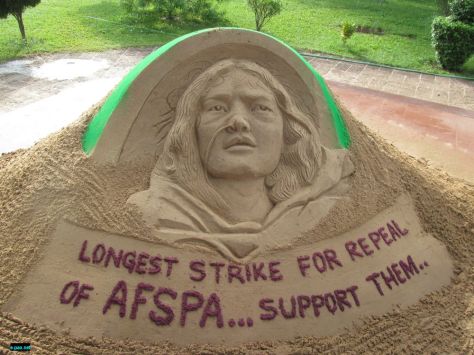
Sand Sculpture at Cuttack, Orissa by artist Himanshu Shekhar Parida, in solidarity with Irom Sharmila’s struggle for repeal of AFSPA,  to mark 15 years of completion of  her hunger protest in 2015. (Image courtesy E-Pao)

“My struggle will continue until AFSPA is struck down” said Irom Sharmila Chanu, the poet and activist from Manipur whose 16-year long hunger strike against the Armed Forces Special Powers Act has made her a global symbol of non-violent resistance. Sharmila was speaking at a press conference organised on October 1, 2016 by the “Stand With Irom Sharmila: Repeal AFSPA” Campaign, a global campaign endorsed by nearly 1000 women – from pioneers of global women’s movements to grassroot activists who have dedicated their lives to the struggle for women’s rights and freedoms.

The Armed Forces Special Powers Act (AFSPA) is a colonial law first promulgated by the British rulers of India in 1942 to try and quell the freedom struggle. It has been continuously operative in several north-eastern states, including Sharmila’s home state of Manipur since 1958. It was also imposed in Jammu and Kashmir in 1990. Under this law, armed forces and other security forces in “disturbed areas” have the license to shoot to kill anyone on suspicion; make arrests without warrants; enter and search any home or establishment; detain and question anyone. Armed forces personnel and security forces have complete immunity for actions taken under this law, and their prosecution requires prior sanction of the government, under Section 6 of the AFSPA. RTI information has disclosed that Sanction for prosecution of armed forces even for egregious human rights violation has never been granted. Nor is the government’s decision on declaring an area “disturbed” subject to judicial review.
Continue reading Women Of The World Stand With Sharmila – Repeal AFSPA Now!

Kashmir Issue – A Brief Report on Solidarity Actions in Punjab: Jagmohan Singh

Guest Post by JAGMOHAN SINGH

Clear Message from the Revolutionary Democratic Movement in Punjab

We Firmly Stand with the People of Kashmir

Once again, Kashmir is boiling with rage. The pent-up anger of the people of Kashmir against their brutal oppression by the Indian security forces has erupted in powerful massive protests in the form of gatherings, demonstrations and skirmishes and clashes with these forces, in which more than 75 people have been killed, many blinded and more than thousand injured so far. It is more than 60 days now since the cold-blooded killing of Hizbul commander Burhan Wani by the security forces on 8th of July. Yet the anger of the people is finding no let-up. Brave Kashmiris are valiantly fighting against the atrocities and brutalities of the security forces. They are coming out on the roads time and again, in large numbers, caring little for the restrictions, curfews and even firings. They deserve our salute.

The just and righteous struggle of the people of Kashmir has gained support from variety of sections of the people world over. In India too, the reports of such solidarity actions supporting the Kashmiri people are pouring in. In Punjab also some such actions have taken place. The solidarity activity in Punjab, scattered over a wide area and taking different forms such as conventions, public meetings, demonstrations and other forms of mass-propaganda, was chiefly organized by the communist revolutionary, revolutionary democratic and other pro-people forces active in the state. Almost all the sections of society such as peasants, workers, employees, intellectuals, students and youth participated in these solidarity actions; especially the leading sections and front rank activists and fighters of the revolutionary democratic movement of the state participated in considerable numbers and with a marked conviction.

Continue reading Kashmir Issue – A Brief Report on Solidarity Actions in Punjab: Jagmohan Singh

Statement against All India Muslim Personal Law Board’s affidavit claiming triple talaq is Islamic: Bebaak Collective

Statement by Hasina Khan, Roshni Rina, Geeta Thatra, Shirin Dalvi  on behalf of Bebaak Collective (Voices of the Fearless).

Contact details: bebaakcollective@gmail.com/ 9870162113

We, as part of women’s movement and practising feminists working with Muslim community and the women of the community for years in India, take the liberty to write this statement condemning the recent affidavit posed by All India Muslim Personal Law Board (AIMPLB). The claims of this affidavit are:

First, abolition of triple talaq is (un) Quranic;

Second, since women lack decision making abilities, it is only men of the community who should have this right;

Third, polygamy is Islamic, though not promoted by Islam, and this practice ensures marital rights for Muslim women, banning of which will result in promiscuous sexual practices or murder of women at the hands of their husbands;

Fourth, the honorable Supreme Court of India has no right to intervene in the religious law of the community.

This statement has been issued by the AIMPLB in the context of the growing number of Muslim women’s petitions challenging the constitutionality of triple talaq in the apex court.

We strongly condemn this statement based on all the four premises.

Continue reading Statement against All India Muslim Personal Law Board’s affidavit claiming triple talaq is Islamic: Bebaak Collective

The Surrogacy Debate and the Missing ART Bill: Chayanika Shah

Guest Post by CHAYANIKA SHAH

Altruistic. Meaning: showing a disinterested and selfless concern for the well-being of others; unselfish.

So once again the government is asking women to be unselfish and show selfless concern for the well being of others. The “others”, however, have been clearly marked. It has to be people within the close family. Women dare not feel selfless or altruistic concern for anyone other than those that are connected to them genetically or through marriage (since that is what defines a family by law and dominant customs). This concern should be so selfless that they should also not worry about their health after the pregnancy, they should not care for the loss of employment or any other changes that may happen in their lives as a result of this concern that they show for a family member. After all we are living in the “Indian ethos” where women are supposed to sacrifice for their “families,” and for none other. And in any case, till very lately, until all these new fangled ideas of women being natural guardians etc. came up, women were giving this altruistic services to their husbands. They are used to it and this is merely an extension of their familial labour. Simple!

It is such a waste of women’s reproductive potential that they bear children just for their husband. The family may as well benefit from the labour of the woman, and it be shared with other family members too. Especially for those who have married as per all the caste and community norms and have even stuck together for five years in spite of not having a child. Why should the hard earned money of “the family” be squandered on someone else? Is that not wasting the potential of women? After all why have we have saved the girl child? So that our boys can have the right girls to marry and also so that we can continue with our eugenic marriage and child bearing practices within the right caste and gotra unions.

Continue reading The Surrogacy Debate and the Missing ART Bill: Chayanika Shah

ABVP and Dalit upsurge: Jatin Goraiya

Guest Post by JATIN GORAIYA who recently resigned from the post of Vice President of ABVP JNU unit. 

Read also his interview to The Telegraph here.

Jatin sent this statement to Kafila, which we publish here in full.

The right wing in our country is keen to strengthen the model of Hindutva fascism in India which is jeopardising the secular fabric of this country. This model of Hindutva fascism is based on a narrow, conservative sense of nation which tends to exclude a major population of dalits, adivasis, muslims and women. This imagination necessarily feeds on this idea of exclusion, the propagators of  RSS and Sangh ideology would never be able to sustain their dominance if they render equal status to Dalits, Adivasis, Muslims and women in this country. Hierarchy and inequality is the basic minimum to keep them in power. At the same time they are trying to inculcate and justify a particular kind of idea of nation and nationalism in people around the country. The BJP has not been able to do any good as far as the rhetoric of development is concerned, so the alternative strategy is to sway people in the name of nationalism and religion. Ideologically they are aware of their hollowness and bankruptcy, so the idea now is to mobilise people in the name of sentimental and unreasonable matters. For example they provide an ideological backup to the Manusmiriti, where women are seen as objects of seduction and are to remain under the feet of men all their lives no matter how brutal he is. Dalits are supposed to serve the upper castes and should be given inhuman punishments if they don’t comply. Following this kind of  mindset, they tend to keep the caste and gender hierarchies and divisions intact, while paying lip service to social justice.

Continue reading ABVP and Dalit upsurge: Jatin Goraiya

Ambedkar University faculty statement on violence against marginalized communities

Ambedkar University Delhi Faculty Association (AUDFA) expresses serious concern and outrage about the growing spiral of violence against various marginalized communities across the country. In the last one month two states particularly have witnessed violence and protests in an extensive scale.

AUDFA condemns the continued violence against people in the Kashmir valley, where the death toll is continuously rising. The violence in Kashmir this time saw a familiar pattern as before, an (encounter) killing, a funeral where rage is vented through slogans and indiscriminate and abominable violence as a response. Kashmir valley remained under a complete blackout with all modes of communication and transport blocked and curfew imposed for several days. AUDFA urges that immediate efforts towards demilitarization of Kashmir valley must be initiated and steps must be taken towards preventing the killing and injury of civilians.

AUDFA also strongly protests against the brutal beating, flogging stripping and parading of seven dalit men in Una taluka of Gujarat. As protests against this violence, at least twelve dalit men attempted suicide. Massive protests by dalits are evidence towards the failure of the justice system which has not been able to provide redress against the high rates of caste atrocity in Gujarat. AUDFA believes that action needs to be taken against vigilante gauraksha groups (who were the perpetrators of the violence) under the SC/ST (Prevention of Atrocities) Act.

Continuous violence and discrimination against Muslims and the dalits goes against the moral fabric of the Constitution and as a faculty association AUDFA expresses its anxiety over the growing everyday intolerance among and polarisation of the people in this country. We express our solidarity with protests against such ongoing violence.

Gopalji Pradhan                   Rukmini Sen                         Arindam Banerjee

Secretary                                President                               Treasurer


A secularism of despondency or a secularism of hope? Vikas Bajpai

Guest post by VIKAS BAJPAI

Mera abai watan, my ancestral home, the place to which I belong, is Lucknow.  Lucknow is ‘my city of joy’; and for me Lucknow’s identity derives from ‘old Lucknow.’ The newer part of the city is a creation of barely thirty to thirty-five years and bears little reflection of what Lucknow otherwise stands for.

There can be little conceptualization of Lucknow’s legendary culture, its tehzeeb, without any imagination of ‘old Lucknow’. As an instance of how deeply this tehzeeb had percolated into society, I still recall, on a few occasions that I happened to accompany my maternal uncle to the Raqabganj sabzi mandi, the hawkers would attract buyers for slender and delicate kakdis (skinny cucumbers) with the poetic call – ‘lijiye – lijiye, laila ki ungliyan, majnu ki pasliyan’ (‘Come, get these delicate fingers of Laila, Majnu’s slender  ribs’, referring to the legendary star-crossed lovers Laila-Majnu).

Old Lucknow’s lanes and by-lanes, its busy bazaars, the Chowk – famous for chikan embroidery and zari work; Prakash ki kulfi in Aminabad (a popular market in old Lucknow); the early morning doodh malai and jalebi stalls; the horse-driven ikkas and the tangas; the masjids and their aazaans; the Siddhanath Mandir next door to our house; burqa clad women and the Muslim men wearing dupalia topis, headgear sometimes worn by Hindu men too, especially on Holi; Chaar Bagh railway station; Hanuman Inter ‘Kalej’ and ‘Quins Kalej’ (colleges from where my mother and father matriculated respectively; in the Awadh area of Uttar Pradesh ‘college’ would typically be pronounced as ‘kalej’); and of course how can one forget the mangoes – all of these shall forever be etched as a part of my childhood memories.

Continue reading A secularism of despondency or a secularism of hope? Vikas Bajpai

Regulating the Surrogacy Industry – A Feminist Perspective: Sarojini Nadimpally, Deepa Venktachalam and Sneha Banerjee

Guest Post by SAROJINI NADIMPALLY, DEEPA VENKTACHALAM and SNEHA BANERJEE of SAMA, a resource group for women and health.

The press briefing on commercial surrogacy by Minister of External Affairs Ms  Sushma Swaraj, on 24th August 2016,  did not come as a surprise to many of us who have been advocating for the rights of surrogate mothers and the regulation of the Assisted Reproductive Technology (ART) industry. Many of the points mentioned in her speech were already in the Draft Assisted Reproductive Technologies (Regulation) Bill 2014. Since 2015, the Ministry of Home Affairs (MHA) had stopped issuing visas to foreigners for commissioning a surrogacy. The Supreme Court of India is currently hearing arguments in a Public Interest Litigation (PIL) demanding a prohibition or ban on commercial surrogacy.  In a recent hearing, the Supreme Court asked the government to develop the framework for the regulation of the  ART and surrogacy industry in India.

The latest regulatory move extends prohibitions in place in the draft ART Bill of 2014, banning commercial surrogacy altogether, and permitting only altruistic surrogacy (without payment), and only for one category of people – heterosexual Indian couples who have been married for five years and do not have any children, specifically excluding NRIs. Only close relatives can be surrogates and there are penalties that are absent in the Draft ART Bill of 2014. The draft ART Regulation Bills (2010, 2014) mentioned marriage as a mandatory clause, with ‘couple’ who could access surrogacy arrangements, defined as a man and woman living in a marital relationship for two years; the current Surrogacy Bill says 5 years.

This approach obviously discriminates against queer couples whose marriage is not legal in India; and as for ‘single’ persons – they are persona non grata. This is highly problematic, moralistic and discriminatory. The briefing was an outpouring of the nation-family-culture rhetoric and patronizing morality. We have not read the current Surrogacy Regulation Bill yet as it is not available in the public domain and hence our concerns are based on the media reports.

Continue reading Regulating the Surrogacy Industry – A Feminist Perspective: Sarojini Nadimpally, Deepa Venktachalam and Sneha Banerjee