All posts by Nivedita Menon

Extra-Judicial Killings in Bijapur, Chhattisgarh: Women Against Sexual Violence and State Repression

Press release from WSS – Women Against Sexual Violence and State Repression – a nationwide platform of feminist activists and women’s organizations working to expose, challenge and resist sexual violence and its use as a tool of systemic repression.
Challenging State Impunity – A PIL on Extra-Judicial Killings in Bijapur, Chhattisgarh
Even as the Bastar police celebrate their “success” in having killed over a hundred alleged Naxalites this year, a Public Interest Litigation challenging the spate of encounters in Bijapur has been filed before the Chhattisgarh High Court in Bilaspur. The petitioners are two young women from Korcholi with extra-ordinary grit and determination –Suneeta Pottam (19 years old).and Munni Pottam (18 years old), who have been supported in this effort by a national women’s organization, the WSS (wssnet.org) as the third petitioner.

 The Petitioners, Suneeta Pottam and Munni Pottam, with a copy of their petition, in their lawyer’s office
The Petition

This petition highlights the extra-judicial executions of 6 people, which took place in the villages of Kadenar, Palnar, Korcholi and Andri in Bijapur district over the course of the last year. The police acknowledge only three of these incidents as encounters, and in each one of these, they providean almost identical story to the media –that these “encounters” occurred when combined teams of local police and paramilitary forces had gone out on combing operations after receiving “verified information” about the presence of Maoists in the area. In each one of these cases –  Kadernar, Palnar and Korcholi – the police claim that they first came under fire, forcing them to return fire – and it was only on searching the area in the aftermath that they stumbled onto the bodies of dead Maoists who had been killed in the exchange of fire. All of these dead Maoists, as per the police accounts, were found conveniently clad in uniforms and lying next to arms, spent ammunition and Maoist literature.
However, the villagers have something completely different to say.  Accompanying this petition are sworn affidavits of ten villagers who are family members of the deceased or eye witnesses of the incident, who challenge the police versions.  In Kadenar, the villagers talk about how a married couple, Tati Pande and Manoj Hapka, were forced out of their home in the evening at gunpoint, on the pretext of getting them “surrendered” in the Gangaloor police station. In Palnar, Seetu Hemla was dragged from the fields which he was ploughing, with his hands tied behind him, in full view of his young wife, mother and other villagers. In Korcholi, the womenfolk witnessed Sukku Kunjam of Itavar being shot point-blank, while he was visiting his relatives house in November 2015.

Continue reading Extra-Judicial Killings in Bijapur, Chhattisgarh: Women Against Sexual Violence and State Repression

International Scholars Condemn the Attack on Faculty and Students of Central University of Haryana

Over 70 UK and Europe-based scholars concerned with South Asia have written a letter to the Vice Chancellor of the Central University of Haryana. They have condemned the September 21, 2016 attack on a group of staff and students of CUH who were involved in putting together a performance based on the award-winning writer Mahasweta Devi’s acclaimed short story “Draupadi”. The attack and threats of charges of sedition against those involved in the performance were instigated by the BJP-affiliated student group ABVP as well as by the local press, which has falsely and maliciously spread the view that the play is anti-national and represented an attack on Indian soldiers. The letter appeals to the Vice Chancellor of CUH to protect the freedom of expression of the university’s staff and students, and to encourage the democratic exchange of ideas through means of debate and discussion.


Dear Vice-Chancellor Mahendra Pal Singh,

We, the undersigned, strongly condemn the attack on faculty members and students of the Department of English and Foreign Literatures at your university by members of the Akhil Bhartiya Vidyarthi Parishad (ABVP) for the performance of a play on 21 September 2016. The play was based on a short story by the eminent Bengali writer Mahasweta Devi. We understand that the staff and students involved in the performance had sought and received all necessary permissions for the event, which was organized to commemorate the literary achievements of Mahasweta Devi, the recipient of some of the most prestigious Indian and international awards.

We write to express our serious concern over this attack on the freedom of academic expression of the staff and students at your university. Mahasweta Devi’s story “Draupadi” was written in 1971 and represents her creative expression of the exploitation of India’s tribals.  It is regularly taught as part of course syllabi all over India and the world, including at the universities of some of the signatories to this letter. The claim by the ABVP and the local press that the play is an attack on Indian soldiers is manifestly fabricated. As one of the faculty members involved in the production, Dr Snehsata, has explained, students and teachers saw the programme as an academic and creative pursuit and their intention was certainly not to hurt the sentiments of soldiers as the ABVP has claimed: “In this event, I read the epilogue of the play recounting the data about atrocities on tribal people, especially sexual crimes against women by the Indian army. How ordinary soldiers are used by the state as a tool against its own people and how the body, especially the female body, becomes the site of revenge in the hands of Indian soldiers by the same state. All the teachers and students who were present there came up and congratulated us.”

Continue reading International Scholars Condemn the Attack on Faculty and Students of Central University of Haryana

Women Of The World Stand With Sharmila – Repeal AFSPA Now!

Statement from Stand With Irom Sharmila campaign

sharmila_20151105

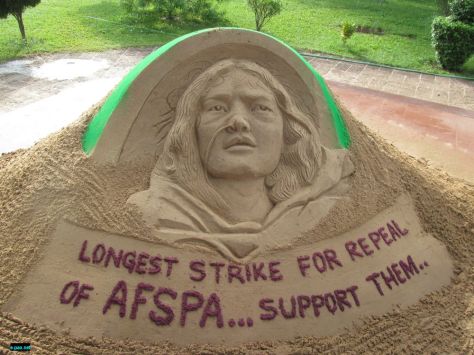
Sand Sculpture at Cuttack, Orissa by artist Himanshu Shekhar Parida, in solidarity with Irom Sharmila’s struggle for repeal of AFSPA,  to mark 15 years of completion of  her hunger protest in 2015. (Image courtesy E-Pao)

“My struggle will continue until AFSPA is struck down” said Irom Sharmila Chanu, the poet and activist from Manipur whose 16-year long hunger strike against the Armed Forces Special Powers Act has made her a global symbol of non-violent resistance. Sharmila was speaking at a press conference organised on October 1, 2016 by the “Stand With Irom Sharmila: Repeal AFSPA” Campaign, a global campaign endorsed by nearly 1000 women – from pioneers of global women’s movements to grassroot activists who have dedicated their lives to the struggle for women’s rights and freedoms.

The Armed Forces Special Powers Act (AFSPA) is a colonial law first promulgated by the British rulers of India in 1942 to try and quell the freedom struggle. It has been continuously operative in several north-eastern states, including Sharmila’s home state of Manipur since 1958. It was also imposed in Jammu and Kashmir in 1990. Under this law, armed forces and other security forces in “disturbed areas” have the license to shoot to kill anyone on suspicion; make arrests without warrants; enter and search any home or establishment; detain and question anyone. Armed forces personnel and security forces have complete immunity for actions taken under this law, and their prosecution requires prior sanction of the government, under Section 6 of the AFSPA. RTI information has disclosed that Sanction for prosecution of armed forces even for egregious human rights violation has never been granted. Nor is the government’s decision on declaring an area “disturbed” subject to judicial review.
Continue reading Women Of The World Stand With Sharmila – Repeal AFSPA Now!

Kashmir Issue – A Brief Report on Solidarity Actions in Punjab: Jagmohan Singh

Guest Post by JAGMOHAN SINGH

Clear Message from the Revolutionary Democratic Movement in Punjab

We Firmly Stand with the People of Kashmir

Once again, Kashmir is boiling with rage. The pent-up anger of the people of Kashmir against their brutal oppression by the Indian security forces has erupted in powerful massive protests in the form of gatherings, demonstrations and skirmishes and clashes with these forces, in which more than 75 people have been killed, many blinded and more than thousand injured so far. It is more than 60 days now since the cold-blooded killing of Hizbul commander Burhan Wani by the security forces on 8th of July. Yet the anger of the people is finding no let-up. Brave Kashmiris are valiantly fighting against the atrocities and brutalities of the security forces. They are coming out on the roads time and again, in large numbers, caring little for the restrictions, curfews and even firings. They deserve our salute.

The just and righteous struggle of the people of Kashmir has gained support from variety of sections of the people world over. In India too, the reports of such solidarity actions supporting the Kashmiri people are pouring in. In Punjab also some such actions have taken place. The solidarity activity in Punjab, scattered over a wide area and taking different forms such as conventions, public meetings, demonstrations and other forms of mass-propaganda, was chiefly organized by the communist revolutionary, revolutionary democratic and other pro-people forces active in the state. Almost all the sections of society such as peasants, workers, employees, intellectuals, students and youth participated in these solidarity actions; especially the leading sections and front rank activists and fighters of the revolutionary democratic movement of the state participated in considerable numbers and with a marked conviction.

Continue reading Kashmir Issue – A Brief Report on Solidarity Actions in Punjab: Jagmohan Singh

Statement against All India Muslim Personal Law Board’s affidavit claiming triple talaq is Islamic: Bebaak Collective

Statement by Hasina Khan, Roshni Rina, Geeta Thatra, Shirin Dalvi  on behalf of Bebaak Collective (Voices of the Fearless).

Contact details: bebaakcollective@gmail.com/ 9870162113

We, as part of women’s movement and practising feminists working with Muslim community and the women of the community for years in India, take the liberty to write this statement condemning the recent affidavit posed by All India Muslim Personal Law Board (AIMPLB). The claims of this affidavit are:

First, abolition of triple talaq is (un) Quranic;

Second, since women lack decision making abilities, it is only men of the community who should have this right;

Third, polygamy is Islamic, though not promoted by Islam, and this practice ensures marital rights for Muslim women, banning of which will result in promiscuous sexual practices or murder of women at the hands of their husbands;

Fourth, the honorable Supreme Court of India has no right to intervene in the religious law of the community.

This statement has been issued by the AIMPLB in the context of the growing number of Muslim women’s petitions challenging the constitutionality of triple talaq in the apex court.

We strongly condemn this statement based on all the four premises.

Continue reading Statement against All India Muslim Personal Law Board’s affidavit claiming triple talaq is Islamic: Bebaak Collective

The Surrogacy Debate and the Missing ART Bill: Chayanika Shah

Guest Post by CHAYANIKA SHAH

Altruistic. Meaning: showing a disinterested and selfless concern for the well-being of others; unselfish.

So once again the government is asking women to be unselfish and show selfless concern for the well being of others. The “others”, however, have been clearly marked. It has to be people within the close family. Women dare not feel selfless or altruistic concern for anyone other than those that are connected to them genetically or through marriage (since that is what defines a family by law and dominant customs). This concern should be so selfless that they should also not worry about their health after the pregnancy, they should not care for the loss of employment or any other changes that may happen in their lives as a result of this concern that they show for a family member. After all we are living in the “Indian ethos” where women are supposed to sacrifice for their “families,” and for none other. And in any case, till very lately, until all these new fangled ideas of women being natural guardians etc. came up, women were giving this altruistic services to their husbands. They are used to it and this is merely an extension of their familial labour. Simple!

It is such a waste of women’s reproductive potential that they bear children just for their husband. The family may as well benefit from the labour of the woman, and it be shared with other family members too. Especially for those who have married as per all the caste and community norms and have even stuck together for five years in spite of not having a child. Why should the hard earned money of “the family” be squandered on someone else? Is that not wasting the potential of women? After all why have we have saved the girl child? So that our boys can have the right girls to marry and also so that we can continue with our eugenic marriage and child bearing practices within the right caste and gotra unions.

Continue reading The Surrogacy Debate and the Missing ART Bill: Chayanika Shah

ABVP and Dalit upsurge: Jatin Goraiya

Guest Post by JATIN GORAIYA who recently resigned from the post of Vice President of ABVP JNU unit. 

Read also his interview to The Telegraph here.

Jatin sent this statement to Kafila, which we publish here in full.

The right wing in our country is keen to strengthen the model of Hindutva fascism in India which is jeopardising the secular fabric of this country. This model of Hindutva fascism is based on a narrow, conservative sense of nation which tends to exclude a major population of dalits, adivasis, muslims and women. This imagination necessarily feeds on this idea of exclusion, the propagators of  RSS and Sangh ideology would never be able to sustain their dominance if they render equal status to Dalits, Adivasis, Muslims and women in this country. Hierarchy and inequality is the basic minimum to keep them in power. At the same time they are trying to inculcate and justify a particular kind of idea of nation and nationalism in people around the country. The BJP has not been able to do any good as far as the rhetoric of development is concerned, so the alternative strategy is to sway people in the name of nationalism and religion. Ideologically they are aware of their hollowness and bankruptcy, so the idea now is to mobilise people in the name of sentimental and unreasonable matters. For example they provide an ideological backup to the Manusmiriti, where women are seen as objects of seduction and are to remain under the feet of men all their lives no matter how brutal he is. Dalits are supposed to serve the upper castes and should be given inhuman punishments if they don’t comply. Following this kind of  mindset, they tend to keep the caste and gender hierarchies and divisions intact, while paying lip service to social justice.

Continue reading ABVP and Dalit upsurge: Jatin Goraiya

Ambedkar University faculty statement on violence against marginalized communities

Ambedkar University Delhi Faculty Association (AUDFA) expresses serious concern and outrage about the growing spiral of violence against various marginalized communities across the country. In the last one month two states particularly have witnessed violence and protests in an extensive scale.

AUDFA condemns the continued violence against people in the Kashmir valley, where the death toll is continuously rising. The violence in Kashmir this time saw a familiar pattern as before, an (encounter) killing, a funeral where rage is vented through slogans and indiscriminate and abominable violence as a response. Kashmir valley remained under a complete blackout with all modes of communication and transport blocked and curfew imposed for several days. AUDFA urges that immediate efforts towards demilitarization of Kashmir valley must be initiated and steps must be taken towards preventing the killing and injury of civilians.

AUDFA also strongly protests against the brutal beating, flogging stripping and parading of seven dalit men in Una taluka of Gujarat. As protests against this violence, at least twelve dalit men attempted suicide. Massive protests by dalits are evidence towards the failure of the justice system which has not been able to provide redress against the high rates of caste atrocity in Gujarat. AUDFA believes that action needs to be taken against vigilante gauraksha groups (who were the perpetrators of the violence) under the SC/ST (Prevention of Atrocities) Act.

Continuous violence and discrimination against Muslims and the dalits goes against the moral fabric of the Constitution and as a faculty association AUDFA expresses its anxiety over the growing everyday intolerance among and polarisation of the people in this country. We express our solidarity with protests against such ongoing violence.

Gopalji Pradhan                   Rukmini Sen                         Arindam Banerjee

Secretary                                President                               Treasurer


A secularism of despondency or a secularism of hope? Vikas Bajpai

Guest post by VIKAS BAJPAI

Mera abai watan, my ancestral home, the place to which I belong, is Lucknow.  Lucknow is ‘my city of joy’; and for me Lucknow’s identity derives from ‘old Lucknow.’ The newer part of the city is a creation of barely thirty to thirty-five years and bears little reflection of what Lucknow otherwise stands for.

There can be little conceptualization of Lucknow’s legendary culture, its tehzeeb, without any imagination of ‘old Lucknow’. As an instance of how deeply this tehzeeb had percolated into society, I still recall, on a few occasions that I happened to accompany my maternal uncle to the Raqabganj sabzi mandi, the hawkers would attract buyers for slender and delicate kakdis (skinny cucumbers) with the poetic call – ‘lijiye – lijiye, laila ki ungliyan, majnu ki pasliyan’ (‘Come, get these delicate fingers of Laila, Majnu’s slender  ribs’, referring to the legendary star-crossed lovers Laila-Majnu).

Old Lucknow’s lanes and by-lanes, its busy bazaars, the Chowk – famous for chikan embroidery and zari work; Prakash ki kulfi in Aminabad (a popular market in old Lucknow); the early morning doodh malai and jalebi stalls; the horse-driven ikkas and the tangas; the masjids and their aazaans; the Siddhanath Mandir next door to our house; burqa clad women and the Muslim men wearing dupalia topis, headgear sometimes worn by Hindu men too, especially on Holi; Chaar Bagh railway station; Hanuman Inter ‘Kalej’ and ‘Quins Kalej’ (colleges from where my mother and father matriculated respectively; in the Awadh area of Uttar Pradesh ‘college’ would typically be pronounced as ‘kalej’); and of course how can one forget the mangoes – all of these shall forever be etched as a part of my childhood memories.

Continue reading A secularism of despondency or a secularism of hope? Vikas Bajpai

Regulating the Surrogacy Industry – A Feminist Perspective: Sarojini Nadimpally, Deepa Venktachalam and Sneha Banerjee

Guest Post by SAROJINI NADIMPALLY, DEEPA VENKTACHALAM and SNEHA BANERJEE of SAMA, a resource group for women and health.

The press briefing on commercial surrogacy by Minister of External Affairs Ms  Sushma Swaraj, on 24th August 2016,  did not come as a surprise to many of us who have been advocating for the rights of surrogate mothers and the regulation of the Assisted Reproductive Technology (ART) industry. Many of the points mentioned in her speech were already in the Draft Assisted Reproductive Technologies (Regulation) Bill 2014. Since 2015, the Ministry of Home Affairs (MHA) had stopped issuing visas to foreigners for commissioning a surrogacy. The Supreme Court of India is currently hearing arguments in a Public Interest Litigation (PIL) demanding a prohibition or ban on commercial surrogacy.  In a recent hearing, the Supreme Court asked the government to develop the framework for the regulation of the  ART and surrogacy industry in India.

The latest regulatory move extends prohibitions in place in the draft ART Bill of 2014, banning commercial surrogacy altogether, and permitting only altruistic surrogacy (without payment), and only for one category of people – heterosexual Indian couples who have been married for five years and do not have any children, specifically excluding NRIs. Only close relatives can be surrogates and there are penalties that are absent in the Draft ART Bill of 2014. The draft ART Regulation Bills (2010, 2014) mentioned marriage as a mandatory clause, with ‘couple’ who could access surrogacy arrangements, defined as a man and woman living in a marital relationship for two years; the current Surrogacy Bill says 5 years.

This approach obviously discriminates against queer couples whose marriage is not legal in India; and as for ‘single’ persons – they are persona non grata. This is highly problematic, moralistic and discriminatory. The briefing was an outpouring of the nation-family-culture rhetoric and patronizing morality. We have not read the current Surrogacy Regulation Bill yet as it is not available in the public domain and hence our concerns are based on the media reports.

Continue reading Regulating the Surrogacy Industry – A Feminist Perspective: Sarojini Nadimpally, Deepa Venktachalam and Sneha Banerjee

Statement Of JNU Faculty On Incident Of Sexual Violence On Campus

We, the undersigned faculty members of JNU, express deep shock and dismay at the news that a complaint of rape has been lodged against a JNU student Anmol Ratan (an activist of a left students organisation but since then expelled from it), by another student of JNU. We express our support and solidarity for the complainant and request the JNU community, the administration, and the GSCASH to ensure that the due process of law is allowed to proceed without any hindrance.

It is of primary importance that the health and safety of the complainant be at the centre of all that the university community and the JNU administration does. This necessitates swift action to ensure that the accused (or those acting on his behalf) do not have any opportunity to intimidate, slander, or harm the complainant or the complainant’s witnesses, tamper with evidence or testimony, or otherwise create a campus environment that indulges in victim blaming or casting aspersions on the motives of the complainant.

We are therefore extremely dismayed to know that more than 48 hours after the complaint has been lodged, the accused has yet to be suspended or declared out of bounds from the university, so that safe conditions of complaint and testimony for the complainant may be maintained. We demand that this be done forthwith. This failure to act has tarnished the image of the JNU administration quite severely.

We also recognize the manner in which over the decades, teachers and students have made JNU a space in which women generally feel safe, and also empowered to report cases of sexual violence when these occur. This atmosphere however, has been caricatured in the recent past by sections of the media and by right-wing individuals as one of irresponsible sexual license, which the JNU administration has done nothing to counter.

We are dismayed also by the instrumental use of this case by some organizations on campus to further their political ambitions.

The JNU administration must undertake to cover all medical and legal costs of the complainant. It must fully cooperate with the investigation. So must all other members of the JNU community, as they are likely to have information relevant to the case and conduct of the accused.

As JNU faculty, we reiterate our commitment to building a campus that is safe, democratic, secular and mindful of the dignity of all sections of our community.

 Signed:

Mohan Rao

Rohit

Ayesha Kidwai

Nivedita Menon

Madhu Sahni

Ranjani Mazumdar

V Sujatha

Ritoo Jerath

Supriya Varma Continue reading Statement Of JNU Faculty On Incident Of Sexual Violence On Campus

Civil War in Hindu Society – Happy Independence Day!

UPDATE FROM UNA :  THIS IS FROM TEAM UNA

Received August 15th evening

Violence broke out this morning on the highway.

We’ve been at Una Police Station since afternoon. The Una victim families, Balubai Sarvaiyya and others who feel threatened want police to escort them back to their villages after violence broke out on the highway today morning. Two cars have been burnt, vehicles are being stoned, roads are blocked. They also want police to put up a post in their villages. But the police is keeping mum. The families continue to agitate in whatever ways they can to express their anguish but the police is clearly indifferent. The Yatra came to an end today on a high note but how much has anything changed?

As Dalits march in hundreds of thousands in the Dalit Asmita Yatra from different places to Una, where four Dalits were flogged for skinning dead cattle, one contingent was physically attacked by ‘upper’ caste villagers at Samter village yesterday. A Bolero with 8 people inside was attacked, the vehicle was damaged and petrol was poured on the vehicle

(Video courtesy Dalit Camera)

Here is the route of this extraordinary journey covering 81 kilometers

Continue reading Civil War in Hindu Society – Happy Independence Day!

The Mahmood Farooqui Rape Conviction – A Landmark Verdict: J Devika & Nivedita Menon

This post is jointly written by J DEVIKA and NIVEDITA MENON

Bitter arguments rage within the community that we may term as broadly secular, leftist, even feminist, around the Farooqui judgement – in many ways, this judgement and the case itself, may be to Left politics in India with regard to sexual violence, what “Nandigram” was with regard to the question of land, agriculture and environmental costs of industrialization. That is, the dismantling of an older framework of ethics and politics and the painful emergence of what one hopes will be a new consensus on what constitutes rape, but more importantly, on what the harm of rape and sexual violence is.

The authors of this post have read the judgement and followed the case closely, and that is the basis of our analysis here.

We believe that the judgement and verdict in the Mahmood Farooqui rape case indicates an unmistakeable and important shift in the way in which rape is viewed in a courtroom.

“She was bitter against the accused for committing a sin and taking what was most precious to her i.e her control over her sexuality.”

Judgement in the Mahmood Farooqui rape case

This is a radical break from the dominant discourse on rape. It does not focus on loss of honour or physical hurt as the most deeply felt loss by a rape survivor. It recognises, instead, that “sin” of rape is that it robs a woman of what is most precious to her: control over her own sexuality. Continue reading The Mahmood Farooqui Rape Conviction – A Landmark Verdict: J Devika & Nivedita Menon

Statement against RSS attack on journalist Neha Dixit and press freedom

UPDATE: The statement now includes below, 31 endorsements received from Gujarat as of 19 August 2016

This statement is being posted with the hundred-plus signatures received between 1 pm and 8 pm today. Please endorse in the comments section if you wish to do so.

We, the undersigned journalists, activists and academics, condemn in the strongest terms, the brazen attack launched by RSS organizations and individuals on journalist Neha Dixit and Outlook magazine for a thorough investigative report by Dixit based on three months of field work. This report revealed how different Sangh outfits trafficked 31 tribal girls, some as young as three years, from tribal areas of Assam, to Punjab and Gujarat. Orders were issued to these organizations by the Assam State Commission for the Protection of Child Rights, the Child Welfare Committee (Kokrajhar), the State Child Protection Society, and Childline (Delhi and Patiala), to return the children to Assam. These orders were violated with impunity by Sangh-run institutions with the help of the Gujarat and Punjab governments.

On the publication of this report in Outlook, a police complaint was lodged at Latasil Police Station on grounds of inciting communal hatred, and the police registered an FIR against Indranil Roy (Publisher), Krishna Prasad (Editor) of Outlook and Neha Dixit, writer of the story. The complainants are Bijon Mahajan (BJP spokesperson and Gauhati High Court advocate), Mominul Awwal (BJP Minority Cell) and Subhash Chandra Kayal (Assistant Solicitor General).

Instead of launching an investigation into the trafficking, the police have chosen to act on a frivolous and motivated complaint against those who exposed the crime.  We demand that the police immediately file charges against those who conduct child trafficking.

In addition, RSS organizations have started a campaign targeting Neha Dixit and Outlook in social media, claiming “defamation”, and we can expect more trumped up police complaints and legal interventions. We are also aware that these Hindutva brigades often take the law into their own hands, unleashing violence with impunity, emboldened by the current regime.

RSS organizations and individuals have long used the law and police machinery to hound artists and intellectuals from MF Hussain to Ashis Nandy, invoking the legal section of “inciting communal hatred” to stifle freedom of expression, using it whenever their own communally violent and hate-inducing tactics and actions are revealed and made public. Journalists are particularly vulnerable, as their investigative reports that reveal RSS organizations’ strategies to attack minorities, Hinduise tribals and created hatred between communities, are themselves targeted as “inciting communal hatred”. Continue reading Statement against RSS attack on journalist Neha Dixit and press freedom

Relaa – Singing in dark times

mynah-1-768x328

RELAA is a collective of cultural activists and independent artists across the country, on an ongoing journey to keep the space for dissent alive, for diverse understandings, imaginations and embodiments of resistance. Relaa does not wish to use the arts as an instrument for politics, but to create forms with rigour, passion, boldness and conviction – forms that can haunt, move, disturb and provoke people to think beyond facts.

Here is a song from them

FOR MORE SONGS AND INFORMATION ABOUT RELAA, VISIT THEIR WEBSITE.

Operation #BetiUthao – How the Sangh Parivar Hinduises tribal girls: Neha Dixit

An investigative report by NEHA DIXIT in Outlook on how the Sangh Parivar has flouted every law, to traffic 31 young tribal girls from Assam to Punjab and Gujarat to ‘Hinduise’ them, leaving their parents forlorn. In a three-month-long investigation, Outlook accessed government documents to expose how different Sangh outfits trafficked 31 tribal girls as young as three years from tribal areas of Assam to Punjab and Gujarat. Orders to return the children to Assam—including those from the Assam State Commission for the Protection of Child Rights, the Child Welfare Committee, Kokrajhar, the State Child Protection Society, and Childline, Delhi and Patiala—were violated by Sangh-run institutions with the help of the Gujarat and Punjab governments.

Excerpts from Neha Dixit’s five part story:

“I never wanted to send my daughter so far. What if she fell sick? What if she needed me? Where will I go looking for her? But this guy forced me,” says Adha Hasda, his eyes bloodshot with anger.

Mangal Mardi, his neighbour and a Rashtriya Swayamsevak Sangh (RSS) worker, stood by the barbed-wire fence marking out the small cowdung-plastered patch on which Adha Hasda’s house stood. He got me to meet Adha to hear for myself about the excellent welfare work that the RSS was doing in Bashbari village of Gossaigaon area in Kokrajhar district. Adha’s unexpected outburst has stunned him. He uttered something in Assamese but Adha was undeterred.

“Then where is Srimukti? Tell me? You sent her!” says Adha, breaking down. His wife Phoolmani consoles him.

“Do you plan to send the other three children too, like Srimukti?” I ask.

“No,” he says, looking up in anger. “Not even if they pay me money.”

Mangal smirks at this exchange, kneeling by the pillar of house as he twirls a smartphone in his hand.

Continue reading Operation #BetiUthao – How the Sangh Parivar Hinduises tribal girls: Neha Dixit

The Gaze of the Developmental State and the Narmada Action Plans: Ashwin V.S

Guest Post by ASHWIN V.S

Malud-Jal-satyagrah

Jal Satyagraha in Narmada valley 2013

The years following the Second World War were characterized by a renewed focus on the ‘Modernization’ of nation-states. While the constant feature of the post-war years was the high-stakes rivalry and arms race between the USA and the USSR; both tread a common ground as regards high-modernization and ‘development’. ‘Development’ fuelled growth was considered a panacea to all ills and soon became dominant across the post-colonial world. WW Rostow’s The Stages of Economic Growth was a significant work which argued for five stages of growth in which “traditional societies” could transform themselves into the “age of high mass-consumption”. It was no wonder therefore as to which nation-states were characterized as ‘traditional’ under this rubric and pushed towards ‘development’.

A standard feature of ‘development’ in India has been the showcasing of large scale industrial and apparently ‘public purpose’ projects; an instance of this is seen in the construction of large dams. As much as ‘modernization’ or ‘development’ can be witnessed through the industrial or ‘public’ projects themselves; the ambition of the ‘developmental state’ and its vision can certainly be understood through the one-constant feature of the bureaucratic machinery – paperwork.

Therefore, for the purposes of this essay, I attempt to evaluate the ambition of the post-colonial ‘developmental state’ in India by analyzing the language of a few planning documents. In this case, I consider the Narmada Valley Development Authority’s (NVDAs) Action Plans prepared in the years 1991, 1993, 1995 and 2000 for the Resettlement and Rehabilitation (R&R) of Sardar Sarovar Project ‘oustees’ in Madhya Pradesh. These Documents are revealing in aspects of the modern state’s enterprise and it’s most significant undertaking, planning.

The State’s gaze and legibility:

James Scott’s magnificent work Seeing Like a State characterizes a crucial difference between the pre-modern state and the modern state: while the former “was in many crucial respects, partially blind” and “knew precious little about its subjects”, the modern state is consumed by a desire to know. Armed with statistics and other tools of ‘accuracy’, the modern state stakes its claim to the accurate depiction of the social world, which it then tries to alter in accordance to its designs of ‘development’. Continue reading The Gaze of the Developmental State and the Narmada Action Plans: Ashwin V.S

In Solidarity With Irom Sharmila – Repeal AFSPA: Forum Against Oppression of Women

Statement issued by FORUM AGAINST OPPRESSION OF WOMEN

index

Let Us Work Together To Create New Strategies Of Struggle Against Armed Forces Special Powers Act (AFSPA)

We wholeheartedly support the decision of Irom Sharmila to withdraw, her fast of nearly 16 years for the revocation of AFSPA, we salute Irom Sharmila for her undying spirit, heroic struggle and undeterred determination in struggle against AFSPA.
It is our responsibility to take the struggle further and also support Irom Sharmila in her continuing struggle against AFSPA.
 
The history of post-Independence India is also the history of subjugation of the citizens of the North-eastern region. There has been a systematic crushing by the Indian state of their aspirations, and a consistent betrayal of promises made. The Armed Forces Special Powers Act (AFSPA) was enacted as long ago as 1958, in order to suppress the genuine protests of the region’s inhabitants.
 
What is essentially a political issue has been treated simplistically as a law and order problem. AFSPA gives unbridled powers to the army and airforce. (Mizoram is the only part of India where the air force has actually bombed its own people.) The original Act allowed state governments to declare an area to be ‘disturbed’ and to call in the army. A 1972 amendment further allowed the central government to override state governments in order to do the same in any area.
 
AFSPA gives army officers the power to arrest without warrant, to shoot and kill on mere suspicion, to destroy property, and many other such draconian powers. The armed forces are required to act “in aid of” civilian authorities, but that caveat exists only on paper. In reality the army has virtually taken over large areas for decades together now, becoming a force unto itself, answerable to none. No army personnel may be prosecuted without permission from the central government – a permission hardly ever granted. Even bodies like the National and State Human Rights Commissions have little jurisdiction when it comes to human rights violations in the context of AFSPA.
 
What might have served at best as a short-term measure has become a permanent feature in Manipur and most of the North East (except Tripura where AFSPA was withdrawn in May 2015) and some parts of Kashmir. Yet the AFSPA is in violation of various international instruments that India has ratified, such as the Universal Declaration of Human Rights (UDHR), the International Covenant on Civil and Political Rights (ICCPR), the Convention Against Torture, the UN Code of Conduct for Law Enforcement Officials, the UN Body of Principles for Protection of All Persons Under Any Form of Detention, and the UN Principles on Effective Prevention and Investigation of Extra-Legal and Summary Executions.  It is patently unconstitutional, which makes it all the more unfortunate that the Indian Supreme Court got carried away by security concerns and upheld the constitutional validity of the Act.
 
In Manipur there has been widespread unhappiness, with the continuing abuse of human rights by the armed forces under cover of AFSPA causing bitter grievances to surface. Protests against these abuses are a constant feature. In one unique protest in 2004, angered by the custodial rape, torture and killing of 32-year-old Manorama who was picked up from her home on “suspicion”, a number of women paraded naked in front of an army base in protest against the army’s atrocities against women. The other unique and non-violent protest has been that of Irom Sharmila, poet and activist from Manipur. In what has possibly been the longest fast-unto-death anywhere, she has spent more than fifteen years now refusing food and demanding the repeal of AFSPA. For these fifteen years she has lived under arrest and been kept alive through intravenous force-feeding by the authorities.

Continue reading In Solidarity With Irom Sharmila – Repeal AFSPA: Forum Against Oppression of Women

Killing of 5 civilians in Gumudumaha: Statement by GASS and HRF

Statement issued by Ganatantrik Adhikar Surakhya Sangathan (GASS, Odisha) and the Human Rights Forum (HRF, AP and Telangana).

We demand that personnel of the Special Operations Group (SOG) who participated in the firing that resulted in the death of five civilians of Gumudumaha village in Paranpanga panchayat of Tumdibandha block in Kandhamal district of Odisha on July 8, 2016 be duly charged under relevant provisions of the IPC as well as those of the SC, ST (Prevention of Atrocities) Act and criminally prosecuted.

A four-member team of the Ganatantrik Adhikar Surakhya Sangathan (GASS, Odisha) and the Human Rights Forum (HRF, AP and Telangana) visited Gumudumaha village on July 17 and spoke with local residents including eyewitnesses to the killings. Over 15 residents of the village had hired an auto-rickshaw at Balliguda on the evening of July 8 to take them to their village. Most of them were returning home after having collected their MGNREGS wages at the sub-divisional headquarters (Balliguda). At about 8.20 pm the auto was close to the village but had to get over a steep incline. The passengers got down and while the women, two of them carrying infant sons, walked ahead, the men pushed the auto up the kutcha road.

Upon reaching the top, the women first began to get into the auto when SOG personnel lying in wait amidst bushes not more than 10 to 15 metres away to the left of the road opened fire with no warning whatsoever. Five people, including three women, and a two-year old boy were killed instantly while seven others were wounded, five of them seriously. The dead and wounded belong to the adivasi Kondh and the Scheduled Caste Pano communities. Continue reading Killing of 5 civilians in Gumudumaha: Statement by GASS and HRF

Kashmir is a Feminist Issue: Sonam Mittal

Guest Post by SONAM MITTAL

To understand why Kashmir is a feminist issue, let’s take up a hypothetical, or not-really-so-hypothetical-after-all, situation of an abusive relationship.
A woman, gorgeous, graceful and delicate is in need of rescue. A man, mighty, strong and resourceful, offers to help. His only condition is that she should be his and only his for now and forever. She agrees.
It could have been the beginning of a beautiful love story if not for the underlying patriarchy and misogyny threatening to burst out. All it needed was an excuse. See, this woman had an acquaintance, a friend, with whom she had shared a part of her life. Her culture, her values and various elements that added to her charm were influenced by this friend. One fine day, this friend returned to lay claim on her. The man got angry, quite obviously. Fists and punches were thrown around and all three parties were badly hurt. Several grudges were adopted and nursed. Days went by but the memory of this brutality never faded away.
The man started placing restrictions on the woman. For her safety, obviously. Silly girl, he said, what if ‘your friend’ comes back again?
Then came in the taunts and verbal attacks. Are you really mine? Is this how you repay the help I gave you? Is this how you behave for sharing my life? Am sure you must have done something to provoke him and make him feel like he owns you.
The neighbors started talking and debating on who had a rightful claim on her. Nobody asked her what she wanted.
Day by day, the atrocities committed by the man, under the garb of protecting her, became unbearable. It was cruel enough that she had suffered many wounds on her body, some which were still hurting. The man would keep poking her, pinching and questioning her. Every action taken only for her ‘protection.’ It was almost as if he gained some perverse pleasure from her torture, knowing that no one can question him.

Continue reading Kashmir is a Feminist Issue: Sonam Mittal

Release Piyush Sethia Manush! Coalition for Environmental Justice – India


Piyush-k0hB--621x414@LiveMint

Piyush Sethia (Manush) (Image courtesy LiveMint)

Coalition for Environmental Justice – India has issued this statement:

We write as concerned citizens and environmental justice activists in support of Piyush Sethia of Salem, Tamil Nadu who has been arrested, denied bail and beaten  inside Salem Central prison. Piyush is a noted environmental activist of Salem Citizen’s Forum (SCF). He has been booked under IPC  sections 341,188, 353 and 506 (2).

On 8.07.2016, when Piyush and other members of SCF were protesting against the railway authorities for starting the construction work of Mulvadi gate over-bridge in Salem without giving prior notice to the people in the area and without laying an alternate road, police arrested Piyush and two other activists, Eesan Karthik and Muthu of SCF.

On 14.07.2016, the Salem Magistrate’s court dismissed Piyush’s bail application while granting conditional bail to the other two activists. Piyush has been kept in solitary confinement since the day of his arrest. And as per Piyush’s wife and his lawyer, Piyush is being subjected to physical and mental harassment and not allowed  to receive reading material or allowed to speak to his wife and other supporters freely. Infact, some of the supporters in Salem are being intimidated and threatened via phone calls to isolate Piyush. According to Piyush’s lawyer, Piyush was beaten ‘for a good half an hour before they sent him to solitary confinement’. Yesterday Piyush informed his lawyer that ‘he was abused by a group of unknown persons numbering nearly 30 inside the prison several times’. We are shocked at this high-handedness of prison authorities and custodial assault on Piyush.

Piyush has done commendable work in the field of Environmental Protection and Climate Change mitigation. We would like to bring to your notice some of them:

1. He leads Salem Citizens Forum to revive many water bodies in Salem city like Mukaneri, Ammapettai eri Kundukkal eri, Ismailkhan eri, Arisipalayam Theppakulam and Pallappatti well.

2. He has created a co-operative forest in Dharmpuri extending upto 150 acres, with the support of his friends and well wishers. This mountain forest acts as a water catchment area for Ettimarathupatti Canal which supplies irrigation water to 17 villages in the vicinity.

3. He has led many citizens’ initiative to protect the natural resources of Salem and its surrounding areas. He has also initiated many green and sustainable livelihood projects and protected the Salem, Yercaud and Hoggenekkal Dam areas from environmental damage.

4. In the recent floods of Chennai and Cuddalore, Piyush and members of SCF, Nizhal and Dharmapuri People’s Forum mobilized 35 containers of relief material and tirelessly worked to reach the materials in time. This won Piyush a CNN-IBN award recently. He was also named as one of the advisors of Nilam, Neer, Neethi (Land, Water, Justice) initiative of Ananda Vikatan group which was kicked off following the floods to protect water bodies in Tamil Nadu.

We demand:

Immediate release of Piyush and all charges foisted against him and other activists be withdrawn forthwith.

Sign the petition for the release of Piyush Manush