All posts by Nivedita Menon

Statement of Solidarity with student protests in Panjab University, Chandigarh: Coordination of Student Forums of the five IITs

Statement by Coordination of Science and Technology Institutes’ Student Associations (COSTISA)

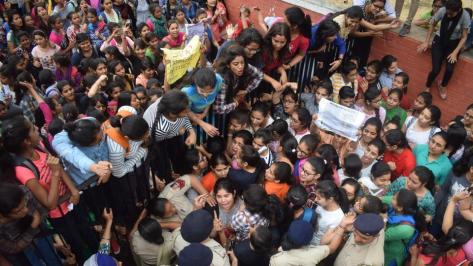
Image Courtesy Hindustan Times

On April 11 2017, Punjab University turned into a war zone. Tear gas, water cannons, lathis, belts and police boots were unleashed on unsuspecting students, along with the choicest of casteist and misogynist abuses. Hundreds of students were mercilessly attacked by Chandigarh police (Police even entered ladies’ hostels) for having the temerity to challenge the jaw dropping fee increase announced by the University (100-1100 percent, across various streams). The protests against fee hike were called by Panjab University Students’ Joint Action Committee, which includes student organizations such as Students for Society (SFS), NSUI, PUSU, SOI, AISA, PSU (Lalkaar). The peacefully protesting students demanded the roll back of fee hike by convening a meeting of the senate at the earliest. Their demand to meet the vice chancellor was met with the ferocious brutality of Chandigarh police.

Continue reading Statement of Solidarity with student protests in Panjab University, Chandigarh: Coordination of Student Forums of the five IITs

Ban self-styled vigilante groups in India – Petition

PETITION ON CHANGE.ORG

Parts of the petition are reproduced below. Follow the link given at the end to sign the petition.

Incidents of mob violence by vigilante groups have become alarmingly common in many parts of India. These groups have frequently committed serious crimes, including harassment, assault and murder…

In spite of these groups repeatedly committing atrocities against minorities, nothing substantial has been done to stop them. The Central and several State Governments have remained silent. In addition, the authorities have extended no support to the victims, predominantly Muslims and Dalits, who have lost their lives and livelihoods.

The recent debates in the Rajya Sabha and the intervention of the Supreme Court are a step towards improvement. An earlier criticism by the Prime Minister proved to be inefficient as the vigilantes continued to operate as before.

Clearly, greater social awareness and resistance is needed to combat vigilante groups. Through this petition, we express our support for the decision of the Supreme Court and demand

1. An immediate ban on vigilante groups irrespective of any cause that has brought them into existence.

2. Unconditional and unequivocal condemnation of vigilantism from the National and State Governments.

3. Social support and compensation for victims.

SIGN THE PETITION HERE.

Statement Condemning Minority Minister’s Statement In Parliament That Alwar Killing Did Not Happen

Statement by concerned citizens
We are writing this statement to strongly condemn minister Mukhtar Abbas Naqvi’s comment in Parliament that Alwar killing  did not happen. In spite of, repeated reporting in media about the Alwar killing, this denial from the minister only strengthens the anti social elements as well as communal ideology. We are working with women against violence, protecting socio-economic rights of weaker sections and minority community across states over many years now. In recent time, with the atrocious rise of ‘gau rakshaks’ in our country, there is a simmering growth of threat and insecurity among the Muslims and Dalit communities who are associated with cattle business and in its various forms. However when the government who should be proactive in protection of minorities ends up with a stoic silence on the unfortunate incident like the killing of Pehlu Khan in Alwar, in turn, ascribes impunity to these fascist forces. Post Dadri killing of 2015, the strategic silence of government on the rise of cow vigilantes attacks the democratic and constitutional rights of citizen; and successively there will be a collapse of constitutional machinery.

Why Ahmadis are Victims of Persecution: Rameez Raja

Guest post by RAMEEZ RAJA

Ahmadiyya Muslim Community (AMC) was founded by Hadhrat Mirza Ghulam Ahmad in 1889 in village Qadian, District Gurdaspur, Punjab. He claimed to be the “Reformer” of the age and fulfilled all the revelations of the Prophet Muhammad (pbuh) regarding the second advent of the Promised Messiah and Mahdi (the Guided One). Hadhrat Mirza Ghulam Ahmad had written over 80 books and one of his greatest scholarly works was The Philosophy of the Teachings of Islam. After his claims, he was criticized by the mainstream Muslim as well as the Christian community. The reason put forth was his book Jesus in India which describes that Jesus is dead and is buried in Khanyar area of Srinagar, Kashmir and above mentioned claims.

After his demise in 1908, AMC has been headed by respective successors and currently Hadhrat Mirza Masroor Ahmad is spiritual head of the AMC worldwide. Hadhrat Mirza Masroor Ahmad has delivered speeches in several parliaments in the West regarding the futility of the nuclear weapons and has sent official letters to the heads of the states which possess nuclear warheads. Most of his speeches and letters are collected in a book World Crises and the Pathway to Peace and is distributed free all over world in order to save this world from nuclear destruction.

Continue reading Why Ahmadis are Victims of Persecution: Rameez Raja

Protesting fee hike is sedition? Student protests in Panjab University: Navprit Kaur

Guest post by NAVPRIT KAUR\

Chandigarh  is an expensive city to live in. It is more so for Buta Singh, a student belonging to a poor family in Punjab and pursuing a BA degree course in the evening studies department of the university. To meet his expenses, Buta at times stands on one of the many labour chowks as he searches  for  work as daily wager to survive in the city. He works as a newspaper vendor also. On April 11th 2017 Buta Singh was so brutally beaten by the police that he could not walk. He was arrested by the police on many charges including sedition. His crime is that he was one of the hundreds of students  protesting against the massive fee hike (600-1100 percent) by the university. On April 11, thousands of students of Panjab University and its affiliated colleges were boycotting the classes on a bandh call given by Panjab University Students’ Joint Action Committee against fee hike. The PUSJAC consists of all the major student organizations except ABVP, such as Students for Society (SFS), NSUI, PUSU, SOI, AISA, PSU (Lalkaar). The protest against recent fee hike has been going on in the university and its affiliated colleges for last many days. Minor scuffles had been  happening between the protesting students and police over last some days.

However, Tuesday 11th April was unprecedented in the history of Panjab University for the kind of violence that was unleashed on the students inside the campus by the police. Police was right inside the campus chasing students everywhere with lathis and tear shells – inside departments, hostels (including women’s hostels), parking lots, the Student Centre, in front of the university library. Continue reading Protesting fee hike is sedition? Student protests in Panjab University: Navprit Kaur

New UGC Regulations not recommended by Expert Committee? JNUTA nails more lies

JNUTA Press Release

UGC/MHRD’s Duplicity Exposed! Was the Nigavekar Committee really behind the 2016 Regulations?

The following response was given to a question asked by Mr. Hussain Dalwai in the Rajya Sabha.


As can be seen from this MHRD Circular, the terms of reference of this Committee never included the formulation of any minimum or maximum regulations for the award of M.Phil. and PhD degrees! Rather, it was tasked with “Evaluation of PhD NET qualifications for entry of teachers and to accordingly suggest a policy for selections.”  Continue reading New UGC Regulations not recommended by Expert Committee? JNUTA nails more lies

Love In The Time Of Hate: Nikita Azad

Guest Post by NIKITA AZAD

It is easy to hate. In fact, one of the strongest emotions to have lasted so long and so vividly in our minds is hate. From La La Land to competitions in schools, we are taught to become self-serving narcissists; we are fed jealousy and hatred strategically. From the day we are born, we learn hating. We learn to mock our classmates for following a different faith, belonging to another caste, non-confirming to given genders, and everything else. As we grow, we learn to despise them for their grades and perhaps, reservations they deserve. And, when looking for jobs, we start hating them absolutely because we believe they are the cause of all our problems.

People hate what others eat. They hate what others wear. They hate Africans who study in this country because they wear ‘revealing’ dresses; they hate Muslim women because they do not wear those dresses. We let our lives be governed by this continuous production of systematic hatred that encompasses all our choices and decisions. For example, some people would never rent a room to independent women or Muslims because they cannot stand the sight of something or someone who doesn’t accrue to their ostensibly ‘homogenous’ culture. And, some would threaten a woman with rape, a woman who wants nothing else but peace and non-violence.

Then there are people like me. Who hate hate; who hate bigotry and prejudices, and who wish to transform this scenario and end this vicious cycle of reproduction of hatred and self-centeredness amongst humans. Continue reading Love In The Time Of Hate: Nikita Azad

Scientism, familism and women scientists: V Sujatha

Guest Post by V. SUJATHA

That the first woman to win the Fields Medal for mathematics in 2014 was an Iranian is important to note. Not only because Maryam Mirzakhani is the first woman to make it in the field of mathematics which is considered to be a male bastion[1], but also because her Persian background deserves some attention. There are certain enabling factors in Eastern cultures that facilitate women excel in the hard sciences, in spite of entrenched patriarchy. The point is not that everything is great in the East versus the West, but that cultural stereotypes about women are not homogenous; they vary from culture to culture and produce gender asymmetries with different effects. This is a sociologist’s
delight; let me explain.

During a literature survey in sociology of science, I was pleasantly surprised to see that the figures on women’s entry and achievements in science and technology education (S&T) in the global south were not only not bad, but were better than the countries in the Anglo-Saxon world that offered better civil liberties for women (Sujatha 2015). While there were fewer women in apex positions in the S&T sector and even lesser numbers to receive prestigious awards everywhere in the world, it is a fact that women from erstwhile socialist countries and from Asian and Latin American societies enrolled in larger numbers in science and technology courses and also made it higher in the career ladder in S&T than their counterparts in western Europe and North America.  The literature on women in science however, attributed everything to the ‘glass ceiling effect’ i.e., soft variables like gender bias in the organisational processes. I do not deny it, but it seems to me that this does not explain why the glass ceiling worked differently in some countries. Continue reading Scientism, familism and women scientists: V Sujatha

Solidarity with Africans in India: Students’ organisations and Unions from North East India

The undersigned students’ organisations and unions from North East India, would like to extend solidarity with people of African origin living in India and particularly those who were attacked in Greater Noida recently. We empathise with the violence, ordeals, and humiliation faced by Africans in India. We are distressed to learn of the ongoing situation, and denial of the Indian government to term the incident as racist is worrying. Various incidents of racism against people of African origin in India from the past are not isolated incidents, they stemmed from the deep rooted prejudice mindset of the majority of Indians. We condemn racial discrimination against anyone (particularly people of African origin) and caricatures people make by creating stereotypes like cannibalism and drug users/peddlers. These stereotypes are reflection of racist mindset which we, people from North East India are also at receiving end over and over again.

Continue reading Solidarity with Africans in India: Students’ organisations and Unions from North East India

Shut down JNU if not one way then another? JNUTA statement on UGC regulations

JNU administration has drastically cut intake into the university for the next academic session and perhaps for years to come, using the UGC ‘caps’ on research as a pretext. JNU Teachers’ Association demonstrates conclusively here through a survey of 46 Central Universities, that barring a handful which have definitively adopted them, most others are still operating with other Regulations based on the preceding 2009 version. And even the few universities that have adopted them, barring JNU, have implemented modifications by way of harmonisation with the statutes, objects, and past practices of the institutions.

JNU not being targeted using the UGC Regulations as a pretext? Right.

Over the past few weeks we have been told that the mandatory nature of the UGC Regulations require them to be implemented by universities immediately and in a chapter-and- verse fashion. JNUTA’s survey of 46 Central Universities however shows that barring a handful who have definitively adopted them, most others are still operating with other Regulations based on the preceding 2009 version. And for even the few universities that have adopted them, barring JNU, modifications in the way of harmonisation with the statutes, objects, and past practices of the institution have inevitably resulted.

Table 1 presents the facts of 46 Central Universities, the year of their founding, and the research programmes they take admission to. To determine whether they had adopted the 2016 UGC Regulations, we examined the Ordinances and notifications on the university website in order to detect its adoption. (The value label unclear is to mark the cases where no explicit information of either type was posted on the university’s website.)CENTRAL UNIVS WITH UGC 2016 Continue reading Shut down JNU if not one way then another? JNUTA statement on UGC regulations

JNUTA statement on HRD Minister’s Observations

JNUTA is disappointed at the statement by the Minister of Human Resource Development regarding the number of research scholars working with each faculty in JNU, and considers his remarks as unbefitting of the Minister of Human Resource Development.

First of all, the claim that there are JNU teachers guiding more than 20/25 registered students is simply false, as this suppresses the important fact that JNU like other universities across India, has a provision that allows students to deregister from the university. This provision has proved very beneficial, as it enables students to take up employment and slow-track their PhDs until their life circumstances allow them to return to their jobs.  It is only when deregistered students over a decade are included that some professors can have a reasonably large number.

Continue reading JNUTA statement on HRD Minister’s Observations

In the face of election results, Nazim Hikmet on life and living

Nazim Hikmet was a Turkish poet and writer. A communist revolutionary, he was repeatedly arrested for his political beliefs and spent much of his adult life in prison or in exile.

Living is no laughing matter:
you must live with great seriousness
like a squirrel, for example–
I mean without looking for something beyond and above living,
I mean living must be your whole occupation.
Living is no laughing matter:
you must take it seriously,
so much so and to such a degree
that, for example, your hands tied behind your back,
your back to the wall,
or else in a laboratory
in your white coat and safety glasses,
you can die for people–
even for people whose faces you’ve never seen,
even though you know living
is the most real, the most beautiful thing.
I mean, you must take living so seriously
that even at seventy, for example, you’ll plant olive trees–
and not for your children, either,
but because although you fear death you don’t believe it,
because living, I mean, weighs heavier…

Translated by Randy Blasing and Mutlu Konuk

Read the whole poem here.

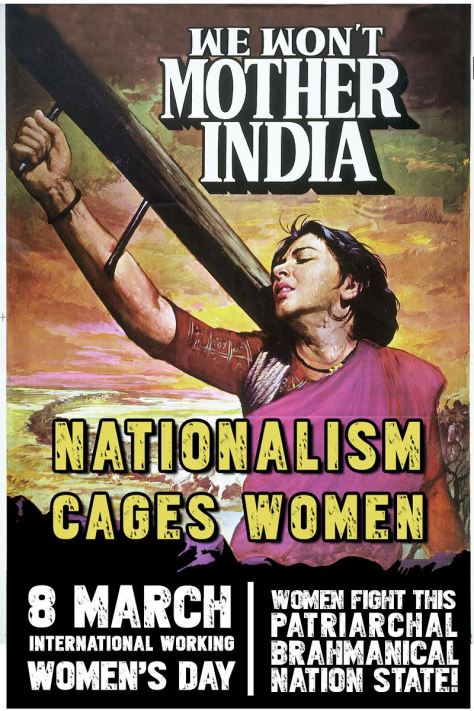
Our “hormonal outbursts” will be your nightmare! Pinjra Tod

Statement and image by Pinjra Tod

On the eve of International Working Women’s Day, Maneka Gandhi has given a deeply patriarchal, casteist and classist statement to a media channel saying that hostel curfews are necessary as “laxman rekha” for controlling women’s “hormonal outbursts”, that the question of “women’s safety in colleges cannot be solved with just two Bihari guards with dandas”, that there should be separate days for men and women to go to the library at night.

Its clear to us that she has said this today in response to the fact that women students across the country from Benaras to Mumbai, Delhi to Patiala, Lucknow to Hyderabad, Chennai to Ludhiana, Roorkie to Cuttack have come out strongly to assert their presence in the university space and claim over public resources.

Continue reading Our “hormonal outbursts” will be your nightmare! Pinjra Tod

March 10th Chalo Nagpur! Women against Manuvaad and Hindutva: Manjula Pradeep

MANJULA PRADEEP on Dalit Camera

Are Students at their Work? Prashant Kumar

Guest Post by PRASHANT KUMAR

Students who are protesting across the country are being charged that they are not doing what they are supposed to do. What I understand this charge say is that they are not doing their “duties” or fulfilling their “responsibilities” as a student. I seriously doubt thislimited understanding of being a “student”. To say this, I feel an intellectual burden to explicate what it means to be a student. I will argue that these students are also the one who, contrary to the charge, does their “duties” and carries out their “responsibilities”.

Generally speaking, anyone who tries to learn and reflect upon what he learnt can be considered as a student. However, one becomes a student technically when he does this job within an academic institution. In this sense, studentship is a job to get mature with the help of institutional academic training(s) as well as reflecting back on these. Maturity, as I discern, is nothing but to understand the real meaning of a world, and act according to this apprehension. In this sense, understanding and acting go together. Lack of one will categorically destruct the purpose of a student.

There is one more aspect of this maturity with relation to, what Kant terms, enlightenment. Continue reading Are Students at their Work? Prashant Kumar

Gender Justice In Naga Society – Naga Feminist Reflections: Dolly Kikon

DOLLY KIKON in raiot.in

Dolly Kikon points out that Article 371 (A) is breached also in the ongoing coal mining operations and the oil exploration negotiations in Nagaland. Naga politicians, landowners, village councils, and business families have all interpreted the provision for their benefit to mine for minerals and not be held accountable for the environmental degradation. But it is only when women may enter the decision-making process (and potentially reverse such policies) that Article 371 suddenly becomes sacrosanct.

What is the meaning of gender? What is the meaning of Justice? Which comes first in Naga society and how do we understand it? Like many nationalist societies around the world, the issue of gender justice and rights have remained marginal for a long time. We were told that issues like women’s rights or gender justice could wait till the Naga people gained their freedom. In that context, what did it mean to bestow any kinds of rights on women in Naga society? When terms like gender ‘rights’ and ‘equality’ remains extremely resentful terms for a larger section of powerful Naga traditional bodies, they become meaningless words. I ask these questions in relation to the opposition against 33% reservation that escalated into a violent protest and brought the entire state of Nagaland to a standstill recently. If Naga customary law is seen as the foundation of justice, the exclusion of women from these powerful decision making-bodies negates the entire notion that these are pillars of justice. The Indian state and the male traditional bodies alike are responsible for excluding the Naga women from all spheres of representative political processes. Article 371 (A) is a prime example of the patriarchal nature of the Indian constitution that bestows the Naga male bodies to have full authority and power to interpret customary affairs covering social, religious, and criminal cases.

JNUTA Statement on ABVP violence in Delhi University

Jawaharlal Nehru University Teachers Association

STATEMENT ON VIOLENCE AND INTIMIDATION IN DELHI UNIVERSITY AND OTHER UNIVERSITIES

Issued on February 23, 2017 

The JNU Teachers Association condemns in strongest terms the violence and hooliganism perpetrated in Delhi University by the ABVP over the last two days, reported widely in the media. What is also worrying, along with the violence unleashed is, that by all accounts, the police seemed unwilling to control the violence and remained a mute spectator. The events at Delhi University are part of a larger pattern by which the university as a space for freedom and the adventure of ideas is being relentlessly attacked.

The Delhi University Incidents

The latest event in this series of attacks on the universities in Delhi University unfolded in two related episodes. Continue reading JNUTA Statement on ABVP violence in Delhi University

The Struggle to Save the JNU Act – The Student Standing Counsel’s response to UGC 2016: Pratiksha Baxi

Guest post by PRATIKSHA BAXI

The growing global mistrust and derision of the intellect and all that is the intellectual, is a political trd that displaces reason, method, contemplation, experiment, reflexivity and critique as valued traits in education. This politics colonises the University Grants Commission (UGC) in specific ways. Unlike 2008-9 when the UGC was mindful of the autonomy of the University, the UGC now is made to mandate every University to follow its anti-intellectual policies and surrender academic autonomy. The UGC has been used to put in place a repressive apparatus that is emptying out Universities of reflexivity, critique and contemplation on which are built standards of excellence. With the 2016 UGC Regulation on minimum standards for MPhil and PhD (in effect since 5 July 2016),[1] the audit culture of the UGC, has now been hijacked to empty out universities of research scholars, literally. Continue reading The Struggle to Save the JNU Act – The Student Standing Counsel’s response to UGC 2016: Pratiksha Baxi

Feminists Condemn Opposition To Women’s Reservation In Nagaland Municipal Councils

We, the undersigned women’s organisations and concerned individuals take serious note of the fierce opposition to women’s reservation of 33% seats in Nagaland Municipal Councils by male dominated tribal bodies in Nagaland in the name of protecting their tradition and customary practices that bar women from participating in decision-making bodies. We strongly condemn this anti-woman position of Nagaland Tribes Action Committee (NTAC) that has been formed supposedly to “protect” Naga tribal practices. While NTAC quotes Article 371(A) of the Constitution to assert that they are empowered to make their own laws, they choose to ignore Constitutional principle of equality before law, thus denying the Naga women their electoral rights.

Time and again women’s movements in India have confronted issues of community identity vs the rights of women. In almost every instance, communities and their leaders have chosen to sacrifice the rights of women to safeguard patriarchal practices in the name of tradition and custom. In the present imbroglio NTAC has used threats and violence to prevent women from filing their nominations, or even to withdraw their papers. Through all this, the State government has remained silent spectator and tried to wash its hands off on the issue of women’s representation in local bodies by cancelling the elections to local bodies under pressure from these tribal bodies by merely citing law and order concerns. In the process, the State has become complicit in protecting patriarchal traditions to the detriment of principles of gender equality. What is not being asserted is that Urban Local Bodies are not traditional Naga institutions recognised by Article 371(A) of the Constitution but rather, Constitutional bodies under Part IX of the Constitution over which the traditional Naga bodies have no mandate. Continue reading Feminists Condemn Opposition To Women’s Reservation In Nagaland Municipal Councils

JNU VC misleads media on research vacancies: Ayesha Kidwai

Guest post by AYESHA KIDWAI
The JNU VC has fed this information to the Times of India. The title of the table below, published in the Times of India, should be Get the Numbers WRONG, as barring two rows, all the numbers are incorrect. And the interpretation that our VC gives to these numbers is even WRONGER!

First of all, JNU has no exclusively M.Phil. intake at all. Continue reading JNU VC misleads media on research vacancies: Ayesha Kidwai