All posts by Nivedita Menon

Three Years Later – Women Struggle for Justice and Freedom from Fear: Statement on the eve of December 16th

Statement by women’s groups, students’ groups, progressive groups and individuals

As 2015 comes to a close, we remember the tumultuous times in December 2012 when thousands of people – young and old – poured into the streets of Delhi in pain, rage and outrage. This was, of course, in the aftermath of the brutal gang rape and assault on a young woman that eventually led to her tragic death. That it occurred in the heart of Delhi, the capital of the country, is a shocking truth that people demanded and the government pledged to change.

Yet, in the three years since December 2012, women continue to face violence in every space they occupy, including their own homes, in public places, on public transport and at workplaces. There have been many attacks on women and girls, some accompanied by huge media coverage, but most taking place away from the public glare. Violence is the weapon used to keep them “in their place” on the basis of their identities, including caste, class race, religion and dis/ability.

These range from sexual assaults and rapes and even murder of adivasi women and girls in Bijapur, Chhattisgarh, by CRPF men; on Muslim women in Muzaffarnagar, Uttar Pradesh; on Dalit women in Haryana, on women from Northeast India, either in their own states or in the places they move to in search of brighter opportunities.

Women occupying workplaces in the informal and formal sectors are facing increasing levels of backlash. From women working in fields, mines or inside homes, on construction sites or tending roadside stalls, to women working in corporate offices, non-governmental organisations, educational institutions, law offices or in the media, countless cases bear testament to the systematic sexual harassment they face at workplaces. While some have taken courage to file cases against their perpetrators, the severe consequences that have had to face from the media and the courts for speaking out are a matter of deep concern. Continue reading Three Years Later – Women Struggle for Justice and Freedom from Fear: Statement on the eve of December 16th
The ‘Pinga’ Controversy, Caste and Subversion: Sneha Gole

Guest Post by SNEHA GOLE

Recently the song ‘Pinga’, from Sanjay Bhansali’s ‘Bajirao Mastani’ went online on YouTube and the song has given rise to a tide of criticism,  mostly from self-professed ‘Puneris’ and ‘Maharashtrians’. Much of the criticism is aimed at what is perceived as the lack of authenticity of the song – that it is unlikely that Kashibai and Mastani would dance together, that the costumes worn by the actresses in the song are historically inappropriate, that a queen would not wear such revealing clothes and dance like an ‘item girl’ along with a ‘courtesan’ etc. While I am in no ways arguing that the song is historically accurate and I can understand the discomfort of those arguing against the song, the tone of much of that writing is troubling to say the least.

While accusing the director of stereotyping, much of this writing is working from an assumption that equates Maharashtrian to Bramhin. One of the posts even talks about how “no Maharashtrian lady would be caught bobbing her head like that” (emphasis mine). Which Maharashtrian women are we talking about? There is also a distinct racist tinge to the criticisms, with a few posts commenting on Priyanka Chopra’s ‘dusky’ skin as unsuitable for Kashibai (with her fair, delicate, ‘Chitpavan’ looks)! Continue reading The ‘Pinga’ Controversy, Caste and Subversion: Sneha Gole

Reflections On The Limitations Of The Call For Full Criminalisation Of Marital Rape: Madhu Mehra

Guest Post by MADHU MEHRA

I will critically discuss the campaign for (full) criminalisation of marital rape to call attention to ways by which this campaign reduces a potentially tranformatory agenda on gender, sexuality and marriage, to one of law, crime and punishment. There is no denying that there is widespread sexual and other forms of intimate partner violence against women within marriage (including marital rape), and the absolute necessity of criminalizing such violence. Yet, the campaign for criminalsing marital rape is troubling – in terms of the aspects it selectively probelematises as harmful to women and aspects relating to sexuality and marriage that it is completely silent on. It is also problematic for privileging the criminal law remedies, over non-punitive interventions which require a broader engagement with concerns related to marriage and sexuality that are equally hurtful to women.

Let us first summarise the legal position on marital rape. Continue reading Reflections On The Limitations Of The Call For Full Criminalisation Of Marital Rape: Madhu Mehra

Moving With Darkness: Rekha Revathy

Guest Post by REKHA REVATHY

A so-called normal person may sometimes wonder how blind people like myself travel to work or move about in other public places like railway stations, bus stands, airports and roads. Large numbers of blind people also travel as commuters in metro trains in Mumbai as well as in buses and local trains, autorikshaws and other transport. They face many difficulties, big and small, in their travel. Some are comfortable with their daily commuting because they have adjusted to the conditions which they have endured for long. Some blind people always take the help of an escort during such travels. But finding an escort daily is not easy and also, what if a blind person depends on his/her colleague in office or a friend to travel to school or work daily, if on any day that colleague or friend is not able to come, then he/she becomes helpless. And in such situations they will be put to a new challenge of reaching their destination in time by themselves. And of course, moving to a different place or a new place is much more difficult for a blind person.

Moving about at the work place is less challenging than traveling in buses or trains for the blind, although there are still difficulties like climbing the stairs, locating their seats, keeping things in their place, going to the dining room, using the wash room and so on. But there are blind people who do all these things without any sighted help because they have adapted to their environment. But it also takes some time. Any changes made in the premises puts them in confusion – changes such as construction of a new counter, changing the positions of chairs tables etc, fitting of a new door or changing the positions of water jars. It is also a fact that blind people cannot always find a person to help them out in their work places. And sometimes they end up injuring themselves. Continue reading Moving With Darkness: Rekha Revathy

Armed Forces as livelihood and State power: Gautam Navlakha

Guest post by GAUTAM NAVLAKHA

Notwithstanding popular perception, professional soldiers do not join the armed services out of overwhelming ‘patriotism’. They are in fact driven by the desire to get a job that offers material security for them and their family. It is predominantly their own livelihood needs that drives people to enlist. On the other hand, the main objective of any government’s concern is to keep the morale of such professional soldiers high, so that they would go out and fight anyone as directed by the government, whether it is ‘enemies’ outside the nation’s borders or within – conducting the predatory war for ‘development’ which profits the corporate class or suppressing popular movements.

More than 101 Districts out of 680 in India are notified as ‘Disturbed Area’ where the military forces enjoy immunity from prosecution and exercise extraordinary authority. In addition, in 35 other districts similar conditions operate even though these have not been notified as “Disturbed Area”. However, the  Union Ministry of Home Affairs exempts the personnel, through a notification, from  prosecution for any crime they commit in course of their service in the designated areas. In the ‘Disturbed Areas’ the Army has begun to exercise veto power over both withdrawal of troops as well as  removal of Armed Forces Special Powers Act.  That apart, the very size of the military force, its use and misuse, its degradation, the fiscal ramifications and socio-political consequences of a bloated military are some of the aspects that invite scrutiny. Continue reading Armed Forces as livelihood and State power: Gautam Navlakha

Free to question India’s imperfections: Laila Tyabji

LAILA TYABJI in The Business Standard

Never in my 68 years have I thought for even a milli-second of living anywhere else except India. Not even when, in the wake of the Ayodhya agitation, I received a stream of poisonous hate mails and a packet of turds (in a mithai box!!) I love the multilayered multiplicity of India, its synergies & paradoxes, its many diverging & converging cultural streams, its colour & chaos, the hit-and-miss judaad of past and present, malls and mandirs, East and West; its unexpected but inherent certainties…. In any case, good or bad, it is MY country.

So it feels strange to be told, when I critically question any aspect, that I should go live somewhere else – Pakistan for instance. I am utterly amazed that Aamir Khan’s confession of momentary vulnerability should be termed a “moral offence” by no less a person than MJ Akbar! I used to so admire the reasoned clarity of his writing.

I have always over-used adjectives. My English teacher would red-pencil an acerbic commentary. A rebuke I secretly courted was “oxymoron”. I loved its sound as well as its meaning – two adjectives contradicting each other.

These days I am being turned into an oxymoron myself! “Indian Muslim” is an identity increasingly open to suspicion by self-proclaimed ‘patriots’; one’s own patriotism needing constant justification plus a certificate that one doesn’t eat beef or critique the nation. That a well-known Sadhvi can dub Shahrukh Khan a Pakistani agent and not be arrested for libel, instead accruing a trail of approving social media comments, or the Culture Minister awards A P J Abdul Kalam the accolade of being a good man “despite being a Muslim” is not exactly a comfortable feeling. That someone can be lynched to death for having meat in his fridge is even more eery. Continue reading Free to question India’s imperfections: Laila Tyabji

Chhota Bheem – Anachronisms, Prejudice & Xenophobia: Sivakumar Radhakrishnan

Guest Post by SIVAKUMAR RADHAKRISHNAN

download (1)

The Chhota Bheem television series, highly popular among the nation’s children and also among many adults, is telecast daily in many Indian languages. The program is a long running show of many years and has its viewership in millions. Its popularity is evident from the fact that other children’s programs and advertisements are churned out from it.

The series evokes interest mainly by its plot, which is almost similar for every episode.  Also the plot is a simple one, where a cute city-state is ruled by a king, with his daughter, a princess of tender years. The king resides in a citadel atop a pretty hill.  The citizens are generally good natured.  A group of kids is shown playing in the countryside, of which the most smart and attractive is Chhota Bheem. He is assisted by a few other kids and a little talking monkey. Suddenly, evil people with sinister designs will start disturbing the peaceful city state of Dholakpur. The king will be found helpless in dealing them. At the right juncture, will enter the little Chhota Bheem and with his might, he will clear the evil elements from Dholakpur. Thus, Chhota Bheem saves the kingdom and the king at the right time. The citizens will celebrate him and continue to be happy thereafter. What could possibly be wrong with such a simple, evil-defeating, goodness-forging narrative?

Continue reading Chhota Bheem – Anachronisms, Prejudice & Xenophobia: Sivakumar Radhakrishnan

NOT IN OUR NAME : JNU faculty for a gender-just campus

We the undersigned teachers of Jawaharlal Nehru University, and members of the JNU Teachers Association, hereby assert that in keeping with the best traditions of teacher politics of this university, we are committed to a gender-sensitive and gender-just university campus. This political understanding contributed to the formation of the GSCASH, and it is this politics that guides us to raise our voices AGAINST the current scenario in which:

  • Conduct of some teachers and officials does not recognise that each incident of sexual harassment results in violation of the fundamental rights of ‘gender equality’ and the ‘right of life and liberty’, wherein right to life means life with dignity.
  • University body decisions set up defendants’ representations as the benchmark against which the enquiry reports of GSCASH are to be judged, when in fact GSCASH is the sole inquiring authority into complaints of gender violence, as designated by the law of the land and the regulations of the University.
  • Confidentiality with regards to complaints enquired into by the GSCASH is blatantly violated by some teacher representatives.
  • Some teacher representatives assume that a ‘struggle for the rights of teachers’ can entail victim blaming and defamation of complainants.
  • Persons charged with (or found guilty of) sexual harassment/violence serve in statutory bodies and as teacher representatives.
  • The processes of GSCASH are perverted by some teachers’ campaigns on unfounded allegations of procedural infirmity.
  • The evaluation of a GSCASH enquiry report is done by persons not bound by the oath of confidentiality and impartiality.
  • The integrity of members of GSCASH is put on public trial in the name of guaranteeing the ‘principles of natural justice’ to defendants.

We stand FOR a campus atmosphere in which the health, and freedom of complainants is always primary and the fundamental rights guaranteed under Article 19(1)(g) of the Indian Constitution ‘to carry on any occupation, trade or profession’ are realised through the provision of a “safe” working environment for all.

Ayesha Kidwai                        

Brinda Bose                            

Chirashree Dasgupta   

Chitra Harshvardhan              

G. Arunima                              

Janaki Nair                    

Madhu Sahni                           

Mohan Rao                    

Mohinder Singh

Nilika Mehrotra                        

Nivedita Menon             

Parnal Chirmuley

Pratiksha Baxi                         

Ranjani Mazumdar                  

Rohit                    

Shambhavi Prakash               

Shankari Sundararaman        

Shukla Sawant

Surajit Mazumdar                    

Tiplut Nongbri                         

Urmimala Sarkar

Vikas Bajpai                  

Statement on the Order of the High Court of Meghalaya on the AFSPA

This statement has been sent out by TARUN BHARTIYA, PRASHANT BHUSHAN, ARUNA ROY AND NIKHIL DEY  for endorsements. Please send your endorsements by tonight (November 24, 2015) to arunaroy@gmail.com

In a recent order, the High Court of Meghalaya has made a suo motu suggestion to the Central Government for the imposition of the Armed Forces (Special Powers) Act, 1958, in the Garo Hills area. It is shocking and deeply disturbing that a draconian law like the AFSPA is being sought to be imposed through a judicial fiat. The order is completely devoid of any kind of legal reasoning and is based on the lay impressions of the bench.
 
 
See below a statement which carries our objections to this order. We want you to also consider lending your name to the statement. As the statement is being released to the press tomorrow, we will request you to send in your endorsement by tonight. Please do circulate the statement widely for endorsements.
Text of Statement

In a recent order, the High Court of Meghalaya has found it fit “to direct the Central Government to consider the use of Armed Forces (Special Powers) Act, 1958, in the Garo Hills area”[1]. We are deeply troubled by this order for several reasons.

Continue reading Statement on the Order of the High Court of Meghalaya on the AFSPA

Vande Mataram?

jaipur-cow-759

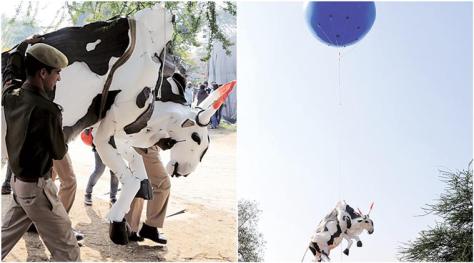
An art installation ‘The Bovine Divine’ by artists Anish Ahluwalia and Chintan Upadhyay was taken down by the police at Jaipur Art Summit

The artists were taken to the police station and held for two hours.

[Correction: The art work was by Siddhartha Kararwal. Anish and Chintan are Sandarbh coordinators. But they were the ones talking to the cops and who were eventually taken to the police station.]

After the cow made of styrofoam was taken down, it was “worshipped and garlanded by a group of protesters”.

While the artists said they wanted to show what eating plastic does to cows, the SHO of Bajaj Nagar Police Station, Mahendra Gupta, was deeply disapproving.

“The way the cow was hanging in the air”, he reportedly frowned, “it was only sending a negative message.”

Read the full story at Indian Express.

Educationists and women’s rights activists oppose closure of Mahila Samakhya

Received via KALYANI MENON-SEN

Women’s rights activists, researchers, academics and scholars have written to the Minister of HRD against the government’s reported move to close the Mahila Samakhya programme. The letter, written in the backdrop of the announcement that the programme would not be funded after 31 March 2016 and a reported move to merge it with the National Rural Livelihoods Mission,  urges the government to retain the autonomy and unique character of this globally lauded programme.

The signatories to the letter include several individuals who have contributed significantly in building an inclusive policy framework and enabling public environment for gender equality in education, who have spoken eloquently of how they have been enriched through their association with  Mahila Samakhya.

Continue reading Educationists and women’s rights activists oppose closure of Mahila Samakhya

Jain Tandoori – When the State Chickens Out: Gita Jayaraj

Guest post by GITA JAYARAJ

New shocks seem to await non-vegetarians almost daily, now. At a popular supermarket chain in Besant Nagar, one of the go-to places in namma Chennai, there seems nothing unusual on the evening of November 11. The floor is littered with stuff as the young shop assistants squat in the narrow aisles trying to stack the packets on the shelves; or laze in small clusters discussing workplace politics, oblivious of the customers milling around.

Seems like a normal evening. Heading towards the billing counter, I decide at the last minute to pick up some chicken. The young girl at the fresh-ground coffee counter, next to the fresh chicken refrigerator, giggles nervously as I open it. “Sale of chicken not permitted today madam”, she tells me hesitantly in Tamil. I am puzzled, has the beef ban in some states been extended to cover chicken as well in all states? Continue reading Jain Tandoori – When the State Chickens Out: Gita Jayaraj

Modi Not Welcome!

Modi-House-of-Commons

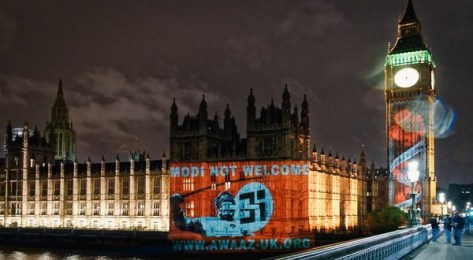
At 9 p.m. on Sunday, Nov 8, 2015, a massive projection of Narendra Modi holding a sword in one hand and a shield with the Oum symbol with a swastika superimposed appeared on the Houses of Parliament next to the iconic Big Ben. Above it were the words Modi Not Welcome. It was the most high profile message from the campaigners of the Modi Not Welcome organisations which have come together as the Awaaz Network.

Read full report in Caravan Daily News.

Tribute to Priya Thangarajah

This tribute to Priya Thangarajah, well known in queer feminist, democratic rights and academic circles in India and Sri Lanka, comes from her friends in Law and Social Sciences Research Network. Priya has written on Kafila too, and was a good friend to many of us. We will remember her incredible energy and inspiring presence.

Priya in JNU

We are heartbroken to share with you that Priyadarshini Thangarajah, to her friends Priya or Thanga, passed away on 4 November 2015 in Colombo. It is hard to think of Priya in the past tense—she was always brimming with life, laughter and love. Each LASS conversation was all the more special, brilliant and spirited solely because of Priya. 

Priya graduated from the National Law School University of India, Bangalore, India, in the summer of 2010. As an aspiring young lawyer, who took the bar examination, Priya wanted to challenge the estranged relationship between law and justice by becoming a magistrate. In 2014-15, Priya was a fulbright scholar and completed her LLM at Georgetown University. Priya worked with different organisations based in Sri Lanka and India on issues of gender, sexuality, violence and human rights. However, her passion for law and legal research was shaped through years of association with the Law and Society Trust in Colombo; and later her work at the Alternative Law Forum at Bangalore.  Continue reading Tribute to Priya Thangarajah

Aadhar Card- is it an intrusion into privacy? Mrinal Sharma

Guest Post by MRINAL SHARMA

The Supreme Court passed an order dated 11th August 2015 declaring that it is not mandatory for the citizens to obtain Unique Identity Number popularly known as Aadhar Card. This order was passed in the light of the petitions which arose against the interim orderpassed by the Supreme Court in September 2013, which stated that ‘no person should suffer for not getting the Aadhaar card in spite of the fact that some authority had issued a circular making it mandatory.’ The petitioners contended that the Aadhar Card scheme involved collection of personal information of the citizens including fingerprints and iris scan, which is capable of being misused. Though the Apex Court’s order declared that the production of Aadhar card is not necessary to draw benefits vested to the citizens (except for getting PDS, kerosene and LPG distribution) butthe court didn’t answer two crucial questions involved in the matter at hand, which it referred to a larger bench of at least 5 judges to decide. One, whether the information collected under this scheme invades person’s right to privacy and two, whether right to privacy is a fundamental right? However judgment of the larger bench is still awaited, I would like to address the two issues that are posted to the larger bench. Continue reading Aadhar Card- is it an intrusion into privacy? Mrinal Sharma

जो पहले नहीं हुआ: किशोर कुमार

Guest Post by KISHORE KUMAR

लगभग चालीस लेखकों के पुरुस्कार लौटाने के बाद अब फिल्म निर्देशकों ने भी पुरुस्कार लौटने शुरू कर दिए. यह पुरुस्कार बढती असहनशीलता और अभिव्यक्ति की स्वंत्रता के दमन के विरोध में लौटाए जा रहे हैं.

बी.जे.पी की राय में यह राजनीति से प्रेरित कदम है और यह सब बी.जे.पी के खिलाफ हो रही साजिश का हिस्सा है. बी.जे.पी के अनुसार आज कुछ ऐसा नया नहीं हुआ जो पहले ना हुआ हो और इन लोगों ने उस समय यह पुरूस्कार वापस क्यों नहीं लौटाए? बी.जे.पी. के अनुसार पुरुस्कार लौटना छदम धर्मनिरपेक्ष लोगों का नाटक है और  असहनशीलता इतनी नहीं बढ़ी और माहौल इतना ख़राब नहीं हुआ कि इतना शोर मचाया जाए. Continue reading जो पहले नहीं हुआ: किशोर कुमार

My name is Ajmal: Ajmal Khan A.T.

Guest Post by AJMAL KHAN A.T.

What is your name?

Ajmal,

Ohh…Ajmal Kasab?

No, I smile.

This is a familiar exchange for me, not to mention my friends often  calling out to me,  hey, Kasab!

I noticed this started  in Mumbai post 26/11, of course.

But there are other instances.  Once, while I was traveling by train from Mumbai to Kerala, a man who was in his mid 50s with whom I was sharing a seat, asked while I was about to get down at the Calicut railway station, ‘boy what is your name?’ I replied – my name is Ajmal. A cute little boy, around 9 years old, who was traveling with him, responded with  Ajmal Kasab?

I somehow managed to smile and say, no my dear. I got down at my station. Continue reading My name is Ajmal: Ajmal Khan A.T.

Can accessibility alone create an inclusive society for persons with disability? Tony Kurian

Guest Post by TONY KURIAN

Amidst the noisy campaigns of “Make In India and Digital India”, a campaign called “Accessible India” was launched by the Central Government recently and unsurprisingly this did not catch much media attention. Department of Persons with Disabilities, Ministry of Social Justice & Empowerment has launched the Accessible India Campaign (Sugamya Bharat Abhiyan), as a nation-wide flagship campaign for achieving universal accessibility for Persons with Disabilities.

The campaign is an extremely welcome initiative in a country like India which is home to more than 2.1 million officiallyrecognized disabled and a lot more who are not counted by the decadal exercise of census. While the campaign disserves much appreciation, it offers an appropriate opportunity for us to rethink some of our common sense, or at least that of majority about disability and disabled. Continue reading Can accessibility alone create an inclusive society for persons with disability? Tony Kurian

Sursuri: Swaang

SWAANG is a Mumbai based cultural group, whose members include actors, writers, directors, singers and composers primarily working with the Hindi Film Industry in Mumbai. The members come from different parts of India and have been associated with progressive arts in the past.

Sursuri, their melodious new song, its melody in stark contrast to the bitterness of the lyrics, reflects on the indifference to growing injustice and intolerance in our country. It asks – What do you do when freedom, pluralism and rationalism are under relentless attack? Relax, don’t speak up, slurp up that hot tingling tea…and fall asleep.

Why the Ban on Cow Slaughter is not Just Anti-Farmer but Anti-Cow as Well: Sagari R Ramdas

SAGARI R. RAMDAS writes in The Wire:

The recent killings of Mohammad Akhlaq, Noman and Zahid Ahmad Bhatt on the claim that they were slaughtering cows is not only an attack on the right to life, livelihood and diverse food cultures but an assault on the entire agrarian economy.

The cynical fetishisation of cows by Hindutva politicians is not only profoundly anti-farmer but, paradoxically, also anti-cow.

What these bigots fail to realise is that the cow will survive only if there are pro-active measures to support multiple-produce based cattle production systems, where animals have economic roles. The system must produce a combination of milk, beef, draught work, manure and hide, as has been the case in the rain-fed food farming agriculture systems of the sub-continent over the centuries.

In meat production systems – whether meat from cattle, buffaloes, sheep, goat, pigs or poultry – it is the female which is reared carefully in large numbers to reproduce future generations, and the male that goes to slaughter. It is only the sick, old, infertile and non-lactating female that is sold for slaughter. In every society where beef consumption is not politicised, farmers known that eating the female bovine as a primary source of meat will compromise future production, and hence they are rarely consumed.

Read the rest of this article here.

The meaning of the sports bicycle: Sanjay Srivastava

Guest post by SANJAY SRIVASTAVA

Our public life is full of vacuous gestures that seek to define public good. The rise of the elite-class bicycle as a symbol of mass welfare is the latest in the addled and self-serving history of ‘ordinariness’ in the republic.

car

TOI photo: Sanjay Sekhri

Over the past few years, the sports bicycle with bells and whistles and its rider whose riding gear might cost more than a month’s salary paid to a professional car driver have become icons of an urban renewal movement. We so perfectly walk in the footsteps of meanings borrowed from elsewhere that we erase our own imprints. Does the fancy bicycle – the kind sported by Arvind Kejriwal in his Dussehra Car Free Day  ride in Delhi —  hold the key to a improved urban environment characterised by reduced pollution levels and, more importantly, ease of access for the city’s most disadvantaged populations? Far from it. For, even our gimmicks are of the cruellest kind.

Continue reading The meaning of the sports bicycle: Sanjay Srivastava