All posts by Nivedita Menon

Whatever happened to the great debate? Ankita Anand

Guest Post by ANKITA ANAND

On 6 November 2014 BBC World invited three panellists from different sectors to debate on ‘A New India: Free, Fair and Prosperous’ as part of the World Economic Forum. Issues of content and objectivity apart, one still has high expectations of a group like BBC when it comes to setting high standards of form. But this ‘debate’ fell flat on its face on all counts.

No rules of the game

One would think that in a discussion like this all three panellists would bring in varied viewpoints due to their specialization in their individual sectors. However, if one wants to quote either the minister or the corporate voice in the debate, it would require constant rechecking to distinguish who said what. Of course businnesses and governments need not always be in conflict with each other. But this smooth overlapping can be dangerous if those who are to be at the receiving end of this coalition between corporate bodies and governing bodies get completely left out. So for all practical purposes, instead of having three distinct voices, the format of the session (to keep calling it a debate would be to perpetuate technical erroneousness) was two against one. The yesmanship resulting out of this format naturally dulled the sparkling energy any debate worth its salt should have. Continue reading Whatever happened to the great debate? Ankita Anand

Aligarh Muslim University women should not back down just because BJP has taken up their cause: Asiya Islam

ASIYA ISLAM argues on Scroll.in that AMU’s women students demanding library access have always been warned not to wash the institution’s dirty linen in public, for fear of providing fodder for Hindutva forces.

Things must have changed since I studied at Aligarh Muslim University for three years until 2009. This week, the vice chancellor of the university, Lieutenant General (retd) Zameeruddin Shah, justified the policy of not allowing undergraduate women to use the main Maulana Azad Library. If more women are allowed, the vice chancellor said, the number of men in the library would swell by at least four times. Somehow, I just do not remember hordes of studious men at AMU.

It is worth noting that the vice chancellor has only upheld a ban that has always existed and articulated his reasons for doing so. The issue is not new. It just seems to surface periodically – the media gets interested, makes a bit of noise, after some time it all dies down, and sadly nothing changes…

In this current political climate, we need to realise that inequalities are multifarious. But demands for gender equality do not compete with other social justice issues at hand – rather, they are complementary. We cannot excuse continued discrimination against women while asking for minority rights. Therefore, we should question the government’s and media’s sudden concern with gender equality in AMU (this is after all a deeply conservative government), but let us not discount the gravity of the library issue for women who study and work there.

Read the whole article here.

There is hatred in the air yet again: Preeti Chauhan

Guest Post by PREETI CHAUHAN on the recent communal tension in Noor e Illahi area of Delhi.

It was around 9 pm on Tuesday, November 11th, I was heading to my parents’ home to go with my sister for an interview the next morning, when my cellphone rang, my sister was asking me frantically where I was. I replied a bit anxiously but with irritation, ‘Kya hai? Pahunch jaaungi thodi der mein’. She said don’t come, turn back. I asked why, ‘yahan dange hone waale hain, saari dukaanein band ho rahin hain’, my sister replied. In those two-three seconds my heart skipped many beats, a strange fear about the safety of my family gripped me. I could for the first time feel what it is to live in fear of communal riots. I called up my close relatives who were out of home to ask where they are. There was such an uncertainty as to how will my sister go for the interview tomorrow? Would I be able to reach home tomorrow morning? Would my vehicle be attacked if I decide to go home now?

In those three- four minutes the world seemed to have taken a terrifying turn for me. Mundane, everyday things, everyday routes suddenly turned hostile and suspicious. I could feel the agony and fear so very close. Then there was a sudden burst of anger that I felt against the communal forces that are so hell bent on creating communal trouble everywhere in Delhi. I had not read the newspaper the whole day yesterday and hadn’t watched TV but just before I was leaving home my spouse told me that my native place is in the news and it was then that I had read about the communal tension and curfew in Noore-illahi. It’s the area, the vicinity of my childhood, adolescence and my adulthood too. It’s the area of the weekly bazaar for us, the Eid bazaar as well from which we had returned at 1 am at times. Noor Chicken is where Noor Jahan furniture once stood if I remember correctly; it belonged to the family of one of my classmates in school. I hear today that Noor Chicken’s owner and his son was badly beaten and the son is rumored to have succumbed to injuries. I shudder to think if he is my primary school classmate Shahnawaaz… Continue reading There is hatred in the air yet again: Preeti Chauhan

Crime and Consent: Vrinda Grover

VRINDA GROVER analyses the recent Delhi High Court judgement on the rape and consequent death of a 65 year old woman, acquitting the accused because the woman was ‘menopausal’ and making a curious distinction between ‘forceful’  and ‘forcible’ intercourse.

In a recent judgment in Achey Lal vs State Govt of NCT Delhi, the Delhi High Court on October 30 set aside the conviction of the appellant for rape and murder. What has provoked discussion are the observations, inferences and conclusions of the court. Briefly, the facts as reported in the judgment are: on December 31 2010, a house maid, aged about 65-70 years, was found dead, with her clothes disheveled to expose her body. The accused, Achey Lal, 45 years old, was present in the room in an intoxicated condition. The husband of the deceased deposed that the accused had come at 8 am that day to his house with a quarter bottle of alcohol and when it finished, the husband left, while the accused stayed on with his deceased wife. The cause of death, according to the doctor who conducted the post mortem, “was asphyxia due to aspiration of gastric contents consequent upon forceful sexual intercourse, which was sufficient to cause death in the ordinary course of nature”.

Read the rest of the article in The Indian Express.

Statement On Sterilsation deaths in Chattisgarh by Public Health groups

The Jan Swasthya Abhiyan, Sama Resource Group for Women and Health, Commonhealth and National Alliance for Maternal Health and Human Rights are shocked at the death of 11 women and the critical condition of 50 other women due to the callous negligence of the Health Department, Government of Chhattisgarh. The deaths and morbidities are a result of a botched-up sterilization operation camp organized by a private hospital under the National Family Planning Programme in Takhatpur Block of Bilaspur District on 8 November 2014. Horrifically, during this camp, 83 women were subject to surgeries in a short span of 5 to 6 hours. Amongst those who have died are Dalits, tribals and Other Backward Classes, leaving behind shattered families and young children. This has resulted in gross violation of the reproductive and health rights of the women.

This tragedy raises grave questions about the unsafe, unhygienic conditions and the slipshod attitude under which these operations were conducted. Moreover, the women who are presently critical continue to get treatment in dismal conditions exposing them to further risks and danger.The surgeries were conducted in complete violation of the Supreme Court orders (Ramakant Rai Vs Govt. of India, 2005 and Devika Biswas Vs Govt. of India, 2012). These orders instruct that a maximum of 30 operations can be conducted in a day with 2 separate laparoscopes only in government facilities. Also, one doctor cannot do more than 10 sterilizations in one day.  Despite this, the surgeon in Chhattisgarh performed about three times the permissible number of surgeries (83) in less than 6 hours in a private hospital which has reportedly remained closed for 15 years. This is evidence of how these operations were not done under standard protocols.

Continue reading Statement On Sterilsation deaths in Chattisgarh by Public Health groups

Oh Darling, Kiss is India! Parodevi Pictures

Do you know more words for “kiss” in an Indian language? Send them to Parodevi Pictures.


tumblr_nedtapC07P1u2ecoeo1_r1_1280

Communal Hatred the Mahapanchayat Way – A Report From Bawana, Delhi: Mohit Pandey

Guest Post by MOHIT PANDEY

An All India Students Association  team visited Bawana on Sunday (November 2, 2014), met local people, witnessed the Mahapanchayat and the developments around it. This report is based on that visit.

Long standing communal tension in Bawana (at the outskirts of Delhi) took a vicious inflammatory turn, when a Mahapanchayat was called on 2nd November to provoke hatred against the Taziya (Moharram procession) in Bawana. Since Bakrid, the blatant lie of ‘cow slaughter’ in the JJ Colony (nearby Bawana) was used as a pretext to mobilize the whole Hindu community against Muslims. India’s ruling party BJP, as well as an entire battery of RSS backed Hindutva outfits were involved in the campaign to divide Hindus and Muslims of the poorest classes.

Our observations about the Mahapanchayat are as follows :

  • People were mobilized from Bawana and many places close to Bawana, from both Haryana and Delhi.
  • The agenda of Mahapanchayat was to prevent the Taziya procession in Bawana. But residents of the JJ Colony told us that the Muslims of the colony had already agreed, in a meeting on 28th October where leaders from both communities and the ACP were present, to limit their procession to the JJ Colony itself. If the issue of the route of the Taziya procession had already been settled, why did the police even allow the mahapanchayat to be held? Continue reading Communal Hatred the Mahapanchayat Way – A Report From Bawana, Delhi: Mohit Pandey

Organized Fundamentalist Hindutva Forces trying to Instigate Communal Tension in Bawana, Delhi

Pressurize the Administration to immediately intervene and stop the communal Mahapanchayat on 2nd November!

Organized Hindutva forces are again trying to instigate communal polarization and spread terror in Bawana area of North-West Delhi in the last few days. They have called for a ‘Mahapanchayat’ at 4 pm on Sunday, 2nd November 2014 to oppose the Taziya procession taken out for Moharram in the area, calling it supposedly a ‘terror procession’.

Only three-four policemen loiter in the area tonight on 1st November, while the administration, including the Lt. Governor and Police Commissioner, has been alerted in the afternoon itself  by various pro-people forces and local people on the rabidly communal ‘parcha’ that has been circulated in the area. This parcha explicitly gives a ‘call for Bawana’ to stop the supposed terror procession and ‘show of arms’, ‘display of strength’, disruption of peace and other baseless allegations on the Muslim community.

The situation of communal tension in Bawana is not spontaneous, but is being instigated by organized Hindutva forces, much like Trilokpuri in the past week. Earlier, on 2nd-6th October, just before Eid celebrations, the ‘Hindu Krantikari Sena’ outfit of the RSS tried to make a case out of imaginary ‘cow slaughter’ and instigate terror and communal tension among residents of Bawana JJ Colony and nearby Bawana village. They had also put up communal posters then calling for a gathering in Bawana Gaushala on 5th October. Continue reading Organized Fundamentalist Hindutva Forces trying to Instigate Communal Tension in Bawana, Delhi

MNREGA’s Swan Song – Not everyone’s idea of ‘achche din’: Amitava Gupta

Guest Post by AMITAVA GUPTA

Concerned about the approach of the central government toward the Mahatma Gandhi National Rural Employment Guarantee Act (MNREGA), 28  development economists wrote a letter to the PM, urging him to stop tampering with the scheme. The letter, as one might have suspected, did not go down well with Jagdish Bhagwati. He, along with his Man Friday Arvind Panagariya, was quick to put forward a rebuttal. Though Bhagwati’s credentials as a trade theorist cannot but be acknowledged even by his bitterest critics, he is hitherto not known for his contribution toward development economics. Panagariya would merit even lesser mention. But, that should not ideally deny their argument a fair scrutiny.

The central government announced a set of measures over the last couple of months or so. Those include restricting the scheme to the poorest 200 districts; reducing the labour to material ratio from 60:40 to 51:49; freezing the real wage rate; imposing cap to state expenditure on the scheme.  Put together, those measures deliver a lethal blow to MNREGA. Bhagwati and Panagariya extend unconditional support to this rather brutal amputation. What they essentially do is to summarize the standard arguments against the scheme. The arguments can be clubbed under two heads— i) the scheme is marred in corruption; ii) it does not generate revenue to justify the spending from the exchequer and hence, it should be done away with. It is worthwhile to check whether any of these arguments has some merit or these are just political salvos packaged as economic wisdom.

Continue reading MNREGA’s Swan Song – Not everyone’s idea of ‘achche din’: Amitava Gupta

The Majestic Parvati Valley – Paradise Lost: Ujithra Ponniah

Guest Post by UJITHRA PONNIAH  

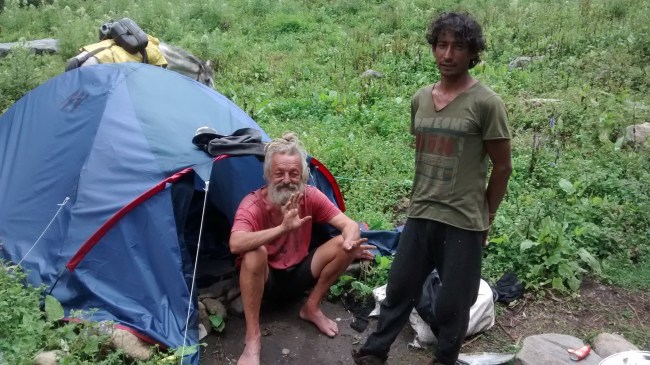
In what is known as the heart of Shiva, the majestic Parvati Valley in Himachal Pradesh, a trekker writes about a chance encounter with a Russian man and the impending destruction of the valley. 

My growing alienation with Delhi and city life in general has been buttressed by my frequent, life breathing trips to the mountains. One such getaway took me on a week long trek to the beautiful Parvati valley in the Kullu district of Himachal Pradesh along with a friend. The valley is home to majestic waterfalls tucked away at every turn, lush green forests with the promise of thriving wildlife, unique flowers and a well marked trekking trail. The waterfalls are generous and since we went in the rainy season every shade of green was visible in the forest. The forests are generously sprinkled with their share of marijuana plants that provides a living to many locals and keeps the travellers, especially a large number of Israelis in states of bliss.

Untitled

Russian Baba with Prem

The trek to Kheerganga begins from Barshani village, which is the last motorable point. It is a 14km uphill trek through the forest.  The forest is alive and buzzing with life and the Parvati River accompanies you through your walk. Having recuperated from our long trek to Kheerganga and enjoyed the dip in the hot spring and rejuvenating sight of the first layer of snow on the surrounding mountains, we trekked further with the hope of reaching Tunda Bhuj, a place adorned with a wide variety of sub-alpine forests. About half way into our journey it began to get dark and started pouring. The mist was setting in impeding our vision and we were happy to see a couple of tents in the middle of the forest, next to a small brook. When we stopped by we were warmly greeted to join in for a cup of hot tea. This is where we met a foreigner, in his late 60s and his two companions – Prem and Mansingh (both from Nepal). The initial round of niceties revealed that the foreigner was from Russia and I realised this is the ‘Russian baba’, we had heard about in Kheerganga. He had dreadlocks in his hair, a pair of torn shoes, a torn t-shirt and a bundle of beedi that he constantly drew on. He could not hear too well and retained a thick Russian accent. Continue reading The Majestic Parvati Valley – Paradise Lost: Ujithra Ponniah

Sophie Joseph’s Sikh Neighbours: John Dayal

Guest Post by JOHN DAYAL

My aunt and God-mother Sophie Joseph had lived in Delhi a long time, and as a young woman, was witness to the communal frenzy art the 1947 Partition of India.

She would also tell stories of heroism, and greed. Many Hindus saved lives, in return for all the cash they could carry, or for rights over the house that would soon be vacated. Others saved their neighbours out of love. Many lived to cross the borders not because the Armymen protected them, but because the neighbours risked their lives to save them from other marauding neighbours. Sophie, then in her teens, remembered all this. She was no heroine and her lower middle class family was not the stuff of which role models are made, but they were happy they connived in the saving of lives.

That lives could be saved if there was courage of conviction was a lesson she learnt. Her lesson would come in handy almost thirty five years later, save many more lives of other neighbours.

Continue reading Sophie Joseph’s Sikh Neighbours: John Dayal

Boycott the Israeli embassy sponsored performance of the Maria Kong Dance Company in Delhi: INCACBI

Statement from The Indian Campaign for the Academic and Cultural Boycott of Israel 

Don’t let apartheid onstage!

Protest against the ‘Israel in India’ initiative!

Boycott the Israeli embassy sponsored performance of the Maria Kong Dance Company at Kamani Auditorium, New Delhi, November 4, 2014

On 4th November, 2014, the Maria Kong Dance Company will perform at the Kamani Auditorium as part of the “Israel in India” initiative, with support from the Israeli embassy in India. This is part of the 8th Delhi International Arts Festival, organised by the Prasiddha Foundation with the support of organisations including the ICCR.

The festival aims to “serve as a significant platform for cultural diplomacy” and “provide a common ground for interaction between the artists and the mass audience”. Is a common ground possible between the Israel and Indians of conscience, whether artists or citizens? Is “cultural diplomacy” possible with Israel when it has attacked Gaza so brutally earlier this year, and held its people to ransom for years? Since Israel does not respect international law and recognize the Palestinian people’s right to freedom, equality and justice, the Indian Campaign for the Academic and Cultural Boycott of Israel (InCACBI) demands that Israel be boycotted from the Indian cultural arena.

Continue reading Boycott the Israeli embassy sponsored performance of the Maria Kong Dance Company in Delhi: INCACBI

Letter to PM about US-India Bilateral Relations on Intellectual Property

Dear Prime Minister Modi ji,

We, the undersigned, wish to share with you some of our concerns on India’s position on intellectual property (IP), particularly in the context of bilateral relations between the United States of America and India. We gather from the US-India Joint Statement dated 30 September 2014 that the Indian Government

(a)greeing on the need to foster innovation in a manner that promotes economic growth and job creation…committed to establish an annual high-level Intellectual Property (IP) Working Group with appropriate decision-making and technical-level meetings as part of the Trade Policy Forum. 

The necessity for setting up the joint Indo-US IP Working Group is not entirely clear. As the Department of Industrial Policy & Promotion (DIPP)‘s press release of 3 October 2014 mentions, there is already in operation an Indo-US Trade Policy Forum since 2010. Therefore, we request your Government to kindly make the specific purpose of this joint Working Group publicly known. Continue reading Letter to PM about US-India Bilateral Relations on Intellectual Property

Witness Account of the Trilokpuri Clashes on October 25, 2014: A.M

AM, a journalist,  writes on Sabrang. Excerpts below and link to the whole piece at the end.

I with a colleague of mine reached East Delhi’s Trilokpuri by 12:00 pm on Saturday. News about alleged clashes had reached us late on Friday night. We were told that the clashes had broken out at around 8:00 pm on Friday but no one was visibly injured. Bricks and empty beer bottles were hurled to and fro interspersed with occasional gunshots. The police reached the area and restored calm. Heavy police presence in the area restored confidence and sent people back into their homes. This is what we had heard.

When we reached the spot on Saturday afternoon at around 12:00 pm, both of us happened to walk right into a mob which had assembled on the main road. Then they started hurling bricks into the air, upped with roaring jubilation and thrill. All at a physical enemy that was not visible. Terrified and taken by surprise, we ducked and ran over to a nearby car parked by the curb. We crouched behind it for over five minutes till we could run farther down to a relatively deserted and safer stretch next to a mother dairy kiosk. That was only one of the many such walk-ins we had and had walked in and out of…

This senseless and directionless fury, we realised, was being whipped up for the fun of it. And, as journalists, we sensed individual families had gathered ammunition, mainly bricks and beer bottles, over the night for a final showdown on Saturday morning. A couple of hours later, my colleague followed a rag picker collecting in a sack bricks strewn over various roads. He saw the rag picker climb into a house and he heard him saying, “Chalo bhai, aaj ke raat ka intezaam ho gaya hai.”…

The atrocities started when policemen began arbitrarily searching houses and rounding perpetrators in the absence of clean evidence or proof. Almost 1000 persons were actively involved in the stone throwing and no one knows which blocks they belonged to and where they had walked to to participate in the violence. Police, clueless and worked up, therefore, randomly began banging on closed doors and shoving their lathis into houses to drive fear and establish control over residents. Most of these houses, however, happened to be in Muslim dominated areas especially in Blocks 14 and 27. The Indian Express reported that “the police have arrested 44 people — 32 Muslims and 12 Hindus” on charges of rioting as listed in the FIRs. This despite Trilokpuri comprising 80 per cent Hindus ( Balmikis) and 20 per cent Muslims. Lopsided statistics and arrests say much about what was happening on the ground…

I was witness to how the Delhi police, had brazenly, in view of  journalists, albeit without cameras employed anarchic, illegal arrests, communal and extrajudicial tactics to impose what they call ‘law and order’- a phrase which constantly equivocates with us, we who lie on the “clean” side of law and those who live outside its underbelly.

READ THE WHOLE ACCOUNT HERE.

The ‘new and improved’ Love Jihad formula, unethical media and ‘social science’ votaries

Caught on the back foot by the humiliating backfiring of their fantastical Meerut scenario of ‘gangrape and forcible conversion’, in which the role of the BJP as well as of sundry Hindutvavaadi organizations in breaking up a consensual Hindu-Muslim relationship have been thoroughly exposed, the Hindu Right appears to have arrived at a new formula. This formula has made its appearance in several spaces – in comments on Kafila (some of which have been passed, many more deleted; mostly pseudonymous or anonymous, and in varying degrees of abusiveness); on the social media and in personal blogs; and more respectably, in newspapers, in signed op-eds and articles, the most recent of them by the perennially amusing Madhu Kishwar.

The formula is patented across these sites and involves all or several of the following claims:

a) Hindutvavaadi groups are not the only ones to fear ‘Love Jihad’ – the Church in Kerala and the Akal Takht have also expressed their anxieties about this campaign. So there must be some fire generating all the smoke.

b) So real is the danger that the claims have been investigated by the police, as directed to do so by courts.

c) Hindutvavaadi groups have no objection to inter-faith marriage, what they object to is the cheating of Hindu women into marriage in a well orchestrated campaign by Muslim men who trap them in polygamous marriages only to convert them and produce several children, thus raising the Muslim population.

d) What is happening in India is only a small part of the Global Islamic Terror Machine’s global campaign to use non-Muslim women as sex slaves, to prostitute them, or to seduce them in order to convert them. The recent exposure of a pedophile ring in the UK run by Pakistani men is treated as proof of the existence of such a globally coordinated campaign in which all Muslims are suspect – from Al-Baghdadi of ISIS to your classmate.

e) As irrefutable proofs, three links are generally circulated: a) a programme of IBN7 that ‘exposes Love Jihad’, and b) two videos of young women who supposedly speak about being victims of Love Jihad.

Madhu Kishwar in her article asserts all of these claims produced by the RSS Myth Machine, although she is probably not yet aware of the last item – which I will address at length in conclusion. Continue reading The ‘new and improved’ Love Jihad formula, unethical media and ‘social science’ votaries

Love Jihad and the roots of hate: John Dayal

JOHN DAYAL writes:

Three parallel strands of India’s cultural history have merged in recent times into a lethal phenomenon that has been termed “Love Jihad”, which has not only obtruded into the personal lives of young men and women of Hindu, Muslim, Sikh and Christian religious communities, but has put to grave risk individual security and community peace.

A attitude to Muslims that verges on Islamaphobia, a pathological hatred for conversions to Christianity – both seen as disturbing the demographic equation in India to  overwhelm the Hindu majority take the traditional national culture of feudalism and patriarchy to a new and explosive level. The current crisis in the Middle east and on the borders with Pakistan in Jammu and Kashmir provide the trigger, as it were, to the short fuse.

The Indo-Gangetic plans of North India are the main sites of this confrontation but its repercussions have been seen deep in the states of southern India, and the Indian and south Asian diaspora in the United Kingdom and the United states of America.

Political encouragement and patronage to lumpen and criminal moral vigilante groups, administrative and police impunity have led to targetted violence, a wave of hate campaigns, a polarized landscape, and deeply traumatised young couples who have dared, and sometimes married across religious borders. The media has taken sides, the Hindi language newspapers and  television news channels  exhibiting majoritarian bigotry. Civil society has found itself outnumbered.

The church, willy nilly, has found itself dragged into this unsavoury situation. Senior  episcopal and lay leadership of both Catholic and  protestant  denominations have so far not been audible in the defence of what, at the end of the day, are issues of human rights guaranteed under the Indian Constitution  and the Charter of the United Nations.

Read the rest of this article here.

Un-owning – Archives in General, Ambedkar in Particular: Rajshree Chandra

Guest post by RAJSHREE CHANDRA

The immediate motivation for writing this piece has been the passionate and often partisan debate that surrounded the publication of the new, annotated critical edition of B. R. Ambedkar’s work, Annihilation of Caste (AoC) by Navayana Publishing. Sufficient water has flowed under the bridge to soften the various sharp edged stones and so it is perhaps time for some dispassionate perspective on the matter.

There are two kinds of debate that got triggered off by the publication of AoC. One of course relates to the 124 page provocative introduction to AoC written by Arundhati Roy titled ‘The Doctor and the Saint’ – The “Doctor” being Ambedkar and the “Saint” referring to Gandhi. The other relates to questions of ownership of archival material and questions of its fair dissemination. While the former has been hotly, and often intractably, debated by experts, scholars, followers and fans of Gandhi and Ambedkar, it is the latter that has received less attention than it deserves.

The question is important: It does not merely relate to the question of who owns Ambedkar, but in general relates to a wider question of authorship and representation of intellectual heritage. And as I have argued in my earlier posts on Kafila [1], for me the legal question is preceded by a normative concern and a political question, which is this: Should the answer to the question of who speaks for and about Ambedkar be selective? And relatedly, should ideas, works and publications of our thinkers and philosophers be policed and guarded by caretakers and/or representatives deemed to be “authentic” and/or “legal”? But before I come to these questions let me briefly contextualize the publication of AoC, as only a specific instance of his large body of work. Continue reading Un-owning – Archives in General, Ambedkar in Particular: Rajshree Chandra

‘The Meerut Girl’, desperate Hindutvavaadis and their Jihad against Love

[With two updates added on October 15, 2014]

The phrase ‘Jihad Against Love’ is Janaki Nair’s in The HinduWhy Love is a Four Letter Word. I can’t think of a better description of this sick, twisted, violent campaign, in which local Hindutvavaadi thugs ally with families desperate to control their young sons and daughters from – quite simply – falling in love. Families that have no qualms in violently separating their children from relationships outside their caste or religious community, often killing one or both of them. Such murders have come to be dubbed ‘honour killings’ by the English media, but a starker, more revealing term is suggested by Pratiksha Baxi – ‘custodial deaths’. Indeed, the young people killed in such cases are in the custody, much like prisoners, of their own families.

If you haven’t had enough of tragic love stories, take a look at Perveez Mody’s book, The Intimate State: Love-Marriage and the Law in Delhi (Routledge, Oxford and New Delhi, 2008) for  heart-breaking accounts of of treachery and betrayal by parents, of their own children who fall in love with the wrong people, and the kinds of physical violence unleashed on rebellious couples by their own families.

The Hindutvavaadi campaign has an able ally in the Christian Right. A report in 2009 in The Times of India said:

‘Love Jihad’, a religious conversion racket which lures gullible girls by feigning love, has brought rivals Vishwa Hindu Parishad and Christian groups in Kerala together.

“Both Hindu and Christian girls are falling prey to the design. So we are cooperating with the VHP on tackling this. We will work together to whatever extent possible,” said K S Samson, an office-bearer of Kochi-based Christian Association for Social Action (CASA), a voluntary Christian association.

Samson said some days ago, CASA got to know about a Hindu family in a Christian parish where a school going girl was the victim. ”We immediately referred it to the VHP,” he said, adding the saffron outfit has helped them in many cases.

Continue reading ‘The Meerut Girl’, desperate Hindutvavaadis and their Jihad against Love

Challenges to “Islamic State” from within Islam

This news was not as widely reported in the Indian media, to my knowledge, but on September 24, 204, 120 Islamic scholars wrote an Open Letter to to the “fighters and followers” of the Islamic State, denouncing them as un-Islamic, using the most Islamic of terms.

Lauren Markoe wrote in Huffington Post a report reproduced in NewAge Islam:

Relying heavily on the Quran, the 18-page letter released Wednesday (Sept. 24) picks apart the extremist ideology of the militants who have left a wake of brutal death and destruction in their bid to establish a transnational Islamic state in Iraq and Syria.

Even translated into English, the letter will still sound alien to most Americans, said Nihad Awad, executive director of the Council of American-Islamic Relations, who released it in Washington with 10 other American Muslim religious and civil rights leaders.

“The letter is written in Arabic. It is using heavy classical religious texts and classical religious scholars that ISIS has used to mobilize young people to join its forces,” said Awad, using one of the acronyms for the group. “This letter is not meant for a liberal audience.”

Even mainstream Muslims, he said, may find it difficult to understand.

Awad said its aim is to offer a comprehensive Islamic refutation, “point-by-point,” to the philosophy of the Islamic State and the violence it has perpetrated. The letter’s authors include well-known religious and scholarly figures in the Muslim world, including Sheikh Shawqi Allam, the grand mufti of Egypt, and Sheikh Muhammad Ahmad Hussein, the mufti of Jerusalem and All Palestine.

Continue reading Challenges to “Islamic State” from within Islam

Letter to PM on NREGA from Development Economists

Dear Prime Minister,

We are writing to express our deep concern about the future of India’s National Rural Employment Guarantee Act (NREGA).

The NREGA was enacted in 2005 with unanimous support from all political parties. It is a far-reaching attempt to bring some much-needed economic security to the lives of millions of people who are on the margin of subsistence.

Despite numerous hurdles, the NREGA has achieved significant results. At a relatively small cost (currently 0.3% of India’s GDP), about 50 million households are getting some employment at NREGA worksites every year. A majority of NREGA workers are women, and close to half are Dalits or Adivasis. A large body of research shows that the NREGA has wide-ranging social benefits, including the creation of productive assets. Continue reading Letter to PM on NREGA from Development Economists

The old Gods haven’t fled: Sankar Radhakrishnan

Guest Post by SANKAR RADHAKRISHNAN

On a morning not long ago, chaya cup in hand, I was getting my regular Kafila fix, when I paused mid-click. What caught my eye was a headline with ‘Gods, Own and Country’ in it. Now that combination of words could only mean one thing — a piece on Kerala. It helped though that right below the headline was a picture of a Kathakali artist in sthree vesham or female makeup.

So I dived right into the essay on Thiruvananthapuram by Professor Mohan Rao. The first couple of lines had me grinning with delight for he wrote of his “four wonderful days” in the city, one that’s been my home for much of the past three decades.

I was so pleased by this that I skimmed the next few lines. Only to be stopped in my tracks, almost spilling some scalding chaya on myself in the process, by the Professor’s declaration that “… Ganesha is not a deity widely worshipped in Kerala.”

Now I’m no expert in Hinduism, but I do know that my extended, and very Malayali, family used to perform a ‘Ganapathy homam’ on a number of specific occasions; before moving into a new house, for instance. And this has been going on for decades. I also remember that both my grandmothers had an image of Ganapathy in their personal pooja spaces. Just to make sure that I hadn’t got my wires crossed, I checked with a couple of Malayali Hindu friends who confirmed that Ganapathy and Ganapathy homams were an integral part of their families’ religious landscape too.  Continue reading The old Gods haven’t fled: Sankar Radhakrishnan