
Guest Post by UJITHRA PONNIAH
In what is known as the heart of Shiva, the majestic Parvati Valley in Himachal Pradesh, a trekker writes about a chance encounter with a Russian man and the impending destruction of the valley.
My growing alienation with Delhi and city life in general has been buttressed by my frequent, life breathing trips to the mountains. One such getaway took me on a week long trek to the beautiful Parvati valley in the Kullu district of Himachal Pradesh along with a friend. The valley is home to majestic waterfalls tucked away at every turn, lush green forests with the promise of thriving wildlife, unique flowers and a well marked trekking trail. The waterfalls are generous and since we went in the rainy season every shade of green was visible in the forest. The forests are generously sprinkled with their share of marijuana plants that provides a living to many locals and keeps the travellers, especially a large number of Israelis in states of bliss.
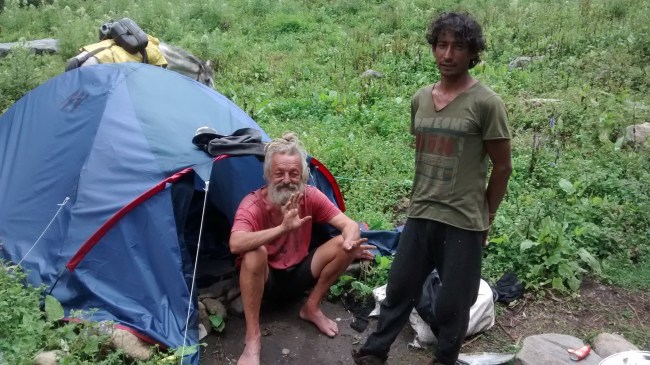
Russian Baba with Prem
The trek to Kheerganga begins from Barshani village, which is the last motorable point. It is a 14km uphill trek through the forest. The forest is alive and buzzing with life and the Parvati River accompanies you through your walk. Having recuperated from our long trek to Kheerganga and enjoyed the dip in the hot spring and rejuvenating sight of the first layer of snow on the surrounding mountains, we trekked further with the hope of reaching Tunda Bhuj, a place adorned with a wide variety of sub-alpine forests. About half way into our journey it began to get dark and started pouring. The mist was setting in impeding our vision and we were happy to see a couple of tents in the middle of the forest, next to a small brook. When we stopped by we were warmly greeted to join in for a cup of hot tea. This is where we met a foreigner, in his late 60s and his two companions – Prem and Mansingh (both from Nepal). The initial round of niceties revealed that the foreigner was from Russia and I realised this is the ‘Russian baba’, we had heard about in Kheerganga. He had dreadlocks in his hair, a pair of torn shoes, a torn t-shirt and a bundle of beedi that he constantly drew on. He could not hear too well and retained a thick Russian accent. Continue reading The Majestic Parvati Valley – Paradise Lost: Ujithra Ponniah
 The Swachh Bharat Abhiyan (Clean India Campaign) is powerful in its simplicity, and problematic for the same reason. The absence of complexity in the presentation of the campaign, and the inherent contradictions between Modi’s consumerist growth agenda and SwachhBharat’s objectives fuels my skepticism and raises many questions: Which parts of India will be cleaned, which not and why not? What will we do with the wastes we remove? Where will we put it?
