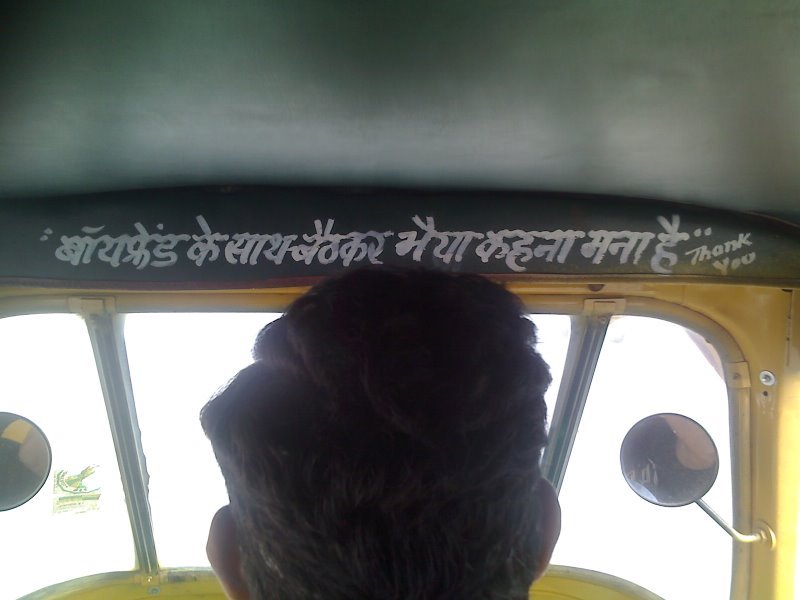
“It is forbidden to sit with your boyfriend and claim he is your brother”
My sister sent me this one…
Carrying forward the debate around Partha Chatterjee’s article in EPW.
by PRASANTA CHAKRAVARTY
In the wake of the development debates around the nation, one witnesses an interesting array of articles—polemical as well as academic—that takes on headlong issues of political intervention by developing the terms of negotiation and deliberation in a certain direction. And that is the story of growing up—that democracy is the story of pragma, of mature understanding of the contestatory space. These are reminders that politics of good intentions is benign self-deception. Worse: it is apolitical, prophetic, self-indulgent.
Continue reading Prasanta Chakravarty – Of Demos, Innovation and Affect
[This guest post is by AHILAN KADIRGAMAR who is an activist with the Sri Lanka Democracy Forum. He has written about the international dimension of the conflict and peace process in Sri Lanka and worked on human rights concerns related to the conflict. His current interests include the political economy of state-society relations and attempts at state reform in Sri Lanka.]
I have been travelling between cities, from Kathmandu to Delhi to Calcutta and down south to Madras. Visiting friends, but also trying to understand peoples’ perceptions of Sri Lanka in a time of war. I give talks here and there, but many more meetings over tea and dinner. There is an older tradition of solidarity, but now I am thinking again of the meaning of Southasian solidarity.
In Calcutta, on an activist’s book shelf, I find a book signed and gifted to her in the mid-eighties by Para, my friend from Berlin who passed away last year. Kumaraswamy Pararajasingham, a Marxist and human rights activist in Lanka in his early years, was a pillar of Tamil dissent over the last two decades of exile in Germany. An old Marxist in Calcutta, asks me about Hector Abhayawardhana, the theoretician of the Lanka Sama Samaja Party Continue reading Ahilan Kadirgamar on Southasian Solidarity and Questions of State and Land
By Rifat Mumtaz and Madhumanti Sardar
(Rifat Mumtaz and Madhumanti Sardar work with NCAS and are involved in campaigns against SEZs).
Recently, Goa became the only state in India to openly declare that no more Special Economic Zones (SEZs) would be set up on its territory. This was a result of relentless pressure from almost the entire state — villagers, educated middle class, professionals, activists, the church and media. Continue reading Goa: How the battle was won
The honourable judges of the honourable judiciary are on an honourable roll…
Anuradha Roy of Permanent Black sent out the following:
On the 9th of February 2008, remarks by two eminent judiciary members the Chief Justice of Karnataka, Cyriac Joseph and State Human Rights Commission Chairperson Justice S.R.Nayak, stating that immodest dressing was the cause of increasing crimes against women were reported in the press.
The Hon’ble Chief Justice further elaborated his statement by mentioning that “Nowadays, women wear such kind of dresses even in temples and churches that when we go to places of worship, instead of meditating on God, we end up meditating on the person before us” and that the “provocative dresses that women wear in buses” put the “men travelling in the buses” in awkward situations and hence “women must dress modestly.”
The Chairperson, State Human Rights Commission, speaking on ‘Human Rights and the Lawyers Role’, gave his opinion on the Mumbai New Year molestation issue, when two women had their dresses torn off by a mob
of men outside a nightclub: “Yes, men are bad… But who asked them (the women) to venture out in the night…Women should not have gone out in the night and when they do, there is no point in complaining that men touched them and hit them. Youth are destroying our culture for momentary satisfaction.”
Anuradha sent this out without comments. I understand her mood. I’m done too. No witty commentary, no smart asides. I’m just plain exhausted.
STATEMENT OF CONCERNED CITIZENS AND PEOPLE’S ORGANIZATONS
A group of former bureaucrats, academicians, lawyers and social activists visited Chhattisgarh from 18 – 22 January 2008 in connection with the prolonged incarceration of Dr Binayak Sen. The team met the Governor and Director General of Police and also met Dr Binayak Sen in the central prison at Raipur. Some members of the group also visited areas in the districts of Bastar, Dantewada and Bijapur.
In the light of the information gathered, the team is of the opinion that the charges filed against Dr Sen under the IPC, CrPC and the Chhattisgarh Public Safety Act (CPSA) are unwarranted and unconstitutional. The CPSA enables the government to interpret the rendering of simple humanitarian acts as unlawful The Act defines “unlawful activity” so broadly that every act of vigilant citizenship can be construed as unlawful and anti-national. Thus it is clear that Dr Sen is being targeted in his capacity as General Secretary of People’s Union for Civil Liberties, Chhattisgarh. The reports produced by the PUCL have highlighted the anti-constitutional violence legitimized by the state through the Salwa Judum campaign.
Continue reading State Repression In Chhattisgarh And Continued Detention Of Dr Binayak Sen
Excerpts from Saikat Datta on the doctored case against Binayak Sen.
What is the basis of the Chhattisgarh police’s case against Dr Sen? The chargesheet against him says he is a Naxalite sympathiser. This conclusion was reached after his name came up when the police recovered three letters from suspected Maoist Piyush Guha, arrested at the Raipur railway station. These were written to Guha by another alleged Maoist, Narayan Sanyal, presently lodged in Raipur Jail. The police claim Guha, under custodial interrogation, confessed that Dr Sen acted as courier.
Dr Sen did meet Sanyal in jail on several occasions. But each time it was with due permission from the jail superintendent and a body search before and after his meetings. And even if we were to accept that Dr Sen smuggled the letters out, what exactly was “incriminating” in them? One letter deals with farmer-related issues, the letter writer’s health and so on. In another note, Sanyal is discussing issues relating to his case and the approach his lawyer has taken in court. In yet another, he complains of there being “no
magazines” to read in jail and terrible conditions in prison.
Activist-lawyers like Prashant Bhushan see the framing of Dr Sen on such flimsy evidence as “a message that clearly states that people must shut their eyes to violations of human rights of the marginalised or risk arrest”.
Continue reading Human rights and public health are now the gravest threats to people’s safety
Binayak Sen’s appeal to the Supreme Court for bail was dismissed on December 10, 2007 (in one of those meaningless ironies, December 10th is of course, International Human Rights Day).
A doctor working in Chhattisgarh, Binayak was arrested on May 14th 2007. His crime? He visited and treated an ailing prisoner in Raipur Central Jail with the permission of the jail authorities. The prisoner is a Naxalite. So Dr Sen is assumed to be a terrorist conspiring to overthrow the state, so dangerous that he cannot be given bail.
Continue reading It’s a new year, and Binayak Sen is still in prison
Recently Kiran Bedi, the country’s first woman police officer, sought voluntary retirement after being in the eye of a storm following her allegations of gender discrimination in the police force. Bedi, who had transformed Tihar jail from filthy dungeons to a clean and livable place and has had an outstanding career, was superseded for the post of Delhi’s police commissioner. Because she was a woman.
Women in civil service have come up against sexism time and again. Madhu Bhaduri, who joined the Indian Foreign Service (IFS) in 1968, recalls how women IFS officers launched their first protest against blatant gender discrimination in this elite branch of service, which was at that time wrapped up in layers of discriminatory codes.
Here is an account of how it all started…
Like many other lovers of Bollywood cinema, I too was caught up since October this year in the countdown to the battle of all battles, with the release of Om Shanti Om (OSO) and Saawariya on 9 November 2007. Reams have been written, debated and analysed on the two films in newspapers, television networks, and everyday discussions. They have been depicted as films catering to very different sensibilities, and representing vastly diverse forms. The verdict seems to have declared both as average films, though OSO seems to be faring better than Saawariya at the box office. I enjoyed the first half of OSO particularly and thought Saawariya as a film with great form, but not much content.
However, as a fan of Bollywood popular cinema, what struck me most was one striking similarity between the two films. I thought both the films offered great visual pleasure and feast for the female spectators, where the spectacular and stylish nude male bodies and images of both Ranbir Raj Kapoor and Shahrukh Khan, though very different from each other, were the prime objects of desire and erotic spectacle. Both OSO and Saawariya have urban heroes, whose bodies are produced and carved, rooted in providing a voyeuristic visual treat especially to most straight women and gay men. The identity of both the heroes in these films in centrally tied to the consumption of their nude bodies by the viewer. The films in some senses signify the coming of age of a new genre of Bollywood cinema, where it is not so much the female body but the male body which circulates and is on display, offering a sexualised imaginative anatomy. They also signify that the language of discourse of Hindi films has undergone a dramatic post modernist change in its conception of desire, where most of it is conducted not through the soul but through the body. There is no central heart, but a decentring of emotions at play here. In the recent past too, nude male bodies of Hrithik Roshan and Salman Khan have been offered to the viewer. It perhaps is also a reflection of the fact that more and more women are crowding the cinema halls and form at times the major chunk of spectatorship, and they are a vital part of the cinematic experience.
What were you doing on December 6, 1992?
We remember with a great sadness that winter’s day on which the unthinkable came to pass…
Continue reading 6th of December 1992 on 6th of December 2007
Read Asad Mustafa on his memories of the day the Babri Masjid was demolished.
In many ways it is just like any other Lucknow winter day. Sun has come up and my mother is watching her pickles dry on the roof. Our neighbor, Shukla-ji’s daughter has come for a lazy winter
afternoon conversation with my mother and is oiling her hair. I am struggling with unsolved papers from previous years’ JEE tests. This year’s JEE is going to be my first big test in the real world.
Arundhati Roy articulated in her interview last night on IBN7, the deep suspicions of the “deep state” that many of us have harboured in our collective anti-national (and now apparently anti-left) bosom. How convenient that the violent anti-Tasleema protests have deflected the anger of the left-secular folks from Nandigram to Islamic fundamentalism. Arundhati responded to a question about whether she was claiming there was a conspiracy, by saying, quite correctly, that there doesn’t need to be anything as crude as that. But we know, people on the street know – there’s something way too convenient in the timing. Or, as she put it elsewhere, quoting a Hindi film song, “yeh public sab jaanti hai.”
Imagine my disappointment as a political theorist to discover that we don’t need to make any intellectual forays into the complex ways in which states “see” and “do”. There was a conspiracy, and it worked out like the the script of a bad street play, in which the villains mutter and grimace and do bad things in the dark of the night, while the good folk get all confused by the sudden transformation of their peaceful locality by dawn. (Life is in fact a bad street play, a realization I came to long ago).
In Wolfgang Becker’s film Good Bye Lenin set in East Germany at the time of the fall of the Berlin Wall, a young boy tries to protect his invalid mother from the shock of learning about the transformation that has overtaken their country. When despite his elaborate deception, she manages to see a television programme showing thousands of cheering Germans at the remnants of the wall, he tells her that the capitalist west has fallen, that refugees from West Berlin are pouring into the East, and that East Germany has welcomed them with open arms. And she believes him.
Thing is, there was no historical inevitability to the fall of communism. The story the boy tells his mother in Good Bye Lenin could well have been the way things went in history, but for the self-destructiveness of Stalinism – its hubris, its fetishization of a certain notion of industrialization and progress, its anti-democratic core, its contempt for the “people” it claimed to represent (or rather, the people it claimed to be.)
Continue reading Theses on Feuerbach, Woody Allen and Nandigram
Even as our own dearly beloved Supreme Court repeatedly shows contempt of the people by handing over tribal lands to corporations and urban spaces to mall developers, the judges across the border seem to be on a radically different track. As is well known by now, the initial dismissal of Chief Justice Iftikhar Choudhary by General Musharraf – an action that launched a million mutinies – was at least partly to punish him for his order preventing the sale of Pakistan Steel Mills to a private group.
As the democratic upsurge in Pakistan carries on unabated, here is a lesser known story, sent to me about a month ago by Nighat Said Khan (better known as Bunny) Women’s Action Forum activist. It is an eye-witness account of the hearing in June 2007, in the Supreme Court of Pakistan, on the appeal by the ‘she-couple’, as a story in Dawn dubbed them, seeking dismissal of a High Court decision sentencing them to three years’ imprisonment for perjury. Not only is the order by the Supreme Court exemplary for its commitment to individual rights, Bunny’s account highlights the extraordinary sensitivity and awareness shown by both the lawyer representing the couple, Babar Awan, and the judges hearing the case.
If this is Pakistan’s judiciary, no wonder the general is a little lost in his labyrinth…
Over to Nighat Said Khan.
I was going to Lahore for the first time, and took a taxi to the IG International airport in Delhi. My local taxi stand had sent a driver whom I didn’t know, and there was another lad in the front seat with him. At some point, as the driver swerved to avoid a vehicle that overtook from the right, he said to me – “Madam, aap bahar ja rahi hain. Bataiye, hamare desh mein aur bahar ke deshon mein kya farak hai”.
It was probably an opening gambit for a diatribe on how uncivil hamare log are as compared to gore log, but I replied – “Vaise main Pakistan ja rahi hoon, mujhe nahin lagta hai ki koi khaas farak hoga.”
At this, he responded, “Pakistan ja rahi hain? Hamare liye ek topi le ayengi?”
Me: “Zaroor. Lekin koi khas kism ki topi chahiye kya?”
Him: “Nahin, hamare musalmanon wali topi. Mere dadaji pehnenge.”
Does the ‘girl-child’ exist? What is it other than empty officialese, a smoke-screen that obscures, almost erases, little girls and the dismal little lives most of them lead? The ‘skewed sex-ratio’ has become a fetishized object for policymakers and governments in India, and improving those numbers a goal in itself. In the pursuit of good-looking sex-ratios, the minister for women and child development has come up with one alarming scheme after the other.
Earlier this year, Renuka Chowdhury announced a government scheme to open centres where people can abandon unwanted daughters rather than aborting them. Can you imagine the girl-children growing up in these doomed institutions? What fates can they expect, unwanted by their parents and kept on by the State only to boost sex-ratios? Chowdhury said at the time that the government was treating the drop in sex-ratio as an issue of national emergency. She also said that through this scheme, the government would “at least ensure that the gene pool is maintained”! In effect, these institutions would be collections of little girls unwanted by all but the census-takers, dropping by periodically to correct the skewed sex-ratio with a quick look at the office records.
What would you call an institution that can overturn any policy adopted by democratically accountable governments; whose decisions are final, and cannot be reconsidered in any other forum; and which can throw into prison anybody who criticizes it? What would you call this institution accountable to nobody but itself, which has the sole power to appoint its own members and the sole power to decide if one of its own is guilty of a misdemeanour?
In India you would call it the Judiciary.
Cheered on vociferously by the freedom-loving media and its viewers/readers, the judiciary for about a decade, has been taking over more and more functions of government, until finally on January 11, 2007, the decisive judicial coup d’etat took place. By a judgement delivered on this day, the Supreme Court gave itself the power to strike down any law if it violates fundamental rights, resulting in the violation of the basic features of the Constitution. It is important to remember that constitutionally, no fundamental right is unconstrained, ‘reasonable restrictions’ being necessary to ensure that every citizen can enjoy these rights. Further, no right is beyond interpretation – does ‘right to equality’ entail affirmative action, for instance? There may be contradictions between fundamental rights; say between the right to equality of individual citizens and cultural rights of minorities. What exactly are the features that constitute the ‘basic features of the constitution’?
Continue reading Contempt of Democracy: Time for Judicial Reform
By SOPHIE McNEILL
Sophie McNeill is a reporter with SBS Television Australia, her blog from Lebanon can be found at http://www9.sbs.com.au/
[Note from NM: I received this from nothing2report@gmail.com, and was struck by how this kind of complex reporting is almost non-existent in India, at least in the English media . How often do reporters actually speak to participants in a rally, going beyond the media-designated ‘stars’ who are present (whose own sincerity and commitment the media itself then paints as being ‘merely for publicity’ – it’s a vicious cycle.) How much political protest by non-party citizens’ groups gets covered at all except as traffic disruptions or if it has been ‘newsworthy’ because of stars/violence/self-immolations? How many reports in print or on the 24 hour TV news channels actually give the consumer a sense of what the issues are, what are the debates, or try to go beyond the Big Fight format of For and Against? Do news reporters do any background research ever? How many 6th of Decembers have passed with no coverage at all of huge-to-small (differing from year to year) secular protests by a range of people from Gandhians to the ultra left; but with two predictable photographs every year – one of recognizable Muslims and another of the Shiv Sena/Bajrang Dal protesting and celebrating respectively, counterposed on front pages of newspapers?
Apart from being an exemplary piece of reportage, Sophie McNeill’s article below give us a fascinating insight into politics in Lebanon.]
A truck laden with yellow Hezbollah flags drives past the Christian neighbourhood of Gemayzeh early Sunday morning in downtown Beirut. There’s a picture of Hezbollah leader Hassan Nasrallah on the windscreen, but it’s not his name that the young men on board are chanting. “General, General!” yell these young Shiite boys.
Their chant is for the leader of Hezbollah’s largest Christian ally, the former General Michel Aoun. And this van captures an important dynamic that many of the international and Lebanese press have omitted from their coverage of the last few days — that almost a quarter of the crowd at the huge anti-government protests have been Lebanese Christians. Continue reading Why Hezbollah’s Al-Manar TV is Broadcasting Sunday Mass
Here’s an amusing little story. According to reports in a leading daily, (August 26 and September 4), Hoshangabad police charged a couple with the murder of their twelve year-old son. Their son was indeed missing, and a body was found near the railway track. The parents confessed to the crime, and spent over 45 days in jail. Six months after his murder, young Gabbar turned up in town. He had fallen asleep while selling peanuts on trains, and woke up in Jalgaon. There he was put into a correctional institution, and later, sent to Bhopal. Finally he managed to convince someone to send him back home. Present in court, he listened to the government pleader arguing that the parents had confessed to the murder, so he could not be Gabbar; that the body found near the railway track was not Kallu alias Tufan, as claimed; and that neighbours had identified the dead body as that of Gabbar. The neighbours meanwhile, told the reporter they had never identified the dead body as his, and that this boy was indeed Gabbar. “We know him since he was born”, said one of them simply, “how could we make such a mistake?” Continue reading Playing Cops and Reporters
The kidnapping of little Anant and his release for ransom highlight once again the great ease with which police fabricate accounts that suit their purposes. (Means: They Lie). Turns out that the case they claimed shamelessly to have cracked was resolved on the terms set by the kidnappers. (Most probably, the two arrests made subsequently are arbitrary and it seems pretty certain the ransom has not been “recovered” as claimed). The holes in the police versions are being relentlessly revealed by the mainstream media, concerned as it is with law and order, especially when it comes to “posh” areas like NOIDA ( a small – tiny – prize awaits anyone finding an English paper that did NOT use this adjective once during the whole Anant episode), and posh people like CEOs of MNCs. I need do no more on this front, except just to mutter “What about Afzal?” before I move on to another aspect of the coverage on the incident.
The Servant Angle. Or, as the French might put it, Cherchez le Servant. No opportunity is too slight for the police and the media to drill this lesson home: Verify Your Servants. They Are Out to Get You.