
- Share on X (Opens in new window) X
- Print (Opens in new window) Print
- Share on Facebook (Opens in new window) Facebook
- Email a link to a friend (Opens in new window) Email
- Share on Reddit (Opens in new window) Reddit
- Share on LinkedIn (Opens in new window) LinkedIn
- Share on Pinterest (Opens in new window) Pinterest
- Share on Tumblr (Opens in new window) Tumblr
All posts by Nivedita Menon
Nandi’s divine wrath strikes BJP leader: Rukun Advani
This is a news flash from rainy Ranikhet, from RUKUN ADVANI of Permanent Black.
Balbir Punj owns a hotel called ‘Windsor Lodge’ on Ranikhet’s outskirts. (When it comes to personal money-making, BJP ideologues seem to have no problems naming their properties after the Queen of England.) Last week Punj came to his Lodge and went to the Kalika temple opposite the property. He did not notice a large bull there, but the bull noticed him: it charged straight for him and before Punj knew what was happening he had been thrown up in the air and gouged in the front. His arm is now in a sling. It being specially embarrassing for a BJP Hindu to be thus cast aside by a cow, Punj has been desperately downplaying his injuries. However, he asked Khanduri to immediately pen the bull, and the bull has been removed from the Kalika temple.
Reservations for Women: ‘Am I That Name?’
[I am posting here the chapter from my book – Recovering Subversion. Feminist Politics Beyond the Law – that I referred to in response to demands for references on my previous post on the WRB. I do apologize to those (including fellow-kafilaites!) who may rightly feel I have said enough on the topic.
The title of this chapter is a tribute to Denise Riley’s question “Am I that name?” referring to the label “Woman.” Am I That Name? Feminism and the Category of ‘Women’ in History Minneapolis, University of Minnesota Press, 1988].
When the Women’s Reservation Bill (WRB) first appeared as the 81st Amendment Bill in 1996, proposing to reserve 33% of seats in Parliament for women, it burst into public discourse full-blown as a “women’s” (indeed, a feminist) issue, and continues to be debated largely in terms of women’s rights. It is becoming increasingly clear however, that the questions thrown up by the timing of the Bill and the responses to it cannot be understood solely within the framework of women’s rights. This chapter attempts to relocate these questions in a complex matrix of political identities in order to realize their full significance. I also argue that the debates around the Bill reveal a more fundamental set of questions about the issues of citizenship, representation, and the subject of feminist politics.
And aren’t OBC women “women”? Loud thinking on the Women’s Reservation Bill
The career of the Women’s Reservation Bill in Parliament since it first appeared in 1996 as the 81st Amendment Bill, has been striking for the high drama and rhetoric of women’s rights that has accompanied it, the passionate opposition to the proposed 33% reservation for women in Parliament, generally being characterised by its supporters as anti-women and patriarchal. However, if we try to organize the welter of arguments that have been flying around for 13 years, we would find that while the proponents of the measure certainly base their claims on the idea of gender justice, the opposition to the Bill does not come from an anti-women position. Rather, the latter arguments stem from either
1) a generally anti-reservation position (which I am not interested in here) or
2) a claim that reservations for women should take into account other disempowered identities within this group – that is, the “quotas within quotas” position, which says that there should be reservation within the 33% for OBC and Muslim women. (The 22.7% reservation for SC/ST women would come into operation automatically.)
In other words, the sharp opposition to the Bill cannot simply be dismissed as anti-women. Continue reading And aren’t OBC women “women”? Loud thinking on the Women’s Reservation Bill
A desk of her own. Farewell to Kamala Das

Kamala Das (Madhavikutty, Kamala Suraiya), died this morning, May 31, 2009, aged 75.
Virginia Woolf wrote in A Room of One’s Own (1929):
“A woman must have money and a room of her own if she is to write fiction; and that, as you will see, leaves the great problem of the true nature of woman and the true nature of fiction unsolved.”
In an interview in 1996, the interviewer Shobha Warrier reminds Das of something she had once said “about the pathetic condition of a woman writer who does not even have a writing table. The dining table has to serve as her writing table once it is cleared.”
Kamala Das replies:
Making Sense of the Ravi Dasis: Surinder S. Jodhka
The recent attack on the head of Dera Sachkhand Ballan in one of their gurudwaras in Vienna and the ensuing shoot-out between Dalit and non-Dalit Sikhs, spilling over in India into angry street demonstrations in Jalandhar by followers of Dera Sachkhand and other Dalit bodies, forces us to confront the question of caste in contemporary Punjab. We asked SURINDER S. JODHKA, sociologist and Director, Institute of Dalit Studies, who works in this area, to give us a background note.
The Dera Sachkhand Ballan is one of the most important Guru Ravi Das Deras in Punjab today. Ravi Das was a 15th century saint of the Chamar caste whose message is constructed by his contemporary followers in a modern language that foregrounds questions of caste oppression and the fight against the prevailing structures of authority and the Brahmanical moral order. In his piece here, Surinder gives us a historical background to the emergence of this movement, and brings us to the point of the 1990s, when the “diasporic energy” of Ravi Dasis who had emigrated to the UK and Europe, gave a boost to the movement both at home as well as in the diaspora, where Ravi Dasis had found things to be no different. In the alien context, with no systemic justification for caste ideology, the Punjabi Dalits did not expect to be reminded of their “low” status in the caste hierarchy, says Surinder, but facing systematic discrimination from wealthy Jat Sikhs, were forced to set up their own autonomous organizations and their own gurudwaras. Continue reading Making Sense of the Ravi Dasis: Surinder S. Jodhka
Barter – is that what they’re calling it now?
It’s a world on the downturn out there.
And new and creative ways of handling the situation emerge. Imagine a journalist accepting some old jeans (in very good condition), some rice, atta and vegetables (and also sugar) from the newspaper proprietor in exchange for her reporting. Meanwhile, an ad agency employee opts for day-old newspapers and fruits for every successful slogan he coins.
Impossible?
Continue reading Barter – is that what they’re calling it now?
Another sort of touch
The British queen placed a royal hand around the American First Lady’s waist, who graciously reciprocated, and a million words and images were launched in the world media on that historical moment.
How come we never got to see this other Touching Moment in London involving another Obama? Thanks to Dilip Simeon, who was sent this by a friend, I received this picture of what happened when Barack Hussein was entering 10, Downing Street on April 1, 2009.
There he is, a British police officer joyously breaching protocol while ushering a black American president into the British corridors of power. As the caption in the forwarded message said – “the two brothers couldn’t resist the historic moment!”
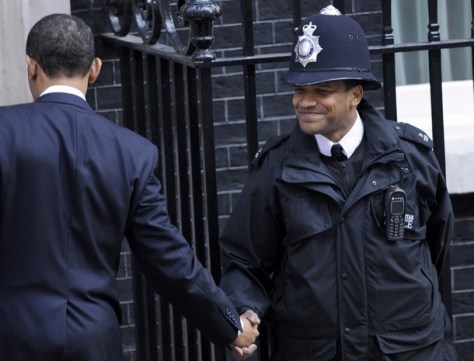
(Reuters/Toby Melville)
That’s it for now, folks.
The Art of Not Writing: Shubhranshu Choudhary
Shubhranshu Choudhary from Chhattisgarh:
How does the media in Chhattisgarh report the conflict between the Naxalites and the Salwa Judum, or the conflict between local communities and corporations? Quite simply, it doesn’t. The pressures on journalists in Chhattisgarh are unique. They are paid not to report stories that are critical of the powers-that-be, whether they are industrial lobbies or state authorities.
Posted on Free Binayak Sen Campaign
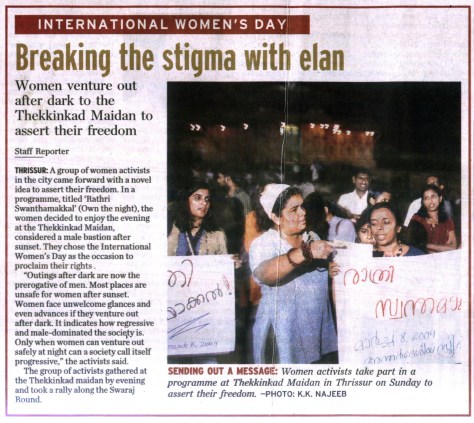
Women’s Day 2009, Thrissur
Civility, Harmuniya Bajaiyke: Prasanta Chakravarty
This guest post was sent to us by PRASANTA CHAKRAVARTY
A recent exchange in a congregation addressing the nature of contemporary civil society caught my attention. This was a formal gathering where there was supposed to be a pitch on an idea tentatively christened civility index: that is, whether it was possible to empirically measure civility and come up with some conceptual conclusions, as well as have more practical usages once such indicators will have been developed. A searching question came from someone who had spent a lifetime fighting liberal centrism and opportunism. “Why do you call the whole thing civility index,” she inquired, “civility connotes propriety and manner and etiquette, when you are interested to scale human capacities, right?”
This is a fundamental and worthy question, especially keeping in mind that certain variants of civil society discourse has caught the imagination of many invested in democracy right now, even as they wish to steer clear of old leftist certainties and eschew easy liberal pluralism at once. Are propriety and etiquette wholly irrelevant to our understanding of modern civil society? Is manner rudimentary to civil society, counterproductive to doing anything worthwhile? Does civility dilute the associational potential of civil society—human capacities being robbed off by issues of mere conduct and comportment? Are traditional societies uncivil by definition? And does civility, more than just civil, civic or public, betray fashionable elitism unabashedly?
Continue reading Civility, Harmuniya Bajaiyke: Prasanta Chakravarty
Will we overcome? Pramada Menon
This is a guest post by PRAMADA MENON
Sundays are days for doing nothing much. Often I sit in front of the television and surf and watch many, many movies until all the story lines start merging into one. It’s fun because it does not require you to think. If one switches on a news channel, the chances are that you will start to splutter like mustard seeds in oil, since there is so much to splutter about – Nirmala Venkatesh, a member of the central government’s National Commission for Women, was put in charge of a three-member panel to investigate the attack on the women at a pub in Mangalore at 4pm in the evening. The way she sees it, Venkatesh is supposed to have said, women have the right to enjoy themselves but should also recognize societal limits. As part of her inquiry, she said, she plans to meet with the attackers, the bar owner and the families of the young women to see whether their parents
allowed them to go out to pubs every night at midnight. “My personal advice: Women should be very careful,” she said. “I can’t just roam after midnight.”
India’s Terror Dossier. Further Evidence of a Conspiracy: Raveena Hansa
This guest post has been sent to us by RAVEENA HANSA
On 5 January 2009, the Indian government handed a 69-page dossier of material stemming from the ongoing investigation into the Mumbai terrorist attacks of 26-29 November 2008 to the Pakistani government. This was subsequently made accessible to the public, so it is possible for us to examine it.
The most striking point about the dossier is its vague and unprofessional character. Enormous reliance is placed on the interrogation of the captured terrorist, Mohammed Amir Kasab, despite the fact that there is an abundance of other evidence – eyewitness accounts, CCTV and TV footage, forensic evidence, etc. – which could have been called upon to establish when, where, and what exactly happened during the attacks. This gives rise to the suspicion that the interrogation is being used as a substitute for real investigation because it can be influenced by intimidation or torture, whereas other sources of evidence cannot be influenced in the same way.
Continue reading India’s Terror Dossier. Further Evidence of a Conspiracy: Raveena Hansa
The meaning of “Obama” and the history of a friendship
At the Mexico Olympics in 1968, this photograph of American athletes Tommie Smith and John Carlos standing on the victory podium with heads bowed and black-gloved fists raised in a Black Power salute in protest at racism in the USA, became the iconic image of the age.
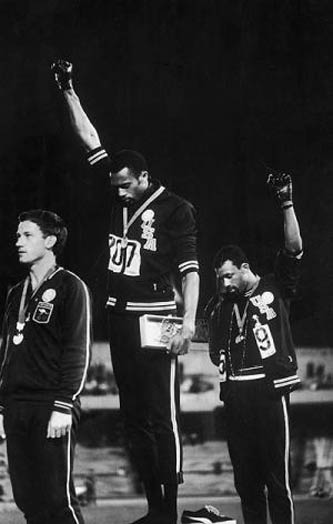
In the fraught years since 1968, the weight of living through the aftermath put a heavy burden on the friendship of Carlos and Smith. In separate interviews with the Los Angeles Times it was revealed that they have barely spoken to each other since the early 1990s, despite living just a short drive apart in southern California. Smith described their relationship as “strained”. Carlos would call his former team-mate only “Mister Smith”.
Continue reading The meaning of “Obama” and the history of a friendship
Reading Swarup, Watching Boyle
When I read Vikas Swarup’s Q & A a year or so ago, I was intrigued and disappointed equally. I felt the author had focused all his energies on the tight and intricate plot, moving rapidly through it with no slip-ups, but this resulted in a grand plot outline rather than a novel. The prose is functional, characters inked in strongly but with little nuance, and when it all comes together with a click at the end, it is sort of morbidly satisfying, but one feels cheated nevertheless. All the more so because the story lingers stubbornly in memory.
I was interested enough keep track of Swarup, and found an interview in which he said that after writing four chapters he had to wind it up in a month since he was getting posted back to India and knew he would not have time for it back home.
“It was August 2003, and I had one more month in London. The plot was in my mind, so I took up the challenge and wrote down the remaining chapters in one month. Over one weekend I wrote 20,000 words.”
Well, that certainly explained the strange slightness and lack of density – the author’s hurry to reach the finish line shows drastically.
After seeing Slumdog Millionaire though, Q & A in retrospect appears serpentine in its complexity, so completely has Danny Boyle extracted the simplest and most predictable story line out of it. Continue reading Reading Swarup, Watching Boyle
The use of “Lese majeste” in Thailand against freedom of speech
Lese majeste literally means an offense or crime committed against the ruler or supreme power of a state – or, in other words, the crime of dissent. In Thailand, this provision is routinely used to silence any form of criticism of the government.
A recent case that has been brought to our attention is that of Associate Professor Giles Ji Ungpakorn, from the Faculty of Political Science, Chulalongkorn University. He is facing Lese Majeste charges for writing a book A Coup for the Rich, which criticised the 2006 military coup. He also wrote an article on the coup for Asia Sentinel. Others who have been accused of Lese Majeste are former government minister Jakrapop Penkae, who asked a question at the Foreign Correspondent’s Club in Bangkok, about exactly what kind of Monarchy they have in Thailand. There is also the case of Chotisak Oonsung, a young student who failed to stand for the King’s anthem in the cinema. Apart from this there are the cases of Da Topedo and Boonyeun Prasertying. In addition to those who opposed the coup, the BBC correspondent Jonathan Head, an Australian writer names Harry Nicolaides and social critic Sulak Sivaraksa are also facing charges. The latest person to be thrown into jail and refused bail is Suwicha Takor, who is charged with Lese Majeste for surfing the internet. The Thai Minister of Justice has called for a blanket ban on reporting these cases in the Thai media. The mainstream Thai media are obliging. Thus there is a medieval style witch hunt taking place in Thailand with secret trials in the courts.
A petition of protest in support of Giles is available here.
Speech and silencing on the Right and Left
Lasantha Wickrematunge, the courageous editor of Sunday Leader, a weekly newspaper from Sri Lanka, was recently assasinated by the Sri Lankan state. Relentless in exposing corruption and human rights abuses, he was fully aware of the price he would have to pay. In a stunning editorial that he appears to have written for publication in the event of precisely such an eventuality, and which was published after his death, he directly accuses the government of killing him:
“It is well known that I was on two occasions brutally assaulted, while on another my house was sprayed with machine-gun fire. Despite the government’s sanctimonious assurances, there was never a serious police inquiry into the perpetrators of these attacks, and the attackers were never apprehended. In all these cases, I have reason to believe the attacks were inspired by the government. When finally I am killed, it will be the government that kills me.”
His words of farewell are defiant:
“If you remember nothing else, remember this: The Leader is there for you, be you Sinhalese, Tamil, Muslim, low-caste, homosexual, dissident or disabled. Its staff will fight on, unbowed and unafraid, with the courage to which you have become accustomed. Do not take that commitment for granted. Let there be no doubt that whatever sacrifices we journalists make, they are not made for our own glory or enrichment: they are made for you. Whether you deserve their sacrifice is another matter. As for me, God knows I tried.”
Meanwhile, in Nepal, the premises of Himal media were attacked by people identified as Maoist activists. Today the ‘bourgeois’ media, tomorrow – dissenting Left voices…?
Fight Terror – Stop Thinking
Oxford Book Store in Mumbai was visited by a cop about ten days ago, and offered a friendly caution to be “careful” about stocking books and CDs related to Pakistan, as the shop might be “targeted” after the recent terror strikes in Mumbai.
Trick question: The reason the cop dropped in was
a) to reassure the store that they would receive police protection in case such threats materialize
b) to pass on a message from Raj Thackeray
(Hint. Looks like there are two options, but there is only one)
Surrogacy Politics: Imrana Qadeer & Mary E. John
This guest post has been sent by IMRANA QADEER and MARY E. JOHN
Surrogacy is suddenly front-page news. First there was the uncertain future of baby Manji, following the divorce of her Japanese commissioning parents; then the happy pictures of an Israeli gay couple with their son born to a Bombay-based surrogate mother. India is becoming a cheap location for foreigners wanting to use ‘assisted reproductive technologies’ (ART) and local clinics are promoting surrogacy arrangements because they are seen as lucrative ventures. While there is hardly any public debate on the ethical, social, epidemiological and medical questions around infertility and surrogacy, the extremely problematic ART Regulatory Bill (2008) is being hurried through. It barely addresses important concerns and ignores national health and population norms. It permits, for instance, three surrogate pregnancies to a woman.
Continue reading Surrogacy Politics: Imrana Qadeer & Mary E. John
The Mumbai Terror Attacks: Need For a Thorough Investigation: RH
This guest post comes from a friend who wishes to be known as RH
In all the confusion and horror generated by the ghastly terrorist attacks in Bombay, a dimension which has not received the attention it deserves is the circumstances surrounding the death of Anti-Terrorist Squad (ATS) chief Hemant Karkare and two of his colleagues, encounter specialist Vijay Salaskar and Additional Commissioner of Police Ashok Kamte. The major pattern of operations involved well-organised attacks on a few high-profile sites in Colaba – the Taj, Oberoi and Trident Hotels, and the less-known Nariman House – while a parallel set of operations was centred on Victoria Terminus or VT (now known as Chhatrapati Shivaji Terminus or CST) station, Cama Hospital and the Metro cinema, in the middle of which is the police headquarters where Karkare worked. The latter is an area where foreigners are much less likely to be found.
Why is a Proper Investigation Crucial?
Continue reading The Mumbai Terror Attacks: Need For a Thorough Investigation: RH
Mumbai terror, the revolt of the elites and Life itself
You have said everything there is to say, and felt everything there is to feel. You have shouted angrily or reflected seriously or stated in the calm tone of conviction that terrorists are as authoritarian as the states they target, that terrorists have no religion, that terrorists are cowards who target soft civilian populations. You have despaired at the carnage wreaked on a city sick and tired of having to be “resilient”; of having faced one disaster after the other – from floods to targeted attacks on specific communities to bomb blasts – and “emerged with its spirit intact”. Your heart has clenched painfully at the inconsolable tears of baby Moshe; at the blood-spattered, newly motherless one-year old Viraj in an exhausted Head Constable Salunkhe’s arms, entrusted to him by his father, a utensil seller wounded by bullets at CST. You have gazed numbly at the image of Maharashtra ATS Chief Hemant Karkare’s young son with drawn countenance bearing the ritual paraphernalia of his father’s cremation ceremonies. Despite yourself you felt a sudden glimmer of hope steal into you at the stony dignity in Kavita Karkare’s dry-eyed grief at her husband’s funeral, at her steadfast bindi and her coloured sari. You have hated yourself for being relieved that those you know in that poor torn city are safe, when hundreds you did not know were not.
In fear and foreboding the feeling has overcome you – “What lies ahead of us now?”
But after all of that, after all of the sorrow and the grieving, in the midst of absolute despair, when you start to think again – STOP. Continue reading Mumbai terror, the revolt of the elites and Life itself

