All posts by Shivam Vij

Shivam Vij is a writer and journalist based in New Delhi.

The Peaceniks prevail over the Realists: India and Pakistan sign new visa pact

While the new visa pact between India and Pakistan is a landmark achievement, it still leaves a lot to be desired to make easier travel possible for the citizens of the two countries. Some suggestions are given in the Aman ki Asha petition, which you may want to sign here. While the full text of the pact does not seem to be online at this time, the most detailed story about the pact has been put out by the ASSOCIATED PRESS OF PAKISTAN, reproduced below. It is not clear when the new regulations come into force.

ISLAMABAD: Pakistan and India on Saturday signed new liberalised visa regime giving more concessions and simplifying the procedure to grant visa with a view to promote people-to-people contacts and enhance trade and business activities between two neighbours.     Continue reading The Peaceniks prevail over the Realists: India and Pakistan sign new visa pact
Muslim youths launch peace forum in Assam

This press release was put out by MY-FACTS, Guwahati, on 3 September 2012

As a response and being aggrieved over the communalisation of the recent violence and mass displacement in BTAD (Bodoland Territorial Autonomous Districts) area and in order to analyse the situation, on 2 September, 2012 about 60 highly educated, secular and liberal Muslim youths from all over Assam assembled at the Bhagabhati Prashad Baruah Bhaban, Guwahati, Assam, to brainstorm about a peaceful solution for the present scenario of hatred and violence prevailing in Assam that is spreading all over the country. The meeting was convened under the aegis of a newly formed platform named MY-FACTS (Muslim Youths: Forum Against Communalism, Terrorism and Sedition). Continue reading Muslim youths launch peace forum in Assam

A Visa for Mahiwaal: Maheep Singh

Guest post by MAHEEP SINGH

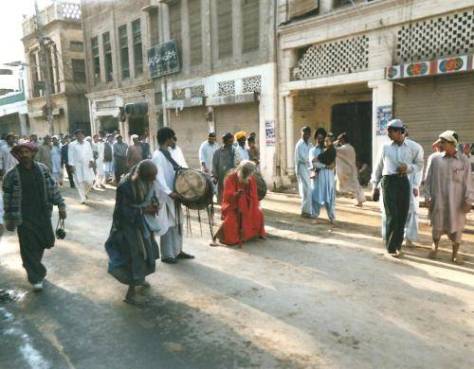
Sufi dervishes join a Sikh Nagar Kirtan parade at the Nankana Saheb shrine near Lahore. Photo credit: S Khalsa

As a child I gave my mother a tough time with all sorts of questions about the world; she would often not have answers. I would ask, for instance, why we couldn’t just go to Nankana Saheb as and when we wanted. Nankana Saheb is the birthplace of Guru Nanak, founder of the Sikh faith. It is in Pakistan, on the outskirts of Lahore.

Sikhism must be the only religion in the world whose official prayers include a plea for visa relaxation. Believe it or not, millions of Sikhs all over the world do that as part of their daily prayer, the Ardas, in which we pray to almighty to grant us free access (“khulle darshan deedaar”) to the birth place of Guru Nanak and other places in present-day Pakistan, considered holy by Sikhs. Continue reading A Visa for Mahiwaal: Maheep Singh

Naroda Patiya judgement rekindles the death penalty debate in India

The Naroda Patiya massacre in Ahemdabad on 28 February 2002 killed 97 Muslims. It is the massacre infamous for the gory stories of a pregnant woman disemboweled and raped, a 20 day child killed, and so on. If this massacre is not fit to be considered “rarest of the rare,” what is?

It is ironical that the court found the kingpin of the massacre to be a woman, Dr Maya Kodnani, a practicing gynaecologist, a former Minister of State for Women and Child Welfare in the Narendra Modi government! The court came down particularly hard on her, commenting that as a legislator, a representative of the people she had done the opposite of what she was expected to: she helped kill people rather than save them. “She led the mob and incited them to violence. She abetted and supported the violent mob,” the court observed.

However, special court judge Jyotsna Yagnik chose not to sentence the accused to death when he announced the sentencing on 1 September. Her court found 32 people guilty, of whom one is absconding. 7 will spend 31 years in jail, 22 will spend 24 years, Maya Kodnani 28 years and former Gujarat state Bajrang Dal president Babu Bajrangi is to live the rest of his life in jail. Continue reading Naroda Patiya judgement rekindles the death penalty debate in India

Don’t let him drink water because then he’ll also want to go to the bathroom

Photo credit: Ishan Tankha

My name is… let that be. Maruti Suzuki is out to get me, not because I did anything but because they want to put virtually every worker in jail, even those who belonged to the third shift and were not even present when violence took place in the Manesar factory on 18 July. I was present there and will tell you what happened, but to understand it you will have to let me begin from the beginning. Read more…

When the pseudo-sentiments of the pseudo-religious are pseudo-hurt

In neighbouring Pakistan, an Islamic cleric recently accused a young Christian girl, Rimsha Masih, of blasphemy, a charge punishable by life imprisonment. He said she had burnt some pages that contained verses from the Quran. The 14 year old girl hails from a poor family and suffers from Down’s Syndrome. An eyewitness to the event showed courage and told a magistrate the truth: it was the Muslim cleric who had put those burnt pages in Rimsha’s bag. The cleric has been arrested and is set, in turn, to be charged with blasphemy.

I have been thinking about the incident. Insulting somebody’s religion is bad. It may cause offence. Often it is intended to cause offence. If somebody insults Islam, by doing things like burning pages containing verses from the Quran, it is bound to outrage a Muslim. Continue reading When the pseudo-sentiments of the pseudo-religious are pseudo-hurt

India and Pakistan: Let people meet

This online petition has been put out by AMAN KI ASHA

The people of Pakistan and India, people of Indian and Pakistani origin around the world, and friends of India and Pakistan, are fed up of the visa restrictions that prevent them from visiting families in the other country. There isn’t even a tourist visa protocol between these two biggest neighbours of South Asia. People in the region want the right to travel and to trade, to walk along coastlines and roads that represent their collective past, to seek and spread harmony across a subcontinent not divided by politics and propaganda. In this modern age of interdependence, it is a tragedy that the citizens of India and Pakistan are left peering over a border made indomitable and intimidating. There is little space for the hand of friendship to be extended across this border. This must change.

The governments of India and Pakistan must:  Continue reading India and Pakistan: Let people meet

On the International Day of the Disappeared: APDP

This press statement was issued yesterday, 30 August 2012, by the ASSOCIATION OF PARENTS OF DISAPPEARED PERSONS, the Bund Amira Kadal, Srinagar – 190001, Jammu and Kashmir
 
Today on the occasion of the International Day of the Disappeared, the Association of Parents of Disappeared Persons (APDP) organized a seminar on the International Convention for the Protection of all Persons from Enforced or Involuntary Disappearances and Institutional Violence and Denial of Justice by India. Various members of the Civil Society addressed the importance of the ratification of the international Convention against Disappearances.
Further, the Association of Parents of Disappeared Persons (APDP) today submitted 507 cases of enforced or involuntary disappearances from Baramulla and Bandipora districts to the State Human Rights Commission (SHRC) for conducting investigations. Continue reading On the International Day of the Disappeared: APDP

Coke Studio Pakistan – At a crossroads: Nandini Krishnan

Guest post by NANDINI KRISHNAN

Rohail Hyatt, producer of Coke Studio Pakistan

Khabaram raseedah…imshab
Khabaram raseedah imshab kih nigaar khaahi aamad

The words are beautiful; the voices that sing them mellifluous. And yet, I find that instead of being overwhelmed as I usually am by the qawwali of Fareed Ayaz and Abu Muhammad, enraptured by the transcendental waves of their music, parts of my consciousness are held down, niggled. Perhaps it’s the constant drumming and strumming, perhaps it’s the psychedelic sound waves zipping across giant screens, perhaps it’s the acoustics that throw back bits of the singers’ strains at them. But the Coke Studio version of Khabaram Raseedah doesn’t affect me the way even scratchy recordings of live, open-air concerts do. Continue reading Coke Studio Pakistan – At a crossroads: Nandini Krishnan

Quietly censors the nanny state: Mishi Choudhary


Guest post by MISHI CHOUDHARY

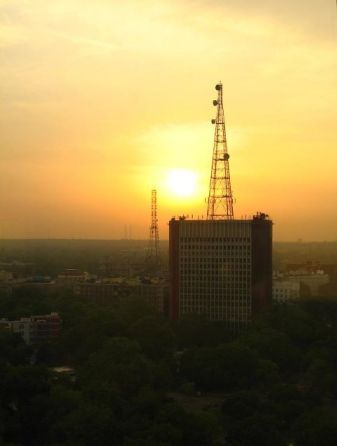
New Delhi’s Sanchar Bhawan, which houses the office of the Ministry of Communications and Information Technology

The recent curbs on social networking websites in India demonstrate the unpredictability of the legal environment, both for businesses and the citizens. Whether its the Government of India’s (GoI) insistence on getting access to corporate emails and text messages sent via BlackBerry devices, or changing stances on “pre-screening” user generated content, the authorities seem to be doing a tap dance around legal issues. The implementation of rules seems surreptitious as they are bent conveniently in the name of “security”. Continue reading Quietly censors the nanny state: Mishi Choudhary

Why is the Indian media building a case for internet censorship rather than against it?

Hundreds of webpages now stand blocked in India, the government has openly been appealing to internet companies to pre- or post-screen content and remove what the government wants it to remove. One Google Transparency Report after another has been revealing how the number one target of the government is criticism of politicians and government. Just imagine what would the Indian media’s response to such censorship have been like had it been hundreds of books or articles we were talking about? Instead of asking Facebook to ‘pre-screen’ our posts, had Kapil Sibal been asking for someone to pre-screen articles in the newspapers, would it not be like the Emergency?

Okay, point taken. Let us not trivialise the Emergency, which entailed jailing of dissidents and forced sterilisation and so on. But still, there’s so much internet censorship in India now that it is surprising that instead of outrage you find the Indian media actually building the case for censorship. What about hate speech, they ask. What about the trolls, Why is there so much abuse on the internet? Continue reading Why is the Indian media building a case for internet censorship rather than against it?

Borderline madness: Sajan Venniyoor


Guest post by SAJAN VENNIYOOR

Now that government agencies in India — some half a dozen of them working with the exceptional coordination we have come to expect from government agencies — have blocked Facebook accounts, Twitter feeds and YouTube videos supposedly originating in Pakistan, perhaps we could contemplate other trans-border electronic transgressions committed by our neighbours.

In August 2011, The Times of India reported that Punjab border farmers still tune into Pak FM radio stations. According to villagers on the fringes of Ferozepur, the limited range of India’s “national radio” broadcasts and the absence of any local FM station have made radio services from Pakistan the most popular source of entertainment in border areas.

About the same time last year, the Indian government had become alarmed by the popularity of Nepal’s FM radio channels in Bihar along the Indo-Nepal border. According to various sources, some half a dozen Nepal FM radio stations are broadcasting programmes – “anti-India advertisements and vulgar songs”, according to one outraged newspaper report – into Bihar, especially Madhepura, Supaul, Madhubani, Kishanganj, Araria, Sheohar, Saharsa, Muzaffarpur, and East and West Champaran districts.  Continue reading Borderline madness: Sajan Venniyoor

Full text: The Indian government’s recent orders to Internet Service Providers to block websites, webpages and Twitter accounts

Joji Thomas Philip has put out these documents in The Economic Times.

18 August:

19 August: Continue reading Full text: The Indian government’s recent orders to Internet Service Providers to block websites, webpages and Twitter accounts

An Analysis of the Latest Round of Internet Censorship in India (Communalism and Rioting Edition): Pranesh Prakash

Guest post by PRANESH PRAKASH

How many items have been blocked?

There are a total of 309 specific items (those being URLs, Twitter accounts, img tags, blog posts, blogs, and a handful of websites) that have been blocked. This number is meaningless at one level, given that it doesn’t differentiate between the blocking of an entire website (with dozens or hundreds of web pages) from the blocking of a single webpage. However, given that very few websites have been blocked at the domain-level, that number is still reasonably useful. Continue reading An Analysis of the Latest Round of Internet Censorship in India (Communalism and Rioting Edition): Pranesh Prakash

How Delhi paper ‘Sahafat’ fell for fake images of violence in Burma

Yousuf Saeed wrote in Kafila on 13 August how fake images of violence against Muslim Rohingyas in Burma – images that were in fact, of, say, earthquake victims. In his post he mentioned how even some Urdu papers in India were fooled by the images,which provoked violent protests in Mumbai,and recently, Lucknow.

Now, CM Naim describes in detail how Sahafat, an Urdu newspaper published from Delhi, fell for these fake images. Naim translates large parts of two charged-up articles in Sahafat, one of which calls for the boycott of Buddhists in Delhi. One article was published on 10 August and one on 16 August. As Naim says, it’s time for the Press Council of India to take note. One excerpt: Continue reading How Delhi paper ‘Sahafat’ fell for fake images of violence in Burma

Kashmir civil society express concern over Amarnath construction plans

The press release below has been jointly issued by a number of eminent citizens and civil society members in Kashmir. Full list of signatories at the end.

Srinagar, 18 August 2012: Civil society groups of Kashmir express their serious concern over the recent Supreme Court directions to the J&K government for undertaking civil engineering works leading to construction of roads and other infrastructure in the environmentally fragile Himalayan habitat around the Amarnath cave shrine in the valley of Kashmir. This move comes even as the committee formed by the Hon’ble court for recommending ways and means to promote safe journey of pilgrims to the cave shrine is yet to submit its report.

At a joint meeting of various civil society groups held on 16 August at Srinagar, the following resolution was adopted: Continue reading Kashmir civil society express concern over Amarnath construction plans

The Myth of the Bangladeshi and Violence in Assam: Nilim Dutta

Guest post by NILIM DUTTA

Map credit: idsa.in

The recent spate of violence that began in the Kokrajhar district of Assam in the month of July 2012 and then spread to the adjoining districts of the Bodoland Territorial Council, primarily between the Bodos and the Muslim community of immigrant origin settled in these districts, has once again unleashed a vicious debate on the perils posed by alleged unrestricted illegal immigration from Bangladesh, this time even on the floor of the Lok Sabha.

The situation has been further complicated by a ‘protest’ in Mumbai against ‘violence on Muslims in Assam’ turning into a riot or by sundry attacks as ‘retaliation’ against people from North East elsewhere in India. Thanks to either shockingly uninformed or brazenly motivated opinions being aired around incessantly, much of it in the national electronic and print media, the dominant discourse that has evolved around the issue has created three distinct perceptions:

First, that illegal immigration of Bengali Muslim peasants from neighbouring Bangladesh into Assam has been continuing unabated, leading to skewed demographic profiles of Assam’s districts bordering Bangladesh and thereafter, turning several adjoining districts of Assam to Muslim majority. Continue reading The Myth of the Bangladeshi and Violence in Assam: Nilim Dutta

Celebrating Tyranny and Victimisation in Kashmir: JKCCS

This press statement comes from the JAMMU AND KASHMIR COALITION OF CIVIL SOCIETY

Srinagar, 15 August 2012: It is despicable that the police officers responsible for serious human rights violations are receiving awards despite the crimes they have perpetrated. Today’s awards to some of the Jammu and Kashmir Police officers are an act of celebrating tyranny and victimization.

Superintendent of Police, Altaf Ahmad Khan is one of the officers who has been awarded with the President’s Police Medal for Gallantry. Altaf Ahmad Khan is notoriously known for perpetrating human rights violations in the areas where he has served. Continue reading Celebrating Tyranny and Victimisation in Kashmir: JKCCS

Of Nationalism and Love in South Asia

The predominant emotion with which jingoistic Indians and Pakistanis view each others’ misfortunes is schadenfreude. They count each other’s conflicts and rebellions to keep score. The Indian will talk about sectarian violence in Pakistan, and the Pakistani will ask about the treatment of Dalits in India. The Pakistani will complain against Indian atrocities in Kashmir  and the Indian will point fingers at Balochistan.

When I see such Indo-Pakistani interactions online, I am reminded of these words: Continue reading Of Nationalism and Love in South Asia

How to start a riot out of Facebook: Yousuf Saeed

Guest post by YOUSUF SAEED

I am utterly shocked and pained to read about the violent rally that many Muslims took out at Azad Maidan in Mumbai on 11 August 2012 in protest against the recent communal carnage in Assam and Burma. More than the accidental death of two men and 50 injured in yesterday’s protest, what alarmed me was the public anger targeted on the media for “not reporting about the violence against Muslims in Assam and Myanmar”. Several vans of TV channels and their equipment were smashed or burnt besides a number of police vehicles destroyed. Of course, the authorities are still probing as to who really began the violence in an otherwise peaceful rally (and we are open to the results of such a probe). But my worst fear came true with this assertion of one of the protesters in a newspaper report: “Why is the media not covering Burma and Assam? We learnt about the incidents from videos posted on the Internet.” This seems to be a very disturbing statement on various accounts. Of course, the media can sometimes be biased, and the Muslims do feel victimised by it all the time. But are the random videos and images posted on the Internet any less biased or misleading? Continue reading How to start a riot out of Facebook: Yousuf Saeed

National contestation, not religion, responsible for the plight of Myanmar’s Rohingyas: Ayesha Siddiqa

Guest post by AYESHA SIDDIQA

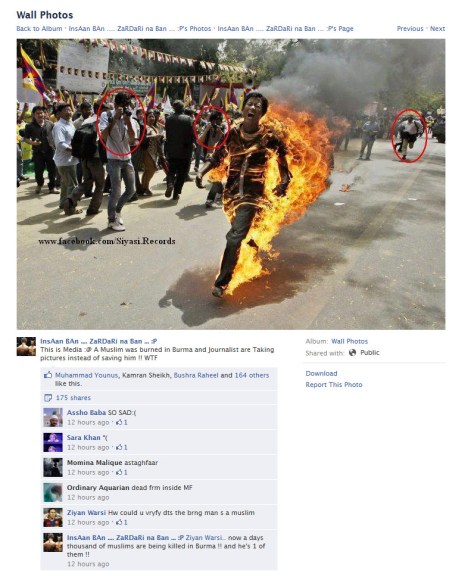
This photo is a screenshot of a Facebook page that incorrectly shows the self-immolation of a Tibetan activist in Delhi as an image of Rohingya persecution in Myanmar. This is one of countless such images circulated in social media. Image credit: Express Tribune, Pakistan.

These days, the social media is abuzz with discussion on Myanmar. Interestingly, it is not even a constructive discussion but one which is meant for point scoring. The nature of the discourse has complicated the issue even more and thus calls for at least a couple of articles: one on the issue and another one meant to be an analysis of the situation of Burmese Muslims. It is important at this stage to disentangle the two dimensions to make sense of what is actually happening. Continue reading National contestation, not religion, responsible for the plight of Myanmar’s Rohingyas: Ayesha Siddiqa