All posts by Shivam Vij

Shivam Vij is a writer and journalist based in New Delhi.

10% Anthology: Tarun Bhartiya

A review by TARUN BHARTIYA

The Oxford Anthology of Writings From North-East India : Poetry and Essays
Edited by Tilottoma Misra
Oxford University Press
New Delhi, 2011, 332 Pages / Rs. 595 ISBN 0-19-806749-6

If you are on the marginalisation trip, and India’s North East is your illicit high, you should be worried. In the last ten years, trying to make up for the dark fifty years of Indian ignorance, anthologies of literature from the region have begun to appear almost annually.

But before I get accused of an inside job, a disclosure that I am loathe to make:

I know many of the poets (some of whose biographies smell of Shillong) who feature in The Oxford Anthology of Writings From North-East India : Poetry and Essays. We share little magazines, anthologies, dark bye-lanes of love, anger, feuds, booze, and journeys to find our next fix.  So, I promise to dull my taste and leash my judgment. And only occasionally lapse into pointless gossip. Continue reading 10% Anthology: Tarun Bhartiya

What do the Maoists want?

The media has by and large focused on the Maoist demand of release of some of their own in exchange of the Malkangiri collector and junior engineer. The list of the total 8 of 14 demands of the Maoists that the Orissa government has agreed to makes for interesting reading:

(1) Orissa government will write to Jharkhand and Chhattisgarh to take action on the extremists demand for release of Maoist central committee members Sheela di (jailed in Jharkhand) and Padma (in Chhattisgarh) owing to their ill-health; (2) ST status for the Konda Reddy and Nukadora communities categorized as OBCs; (3) stopping the multi-purpose Polavaram project of Andhra Pradesh; (4) ‘pattas’ (record of rights) to tribals dispossessed of their land in Malkangiri and Koraput; (5) irrigation in Maribada and Maniamkonda villages in Malkangiri; (6) compensation based on HC order to Tadangi Gangulu and Ratanu Sirika who died of disease allegedly due to torture; (7) relevant laws for mining operations in Mali and Deomali bauxite mines; (8) minimum displacement of tribals and adequate compensation. [ToI]

Are Ikhwanis back in Kashmir?

A report by Pradeep Thakur in the Times of India today has stunned a lot of people in Kashmir. The report says that the Ministry of Home Affairs and the Indian Army are reviving Ikhwan units in Kashmir to quell the anti-India movement. Some Kashmiris living in Kashmir feared the era of Ikhwani terror and blackmail will be back. The stunning bit is how openly the effort of the MHA and the Indian Army is being acknowledged in creating a renegade political pro-India militia force in today’s political environment in Kashmir. What is not surprising is that this is happening at all, because it has happened before. At worst, this seemed like a stupid move to publicise an overt political operation of the sort Kashmir has seen no dearth of.

The story, titled, “Two pro-India parties floated in J&K with Army, MHA help” by Pradeep Thakur reads: Continue reading Are Ikhwanis back in Kashmir?

The Virtues of Waiting Patiently: Arnav Das and Soumik Mukherjee

Guest post by ARNAV DAS SHARMA and SOUMIK MUKHERJEE. Photographs by SOUMIK MUKHERJEE

This slideshow requires JavaScript.

Peepalguda, Koraput, Odisha: “You see, for the bridge over that rivulet, forty thousand rupees were sanctioned”, the sarpanch of Mossigam gram panchayat starts off emphatically. It is only after a good amount of probing that he confesses that it was foolish of the Public Works Department (PWD) to sanction Rs 40,000 for a bridge when a similar bridge was built seven years ago in another village for Rs 43 lakh. In any case, a slight bureaucratic nudge resulted in even this amount to get diverted to another village in the Lima panchayat. Continue reading The Virtues of Waiting Patiently: Arnav Das and Soumik Mukherjee

Ravinder Tyagi of Batla House (in)fame in yet another frame up!: JTSA

This release comes from the JAMIA TEACHERS’ SOLIDARITY ASSOCIATION

10th February 2011

Ravinder Tyagi of Batla House (in)fame in yet another frame up!

Veteran of fake encounters must be suspended immediately!

It seems there is no end to Special Cell’s gallantry. One of its most celebrated and decorated heroes, Ravinder Tyagi, also the key architect of the Batla House ‘encounter’ has been found guilty of yet another frame-up of innocents as terrorists. The additional sessions judge Virendra Bhat yesterday absolved and acquitted seven men accused of terrorism in a case dating back to 2005; while pronouncing four officers of the Delhi Police guilty of manufacturing a fake story about an ‘encounter’. The Police had claimed to have recovered AK-47 assault rifles, fake currency and ammunition from the men they claimed were ISI agents—a brazenly false claim. Continue reading Ravinder Tyagi of Batla House (in)fame in yet another frame up!: JTSA

Remembering Shahid Azmi, the Shaheed: Mahtab Alam

Guest post by MAHTAB ALAM

It must have been around nine pm on 11th February last year. The nightfall and Delhi’s infamous wintry chill ensured that I stayed indoors at the mercy of closed walls and work for company. Sure enough, I was seated warmly in my setting of a cyber cafe of Jamia Nagar in Okhla. Okhla, an area I had migrated to as a 14 year boy from my hometown, to pursue my further education, like many other Muslim students from other parts of this country. As Basharat Peer has rightly observed, ‘India’s Muslims don’t move to Delhi; they move to Okhla’. Continue reading Remembering Shahid Azmi, the Shaheed: Mahtab Alam

Md. Salman discharged from the 2008 Delhi Blasts Case

Release from the JAMIA TEACHERS’ SOLIDARITY ASSOCIATION
5th February 2011

Show me the evidence, says Judge
The Prosecution is able to produce none!
Md. Salman discharged from the 2008 Delhi Blasts Case!

Md. Salman, arrested by the Uttar Pradesh ATS from Siddharthnagar on 6 March 2010, was accused of being a conspirator in the 2008 Delhi blasts. Today (5th February 2011), additional sessions Judge Ms. Santosh Snehi Mann threw out all charges against him— at the point of charge—in all five cases in Delhi bomb blasts for lack of any evidence that could prove that he had conspired to bomb various places in Delhi in 2008. Continue reading Md. Salman discharged from the 2008 Delhi Blasts Case

‘How Leaving the Internet Fueled Our Revolution’

For those who worry themselves sick about laptop radicalism, this is essential reading:
The web is in many ways a more modern, much larger version of the kinds of public spaces and forums that have made citizenship possible throughout history. Losing it for a week didn’t stop Egyptians from protesting or airing their frustrations; we still know how to use physical public spaces, after all. But it did remind us that a forum for the open exchange of words and ideas is central to any sustainable democracy; alternatively, we end up in a perilous cycle of control and chaos. Instead of expressing pent-up opinions with fists and bullets, as is happening now in the streets of Cairo, people who can express them freely in conversation, even in a virtual one, have a chance to hear one another and deliberate together about the future. Never mind the vacant symbolism of “Twitter revolutions” and Youtube activism: losing the Internet at the hand of our own government simply offers us a powerful reminder of why we actually want the Internet to begin with, and why we’re doing any of this. [Read the full article by Haisam Abu-Samra]

Excellent as the al-Jazeera coverage is, if you’re tired of it, see videos from Egypt on YouTube, created and uploaded by the people whose revolution it is. It will give you the closest possible feel of what it’s like to be there. Not even al-Jazeera can manage that!

And if you’ve been watching the events in the Arab world and consoling yourself that it’s not that bad in India, consider this: India recently gave Hosni Mubarak an award in Nehru’s name for ‘international understanding’ and Vice President Hamid Ansari addressed him thus:

Your support for regional and international efforts to promote and maintain peace in the West Asian region is eloquent testimony to your commitment to the promotion of international peace and goodwill. I feel deeply privileged to convey my warmest greetings to you. [Press Information Bureau]

The Flea Market of the Indian Media: Dibyesh Anand on the Karmapa story

Guest post by DIBYESH ANAND

India prides itself for having a free and vibrant media. A recent story around Tibetan exile leader Karmapa lama has exposed the Indian media scene as closely resembling a chor bazaar. One where uninformed assertions, distorted facts, libelous statements, ad hominem attacks, and lazy analysis are recycled again and again to create a sensation.

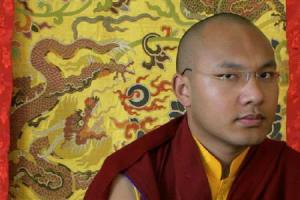
The remarkable convergence in how the different channels and newspapers covered the story of police raids and findings of unaccounted foreign currencies at Karmapa’s temporary establishment near Dharamsala is conspicuous. In the media, the unaccounted money is however presented in salacious and sensationalist manner. Money is not the focus, the Karmapa’s alleged China connection is. A possible financial irregularity of $1.6 million is a non-story in India where scams, schemes and scandals of billions erupt with the regularity of tides. The story becomes one of Karmapa as a probable Chinese spy. Continue reading The Flea Market of the Indian Media: Dibyesh Anand on the Karmapa story

My friend in Thailand, may you be free

‘Prachatai’ means “free people” in Thai. Prachatai calls itself an online newspaper, with Thai and English versions. You can see the English version here. Prachatai in the Thai internet universe is a bit like this website, Kafila, only a lot more popular. Prachatai’s webmaster, Chiranuch Premchaiporn, is facing trial for comments posted on the site that allegedly violated Thailand’s lese majeste (insulting the monarch) laws. While the lese majeste charges against the person who wrote that comment have been dropped, Chiranuch is still being charged under lese majeste and other laws, including ‘intermediary liability’ laws. Intermediary liability laws in relation to internet freedom mean that if you post a comment on my site that violates the law, I too will be charged as having abetted the crime. India’s cyber crime laws were amended some time ago to remove the intermediary clause, not because the Government of India was concerned about free speech, but because of Ebay India, whose head was charged and arrested when a user uploaded a pornographic ‘MMS’ on Ebay India that featured minors.

I first met Chiranuch at an social media workshop in Thailand, and then again last September in Budapest, Hungary, at a Google conference on internet freedom across the world. It is curcuial to note that upon her return from Budapest, she was arrested, given bail for a very high bail amount, and fresh new charges – and a lot of them – were added against her – clearly, they don’t like her talking about internet freedom. If convicted, she faces up to 50 years in jail! See here an article in The Economist. The trial began today, 4 February, a few hours ago.

Chiranuch could easily have escaped Thailand and taken asylum elsewhere by now. She hasn’t done that because she is consciously fighting a battle for freedom of expression in Thailand. She didn’t want to run away because it would have discouraged, rather than encouraged, that crucial fight.

One expresses solidarity with her, one hopes she is free, and that her case becomes the turning point in the fight from democracy and democratic rights in Thailand. Above all, one salutes her courage. For those who are interested in the details, given below are notes from the Thai Netizen Network.

Continue reading My friend in Thailand, may you be free

Tahrir at Midan Tahrir

This slideshow requires JavaScript.

These six photos come to Kafila from an art collective in Cairo. Photographs by artist HR and other members. They do not want their identities revealed for their safety. Note how that gas canister says Made in USA!

Also see this video doing the rounds, perhaps its not the only effort that brought about the 25 January uprising in Egypt but may still be an important one.

Previously on Kafila: A Phone Call From Alexandria

Thus Sudan Splits, What’s Next for the Aspiring Rest?: Tanmoy Sharma

Guest post by TANMOY SHARMA

Pro-separation activists hold signs and chant pro-independence slogans outside the Juba airport in southern Sudan, on Jan. 4, where Sudanese President Omar al-Bashir arrived. Photo credit: Pete Muller/AP/File

To add to the tumultuous political dynamics of Africa, the world is most likely to see a new country adorning its map by the middle of this year with the two-way split of the continent’s largest country, Sudan.  For Africa, which has again hit the international headlines for fresh troubles in Ivory Coast, Tunisia and most recently in Egypt, civil wars based on identity and protests against despotic governments are nothing new. However the larger question that has kept many wondering is whether the world is going to see a new era of a large-scale statebirth with the formation of South Sudan, a process that almost stopped barring the examples of Kosovo two years back or East Timor ten years back. As millions of jubilant south Sudanese in the city of Juba, went to vote in a long awaited independence referendum in the second week of January to see their war torn region emerge as a new nation, it will be important to revisit the troubling status quo of other regions of the world demanding secession. Continue reading Thus Sudan Splits, What’s Next for the Aspiring Rest?: Tanmoy Sharma

The Birth of God: Siddhartha Gigoo on Pt Bhimsen Joshi (1922-2011)

Guest post by SIDDHARTHA GIGOO

It was on a nice summer evening in the year 1996 that I first got to attend Pandit Bhimsen Joshi’s concert.

I was studying literature at the Jawaharlal Nehru University in New Delhi. Those were terrible times for me. I struggled with my studies. Good grades evaded me. Failure stared at my face and the world mocked me. It was difficult to trudge through the endless days and the nights. Reading books became a cumbersome task because one had to present seminars and write the boring term papers at the end of the semesters. Some of us slept during the days and idled during the nights. There seemed to be no respite in sight. Life, what atrophy? I laboured somehow from one book to another, sometimes seeking enjoyment and sometimes to broaden my experience and understanding of life and the world. I had heard somewhere that one must not seek knowledge. Some said knowledge didn’t exist, while others argued that knowledge was a perilous trap from which there was no escape. I was perhaps frantically looking for a reprieve from my fears and imperfections. Continue reading The Birth of God: Siddhartha Gigoo on Pt Bhimsen Joshi (1922-2011)

‘As followers pushed to get close, the pole broke in several places and the flag tumbled down onto Mr. Joshi’

History repeats itself, and we learn so little from it. Or rather, we learn too much from it. I am excerpting below about half the text of a report dated 27 January 1992, written by EDWARD A. GARGAN in The New York Times, describing in detail Murli Manohar Joshi’s hoisting of the Indian flag in Srinagar’s Lal Chowk. Wish I had a picture!

He [Murli Manohar Joshi] had begun his trek, which he named Pilgrimage for Unity, 44 days before at India’s southernmost point. But the inability of the security forces to protect even their highest officials made it clear that there was no way, despite the presence of several hundred thousand troops in the Vale of Kashmir, to protect a convoy of cars and buses filled with zealous Hindus. So Mr. Joshi and a small contingent of his closest supporters were flown here on Saturday night. Continue reading ‘As followers pushed to get close, the pole broke in several places and the flag tumbled down onto Mr. Joshi’

Sound Enough: How to Enjoy the Jaipur Literature Festival: Revati Laul

Guest post by REVATI LAUL

“Excuse me, Mr. Farooqui, I just need a sound byte from you,” said a young reporter from the fairly young news channel News X. He was talking to my friend Mahmood Farooqui, author of Besieged: Voices From Delhi 1857, co-director of the Oscar nominated film Peepli Live and founder-revivalist of Dastangoi – the rich, medieval art of storytelling. Seeing that the setting was the beautiful and quaint Diggi Palace in Jaipur with a substantial gathering of the world’s literati for the Jaipur Literary Festival, Mahmood was preparing to hold forth on storytelling, culture, 1857…when this completely unexpected gem poured forth from the fearless reporter’s lips.

“Can you sum up what you think of literature in one word?” Continue reading Sound Enough: How to Enjoy the Jaipur Literature Festival: Revati Laul

The doom-sayers are wrong about Pakistan. Here’s proof


If you click on it, you can also see the rest 3 parts of the show with Veena Malik and a maulvi on Pakistan’s Express TV.

The dirty ‘S’ word in Pakistan: Urooj Zia

Guest post by UROOJ ZIA

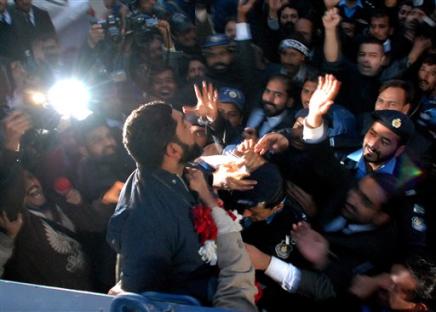
Images aired earlier this month where lawyers and other citizens in Pakistan were seen garlanding and felicitating the murderer of Punjab Governor Salmaan Taseer might have made those involved look tasteless and crude, but their acts were far from shocking. All his faults aside, Taseer had stood up for a Christian woman who had been accused of blasphemy and sentenced to death by a district and sessions (lower) court. He was killed because he had referred to the blasphemy statutes as ‘black laws’ which are abused at will, and had called for reform. As such, Taseer was killed because he had stood up, albeit in a roundabout way, for secularism and basic humanity.  Continue reading The dirty ‘S’ word in Pakistan: Urooj Zia

“These are not stones these are my feelings”

An image taken in downtowon Srinagar.

Given below is a note written by a Kashmiri student from downtown Srinagar who calls himself ‘Kale Kharab’, meaning ‘hot headed’. Taken from his blog, the note reads like a personal manifesto, a statement of purpose, a testimony more telling than what the most patient interviewer can elicit. This note gives you more insight into what is happening in Kashmir than a lot of what you may have read or seen on TV news about the killing of 115 protestors across Kashmir in 2010 by Indian forces. This testimony, written early on during the uprising, on 30 August 2010, shows how irredeemably India has lost the plot in Kashmir all over again, with a new generation of Kashmiris.

How and why I became a stonepelter

by KALE KHARAB

I am from downtown srinagar born in 1991. I was admitted to one of the best school of valley. As a child I had dream to became engineer. Whenever somebody used to ask me about my aim I would proudly say engineer. As I started to grow up I started to became familar with many words which everyone used to talk about that among them few were “azadi” (freedom), “hartal” (shutdown) but I was unable to understand the meaning of these words. I loved the word hartal as it was holiday, so I always wished for hartal. As I grew up I came to know about mujahids. I used to listen stories of mujahids. I would oftenly ask my elders to tell me about mujahids. They told me stories of many mujahids like Issac, Ishfaq, Jan Malik which I liked to share with my friends.  Continue reading “These are not stones these are my feelings”

Is the cat out of the bag?

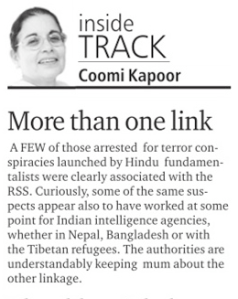
Veteran journalist Coomi Kapoor wrote this small snippet in the Indian Express yesterday. Hope it is only the beginning of more information on what this country’s intelligence agencies have been up to in the name of its citizens.

Sumangala Damodaran on IPTA’s protest music

See also: Singing of Defiance