All posts by Shivam Vij

Shivam Vij is a writer and journalist based in New Delhi.

Historic Mandate, Historic Turning Point or More of the Same? Gail Omvedt on Elections 2009

Guest post by GAIL OMVEDT

The 2009 Lok Sabha elections in India were projected to be a historical turning point just as the 2008 Presidential elections in the U.S. were a turning point.  But the nature of that expected turning point was very different.

Five years ago, even two years before the elections, no one in the U.S. would have expected that a “Black” man with two Muslim names and one African name could have been elected President of the United States.  Yet it happened, and it happened not simply because Barack Husain Obama ran a brilliant campaign and is proving the most effective president in dealing with the economic and social crises besetting the world today, but also because of the racial transformation the U.S. has undergone in recent decades. Continue reading Historic Mandate, Historic Turning Point or More of the Same? Gail Omvedt on Elections 2009

Why the Delhi High Court judgement on IPC 377 does extend to the rest of India

While expanding the territorial jurisdiction of high courts in such cases, the SC took cognizance of the principle contained in Article 226(2), which empowers a high court to issue directions to entities located outside its territory. [Manoj Mitta]

When Pakistanis and Indians cheered for the same team

Continue reading When Pakistanis and Indians cheered for the same team

A review of Anand Teltumbde’s “Khairlanji: A Strange and Bitter Crop”

Khairlanji: A Strange and Bitter Crop By Anand Teltumbde; Navayana, New Delhi, 2008, 214 pp.; Rs 190; ISBN 978-81-89059-15-6

Anand Teltumbde is a noted Bombay-based Dalit intellectual who also wears the hat of a business executive. He has written this book about the lynching of a Dalit family in a Maharashtra village in 2006 to ensure that the incident is not easily erased from memory. He quotes Milan Kundera: “The struggle against power is the struggle of memory against forgetting.” In other words, he sees this book as being a seminal work on the Khairlanji atrocity.

The book begins with Abel Meeropol’s song Strange Fruit, written in 1936 (and not 1939, as the book incorrectly states) about the lynching of two black youth. It is from this song that the book derives its sub-title, “A Strange and Bitter Crop,” which once again reinforces the book’s ambition. Billie Holiday’s rendition of Strange Fruit (in 1939) soon became an anthem for the anti-lynching movement in the US, but does Teltumbde’s book achieve its ambitious goal?

The book’s first chapter is a narration of the events of 29 September 2006, when Bhaiyyalal Bhotmange’s family was lynched to death. The atrocity is reduced in this narrative to a dry report, as if it were from the file of a district magistrate. Sample this: Continue reading A review of Anand Teltumbde’s “Khairlanji: A Strange and Bitter Crop”

‘Only 35% Indians say freedom for Kashmir unacceptable’

Believe it or not, that is one of the findings of a new survey on Kashmir, conducted in both India and Pakistan.

And some more disbelief here:

A majority of Pakistanis say Pakistan’s government does not provide support to militant groups that conduct attacks against civilians in India, while a majority of Indians tend to believe it is providing support. Continue reading ‘Only 35% Indians say freedom for Kashmir unacceptable’

Lathi, Charged

I gather that the Uttar Pradesh police has become especially sensitive to crimes against Dalits after the Lok Sabha debacle of the ruling Bahujan Samaj Party. I gather that the head of the state police is now flying dowin in his helicopter to areas that are reporting serious atrocity cases, routinely suspending his department’s employees in-charge of the area. I gather that Dalits going to the police station in UP’s villages are no longer being told, ‘Do a compromise. Why do you want to complicate matters? After all inter-caste harmony is needed to make Behenji Prime Minister!’ Continue reading Lathi, Charged

Are ‘careers’ more important than lives?

Continue reading Are ‘careers’ more important than lives?

When a Guinness world record isn’t news

Every little entry from India in the Guinness Book of World Records makes it to our Delhi papers. But, a recent one didn’t. News editors are proud patriots.

Kitnay Kashmir

To the growing voices of peace, return and reconciliation amongst young, exiled Kashmiri Pandits, Rashneek Kher has a revealing response:

I have neither been a votary nor a detractor of the idea or concept of Panun Kashmir but truth be told I have always found it as a perfect counterweight to the secessionists policy of Azad Kashmir. Continue reading Kitnay Kashmir

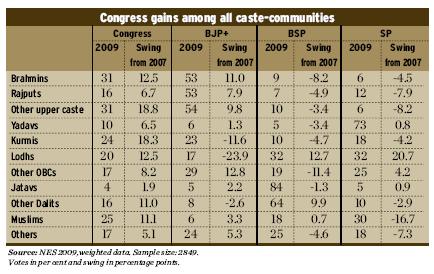
CSDS data on caste voting patterns in UP LS ’09 elections

csdsdataupls09In my post a few days ago I had mentioned a survey who source I could not reveal, except that the BSP is looking at these figures. Truth be told, I don’t know who conducted that survey. But, to back the conclusions, I had a little more than just that survey. Continue reading CSDS data on caste voting patterns in UP LS ’09 elections

The Future

Tarun Tejpal to Sonia Gandhi:

And yes, as I bid you speed and strength, with the extra god by your side, may I make a final plea. You have given us of yourself, and of your son. Now will you kindly also give unto us your luminous daughter.

YOURS EXPECTANTLY,
TARUN

[Link]

UP’s Dalits Remind Mayawati: Democracy is a Beautiful

Party Vote-share Seats
BSP 27.42% 20
SP 23.26% 23
Congress 18.25% 21
BJP 17.5%
10

The higher you fly, the harder you crash. Kumari Mayawati has just learnt this lesson, and is finally giving her ever-expanding fleet of air-crafts some rest. There was clear evidence before the results were out that Dalits were not going to the polling booths to vote; if they did they wouldn’t be able to press any button other than the elephant. Dalit activists in UP had been telling me this for some time now. There were rumours that the UP police has also informed the administration of this trend. Continue reading UP’s Dalits Remind Mayawati: Democracy is a Beautiful

People of the Vaish Community Honouring Shri JP Aggarwal…

"jai prakash aggarwal ko vaish samaj ke logo ne sammanit kiya"
"Jai Prakash Aggarwal ko vaish samaj ke logo ne sammanit kiya."

The photograph above has been sent to me, in my capacity as a journalist, by the PR company hired by Jai Prakash Aggarwal. He was the Congress candidate from the North East Delhi seat, a replacement for Jagdish Tytler. Aggarwal is also the president of the Delhi unit of the Indian National Congress party, that has returned to power with a less encumbering coalition than the one it ran for five years. JP Aggarwal was a reluctant replacement: he was also a Rajya Sabha MP and feared he might lose to the BJP, which would be a great embarrassment for him as the president of the Delhi Pradesh Congress Committee. But the Congress insisted they wanted a ‘baniya’ for the seat. Happily for him, he has won, and this press release is about how the Vaish community has honoured him. Continue reading People of the Vaish Community Honouring Shri JP Aggarwal…

How to be TV-free on election results day

Avoid the pundits on the nauseating news channels, keep your peace of mind, cut the noise and save your aspirin bills. Watch the results live tomorrow morning 8 am onwards on http://eciresults.nic.in/


Why Delhi voted and Mumbai didn’t

These have been doing the rounds on Facebook.

Ten reasons why South Mumbai did not vote

by Abhinav Dhar

10. Clashed with Salsa class
9. Election whites not drycleaned
8. No candidate a hottie
7. Tony Jethmalani contesting from suburbs. Sigh
6. No valet parking at booth
5. Spotted servant in queue ahead of us
4. Driver not come
3. “Elections over dude, Obama won!”
2. No party tackling real issues, eg, reduce Gold Gym rates
1. No home delivery!

Why Delhi turned up to vote

By Madhavan Narayanan

1. They loved the Tata Tea ad
2. They saw the Chopras go out, and thought they must overtake the Lancer from left
3. Bunty’s girlfriend wanted it when they were going out for some Chinese
4. Diwan Saheb on second floor persuaded them. He is jaaaint saactry in DPCC
5. Without stable government, real estate will not revive
6. Election Commission directly asked Pappu. So nice of them
7. Grandfather started talking on Partition, and they had to run
8. Auntyji hoped some TV crew will come and take a soundbite
9. Baba Ramdev said it is good for health

And finally
10. They had to beat the Bambaiyaas. Izzat ka sawaal hai, hainji?

Olive Ridley Turtles still wait for Ratan Tata to spare them their lives

The nationalist Delhi media and elections in Kashmir

How free can an election under the gun be?

There are times when nationalism supercedes journalistic objectivity. Such interesting times are often witnessed in the Delhi media’s relationship with that ‘integral’ part of India called the Kashmir valley, as we have seen before.

And this time:

If the participation of the people in the J&K assembly elections was a vote for India why is the non-participation this time being attributed to broken promises… [Naser A. Ganai]

On April 30 the turnout in the Anantnag constituency as in many other parts of the country was low, but the contrast in how the story was reported (and framed) in the national press, and in the local English press in Srinagar is significant. [Sevanti Ninan]

Buffalo Soldier

“Come in,” says Munisa, “it’s such a large house you’ll be surprised.” The room isn’t big enough for a single person, and Munisa, a widow at 30, shares it with six children and her mother-in-law. She’s trying to turn the courtyard into a room even though she knows the impending monsoons will was away the mud thatch: “At least the summer will pass.” She works as farm labour, earning Rs 35 a day, and can’t make use of NREGA because the chronic pain in her legs won’t let her do hard labour.

Two years ago, an NGO did a survey in the village and found her to be the poorest. They gifted her a cow. “It gave milk because I fed her. And then, six months ago, she died.” But Munisa is not ungrateful: she will still vote for the candidate who runs the NGO that gifted her the cow. So will her neighbours who didn’t get anything: “Here’s someone who has at least proven her concern for the poor,” says one. Read More…

Anatomy of a prejudice

The BSP’s politics may trouble the popular conception of Indianness, among English speaking middle classes, who understand India as one whole, where the ‘Indian’ identity dominates and the rest, which reflect real India (inequality and conflicts) are hushed up. On the other hand, the BSP’s politics reiterates that India is a country of various minorities (castes, religions, regions) who may be victimised by fellow Indians in different contexts. Emphasising the BSP or Mayawati’s Dalitness ignores the complexity of caste society and associated politics. Kanshiram in the past and Mayawati now raise issues of caste not to sustain inequality but to challenge them. What Mayawati and BSP’s growth represents is the deepening of democracy in India. [Suryakant Waghmore]

The Liberals and the Bahujans

There was this article in the Indian Express yesterday by Mihir Sharma which basically says liberals don’t have to feel guilty about not supporting Mayawati for PM because Mayawati and the BSP don’t have a “programme”. That desire for a new, revolutionary “programme” sounds Stalinist to me. But more than that, it is revealing about the picture of the good Indian liberal that the author has. The good Indian liberal seems to be completely unaware of the five letter word, Caste; s/he does not appreciate what untouchability means for millions, what the monopoly over the power structure by upper castes means for the ‘majority of the oppressed’ (Bahujan). This good liberal sounds like a foreign-educated babalog who is not very different from someone we have met before.

But wait, I don’t have to continue this rant because in the same morning’s HT, Ashutosh Varshney had what could be an excellent rejoinder to the Mihir Sharma piece: Continue reading The Liberals and the Bahujans

Iqbal Bano (1935-2009)